R ation al C auses
T h e C o n cep t o f P referen ce in th e S ocial S cien ces
Till Griine
L ondon School o f E con om ics
UMI Number: U615850
All rights reserved
INFORMATION TO ALL USERS
The quality of this reproduction is dependent upon the quality of the copy submitted.
In the unlikely event that the author did not send a complete manuscript and there are missing pages, these will be noted. Also, if material had to be removed,
a note will indicate the deletion.
Dissertation Publishing
UMI U615850
Published by ProQuest LLC 2014. Copyright in the Dissertation held by the Author. Microform Edition © ProQuest LLC.
All rights reserved. This work is protected against unauthorized copying under Title 17, United States Code.
ProQuest LLC
Library
arms. it ^oiitica anr ^uniw rn Science
I
M S
Von dem, was der Mensch sein sollte, wissen auch die
B esten nichts Zuverlassiges. Von dem, was er ist, kann
m an aus jed e m etwas lernen.
A s to what m an should be, even the w isest know little of
certainty. A s to what he is, it is from the behaviour of
everybody that he learns.
A b str a c t
The concept of preference is used in the social sciences to explain and predict behaviour. This thesis investigates the conditions the
preference concept has to satisfy in order to operate as explanans.
C on ten ts
I n tr o d u c tio n 2
1 M e n ta l P r o p e r tie s 8
1.1 In tro d u ctio n ... 8
1.2 The Concept of C a u sa tio n ... 10
1.3 Internal Factors and System B ehaviour... 14
1.4 Mental C au satio n ... 19
1.5 Mental C o n te n t... 27
1.5.1 Measurement T h eo ry ... 30
1.5.2 Measuring Mental P r o p e r ti e s ... 34
1.6 Conclusion ... 41
2 T h e M e th o d o lo g y o f M e n ta l P r o p e r ty A ttr ib u tio n 43 2.1 In tro d u ctio n ... 43
2.2 Insufficiency of Causal M e th o d o lo g y ... 44
2.2.1 Incompleteness and Fallibility of Introspection ... 46
2.2.2 The Circularity of B e h a v io u rism ... 54
2.2.3 Saving B eh av io u rism ?... 61
2.3 A Cognitive Theory of B eh av io u r... 63
2.3.1 A New Type of Mental P r o p e r ti e s ... 64
2.3.2 Mental Properties as Theoretical T e r m s ... 74
2.4 Cognitive Theories in Action ... 80
2.4.1 Will, Passions, D e s i r e ... 80
2.4.2 Ramsey: Bayesian Decision T h e o ry ... 83
2.4.3 Regret T h e o r y ... 88
2.4.4 Holism, Rationality, Intelligibility... 92
2.5 Conclusion ... 95
3 P r e fe r e n c e E x p la n a tio n on th e B a sis o f C a u sa l S tr u c tu r e 97 3.1 In tro d u ctio n ... 97
3.2 Prospect P referen c es...101
3.2.1 Conjointly Exhaustive P r o s p e c ts ... 103
3.2.2 Conjointly Non-Exhaustive Prospects ...108
3.3 Constructing the Selection F u n c t i o n ... 113
3.4 Conclusion &; R em ark s... 119
3.4.1 Possibility or Probability ...120
3.4.2 Small W o r ld s ...121
3.4.3 Prospect Preference A g g re g a tio n ...122
4 A M o d e l o f P r e fe re n c e C h a n g e 125 4.1 In tro d u ctio n ... 125
4.2 A Theory of Preference C h a n g e ...128
4.2.1 Five Kinds of Interpreting Contradictory Behaviour . . . 128
4.2.2 The Principles of a Theory of Preference C h a n g e 132 4.3 Three Illustrations of Input-Driven Collateral Preference Change 137 4.4 The Model ... 141
4.4.1 General Considerations ... 141
4.4.2 The Formal S tr u c t u r e ... 144
4.5 C o m p ariso n ... 152
5 C o n c lu sio n 158 5.0.1 O u tlo o k ... 162
List o f Figures
1.1 Causes of B e h a v io u r... 18
1.2 Epiphenomenalism vs. Token I d e n t i t y ... 25
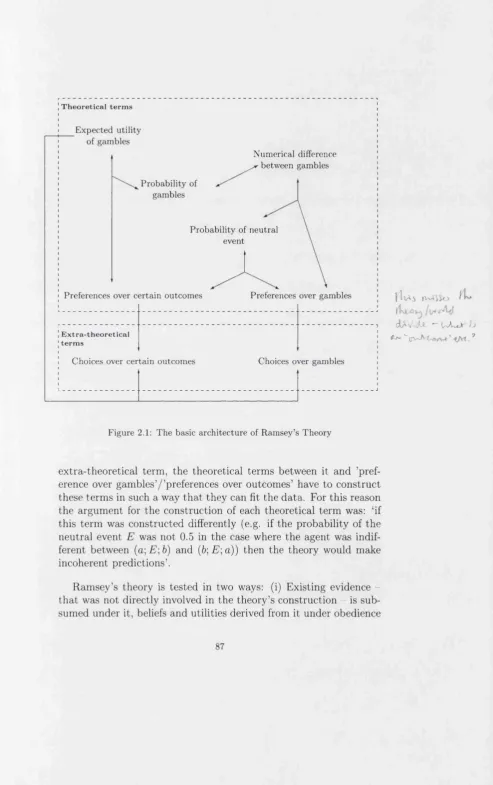
2.1 The basic architecture of Ramsey’s Theory ... 87
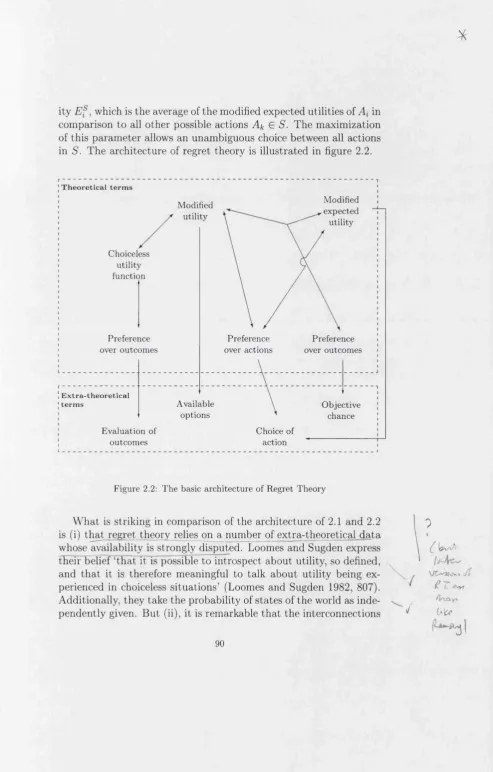
2.2 The basic architecture of Regret T h e o r y ... 90
3.1 Ceteris paribus com parisons... 104
3.2 An example of a causal g r a p h ... 114
3.3 Diogenes’ causal beliefs ...117
3.4 Truncating the causes of Diogenes’ a c t i o n ... 118
4.1- H ubert’s preference ch a n g es...
In trod u ction
The concept of preference enjoys widespread use in the social sci ences. It is found in most disciplines of microeconomics, in particular consumer choice theory and welfare economics, in decision theory, game theory, and rational choice theory; the notion as well appears in the empirical methods of sociology and in some anthropological investigations. Preference is one of the central notions of the social sciences.
In chapter one, I develop and defend a naturalistic notion of mental properties that are identified by their causal role in bring ing about behaviour. I argue firstly th at facts can be the relata of a causal relation and th at hence the realization of a mental prop erty can be such a relation between facts. Further, I presented a concept of mental properties as internal factors interacting with ex ternal factors in the production of behaviour. The question then arises how mental properties can be causes at all. I argue that they are not causally efficacious, but causally relevant in th at they re alise efficacious properties. By defending this position, I reject both type-reductionism and epiphenomenalism, while maintaining a nat uralistic understanding of mental properties.
One of the most fundamental anti-naturalistic attacks on such a position is the claim that mental properties are intentional proper ties, and th at their semantic content makes them different in kind from physical properties. If this attack was valid, then the social sciences would face fundamentally distinct objects and had to em ploy fundamentally distinct methods. I defend the naturalistic po sition by drawing an analogy between measurement in physics and measuring mental properties, and by showing how the propositional content of mental properties arises in their measurement, without any significance for their ontological status. W hat this chapter es
tablishes is th at the explanandum of the social sciences i.e. human
behaviour and, derived from that, the emergence and persistence
of social institutions - is the effect of the explanans - i.e. mental
properties of the agent.
In chapter two, I discuss how the explanans as the cause of the
explanandum is identified - th at is, how mental properties are at tributed to agents. I argue th at a methodology that identifies mental properties as causes of behaviour through a methodology of constant conjunctions is not sufficient for the social sciences. In particular, I will criticise introspection as a methodology in this direction as insufficient. Further, I will caution against a whole|o m g; rejection of mental properties as explanans, as scientific behaviourists did in response to the shortcomings of introspective psychology.
will serve as a basis here. However, in contrast to Lewis’ account, I will caution against the employment of ‘folk psychological plat itudes’ to fill such a theory with content. In its place, I suggest to adopt a particular theory only as a conjecture. This raises the problem how to select any candidate from the infinite set of possi
ble conjectures. Contrary to some claims, I will dispute any apriori
arguments, and admit that mental properties are epistemically in determinate.
In chapter three, I discuss how different types of preference are interrelated. Preferences can be between different concrete options
the agent faces (which I call worlds), and between highly abstract
aspects (which I call prospects). Preferences over worlds, I will ar
gue, are the only ones that can be derived from observed behaviour; but preferences over prospects are necessary for the explanation and prediction of behaviour. If the outcomes over which preferences are defined are too specific, then the theory is empty - one cannot ex plain any situations with it that are not exact repetitions of past
choices. Thus a principle of equivalence is needed that connects
preferences over worlds with preferences over prospects. I will pro vide such a principle that is based on a model of causal beliefs, and that I think is acceptable on the basis of very weak plausibility considerations.
The fourth chapter offers a model of preference change. It is constructed following the general structure of models of epistemic change. It distinguishes between the externally caused direct change of a single preference, and the collateral change that the system has to undergo in order to accommodate the direct change and remain consistent. The satisfaction of these two principles of accommoda tion and consistency still allow for a multitude of possible results, which need to be narrowed down by additional principles. The two further principles discussed here are that of conservatism and of en trenchment. Three preference change operators are constructed that satisfy some important properties.
Chapter 1
M ental P rop erties
1.1
In tro d u ctio n
In a paper that ‘opened the eyes of so many of us’,1 Donald David son argued that action explanations require not only reasons but also causes. The reasons for an action are the mental properties at tributed to an agent through a successful rationalization. To yield an explanation, such a rationalization must first of all be true -the agent must indeed hold those reasons - and secondly, -the ac tion must appear reasonable in the light of the reasons attributed. Those are plausible conditions, but the question is whether they are sufficient for explanation - a question Davidson clearly denies:
Something essential has clearly been left out, for a per son can have a reason for an action, and perform the ac tion, and yet this reason not be the reason why he did it. Central to the relation between a reason and an action it explains is the idea that the agent performed the action because he had the reason. Of course we can include this idea too in justification; but then the notion of justifica tion becomes as dark as the notion of reason until we can account for the force of that ‘because’. (Davidson 1963,
9)
L et’s imagine Hans who is visiting his grandmother. Hans is generally not a very altruistic chap, and we know that what he
loves most about his grandmother is her money. So, in general, Hans’ occasional visits to his grandmother were explained (both by him, if he chose to be honest, and by those who knew him) by his desire to win her favour and hence be placed prominently in her will.
But on one earlier occasion, Hans had reported that to his own
surprise - he went solely out of fondness for the old lady.
Now, how do we explain Hans’ current visit? Why did he go
this time? It could be out of greed, or out of love, or both but
rationalization cannot tell us which of the three it was. All of them are plausible - Hans has affection both for his grandmother and for her money - and both times the action is reasonable in the light of the reasons given. But it might nevertheless be the case th at Hans
acted out of one reason only, and hence rationalization cannot be
a sufficient condition for action explanation. W hat is needed is an account of how reasons have a causal effect, and how these reasons which are also causes provide a sufficient, explanation of action. This is what this chapter tries to do.
However, this chapter will not follow Davidson’s argument in ask
ing how reasons can also be causes. Davidson’s approach is to take
mental properties primarily as reasons, which are by their nature
under-determined by physical properties, and which by their nature
have to be identified by interpretation. This leads to a fundamen tal inconsistency with his objective of making reasons also causes (Antony 1989).
Instead, in this chapter I will develop a notion of mental prop erties that does not rely much on the notion of reason. Mental properties - beliefs and desires - are identified by the causal role they play in the production of behaviour, and they have this role because they pick out a physical property by which they are realised. I then argue why they can be realised by physical properties despite the fact that these mental properties are usually depicted as having semantic content. Given this, I argue th at mental properties are
causally relevant for action relevant in the sense th at they pick
out the causes of behaviour. And th at should be sufficient for ex planation: we learn something about the causal history of an action if we are provided with a mental property of the agent.
1.2
T h e C o n cep t o f C a u sa tio n
Mental properties in this chapter will be defined in terms of causal roles. Thus, their instantiation (or at least the instantiation of a property that they realise) will feature as the relata of causa tion. This requires a specific understanding of causation - namely, whether the relata of causation are events or facts. Events are par ticulars like persons or things. They can be described as individuals instantiating certain properties, but no description will ever fully exhaust them; they have a ‘secret life’ (Steward 1997) beyond any description. Facts, on the other hand, function as truth-makers of propositions or sentences. They are as Ramsey puts it, ‘existential propositions, asserting the existence of an event of a certain sort’ (Ramsey 1927). Facts report the instantiation of properties, but they do not themselves instantiate properties. They are different from events, because they are not particulars. So even though the event ‘the death of Caesar’ might be close to the fact ‘that Caesar died’, it is easy to distinguish the two by ascribing them a fur ther property and checking for their identity: while ‘Caesar’s death’ might have been bloody, treacherous or a deed of dedication to re publicanism, and still remain the same event, the fact ‘that Caesar died’ can have none of these properties, and the fact ‘that Caesar dies bloodily’ is a different fact altogether.
then different combinations of these ascribed properties will render different explanations or predictions.
For this understanding of mental causation, nevertheless, causa- tion must be of facts. If causation were between events, the cause oFairactTori would be one and only one event each time - a partic ular th at instantiated various properties. The non-analysability of events then would therefore prevent the possibility of a combinato rial framework of mental properties to sufficient causes of actions, and thus would greatly reduce the explanatory power of the whole project.
There has been considerable opposition to the position th at cau sation must be of facts. The most widely cited one is Davidson’s employment of the famous ‘slingshot argument’, originally designed to show th at there cannot be more than one fact, to the question of the relata of causation. Davidson’s argument th at causation cannot be between facts proceeds with three assumptions: (a) that the con nective ‘causes’ in the sentence ‘C causes E ’, where C and E are facts, cannot be truth-functional. If ‘- causes •’ were truth-functional, then the substitution of a relatum by another one with the same truth- value would preserve the truth of the sentence. For example, let ‘the streets are wet today because it rained’ be a true sentence. Further, it is true that whenever it rains in London, then individual trans port increases by 20%. Thus, if ‘- causes •’ was truth-functional, ‘it rained1 would be substitutable by ‘individual transport increased by
20%’ salva veritate. But this would yield the sentence ‘the streets
are wet today because individual transport increased by 20%’, which might well be wrong. Thus ‘- causes •’ is not truth-functional.
However, it is plausible to assume that (b) a logically equivalent sentence can be substituted for a sentence flanking the ‘because’ salva veritate. Logical equivalence of two sentences means th at they
have the same truth-value in all models. For example, we can use the
substitution ‘the streets are wet because the heavens opened’ salva
veritate as long as ‘the heavens opened’ is true in every instance in which it rains and vice versa. Last, it seems plausible th at (c) the tru th of a sentence ‘a cause b ’ is preserved under substitution of coextensive singular terms. In Davidson’s own words:
the fall from the ladder was the cause of the death of the first man to land on the moon. (Davidson 1967, 152)
The slingshot argument itself goes as follows. If causation is
between facts, then the sentential relatum C in ‘C causes £ ” is log
ically equivalent to the sentence ‘all x such that x = x are identical
to all x such that x = x and C (formally: all x : {x = x) = all
x : (x = x A C)), as it retains its truth value in all and only those
cases where C is true. Then, according to (b), C in lC causes E ‘
can be substituted by this logically equivalent sentence such that:
[all x : (x = x) = all x : (x = x A C)\ causes E
But according to assumption (c), we can now replace the singular
term ‘all £ : (x = x A C )’ with the singular term ‘all x : (x =
x A X ) \ because they refer to the same objects: those objects which
are identical to themselves. Neither C nor X are quantificationally
bound by x and can thus freely exchanged in the term without
changing the reference. Thus our sentence can be changed to
[all x : (x = x) = all x : {x = x AX )] causes E
But then by assumption (b) it follows from the above sentence
that ’X causes E \ Any sentence that has (contingently) the same
truth value as C can by this method replace C in ‘C causes E \
Thus it seems that the ‘causes’ in lC causes E 1 after all is
truth-functional, which contradicts assumption (a). Given the correctness of all three assumptions, Davidson sees as the only solution to this paradox to conclude that causation cannot be between facts.
As Mellor (1987) has demonstrated, we do not have to accept the conclusion, as the assumptions can be shown to be wrong. Mel lor focuses on Davidson’s assumption (c), and points out a group of cases, where the substitution of one singular term by another co-extensive one does falsify a causal statement.2 This group con sists of facts that state a contingent identity, as ‘the F = the G ’, where one of these singular terms is replaced by the other one, thus creating a necessary identity. Such a necessary identity then turns out to falsify the causal statement, as necessary facts cannot be ei ther causes or effects. For example, take the statement concerning a mountaineering accident involving more than one climber:
Don’s fall is the first fall because Don’s rope is the weakest rope
Given the truth of this statement, both ‘D on’s fall is the first fall’ and ‘Don’s rope is the weakest rope’ are true. Thus, ‘D on’s fall’ and ‘the first fall’ are co-extensive events, and ‘D on’s rope’ and ‘the weakest rope’ refer to the same thing. Hence it follows from (c), that they can be substituted for each other, yielding, amongst others, the following results:
Don’s fall is Don’s fall because his rope is the weakest
Don’s fall is the first fall because his rope is his rope
But these causal statements are clearly false; which falsifies as sumption (c). Thus, Davidson’s slingshot argument is rejected: cau sation does not need to be fully truth-functional, when it appears be tween facts. Causation can therefore be between facts, and it should be, as Mellor further points out. While it seems possible that the sentential relata of ‘causes’ or ‘because’ often refer to events, they
cannot always do so. Causes are often expressed as negative facts,
as in: ‘he did not die, because he secured him self’. To translate such a sentence into an event requires the existence of a non-event, as ‘his survival’ (or ‘his non-death’, if you like), which would lead to an awkward ontology. In particular, non-events do not make true all sentences that should be related to them. While ‘He dies slowly’ and ‘He died instantly’ both imply ‘He died’, and hence are made true or false by the event of his death, nothing like that holds for non-events. ‘He did not die slowly’ and ‘He did not die instantly’ do not imply ‘He did not die’, hence they cannot be made true or false by the event of his non-death. It therefore seems preferable - or even metaphysically mandatory - to employ facts instead of events in causal statements.
1.3
Internal Factors and S y stem B ehaviour
In this section I will present a concept of mental properties that bears similarities to Dretske’s (1988) account. The first step will be to specify what an internal factor of a system is, on the basis of a notion of a system and its behaviour, and then build the concept of mental property from there. I start with the claim th at a system behaves when a factor internal to the system contributed to a change
in some of its systemic properties.
Any collection of components th at is perceived as producing a
unified outcome of some sort is a system. A property is systemic
if it is attributed to the whole system, not only to a part of it. For example, the position of her index finger is a property of an agent, not to her finger alone, as it specifies the position of the finger in relation to the agent’s physical appearance in its entirety; the liquid content in one of the finger’s cells, on the other hand, is a property usually attributed to the cell, not to the agent. Therefore, bending the index finger is a candidate for the agent’s behaviour, while osmosis on the cell’s wall is generally not. The attribution of properties to a system or to its parts of course leaves many borderline
cases ambiguous internal organs, for example, can to some extent
be said to have a life of their own - but a crude distinction will suffice here.
A property internal to the system is considered an internal factor,
if it contributes to a change in one or more of the system’s properties
distinct from it. Systems of sufficient complexity behave if they
exhibit property changes that are caused by at least one internal factor. Internal here means that the factor in question is the system or any part of it. Growing fingernails, sweating, losing hair or getting pregnant is therefore human behaviour, just as is writing a poem, speaking to one’s child or making love. Similarly, machines and plants do things: jets fly to Bangkok, vacuum cleaners pick up dust, and flowers bloom and shed their leaves. W hat are excluded are systemic property changes that are caused by external factors only. Having one’s hair ripped out, falling down the stairs or being flown to Bangkok thus does not fall under the category of behaviour.
The internal/external divide of course depends on the definition of the borders of a system and is therefore crude. For example, certain things happen inside of a system and yet are not internal
to it, like the aneurysm in a human brain or the electrode (with micro-battery attached) in a rat’s spine. Further, many systems are too primitive to really have any internal/external divide. For example, a feather describes a series of very complex movements in the wind, which are partly determined by its mass and shape. When we speak of its mass and its shape as its internal factors and thus of
the feather’s behaviour, we don’t mean to say that the feather does
anything. The internal/external divide in these cases just breaks down due to lack of complexity in the system:
There is no difference, as far as I can tell, between what happens to an electron in a magnetic field and what an
electron does in a magnetic field. There definitely is a
difference between what happens to an animal placed in water and what it does when placed in water. (Dretske 1988, 11, his italics)
Albeit behaviour is characterised by at least one internal factor causing a systemic property change, the behaviour is not brought about solely by those internal factors. Internal factors are, as dis cussed above, individually necessary elements of a jointly sufficient but not necessary cause. In many cases, external factors are further elements of the joint cause. Two types of external factors can be
distinguished. First, triggering factors cause behaviour by affecting
internal factors which in turn bring about behaviour. Second, facil
itating factors cause behaviour by accomplishing the causal efficacy of internal factors. An example for a triggering factor is the tap just below a person’s uppermost knee: it causes a complex chain of internal factor changes (neurons firing, muscles contracting) which then causes the person to jerk her leg. An example for a facilitat ing factor is the presence of air, allowing a person to speak. While in a vacuum, the speaker would perform a series of internal factor changes: vocal cord contractions, mouth movements, etc., without any speech resulting. Only the presence of air allows the transmis sion of sound waves and thus of speech.
Behaviour is thus an event characterised by a change of systemic
properties caused by at least one internal factor. The description
factors to change. Provided the system is intact, such a description is always possible. For example, we can describe speech behaviour without invoking any facilitating factors like the presence of air: instead of describing the production of sound-waves, we can describe the vocal cord contractions, breathing rhythm, tongue movements and mouth positions that would produce speech under appropriate conditions.
However, descriptions of this sort are found in common parlance only for relatively simple kinds of behaviour: sweating, smiling or farting are examples. Most behaviour descriptions of everyday lan guage aim at a level that requires external facilitating factors for the behaviour’s realization. Like a Russian doll, the description of behaviour consists of many layers, according to the degree to which external facilitating factors are included. At the core is the descrip tion by purely internal factors; at the outside is a description that hardly seems to be behaviour of a single agent at all. This is illus trated in the following series of descriptions of the same behaviour: her neurons fired, her muscles contracted; her vocal strings vibrated, her mouth opened; she uttered a number of meaningful sounds in front of her; she declared war on the neighbours; she started the conflict; she unleashed a nuclear holocaust; she brought about the end of the human race.
Most behaviour descriptions lie between those extremes. They require the presence of some external facilitating factors, but at the same time try to ensure that at least one internal factor of the system is still a necessary element - if it was not, the phenomenon could not be described as behaviour of that system.
External descriptions of behaviour (i.e. those that require exter nal facilitating factors) are broad and less precise than the small-scale internal descriptions, as they cover the many possible ways in which those external effects can be brought about by internal means. ‘She boarded a plane’, for example, does not specify in pre cisely what ways the passenger observed her environment, or how exactly she moved her legs. Instead, the external description covers all the internal factors which are appropriate for the external effect to be reached - external behaviour descriptions therefore often have a teleological form.
the system in question. Instead of describing the complex prop erty changes internal of the system, it describes the goal at which these changes are aimed. We don’t need to say that Fritz registered a static shadow on his retina of a particular size and a particular angle of aberration between his left and right retina, that he raised his stretched arm to the height of his eyes, and that he bent his finger - we can say that Fritz shot Franz with a gun. The killing, of course, is contingent upon a number of external causes - the object Frits holding in his hand being a pistol, the cartridge being live, no obstacle between Fritz and Franz, Franz’ position in relation to his shadow - all of these external causal relation are assumed in the description.
The internal factors, however, often get associated with the goal of the behaviour, even if one or more of the external factors are not present. In this case people often say that she tried to speak, board the plane, etc. signifying that while the internal factors were active, the absence of some external facilitating factor prevented the realization of the action. (Absence of the right internal factors in relation to ‘trying’, ‘attem pting’ is a more difficult notion which I will not discuss here).
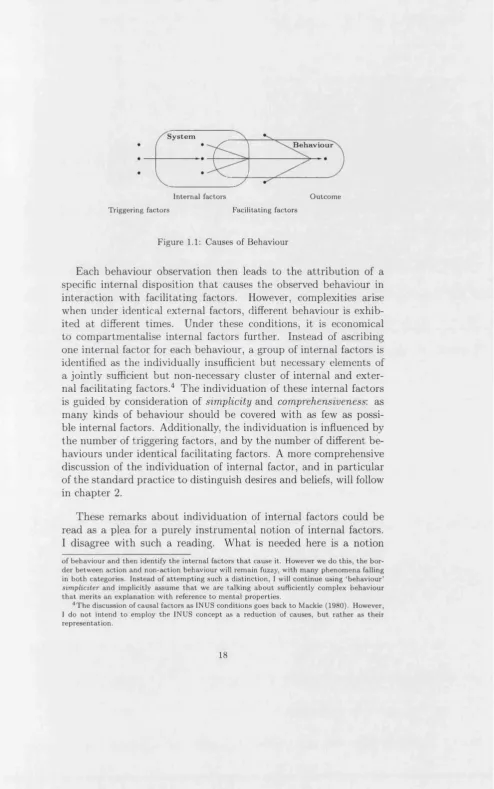
We now have all the building blocks we need for mental proper ties. Human beings are usually able to identify what is human or animal behaviour or not - the absence of external causes that could fully explain some human or animal locomotion lets them conclude that some internal factor must have contributed, and hence that they witness behaviour. The internal factor(s) at work then can be identified according to the specific behaviour that they help produc ing: they are identified by their causal role. But external factors also contribute - hence internal factors are identified according to their causal role, conditional on certain external triggering and facilitating factors. The interrelations between internal factors, triggering and facilitating external factors and behaviour is illustrated in figure 1.1. One can think of properties thus individuated as dispositions to behave.3
S y s te m
B eh a v io u r
Internal factors O utcome
Triggering factors Facilitating factors
Figure 1.1: Causes of Behaviour
Each behaviour observation then leads to the attribution of a specific internal disposition that causes the observed behaviour in interaction with facilitating factors. However, complexities arise when under identical external factors, different behaviour is exhib ited at different times. Under these conditions, it is economical to compartmentalise internal factors further. Instead of ascribing one internal factor for each behaviour, a group of internal factors is identified as the individually insufficient but necessary elements of a jointly sufficient but non-necessary cluster of internal and exter nal facilitating factors.4 The individuation of these internal factors
is guided by consideration of simplicity and comprehensiveness: as
many kinds of behaviour should be covered with as few as possi ble internal factors. Additionally, the individuation is influenced by the number of triggering factors, and by the number of different be haviours under identical facilitating factors. A more comprehensive discussion of the individuation of internal factor, and in particular of the standard practice to distinguish desires and beliefs, will follow in chapter 2.
These remarks about individuation of internal factors could be read as a plea for a purely instrumental notion of internal factors. I disagree with such a reading. W hat is needed here is a notion
of behaviour and then identify the internal factors th a t cause it. However we do this, th e bor der between action and non-action behaviour will remain fuzzy, w ith many phenom ena falling in b oth categories. Instead of attem p tin g such a distinction, I will continue using ‘behaviour’
sim pliciter and implicitly assume th a t we are talking about sufficiently complex behaviour th a t m erits an explanation w ith reference to m ental properties.
[image:23.595.28.523.24.814.2]of internal factors (as behavioural disposition) which are causally relevant for behaviour. This requirements puts certain constrains on internal factors that render them with ontological substance.
To speak of an object having a dispositional property en tails that the object is in some non-dispositional state or that it has some property which is responsible for the object manifesting certain behaviour in certain circum stances. (Armstrong 1968, 86)
This raises the question of how functional (dispositional) proper ties are realised, and the related issue of how the identification of functional properties can in any way provide a causal history that explains the agent’s behaviour. This is the topic of the next section.
1.4
M en ta l C a u sa tio n
Mental properties, as defined above, are distinct from physical prop erties, in the sense that they are not part of the terminology of physics. Nevertheless, mental properties are employed to individu ate the causes of behaviour - hence mental properties, albeit distinct from physical properties, are claimed to witness physical effects. At the face of it, this distinction collides with the assumption that physics is complete; an assumption which claims that:
All physical events are determined, or have their chances determined, by prior physical events according to physical laws. (Papineau 1993, 16)
If this assumption were true, then all the causes of behaviour must be describable as physical properties. Under this conclusion, it seems wrong to claim that instantiations of mental properties cause be haviour; unless one also claims that mental properties are nothing but physical properties, or that behaviour suffers constant overde termination from two types of causes. The dilemma the naturalist philosopher of mind finds herself in is expressed by Moser:
If one wants to remain within a naturalist position - which assumes. that behaviour h a s^ physical component, that physics js complete and that there M e lio T ^ u ta in ^ ^ F H ^ eriJ ete rm ination - then one cannot adm it’Moser’s secohd’ldp^fdn. Instead, I will grasp the first horn of Moser’s dilemma.
To do so without falling either for epiphenomenalism or reduc-tionism, I have to argue that mental states can be causally relevant to behaviour without being causally efficacious, jmd that therefore
mental properties can Be meaningfully differentiated from physical
properties without becoming causal competitors. I will first argue for a claim that is already implicit in the functional definition of mental properties given above: that mental properties are super venient on physical properties. I will then limit that claim so that type reductionism of the mental to the physical is excluded; and last I will argue for a realization relation between the mental and the physical such that mental properties do come out as more than mere effects of physical properties, and thus reject an epiphenomenal con clusion. This, I hope, will suffice to see that mental properties can
be considered causally relevant for behaviour.
According to the functionalist approach endorsed here, to have a mental property means having a physical property that typically occupies a particular causal role, given certain sensory inputs and other mental properties. The mentaljsupervenes on the physical in the sense that there cannot be a difference between the men-tal properties of a system without there being a difference between th e^ h ysical properties of a system. As the functionalist account presupposes that the mental is realised through the physical, and this presupposition entails supervenience, the functionalist therefore presupposes supervenience.
The supervenience of the mental on the physical derives from two
premises: the completeness of physics, and the so-called
manifesta-bility of the mental.5 This latter premise assumes that if two systems are different in some mental property, there must be a possibility
of this difference manifesting itself in some physical property inside
of the system s.6 Roughly, mental differences must be in principle
5Compare McGinn 1982: 29; Papineau 1993, 18.
detectable in physical terminology, while magical powers and super natural sensory abilities (divine revelation, telepathy) are excluded. From completeness follows that identical physical causes yield identical physical effects; and from manifestation follows that men tal difference requires physical difference. Thus, completeness and manifestation together imply that physical identity prohibits men tal differences, and hence imply supervenience of the mental on the physical.
Supervenience, however, is too wide a notion to cope with men tal causation adequately. After all, both the epiphenomenalist and the reductionist approach to mental states are compatible with su pervenience of the mental. The epiphenomenalist on the one hand claims that the physical states which cause behaviour also cause the respective mental state, while this state itself does not cause any thing. As the mental state according to this view is an effect of the physical state (or at least of the collection of all physical states of the system) it can change only with its causes, and hence su pervenes on them. The reductionist on the other hand claims the
identity between physical and mental properties (state types), which
trivially implies supervenience. Hence in both views supervenience is satisfied, but mental states are causally irrelevant.
The reductionist argues for the identity of mental and physical
properties. If a mental property M is identical to a physical prop
erty P , it follows that for any instantiation of M through an object
o, the identical physical property is instantiated; i.e. from the iden
tity of P and M follows M o <=$ Po. Such a biconditional then serves
as a bridge law for a reduction of any theory involving property M
fellow creatures and assigns similar mental properties to them as to humans. If one imagined being confronted with such creatures, whether constructed by humans, or arriving from a different time or planet, would it be wrong to attempt such attributions in the face of behaviour structurally similar to humans? At the least, it is not clear what purpose such a differentiation would serve but the upholding of type physicalism.7 Finally, beyond the differences in species or between terrestrial and extraterrestrial, it is not even clear that hu man beings instantiate their mental states in any uniform manner. So far, neurophysiology has identified little more than areas of the brain that show more activity when the agent is aroused, angered or concentrates on a given task. But whether identical physical pro cesses take place in the agent’s brain whenever the agent is in a specific mental state is by no means uncontroversial.
It therefore seems plausible to admit that mental states can be realised in a multitude of physical ways. According to this multiple
realisability assumption, the relation between instantiations of M
and P are weaker than reductionists assume. All that has to hold is
that any instantiation of a mental property necessitates a physical
property: M o =$> 3Pi : PiO. The reductionists’ biconditional, on the
other hand, does not hold for any Pi: and hence the identity between
any Pi and M must be false.
Papineau (1993, 38), however, doubts the credibility of multiple realisability. If functionally identified mental properties could be realised in different ways, he says, it would be incredible that they all led to the same behavioural output:
I am not accusing the functionalist picture of inconsis tency, but only of incredibility. The difficulty I am con
cerned with arises when some mental state S, which me
diates between physical input R and physical output T,
is realised by a range of different physical states Pi. The
puzzle is: why do all the different P*s which result from
R all nevertheless yield the common effect T? Now, it is
possible that every such Pi should just happen to yield T
. . . . However, if this were so, it would be the kind of coincidence that cries out for explanation. (Papineau 1993, 35-36)
This argument seems puzzling - after all, all the different P*s yield
the same effect T because they were individuated by their potential
to yield T. All the Pis are simply of the same psychological type.
That this unity does not establish the unity on the physical level -that a psychological type does not necessarily establish a physical type - is exactly the point of autonomous mental property explana tion that I want to defend here.
Naturalism that rejects the possibility of multiple realisation Papineau-style begs the question of what constitutes mental proper ties. It presupposes without justification that it is the physical level that determines the unifying and distinguishing criteria for mental states - in other words, it requires mental properties to be natural kinds. Only on this basis can people conclude that certain mental properties are only superficially similar, while being distinguished in their deep (physical) structure:
. . . in spite of their superficial similarity when viewed top-down, human psychology and Martian psychology are independent of each other in causal/explanatory structure and sources of evidence and must be considered, to all intends and purposes, distinct sciences. (Kim 1998: 122)
The line of attack against this argument is to point out the se vere limitations of requiring mental properties to be natural kinds. Behaviour is an event of purely physical manifestation; however, the possibility of describing this event in merely physical terms, derived from this point is largely theoretical. When we want to explain why the agent reached out for the ice-cream, or why the car crash oc curred, we talk about events which themselves do not have the unity of natural kinds.
Someone equipped only with the vocabulary and explana tory resources of physics would not hit either on car crashes or on Teachings for ice-creams as types of physical event
which required uniform physical explanations. And so
To require mental properties to be homogeneous from a physical per spective, as Papineau requires against functionalism, is to eliminate exactly those resources. The moral high ground of the naturalist then seems to stand against the possibility of social science. It is however not necessary to reject naturalism; rather, it suffices to re ject the ill-understood concept of natural kinds as a requirement for mental properties.
It is perfectly consistent to accept the Kripke-Putnam ac count of semantics of natural kind terms like ‘gold’ and ‘water’ while rejecting such an account for mental terms. The notion of a natural kind is not the most luminous of notions; but I do not think that we should be both ered if we are required to say that pains, like poisons and mousetraps, are not a natural kind, and lack a scientifi cally determinable essence. (Shoemaker 1984, 283)
To the contrary: that mental properties are not natural kinds, but supervene on physical properties, is the justification of the social sciences autonomy from the natural sciences while maintaining a naturalistic position.
A second reductionist response claims that even though mental properties might be multiply realised, it is nevertheless possible to reduce them to the disjunction of these physical properties. The reply of the anti-reductionists here is twofold: first, they doubt that such a disjunction can be considered a real property. This defense is rather weak, as it seems difficult to clarify what exactly a ‘real prop erty’ is. A second defense is more fruitful. It hinges on the principal openness of the above thought experiments. If mental properties are multiply realisable at all, i.e. if different physical properties can take on the causal role that specifies the mental property, then it is always possible that there are more realisers than we know so far. Under these conditions it is not possible to form a disjunction of physical properties which could serve as a reductive basis - all that such a disjunction could do is to summarise the current state of scientific knowledge.
From mind-body supervenience, however, follows a minimal rela tion between mental and physical properties. Mental properties are not realised by the same physical property all the time; but each time a mental property is be realised, it must be realised by some physical fact (an instantiation of a physical property). Papineau formulates this realization relation as follows:
In order for a mental . . . type M to be realised by
an instance of some physical type P , M needs to be a
second-order property, the property of having some prop
erty which satisfies certain requirements R. And then M
will be realised by P in some individual X if and only
if this instance of P satisfies requirements R. In such a
case we can say X satisfies M in virtue of satisfying P.
(Papineau 1993, 25)
The desire to drink milk then is the secondary property of having a
(possibly undetermined) physical property th at under specific con ditions makes one drink white liquids out of suitably shaped con tainers. To identify this secondary property, one does not have to determine what physical properties are involved here; it is enough that there are some, and that they are the realisers of the causal role in question.
M
I
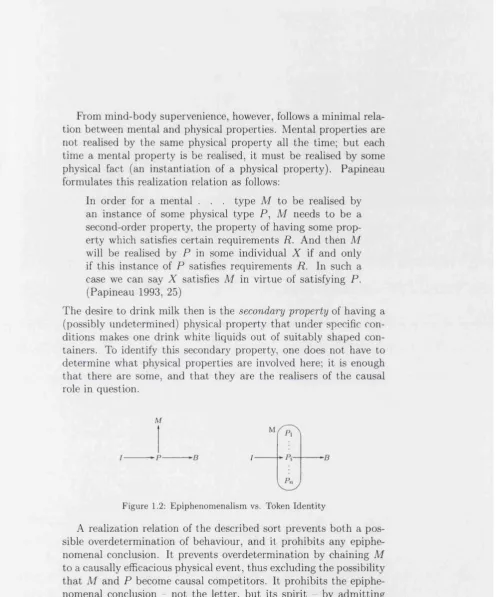
Figure 1.2: Epiphenomenalism vs. Token Identity
A realization relation of the described sort prevents both a pos sible overdetermination of behaviour, and it prohibits any epiphe-
nomenal conclusion. It prevents over determination by chaining M
to a causally efficacious physical event, thus excluding the possibility
that M and P become causal competitors. It prohibits the epiphe-
nomenal conclusion - not the letter, but its spirit - by admitting th at a mental event is not causally efficacious as the epiphenome
[image:30.595.28.525.30.628.2]a causally efficacious event. The difference between the two inter pretations is illustrated in figure 1.2. While the epiphenomenalist claims th at the mental property is nothing but a causal by-product of the causally efficacious physical property, the position defended here claims that the mental property is the category of a set of physical properties that all realize the behaviour in question. In
thissense, the causally relevant property programs for causally effi
cacious ones in the following sense:
A useful metaphor for describing the role of the property is to say th at its realization programs for the appearance of the productive property and, under a certain description, for the event produced. The analogy is with a computer program which ensures th at certain th ings will happen (. . I", though all the work of producing those things goes on at^a lower, mechanical level. (Jackson and P ettit 1990a, 114)
Programming properties relevant for an effect, although not involved in the causal chain, provide a causal history of th at effect. The epiphenomenalist claim that mental properties are causally inert thus stands undefeated; but the bearing this result has on the pos sibility of explanation of behaviour with recourse to those mental properties is greatly changed.
How is a particular psychological set causally relevant to an agent’s doing something . . . given th at the action is
produced (...) without leaving anything to be explained
by a certain complex of neurophysiological states? The programme model suggests that the psychological set will be causally relevant so far as its realization in an agent of th at kind makes it more probable than it would otherwise have been . . . th at there will be a neurophysiological configuration present - maybe this, maybe th at - th at is sufficient to produce the required behaviour. (P ettit 2002,
181)
globally speaking - much better at this type of explanation than anything else so far available. They master multiple realisability, which hampers progress in neurophysiological explanations (and will possibly make it impossible in principle); they allow one to explain behaviour in the terminology in which it is described, and not in the overtly reductive terminology of physics. It therefore allows one to focus on the macrostructure of behaviour, instead of the causal (and thus physical) microstructure. Finally, mental events come equipped with an easy (if somewhat rough) epistemology, as I will discuss in chapter 2.
1.5
M en ta l C on ten t
Mental properties are often presented as propositional attitudes. In particular, beliefs and desires, the mental properties which are most important for explanations in the social sciences, are considered to have propositional content: we say that the agent believed that it was raining and she desired that she stayed dry when we explain why she took the umbrella. This impression is supported by the
formal treatment of mental properties: as the belief that p, bel(p),
or the desire that q, des(q), or as the preference relation p P q between
propositions p, q.
Many philosophers therefore think of mental properties as rela tions between people and propositions: my belief that the sun is shining is a special kind of relation between me and the proposition ‘The sun is shining’; your desire to stay at home on such a beautiful 1 day like this is a relation between you and the proposition ‘I stay home on Mon, 1st of March 2004’. To claim that mental proper ties are propositional attitudes then becomes an ontological claim: namely that semantic content in the form of a proposition is part of the mental property. Colloquially, as mental properties are in ternal factors, it is claimed that propositions must be ‘in the head’. The claim that mental properties are relations between people and propositions is called the ‘Relational Thesis’.8
Whatever we think propositions to be exactly, they are seman tic content - that is, they are what sentences of the same meaning express. But objects of such a sort do not have either location in
time or space: propositions are abstract objects. The Relation The sis therefore implies that mental states (as instantiations of mental properties) are very specific kinds of objects; in particular, th at they are fundamentally different from physical states. This claim - al beit of course not cast in terms of propositions - can be found in the writings of the 19th century German philosopher and psychologist Franz Brentano.
Every mental phenomenon is characterised by what the Scholastics . . . called the intentional (...) inexistence of an object, and what we might call (...) reference to a content, direction toward an object (...), or immanent objectivity. Every mental phenomena includes something as object within itself, although they do not all do so in the same way. In presentation something is presented, in judgment something affirmed or denied, in love loved, in hate hated, in desire desired and so on. This inten tional in-existence is characteristic exclusively to mental phenomena. No physical phenomenon exhibits anything like that. We can, therefore, define mental phenomena by saying th at they are those phenomena which contain an object intentionally within themselves.’ (Brentano 1995, 88-89)
Propositions the abstract objects Brentano calls content of di
rection toward an object do not have any physical correlate. The
Relational Thesis implies th at mental properties are relations be tween persons and these abstract objects; hence there cannot be a physical or neurophysiological correlate of mental states either. As causation is between physical phenomena only, mental properties, understood as relations between people and propositions, cannot be causes of anything, and in particular not causes of actions.
This is a far-reaching result. If the social sciences deal with men tal properties, and the natural sciences with physical phenomena, then it follows from Brentano’s distinction that the social sciences
and the natural sciences are fundamentally distinct in their objects.
But if intentional properties are fundamentally different from physi cal properties, and cannot be causes, then nothing can be explained by referring to them. Thus it would follow that the natural and the
the natural sciences explain, the social sciences have to adopt some
other practice, maybe Verstehen, maybe something else. The char
acterization of mental properties as intentional states contributes to
the deep-reaching divide between Geistes- and Naturwissenschaften.
I think that the thus constructed divide between the social and the natural sciences on these grounds is unwarranted. I think that
we can explain in the social sciences, and that this explanation refers
to mental properties as the causes of behaviour.
There are two ways to defend such a naturalistic account of men tal properties. One can either expand the supervenience-base of the mental - to include all ontological constituents of the representa tional content - or one can argue that the individuation through the representational content is ontologically irrelevant. That is, one drops the assumption that mental properties have semantic content in any essential way and thus frees oneself from the burden to show how this semantic content could be reducible to physical events.
I think the attem pt to extend the supervenience-base is not fruit ful. First, there is the question whether it can be done at all. Propo sitions are abstract objects. Thus it is not clear whether they have physical realisers at all; or if they do, then it is an open question what these physical realisers are. Second, if it can be done, then the result will be an extremely uneconomical ontology. To answer the qualms of the anti-naturalists, one had to point out what parts of the realisers of a mental property were the realisers of the semantic content, a rather dooming task it seems to me.
Instead, I will argue for a naturalistic account of mental proper
ties by denying that intentional states are genuine relations between
people and abstract objects. Any such argument against the onto logical relevance of propositional content has to show how mental properties acquire their semantic content - which they undoubtedly have - without being ontologically committed to them. The argu ment presented here relies on an analogy between the ascription of semantic content to mental properties and the ascription of num bers to physical objects in (numerical) measurement procedures.9 To clarify this analogy, I will first rehearse some basics of the theory of measurement.
1.5.1 M easurem en t T h eory
Measurement theory explains why and how numbers can be em ployed to represent a property; more precisely, how a scale - a mathematical structure consisting of a set of numbers and a trans formation rule - can be meaningfully applied to a set of objects. A
scale is an ordered triple (U, N, / ) with U being an empirical rela
tional system, N a full numerical relational system, and / a function
that maps U homomorphically onto a subsystem of N . An empirical
relation system consists of a domain specification and one or more relations over that domain; for example, the set of all extended ob
jects O which are ordered according to their weight Ry, forms an
empirical relational system (O, Ryj); the set of extended objects or
dered according to their weight and their density Rd forms another
empirical relation (O, R w, Rd)- A full numerical relational system
consists of the set of all real numbers and one or more relations
S i...S n defined over it - mathematical relations like, for example, equality or calculus operations. A subsystem of a relational system consists of a subset of the domain of the system with the same rela tions defined over it. We say that a numerical subsystem preserves properties and relations of an empirical system if the function /
maps the elements of the empirical domain a, b, c. . . G O onto the
numerical domain N in such a way that
aRib if and only if f { a ) Sj f ( b)
If / satisfies this requirement, we speak of A" as a homomorphic
image of U. To prove that there is such a scale with a homomorphic
mapping is to prove a representation theorem; its result is that the
property or relation that was identified in the empirical relational system is indeed preserved in the numerical subsystem.
‘Measuring an object’ thus is a two-step procedure. First, the empirical structure of an object is identified: its weight, length or
temperature. The empirical structure determines the dimension of
measurement. For each dimension, the homomorphic image of the
empirical structure allows the measurement of magnitude. The as
Prom the existence of a homomorphic image of an empirical sys tem it does not necessarily follow that this numerical subsystem is the only possible representational space. To say that a stone has a weight of 11 pounds, attributes a property to the stone - that of having a certain mass. But we can express exactly the same fact by saying that the stone weighs 5 kilogram, or 175.57 ounces. There is - to some degree - an arbitrary choice of unit in expressing the same fact about the object numerically. The theory of measurement discusses this peculiar relation between objects and their properties on the one hand, and numbers and their operations on the other.
When we express weight in kilos or pounds, we represent a fea ture of this property in a numerical space. Such a representation preserves a certain structure of that property (the ‘greater than’ relation, its additivity or substractability, for example), and makes it more convenient to handle. But there are many kinds of rep resentations that all preserve the same structural features of that property: pounds and kilos are just two examples from an infinite set of possible representations. We then say that in these cases
the scales measuring this property are equivalent transformations of
each other.
Where scales are equivalent transformations of each other, the empirical domain stays the same, but the mapping and the nu
merical subdomain change: let ( U , N , f ) be the Celsius scale and
(Uj N, g) the Fahrenheit scale. Then g = F o / , that is, g can be
generated through a transformation function F from / . We say
that (£/, N, f ) is unique up to transformation F , and thus categorise
scales according to the kind of transformation function they allow. Absolute scales only allow identity transformation; ratio scales (e.g. weight, length) allow for transformation by a coefficient; interval scales (e.g. temperature) allow for positive linear transformations; ordinal scales allow for monotone transformations.
How is the uniqueness of a scale determined? If all elements of a scale are known, the type of scale can be proven:
But the exact structure of the empirical system is not known a priori. Instead, the form of the empirical system is conjectured, measurement scales established on that basis and the results of the measurement employed in explanatory or predictive theories. Mea surement thus proceeds by trial-and-error: different measurement scales are applied to a system - i.e. measurements are taken - and the measurements are compared for consistency.
The numerical relational subsystems employed in such measure ment scales are not necessarily identical to subsets of the real num ber system. To prove that an empirical system is homomorphic to a numerical one does not mean that the empirical system is homo morphic to the real number system. A real number system contains amongst others the operations of addition and multiplication - that is, three-place relations - as well as the binary relation ‘less than’. Relations of empirical systems measured with a numerical system can be considerable weaker, in that they lack e.g. addition or multi plication. For example, the empirical system measured with Moh’s hardness scale does not contain any relation corresponding to the addition operation, but only the ‘less than’-relation. That a numeri cal relational system of a given scale is isomorphic to the real number system is therefore an additional result that is not necessarily born out in the representation theorem itself.
Hence there are many relations definable over the numerical do main, which do not have any correspondence to any property in the empirical system. Strictly speaking (as in the above paragraph) these properties or relations are therefore not part of the