Opinion Observer: Recommendation System on
E-Commerce Website
Mohammad Daoud
Centre for Education TechnologyIndian Institute of Technology New Delhi, India
S.K Naqvi
FTK-Centre for Information Technology Jamia Millia Islamia
New Delhi, India
Asad Ahmad
FIS Global Business Solutions Private Ltd. Gurgaon, India
ABSTRACT
To overcome the product overload of online shoppers, a variety of recommendation methods have been developed. Recommender systems are being utilized by an ever-increasing number of E-commerce sites to help consumers discover products to buy. The most of existing system gives the recommendation based on best selling product, on demographics of the consumer, or on an analysis of the past buying behavior of the consumer. Our purposed system based on the consumer reviews and advanced multi-criteria search engine. In this paper, we used a text mining approach to mine product features, opinions and their semantic similarity from Web opinion sources. The consumer can clearly see the strengths and Weaknesses of each product in the minds of existing consumer’s opinion. The system assists on-line shoppers or goal oriented shopper by suggesting the most effective navigation products for their specified criteria and preferences.
Keywords:
Recommender Systems, e-commerce, feature, opinion
1.
INTRODUCTION
Recommender Systems make it possible for users to navigate through large product assortments, make decisions in e-commerce scenarios and overcome information overload. These systems take the behaviour, opinions and tastes of a large community of users into account and thus constitutes a social or collaborative recommendation approach, whereas in content-based approaches, product features and textual item information’s are considered. Knowledge-based approaches the knowledge about how a particular item meets a specific consumer need. Demographic recommenders systems intend to categorize the user based on personal attributes and make recommendations based on demographic classes. Hybrid approach combines two or more techniques. Marginal utility is an economic concept because economists and marketing research use it to decide how much of an item a customer will purchase. Association rule mining as a machine learning approach, concentrates on the mining of associations over sales data and help supermarket managers to analyze past transaction data and to improve their future business decisions and recommend products to a user on the basis of other users’ ratings for these products as well as the similarities between this user’s and other users’ tastes. These type systems that depends upon the consumer profile or past purchasing behavior. But with the rapid growth of e-business the web provided an excellent platform for consumer and manufacturer. Consumer shopping behavior may be experiential or goal-oriented [1]. Goal-oriented shopping is efficient and purposeful, with a preplanned purchase in mind.
Two thirds to four fifths of Internet consumers are goal-oriented, performing narrowly described searches for particular products online rather than browsing [2]. Analysis of click stream data of major e-commerce sites also propose that most online consumers are goal-focused, as goal-oriented consumers are expected to spend less time at a site. In top line click stream data posted weekly at Nielsen-Net Ratings (nielsenetratings.com),the average length of visits at major e-commerce sites (with the significant exception of e-Bay) is shown largely to be 10 min or less. Consumers with goal-oriented more likely to shop online [3]. E-commerce website is to provide the best recourse for merchant to show their products online to the large audience and audience have an opportunity to choose the best product that they want. Large audience shopping online and express their opinion on website that’s called the reviews or user generated content. Manufacture keeps track of customer opinion from these reviews on their product and the customer also making decision on whether to buy the product. But some popular merchant the number of reviews is usually over hundreds or even thousand. This makes it difficult for a customer to read through the reviews one by one and inform decision on whether to buy the product or extract the useful information or manufacturer services. The vast number of reviews has made it difficult also for product manufactures to keep track of customer opinions and sentiments on their products and services. Since, most of the reviews are keep either in unstructured or semi-structured pattern. It would be a great help for both customers and manufacturers if the reviews could be handled automatically and presented in a summarized form highlighting the product features and consumers opinions expressed over them. Online-shopping has become the most effective way for shopping. Consumer opinion can effectively improve the quality of the e-commerce recommendation system. The paper presents of e-commerce recommendation system that used the text mining approach to mine product features and opinions from review documents and compare existing consumer opinions of different products; the consumer can clearly see the strengths and Weaknesses of each product in the minds of existing consumers. The system assists on-line shoppers by suggesting the most effective navigation products for their specified criteria and preferences.
2.
RELATED WORK
communication of research and purchase. Due to the continuous expansion of products in E-commerce, users have the doubt for correct product selection. User preferences are represented by the recommendation systems for suggesting items to purchase or find out. They have become the basic applications in electronic commerce and information access, offering suggestions that effectively trim large information spaces so that users are pointed toward those points only that best satisfy their necessities and preferences [4]. In e-commerce, customers are encountered to so many and multi-category products and services. Hence, a great deal of time is spent on information search and choice before they can ascertain out what they really require [5]. These tools also assist companies to deliver personalized offers to their customers and define a system which recommends the right product or service after learning the customers’ preferences, and desires. Customer’s preferences are extracted through their buying behavior and history of purchased products [5]. Firstly, the recommender system matches the customers’ preferences and desires through their purchasing behavior and history of purchasing product and target same type customers’ using the content base and collaborative filtering or hybridization and recommend those product that they liked/bought in past. Since it is very challenging to recommend the products to new customers, therefore Demographics techniques are used to handle this kind of problem. Demographic techniques form” consumer-to- consumer” correlations like collaborative ones but use different data. It is good in a way that it may not require a history of user ratings of the type needed by collaborative and content-based techniques [4]. It just gets the feedback from the customer Researcher analysis for the products having high rating or matching against the customer preferences. For example the system recommends a vacation package to customer [6]. System recommends those places for which they have high rating or match against the customer preferences without knowing the time period. Suppose the customer has a vacation plan in winter than the system also recommend those places where the customer prefers to go in summer. Knowledge-based system handles this kind of problem. The system should have the knowledge about the object and customer needs with time and place. Knowledge-based approaches are distinguished in a way that they have functional knowledge: they have knowledge about how a specific item meets a particular consumer need, and can therefore reason about the relationship between a need and a possible recommendation [4]. E-commerce websites can predict a consumer’s future purchasing behavior through the information amassed from a consumer’s past purchasing behavior and demographic information. The system grouped together those consumer have the same purchasing behavior and needs for recommendation. but that Recommendation is unable to completely satisfy the customers. Then Marginal utility concept comes into the play. The economists and marketing research use it to determine how much of an item a consumer is going to purchase. Granting to the Law of Diminishing Marginal Utility, many products have the decreasing marginal utility with the increase of purchase count, such as mobile phones, laptop, garments, and hence along. Users are not likely to buy the same or similar product again in a short time if they already used it before. On the other hand, some products, such as food item, would be purchased again and again. Then marginal utility will be increased [8]. Up to the different recommendation technique applies to recommend the product. E-commerce website has developed Web-based information systems to handle large numbers of transactions on the Internet. These systems can
automatically collect data on the browsing histories and purchasing records of each consumer. It can be applied to discover customers’ behavior and purchasing patterns over time. As a consequence, many data-mining applications have been acquired to discover useful customer and market information from the data, such as Web merchandising Web site design improvement, click stream analysis, product recommendation, customer profiling, and e-catalog design [9, 10, 11]. But Most of the e-commerce recommender system focuses on user historical activity data, user’s social network, and Cart abandonment from that they get the user preference, integrate peer group for a recommendation and get the user purchase. But it is possible that a past purchasing pattern may not be present again [12][13] . Due the rapid growth in online customer it is very complicated to keep up the each user logs and purchasing profile for recommendation. We purpose a system who gives the recommendation on consumer current purchasing behavior.
3.
PROBLEM STATEMENT AND
PURPOSED WORK
4.
BENEFITS OF PURPOSED SYSTEM
In a web-system like an e-shop a user is overloaded with items. The system database typically contains thousands of items separated into respective classes. System provides user with items that are likely to be interesting without requiring him/her to search for them. This saves user's time and assists him/her drop more time exploring the interesting items than messing around uninteresting items. The provided recommendations are user opinions based on products feature; the user can clearly understand the strengths and Weaknesses of each product in the minds of existing users. The system assists on-line shoppers by suggesting the most effective navigation products for their specified criteria and preferences. so the recommendations are likely to be much accurate. In comparison to advanced multi-criteria search, recommender systems are better at showing users' preference in criteria that aren't easy to express and depend on the experience of the user. The advantage of recommender system is their user-friendliness they don't need any extra search terms, they just use certain keyword according to user knowledge. This can be a significant advantage for inexperienced internet users. Advance search engine uses the shorting algorithm and they easily refined the user query and find the result. E.g. if the user is absolutely certain he/she wants a blue lap-top with the given display size at the lowestprice, the multi-criteria search is easily to find such a product. But multi-criteria search don’t shows the pros and cons of that product. However, we used the multi-criteria search figure [1] into our system, for performing well defined search queries and recommender systems help users find novel items.
5.
METHODOLOGY
We used the existing web interface or advanced search shown in fig.[1].we considers the shortlisted products are fulfilling the desired criteria of consumer requirements. We have selected the products reviews from the merchant website and categorized the product in prize wise shown Fig.2 ( for example different type consumer have the different budget for shopping so we provide the best product in consumer search criteria )
In online environment most of the consumers are goal oriented. So during the shopping they have some basic ideas like as their requirements, desired feature, brands and budget etc. multi-criteria search engine have these type facility for consumer and they can select the desired option, and the system filter the consumer query and show the shortlisted products all these task are done by E-commerce web interface. Our system get the selected products from web interface and collect the user reviews on it from the merchants website (Amazon, flip kart, snap deal, eBay etc).
[image:4.595.282.535.141.765.2]
Fig.2 existing consumer reviews (www.flipkart.com) we performed our experiments on IBM SPSS Text Analytics
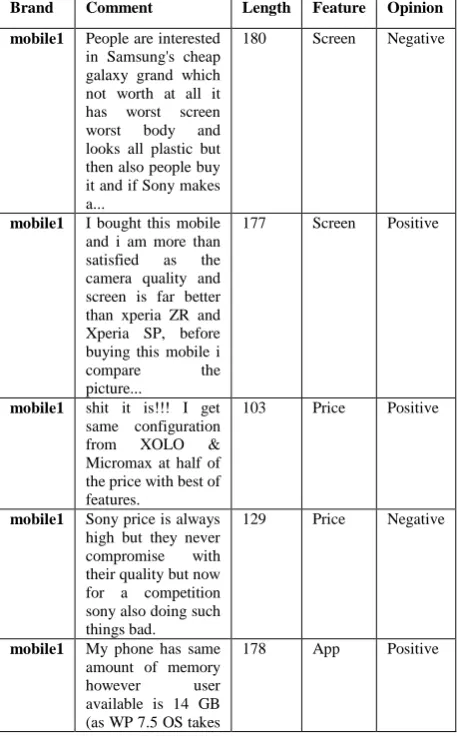
for Surveys for extracting the feature and opinion from reviews and also find the semantic similarity between them As a result, we can gain a clearer understanding of what people like or don’t like – and why. When we understand what people think and feel in their own words, we can draw more reliable conclusions about people future behavior and use that predictive insight to meet their needs more successfully. we can rely on this product to make text analysis easier and more efficient for our research because it is a linguistics-based solution. Specifically designed for categorizing or “coding” text responses and sentiments. The system generated a report that’s based on the consumer selected option and show all positive and negative opinion results Table [1]. Our system recommends those products that have the highest positive opinion on its feature that selected by consumer see in Fig [3,4].
[image:4.595.49.278.391.760.2]6.
RESULTS
Table 1.Expriment result of consumer reviews
Brand Comment Length Feature Opinion mobile1 People are interested
in Samsung's cheap galaxy grand which not worth at all it has worst screen worst body and looks all plastic but then also people buy it and if Sony makes a...
180 Screen Negative
mobile1 I bought this mobile and i am more than satisfied as the camera quality and screen is far better than xperia ZR and Xperia SP, before buying this mobile i compare the picture...
177 Screen Positive
mobile1 shit it is!!! I get same configuration from XOLO & Micromax at half of the price with best of features.
103 Price Positive
mobile1 Sony price is always high but they never compromise with their quality but now for a competition sony also doing such things bad.
129 Price Negative
mobile1 My phone has same amount of memory however user available is 14 GB (as WP 7.5 OS takes
178 App Positive
bit less memory) and still only 2 GB is left after having my favorite app, games and music.
mobile2 Now everyone knows that App market is very low in number, but there are no fake apps and the best thing is there are no viruses or malwares in the apps of the window store.
172 App Positive
mobile2 Apart from this, it’s
pretty much all stock Windows Phone 8 and unlike Nokia, HTC doesn’t seem to have bothered much with any exclusive apps for the platform.
158 App Negative
mobile2 The touch, the apps, office integration, decent battery backup, large screen, excellent back and front cameras (blink, microsoft app adds more value to it) make it excellent...
176 Screen Positive
mobile2 OS (Windows) is useless because of no proper applications.
58 OS Negative
mobile2 My battery life has been great too.
35 Battery Positive
mobile3 Great Android offering from Sony at this price.
47 OS Positive
mobile3 Camera is great but not awesome
31 Camera Negative
mobile3 Camera is great but not awesome
31 Camera Positive
mobile3 Camera Quality : Zooming the camera is totally waste since its digital zoom support and no optical zoom support so image capturing with zoom may create problem
159 Camera Negative
mobile3 Camera quality is good(don't compare with sony mobile)
54 Camera Positive
mobile3 Almost 4 Gb available internal memory - Sufficient for all the apps one wants
77 App Positive Model
name
Prize (Rs) No. of comments Mobile1 18,340.00 224
Mobile2 18660.00 89
mobile 3 18,870.00 270
Model name
Prize (Rs)
No. of comments mobile4 8200.00 75
mobile4 The only pro is the good battery life.
38 Battery Positive
mobile4 Battery life is great! .
24 Battery Positive
mobile4 Even the battery life isn't that great.
39 Battery Negative
mobile4 brilliant battery. 18 Battery Positive
mobile4 No GPS, low end processor, bad camera and a glossy plastic body.
64 Camera Negative
mobile5 these are jst basic apps i require because i m nt a much app savy but these apps are sufficient.
96 App Positive
mobile5 As already mentioned, I had to gift a mobile for my mom with decent camera and a decent screen.
95 Screen Positive
mobile5 b) No flash and secondary
camera(even u can go for Skype calling but u have to use the
164 Camera Negative
mobile from back side bcoz it don't have secondary camera for video calling).
mobile5 The camera is amazing which is of 5 mega pixel with it's touch focus.
69 Camera Positive
mobile5 Good looks, simple lightweight OS, no hangs or lags as of now.
62 OS Positive
mobile5 it is the WhatsApp that is really bad/bloated app and it used to crash REGULARLY on my previous BlackBerries too.
113 App Negative
Fig.3 existing consumer opinion on product features
Fig.4 existing consumer opinion on product features -15% -5% 5% 15% 25% 35% m o b ile 2 m o b ile 3 m o b ile 1 m o b ile 2 m o b ile 3 m o b ile 1 m o b ile 2 m o b ile 3 m o b ile 1 m o b ile 2 m o b ile 3 m o b ile 1 m o b ile 2 m o b ile 3 m o b ile 1 m o b ile 2 m o b ile 3 m o b ile 1
APP Battery Camera OS Price Screen
Positive Negative -15% -5% 5% 15% 25% 35% 45% mobile 4 mobile 5 mobile 4 mobile 5 mobile 4 mobile 5 mobile 4 mobile 5 mobile 4 mobile 5 mobile 4 mobile 5
APP Battery Camera OS Price Screen
7.
CONCLUSION AND FUTURE WORK
The rapid expansion of e-commerce forces existing recommender systems to deal with a large number of customers and products and to ensure high quality of recommendations. In this paper, we have studied about the E- commerce web interface and online reviews available on web and extraction product features opinion and categorization, from online product reviews using the IBM SPSS Text Analytics for Surveys. We utilize the semantic knowledge similarity measures to calculate the similarities and categorize product features into different feature groups. The experimental results have demonstrated the effectiveness of our proposed model. In this article, a new assessment mechanism is introduced to short out the new consumer problem of E- commerce recommendation.8.
REFERENCE
[1] Babin, Barry J., William R. Darden, and Mitch Griffin. "Work and/or fun: measuring hedonic and utilitarian shopping value." Journal of consumer research (1994): 644-656.
[2] Hoffman, Donna L., and Thomas P. Novak. "Marketing in hypermedia computer-mediated environments: conceptual foundations." The Journal of Marketing (1996): 50-68.
[3] Hoffman, Donna L., Thomas P. Novak, and Ann Schlosser. "Consumer control in online environments." Elab. vanderbilt. edu (2000).
[4] Apeh, Edward Tersoo, Bogdan Gabrys, and Amanda Schierz. "Customer profile classification using transactional data." Nature and Biologically Inspired Computing (NaBIC), 2011 Third World Congress on. IEEE, 2011.
[5] Mobasher, Bamshad. "Data mining for web personalization." The adaptive web. Springer Berlin Heidelberg, 2007. 90-135.
[6] Jakob, Niklas. "Extracting Opinion Targets from User-Generated Discourse with an Application to Recommendation Systems." (2011).
[7] Yousefi, Ayoub, and Jie Tang. "E-commerce: Consumer Online Shopping in Canada." Contemporary Research on E-business Technology and Strategy. Springer Berlin Heidelberg, 2012. 1-14.
[8] Gretzel, Ulrike, and Daniel R. Fesenmaier. "Persuasion in recommender systems." International Journal of Electronic Commerce 11.2 (2006): 81-100.
[9] Chen, Yen-Liang, et al. "Market basket analysis in a multiple store environment." Decision support systems 40.2 (2005): 339-354.
[10]Lin, Qi-Yuan, et al. "Mining inter-organizational retailing knowledge for an alliance formed by competitive firms." Information & management 40.5 (2003): 431-442.
[11]Tang, Kwei, Yen-Liang Chen, and Hsiao-Wei Hu. "Context-based market basket analysis in a multiple-store environment." Decision Support Systems45.1 (2008): 150-163.
[12]Chen, Yen-Liang, et al. "Discovering recency, frequency, and monetary (RFM) sequential patterns from customers’ purchasing data." Electronic Commerce Research and Applications 8.5 (2009): 241-251.