Building Learning Repository based on Semantic and
Shareable Learning Objects
Khaled M. Fouad
Computer Science Dept., College of Computers and Information Technology, Taif University, Kingdom of Saudi
Arabia (KSA)
Mostafa A. Nofal
Computer Engineering Dept., College of Computers and Information Technology, Taif University, Kingdom of Saudi
Arabia (KSA)
Jehan A. Hasan
Computer science Dept., College of Education and Science, Taif University, Kingdom of Saudi Arabia
(KSA)
ABSTRACT
Learning Objects (LO) represent important elements when using electronic media to deliver educational contents to an audience in a learning environment.Construction of LOs does not involve a simple method, as their nature is directly linked to the intricacies of human cognitive and learning processes.Learning Objects Repository (LOR) not only provides a distributed storage mechanism but also emphasizes on the shareability and reusability of LOs. To ensure reusability and shareability, the metadata has been annotated to help LO discovery. To enhance the annotations in a traditional metadata format, ontological approach is proposed to achieve efficient LOs and to assist users in retrieving LOs. In this paper, new approach is proposed to acquiresemantic shareable learning objectsto create LOR. This proposed system presents the advantages that facilitate the development of new didactic tools with improved LO retrieving, integration and building capabilities.The experiment executed in this research shows that the proposed approach improves LO retrieving in the learning system.
General Terms
E-Learning, Learning objects (LO), Shareable learning objects,Learning object metadata (LOM), Domain ontology, WordNet.
Keywords
Learning object repository, Semantic Web, Domain ontology, Semantic learning objects, Semantic annotation, LO refinement.
1.
INTRODUCTION
When an E-Learning system to be delivered contains learning materials covering different levels of learning, the level of learner is taken into consideration to provide the learner with the learning materials that suit his/her level and his/her fields of interest [1]. In advanced e-learning systems, shareable learning objects [47] will be presented as a way for sharing information in standard ways that will allow the design of learning events that fit the needs of learners and provide just-in-time opportunities to develop skills and knowledge. Learning Object Repositories [48] (LORs) are an important element in the management, publishing, location and retrieval of LOs.
Using ontology [2, 3] in learning environments aims at providing mechanisms to enhance the process of searching and finding learning resources. And, they have the capability
to organize and display information that makes it easier for learners to draw connections, for instance, by visualizing relationships among concepts and ideas.The annotations [10] mean comments, notes, explanations, or other types of external remarks that can be attached to any Annotations are very helpful if they are inserted into documents containing many terms specific to subject. Semantic annotation [25] provides a more precise description of the knowledge contained in a document and it’s semantics in the domain. Semantic annotation [25, 26] is about assigning entities in the text links to their semantic descriptions. The present research first proposes anapproach that extends the IEEE LOM (Learning Object Metadata) standard [9] with ontology-based semantic annotations [23] for efficient use of learning objects (LOs) outside learning management systems (LMS). This approach is presented in the context of existing approaches that adopt ontologies in order to annotate e-learning resources. Its particularity consists in a simple solution for integrating semantic annotations in the structure of the IEEE LOM [9] description of the e-learning resources.The proposed approach aims at building learning repository based on semantic and shareable LO. The approach provides new steps towards the unification of existing learning object conceptualizations. Based on the new formal semantic web specifications, proposed approach provides new room for interchanging, reusingand sharing of web-oriented educational contents in the form of learning objects. These advantages facilitate the development of new didactic tools with improved searching, integration and building capabilities.
2.
RELATED WORK
Semantic Annotation Platforms (SAPs) [11] were developed to provide a level of automation to the semantic labeling process, and overcome the limitations of manual annotation. SAPs designed with extensible architectures can adapt to evolving technology. Information extraction components can be replaced as different approaches are developed. The most common toolkits used within SAPs are GATE and Amilcare.
35 by using several approaches as examples. Authors have
described several annotation systems and compared the main features and the algorithms employed in the systems. Moreover, we have introduced several practical application of semantic annotation.
Authors in [13] proposed to utilize data mining technologies for time series data to gather the relevant information, such as citations, of specific LOs in different timescales. That is, citations in different timescales represent different meaning of the LOs. They revised the Time-Fading Model and Tilt-Time Window Model to measure the weight of LOs. In addition, authors provided a mechanism to rank these LOs. Utilizing the proposed mechanism, it can enhance reusability of LOs. Furthermore, to assist users in the searching phrase, they revised the algorithm of Relevance Feedback and combined it with the weight of LOs that we proposed. They did not provide actual items, like the recommendation systems, to users. Instead, they provided suggestions that can guide them to revise the query process especially in the input query terms. They proved that, with the proposed mechanisms and the distance learning standard that focuses on describing LOs (i.e., IEEE LOM); LOs can be searched in an efficient way, which will help the promotion of SCORM and CORDRA specifications in the international community of distance learning.
The authors in [14] applied the graph-theoretic clustering to Web data for noising, clustering and constructing semantic concept model. They proposed a novel image annotation method. The proposed method offline processes and mines Web data collected from several image search engine to construct a concept clustering model. Moreover, it can be continuously upgraded; the effectiveness of image annotation can be increased gradually with the development of the update phase. They demonstrated that it can obviously improve the effectiveness of annotation algorithm through offline deleting the noise data and mining the important terms in Internet data.
The aims in [15] were to create a system that annotates automatically a set of Web pages according to domain ontology. They were interested in data-rich web pages which are pages that contain a list of records. Most of these pages are automatically generated conforming to a template. This property makes possible extracting data they contain using wrapper induction techniques. They tried to associate it with different sets of data units' concepts or properties that best match it. Their approach was based, among other things, on syntactic descriptions of concepts and properties with which they have enriched the ontology.
In the paper [16], authors presented an approach for the automatic generation of metadata for LOs. Main ingredients of their model were the ontology and the classifier. The classifier automatically classifies the LOs according to the concepts in the given ontology. Classified LOs were then automatically attached with ontological metadata. The proposed approach is easy to implement and reduces the amount of manual intervention while integrating the LOs with metadata.
In the paper [17], authors presented a system to semantically annotate any named entity contained in a text, using a URI link. The URI resource used is a standard one, compatible with the Semantic Web network Linked Data. They have introduced the concept of Linked Data Interface, an exhaustive statistical resource containing contextual and nature description of potential semantic objects to label. The Linked Data Interface gives a possible answer to solve the
problem of ambiguity resolution for an exhaustive semantic annotation process. This system is a functional proposition, available now, to establish automatically a relation between the vast amount of entry points available on the Linked Data network and named entities contained in an open text.
The specific purposes of the study [18] were to (1) implement an online social annotation tool, HyLighter, for question-answering tasks in a college argument and persuasion course, and (2) investigate the effects of HyLighter on the students’ mental models, motivation for the course, and achievement in the course, compared to the students who engaged in question-answering tasks without using HyLighter.
Authors in [19] have proposed an automated video annotation method which is able to detect and label the foreground region of interest using appearance and motion information. More specifically, they focused on annotating rigid moving objects such as cars, airplanes, etc. in Web videos, and they considered videos with only one foreground object present. Authors proposed to construct consensus foreground object templates (CFOT) to address moving object detection. Their method was robust to significant camera motions (e.g. panning, tilting, zooming, etc.) or low contrast environments. They also considered the integration of features collected in different domains, which further improves the annotation accuracy.
In [20], authors discussed some of the most important problems that occur when creating semantic annotations of multimedia/textual resources during the CIPHER project. First, relevant formalisms, like frames, semantic networks and description logics, were introduced. The discussion in this chapter showed the most advantageous choice for creating semantic annotations. In spite of the difficulties of description logics to model relations, they provided a well-defined semantics that opened the door to advanced and useful services, like modeling error explanations. The subsequent sections in the chapter presented the state of the art in error explanation techniques for OWL Web Ontology Language and the possibility of solving the problems with modeling relations in OWL.
3.
BASIC CONCEPTS
3.1
E-Learning and Semantic Web
Electronic learning [27] is interactive learning in which the learning content is available online and provides automatic feedback to the student's learning activities.
It is generally agreed that credible evidence for mastery of learned material [28] is the goal of instruction. While educators and domain experts agree that decoding meaning from text plays a critical role in the acquisition of knowledge across all disciplines, what particular evidence of mastery is required and what lends credibility to such evidence are the subjects of a lively debate among experts in the learning community. The need for new methods for semantic analysis of digital text is now widely recognized in the face of the rising tide of information on the Web.
As such, they may be classified as lightweight ontology languages. Full ontology description languages appear in the fourth layer as a way to capture more semantics. The topmost layer introduces expressive rule languages. The brief history of ontology description languages in this section expands the above comments. It was introduced the concept of a markup language in 1967. Very briefly, a markup language indicates the structure of a document with help of tags intermixed with the data.
Fig 1: Architecture for the Semantic Web.
The semantic web [21] is a space understandable and navigable by both human and software agents. It adds structured meaning and organization to the navigational data of the current web, based on formalized ontologies and controlled vocabularies with semantic links to each other. From the E-Learning perspective, it aids learners in locating, accessing, querying, processing, and assessing learning resources across a distributed heterogeneous network; it also aids instructors in creating, locating, using, reusing, sharing and exchanging learning objects (data and components). The semantic web-based educational systems need to interoperate, collaborate and exchange content or re-use functionality. A key to enabling the interoperability is to capitalize on (1) semantic conceptualization and ontologies, (2) common standardized communication syntax, and (3) large-scale service-based integration of educational content and functionality provision and usage. The vision of the semantic web-based E-Learning is founded on the following major premises (1) Machine-understandable educational content, (2) Shareable educational ontologies, (3) Educational semantic web services, and (4) Semantic interoperability.
Interoperability requires the use of standard SW languages for representing ontologies, educational content, and services.
3.2
Learning Object (LO) and Learning
Object Repository (LOR)
The Learning Object (LO) [30] is derived from object oriented programming conception. The object oriented emphasizes on the reusability of objects. According to the idea that LO can share itself to other instructors, the instructor can also reuse them on different teaching materials. Based on the framework, it is not hard to image that a new updated LO which has been stored in a specific system in network, could be immediate used by others. This kind of Learning Object Repository LOR system can greatly reduce the developmental cost, accelerate the development of teaching materials, and easy to download or integrated other application by other users conveniently. The major characteristic of learning object transformed by a standardized process can be recomposed to a new learning resource. While a teaching material stored in LOR, it implements standardized structure means to divide the teaching material into small learning unit and stored in individual location of LOR. It is one of the most differences between traditional teaching materials.
It was provided a classification of types of learning objects, making it easier to understand the nature of the elements contained inside of them [5]:
Fundamental – The basic, most simple form of learning aid. A simple image depicting a stage of a surgical procedure
Combined-closed – Still a simple element but one that integrates more complex mechanisms in order to provide an explanation. An animation or video clip depicting a surgicalprocedure, including audio
Combined-open – Several simple objects encased inside integration elements. An integration element (i.e. a website) that includes the image and the video clip of the surgicalprocedure,along with the use of plain text that explains the procedure
Generative-presentation – Combination of objects providing advanced visual and auditive capabilities with limited interactive features. A dynamic Flash animation capable ofgenerating and recreating a visual picture depicting a surgical procedure and its inherent operational conditions
Generative-instructional – Combination of objects providing advanced visual and auditive capabilities with advanced interactive features, allowing a high level of hands-on experience.
A dynamic Flash animation, linked to an image and text database, capable of generating a graphic environment depicting a surgical procedure and its operational environment, where users can manipulate surgical instruments and monitor patient vital signs in order to provide hands-on instruction.
Still, it was previously noted that learning objects are dynamic in terms of their nature. Technology is not static and its inherent evolving characteristics suggest several aspects regarding the properties of learning objects that need to be taken into account. Table 1 shows those properties in detail as found in [6].
Table 1: Goals of Learning Objects [6]
Goal Description
Reusability Learning content modularized into small units of instruction suitable for assembly and reassembly into a variety of courses
Interoperability Instructional units that interoperate with each other regardless of developer or learning management system
Durability Units of instruction that withstand ever evolving delivery and presentation technologies without becoming unusable
Accessibility Learning content that is available anywhere, anytime learning content that can be discovered and reused across networks
[image:3.595.304.553.496.672.2]37 preserving a coherent context across a group of Learning
Objects. When we connect Learning Objects we also associate specific context with them. It is possible to realize a situation where all the interconnected Learning Objects will be considered as mutually inconsistent, in other words taken of out their context.
3.3
Learning Objects Metadata (LOM)
Several metadata [7, 31] standards have emerged for the description of learning resources. The Dublin Core metadata initiative (DCMI, http://dublincore.org/) is an open forum engaged in the development of interoperable online metadata standards that supports a broad range of purposes and business models. Although Dublin Core attributes that contains metadata such as authors, title or granularity, are definitely useful for describing educational resource content, but Dublin Core does not contain attributes describing the pedagogical perspective of a document. In order to cope with the educational concerns, various metadata standards were defined such as IMS Metadata (IMS, http://www.imsglobal.org/), SCORM Metadata (SCORM, http://www.adlnet.gov/scorm/index.cfm), CanCore (http://www.cancore.ca/) and IEEE Learning Object Metadata (IEEE LOM,http://ltsc.ieee.org/wg12/index.html).
4.
THE PROPOSED SYSTEM
To increase the reusability and the quality description of a learning object, it is necessary to use more specialized metadata than those proposed by the LOM specifications.Metadata can also be defined as descriptive and classifying information about the object. Learning object metadata (LOM) standard specifies a conceptual model that defines the structure of a metadata instance for a learning object.In order to enable effective reusing and repurposing of LOs, we have to further enhance semantics of their content. Here, an approach is recommendedto build upon the traditional LO creational schema, but further extends it to incorporate support for semantic structuring and markup of LO content using content structure and domain ontologies, respectively.
[image:4.595.317.541.378.584.2]In our approach, LOs’ metadata are presented in accordance with metadata ontology (MO). This metadata can be enriched with the concepts from the domain ontologies (DO). Each LO is assigned an ontology-based description of its structure [23], whereas its content is enriched with references to the concepts of one or more domain ontologies (DO).Semantic annotation approach also is proposed [24]. WorldNet used as ontology to acquire the relation between different keywords. Figure 2 shows the proposed system architecture.
Fig 2: The proposed system architecture
The present research first proposes a model that extends the IEEE LOM (Learning Object Metadata) standard with ontology-based semantic annotations for efficient use of Learning Objects (LOs) outside Learning Management Systems (LMS). This model is presented in the context of existing approaches that adopt ontologies in order to annotate e-learning resources. Its particularity consists in a simple solution for integrating semantic annotations in the structure of the IEEE LOM description of the e-learning resources.
4.1
LO Creation
As mentioned in [32], authors have determined that the reusable learning objects is a reusable chunk of content with the following two fundamental properties: first is instructionally sound content with focused learning objectives. Second property is the facility that allows the learner to practice, learn, and receive assessment. Also they define the sharable learning objects SLOas reusable learning objectsRLO with the additional interoperability property that is the metadata or keywords that describe the object's attributes and mechanisms for communicating with any e-learning system.
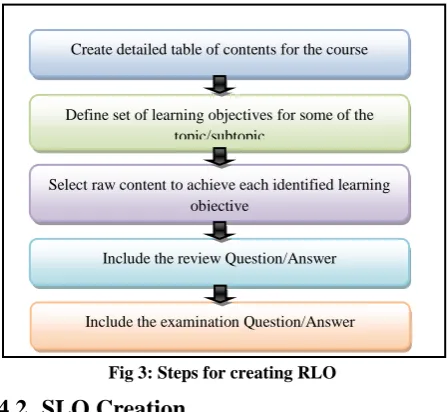
[image:4.595.53.289.605.736.2]The aim of learning objects [35] creation is selecting and extract as much of the existing raw content into RLO. The methodology is an iterative five step process to select appropriate content for the RLO with opportunities to refine and re-structure as the extraction is taking place. The steps are shown in figure 3.
Fig 3: Steps for creating RLO
4.2
SLO Creation
In order to create sharable learning objects(SLO) [40] from RLO, the metadata must be added. The metadata will describe its properties which can be used to determine how should interact with LO. The metadata is also used to facilitate discovery of the SLO when it is stored in digital repository. IMS Learner Information Package Specification corresponding to some IEEE LOM [9] standard has been chosen. The IEEE LOM specification consists of nine categories, which includes 60 data elements. Although the lack of clarity in the IEEE LOM standard makes its value spaces hard to interpret, most metadata editors today continue to use that standard without seeking to explain the meaning of each space [33]. This issue is addressed to enable suitable learning objects management data to be introduced into learning environments by devising a set of definitions to clarify the content of each value space in the LOM.To design
SLO
Creation LOM
LO Refinement
LO Creation
SLO LO
Semantic Annotation
DO
WordNet
LO Relation
Acquiring Semantic
SLO
(LO+ LOM )
Lear ner
Create detailed table of contents for the course
Define set of learning objectives for some of the topic/subtopic
Select raw content to achieve each identified learning objective
Include the review Question/Answer
38 the metadata schema, the IEEE LOM standard has been
followed [9]. A subset of metadata have been identified from the IEEE LOM specification, which are relevant for finding the suitability of a document to a particular e-learner and can automatically be extracted from learning materials [34, 36]. Recent work [9] provides standardization of LO metadata: the LOM framework is already part of the Sharable Content Object Reference Model [37] and all this effort, despite of some criticism, is expected to speed up the creation of learning objects repositories, that is large pools containing retrievable LO and metadata indexes based on the standard [38].
4.3
LO Annotation
In general, annotation [10] is a process of document enrichment with additional information especially in form of notes or comments. This information has to be created or collected, stored and then inserted back in some form into the document to be presented to the user. Semantic Annotation [39] of textual document is to identify the concept with the help of domain ontologies. For this purpose, a robust text analysis technique is required which will be composed of identification of object in a text, identification of relationship betweenthese objects and analysis on how these objects and their relationships combine toform a concept. Hence the objective of Semantic Annotation is to tag ontology class instances foundin the text using text analysis process and map it into ontology classes as depictedin.
[image:5.595.312.537.257.534.2]In [41], authors presented a survey of current semantic annotation platforms that can be used to perform semi-automatic annotation. The presented platforms vary in their architecture, information extraction tools and methods, initial ontology, amount of manual work required to perform annotation, performance and other features, such as storage management.Figure 4 shows the algorithm of the semantic annotation in the proposed system.
Fig 4: The algorithm of the semantic annotation
4.4
LO Refinement
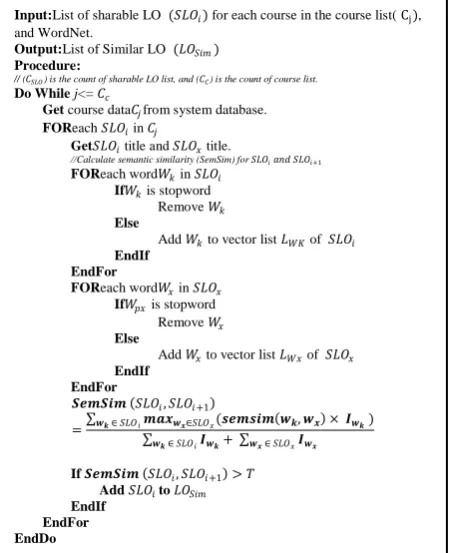
LO refinement aims at determining the redundancy found in the generated LO by analyzing LO titles using semantic similarity. In the proposed system, the LO refinement is performed by extracting the most similar LO from the generatedLO by calculating the semantic similarity for each LO. Semantic similarity [42, 49] used in the proposed system is based on WordNet [43]to refine the generated LO. The used method considers the LO titles as sentence and get the semantic similarity between them to refine generated LO. Figure 5 shows the algorithm of LO refinement.
4.5
LO Relation Acquiring
In WordNet [43], Synsets are interlinked by means of conceptual-semantic and lexical relations. Various semantic relationships such as synonym, antonym, hyperonym, meronym are represented among the synsets. In order to utilize the WordNet for learning taxonomical (hyperonym) relations, one must solve the problem of identifying the word sense, by using word sense disambiguation WSD [44], so that the synonym, hyperonym, hyponym of the word in LO in that sense could be located in the hierarchical synsets.
In the proposed system, this method aims at extracting high quality domain-specific concepts using WordNet. With this concept extraction as the basis, WordNet based method is presented for taxonomy extraction using WordNet [43] and word sense disambiguation [44].
4.6
The Domain Ontology
The main reason for ontology [45] is to enable communication between computer systems in a way that is independent of the individual system technologies, information architectures and application domain. It is used mainly to index the relevant learning objects and to facilitate semantic search and re-usability of learning objects.
It was proposed in [46] a knowledge engineering approach to build domain ontology. Figure 6 shows main steps of the ontology development process.
Input:List of sharable LO (𝑆𝐿𝑂𝑖) for each course in the course list ( Cj), and concepts ( Conk) in the ontology.
Output:List of Annotated LO (𝐿𝑂𝐴𝑛𝑛𝑜𝑡) Procedure:
// (𝐶𝑆𝐿𝑂) is the count of sharable LO list, and (𝐶𝐶) is the count of course list.
Do While j<= 𝐶𝑐
Get course data𝐶𝑗from system database.
FOReach 𝑆𝐿𝑂𝑖 in 𝐶𝑗
Get 𝑆𝐿𝑂𝑖 title and description.
Load Domain ontology concepts Conk If 𝑊in 𝑆𝐿𝑂𝑖 title and description mapped to Conk
Annotate Conk to 𝑊
Save the annotated LOLOAnnot in System database. EndIf
EndFor EndDo
Fig5:The algorithm of LO refinement
𝑺𝒆𝒎𝑺𝒊𝒎 𝑆𝐿𝑂𝑖, 𝑆𝐿𝑂𝑖+1
= 𝒘𝒌 ∈ 𝑆𝐿𝑂𝑖𝒎𝒂𝒙𝒘𝒙∈𝑆𝐿𝑂𝑥(𝒔𝒆𝒎𝒔𝒊𝒎 𝒘𝒌, 𝒘𝒙 × 𝑰𝒘𝒌 )
𝑰𝒘𝒌
𝒘𝒌 ∈ 𝑆𝐿𝑂𝑖 + 𝒘𝒙 ∈ 𝑆𝐿𝑂𝑥𝑰𝒘𝒙
Input:List of sharable LO (𝑆𝐿𝑂𝑖) for each course in the course list( Cj), and WordNet.
Output:List of Similar LO (𝐿𝑂𝑆𝑖𝑚) Procedure:
// (𝐶𝑆𝐿𝑂) is the count of sharable LO list, and (𝐶𝐶) is the count of course list.
Do While j<= 𝐶𝑐
Get course data𝐶𝑗from system database.
FOReach 𝑆𝐿𝑂𝑖 in 𝐶𝑗
Get𝑆𝐿𝑂𝑖 title and 𝑆𝐿𝑂𝑥 title.
//Calculate semantic similarity (SemSim) for 𝑆𝐿𝑂𝑖 𝑎𝑛𝑑 𝑆𝐿𝑂𝑖+1
FOReach word𝑊𝑘 in 𝑆𝐿𝑂𝑖 If𝑊𝑘 is stopword
Remove 𝑊𝑘 Else
Add 𝑊𝑘 to vector list 𝐿𝑊𝐾 of 𝑆𝐿𝑂𝑖 EndIf
EndFor
FOReach word𝑊𝑥 in 𝑆𝐿𝑂𝑥 If𝑊𝑝𝑥 is stopword Remove 𝑊𝑥 Else
Add 𝑊𝑥 to vector list 𝐿𝑊𝑥 of 𝑆𝐿𝑂𝑥 EndIf
EndFor
If 𝑺𝒆𝒎𝑺𝒊𝒎 𝑆𝐿𝑂𝑖, 𝑆𝐿𝑂𝑖+1 > 𝑇
Add 𝑆𝐿𝑂𝑖 to 𝐿𝑂𝑆𝑖𝑚 EndIf
EndFor EndDo
Ontology Acquisition Identify purpose and requirement specification
Enumerate important concepts and items
Define Concepts, slots and the relations of concepts
Ontology Implementation
Formal Ontology Evaluate / Check
Existing ontology
[image:5.595.57.290.463.601.2]39
4.7
System Database
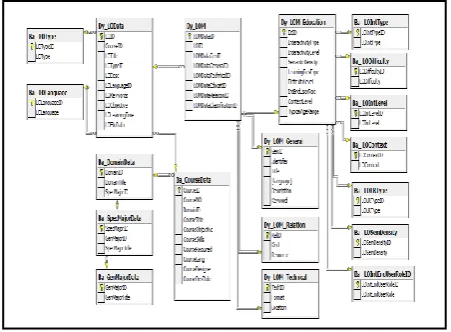
[image:6.595.54.280.131.297.2]The system database contains the required data such as courses and sharable learning objects. Figure 7 shows the database diagram that is implemented in SQL Server 2008.
Fig 7: The system database diagram
5.
SYSTEM EVALUATION
In this section, the results of the experiments carried out to evaluate the performance of proposed system is discussed from a quantitative point of view by running some experiments to evaluate the precision of the results.
The proposed system is implemented in ASP.Net as Web-based system using Visual Studio 2010, .NET Framework 4, and SQL Server 2008. The number of stored courses is 3courses that have276 LOs. These courses are about computer science domain. Figure 8 shows the samples of the system screens.
[image:6.595.314.541.550.676.2]Figure 9 shows the ontology editor of the selected domain.
Figure 10 shows the LO annotation.
In order to evaluate the efficiency of the proposed method, the computer science domain ontologyhas been constructed by ontology editor that is created in the system. Based on semantic web, a prototype system has been designed and implemented. In this research, recall ratioPrecalland precision ratioP𝒑𝒓𝒆𝒄𝒊𝒔𝒊𝒐𝒏are applied to evaluate efficiency and accuracy of retrieving results.Precallrefers to proportion of retrieved
related LO (LORR) out of all related LO (LOAllRel) in the
system. Pprecision is defined as proportion of retrieved related
LO (LORR) relative to all retrieved LO (𝑳𝑶𝑨𝒍𝒍𝑹𝒆𝒕).
Precall = 𝑳𝑶𝑹𝑹
𝑳𝑶𝑨𝒍𝒍𝑹𝒆𝒍
P𝒑𝒓𝒆𝒄𝒊𝒔𝒊𝒐𝒏= 𝑳𝑶𝑳𝑶𝑹𝑹
𝑨𝒍𝒍𝑹𝒆𝒕
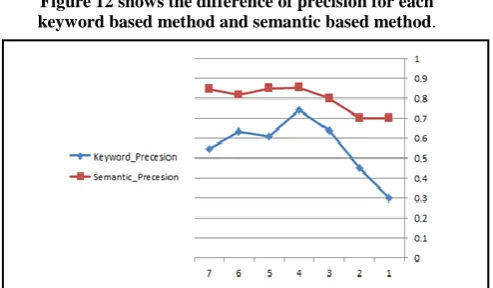
In order to analyze the efficiency, the comparison among the syntax based LO creating, semantic based LO creating is accomplished. Table 6 shows the experiment that appears the efficiency of the semantic based method for creating the learning objectsrepository in learning system.
Table 3 shows the samples of the experiment data and the calculated Precall and P𝒑𝒓𝒆𝒄𝒊𝒔𝒊𝒐𝒏 for keyword based method
and table 4 shows the data for semantic based method.
Table 3: The data of keyword based method
𝑳𝑶𝑨𝒍𝒍𝑹𝒆𝒕 𝑳𝑶𝑨𝒍𝒍𝑹𝒆𝒍 𝑳𝑶𝑹𝑹 𝑷𝒓𝒆𝒄𝒂𝒍𝒍 𝑷𝒑𝒓𝒆𝒄𝒊𝒔𝒊𝒐𝒏
10 9 3 0.3333333 0.3
20 18 9 0.5 0.45
50 47 32 0.6808511 0.64
70 67 52 0.7761194 0.74286
100 88 61 0.6931818 0.61
120 105 76 0.7238095 0.63333
150 140 82 0.5857143 0.54667
Table 4: The data of semantic based method
𝑳𝑶𝑨𝒍𝒍𝑹𝒆𝒕 𝑳𝑶𝑨𝒍𝒍𝑹𝒆𝒍 𝑳𝑶𝑹𝑹 𝑷𝒓𝒆𝒄𝒂𝒍𝒍 𝑷𝒑𝒓𝒆𝒄𝒊𝒔𝒊𝒐𝒏
10 9 7 0.778 0.7
20 18 14 0.778 0.7
Fig8:Samples of the system screens
Fig10:LO annotation
[image:6.595.50.293.635.773.2]50 47 40 0.851 0.8
70 67 60 0.896 0.857143
100 88 85 0.966 0.85
120 105 98 0.933 0.816667
[image:7.595.48.295.343.487.2]150 140 127 0.907 0.846667
Figure 11 shows the difference of recall for each keyword based methodand semantic based method.
Figure 12 shows the difference of precision for each keyword based method and semantic based method.
6.
CONCLUSION
In this paper,the functioning prototype is presented for semantic and shareable basedrepository of learning objects. Such proposed system allows the retrieval of, not only a perfect LO match, but also of related LO.
To support the proposed approach, we described why current metadata schemes do not cope with current usage of educational material in general, and of learning objects in particular. We described our basis to deploy the repository, which is linked to a coupled system integrating an IS and a LMS.
The proposed approach enables e-learning systems to easily reuse and share semantic learning objectspublished by various systems. It can easy process learning object and can infer a learner should study and what learning objects a system should look.The system can retrieve all the LO, which are relevant while retrieving as few non-relevant LO as possible.
7.
REFERENCES
[1] Alian, M. &AL-Akhras, M. (2010). AdaLearn: An Adaptive E-Learning Environment. ISWSA’10, June 14– 16, 978-1-4503-0475, ACM.
[2] Zschocke, T. & Villagrán de León, J. (2010). Towards an Ontology for the Description of Learning Resources on Disaster Risk Reduction. WSKS 2010, Part I, CCIS 111, pp. 60–74, Springer-Verlag Berlin Heidelberg.
[3] Ghaleb, F., Daoud, S., Hasna, A., Jaam, J., El-Seoud, S., El-Sofany, H. & Alja 'am, J. (2006). E-Learning Model Based On Semantic Web Technology, International Journal of Computing &Information Sciences Vol. 4, No. 2, August 2006, On-Line. Pages 63 – 71.
[4] Liu, J., Huang, B. &Chao, M. (2005). The Design of Learning Object Authoring Tool Based on SCORM. Proceedings of the Fifth IEEE International Conference on Advanced Learning Technologies (ICALT’05). 0-7695-2338-2/05, IEEE.
[5] Wiley, D. A. (2000). Connecting learning objects to instructional design theory: A definition, a metaphor, and a taxonomy. In D. A. Wiley (Ed.), The instructional use of learning objects. Retrieved 2 - 17 - 2005 from: http://reusability.org/read/chapters/wiley.doc.
[6] Lerma, C. (2007). Creating Learning Objects. Proceedings of the 2007 Informing Science and IT Education Joint Conference.
[7] Roy, D. (2006). Automatic Annotation of Learning Materials for E-learning. Ph.D Thesis, Department of Computer Science and Engineering Indian Institute of Technology, Kharagpur.
[8] Vidal, C., Navarrete, A., Menéndez D, V., Gonzalez, A. &Prieto, M. (2010). Metadata and Ontologies in Learning Resources Design. M.D. Lytras et al. (Eds.): WSKS 2010, Part I, CCIS 111, pp. 105–114, Springer-Verlag Berlin Heidelberg.
[9] Draft Standard for Learning Object Metadata. IEEE P1484.12.1, IEEE Learning Technology Standards Committee(2002),
http://ltsc.ieee.org/wg12/files/LOM_1484_12_1_v1_Fina l_Draft.pdf.
[10]Mihal, V. & Bielikova, M.. (2009). AnApproach to Annotation of Learning Texts on Programming within a Web-Based Educational System. 2009 Fourth International Workshop on Semantic Media Adaptation and Personalization. 978-0-7695-3894-5/09, IEEE.
[11]Reeve, L. &Han. H. (2006). A Comparison of Semantic Annotation Systems for Text-Based Web Documents. In the publication, Web Semantics Ontology edited by David Taniar and Johanna Wenny Rahayu, Idea Group Inc.
[12]Tang, J., Zhang, D., Yao, L. & Li, Y. (2009), Automatic Semantic Annotation Using Machine Learning. In: The Semantic Web for Knowledge and Data Management. DOI: 10.4018/978-1-60566-028-8.ch006. IGI Global.
[13]Yen, Neil, Shih, T. &Jin, Q. (2010). A New Paradigm of Ranking & Searching in Learning Object Repository. MTDL’10, October 29, 2010, ACM 978-1-4503-0158-9/10/10.
[14]Ding, G. & Xu, Na. (2010). Automatic semantic annotation of images based on Web data. 2010 Sixth International Conference on Information Assurance and Security. 978-1-4244-7409-7/10, IEEE.
Fig11:Recall difference between keyword and semantic
41 [15]Jellouli, I. & El Mohajir, M. (2009). Towards automatic
semantic annotation of data rich Web pages. 9781-4244-2865-6/09, IEEE.
[16]Saini, P., Ronchetti, M. &Sona. D. (2006). Automatic Generation of Metadata for Learning Objects. Proceedings of the Sixth International Conference on Advanced Learning Technologies (ICALT'06). 0-7695-2632-2/06, IEEE.
[17]Eric, C., Gagnon, M. & Ozell, B. (2011). Automatic Semantic Web Annotation of Named Entities. C. Butz and P. Lingras (Eds.): Canadian AI 2011, LNAI 6657, pp. 74–85, 2011. Springer-Verlag Berlin Heidelberg.
[18]Mendenhall, A., Kim, C. & E. Johnson, T. (2011). Implementation of an Online Social Annotation Tool in a College English Course. D. Ifenthaler et al. (eds.), Multiple Perspectives on Problem Solving and Learning in the Digital Age, DOI 10.1007/978-1-4419-7612-3_20, Springer Science+Business Media.
[19]Sun, S., Frank, Y., Hung, Y, Chang, C., Chen, K., Shih-Sian, C., Wang, H. & Liao, H. (2011). Automatic Annotation Of Web Videos. 978-1-61284-350-6/11, IEEE.
[20]Kremen,P., Blaško, M. &Kouba, Z. (2009). Semantic Annotation of Objects, In: Handbook of Research on Social Dimensions of Semantic Technologies and Web Services. DOI: 10.4018/978-1-60566-650-1.ch011. IGI Global.
[21]Dicheva, D. (2008), Ontologies and Semantic Web for E-Learning.In: "Handbook on Information Technologies for Education and Training, International Handbooks on Information Systems, pp 47-65, Springer Berlin Heidelberg.
[22]Różewski, P., Kusztina, E., Tadeusiewicz, R. & Zaikin, O. (2011). Learning Object Methodology. In: Intelligent Open Learning Systems Concepts, Models and Algorithms. Springer-Verlag Berlin Heidelberg.
[23]Gasevic, D., Jovanovic J., and Devedzic V. (2007). Ontology-Based Annotation of Learning Object Content. Interactive Learning Environments Vol. 15, No. 1, April 2007, pp. 1 – 26. Taylor & Francis.
[24]Zhang, T. &Shen, R. (2009). Learning Objects Automatic Semantic Annotation by Learner Relevance Feedback. Biomedical Engineering and Informatics, 2009. BMEI '09. 2nd.978-1-4244-4134-1/09, IEEE.
[25]Dingli,A. (2011). Introducing Annotation. In: Knowledge Annotation: Making Implicit Knowledge Explicit, ISRL 16, pp. 3–17. Springer-Verlag Berlin Heidelberg.
[26]Kiryakov, A.,Popov, B., Terziev, I., Manov, D.&Ognyan, D. (2004). Semantic annotation, indexing, and retrieval. Web Semantics: Science, Services and Agents on the World Wide WebVolume 2, Issue 1, 1 December 2004, Pages 49–79. Elseiever.
[27]Devedžic, V. (2006).Semantic Web And Education, ISBN: 0-387-35417-4, Springer Science+Business Media, LLC.
[28]Shafrir, U. & Etkind, M. (2006).E-Learning for depth in the Semantic Web, British Journal of Educational Technology, Vol 37 No 3 2006 425–444, Published by
Blackwell Publishing, 9600 Garsington Road, Oxford OX4 2DQ, UK and 350 Main Street, Malden, MA 02148, USA.
[29]Karin, B., Antonio, M.&Walt, T. (2007), Semantic Web: Concepts, Technologies and Applications, e-ISBN: 978-1-84628-710-7, Springer-Verlag London Limited.
[30]Liu, J., Huang, B. &Chao, M. (2005). The Design of Learning Object Authoring Tool Based on SCORM. Proceedings of the Fifth IEEE International Conference on Advanced Learning Technologies (ICALT’05). 0-7695-2338-2/05, IEEE.
[31]McGreal, R. (2009). Learning Objects and Metadata Understanding the field. International Workshop on Technology for Education (T4E), Aug 4-6, 2009, Bangalore. 978-1-4244-5505-8/09, IEEE.
[32]Singh, G., Bernard, M. & Gardler, R. (2004). Creating sharable learning objects From Existing Digital Course Content. WCAE '04 Proceedings of the 2004 workshop on Computer architecture education.ACM.
[33]Morgado, E., Peñalvo, F., Ruiz, Á., Rego, H. & Moreira, T. (2008). Learning Objects for eLearning Systems. WSKS 2008, CCIS 19, pp. 153–162. Springer-Verlag Berlin Heidelberg.
[34]Mohan, P., Brooks, C. (2003). Learning Objects on the Semantic Web. The 3rd IEEE International Conference on Advanced Learning Technologies (ICALT’03). 0-7695-1967-9/03,IEEE.
[35]Abad, C. (2008). Learning Through Creating Learning Objects Experiences with a Class Project in a Distributed Systems Course, ITiCSE’08, June 30–July 2, 2008, Madrid, Spain, Copyright 2008 ACM 978-1-60558-115-6/08/06.
[36]Mavrommatis,G. (2008). Learning objects and objectives towards automatic learning construction, European Journal of Operational Research 187 (2008) 1449–1458, doi:10.1016/j.ejor.2006.09.024, Elsevier B.V.
[37]Sharable Content Object Reference Model, http://www.adlnet.gov/Technologies/scorm/default.aspx.
[38]Neven, F. & Duval, E. (2002), Reusable Learning Objects: a Survey of LOM-Based Repositories, Multimedia’02, December 1-6, 2002, Juan-les-Pins, France, ACM 1-58113-620-X/02/0012.
[39]Kiryakov, A., Popov, B., Terziev, I., Manov, D. & Ognyanoff, D. (2005).Semantic annotation, indexing, and retrieval. Elsevier's Journal of Web Semantics.
[40]Fouad, K., Nagdy, N. & Harb, H. (2013). Adaptive E-Learning System Based on Semantic Search and Recommendation in the Arab World. In: Albadri, F. Information Systems Applications in the Arab Education Sector. DOI: 10.4018/978-1-4666-1984-5.ch018. IGI Global.
[41]Reeve, L. & Han, H. (2005). Survey of Semantic Annotation Platforms. SAC’05, March 13-17, 2005, Santa Fe, New Mexico, USA. ACM 1-58113-964-0/05/0003.
System Modeling (ICCASM 2010). 978-1 -4244-7237-6/10, IEEE.
[43]Fellbaum, C. (2010). WordNet. Theory and Applications of Ontology: Computer Applications, 231, PP: 231-243, Springer Science+Business Media B.V.
[44]Lee, W. & Mit, E. (2011). Word Sense Disambiguation By Using Domain Knowledge. International Conference on Semantic Technology and Information Retrieval. 978-1-61284-353-7/11, IEEE.
[45]U. Siti, A. Rohiza, M. Shakirah. (2010). Ontology of Programming Resources for Semantic Searching of Programming Related Materials on the Web. 978-1-4244-6716-7110, IEEE.
[46]H. YUN, J. XU, M. J. XIONG. (2009). Development of Domain Ontology for E-learning Course, 978-1-4244-3930-0/09, IEEE.
[47]Stavredes, T. (2005). Shareable Learning Objects. In: Encyclopedia of Distance Learning. DOI: 10.4018/978-1-59140-555-9.ch244. IGI Global.
[48]The Jorum Team. 2005. Report on Open Source Learning Object Repository Systems. Signed-Off by JISC.
http://www.jorum.ac.uk/squeezy/cms/docs/pdf/JORUM_ osswatch_final.pdf.
![Table 1: Goals of Learning Objects [6]](https://thumb-us.123doks.com/thumbv2/123dok_us/8075706.780909/3.595.80.242.169.260/table-goals-of-learning-objects.webp)