Enhanced Bandwidth Utilization in Image
Steganography with Enhanced Data Security
Balkrishan
Department of CE, Yadavindra College of Engineering, Punjabi University, Guru Kashi
Campus, Talwandi Sabo-151302 District: Bathinda Punjab, India
Amar Partap Singh
Department of ECE, Sant Longowal Institute of Engineering and Technology,Longowal-148106
District: Sangrur, Punjab, India
ABSTRACT
In this paper, a new method is proposed for image steganography that involves double encryption as well as compression of a message followed by its subsequent hiding in a digital image. In the first instance, original data is encrypted using flexible matrix. Further, encrypted data is encrypted and compressed using Chinese Remainder Theorem (CRT) for extra layer of security and increased the data hiding capacity. The proposed method enhances bandwidth utilization besides ensuring three layered security to the message. The underlying principle of this method involves decomposition of each image-pixel into two blocks. One block is called Parity Reflecting Block (PRB) whereas other is known as Pixel Adjustment Block (PAB). The information about hidden bit is reflected by parity condition in the Parity Reflecting Block. The Pixel Adjustment Block is used to perform local pixel adjustment in order to reduce the degradation effect in the cover image produced as a result of alteration in the moderate bit. The performance of the proposed algorithm is evaluated in terms of Image Quality Measures (IQM) including Mean Square Error (MSE), Peak-Signal-to-Noise Ratio (PSNR), Entropy, Correlation, Mean Value and Standard Deviation. Security analysis is also carried by comparing the histograms of the cover and stego-images. The results of this study are quite promising.
General Terms
Information Security
Keywords
Data Hiding, Chinese Remainder Theorem, Crypto-Compressed-Data, Flexible Matrix, Parity
1.
INTRODUCTION
Data encryption [1-4] & compression [2-4] are pivotal for proper storage and transmission of data. The rapid growth in the internet coupled with high bandwidth requirement has propelled the explosive growth of information communication. This type of advancement in the field of data communication has hiked the fear of getting the data snooped at the time of sending it from sender to the receiver. So, information security has already become an important part of data communication. In order to address this issue of information security, data-encryption as well as its hiding [5-16] plays an important role. Data hiding conceals the existence of secret message while cryptography protects its contents.The word steganography is derived from the Greek words- stegos meaning roof or cover and graphia meaning writing, i.e., it is an art of hiding information in such a way that communication takes place without any failure [5-7]. The objective of modern steganography is to keep the payload (embedded information) undetected, but the steganographic
systems, because of their invasive nature, may leave behind somewhat traces in the cover image [8]. Steganography techniques use different carriers (cover medium in digital format) to hide data. These carriers may be network packets, floppy disk, hard drive, amateur radio waves [9] or general computer files such as text, image, audio, video, etc. [5, 9-12]. Data hiding capacity & invisibility are the two important parameters used to evaluate the effectiveness of the data hiding technique [14]. In [5] crypto data was embedded into the moderate significant bit of pixel of the cover image by parity condition of bits. The weakness of this method is that author used only lower bits for pixel adjustment and not used the upper bits for re-adjustment of the pixels of the stego image.
The simultaneous data encryption and compression technique is an attempt to provide a solution for optimal bandwidth utilization, space required for data storage and the encryption problems at the same time [2]. Number theory based data encryption and compression is an algorithm that employs Chinese Remainder Theorem (CRT) in order to generate and solve congruencies. However, several methods are available for data or image compression including JPEG-LS, SPIHT, JPEG2000, CALIC, etc. These are standards that use some kind of transform including Discrete Fourier Transformation (DFT), Discrete Cosine Transformation (DCT) & Discrete Wavelet Transformation (DWT) [3]. There are two main drawbacks of traditional transformation based compression methods: (a) In transform techniques, data is transformed from one domain to another, (b) Moreover, these techniques do not encrypt and compress image and/or data in single step [4]. However, such problems of traditional methods of compression are addressed in the proposed approach in which only basic mathematical operations are employed instead of transformation of the data. It also ensures encryption and compression of data in a single step.
Fig.1 Proposed Method for Data Encryption and Compression Crypto- compress-ed data CRT
1-D array Flexible
matrix
Column array Original
Message
Encrypted Data
Data
Row array
cover image by compressing the secret data. At the end, crypto-compressed-data is embedded into the pixel of cover image using moderate-bit substitution thus providing third layer of security in the form of camouflage. Moderate bit substitution is achieved in such a way that no appreciable distortion is observed in the cover image. To improve the image quality further, a pixel adjustment process is also applied at each pixel of the cover image where alteration has occurred due to moderate significant bit substitution. This is done by slight adjustment of other bits in the image pixel without any damage to the secret data. To evaluate the visual quality of stego-image, Image Quality Measures (IQM) are evaluated including Mean Square Error (MSE), Peak-Signal-to-Noise Ratio (PSNR), Entropy, Correlation, Mean Value and Standard Deviation [17]. The proposed method is applied on different standard test-images of size 256×256 serving the purpose of good cover. Extensive experimental results proved that the hidden data remains invisible and there is no appreciable visual distortion in the image at all.
2.
CHINESE REMAINDER THEOREM
The Chinese Remainder Theorem (CRT) is a good application of number theory to other fields. It is based on the algorithm of linear and modular congruencies. Congruence is nothing more than a statement about divisibility [4]. The Chinese Remainder Theorem is mainly based on the system of linear congruencies
which can be reduced to a set of
, where are prime factors of n.
(a) Theorem
Let denote k positive integers which are relatively
prime numbers, and let
denote any k integers. Then the congruencies , where i = 1, 2,…., k have common solutions. Any two solutions are congruent Modulo
.
The remainder of the solved congruencies X is transmitted. At the receiving end, are found using
and the original data is reconstructed by row number and column number of flexible matrix.
(b) Numerical Example of data encryption and compression using CRT
Encryption:
Decryption:
3.
PROPOSED METHOD
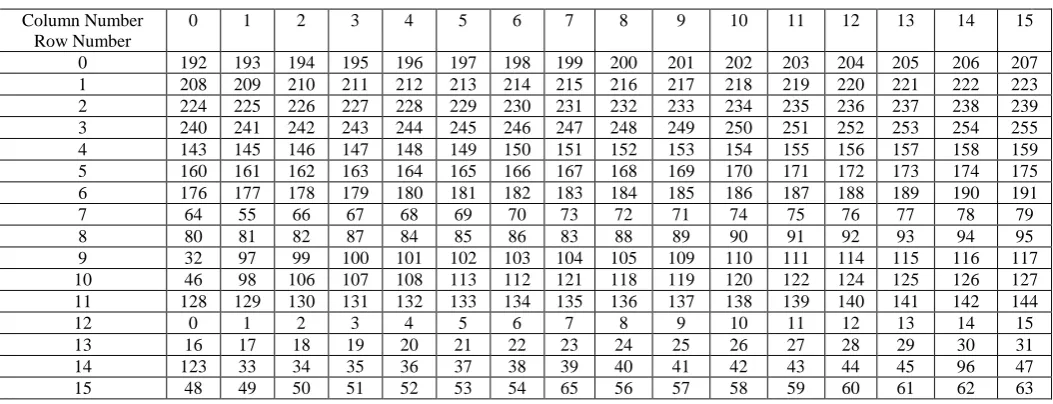
The secret data is first encrypted using flexible matrix proposed by the authors of the present paper in their earlier work [15]. This matrix is reproduced in Table-1 with new entries for the sake of illustration [15]. The enciphered data is further re-encrypted & then compressed using CRT. The complete process is illustrated in Fig.1. The number theory based technique is applicable for encryption application by suitable selection of relatively prime numbers (ni). Data compression depends on the block size used in CRT.
Relative prime numbers are chosen in such a way that these are larger than any value in one dimensional (1-D) array. During decoding, the same combination of ni, that are selected for encoding should be applied correctly. To achieve safe transfer of data and obtain better results of embedding, moderate-bit substitution method is proposed in the present work for hiding crypto-compressed-data in a digital image. In this paper, for compression purpose, the block size (1×K) with K = 4 is taken. Depending on the amount of compression requirement, a large block size can also be considered.
3.1 Data Encryption and Compression
using CRT
Consider a data of n characters and assign the row number and column number of n characters using flexible matrix [15]. The Row number and column number are combined to form 1- D array. Pad the 1-D array with zeros to make a block size of 10 or 8 or 4. Now, 1-D array is solved using the Chinese Remainder Theorem for block of 4. In equation (2) Ni and xi are pre-calculated as coefficients and these values need not be calculated for every X. All ai (i = 1, …, m, where m is the elements in 1-D array) are the 1-D array values after encryption using flexible matrix. The reason for using Chinese Remainder Theorem for solving the linear congruencies is to reduce a bigger number to a smaller representation. For data of size 1×3000 bytes and block size 4, all 1500 or less X are computed. After computing all X, the frequency of each distinct X and their counts are determined. All X are sorted in descending order of their count. A table of unique X and an equivalent smaller code is generated. Using this table, each X obtained is encoded into this smaller code. Data compression ratio was 1.35 for 3000 bytes. For the sake of clarification, the complete process is illustrated here.
3.2 Data Decryption and Decompression
3.3 Illustration
Original message to be embedded
Image steganography Data byte/ASCII value of
character
105 109 97 103 101 32 115 116 101 103 97 110 111 103 114 97 112 104 121
Encrypt the message using flexible matrix
Column array = 9 9 9 9 9 9 9 9 9 9 9 9 9 9 9 9 10 9 10
Row array = 8 9 1 6 4 0 13 14 4 6 1 10 11 6 12 1 6 7 7
Combine the column and row array to get a 1-D array and pad with zeros such that total values in 1-D arrays divided by 4
1-D array = 9 9 9 9 9 9 9 9 9 9 9 9 9 9 9 9 10 9 10 8 9 1 6 4 0 13 14 4 6 1 10 11 6 12 1 6 7 7 0 0
Further encrypt and
compress crypto data using
Chinese Remainder
Theorem
Calculate the values of X and assign the smaller code to each X
Data embedding into cover image to obtain stego-image
Data embedding at Moderate Significant Bit position
3.4 Crypto-compressed-data hiding
To understand the process of crypto-compressed-data hiding, it is assumed that a cover image is composed of pixels with odd or even number of one’s. In the pixel of cover image, bit is altered at moderate position depending upon the parity condition of the bits counted from moderate position to the most significant bit (MSB). All the lower bits from moderate position to Least Significant Bit (LSB) are used for local pixel adjustment. The procedure used for moderate bit alteration followed by local pixel adjustment is narrated below:
I. If the PRB is of odd parity and message bit is 1, then there is no change in both the pixel blocks of the image pixel. The odd parity condition in the PRB reflects that the stored bit is 1 [16]. II. If the PRB is of odd parity and the message bit is
0, then complement the 4th moderate significant bit. Convert all the lower bits to 1 if moderate bit is changed to 0 or vice-versa otherwise [16]. III. If the PRB is of even parity and the message bit is
also 0, then there is no change in both the pixel blocks of the image pixel. The even parity condition of the PRB reflects that image pixel stores 0 as the message bit [16].
IV. If the PRB is of even parity and the secret message bit is 1, then complement the 4th moderate significant bit. Convert all the lower bits to 1 if moderate bit is changed to 0 or vice-versa otherwise [16].
3.5 Pixel Adjustment Process
Following are the two steps used in pixel adjustment process. Pixel Adjustment [16]
If crypto-bit to be embedded is equal to the 4th LSB, then there is no need for doing any pixel adjustment. However, if crypto-bit to be embedded is not equal to 4th LSB, pixel adjustment is performed by using first three LSBs. The underlying logic for the same is detailed below:
(a) If crypto-bit to be embedded is one, then pixel is adjusted by changing first three LSBs to zero.
(b) If crypto-bit to be embedded is zero, then pixel is adjusted by changing first three LSBs to one.
Post pixel adjustment
In this step, post pixel adjustment is applied further improve the visual quality of stego image obtained after pixel adjustment. This process involves only two bits, i.e., 5th and 6th bits. Let P, P’ and P” are the values of ith pixel in the cover-image, modified pixel of stego-image after pixel adjustment and modified pixel of stego image after post pixel adjustment, respectively. Calculate the error (D1) between modified pixel of stego-image after pixel adjustment and original pixel of cover image, i.e., D1 = abs (P-P’). If D1 > 4, then post pixel adjustment is required otherwise there is no need of doing post pixel adjustment. The value of D1 > 4 is chosen in such a way that it gives better visual quality as compared to its other values including D = 1, 2, 3, 5, 6, 7 or 8. The underlying logic for the same is detailed below:
(a) If after the process of embedding, 4th & 5th LSBs are unequal and 4th & 6th LSBs are equal, then post pixel adjustment is performed by complementing 1st, 2nd , 3rd, 5th and 6th bits of p’.
4.
PROPOSED ALGORITHM FOR
HIDING CRYPTO COMPRESSED DATA
4.1 Message Ciphering & Embedding
Step-1: Save secret message as a text file.
Step-2: Commencing with first character, read secret message character-wise from saved text file.
Step-3: Encrypt each character into row and column numbers using flexible matrix.
Step-4: Repeat Step-3 for all characters in the saved text file to obtain a row and column numbers.
Step-5: Combine all the row and column numbers into 1-D array.
Step-6: Pad the 1-D array with zeros such that total values in array must be divided by 4 for a block size of 4.
Step-7: Further encrypt and compress the ciphered data by
applying the CRT using block of 4 values of 1-D array to calculate the value of X.
Step-8: Repeat step 7 for all values in 1-D array to obtain the values of X.
Step-9: After computing all X, the frequency of each distinct X and their counts are determined. All X are sorted in descending order of their count. A table of unique X and an equivalent smaller code is generated. Using this table, each X obtained is encoded into this smaller code.
Step-10: All value of X and smaller codes are converted into equivalent binary number (all X and smaller codes have equal number of bits by padding with zeros from left side) and make a binary string.
Step-11: Read each pixel of the cover image commencing with first pixel.
[image:4.595.106.526.73.315.2]Step-12: Convert each pixel into equivalent eight-bit binary number called image byte.
Table 1. Proposed 16×16 Matrix for Enciphering Data [15]
Column Number Row Number
0 1 2 3 4 5 6 7 8 9 10 11 12 13 14 15
0 192 193 194 195 196 197 198 199 200 201 202 203 204 205 206 207 1 208 209 210 211 212 213 214 215 216 217 218 219 220 221 222 223 2 224 225 226 227 228 229 230 231 232 233 234 235 236 237 238 239 3 240 241 242 243 244 245 246 247 248 249 250 251 252 253 254 255 4 143 145 146 147 148 149 150 151 152 153 154 155 156 157 158 159 5 160 161 162 163 164 165 166 167 168 169 170 171 172 173 174 175 6 176 177 178 179 180 181 182 183 184 185 186 187 188 189 190 191
7 64 55 66 67 68 69 70 73 72 71 74 75 76 77 78 79
8 80 81 82 87 84 85 86 83 88 89 90 91 92 93 94 95
9 32 97 99 100 101 102 103 104 105 109 110 111 114 115 116 117 10 46 98 106 107 108 113 112 121 118 119 120 122 124 125 126 127 11 128 129 130 131 132 133 134 135 136 137 138 139 140 141 142 144
12 0 1 2 3 4 5 6 7 8 9 10 11 12 13 14 15
13 16 17 18 19 20 21 22 23 24 25 26 27 28 29 30 31
14 123 33 34 35 36 37 38 39 40 41 42 43 44 45 96 47
[image:4.595.49.576.570.772.2]15 48 49 50 51 52 53 54 65 56 57 58 59 60 61 62 63
Fig 2: Moderate-Bit Altered Image Steganography
Cover Image
Stego-image
Post pixel Adjustment at 5th & 6th bits of pixel of the Stego Image
Moderate Bit Alteration
Combine Pixel-Adjusted and Moderate-bit Altered Blocks Local pixel
Adjustment
Pixel Adjusted Blocks Moderate-Bit Altered Blocks
Crypto Compressed Data Hiding
Step-13: Convert image byte into two blocks-Pixel Adjustment Block and Parity Reflecting Block.
Step-14: Determine the parity of the Parity Reflecting Block (PRB) & read first crypto-compressed-bit.
a) If the PRB is of odd parity and message bit is 1, then there is no change in both the pixel blocks of the image pixel. The odd parity condition in the PRB reflects that the stored bit is 1.
b) If the PRB is of odd parity and the message bit is 0, then complement the 4th moderate significant bit. Convert all the lower bits to 1 if moderate bit is changed to 0 or vice-versa otherwise.
c) If the PRB is of even parity and the message bit is also 0, then there is no change in both the pixel blocks of the image pixel. The even parity condition of the PRB reflects that image pixel stores 0 as the message bit.
d) If the PRB is of even parity and the secret message bit is 1, then complement the 4th moderate significant bit. Convert all the lower bits to 1 if moderate bit is changed to 0 or vice-versa otherwise.
Step-15: Go to next image byte and next compressed-bit and repeat the Steps-12 to 14 until all the crypto-compressed bits of the secret message are embedded into the PRBs of the cover image.
4.2 Message Extraction & Decryption
Step-1: Read the pixel of stego-image starting from first pixel.
Step-2: Convert each pixel value into equivalent binary number called image byte.
Step-3: Extract first crypto-compressed-bit by determining the parity condition of the Parity Reflecting Block. If it is odd parity then embedded crypto-bit is 1 otherwise it is 0.
Step-4: Repeat steps 2 to 3 until all the crypto-compressed-bits of the secret message are extracted.
Step-5: Divide the crypto-compressed-bits for values of X and smaller codes.
Step-6: Smaller codes are also replaced with X values.
Step-7: Apply the equation (4) and Ai of each X using the equation.
Step-8: Repeat step 7 for all values of X.
Step-9: Combine all Ai to form a single 1-D array. Divide the 1-D array into two equal sized arrays (Row & Column). The original pixel values are then reconstructed using the flexible matrix.
Step-10: Save all characters in the form of text file.
5.
RESULTS AND DISCUSSION
In this section, simulation results of the proposed algorithm are presented by embedding 3000 bytes of crypto-compressed data at moderate significant bit positions of the pixels in the cover image. For experiments, four standard gray scale test images with 256×256 pixel size are employed as cover images (Lena, Mandrill, Pepper and Cameraman). MATLAB software is used to implement the algorithm and validate the results. Original cover images are shown in Fig. 3(a) along
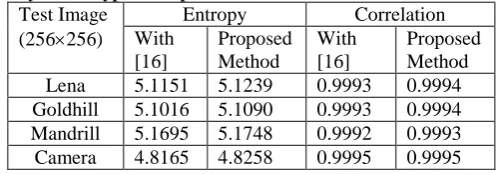
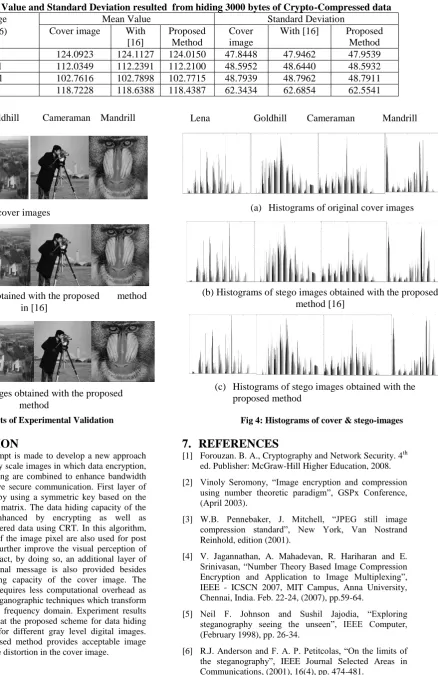
with their corresponding stego-images are shown in Fig. 3 (b) & (c) that are generated as a result of proposed algorithm. The proposed technique embeds crypto-compressed-data into moderate-significant-bit positions in the image-pixels without causing any appreciable distortion in the cover image. Visual quality of a stego image is an important parameter in evaluating the performance of the proposed algorithm. It is expressed in terms of Image Quality Measure (IQM) parameters including Mean Square Error (MSE), Peak-Signal-to-Noise Ratio (PSNR), Entropy, Correlation, Mean Value and Standard Deviation. The performance of the proposed algorithm is summarized in terms of IQM parameters. These results are tabulated in Table-2, Table-3 and Table-4. The results in these tables indicate that PSNR, Entropy, correlation, Mean value and Standard Deviation are decreasing whereas the MSE is increasing as the hidden message bit moves from LSB towards moderate significant bit position. The performance of the proposed method is better than [16] in terms of IQM parameters shown in Tables 2, 3 and 4.
[image:5.595.297.549.503.601.2]The histograms of cover and stego-images give clear idea of the security of the transmitted data, i.e., if change in the cover is minimal, then stego system is considered secure. In this context, the effectiveness of the proposed algorithm is also determined in terms of having a comparison of the histograms of cover and stego images as show in Fig.4. The histogram analysis of the stego-images proves that these images look exactly similar to that of the original image. Further, this process provides two additional layers of security to the hidden message. First, cryptography technique is used to protect the information and it requires less computational overhead as compared to other steganographic techniques which transforms cover images into frequency domain. Secondly data hiding capacity of cover image is increased by encrypting and compressing the ciphered data using CRT. It also provides 256 combinations for data byte instead of single combination (remainder and quotients) when data byte is divided by 16 in CRT.
Table 2. Mean Square Error and Peak Signal-to-Noise Ratio resulted from hiding 3000 bytes of Crypto-Compressed data Test
Image
(25625
6)
Peak Signal-to-Noise Ratio (PSNR)
Mean Square Error (MSE)
With [16] Proposed
Method
With [16]
Proposed Method
Lena 42.7959 43.6624 3.4158 2.7980
Goldhill 42.7764 43.3040 3.4312 3.0387
Mandrill 42.5498 43.2155 3.6150 3.1012
Camera 41.7003 42.2161 4.3959 3.9036
Table 3. Entropy and Correlation resulted from hiding 3000 bytes of Crypto-Compressed data
Test Image
(256256)
Entropy Correlation
With [16]
Proposed Method
With [16]
Proposed Method
Lena 5.1151 5.1239 0.9993 0.9994
Goldhill 5.1016 5.1090 0.9993 0.9994
Mandrill 5.1695 5.1748 0.9992 0.9993
[image:5.595.299.549.644.731.2]6.
CONCLUSION
In this study, an attempt is made to develop a new approach for data hiding in grey scale images in which data encryption, compression and hiding are combined to enhance bandwidth utilization and achieve secure communication. First layer of security is achieved by using a symmetric key based on the concept of a flexible matrix. The data hiding capacity of the cover image is enhanced by encrypting as well as compressing the ciphered data using CRT. In this algorithm, upper 5th & 6th bits of the image pixel are also used for post pixel adjustment to further improve the visual perception of the stego image. In fact, by doing so, an additional layer of security to the original message is also provided besides increasing data hiding capacity of the cover image. The proposed algorithm requires less computational overhead as compared to other steganographic techniques which transform the cover image into frequency domain. Experiment results have demonstrated that the proposed scheme for data hiding works satisfactorily for different gray level digital images. Moreover, the proposed method provides acceptable image quality with very little distortion in the cover image.
7.
REFERENCES
[1] Forouzan. B. A., Cryptography and Network Security. 4th ed. Publisher: McGraw-Hill Higher Education, 2008. [2] Vinoly Seromony, “Image encryption and compression
using number theoretic paradigm”, GSPx Conference, (April 2003).
[3] W.B. Pennebaker, J. Mitchell, “JPEG still image compression standard”, New York, Van Nostrand Reinhold, edition (2001).
[4] V. Jagannathan, A. Mahadevan, R. Hariharan and E. Srinivasan, “Number Theory Based Image Compression Encryption and Application to Image Multiplexing”, IEEE - ICSCN 2007, MIT Campus, Anna University, Chennai, India. Feb. 22-24, (2007), pp.59-64.
[5] Neil F. Johnson and Sushil Jajodia, “Exploring steganography seeing the unseen”, IEEE Computer, (February 1998), pp. 26-34.
[image:6.595.312.584.75.482.2][6] R.J. Anderson and F. A. P. Petitcolas, “On the limits of the steganography”, IEEE Journal Selected Areas in Communications, (2001), 16(4), pp. 474-481.
Table 4. Mean Value and Standard Deviation resulted from hiding 3000 bytes of Crypto-Compressed data
Test Image (256256)
Mean Value Standard Deviation
Cover image With
[16]
Proposed Method
Cover image
With [16] Proposed
Method
Lena 124.0923 124.1127 124.0150 47.8448 47.9462 47.9539
Goldhill 112.0349 112.2391 112.2100 48.5952 48.6440 48.5932
Mandrill 102.7616 102.7898 102.7715 48.7939 48.7962 48.7911
[image:6.595.133.572.80.756.2]Camera 118.7228 118.6388 118.4387 62.3434 62.6854 62.5541
Fig 3: Results of Experimental Validation
Lena
Goldhill
Cameraman Mandrill
(a) Original cover images
(b) Stego images obtained with the proposed method in [16]
(c) Stego images obtained with the proposed method
Fig 4: Histograms of cover & stego-images
Lena Goldhill Cameraman Mandrill
(a) Histograms of original cover images
(c) Histograms of stego images obtained with the
proposed method
[7] F. A. P. Petitcolas, R.J. Anderson and M. G. Kuhn, “Information Hiding–A Survey”, Proceedings of IEEE, (July 1999), vol. 87 pp. 1062-1078.
[8] K. B. Raja, C. R. Chowdary, R. K. Venugopal, L. M. Patnaik, “A Secure Image Steganography using LSB, DCT and Compression Techniques on Raw Images”, Proceedings of IEEE, (2005), pp. 171-176.
[9] Westfeld A., “Steganography for Radio Amateurs-A DSSS Based Approach for Slow Scan Television”, LNCS 4437, Springer-Verlag Berlin Heidelberg, 2007, pp. 201-215.
[10]Y. K. Lee and L. H. Chen, “A high capacity image steganographic model”, In IEE Vision, Image and Signal Processing, (2000), 147(3), pp. 288-294.
[11]Michael Backes, “A cryptographically sound Dolev Yao style security proof of the Otway-Rees protocol”, In Proceedings of the 9th European Symposium on Research in Computer Security (ESORICS), vol. 3193, Springer Verlag, Berlin Germany, (September 2004), pp. 89-108.
[12]L. M. Marvel, C. G. Boncelet, and C. T. Retter, “Spread spectrum image steganography”, IEEE Transactions on Image Processing, vol. 8, Aug. (1999), pp. 1075–1083.
[13]Xin Li, Hong-heather Yu, “Transparent and Robust Audio Data Hiding in Spectrum Domain”, IEEE International Conference on Multimedia and Expo (ICME), NY, USA, (2 August 2000).
[14]Chin-Chen Chang, Chi-Shiang Chan,Yi-Hsuan Fan, “Image hiding scheme with modulus function and dynamic programming strategy on partitioned pixels,” Pattern Recognition, vol. 39, (2006), pp. 1155-1167. [15]Balkrishan and Amar Partap Singh, “Hiding Encrypted
Data using Randomly Chosen Moderate Bit Insertion in Digital Image Steganography”, Journal of Computer Science and Engineering, vol. 1, issue 2, (June 2010), pp. 21-27.
[16]Jindal B, Singh AP (2013) Camouflaging in Digital Image for Secure Communication. J. IE(I)-Springer: Electrical, Electronics & Telecommunication and Computer Engineering, vol. 94, no. 2, pp 85-92, June 2013.