BIROn - Birkbeck Institutional Research Online
Sotiriadis, Stelios and Bessis, Nik and Buyya, Rajkumar (2017) Self
managed virtual machine scheduling in Cloud systems.
Information
Sciences 433-43 , 381 - 400. ISSN 0020-0255.
Downloaded from:
Usage Guidelines:
Self managed virtual machine scheduling in Cloud
systems
Stelios Sotiriadis
The Edward Rogers Sr. Department of Electrical and Computer Engineering, University of Toronto, Bahen Centre for Information Technology St. George Campus,
40, Toronto, ON M5S 2E4, Canada e-mail: [email protected]
Nik Bessis
Department of Computer Science, Edge Hill University, St Helens Rd, Ormskirk, Lancashire L39 4QP, UK
e-mail: [email protected]
Rajkumar Buyya
Cloud Computing and Distributed Systems (CLOUDS) Laboratory, University of Melbourne, Parkville VIC 3010, Australia
e-mail: [email protected]
Abstract
Cassan-dra and Elasticsearch). The results show that our solution refines traditional instant-based physical machine selection as it learns the system behaviour as well as it adapts over time. The analysis is prosperous as for the selected setting we approximately minimize performance degradation by 19% and we maximize CPU real time by 2% when using real world workloads.
Keywords: Cloud computing, OpenStack, Virtual machine placement, Virtual machine scheduling
1. Introduction
In latest years, Cloud computing has been emerged as one of the most widely used systems for provisioning virtual resources to everyday Internet users. Many cloud platforms host services (including infrastructure, platform and software) that are available on a pay as you go and on-demand model. One of the most important process of such systems is the virtual machine (VM) scheduling that determines the way in which Physical Machine (PM) resources are allocated in order to launch a VM instance (a process called VM placement) Sotiriadis et al. (2016). Simple solutions include VM scheduling to a PM that has the most available computational resource (for example RAM) and is within an availability zone (location constraints set by users) so is ranked as the best available host among others. There are various criteria for VM placement such as scheduling to hosts with fewer running instances or according to filtering with regards to current resource utilization levels. Other include multi sub-scheduling layers that allow more refined placement according to network traffic, availability zones and other criteria. In general, a second level of scheduling could provide flexibility over the regular scheduling decision Fitfield (2013).
that host idle VMs could be shown as busy during specific time instances, however overall are under-utilized. Another important factor is that Cloud systems use an over-commit resource sharing method Intel-opensource.org (2015), where PMs provide more cores and memory than the capacity of the physical host can serve. This is based on the fact that users, have un-derutilized VMs and do not have the same resource usage pattern over the day. Finally, Cloud management processes, such as VM placement, affect already deployed systems (for example this could involve throughput drop in a database cluster) as well as overloaded VMs tend to steal CPU times from neighbouring VMs. These represent simple cases that demonstrate the need for a more refined VM scheduling that could improve performance.
In this work we focus on the OpenStack platform1, that is an open source software to build private and public clouds. OpenStack default configuration involves placing VMs by selecting the host with the most available memory until the VMs number exceeds the limit. Such behaviour overloads powerful PMs in the stack and leaves low RAM PMs under-utilized Folco (2015). Sim-ilarly in Intel-opensource.org (2015), authors suggest that it might be more efficient to launch VMs to idle hosts with powerful CPUs and less memory, thus bypassing the default OpenStack scheduler could improve cluster per-formance. Having said that, current OpenStack scheduling is considered as simple since it sorts and weighs PMs on instantaneously collected resource usage. It should be mentioned that a more detailed discussion of sched-ulers is presented in Sotiriadis et al. (2011). In this work we suggest real time resource analytics based on past resource usage by developing a ma-chine learning model that analyzes PMs and VMs resource usage on-the-fly. The training data set is populated on a regular interval so the solution pro-vides indications and predictions as vital factors for VM placement. We expect that our solution will provide deeper understanding of parameters affecting performance of the already deployed system. We present an ex-perimental analysis such issues based on real world systems (e.g. Apache Cassandra, MongoDB, Elasticsearch) and workload such as Yahoo! Cloud Serving Benchmark (YCSB) .
The primary ”contribution” of our paper is a new Cloud VM scheduling algorithm that is dynamic and adaptive based on historical resource usage of PMs and VMs. We perform pattern extraction according to continuous
monitoring and data analysis using machine learning. Our contribution is on two cases, (a) we minimize performance degradation of already deployed systems during the VM scheduling process by demonstrating elimination of throughput drops in database systems and (b) we increase CPU real time of deployed VMs by minimizing CPU steal times caused by overloaded PMs. So, in Section2 we present an extensive literature review analysis on algorithms and approaches based on cloud VM placement and scheduling, in Section 3 we presents the VM scheduling algorithm, in Section 4 we present the performance evaluation and in Section 5 we discuss the conclusions and future research directions.
2. Literature review
This section presents the literature review study for VM placement. We classify accordingly to different areas related with (a) cloud platform schedul-ing, (b) energy efficiency and power cost management, (c) resource provision-ing and (d) optimization of resource usage related parameters.
2.1. Cloud platform scheduling
VMs to share hosts without interfering performance and VM to host map-ping strategy. The experimental results show high CPU resource utilization when co-hosting VMs. In Bin et al. (2011) authors presented a hight avail-ability property for a VM named as k-resilient. The work suggested a novel algorithm that guarantees resilience meaning that a VM can be relocated to a non failed host without the need to relocate other VMs. The experimen-tal solution is based on a simulation, and the results show optimization in load balancing compared to a stand alone host solution. In Sotiriadis et al. (2013a), we presented a Cloud simulation framework where we included basic Cloud scheduling features.
In Marzolla et al. (2011) authors presented V-Man that is a decentralize algorithm for VM consolidation in clouds. The aim of the algorithm is to maximize the number of PMs by iteratively producing more allocations. The PMs exhange messages in order to maintain an unstructured overlay network in order to exchange VMs so PMs from heave usage nodes to move to low usage ones. They present a peer to peer simulation study and they demon-strate that an optimal allocation can be achieved in a five round of message exchanges. Yet, the authors assume that all VMs are identical.
2.2. Energy efficiency and power cost management
This section presents approaches focusing on VM placement to achieve objectives for energy efficiency for cloud clusters and on more effective cost management.
(2012), authors present an analytical study to explore single VM migration and consolidation and their respective online deterministic algorithms. They provide adaptive heuristics (VM placement optimization and power aware best fit decreasing) that analyze historical data of physical machines with regards to resource usage for optimizing energy and performance of VMs. They evaluate the algorithms using a large scale experimental simulation.
In Tseng et al. (2015) authors explore the service-oriented VM placement as an optimization problem. They try to solve the problem using a graph of Tree (to minimize communication between VMs) and Forest algorithm (for balancing traffic load between VMs). To evaluate the algorithms they present a comparison with the Best Fit algorithm. They claim that the Forest algorithm decreases outbound communication cost by 22% and Tree algorithm by 92%. They authors suggest that dynamic VM allocation will be further investigated. In Cardosa et al. (2009) present VM placement and consolidation of VMs in cloud datacenters using min-max. The authors sug-gest that guided by application utilities could provide better resource alloca-tion, so high utility applications get most resources. They experiment using synthetic and real datacenter testbed and they conclude that the PowerEx-pandMinMax algorithm is the best utility ”for power-performance tradeoffs in modern data centers running heterogeneous applications”.
In Van et al. (2010), authors present a VM placement framework for minimizing energy consumption and maximize profits. They suggest that these are constraint satisfaction problems and they suggest a utility function that expresses the SLA satisfaction. From the perspective of the system they provide a VM placement formulation in order to maximize the number of the machines to be turned off. The experimental analysis is based on the Xen hypervisor and authors demonstrate that different parameters can affect the operational costs and to balance the QoS.
In Dupont et al. (2012) authors provide a framework that allows allocation of VMs in a datacenter to achieve energy awareness. They further decou-ple constraints from algorithms and they imdecou-plement 16 frequently used SLA parameters in the form of constraints. The experimental analysis shows an 18% improvement in savings of both energy and CO2 emissions. In Li et al. (2009), the work presents the EnaCloud that is an energy aware heuristic algorithm for VM placement in a dynamic way by considering energy effi-ciency. Authors present an experimental case for Xen VMM and they claim that their solution saves energy in cloud platforms by comparing their al-gorithm with FirstFit and BestFit. Also, they seperate their workloads to web/database server, compute-intensive and common applications.
2.3. Resource provisioning
This section summarizes the resource provisioning VM placement ap-proaches.
In Chaisiri et al. (2012), authors suggest that in cloud computing there are two provisioning plans, the reservation and the on-demand plan for cloud consumers. However, advance reservation is difficult to be achieved because of the uncertainty of the resource usage by the users. To reduce this prob-lem, authors suggest an optimal cloud resource provisioning algorithm based on a stochastic programming model. The work is based on an numerical analysis and evaluations is based on simulations that show minimization of on-demand costs. Also, they suggest that VM outsourcing i.e. private to public cloud could offer significant advantages. In Corradi et al. (2014), authors focused on the VM consolidation problem in OpenStack systems re-lated with features such as power, CPU and network sharing. They propose a cloud management platform to optimize these features. They conclude that VM consolidation among PMs may offer significant benefits however it can also lead to significant performance side effects.
They suggest that they achieve 20% better load balancing with low perfor-mance degradation.
2.4. VM placement for optimizing resource usage
This section summarizes the VM placement approaches that aim to achieve objective or multi-objective parameters such as optimization of resource us-age for more efficient utilization of the PMs within a cloud cluster.
In Gao et al. (2013), authors discusses the concept of VM placement from an analytical perspective of VM cloud placement to achieve power efficiency and resource utilization. They present the VM placement as an ant colony optimization problem in order to minimize resource wastage and power con-sumption based on non dominated solutions. They use PM resource usage statistics for a period of time. In Kousiouris et al. (2011) authors focus on the prediction of the effect that could have critical parameters on the per-formance of VMs. These are allocation percentages, real-time scheduling and co-placement of VMs in the same PM. They use linear regression and genetically optimized artificial neural networks for measuring the prediction degradation. They suggest that an interest aspect of future work is the de-tection of the workload types for applications that will affect the predicted value.
In Piao and Yan (2010), suggested that VM placement and migration can be executed during unexpected network latencies in a more sophisticated way that minimizes the data transfer times. They propose an analytical model with algorithms for both cases that places VMs to PMs by considering the network conditions among PMs and data storage. Also they present a sim-ulation, where results are prosperous for selected configurations. In Xu and Fortes (2010), authors presented the VM placement as a multi-objective op-timization problem that aims to minimize the total resource wastage, power consumption and thermal dissipation costs. They use genetic algorithms to search using conflicting objectives, i.e. for VM placement the objectives are performance, scalability and robustness, and every VM placement has a corresponding chromosome. The results are prosperous and achieve sig-nificant optimization in performance when compared with he bin-packaging algorithm and single-objective approaches.
In Jayasinghe et al. (2011), a structural constraint- aware VM placement is presented that include demand, communication and availability. They present an optimization problem and they design a hierarchical placement approach using algorithms including a constraint-aware VM grouping (with minimal communication cost) and VM groups to server rack assignment. They simulate different VM placement settings and they optimize the com-munication cost during this action. In Jiang et al. (2012) authors present a VM placement problem to minimize the traffic cost. They provide a Markov approximation solution based on an online algorithm that is dynamic in terms of changing traffic loads that minimizes the number of VMs that need to be relocated. Also, they provide a performance evaluation by comparing server placement approaches (sequential and random) and routing selection approaches (shortest path and oblivious) and results are prosperous since their algorithm provides significant improvements in large and small flows.
2.5. OpenStack scheduling
OpenStack is a open source platform for private and public clouds (Open-Stack (2016)). It uses the nova-scheduler to decide how VMs should be placed among the PMs of the OpenStack cluster. Also, it does a systematic search for the best resource by having an aggregated resource view of all hosts in the cluster Khedher (July 2015). It follows the concept of filtering, meaning that VMs are placed according to the PMs parameters such as computational resources (CPU, memory etc.), architectural characteristics (hypervisors, im-age properties etc.) and availability properties (i.e. zones). According to Khedher (July 2015) these are classified as simple, chance and zone using a host ranking weight filtering. Moreover, the scheduler stores available hosts into a list and updates it at intervals configured by the cloud administrator. At the time of the VM scheduling it makes informed decisions based on the following:
1. A filtering algorithm for PMs to decide which are capable for hosting the required virtual resources (accepted or rejected). There are many available filters like the AggregateCoreFilter based on CPU alloca-tion ratios, AggregateDiskFilter based on disk allocaalloca-tion ratios, Aggre-gateImagePropertiesIsolation for determine images that are matched with aggregation metadata and many others as presented in (Open-Stack (2016)).
2. A weighting algorithm to decide which host from the filtered list is the most dominant for the current request (i.e. by default is based on RAM weighting).
OpenStack uses two approached to achieve better resource utilization according to Intel-opensource.org (2015) as follows:
1. Over-commit allows CPU and RAM sharing by VMs meaning that OpenStack commits more resources that could actually provide by the physical host to an over-commit limit, thus more users could be served by a PM. The idea is based on the fact that usually users do not simultaneously use their resources at highest levels (an action called resource pegging).
An interesting configuration in the OpenStack scheduler is the JSON filter that allows simple JSON based grammars for selecting hosts. This could include a further step of the selection process i.e. after filtering and weighting to allow a more sophisticated querying combing various metrics to optimize scheduling. In particular schedulers does not only affect the performance from the perspective on where to place the VM but also influence the performance of the hosts in terms of over-commiting limit. This means that VMs are placed without considering their projected resource usage levels at it is impossible to forecast such behaviour before the actual deployment.
2.6. Review conclusions
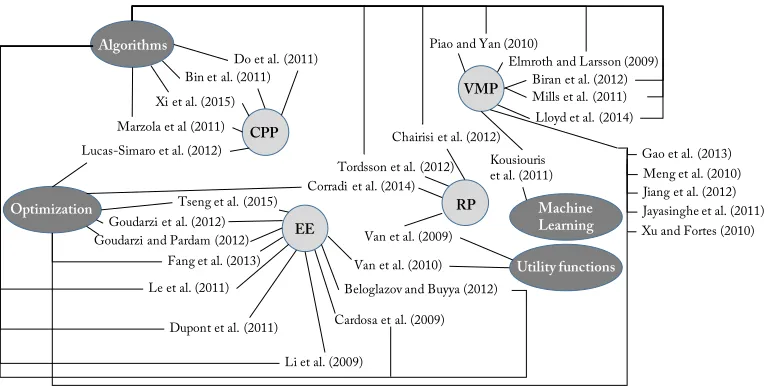
Figure 1 presents the approaches for Cloud Platform Scheduling (CPP), Energy Efficiency (EE), Resource Provisioning (RP) and VM Placement (VMP). We also correlate the approaches to their methodology including algorithms, optimization, utility functions and machine learning. We can observe that
RP CPP
EE
VMP Do et al. (2011)
Bin et al. (2011)
Xi et al. (2015)
Marzola et al (2011)
Lucas-Simaro et al. (2012) Algorithms
Optimization
Dupont et al. (2011)
Le et al. (2011) Beloglazov and Buyya (2012)
Li et al. (2009)
Cardosa et al. (2009) Fang et al. (2013)
Goudarzi and Pardam (2012) Goudarzi et al. (2012)
Tseng et al. (2015)
Van et al. (2010) Utility functions Tordsson et al. (2012)
Chairisi et al. (2012)
Corradi et al. (2014)
Van et al. (2009)
Machine Learning Piao and Yan (2010)
Elmroth and Larsson (2009) Biran et al. (2012) Mills et al. (2011) Lloyd et al. (2014)
Kousiouris et al. (2011)
[image:12.612.111.496.366.559.2]Gao et al. (2013) Meng et al. (2010) Jiang et al. (2012) Jayasinghe et al. (2011) Xu and Fortes (2010)
Figure 1: Classification of literature review approached according to CPP, EE, VMP and RP and according to their method (algorithms, optimization, utility functions and machine learning).
, Biran et al. (2012), Intel-opensource.org (2015) and Goudarzi and Pedram (2012) focus on algorithms and optimization methodologies to achieve better VM placement in cloud systems using either current resource usage or his-torical data from cluster PMs. Works like Jayasinghe et al. (2011), Dupont et al. (2012), Lucas-Simarro et al. (2013) and Van et al. (2009) focus on con-straints satisfactin objectives following PMs resource usage. Approaches like Gao et al. (2013), Tseng et al. (2015) and Li et al. (2009) focus on optimiz-ing NP hard VM placement. Approaches like Fang et al. (2013), Jiang et al. (2012), Jayasinghe et al. (2011) and Meng et al. (2010) focus on networking aspects in order to optimize the communication cost function usually related with optimal VM placement in order VMs to be close to each other.
The work of Kousiouris et al. (2011) is different from aforementioned so-lutions as approaches the problem from a different perspective as it includes a machine learning linear regression model for predicting behaviour of un-known applications. However, the authors define the VM placement as a heuristic optimization problem using genetic algorithms for quantifying and predicting the performance of the applications.
Based on this discussion, we conclude that to the best of our knowledge, current works does not consider dynamic VM placements according to past VM resource utilization. Yet, almost all the approaches focus on the problem of allocating VMs considering only the PMs resource usage (either real-time, opportunistic or as an optimization problem). Moreover, machine learning models are hardly used in literature.
3. VM scheduling algorithm
This section presents the VM scheduling algorithm that includes two op-timization schemes based on machine learning. The algorithm enhances the VM selection phase based on real time monitoring data collections and analy-sis of physical and virtual resources. Our aim is to strengthen VM scheduling in order to incorporate criteria related to the actual VM utilization levels, so VMs can be placed by minimizing the penalization of overall performance levels. The optimization schemes involve analytics ot the already deployed VMs to include (a) maximization of utilization levels and (b) minimization of the performance drops. In Section 3.1 we present the proposed VM sched-uler and in Section 3.2 we present the optimization schemes for classifying resources according to past historical records.
3.1. Online Scheduler
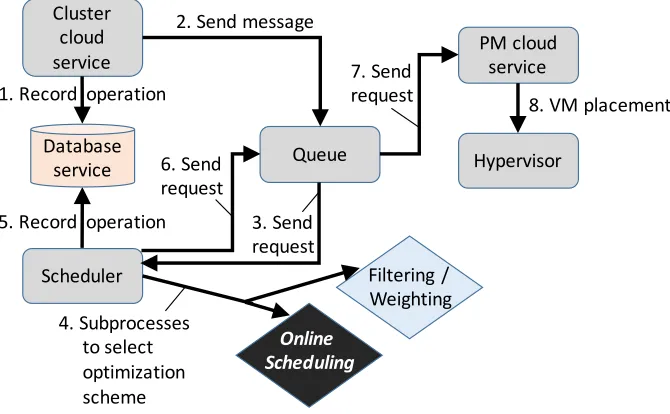
Our technique is based on the OpenStack VM scheduling process that includes PMs evaluation prior selecting the best host for VM placement. The assumption is that requests for VMs are submitted to a Cloud service (in OpenStack is the nova service) that initiates that process. After PMs evaluation, the VM is scheduled to the best ranked host. In our case, we extend the selection steps to include the online VM scheduling that includes past history records. In detail, we include one more step that allows selected PMs to be sorted according to the ones that (a) have computational resources and (b) will have the least affection to the already deployed systems. to achieve (b) we perform prediction on real time according to the past resource usage. Figure 2 demonstrates the VM scheduling process.
The process includes 8 steps (starting from receiving the request to plac-ing the VM to the best ranked PM) and are as follows.
Step 1 The cloud hosting service (that is the Cloud fabric controller) receives a request for creating a new VM including resources to be allocated such as number of Cores, memory and hard disk resources. Other information includes network and VM metadata configurations that are out of the scope of this study.
Step 2 The cloud hosting service sends a request to the Cloud database ser-vice that records all operations.
Cluster cloud service
Queue
Scheduler
PM cloud service
Hypervisor 1. Record operation
2. Send message
3. Send request
4. Subprocesses to select optimization scheme 5. Record operation
6. Send request
8. VM placement Database
service
Filtering / Weighting 7. Send request
[image:15.612.138.473.129.336.2]Online Scheduling
Figure 2: Online VM Scheduler in OpenStack system
Step 4 The scheduler performs the following two subprocesses.
(a) First it collects a list with all available PMs in the cluster and performs a filtering by selecting PMs according to their current available resources. The filter is binary, meaning that a PM is capable or not for hosting a VM. For example if the VM requests 8GM of RAM, all PMs that have greater or equal available RAM will be selected.
normalization parameter and ν is the total number of weighers.
w=w1mul∗n(w1) +w2mul∗n(w2) +...+wνmul∗n(wν) (1)
In our case we replace this process by using the optimization schemes. In other words, weighing is based on real time data and historical records instead of instantaneous collected PM data. In detail, the algorithm evaluates past resource utilization lev-els (e.g. last 7 days) and classifies according to the overall re-source usage. At the end the list of candidate hosts is populated and the resources are ranked accordingly. In detail, by using this algorithm PMs are re-ranked according to the selected op-timization scheme and based on their VM usage. For example we use as data set resource information from 24 hours monitor-ing and as training set a seven day resource usage monitoring. The analytics are (a) according to utilization levels over time by characterizing it as low, medium and heavy and (b) according to continues data (e.g. memory percent that increases over time). The algorithm performs a weighting process for the selected PMs according to different features (e.g. CPU, RAM percentage).
Step 5 The scheduler sends a request to the database service to record the operation.
Step 6 The scheduler sends a request to the queue of the cloud hosting service with the selected PM for placement.
Step 7 The service sends a request to the cloud hosting service of the selected PM.
Step 8 The selected PM hypervisor launches the VM and the operation is recorded to the database service.
percent, used, free, active, inactive, wired), swap (total, used, free, percent, sin, sout), disk usage (total, used, free percent), IO (read count, write count, read bytes, write bytes, read time, write time) according to the psutil cross-platform library2 for collecting information on running processes and system utilization.
3.2. Optimization schemes
The aim of this optimization schemes is to define the weight of the PM according to the resource usage of the VMs. This will reveal information about the already deployed VMs status, like indications that a workload is running or not. To achieve this we provide two optimization schemes. Firstly a classification of the VM status about its current resource usage according to history records (using SVM and SVR) and secondly a convolution method for comparing signals and find their similarity. To achieve this we run well known workloads and we tag them accordingly so the monitoring information contain resource usage and a label about the workload status. Figure 3 demonstrates this process.
VM VM
VM
…
Monitoring workloadworkload workload
…
Monitoring Monitoring
report report
report
…
…
Opt 1
SVM or SVR ConvolutionOpt 2 Archive
Figure 3: VM resource monitoring process for online VM scheduling
In detail, the VMs are constantly monitored while workloads are running. Reports that are generated by the system are stored into an archive for later usage. Further, we perform statistical evaulation using opt1 that involves classification and regression using SVM and SVR respectively or opt2 that
involves convolution in the signal to identify similarities and/or patterns. For example, binary classification can allow us to classify a VM according to its resource usage (e.g. to low, medium and high utilization) while the convolution method will allow to find patterns according to workloads stored in an archive. Thus, we first classify VMs and in case a VM has high CPU usage we try to identify if there is a pattern in the CPU usage. If this is the case, the VM is tagged as running and we set its weight accordingly. VMs with high CPU usage matched with workload running are assigned a small weight, while VMs with medium CPU usage matched with running workload are assigned with a medium value weight. High value weights are assigned to VMs that have low CPU utilization and no mathced workloads. The weight is calculated as w=CPU utilization percent-1.
We use SVM and SVR methods for binary classification and regression according to resource utilization status. Lets consider the example dataset of CPU (CPU percent, memory percent and disk usage percent) in x,y plane and we represent feature geometrically by vectors. We first find the linear decision hyperplane that separates the features and has the largest margin and we train SVM by minimizing the error function given by the formula
1 2w
Tw+C n
X
1
ai, where C is the capacity constraint, a the parameters for
handling no seperable data andn are the training data. In addition, to solve for continues data we use the SVR that works as follows. SVR finds a function with at most e-deviation from the target y. The problem can be represtented as a convex optimization problem given by the formula min12kwk2.
In our study we consider a scenario of a PM pi, with pi ∈ P where P is the total number of servers, and it hosts a VM vj with vj ∈ Vpi, where Vpi defines the VMs per server. Each P, V have a resource R =
c m d
where c is the cpu, m is the memory,s the swap memory, d disk and io the IO usage. We can define the total cluster size
(T) as: pcT =
P
X
i=1
pc(i), pmT =
P
X
i=1
pm(i) and pdT =
P
X
i=1
ps(i).
Similarly,vcT =
V
X
i=1
vpc(i),vmT =
V
X
i=1
vpm(i)andvdT =
V
X
i=1
vps(i)are defined
as the total VM size per server (p).
For each VM placement request, vν with Rν =
cν mν dν
and if pcT < vν cT and pmT < vν mT and pdT < vν dT it creates an M =
c m d
p1 c1 m1 d1
... ... ... ...
pq cq mq dq
where q is the maximum number of candidate nodes to
host. We define a coefficient coef as a constraint for sorting the M matrix. If coef is set to 1 we sort the matrix according to the cpu size thus the PM
pm with the higher cpu will be the first at the list. It should be mentioned that the default sorting parameter for OpenStack is the memory.
For each pi, with pi ∈P we follow an optimization scheme to model the selection of PMs. The algorithm can perform predictions on selected criteria based on two properties (a) classification where the output variable takes class labels e.g. for CPU utilization levels (idle, medium and high) and (b) regression where the output variable takes continuous values e.g. for CPU, memory percentages etc.
To do this we use a model, where we have a given datasetD= (x1, y1),(x2,
y2), ...,(xw, yw) wherexi = (xi1, xi2, ..., xiν) withxis the input vector and
x =⊆ <ν and y is the label need to classify and y
i ∈ 1,−1. We build the
linear function as follows f(x) = ν
X
i=1
(wi × xi) +β where w is the weight
vector w= (w1, w2, ..., wr) and β is bian If f(xi)≥ 0 then the vector xi ≥0 and yi
yi =
1 ν X i=1
(wi×xi) +β ≥0
−1
ν
X
i=1
(wi×xi) +β <0
set of data Di with associated errors σi measured at positions Xi as given by the following formula (2).
CCF =
ν
X
i=1
P(Xi−X)Di/σi2
ν
X
i=1
P2(Xi−X)Di/σi2
(2)
To find the similarity between the two signals, we use convolution neural networks. In convolutional neural networks every network layer acts as a detection filter for the presence of specific features or patterns present in the original data. The first layers detect (large) features that can be recognized and interpreted relatively easy. Later layers detect increasingly features that are more abstract (and are usually present in many of the larger features detected by earlier layers). The last layer is able to make an ultra-specific classification by combining all the specific features detected by the previous layers in the input data. In our work, we use convolution neural networks to compare signals and identify their similarity. We extract the similarity by empirically identity local maxima in the convolution signal. In particular, we set distance thresholds for identifying maxima and compare between them.
4. Evaluation
4.1. OpenStack influence in VMs
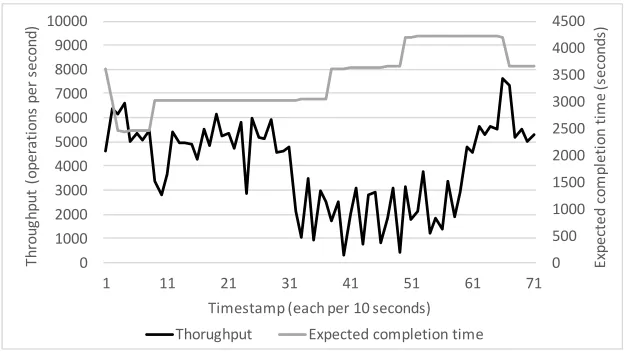
Firstly, we deploy an Apache Cassandra node in OpenStack and we ex-ecute the YCSB workload (100 thousand reads and updates). During the reading phase, we execute a VM scheduling process that places a VM in the controller host (since it has the most available memory at that time) and we observe the resource utilization levels and Cassandra throughput metrics. Figure 4 demonstrates the variation of the Cassandra throughput and the workload expected completion time while we create a new VM. We run the experiment 10 times and we measure the average for each timestamp (the sampling rate is 10 seconds). In particular, between timestamps 7 and 13 we create a small size VM of a typical Cirros image and between timestamps 30 and 65 we create a medium size Ubuntu image (2 CPUs, 4 GB RAM and 40 GB HD) with preinstalled Cassandra. It should be mentioned that the VMs are placed in the controller node that already hosts the Cassandra VM. We can observe that during these two OpenStack processes, the Cassandra throughput drops while the expected estimation time increases. Especially in the second case (of the medium size image) the VM placement penalizes the deployed system performance.
0 500 1000 1500 2000 2500 3000 3500 4000 4500 0 1000 2000 3000 4000 5000 6000 7000 8000 9000 10000
1 11 21 31 41 51 61 71 Ex
pe ct ed c om pl et io n tim e (s ec on ds ) Th ro ug hp ut ( op er at io ns p er s ec on d)
[image:21.612.149.464.401.577.2]Timestamp (each per 10 seconds) Thorughput Expected completion time
Figure 4: OpenStack VM placement influence to the Apache Cassandra throughput
influence the performance of the already deployed system.
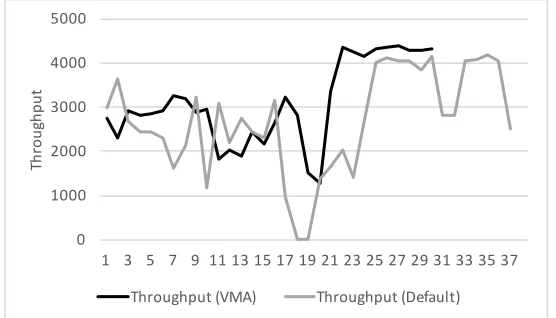
To demonstrate the effectiveness of our solution (called VMA), we run an example case in an OpenStack cluster of 3 PMs (1 controller (32 GB RAM) and 2 compute nodes (16 GB RAM)). We first run the default OpenStack scheduler in order to place 3 VMs of a pre-installed Cassandra cluster that are placed in P M1, P M2 and P M3 respectively. Then we execute a YCSB workload to P M1 whileP M2 and P M3 are in idle state and we execute one more VM placement. We observed that the default VM scheduler forces the VM to be placed inP M1 (which at that time instance has the most available RAM), however our scheduler selects P M2 due to the fact that recognizes the increased resource usage of P M1.
0 1000 2000 3000 4000 5000
1 3 5 7 9 11 13 15 17 19 21 23 25 27 29 31 33 35 37
Th
ro
ug
hp
ut
[image:22.612.167.445.299.458.2]Throughput (VMA) Throughput (Default)
Figure 5: Prediction of MongoDB CPU percent when running YCSB
Figure 5 demonstrates the throughput in both cases. In particular the grey line demonstrates the throughput in the default case (where the VM is placed in the same host) while the black line is based on our scheduler. We can observe that our solution does not affect the throughput (that in the default case drops almost to 0 between timestamps 17 and 19). For this specific scenario (of 100.000 YCSB reads and updates) our solution optimizes throughput averagely by 19%.
After, we create a new VM and the default OpenStack scheduler places it in the P M1, thus affecting the performance of the running workload. We can observe that even if the signal is not so stable (as in the Cassandra case), in average the OpenStack placement process affects the throughput (repre-sented by the black line). We calculated that averagely our solution offers 26% performance optimization over the default scheduler.
Figure 6: Prediction of Elasticsearch VM memory percent when running YCSB
0 500 1000 1500 2000 2500 3000 3500 4000
1 3 5 7 9 11 13 15 17 19 21 23 25 27
Th
ro
ug
hp
ut
Throughput (VMA) Throughput (Default)
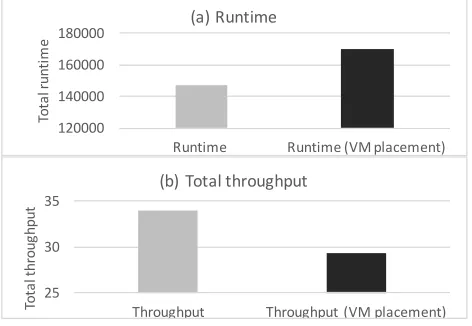
Finally, Figure 7 demonstrates the Elasticsearch performance measure-ments that include (a) total runtime calculation and (b) total throughput.
Figure 7: Prediction of Elasticsearch CPU percent when running YCSB
25 30 35
Throughput Throughput (VM placement)
To
ta
l t
hr
ou
gh
pu
t
(b) Total throughput
120000 140000 160000 180000
Runtime Runtime (VM placement)
To
ta
l r
un
tim
e
(a) Runtime
[image:23.612.186.422.488.651.2]Open-Stack and we compare default versus VMA solution. In detail, VMA solution offers 13% optimization over the default scheduler. To conclude, these ex-periments demonstrate that default OpenStack scheduling affects already deployed systems performance. Our solution refines scheduling by evaluat-ing VM resource usage, thus VM placements are happenevaluat-ing accordevaluat-ingly (for example in PMs that contain under-utilized VMs).
4.2. VMs CPU steal time
In this experiment we observe the CPU steal time (that reflects the time that a hypervisor services another virtual processor) in two Cassandra nodes. Figure 8 demonstrates the CPU steal time between a single VM and two VMs that are executed concurrently in an OpenStack cloud system. We used the real world workload of YCSB and we executed 10 thousand reads and updates respectively in both Cassandra nodes. We executed the same workload for both VMs and we ran 10 experiments and we calculated the average of the overall tests. We conclude to the following observations. When we increase the VMs from one to two the CPU steal time is increasing. For example for a single VM the CPU steal time is around 6% while when we launch a second VM in the same PM, the CPU steal time is increased to 10%. Based on this simple experiment we can conclude that by increasing the number of VMs the percentage of the CPU steal time is also increased and this affects VM utilization.
0% 2% 4% 6% 8% 10% 12% 14%
1 10 19 28 37 46 55 64 73 82 91
100 109 118 127 136 145 154 163 172 181 190 199 208 217 226 235 244 253 262 271 280 289 298 307 316 325 334 343
Pe
rc
en
ta
ge
o
f C
PU
st
ea
l t
im
e
Time
[image:24.612.151.463.454.623.2]CPU Steal Single VM CPU Steal 2 VMs concurrently
To calculate the actual resource usage, we introduce the factor of the ”real” CPU utilization that is related to the amount of CPU that subtracts the amount that has been ”stolen” (or in our case has not be offered by the hypervisor to the running VM). Figure 9 demonstrates the average value of the ”real” CPU utilization rates for the YCSB read and update phases from 10 runs. We observe (for the YCSB updating phase between the timestamps 220 and 365) that while the system CPU utilization is 81%, when we launch the seconds VM this value drops to 73%, so resource utilization in reality it is dropped by 8%.
0 20 40 60 80 100
1 25 49 73 97
121 145 169 193 217 241 265 289 313 337 361 385 409 433
CP
U
p
er
ce
nt
[image:25.612.170.443.267.427.2]Timespamp Observed (system) Real
Figure 9: ”Real” CPU utlization percentage for YCSB Apache Cassandra workload exe-cution in small size VM for 10.000 ”inserts” and 10.000 ”updates” records in OpenStack
6.82 6.84 6.86 6.88 6.9 6.92 6.94 6.96 6.98 7
1 25 49 73 97
121 145 169 193 217 241 265 289 313 337 361 385 409 433 457 481 505 529 553 577
CP
U
S
te
al
ti
m
e
[image:26.612.188.423.122.285.2]Time (seconds)
Figure 10: ”CPU steal time” for YCSB Apache Cassandra workload execution in medium size VM for 50.000 ”inserts” and 50.000 ”updates” records in an Amazon EC2 instance
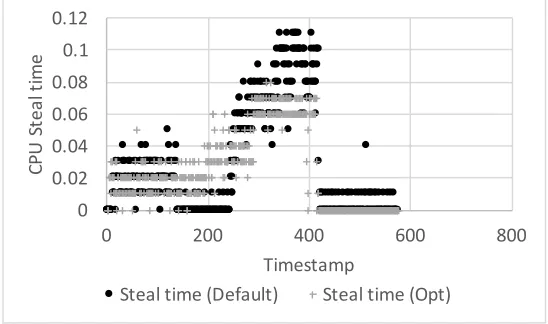
To demonstrate our solution we run a CPU steal case in an OpenStack cluster of 2 PMs (P M1 and P M2). In our case, P M1 has 32GB or RAM while P M2 has 16 GB of RAM. After, we place one VM toP M1 and we run the YCSB workload respectively. Figure 11 shows the statistical CPU steal time distribution in an x,y plane. We can observe that the CPU steal time (default) is higher than our solution (that minimizes the overall steal time).
0 0.02 0.04 0.06 0.08 0.1 0.12
0 200 400 600 800
CP
U
S
te
al
ti
m
e
Timestamp
Steal time (Default) Steal time (Opt)
Figure 11: Comparison of default OpenStack scheduler versus VMA for CPU steal time when running YCSB in Cassandra node
[image:26.612.168.442.437.599.2]toP M1 that has already the MongoDB system. Figure 12 demonstrates the comparison of the CPU steal time for both cases. We can observe that our solution outperforms the default one. In detail, the average CPU steal time for the default scheduling case is 4% while for the VMA scheduler we reduce this value to 2%.
Figure 12: Comparison of default OpenStack scheduler versus VMA for CPU steal time in MongoDB
0 0.02 0.04 0.06 0.08 0.1 0.12 0.14
0 100 200 300 400 500
CP
U
s
te
al
ti
m
e
Timestamp
CPU Steal (Default) CPU Steal (Opt)
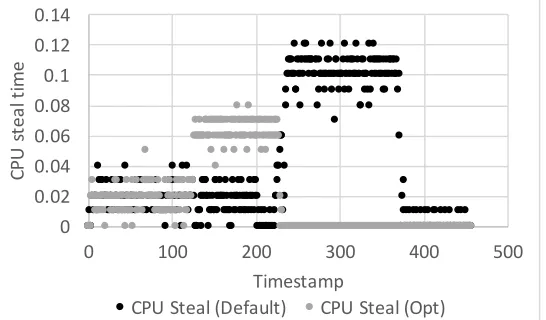
Finally, we run an experiment by deploying an Elasticsearch system as shown in Figure 13.
Figure 13: Comparison of default OpenStack scheduler versus VMA for CPU steal time in Elasticsearch node
0 0.02 0.04 0.06 0.08 0.1 0.12 0.14
0 100 200 300 400 500
CP
U
s
te
al
ti
m
e
Timestamp
[image:27.612.169.442.497.657.2]Our experiment demonstrates the comparison of default OpenStack sched-uler versus VMA for CPU steal time when running YCSB in Elasticsearch node. Similarly to previous experiments VMA outperforms default scheduler.
4.3. Analysis of the tools
This section presents the analysis of the tools and their performance. We include (a) the results related with the accuracy of the prediction models (that use SVR), (b) the results related with the signal similarity comparison and (c) performance measures of the real time resource monitoring system.
4.3.1. Analysis of the predictions
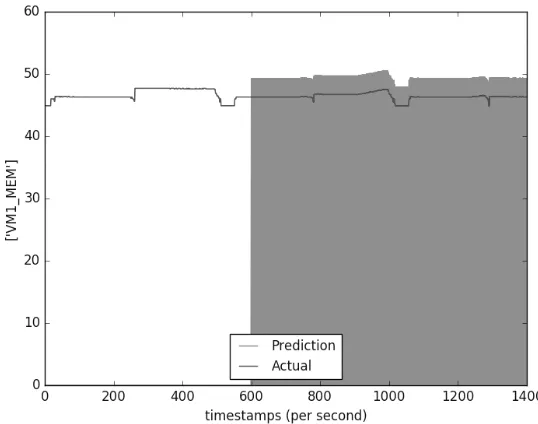
[image:28.612.166.435.431.643.2]To demonstrate the accuracy of the prediction model we train our model with data from 24 hours by running YCSB workloads. Then we select a win-dow of real time data collected by the system and the actual prediction. To demonstrate the patterns in a more clear manner we increase the prediction rates by 5%. Figure 14 demonstrates the Cassandra VM memory usage by running a typical YCSB workload (that includes 100 thousands reads and writes). Rest figures in 7 show the prediction analysis for the rest of the deployed systems (including MongoDB and Elasticsearch).
In particular, Figure 17 (page 37)demonstrates the CPU utilization levels and the prediction during two different timeframes. Figure 18 (page 38) and Figure 19 (page 38) demonstrate the accuracy of our algorithm for predicting the memory and CPU resource usage of the MongoDB system respectively. Finally, Figure 20 and Figure 21 (page 39) demonstrate the accuracy of our algorithm for predicting the memory and CPU resource usage of the Elastic-search system respectively. For all cases, it is apparent that the prediction is similar to the real usage pattern.
Based on this analysis, we can conclude that for both CPU and memory, the workload executions demonstrate a repeating pattern. Thus, in our case we evaluate the workload executions (e.g. the last hour) by feeding this records to the model, and we identify if a VM is in the middle of a workload execution or not by comparing sequences of signals. In case of signal matching we classify the VM as ”running” or not.
4.3.2. Analysis of signal similarity using convolution
[image:29.612.163.442.397.609.2]In this section we present the analysis of the signal similarity algorithm.
We used the convolution method in order to compare the signals and we set a comparison coefficiency that is related with the similarity of the convolution comparison. Figure 15 demonstrates the signal similarity and the pattern extraction between the test signal and the real time signal. It should be mentioned that test signals are stored into the archive, so the more the samples, the higher the accuracy of our model. We present the similarity comparison and the convolution signal in the Appendix section (MongoDB signal is in page 40 and Elasticsearch in page 40). We can observe that when there are 4 repetitions between the signals meaning that a workload is running. In the specific signal, we can observe that the local maximum points demonstrate the peaks of the pattern matching.
4.3.3. Real time monitoring engine benchmark analysis
In this section we present the analysis of the real time monitoring engine that is preinstalled and configured to each We set the data collection interval to 1 second and we aim to explore what is the timeframe in which data should be recorded and forwarded to the cloud. The machine learning engine connects to a cloud service and parses the data in an iteratively mode. It executes a series of machine learning models in order to calculate the best accuracy score, thus to conclude with the best model for VM placement. The data is stores in csv format and are the input to the machine learning model. Figure 16 demonstrates the transfer delay versus the rate (that is given by the equation rate = rows−countrows where rows are the uploaded rows per iteration and count is the total rows stored in an array).
0 0.2 0.4 0.6 0.8 1
0 20 40 60 80 100 120 140 160
1 6 11 16 21 26 31 36 41 46 51 56 61 66 71
Tr
an
sfe
r
ra
te
Ti
m
e
(s
ec
on
ds
)
[image:30.612.177.433.485.639.2]Transfer delay Transfer rate
We observe that the transfer delay is increased significantly after the timestamp 50 where each timestamp is a window of 1 second. We can also notice that the transfer rate keeps a steady trend line at that time window. Based on these facts we set the transfer point in 50 seconds, and we perform the iterations after every successful completion of a machine learning round. It should be mentioned that each learning round includes the measurement of accuracies for selected models.
Since data are uploaded dynamically, to achieve up to modelling of real time data we force the engine to load data for each iteration. This means that the system will spend a significant amount of time to load the data, thus the actual modelling is happening based on this delay. For example data upload rate is 3,37 MB per second meaning that in this example case a file size of 2.84 MB will be uploaded in 9.56 seconds. Thus the machine learning model refers to data collected before that time.
5. Conclusions
Cloud systems use different virtual machine (VM) placement algorithms to schedule instances by selecting physical machines (PMs) according to real time system information (i.e usage of CPU, memory, hard disk, network and other). In this work we stress the problem of instantaneously collected system data that in many cases does not reflect the big picture (i.e. average resource utilization levels). The current VM placement does not consider real time VM resource utilization levels. In this work we propose a new VM placement algorithm based on past VM usage experiences. We monitor the VM usage in real time and we train different machine learning models to calculate the prediction of the VM resource usage per server, thus to place VMs accordingly. We present an algorithm that allows self managed VM placement according to PM and VM utilization levels. Usually, traditional systems (i.e. OpenStack) use a filtering (which PMs can host the VM thus having resources) and weighing method (which PM has the higher RAM) to select PMs based on the specific time instance, without considering the actual VMs’ resource usage of the selected PMs. We introduce the concept of analyzing past VM resource usage according to historical records based on computational learning to optimize the PM selection phase.
a monitoring engine that collects resource usage data on real time. The VMA collects data and applies different models for class labels (classification) and/or continues values (regression). The proposed algorithm allows data processing based on a timeframe window to define the actual behaviour of the PMs or VMs. The experimental analysis is prosperous and results highlight major improvements in the VM placement process. The future steps of our research include further experimental analysis and experimentation related to different machine learning models.
6. References
Beloglazov, A., Buyya, R., Sep. 2012. Optimal online deterministic algo-rithms and adaptive heuristics for energy and performance efficient dy-namic consolidation of virtual machines in cloud data centers. Concurr. Comput. : Pract. Exper. 24 (13), 1397–1420.
URL http://dx.doi.org/10.1002/cpe.1867
Bessis, N., Sotiriadis, S., Cristea, V., Pop, F., 2011. Modelling requirements for enabling meta-scheduling in inter-clouds and inter-enterprises. In: Pro-ceedings of the 2011 Third International Conference on Intelligent Net-working and Collaborative Systems. INCOS ’11. IEEE Computer Society, Washington, DC, USA, pp. 149–156.
URL http://dx.doi.org/10.1109/INCoS.2011.120
Bin, E., Biran, O., Boni, O., Hadad, E., Kolodner, E. K., Moatti, Y., Lorenz, D. H., June 2011. Guaranteeing high availability goals for virtual machine placement. In: Distributed Computing Systems (ICDCS), 2011 31st Inter-national Conference on. pp. 700–709.
Biran, O., Corradi, A., Fanelli, M., Foschini, L., Nus, A., Raz, D., Silvera, E., 2012. A stable network-aware vm placement for cloud systems. In: Proceedings of the 2012 12th IEEE/ACM International Symposium on Cluster, Cloud and Grid Computing (Ccgrid 2012). CCGRID ’12. IEEE Computer Society, Washington, DC, USA, pp. 498–506.
URL http://dx.doi.org/10.1109/CCGrid.2012.119
of the 11th IFIP/IEEE International Conference on Symposium on Inte-grated Network Management. IM’09. IEEE Press, Piscataway, NJ, USA, pp. 327–334.
URL http://dl.acm.org/citation.cfm?id=1688933.1688986
Chaisiri, S., Lee, B. S., Niyato, D., April 2012. Optimization of resource pro-visioning cost in cloud computing. IEEE Transactions on Services Com-puting 5 (2), 164–177.
Corradi, A., Fanelli, M., Foschini, L., Mar. 2014. Vm consolidation: A real case based on openstack cloud. Future Gener. Comput. Syst. 32, 118–127. URL http://dx.doi.org/10.1016/j.future.2012.05.012
Do, A. V., Chen, J., Wang, C., Lee, Y. C., Zomaya, A. Y., Zhou, B. B., July 2011. Profiling applications for virtual machine placement in clouds. In: Cloud Computing (CLOUD), 2011 IEEE International Conference on. pp. 660–667.
Dupont, C., Schulze, T., Giuliani, G., Somov, A., Hermenier, F., 2012. An energy aware framework for virtual machine placement in cloud federated data centres. In: Proceedings of the 3rd International Conference on Future Energy Systems: Where Energy, Computing and Communication Meet. e-Energy ’12. ACM, New York, NY, USA, pp. 4:1–4:10.
URL http://doi.acm.org/10.1145/2208828.2208832
Elmroth, E., Larsson, L., Aug 2009. Interfaces for placement, migration, and monitoring of virtual machines in federated clouds. In: Grid and Cooper-ative Computing, 2009. GCC ’09. Eighth International Conference on. pp. 253–260.
Fang, W., Liang, X., Li, S., Chiaraviglio, L., Xiong, N., 2013. Vmplanner: Optimizing virtual machine placement and traffic flow routing to reduce network power costs in cloud data centers. Computer Networks 57 (1), 179 – 196.
Fitfield, T., Nov. 2013. Introduction to openstack. Linux J. 2013 (235). URL http://dl.acm.org/citation.cfm?id=2555789.2555793
Gao, Y., Guan, H., Qi, Z., Hou, Y., Liu, L., Dec. 2013. A multi-objective ant colony system algorithm for virtual machine placement in cloud computing. J. Comput. Syst. Sci. 79 (8), 1230–1242.
URL http://dx.doi.org/10.1016/j.jcss.2013.02.004
Goudarzi, H., Ghasemazar, M., Pedram, M., May 2012. Sla-based optimiza-tion of power and migraoptimiza-tion cost in cloud computing. In: Cluster, Cloud and Grid Computing (CCGrid), 2012 12th IEEE/ACM International Sym-posium on. pp. 172–179.
Goudarzi, H., Pedram, M., 2012. Energy-efficient virtual machine replication and placement in a cloud computing system. In: Proceedings of the 2012 IEEE Fifth International Conference on Cloud Computing. CLOUD ’12. IEEE Computer Society, Washington, DC, USA, pp. 750–757.
URL http://dx.doi.org/10.1109/CLOUD.2012.107
Intel-opensource.org, 2015. Utilization based scheduling in openstack com-pute (nova).
Jayasinghe, D., Pu, C., Eilam, T., Steinder, M., Whally, I., Snible, E., July 2011. Improving performance and availability of services hosted on iaas clouds with structural constraint-aware virtual machine placement. In: Services Computing (SCC), 2011 IEEE International Conference on. pp. 72–79.
Jiang, J., Lan, T., Ha, S., Chen, M., Chiang, M., March 2012. Joint vm placement and routing for data center traffic engineering. In: INFOCOM, 2012 Proceedings IEEE. pp. 2876–2880.
Khedher, O., July 2015. Mastering OpenStack. Vol. 978-1-78439-564-3. Packt Publishing.
Kousiouris, G., Cucinotta, T., Varvarigou, T., Aug. 2011. The effects of scheduling, workload type and consolidation scenarios on virtual machine performance and their prediction through optimized artificial neural net-works. J. Syst. Softw. 84 (8), 1270–1291.
URL http://dx.doi.org/10.1016/j.jss.2011.04.013
for High Performance Computing, Networking, Storage and Analysis. SC ’11. ACM, New York, NY, USA, pp. 22:1–22:12.
URL http://doi.acm.org/10.1145/2063384.2063413
Li, B., Li, J., Huai, J., Wo, T., Li, Q., Zhong, L., Sept 2009. Enacloud: An energy-saving application live placement approach for cloud computing en-vironments. In: Cloud Computing, 2009. CLOUD ’09. IEEE International Conference on. pp. 17–24.
Lloyd, W., Pallickara, S., David, O., Arabi, M., Rojas, K., March 2014. Dynamic scaling for service oriented applications: Implications of virtual machine placement on iaas clouds. In: Cloud Engineering (IC2E), 2014 IEEE International Conference on. pp. 271–276.
Lucas-Simarro, J. L., Moreno-Vozmediano, R., Montero, R. S., Llorente, I. M., Aug. 2013. Scheduling strategies for optimal service deployment across multiple clouds. Future Gener. Comput. Syst. 29 (6), 1431–1441. URL http://dx.doi.org/10.1016/j.future.2012.01.007
Marzolla, M., Babaoglu, O., Panzieri, F., June 2011. Server consolidation in clouds through gossiping. In: World of Wireless, Mobile and Multimedia Networks (WoWMoM), 2011 IEEE International Symposium on a. pp. 1–6.
Meng, X., Pappas, V., Zhang, L., 2010. Improving the scalability of data cen-ter networks with traffic-aware virtual machine placement. In: Proceedings of the 29th Conference on Information Communications. INFOCOM’10. IEEE Press, Piscataway, NJ, USA, pp. 1154–1162.
URL http://dl.acm.org/citation.cfm?id=1833515.1833690
Mills, K., Filliben, J., Dabrowski, C., 2011. Comparing vm-placement al-gorithms for on-demand clouds. In: Proceedings of the 2011 IEEE Third International Conference on Cloud Computing Technology and Science. CLOUDCOM ’11. IEEE Computer Society, Washington, DC, USA, pp. 91–98.
URL http://dx.doi.org/10.1109/CloudCom.2011.22
OpenStack, 2016. Scheduling.
International Conference on Grid and Cloud Computing. GCC ’10. IEEE Computer Society, Washington, DC, USA, pp. 87–92.
URL http://dx.doi.org/10.1109/GCC.2010.29
Pintea, C.-M., Pascan, C., Hajdu-Macelaru, M., 2012. Comparing several heuristics for a packing problem. CoRR abs/1210.4502.
Sotiriadis, S., Bessis, N., 2016. An inter-cloud bridge system for heteroge-neous cloud platforms. Future Generation Computer Systems 45, 180–194.
Sotiriadis, S., Bessis, N., Amza, C., Buyya, R., 2016. Vertical and horizontal elasticity for dynamic virtual machine reconfiguration. IEEE Transactions on Services Computing PP (99), 1–1.
Sotiriadis, S., Bessis, N., Anjum, A., Buyya, R., 2015. An inter-cloud meta-scheduling (icms) simulation framework: Architecture and evaluation. IEEE Transactions on Services Computing PP (99), 1–1.
Sotiriadis, S., Bessis, N., Antonopoulos, N., 2011. Towards inter-cloud sched-ulers: A survey of meta-scheduling approaches. In: Proceedings of the 2011 International Conference on P2P, Parallel, Grid, Cloud and Internet Com-puting. 3PGCIC ’11. IEEE Computer Society, Washington, DC, USA, pp. 59–66.
URL http://dx.doi.org/10.1109/3PGCIC.2011.19
Sotiriadis, S., Bessis, N., Antonopoulos, N., Anjum, A., March 2013a. Simic: Designing a new inter-cloud simulation platform for integrating large-scale resource management. In: 2013 IEEE 27th International Conference on Advanced Information Networking and Applications (AINA). pp. 90–97.
Sotiriadis, S., Bessis, N., Kuonen, P., Antonopoulos, N., 2013b. The inter-cloud meta-scheduling (icms) framework. In: Proceedings of the 2013 IEEE 27th International Conference on Advanced Information Networking and Applications. AINA ’13. IEEE Computer Society, Washington, DC, USA, pp. 64–73.
URL http://dx.doi.org/10.1109/AINA.2013.122
367.
URL http://dx.doi.org/10.1016/j.future.2011.07.003
Tseng, F.-H., Chen, C.-Y., Chou, L.-D., Chao, H.-C., Niu, J.-W., Oct. 2015. Service-oriented virtual machine placement optimization for green data center. Mob. Netw. Appl. 20 (5), 556–566.
URL http://dx.doi.org/10.1007/s11036-015-0600-9
Van, H. N., Tran, F. D., Menaud, J. M., Oct 2009. Sla-aware virtual re-source management for cloud infrastructures. In: Computer and Informa-tion Technology, 2009. CIT ’09. Ninth IEEE InternaInforma-tional Conference on. Vol. 1. pp. 357–362.
Van, H. N., Tran, F. D., Menaud, J. M., July 2010. Performance and power management for cloud infrastructures. In: Cloud Computing (CLOUD), 2010 IEEE 3rd International Conference on. pp. 329–336.
Xi, S., Li, C., Lu, C., Gill, C. D., Xu, M., Phan, L. T. X., Lee, I., Sokolsky, O., June 2015. Rt-open stack: Cpu resource management for real-time cloud computing. In: Cloud Computing (CLOUD), 2015 IEEE 8th International Conference on. pp. 179–186.
Xu, J., Fortes, J. A. B., 2010. Multi-objective virtual machine place-ment in virtualized data center environplace-ments. In: Proceedings of the 2010 IEEE/ACM Int’L Conference on Green Computing and Communi-cations & Int’L Conference on Cyber, Physical and Social Computing. GREENCOM-CPSCOM ’10. IEEE Computer Society, Washington, DC, USA, pp. 179–188.
7. Appendix
Figure 18: Prediction of MongoDB VM memory percent when running YCSB
[image:39.612.166.443.428.639.2]Figure 20: Prediction of Elasticsearch VM memory percent when running YCSB
[image:40.612.169.441.428.640.2]Figure 22: Prediction of Elasticsearch VM memory percent when running YCSB
[image:41.612.164.442.424.635.2]Table 1: Approaches for Cloud Platform Scheduling (CPP) and Energy Efficiency (EE)
Class Authors Method Method concept Parameter 1
CPP Do et al. (2011), Algorithms
Canonical correlation analysis
Scheduling
CPP Bin et al. (2011) Algorithms k-resilient Load balancing
CPP Xi et al. (2015) Algorithms Mapping strategy
Resource utilization
CPP Marzolla et al.
(2011) Algorithms Message exchanging Resource allocation CPP Lucas-Simarro
et al. (2013) Optimization
Constraints satisfaction
Resource utilization
EE Dupont et al.
(2012) Algorihtms
Constraints satisfaction
Energy
consumption, CO2
EE Le et al. (2011) Algorihtms Heuristics Electricity price, Temperature
EE Beloglazov
and Buyya (2012) Algorihtms Heuristics
Resource usage
EE Li et al. (2009) Algorithms Heuristics
(FirstFit/BestFit)
Energy consumption
EE Cardosa et al.
(2009) Algorithms Min-max
Power performance
EE Fang et al. (2013) Optimization Greedy Bin-Packing
Traffic volume
EE Goudarzi and
Pedram (2012) Optimization Local search
Energy consumption
EE Goudarzi et al.
(2012) Optimization
Probabilistic
Analysis Resource usage
EE Tseng et al. (2015) Optimization Tree & Forest
Commun-ication cost
EE Van et al. (2010) Utility function Constraints satisfaction
Table 2: Approaches for Resource Provisioning (RP) and VM Placement (VMP)
Class Authors Method Method concept Parameter 1
RP Tordsson et al.
(2012) Algorihtms Cloud brokering
Load balancing
RP Chaisiri et al.
(2012) Algorihtms Stochastic programming model On-demand costs
RP Corradi et al.
(2014) Optimization Optimize resource usage Resource usage
RP Van et al. (2009) Utility function Constraints satisfaction
Resource usage
VMP Piao and Yan
(2010) Algorithms
Analytical model
Network factors
VMP Elmroth and
Larsson (2009) Algorithms
Cross VM management
Resource utilization
VMP Biran et al. (2012) Algorithms Min Cut Ratio-aware
Communication cost, Resilience
VMP Mills et al. (2011) Algorithms Objective method
Resource utilization VM type VMP Lloyd et al. (2014) Algorithms Services Scalability
VMP Kousiouris et al. (2011)
Machine learning /Algorithms Linear regression/ Genetic algorithms Prediction degradation
VMP Gao et al. (2013) Optimization Ant colony optimization
Resource wastage, performance
VMP Meng et al. (2010) Optimization Approximation Communication cost
VMP Jiang et al. (2012) Optimization Approximation
(Markov) Traffic cost
VMP Jayasinghe
et al. (2011) Optimization
Constraints satisfaction
Server rack assignment
VMP Xu and
Fortes (2010) Optimization Multi-objective