Kalanthroff, E. and Henik, A. and Derakhshan, Nazanin and Usher, Marius
(2016) Anxiety, emotional distraction, and attentional control in the Stroop
task. Emotion 16 (3), pp. 293-300. ISSN 1528-3542.
Downloaded from:
Usage Guidelines:
ANXIETY, EMOTIONAL DISTRACTORS AND ATTENTIONALCONTROL 1
Anxiety, Emotional Distraction and Attentional Control in the Stroop Task
Eyal Kalanthroff1, 2, Avishai Henik2, Nazanin Derakshan3, & Marius Usher4
1Anxiety Disorders Clinic and the Center for OCD and Related Disorders, New York State
Psychiatric Institute, Columbia University Medical Center in the City of New York, NY
2Department of Psychology and the Zlotowski Center for Neuroscience, Ben-Gurion
University of the Negev, Beer-Sheva, Israel
3Department of Psychological Sciences, Birkbeck University of London, UK
4School of Psychology and Sagol School of Neuroscience, Tel Aviv University, Tel Aviv,
Israel
Authors Note
We wish to thank Amir Avnit, Nitzan Ganor, Tzlil Malka, Noa Schwartz (main
experiment), Zeev Mogilvsky and Adi Frish for collecting the (pilot) data; and Desiree
Meloul for a critical reading.
This research was supported by funding from the German Israeli Foundation (grant
158/2011 [MU]), the Israeli Science Foundation (grant 743/12 [MU]; grant 79/15 [EK])
and the Rothschild foundation [EK].
Correspondence concerning this article should be addressed to Eyal Kalanthroff,
Columbia University Medical Center, New York State Psychiatric Institute, Unit #69, 1051
Riverside Drive, New York, NY 10032 unit 3205, Phone: 1646-774-8049, Email:
Abstract
Using a Stroop task, we investigated the effect of task irrelevant emotional distractors on
attentional proactive control and its interaction with trait anxiety. On the basis of recent
findings showing opposed neural responses in the dorsal-executive vs. the ventral-emotional
systems in response to emotional distractors and of the Attentional Control Theory (Eysenck,
Derakshan, Santos & Calvo, 2007), we hypothesized that negative-distractors will result in
a reduction of proactive task control in the executive system, especially for high trait anxious
individuals. Using a computational model of the Stroop task we derive two specific
behavioral predictions of reduced proactive task control: increased Stroop interference and
reversed Stroop facilitation. Twenty-five high and 25 low trait anxious participants
completed a Stroop task in which the target stimuli were preceded by brief (neutral vs.
aversive) emotional distractors. While no effects of picture valence on proactive control was
found in the low-anxious group, the predicted signatures of reduced proactive control were
observed in the high anxiety group. These results indicate that trait anxiety influences the
interaction between irrelevant emotional stimuli and proactive control.
Executive control is a key human capacity that enables flexible responding to the
environment, facilitating goal-directed behavior, unconstrained by automaticity or
stimulus-bound behavior (Miller & Cohen, 2001; Miyake et al., 2000). An important role of the
executive control system is to filter out (or inhibit) task-irrelevant, often emotional, input
that interferes with the task at hand. For example, a basketball player taking a free throw
would do well if he manages to filter out aversive noise coming from the opposition fans ―
the executive control component serving this function is usually labeled response-inhibition
(suppressing automatic but irrelevant actions; Verbruggen & Logan, 2008) or task control
(Braver, 2012; Botvinick, Braver, Barch, Carter, & Cohen, 2001). Another well-known
component of the executive control system is working memory, a system that regulates the
maintenance and updating of active representations of information available for use; Banich,
2009). Research on the impact of task-irrelevant emotional distractors (pictures or words)
on working-memory and on the response-inhibition component of the executive control
system portrays a complex picture. While a number of studies have reported that aversive
(compared with neutral) stimuli interfere with working-memory performance (Dolcos &
McCarthy, 2006, Denkova et al., 2010) and with response inhibition in the stop signal
(Verbruggen & De Houwer, 2007) and the Stroop task (Hart, Green, Casp, & Belger, 2010;
Padmala, Bauer, & Pessoa, 2011), other studies found no effects of emotional distractors in
the Stroop task and even an opposite direction of causality. For example, in a pilot Stroop
study using materials similar to those of Hart et al. (2010) 1, we found no significant effects
of the valence of irrelevant emotional distractors on any of the Stroop measures (see
Supplementary Material B). Furthermore, in a series of studies, using the Flanker task,
Cohen, Henik and colleagues reported that in conditions of high conflict (incongruent flanker
stimuli), participants were immune from the effects of emotional distractors; with such
effects found only in conditions with low conflict, such as neutral or congruent stimuli. The
authors explained this result by proposing that incongruent stimuli can engage executive
processes, which help the observers filter out (or inhibit) the content of the irrelevant
emotional distractors, making those trials immune from detrimental effects on performance
outcome(s) (e.g., Cohen, Henik, & Mor, 2011; see also Kalanthroff, Cohen, & Henik, 2013).
The former results (of reduced cognitive control caused by emotional distractors) are
the ventral-emotional systems in response to emotional distractors in a working memory task
(Dolcos & McCarthy, 2006, Dolcos, Diaz-Granados, Wang, & McCarthy, 2008; Dolcos,
Miller, Kragel, Jha, & McCarthy, 2007; ; Iordan, Dolcos & Dolcos, 2013). For examples, a
number of studies by Dolcos and colleagues have found that “increased activity in the ventral
affective regions in the presence of emotional distracters, temporarily takes offline the dorsal
executive system” (Iordan et al., 2013, p. 3).
One possible source for the variability between studies (in addition to procedural and
task differences) is the influence of individual differences (Kanske, 2012; Cohen, Henik, &
Moyal, 2012). The current investigation addresses this issue by examining how the
interaction between an emotional distractor, administered before a Stroop stimulus is
presented, and the executive control that is supposed to filter it out, depends on trait anxiety.
Trait anxiety refers to a general tendency to experience and exhibit anxiety related
symptomatology and worrisome thoughts over time and across a wide range of situations,
involving high physiological arousal (Spielberger, Gorsuch, Lushene, Vagg, Jacobs, 1983).
Many studies have shown that anxiety is associated with a selective attention bias toward
negatively laden stimuli (for a review see Bar-Haim, Lamy, Pergamin,
Bakermans-Kranenburg, & van IJzendoorn, 2007). According to the Attentional Control Theory (ACT)
(Berggren & Derakshan, 2013a; Eysenck, Derakshan, Santos, & Calvo, 2007; Derakshan &
Eysenck, 2009), anxiety impairs the efficiency of the main functions of the central executive
system, biasing the attentional system towards bottom-up/stimulus-driven processing. This
theory is supported by a vast set of accumulating evidence (see Berggren & Derakshan,
2013a, for a review), indicating that trait anxiety impairs response-inhibition in antisaccade
(Berggren, Richards, Taylor, & Derakshan, 2013; Derakshan, Ansari, Hansard, Shoker, &
Eysenck, 2009; Ansari & Derakshan, 2010, 2011a, 2011b) and in flanker tasks (Berggren &
Derakshan, 2013b). Based on this, and on the potential competition between the
ventral-affective system transiently activated by the distracters and the executive control system
(Iordan et al., 2013; Pessoa, 2009), we predicted that individuals with high trait anxiety will
resolve this competition in favor of the affective stimuli, resulting in a reduction of proactive
task-control in the Stroop task. Proactive task-control is an attentional focus to the relevant
task dimension that is allocated in advance of the stimulus to inhibit automatic (incorrect)
reduced proactive task control, participants need to rely on a reactive control mechanism to
carry out conflict tasks, such as the Stroop task (see also Kalanthroff, Avnit, Henik, Davelaar,
& Usher, 2015).
We start with a brief presentation of an explicit computational model of the Stroop
task, which allows us to make specific behavioral predictions for the effects of reduced
proactive control in the Stroop task, which we predict to affect high anxiety participants in
conditions with negative (emotional) distracters. To preview our computational results, we
find two specific behavioral signatures of reduced proactive task-control: increased Stroop
interference and reverse Stroop facilitation (a component that is associated with task conflict;
Goldfarb & Henik, 2007; Kalanthroff, Goldfarb, & Henik, 2013; Kalanthroff & Henik,
2013). We then present the experimental study that tests these specific predictions.
A computational model of task-conflict in the Stroop task.
In recent work, we have shown that reducing proactive task control, via a concurrent
load manipulation, results in increased task-conflict in the Stroop task, as indicated by a RF
effect (Kalanthroff et al., 2015; see Berggren et al., 2013 for effects of concurrent load and
trait anxiety in the antisaccade task). We have provided predictions for this effect using a
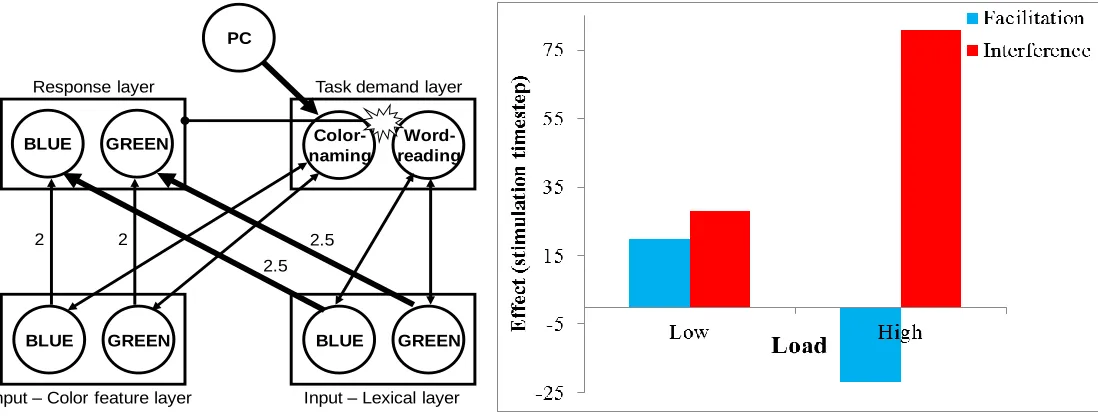
computational model of the Stroop task, which is illustrated in Figure 1 (left panel). This
proactive-control/task-conflict model assumes a set of task-control units that bias
information processing toward the relevant task dimension via bilateral connections to the
input representations (Figure 1, left panel). Due to these bilateral connections, task-demand
units do not only top-down modulate the processing from input to the response layers, but
are also activated bottom-up by the input (Stroop-stimuli): words activate the word-reading
task unit, while colors the color-naming task unit. When both of the task units (i.e., color
naming and word reading) are (bottom-up) activated, task-conflict emerges (the flash event
in the figure, computed as the multiplication of the task-unit activation (Botvinick et al.,
2001), inhibiting the response layer and allowing the task-conflict to be resolved before the
response is triggered.
---
Insert Figure 1 here
According to this account, task-conflict slowdown is expected to take place only for
word (congruent or incongruent) but not for non-word (neutral) Stroop stimuli, as only word
stimuli activate the task demand word-units in a bottom up fashion. Furthermore this
slowdown is contingent on reduced proactive control (Figure 1, left panel), since only then
the bottom up activation can overcome the mutual task-demand inhibition supported by
top-down control. As shown in the right panel of Figure 1, while under a high load the model
predicts a regular facilitation effect (RT-congruent < RT-neutral), this is predicted to reverse
under a low load (RT-congruent > RT-neutral; for parameters and computational details see
Kalanthroff et al., 2015).
While in our previous work (Kalanthroff et al, 2015), the reduced proactive control
(which led to task-conflict and Stroop-RF) was due to a concurrent load, in our present task
we aim to test if brief emotional distractors can also reduce proactive task control. As
suggested by Wyble, Sharma, and Bowman (2008), emotional distractors may cause a shift
from top-down mode to bottom-up mode, as a result from mutual inhibition between the
dorsal and posterior ACC areas (e.g., Dolcos & McCarthy, 2006). Crucially, based on ACT
we expect that inhibitory control will be modulated by individual differences in the level of
anxiety (Berggren et al., 2013). As shown by Derakshan et al (2009; Exp. 2), trait anxiety
interferes with the ability to inhibit negative emotional cues in the antisaccade task.
Here we used the Stroop task, which allows us to distinguish between task and
response-conflict (as well as general slow-down) and we present emotional stimuli as
irrelevant brief distractors that precede the Stroop stimuli; thus they affect proactive control
rather than diverting attention from the relevant stimulus at hand. We predict that while low
trait anxious participants will resolve the interference in favor of cognitive control (the
proactive task-control remaining high and inhibiting the emotional distractor), high anxious
participants, for which the emotional effects are more potent and who are more prone to
bottom up processing will show reduced proactive task control. Thus, we expect that unlike
the low anxious participants, who will able to inhibit the irrelevant emotional distractors,
high anxious participants would have difficulty inhibiting the emotional impact of the prime
pictures, resulting in bottom-up processing, enhancing both response and task conflict. In
particular, we predict that both the Stroop interference (increased) and the Stroop facilitation
participants, as shown in Figure 1 (right panel). To test these predictions we carried out a
regular color-naming Stroop task, with each Stroop stimulus preceded by a brief emotional
distractor (aversive vs. neutral), in low and high anxious participants.
Method
Participants. Fifty-two participants (26 in each of the low- and high-anxious groups)
participated for a small monetary reward. All participants had normal or corrected-to-normal
vision, no history of attention deficit or dyslexia, were native speakers of Hebrew, and all
were naive as to the purpose of the experiment. All participants were recruited from an
undergraduate university sample. The high trait anxious participants (HA) participants were
initially screened using a survey with 4 items from the State-Trait Anxiety Inventory (STAI;
Spielberger et al., 1983) which was sent to approximately 3,230 undergraduate students (as
part of a larger screening survey). Students who scored within the top 5% were invited to the
lab by email to complete the full version of the STAI. All participants in the HA group had
anxiety scores of 45 or above (for similar ranges see Georgiou et al., 2005), while low trait
anxious participants (LA) had anxiety scores of 32 or below, on the state as well as the trait
index of the STAI2.
One LA participant was excluded due to an unusually high error rate (more than 50%)
and one HA participant was excluded due to unusually long RTs (more than 2 standard
deviations (SD) from the mean). Eventually there were 25 participants in each group (LA:
17 females, mean age = 23.80 years (SD = 2.35, range: 21-32), STAI (state) = 25.28 (SD =
2.07, range: 22-30, STAI (trait) = 26.20 (SD = 2.65, range: 21-31; HA: 20 females, mean age = 23.44 years (SD = 1.12, range: 21-26), STAI (state) = 52.08 (SD = 4.96, range: 45-66,
STAI (trait) = 52.60 (SD = 5.55, range: 45-63). A power analysis using G*Power 3.1 (Faul,
Erdfelder, Lang, & Buchner, 2007) indicated that the current sample allowed for examination
of the triple interaction (congruency X distractor-valance X group) at a power >90% to test
small to medium effects size with a Type 1 error (α < 0.05).
Materials. Each stimulus consisted of one of four Hebrew color words (equivalents
of blue, red, green, and yellow)—or a four-letter string (parallel to XXXX in the English
version). The print colors of the stimuli were red, blue, green or yellow. Eighty images (half
(International Affective Picture System; Lang, Bradley, & Cuthbert, 2008) based on
Verbruggen and De Houwer (2007; see Supplementary Material A) (negative: mean valence
= 2.41, mean arousal = 6.16; neutral: mean valence = 5.01, mean arousal = 2.84). The
aversive pictures used in this study were selected so as to further maximize their emotional
impact (low valence). The words and emotional distractor were presented at the center of a
screen on a black background. The words were 2.5 cm high and 6 cm wide and the
prime-images were 7.4 cm high and 9.7 cm wide.
Procedure. Data collection and stimuli presentation were controlled by a DELL
OptiPlex 760 vPro computer with an Intel core 2 duo processor E8400 3 GHz. Stimuli were
presented on a DELL E198PF 19’’ LCD monitor. Participants were tested individually and
sat approximately 60 cm from the computer screen.The Stroop task started with 36 feedback
practice trials. Subsequently, there were 144 experimental trials in which the three
congruency conditions and the two valence conditions (neutral vs. negative) were equally
presented and in a random order. Participants were instructed to respond (with their dominant
hand) to the color of the word by pressing a set of adjacent keys (marked with colored
stickers) on the keyboard. They were asked to ignore the meaning of the word and to press
the correct color key as quickly and accurately as possible. Participants were told that the
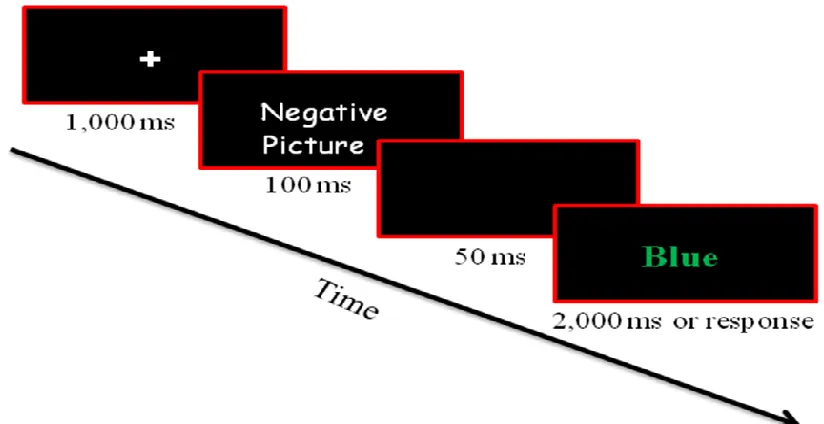
picture would appear but no action would be required (see Figure 2).
---
Insert Figure 2 here
---
Results
Stroop task. Accuracy rates were high and no modulation by anxiety group or
valence was found (see Table 1). We therefore focused our analysis on reaction times (RT).
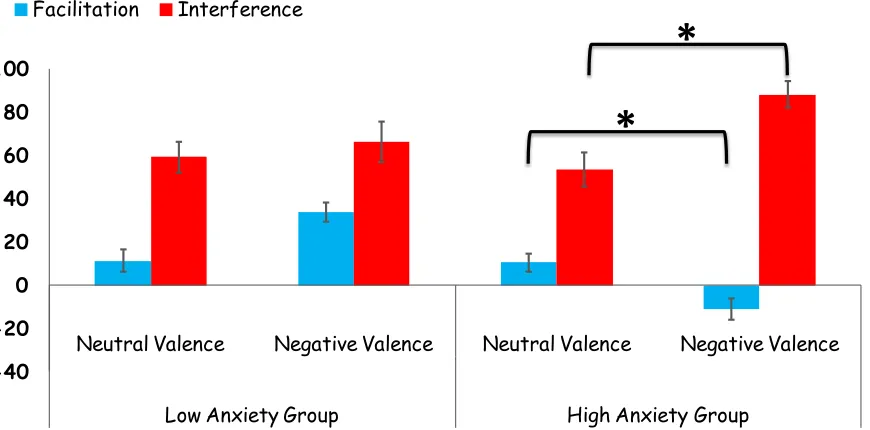
The mean RT for the correct responses as a function of distractor-valance and Stroop
congruency is shown in Figure 3 and Table 1.
---
Insert Table 1 here
---
with congruency (congruent vs. neutral vs. incongruent) and valence (neutral vs. negative)
as within-subjects factors and group (HA vs. LA) as a between-subjects factor. The results
revealed the expected main effect of congruency (incongruent RT > neutral RT > congruent
RT), which was significant, F (2, 96) = 47.38, MSE = 3,754.18, p < .001, = .5; a main
effect of picture valence (negative RT > neutral RT), F (1, 48) = 10.32, MSE = 1,602.17, p
< .01, = .18; and no significant effect of group (F < 1). Critical to our hypothesis, the
triple interaction between congruency, valence, and group was significant, F (2, 96) = 3.22,
MSE = 950.78, p = .04, = .06)3.
In order to examine our a priori assumption and to investigate the triple interaction,
we carried out two post-hoc planned ANOVAs with congruency and valence as
within-subjects factors, for HA and LA groups separately. In the LA, we only found a main effect
of congruency, F (2, 48) = 21.77, MSE = 4,489.38, p < .001, = .48; and no main effect for
picture valence. F (1, 24) = 1.27, MSE = 1,615.22, p = .27, nor an interaction between
congruency and valence, F (2, 48) = 2.54, MSE = 1,217.82, p >.1. Post-hoc analyses revealed
that there were no effects of the aversive emotional distractor for any of the congruency
conditions (p > .1 for all analyses) nor for the facilitation or interference effects. Thus, for
the low-anxiety group the negative emotional distractors had little or no effect on task
performance in each congruency condition (Table 1).
---
Insert Figure 3 here
---
For the HA, we also found a main effect of congruency, F (2, 48) = 27.65, MSE =
3,018.97, p < .001, = .535. However, in contrast to the LA, we also found a main effect
of valence, F (1, 24) = 11.75, MSE = 1,589.13, p < .01, = .33, and an interaction between
congruency and valence, F (2, 48) = 4.86, MSE = 783.73, p = .01, = .17. This interaction
was due to a slowdown following an aversive (compared with neutral) distractor for the
congruent, t(24) = 3.03, p < .01, Cohen’s d = .61, and the incongruent conditions, t(24) =
3.86, p < .001, Cohen’s d =.77, but not for the neutral condition, t(24) < 1, p = .7. Thus, as
predicted by our model (Figure 1), for the high-anxiety group we found that negative
interference, t(24) = 2.89, p < 0.1, Cohen’s d =.60, and a smaller (and even reversed)
facilitation effect, t(24) = 2.01, p < .05, Cohen’s d =.42 (see Figure 3; compare with Figure
1; right panel).
Discussion
We examined how trait anxiety influences the impact of irrelevant briefly flashed
(aversive vs. neutral) distracters in the Stroop task. As the emotional distracters were
task-irrelevant and did not compete directly with the task-stimuli we were able to investigate the
effect of emotional distracters that precede the task on proactive control processes. The
results showed that while the negative emotional distractor had little effect on the Stroop-RT
in low trait anxious participants, they had a significant effect in high trait anxious participants
resulting in a slowdown after negative emotional distractors, for both congruent and
incongruent Stroop stimuli, but not for neutral Stroop stimuli.
The lack of an emotion-valence effect on incongruent trials in low anxious
participants extends the results from our pilot experiment (see Supplementary Material B)
and converges with previous results (Cohen et al., 2011) where no effect of distractor-valance
on incongruent flanker trials was found in an unselected sample of participants not defined
by their levels of anxiety4. Extending the interpretation put forward by Cohen et al. (2011),
our results suggest that participants scoring at low or medium ranges on measures of anxiety
are often able to recruit executive control to inhibit the aversive impact of task-irrelevant
stimuli. These results are also consistent with those of Derakshan et al. (2009, Exp. 2), who
found no increase in the antisaccade-RT for angry (compared with neutral) cues. Recent
neuroscientific evidence provides a potential neural mechanism for the inhibition of the
task-irrelevant distractors in low anxiety participants (Etkin, Egner, Peraza, Kandel, & Hirsch,
2006). Using a modified Stroop task with emotional material, Etkin et al., have reported a
top-down inhibition from a conflict-resolution area (rostral cingulate) to emotional conflict
areas (right amygdala). The results, however, differ from those of Hart et al. (2010), in which
a slowdown after aversive emotional distractor was found on Stroop incongruent trials. The
reason for this difference may relate to individual differences, as the participants’ anxiety
level was not reported (see below), as well as some procedural differences that may have
to emotional interference.
For high trait anxious participants, however, we found a specific slowdown in both
incongruent and congruent (but not in neutral) Stroop trials, after negative (compared with
neutral) emotional distractors (see also Hart et al., 2010). This slowdown indicates that in
high trait anxious participants, the emotional distractors disrupted proactive control, as
predicted by the proactive-control/task-conflict model (Kalanthroff, et al., 2015). These
results are also consistent with, and extend the basic tenets of ACT (Berggren & Derakshan,
2013a; Eysenck et al., 2007), where anxiety is believed to bias the attentional system in favor
of bottom-up processing over top-down control exaggerating the impact of emotional
(threat-related) stimuli (Derakshan et al. 2009) and concurrent load (Berggren et. al., 2013)
on working memory. Finally, our results are consistent with the dual competition model,
according to which there is a common and limited resource of emotional and executive
control processes (Pessoa, 2009), as well as fitting in with biased competition models of
attention (Desimone & Duncan, 1995), where the competition between task-relevant control
process and the transient activation triggered by the emotional distractor is expected to be
exacerbated in individuals high in anxiety. (Iordan et al., 2013).
The current results have specific implications for the field of executive control as
well as for the field of emotion-regulation, in particular emotional disorders such as anxiety
and depression. It is noteworthy to mention that emotional distractibility was not apparent
as a general slowing down of RT (Algom, Chajut & Lev, 2004; Tipples & Sharma, 2000), as
we found no slowdown in the Stroop neutral condition after aversive distractors in high
anxiety participants (Table 1). Rather the slow down we found here was specific to the
incongruent and congruent conditions. While the former can reflect the familiar
response-conflict, the latter likely indicates task-conflict (both congruent and incongruent conditions
are subject to a conflict between the relevant task of color-naming and the irrelevant but
automatic one of word-reading). Due to the efficiency of the task control mechanisms (e.g.,
Glodfarb & Henik, 2007; La Heij & Boelens, 2011), task conflict is commonly not evident
in the Stroop task and thus commonly ignored. As depicted in our computational model
(Figure 1, right panel), task-conflict, as indicated by increased interference and reverse
facilitation, is an outcome of reduced proactive task-control, an effect only found in high
reducing proactive task control, compromising on performance outcome. Our results extend
previous findings (see Berggren & Derakshan, 2013a for a review) suggesting that anxiety
is associated with difficulties in filtering the impact of a prior emotional event on subsequent
task processing demands. Here, it is likely that trait anxious individuals held the negatively
laden task irrelevant information in working memory to subsequently impair their
performance on a task that required the efficient regulation of prefrontal mechanisms of
inhibitory control. It is for future research to understand the causal mechanisms behind
anxiety based impairments in filtering task irrelevant negative information. Such
impairments are most likely due to reduce processing efficiency of attentional control. The
adverse effects of excessive emotional processing and its pre-occupation in working
memory, that is needed for efficiency in day to day functioning, can result in unwanted
consequences that will in turn be erroneously attributed to one’s own efficacy. Such common
difficulties in the regulation and execution of prefrontal mechanisms of control when
exposed to negative information may impair the quality of life of anxious individuals over
and above the effect of anxiety over the emotional system and attention. Future studies may
also examine possible ways in which attentional control can be enhanced to reduce the
impact of threat related material in working memory (see Sari, Koster, Pourtois, &
Derakshan, under review).
The results of the current investigation pave the way for more refined methods and
theoretical directions that may be explored in future studies, to also address some of the
limitations of the present investigation. To further maximize their emotional impact, the
aversive pictures used in the current study were of low valence and high arousal, identical
to previous studies that investigated the effect of emotional valence on the executive system
(i.e., Kalanthorff, Cohen, & Henik, 2013; Verbruggen & De Houwer, 2007; Hart et al., 2010).
Future research should clarify the attributed effects to dimensions of valence and arousal.
Given that trait anxiety is an important vulnerability factor in the development of clinical
anxiety levels with deleterious effects on every day functioning, it will be helpful to also
extend the current investigation to a clinical sample of anxious participants. Finally, it will
be interesting to examine how attentional control in low anxious individuals is affected by
emotional distractors in more ecological situations, such as those where the emotional
name). An attractive hypothesis is that emotional stimuli generate a switch from a top-down
task-control mode to a bottom-up processing mode that facilitates the processing of the
salient emotional stimulus at the expense of top down control (Wyble et al., 2008).
Accordingly, attentional capture by emotional distracters will be evident even in low anxious
participants under such conditions.
In conclusion, in line with the predictions of our proactive task-control model, we
found that emotional distractors reduce proactive task control in trait anxious individuals.
We conclude that while low anxious participants can filter out emotional distracters,
maintaining intact task control, anxious individuals show difficulty filtering out emotional
References
Algom, D., Chajut, E., & Lev, S. (2004). A rational look at the emotional Stroop
phenomenon: a generic slowdown, not a stroop effect. Journal of Experimental
Psychology: General, 133, 323.
Ansari, T. L., & Derakshan, N. (2010). Anxiety impairs inhibitory control but not volitional
action control. Cognition and Emotion, 24, 241-254.
Ansari, T. L., & Derakshan, N. (2011a). The neural correlates of cognitive effort in anxiety:
Effects on processing efficiency. Biological Psychology, 86, 3`7-348.
Ansari, T. L., & Derakshan, N. (2011b). The neural correlates of impaired inhibitory
control in anxiety. Neuropsychologia, 49, 1146-1153.
Banich, M. T. (2009). Executive function the search for an integrated account. Current
Directions in Psychological Science, 18, 89-94.
Bar-Haim, Y., Lamy, D., Pergamin, L., Bakermans-Kranenburg, M. J., & Van Ijzendoorn,
M. H. (2007). Threat-related attentional bias in anxious and nonanxious
individuals: a meta-analytic study. Psychological Bulletin, 133, 1.
Berggren, N., & Derakshan, N. (2013a). Attentional control deficits in anxiety: Why you
see them and why you don’t. Biological Psychology, 92, 440-446.
Berggren, N., & Derakshan, N. (2013b). The role of consciousness in attentional control
differences in trait anxiety. Cognition & Emotion, 27, 923-931.
Berggren, N., & Derakshan, N. (2014). Inhibitory deficits in trait anxiety: Increased
stimulus-based or response-based interference? Psychonomic Bulletin &
Review, 21, 1339-1345.
cognitive load: reduced emotional biases but emergent anxiety-related costs to
inhibitory control. Frontiers in Human Neuroscience, 7.
Botvinick, M. M., Braver, T. S., Barch, D. M., Carter, C. S., & Cohen, J. D. (2001).
Conflict monitoring and cognitive control. Psychological Review, 108, 624–652.
Braver, T. S. (2012). The variable nature of cognitive control: a dual mechanisms
framework. Trends in Cognitive Sciences, 16, 106–113.
doi:10.1016/j.tics.2011.12.010
Cohen, N., Henik, A., & Mor, N. (2011). Can emotion modulate attention? Evidence for
reciprocal links in the Attentional Network Test. Experimental Psychology, 58,
171-179.
Cohen, N., Henik, A., & Moyal, N. (2012). Executive control attenuates emotional
effects—For high reappraisers only? Emotion, 12, 970-979.
Denkova, E., Wong, G., Dolcos, S., Sung, K., Wang, L., Coupland, N., & Dolcos, F.
(2010). The impact of anxiety-inducing distraction on cognitive performance: a
combined brain imaging and personality investigation. PLoS One, 5, e14150.
Derakshan, N., Ansari, T. L., Hansard, M., Shoker, L., & Eysenck, M. W. (2009). Anxiety,
inhibition, efficiency, and effectiveness: An investigation using the antisaccade
task. Experimental Psychology, 56, 48-55.
Derakshan, N. & Eysenck, M. W. (2009). Anxiety, processing efficiency and cognitive
performance: New developments from attentional control theory. European
Psychologist, 14, 168-176
Desimone, R. & Duncan, J. (1995). Neural mechanisms of selective visual attention.
Dolcos, F., Diaz-Granados, P., Wang, L., & McCarthy, G. (2008). Opposing influences of
emotional and non-emotional distracters upon sustained prefrontal cortex activity
during a delayed-response working memory task. Neuropsychologia, 46, 326-335.
Dolcos, F., & McCarthy, G. (2006). Brain systems mediating cognitive interference by
emotional distraction. The Journal of Neuroscience, 26, 2072-2079.
Dolcos, F., Miller, B., Kragel, P., Jha, A., & McCarthy, G. (2007). Regional brain
differences in the effect of distraction during the delay interval of a working
memory task. Brain Research, 1152, 171-181.
Etkin, A., Egner, T., Peraza, D. M., Kandel, E. R., & Hirsch, J. (2006). Resolving
emotional conflict: a role for the rostral anterior cingulate cortex in modulating
activity in the amygdala. Neuron, 51, 871-882.
Eysenck, M. W., Derakshan, N., Santos, R., & Calvo, M. (2007). Anxiety and cognitive
performance: attentional control theory. Emotion, 7, 336-353.
Georgiou, G., Bleakley, C., Hayward, J., Russo, R., Dutton, K., Eltiti, S., & Fox, E. (2005).
Focusing on fear: Attentional disengagement from emotional faces. Visual
Cognition, 12, 145-158.
Goldfarb, L., & Henik, A. (2007). Evidence for task conflict in the Stroop effect. Journal
of Experimental Psychology: Human Perception and Performance, 33, 1170–1176.
doi:10.1037/0096-1523.33.5.1170
Hart, S. J., Green, S. R., Casp, M., & Belger, A. (2010). Emotional priming effects during
Stroop task performance. NeuroImage, 49, 2662–2670.
doi:10.1016/j.neuroimage.2009.10.076
emotional distraction: a review of evidence from brain imaging
investigations. Frontiers in Human Neuroscience, 7.
Kalanthroff, E., Avnit, A., Henik, A., Davelaar, E. J., & Usher, M. (2015). Stroop proactive
control and task conflict are modulated by concurrent working memory
load. Psychonomic Bulletin & Review, 22, 869-875.
Kalanthroff, E., Cohen, N., & Henik, A. (2013). Stop feeling: inhibition of emotional
interference following stop-signal trials. Frontiers in Human Neuroscience, 7, 78.
doi:10.3389/fnhum.2013.00078
Kalanthroff, E., Goldfarb, L., & Henik, A. (2013). Evidence for interaction between the
stop signal and the Stroop task conflict. Journal of Experimental Psychology:
Human Perception and Performance, 39, 579–592. doi:10.1037/a0027429
Kalanthroff, E., & Henik, A. (2013). Individual but not fragile: Individual differences in
task control predict Stroop facilitation. Consciousness and Cognition, 22, 413-419.
Kanske, P. (2012). On the influence of emotion on conflict processing. Frontiers in
Integrative Neuroscience, 6, 42.
La Heij, W., & Boelens, H. (2011). Color–object interference: Further tests of an executive
control account. Journal of Experimental Child Psychology, 108, 156-169.
Lang, P., Bradley, M., & Cuthbert, B. (2008). International affective picture system (IAPS):
Affective ratings of pictures and instruction manual. Technical Report A-8.
University of Florida, Gainesville, FL.
Lang, P. J., Davis, M., & Öhman, A. (2000). Fear and anxiety: animal models and human
cognitive psychophysiology. Journal of Affective Disorders, 61, 137-159.
function. Annual Review of Neuroscience, 24, 167-202.
Miyake, A., Friedman, N. P., Emerson, M. J., Witzki, A. H., Howerter, A., & Wager, T. D.
(2000). The unity and diversity of executive functions and their contributions to
complex ‘‘frontal lobe’’ tasks: A latent variable analysis. Cognitive Psychology, 41,
49–100.
Padmala, S., Bauer, A., & Pessoa, L. (2011). Negative emotion impairs conflict-driven
executive control. Frontiers in Psychology, 2, 192. doi:10.3389/fpsyg.2011.00192
Pessoa, L. (2009). How do emotion and motivation direct executive control? Trends in
Cognitive Sciences, 13, 160–166.
Peterson, R. A., & Reiss, S. (1987). Test manual for the Anxiety Sensitivity Index. Orland
Park, IL: International Diagnostic Systems.
Sari, B., Koster, E.H.W., Pourtois, G., & Derakshan, N. (under review). Training working
memory to improve attentional control in anxiety: A proof of principle study using
behavioural, cognitive and electrophysiological measures.
Spielberger, C. D., Gorsuch, R. L., Lushene, R., Vagg, P. R., Jacobs, G. A. Manual for the
State–Trait Anxiety Inventory. Palo Alto, CA: Consultant Psychologists Press:
1983.
Stroop, J. R. (1935). Studies of interference in serial verbal reactions. Journal of
Experimental Psychology, 18, 643-662.
Tipples, J. & Sharma, D. (2000). Orienting to exogenous cues and attentional bias to
affective pictures reflect separate processes. British Journal of Psychology, 91,
87-97.
inhibition? Evidence from the stop signal paradigm. Cognition & Emotion, 21,
391–403. doi:10.1080/02699930600625081
Verbruggen, F., & Logan, G. D. (2008). Response inhibition in the stop-signal
paradigm. Trends in Cognitive Sciences, 12, 418-424.
Wyble, B., Sharma, D., & Bowman, H. (2008). Strategic regulation of cognitive control by
emotional salience: A neural network model. Cognition & Emotion, 22, 1019–1051.
Footnotes
1The main difference is that in our study the frequency of congruent, incongruent
and neutral Stroop stimuli was equal, while in Hart et al.’s study 66% of the stimuli were
neutral.
2 Participants also completed a number of additional anxiety related questionnaires
that are not reported here.
3The two-way interactions were not reported since they were qualified by the
triple-interaction and were not at the center of this investigation.
4In Cohen et al. (2011), an effect of negative emotional distractor was found in
congruent trials. This, however was a flanker-task, which unlike the Stroop task does not
Figure 1 (adopted from Kalanthroff, Avnit, Henik, Davelaar, & Usher, 2015). Left: A schematic model demonstrating the work of two task-control units in the Stroop task, which project and receive projection from sensory layers. Task-conflict is represented by the flash-event and it inhibits the response units. The task demand units are modulated by a proactive control (PC) circuit associated with the Anterior Cingulate (AC; Botvinick, et al, 2001). The numbers in the figure represent weights for the different connections, which are stronger for word-reading (2.5) compared to color-naming (2), indicating automaticity of the former. Right: Model predictions for facilitation and interference under high and low proactive task-control (emotional) load.
BLUE GREEN
BLUE GREEN BLUE GREEN
Color-naming
Word-reading PC
Input – Color feature layer Input – Lexical layer Response layer Task demand layer
2 2
[image:22.612.30.579.63.271.2]Figure 3. Results of the emotional Stroop task as a function of group and emotional distractor valence. Results revealed that the for the low anxiety group, distractor-valence did not affect task performance in any congruency condition, whereas for the high anxiety group, negative emotional distractors resulted in reduced facilitation (neutral RT minus congruent RT) and increased interference (incongruent RT minus neutral RT) whereas neutral trials were not affected. Error bars represent one standard error from the mean. * - significant at 0.05 level.
-40 -20 0 20 40 60 80 100
Neutral Valence Negative Valence Neutral Valence Negative Valence
Low Anxiety Group High Anxiety Group Facilitation Interference
Table 1
Reaction times in the Emotional Stroop Task
Note: Mean RTs ± 95% confidence intervals, (standard error of the means), and [accuracy rate] under the different congruency conditions of the emotional Stroop task.
Task congruency
Valence Congruent Neutral Incongruent
Low anxiety
Neutral 652±28 (14) [.96] 663±33 (16) [.95] 722±50 (24) [.96]
Negative 642±26 (13) [.93] 676±32 (16) [.95] 742±54 (26) [.94]
High anxiety
Neutral 659±35 (17) [.95] 670±35 (17) [.96] 723±42 (20) [.97]
Negative 684±37 (18) [.98] 673±38 (18) [.97] 762±42 (20) [.95]
[image:25.612.75.474.160.456.2]