Proportional-integral-plus control applications
of state-dependent parameter models
C J Taylor1*, E M Shaban1, M A Stables1,andS Ako2
1Engineering Department, Lancaster University, Lancaster, UK
2Bachy Soletanche Limited, Burscough, UK
The manuscript was received on 10 October 2006 and was accepted after revision for publication on 23 May 2007.
DOI: 10.1243/09596518JSCE366
Abstract: This paper considers proportional-integral-plus (PIP) control of non-linear systems defined by state-dependent parameter models, with particular emphasis on three practical demonstrators: a microclimate test chamber, a 1/5th-scale laboratory representation of an intelligent excavator, and a full-scale (commercial) vibrolance system used for ground improve-ment on a construction site. In each case, the system is represented using a quasi-linear state-dependent parameter (SDP) model structure, in which the parameters are functionally dependent on other variables in the system. The approach yields novel SDP–PIP control algorithms with improved performance and robustness in comparison with conventional linear PIP control. In particular, the new approach better handles the large disturbances and other non-linearities typical in the application areas considered.
Keywords: control system design, non-minimal state space, state-dependent parameters, hydraulic actuators, system identification
1 INTRODUCTION but with additional dynamic feedback and input
compensators introduced automatically when the process has second-order or higher dynamics, or Previous papers have considered the
proportional-pure time delays greater than unity. In contrast to integral-plus (PIP) controller, in which non-minimal
conventional PI/PID control, however, PIP design state-space (NMSS) models are formulated so that full
exploits state variable feedback (SVF) methods, where state variable feedback control can be implemented
the vagaries of manual tuning are replaced by pole directly from the measured input and output signals
assignment or linear quadratic (LQ) design. of the controlled process, without resort to the
To date, however, inherent non-linearities in the PIP design and implementation of a deterministic state
system have been accounted for in a rather ad hoc reconstructor (observer) or a stochastic Kalman
manner at the design stage, sometimes leading to filter [1–3].
reduced control performance. For example, pressure Such PIP control systems have been successfully
disturbances sometimes take the ventilation rate in a employed in a range of practical applications,
parti-building sufficiently far from the operating condition cularly in the areas of microclimate control for
on which the linear controller is based for the agricultural buildings [4,5], and in the automation
response to such a disturbance to be relatively slow. of construction robots on building sites [6,7]. In both
Similarly, on a construction site, the behaviour of these application areas, the most common types of
hydraulically driven manipulators is dominated by controller used previously have been derived from
the highly non-linear, lightly damped dynamics of the ubiquitous proportional-integral-derivative (PID)
the actuators [10]. approach (see, for example, references [8] and [9]).
To improve PIP control in such cases, therefore, In this regard, PIP control can be interpreted as one
the present paper identifies, and subsequently exploits logical extension of conventional PI/PID methods,
e.g. Young [11]. The linear-like, affine structure of the 2.1 Model structure SDP model means that, at each sampling instant, it
Consider the deterministic form of the SDP model can be considered as a ‘frozen’ linear system. This [11,16]
formulation may then be used to design an SDP–PIP
y
k=wTkpk (1)
control law at each sampling instant using linear
methods [12]. where wT
k is a vector of lagged input and output The present paper develops this new approach for variables and p
k is a vector of SDP parameters, three practical demonstrators, related to both the defined as follows
above application areas: a microclimate test chamber
wT
k=[−yk−1 −yk−2 , −yk−n uk−1 , uk−m] representing a section of a livestock building, a
1/5th-scale laboratory model of an intelligent excavator, p
k=[a1{xk} a2{xk} , an{xk} b1{xk} , bm{xk}]T and a full-scale (commercial) vibrolance system used Here,
y
kis the output andukthe control input, while for ground improvement on a construction site.
a
i{xk} (i=1, 2, … ,n) and bj{xk} (j=1, … , m) are With regard to the first of these examples, the
state-dependent parameters. The latter are assumed paper focuses on the control of ventilation rate using to be functions of a non-minimal state vector an axial fan. Ventilation is one of the most significant
xT
k=[wkT Uk] in which Uk=[U1,k, U2,k, … , Ur,k] is a inputs in the control of the microclimate surrounding vector of other variables, not necessarily y
k or uk. plants or animals within the majority of agricultural However, for SDP–PIP control system design, it is buildings [13]. For example, without adequate fresh usually sufficient to limit model (1) to the case where air supply within a livestock enclosure, animal com- xT
k=wTk. Any pure time delay t1 is represented fort and welfare are drastically reduced, especially by setting the leading b
1{xk} …bt−1{xk} terms to during high-density occupation, where excessive levels zero. Finally,n and mare integers representing the of moisture, heat, and internal gases are generated. maximum lag associated with the output and input
By contrast, in the civil and construction industries, variables respectively.
semi-automatic functions are starting to be adopted Numerous recent publications describe an approach as a means of improving efficiency, quality, and safety. for the identification and estimation of the SDP model The control problem is made difficult by a range of defined by equation (1), together with the application factors that include highly varying loads, speeds, and of such methods to a wide range of environmental, geometries, as well as the soil–tool interaction in the biological, and engineering systems (see references case of autonomous excavators [14,15]. In the pre- [11] and [16] and the references therein). In the sent paper, inverse kinematics is utilized online to present context, the approach is broadly composed convert the task into a desired trajectory in the joint of two distinct stages, as discussed below.
space, while a feedback controller regulates the
2.2 Model identification applied voltage to the hydraulics, so as to maintain
these joint angles.
The underlying model structure and potential state In each case, the novel SDP–PIP approach is com- variables are first identified by statistical estimation pared with a benchmark linear PIP design. Sections of discrete-time linear transfer function models. Such 2 and 3 of the paper describe the identification and models take a similar form to equation (1) but with control methodologies. Sections 4 to 6 introduce time-invariant parameters, i.e.a
i(i=1, 2, … , n) and each demonstrator and present the implementation b
j (j=1, … , m) are constant coefficients, estimated results. Finally, the conclusions are given in section 7. using the simplified refined instrumental variable
(SRIV) algorithm [17,18].
Two main statistical measures are utilized to help identify the most appropriate linear model structure, 2 SYSTEM IDENTIFICATION i.e. the values ofnandmand the time delayt. These
are the coefficient of determinationR2
T,based on the
The controllers used in this paper are based on the response error, and Young’s identification criterion, simplest multiple-loop, single-input, single-output which provides a combined measure of model fit and models. In the case of the robot arms, there is some parametric efficiency [17,18].
However, since the changes in the parameters are initial conditions for the optimization are based on the SDP estimates obtained from the earlier KF/FIS functions of the state variables, the system may
stage of the analysis. This helps to avoid the potential exhibit severe non-linear or even chaotic behaviour.
problem of fminsearch finding a local (rather than Normally, this cannot be approximated in a simple
global) optimal set of parameters. TVP manner because the parameters can vary at a
very rapid rate. For this reason, recourse is made to a novel approach that again exploits recursive KF/FIS estimation but this time within an iterative
3 CONTROL METHODOLOGY ‘backfitting’ algorithm that involves special reordering
of the time series data [11,16].
The NMSS representation of system (1) is
x
k+1=Fkxk+gkuk+dyd,k 2.3 Parameter estimation
y k=hxk Eacha
i{xk} andbj{xk} in model (1) can be considered (2)
as a ‘non-parametric’ estimate because it has a
different value at each sample and can only be where the non-minimal state vector at the kth viewed in complete form as a graph. However, it is sample is defined as
possible to proceed to a final parametric estimation
stage where the non-parametrically defined non- x
k=[yk , yk−n+1 uk−1 , uk−m+1 zk]T linearities obtained initially by KF/FIS estimation are
and z
k=zk−1+[yd,k−yk] is the integral of error now parameterized in some manner in terms of their
between the reference or command input y d,k and associated dependent variable.
the sampled output y
k. As usual for NMSS design, This can be achieved by defining an appropriate
inherent type 1 servomechanism performance is parametric model in some convenient form, such
introduced by means of this integral-of-error state [1]. as a trigonometric function, a radial basis function,
The state transition matrixFkand input vectorgk at or a neural network. The parameters of this
para-the kth sample, together with the time-invariant meterized model can then be estimated directly
commanddand observation vectors h, are defined from the input–output data using some method of
as follows dynamic model optimization, e.g. deterministic
non-linear least squares or a more statistically efficient
F
k=[F1,k F2,k] stochastic method, such as maximum likelihood.
However, for the practical applications considered g
k=[b1{xk+1} 0 0 , 0 1 0 , 0 −b1{xk+1}]T below, polynomial or linear functions of the state
variables are sufficient for control system design. The d=[0 0 0 , 0 1]T associated coefficients are straightforward to estimate
h=[1 0 0 , 0 0] using standard numerical optimization functions,
such as fminsearch in MATLABA. In this case, the
with the components
F 1,k= t N N N N N N N N N N N N N N N v −a
1{xk+1} −a2{xk+1} , −an−1{xk+1} −an{xk+1}
1 0 , 0 0
0 1 , 0 0
e e P e e
0 0 , 1 0
0 0 , 0 0
0 0 , 0 0
e e P e e
0 0 , 0 0
a
F2,k= t N N N N N N N N N N N N N N N v
b2{x
k+1} , bm−1{xk+1} bm{xk+1} 0
0 0 0 0 0
0 0 0 0 0
e e e e 0
0 , 0 0 0
0 , 0 0 0
1 , 0 0 0
e P e e e
0 , 1 0 0
−b2{x
k+1} , −bm−1{xk+1} −bm{xk+1} 1 u N N N N N N N N N N N N N N N w
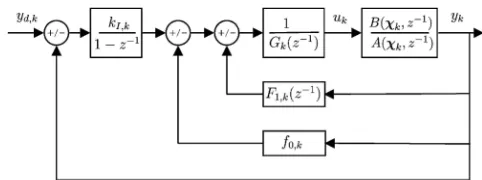
Fig. 1 SDP–PIP control implemented in feedback form
A(xk, z−1) and B(xk,z−1) in Fig. 1 represent the SDP model (1) in polynomial form, similar to a transfer function but with state-dependent parameters [11,16].
Note that the elements of the (n+1)th row ofF kare
all zero ifm>1. 3.2 Controllability
A prerequisite of global controllability is that the 3.1 Control algorithm
system {F
k,gk,h,d} is piecewise controllable at each The control law takes the usual SVF form sample k, with the standard NMSS controllability conditions applying over the sampling period. This
v
k=−lkxk (3) requirement follows from the fact that, if a system
where the control gain vector is globally controllable, it clearly has to be locally controllable. Although omitted here for brevity,
l
k=[f0,k , fn−1,k g1,k , gm−1,k −kI,k} such NMSS/PIP linear controllability conditions are derived by Younget al.[1].
is obtained at each sampling instant by either pole
assignment or optimization of an LQ cost function. The first condition states that there should be no pole zero cancellations in the model, while the With regard to the latter approach, earlier research has
either used a ‘frozen-parameter’ system defined as a second avoids the presence of a zero at unity, which would cancel with the unity pole associated with sample member of the family of NMSS models
{F
k,gk,d,h} or has solved the discrete-time algebraic the integral action. In the SDP–PIP case, it is straight-forward to check these conditions at every sampling Riccatti equation at each sampling instant [12]. For
pole assignment, the control gains are similarly deter- instant to ensure local controllability. If they fail to hold at thekth sample, model (1) is instead evaluated mined using linear methods. One approach, for
example, involves definition of a genericSmatrix [1]. for k−1. Unfortunately, this effectively leaves the system in linear (fixed-gain) mode for a period of Alternatively, it is straightforward to derive algebraic
solutions for specific cases, as illustrated in reference time, something that can be undesirable in practice. For this reason, the present research first identifies [21].
Note that the expected design response in the pole any problem regions of the parameter space by off -line simulation. This is feasible because, in practice, assignment case, such as dead-beat or a specified
degree of overshoot, is only obtained when the most the system variables will always be constrained to lie within a certain range. For example, the boom angle recent SDP estimates are utilized, i.e. Fk and gk are
defined in terms of x
k+1 rather than xk in equations of the vibrolance system is limited by hardware to 060°, while the input is a voltage signal scaled (2). This result mirrors that found for PIP control of
bilinear systems, a special case of the SDP model con- within ±1000 (section 6). The trajectory of the command input is subsequently chosen to avoid sidered here [22]. In a similar manner to the present
example, reference [23] demonstrates that the bilinear local controllability problems, if any arise. Of course, such an approach is necessarily based on a case-parameter utilized in the control law should be based
onk+1 rather than k. by-case empirical study and, as the order of the
[image:4.595.53.294.62.234.2]system increases (for example with multiple state Figure 1 illustrates the SDP–PIP controller in block
diagram form, where the control polynomials are dependencies), requires an increasing computational burden to evaluate [24].
given by F
1,k(z−1)=f1,k+,+fn−1,k and Gk(z−1)= 1+g
[image:4.595.305.546.66.156.2]of ongoing research by the authors, the pragmatic approach described above appears satisfactory for all three applications considered in the present paper, as shown below.
4 VENTILATION CHAMBER
Taylor [25] describes the utility of a 2 m2 by 1 m forced-ventilation test chamber at Lancaster University. A computer-controlled axial fan is positioned at the outlet in order to draw air through the chamber, while an air velocity transducer measures the associated ventilation. The inlet airflow is independently regulated by a second fan, utilized to represent realistic pressure disturbances and
Fig. 2 Ventilation rate SDP model. Upper graph:a
1{xk} external wind conditions. estimates (dots) and least-squares fitted straight line (solid trace) plotted against air velocity 4.1 SDP model for ventilation rate (m/s). Lower graph: power curve represented by equation (5), showing the steady-state air Analysis of experimental data from the chamber
velocity (m/s) plotted against the scaled voltage yields the following SDP model for ventilation rate, input (%)
witht=2sample time delays [21] y
k=−a1{xk}yk−1+b2{xk}uk−2
For comparison, a fixed-gain PIP controller is also a
1{xk}=a1+a2yk−1 developed for an operating level of 4–5 m/s. As would be expected, the performance of the SDP–PIP and b
2{xk}= w{u
k−2}(1+a1{yk−1}) u
k−2 linear PIP designs are very similar for ventilation
rates close to this operating level. (4)
By contrast, Fig. 3 shows the advantage of the where a
1 anda2 are constant coefficients,w{uk−2} is non-linear approach when low airflow rates are the non-linear relationship discussed below,y
kis the encountered (similar results emerge for high airflows). outlet air velocity (m/s), andu
kis the voltage applied to the fan, expressed as a percentage of the maximum voltage. Equation (4) is based on a sampling rate of 2 s, which yields a good compromise between a fast response and a desirable low-order model.
At high applied voltages, the steady state airflow rate converges asymptotically to a maximum value determined by the characteristics of the fan, defined by the following relationship based on a logistic growth function
y
2=w{u2}=
G
ymax
1+e−h(u2−x0)1/c
H
(5)where y
2 is the steady-state air velocity, u2 is a constant applied voltage, and y
max, h, x0, and c are
coefficients. Figure 2 illustrates the estimated linear state dependency for a
1{xk} and the power curve equation (5).
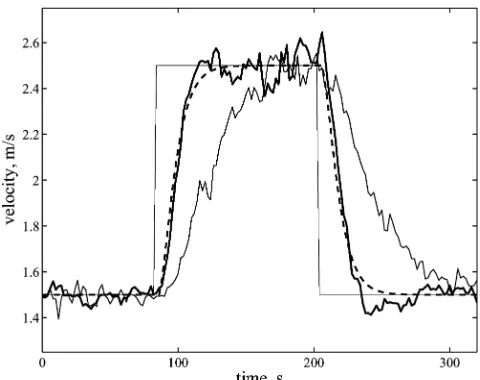
Fig. 3 Ventilation chamber implementation experiment showing the air velocity plotted against time (s): 4.2 Implementation
command input (step changes), SDP–PIP (thick For the present example, SDP–PIP design is based trace), fixed-gain PIP (thin), and simulated
[image:5.595.309.546.65.251.2] [image:5.595.308.548.484.674.2]Figure 3 shows that the SDP–PIP-controlled output 5 LABORATORY EXCAVATOR approximates the desired speed of response specified
by the pole positions, determined by simulating the The laboratory robot arm is a 1/5th-scale represent-ation of the more widely known Lancaster University design polynomial in open loop. By contrast, the
inherent model mismatch of the linear controller computerized intelligent excavator (LUCIE), which has been developed to dig trenches on a construction yields a significantly slower response.
In the context of agricultural buildings, the site [6,9]. It provides a valuable test bed for the safe development of new control strategies before disturbance response illustrated by Fig. 4 is of
parti-cular significance. Here, the secondary fan at the implementation on full-scale systems.
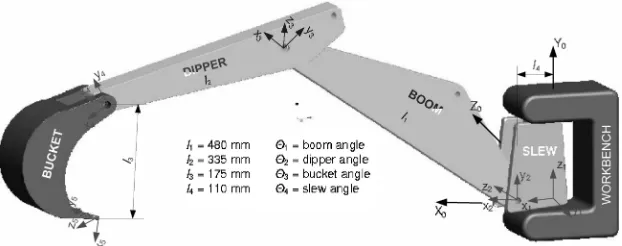
As illustrated in Fig. 5, the arm consists of four chamber inlet is employed to simulate large pressure
disturbances. These disturbances temporarily take hydraulically actuated joints. The joint angles are measured directly by mounting rotary potentiometers the ventilation rate away from the operating level of
the fixed-gain controller, and hence the SDP–PIP concentrically with each joint pivot. These signals are routed to high-linearity instrumentation amplifiers design reacts fastest to the problem.
within the card rack for conditioning before forward-ing to the A/D converter. The rig is supported by multiple I/O asynchronous real-time control systems, which allow for multitasking processes via modularization of code written in Turbo C++A.
Valve calibration is based on normalizing the input voltage of each joint into input demands, which range from −1000 for the highest possible downward velocity to+1000 for the highest possible upward velocity. Here, an input demand of zero corresponds to no movement. Note that, without such valve calibration, the arm will gradually slack down because of the payload carried by each joint (see reference [24] for details).
In open-loop mode, the arm is manually driven to dig a trench in the sandpit, with the operator using two analogue joysticks, each with two degrees of freedom. The first joystick is used to drive the boom Fig. 4 Ventilation chamber disturbance experiment. and slew joints, while the other is used to move the Upper graph: air velocity with the operating dipper and bucket joints. In this manner, a skilful level removed, plotted against time (s):
com-operator moves the four joints simultaneously to mand input (constant), SDP–PIP (thick trace),
perform the task. By contrast, the objective here is to and fixed-gain PIP (thin). Lower graph: SDP–PIP
design a computer-controlled system for automatic control input (thick) and disturbance fan input
(thin), both scaled voltages (%) digging without human intervention.
[image:6.595.46.285.272.454.2] [image:6.595.142.453.585.708.2]5.1 Kinematics invariant parameters. Note that the arm essentially acts as an integrator, since the normalized voltage The kinematic equations below allow the tool tip to
has been calibrated so that there is no movement be programmed to follow the planned trajectory, while
whenu
k=0. In fact, a1=−1 is fixed a prioriin the
the bucket angle is separately adjusted to collect or
final model, so that only the numerator parameter release sand. In this regard, Fig. 5 shows the laboratory
b
tis estimated in practice for linear PIP design. excavator and its dimensions, i.e.h
i(joint angles) and However, further analysis of open-loop data reveals l
i(link lengths), wherei=1, 2, 3, and 4 for the boom, limitations in the linear model. In particular, the dipper, bucket, and slew respectively.
value of b
t changes by a factor of ten or more, Given {X, Y, Z} from the trajectory planning routine,
depending on the applied voltage used in the step i.e. the position of the end-effector using a
coordi-experiments. In fact, SDP analysis suggests that a nate system originating at the workbench, together
more appropriate model for the boom takes the form with the orientation of the bucket H=h
1+h2+h3, of equation (4) with the following inverse kinematic algorithm is derived
by Shaban [24] using the well-known Denavit– a
1{xk}=0.28×10⁻⁶u2k−2−1 Hartenberg convention. Here,C
iandSidenote cos(hi) b
2{xk}=−5.8×10⁻⁶uk−2+0.0194 and sin(h
i) respectively, whileC123=cos(h1+h2+h3)
(12) h
4=−arctan
C
ZX
D
(6) In this regard, Fig. 6 shows the SDP model responsecompared with typical open-loop data for the boom. X9=X−l4C4
C 4
−l
3C123 (7) Here, the input sequence consists of a random series of step inputs at random levels, so as to fully excite Y9=Y−l
3S123 (8) the non-linearities in the system. For this reason,
only the SDP model captures the dynamic behaviour of the system (R2T=0.9), while the SRIV estimated h
1=arctan
C
(l1+l2C2)Y9−l2S2X9 (l
1+l2C2)X9−l2S2Y9
D
(9)
linear model fails to converge to a useful solution (R2
T<0).
h
2=±arccos
C
X92+Y92−l2 1−l22 2l
1l2
D
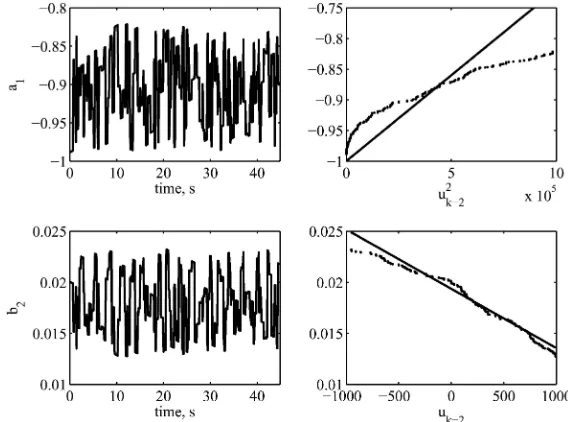
(10) Finally, Fig. 7 illustrates the parameter estimates associated with equation (12). The unsorted time h
3=H−h1−h2 (11) histories of each SDP are shown on the left-hand subplots, while the right-hand subplots illustrate the During the excavation of a trench, each cycle can
more meaningful state dependencies. For brevity, be divided into four distinct stages: positioning the
similar SDP models for the dipper, slew, and bucket bucket to penetrate the soil; the digging process in
angles are omitted here. However, full details of these a horizontal straight line along the specified void
models and associated SDP–PIP control algorithms length; picking up the collected sand from the void to
are reported by Shaban [24]. In this case, the control the discharge side; and discharging the sand. For the
algorithms are updated at each sampling instant present example, the speed profile typically ramps
using linear LQ methods. up at a constant acceleration before proceeding at a
constant speed and finally ramping down to zero at
5.3 Implementation a constant deceleration [24].
Typical implementation results for the boom arm 5.2 SDP models for joint angle
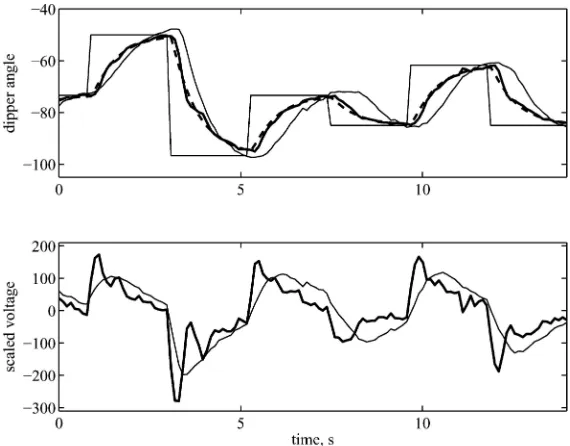
are illustrated in Fig. 8, where it is clear that the SDP–PIP algorithm is more robust than the linear For linear PIP design, open-loop step experiments
are first conducted for a range of applied voltages PIP algorithm to large steps in the command level. In fact, the linear design yields unwelcome high-and initial conditions, all based on a sampling rate
of 0.11 s. In this case, the SRIV algorithm suggests frequency oscillations in the control input signal. Note that the two controllers are designed to yield a that a first-order linear model witht samples time
delay, i.e. y
k=a1yk−1+btuk−t provides an approxi- similar speed of response to the theoretical case, shown as the dashed trace, and hence the differences mate representation of each joint, witht=1 for the
dipper and bucket joints and t=2 for the boom seen in Fig. 8 are entirely due to the inherent non-linearities in the system. The time-varying SDP–PIP and slew.
Here, y
k is the joint angle and uk is the scaled control gains for this experiment are compared with the linear gains in Fig. 9.
voltage in the range±1000, while {a
time-Fig. 6 Open-loop data for the laboratory excavator boom arm. Upper graph: boom angle (deg, dots) and SDP model response (solid) plotted against time (s). Lower graph: scaled input voltage
Fig. 7 Parameter estimates for the laboratory excavator boom arm. Left-hand graphs: SDP estimates plotted against time (s). Right-hand graphs: SDP estimates plotted against state variable, showing a typical realization from one experiment (dots) and the optimized fit from four datasets (solid)
It should be pointed out that the response time in this case, even small variations in the response time are multiplied up when the bucket position is for this example has been deliberately increased to
the practical limit of stable linear PIP control in order finally resolved in the sandpit.
In the latter regard, Table 1 compares the response to emphasize these differences. By contrast, Fig. 10
illustrates control of the dipper arm using slower time of the PIP and SDP–PIP approaches, represented by the number of seconds taken to complete three LQ weightings. Here, the SDP–PIP response closely
follows the theoretical design response, while the complete trenches, each consisting of nine digging cycles. Here, the improved joint angle control allows linear controller is rather slower. Although the
[image:8.595.155.439.66.286.2] [image:8.595.152.436.346.557.2]Fig. 8 Isolated control of the laboratory excavator boom arm, using relatively ‘fast’ control weights. Upper graph: command input (deg, sequence of step changes), theoretical response (dashed), non-linear SDP–PIP (thick), and linear PIP (thin), plotted against time (s). Lower graph: scaled input voltages
Fig. 9 Non-linear SDP–PIP (thick) and linear PIP (thin) control gains for the experiment shown in Fig. 8, plotted against time (s). Upper graph: proportional gain. Lower graph: input gain
[image:9.595.156.440.68.288.2]per cent reduction in the digging time. Finally, Fig. 11 Table 1 Time (s) taken to complete
illustrates typical SDP–PIP implementation results for one trench
one cycle of the bucket, showing a three-dimensional Trench SDP–PIP Linear PIP coordinate plot of the end-effector. This graph shows the bucket being first lowered into and sub-1 339 369
2 334 370 sequently being dragged through the sand, followed
3 336 373
[image:9.595.153.439.368.595.2] [image:9.595.87.243.677.736.2]Fig. 10 Isolated control of the laboratory excavator dipper arm. Upper graph: command input (deg, sequence of step changes), theoretical response (dashed), non-linear SDP–PIP (thick), and linear PIP (thin), plotted against time (s). Lower graph: scaled input voltages
Fig. 11 Resolved position of the laboratory excavator end-effector for one digging cycle in sand using SDP–PIP control, showing the planar horizontal and vertical displacements (XandZ), together with the slewY, with the setpoint shown as straight lines (mm)
6 GROUND COMPACTION lowered into the ground, penetrating downwards by regulating the boom (joint 2) and dipper (joint 3).
Here, the objective is to keep the arm tip moving With regard to the full-scale commercial system, the
field tests utilized a KOMATSU-PC-240-LC-7 hydraulic in a vertical straight-line path. In this manner, the surrounding soil is compacted up to a distance of excavator, as illustrated in Fig. 12. The vibrolance is
connected to the excavator arm and hangs freely like about 5 m from the probe; for granular soils, the cavity produced is subsequently filled with gravel. a pendulum (joint 4). The operator first positions the
[image:10.595.158.433.357.563.2]follows
b
b{xk}=1.5×10⁻¹¹u3k−2+1.3×10⁻⁹u2k−2 −1.88×10⁻⁵u
k−2+0.007 (13) The equivalent model for the dipper has
b
d{xk}=−1.078×10⁻⁵|uk−2|+0.015 (14) where |u
k−2| represents the absolute value of the lagged input signal. In a similar manner to the laboratory excavator,u
kis scaled in the range±1000.
6.2 Implementation
Solution of the discrete-time algebraic Riccatti equation for {F
k,gk,d,h}, yields the following SDP–PIP gain vector for the boom angle [24]
lT k=
C
22.1
22.1×b b{xk} −1.46
D
[image:11.595.46.285.63.307.2](15)
Fig. 12 Schematic diagram of the two-arm manipulator
with vibrolance The equivalent gain vector for the dipper angle is as follows
on operator skills and a lower work load, both of which might be expected to contribute to
improve-lT k=
C
25.8
25.8×b d{xk} −3.15
D
(16) ments in quality and productivity, and an increase
in tool life.
In fact, verticality errors in the uncontrolled system,
Typical closed-loop results for lowering the probe in particularly when the probe is raised from the soil,
the air are illustrated in Fig. 13. Here, it is clear that have previously led to probe repair costs of over
the SDP–PIP approach yields more accurate control £8000 on each occasion. In this regard, the present
than the linear PIP algorithm, particularly in the authors have recently developed a semi-automatic
initial positioning of the arm. In general, SDP–PIP system, whereby the operator only moves a joystick
control appears to offer smoother, more accurate either forwards or backwards in order to raise or
movement of the excavator tool and hence potentially lower the probe [24,26]. For brevity, the necessary
allows for faster response times. Note that the slew kinematic equations and rule-based algorithms for
is fixed once the probe starts to be lowered, and determining the appropriate tool-tip trajectory are
hence Fig. 13 shows only the {X, Z} coordinates, while omitted here. However, in both instances, a similar
Yremains constant during probe operations. approach to that of the laboratory excavator is
On-site implementation experiments for lowering followed (see reference [24] for details).
the probe into soil using the linear PIP controller are very promising, as reported in reference [26]. Here, 6.1 SDP models for the vibrolance
the error between the measured tool-tip trajectory and the horizontal setpoint is typically less than For this application, experimentation suggests that
a sampling rate of 0.44 s provides a good com- 10 cm for over 90 per cent of the time. To the authors’ knowledge, this level of performance is not normally promise between a fast response and a desirable
low-order model. In this case, the linear model achieved by a skilled human operator. Furthermore, the automatic system completes an entire cycle at y
k=a1yk−1+b2uk−2 again provides a reasonable
explanation of the data for a wide range of operating least as fast as a skilled human operator.
However, relatively large transient deviations from conditions. In fact, this model has been successfully
used in the design of a preliminary linear PIP control the setpoint do occasionally occur using linear PIP methods. Although these are often associated with system [26]. For non-linear design, the SDP model
of the boom takes the form of equation (4) with difficult obstructions in the soil, they provide the motivation for the present research using SDP–PIP time-invarianta
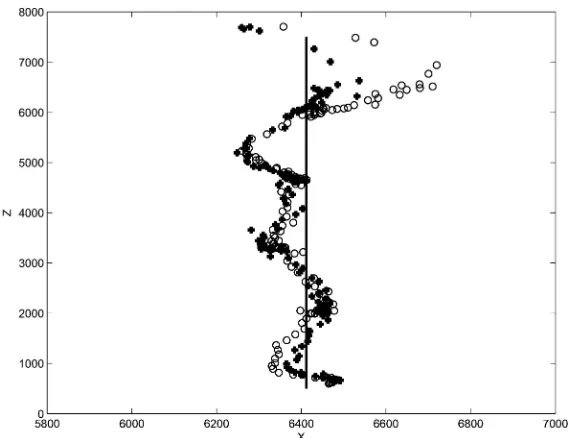
Fig. 13 Implementation experiment for the vibrolance, showing the resolved position of the end-effector, represented by the horizontal and vertical displacements (mm). Non-linear SDP–PIP control (crosses) is compared with linear PIP (circles) and the horizontal setpoint (solid)
methods. In this regard, Fig. 13 presages potential to the disturbance response. In the case of the laboratory excavator, the new approach yields improvements, and it is clear that the next step of
the research is to evaluate the on-site performance improved control of the joint angles and hence a reduced time to complete a trench. Finally, the of the new approach. Although the commercial system
used above is presently unavailable for research, the vibrolance experiments similarly suggest improved performance and robustness in comparison with the authors hope that the present paper will stimulate
further interest in this area. linear PIP methods previously developed.
ACKNOWLEDGEMENTS 7 CONCLUSIONS
The authors are grateful for the support of the Engineering and Physical Sciences Research Council This paper has developed SDP–PIP control systems
(EPSRC). Video footage of the demonstrators may for three practical demonstrators: a forced-ventilation
be downloaded from www.lancs.ac.uk/staff/taylorcj/ test chamber, a 1/5th-scale laboratory representation
nonlinear. The statistical tools and associated esti-of an intelligent excavator, and a vibrolance system
mation algorithms have been assembled as the used for ground improvement on a construction
CAPTAIN toolbox [16] within the MATLABAsoftware site. These examples represent the first practical
environment and may be downloaded from implementations of the recently proposed SDP–PIP
www.es.lancs.ac.uk/cres/captain. control methodology.
In each case, the system was modelled using the quasi-linear SDP model structure, in which the
para-REFERENCES meters are functionally dependent on other variables
in the system. This formulation is subsequently
1 Young, P. C., Behzadi, M. A., Wang, C. L., and used to design an SDP–PIP control law using linear
Chotai, A. Direct digital and adaptive control by system design strategies, such as suboptimal LQ
input–output, state variable feedback pole assign-design, in which the control gains are themselves
ment.Int. J. Control, 1987,46, 1867–1881.
state dependent. 2 Taylor, C. J., Chotai, A., and Young, P. C.
3 Taylor, C. J., Young, P. C., and Chotai, A. State 19 Kalman, R. E.A new approach to linear filtering and prediction problems.Trans. ASME, J. Basic Engng, space control system design based on non-minimal
1960,83, 95–108. state-variable feedback: further generalisation and
20 Bryson, A. E.andHo, Y. C.Applied optimal control, unification results. Int. J. Control, 2000, 73,
optimization, estimation and control, 1969 (Blaisdell 1329–1345.
Publishing Company, Waltham, UK). 4 Young, P. C., Lees, M., Chotai, A., Tych, W., and
21 Stables, M. A.andTaylor, C. J.Nonlinear control of Chalabi, Z. S.Modelling and PIP control of a
glass-ventilation rate using state dependent parameter house micro-climate.Control Engng Practice, 1994,
models.Biosyst. Engng, 2006,95, 7–18. 2(4), 591–604.
22 Burnham, K. J., Dunoyer, A., and Macroft, S. 5 Taylor, C. J., Leigh, P. A., Chotai, A., Young, P. C.,
Bilinear controller with PID structure. Computing Vranken, E., and Berckmans, D. Cost effective
and Control Engng J., 1999,10, 63–69. combined axial fan and throttling valve control
23 Ziemian, S. J. Bilinear proportional-integral-plus of ventilation rate. IEE Proc. Control Theory and
control.PhD Thesis, Coventry University, UK, 2002. Applic., 2004,151(5), 577–584.
24 Shaban, E. M. Nonlinear control for construction 6 Gu, J., Taylor, C. J., and Seward, D. W. The
robots using state dependent parameter models.PhD automation of bucket position for the intelligent
Thesis, Lancaster University, 2006. excavator LUCIE using the
Proportional-Integral-25 Taylor, C. J. Environmental test chamber for the Plus (PIP) control strategy.J. Computer-Aided Civil
support of learning and teaching in intelligent and Infrastruct. Engng, 2004,12, 16–27.
control.Int. J. Elect. Engng Education, 2004, 41(4), 7 Taylor, C. J., Shaban, E. M., Chotai, A.,andAko, S.
375–387. Nonlinear control system design for construction
26 Taylor, C. J., Shaban, E. M., Chotai, A.,andAko, S. robots using state dependent parameter models. In
Development of an automated verticality alignment UKACC International Conference (Control 2006),
system for a vibro-lance. In 7th Portuguese Inter-Glasgow, UK, September 2006.
national Conference on Automatic Control, Lisbon, 8 Davis, P. F. and Hooper, A. W. Improvement of
Portugal, March 2006. greenhouse heating control.IEE Proc. Control Theory
and Applic., 1991,138, 249.
9 Bradley, D. A. and Seward, D. W. The develop-ment, control and operation of an autonomous
APPENDIX robotic excavator. J. Intell. Robotic Syst., 1998, 21,
73–97.
Notation 10 Merritt, E. Hydraulic control systems, 1976 (John
Wiley, New York). a
i{xk} output state-dependent parameters 11 Young, P. C. Stochastic, dynamic modelling and (i=1, 2, … , n)
signal processing: time variable and state dependent
A(x
k,z−1) denominator polynomial parameter estimation. In Nonlinear and
non-b
b{xk} laboratory excavator boom angle stationary signal processing (Ed. W. J. Fitzgerald),
parameter 2000 (Cambridge University Press, Cambridge, UK).
b
d{xk} laboratory excavator dipper angle 12 McCabe, A. P., Young, P. C., Chotai, A., and
Taylor, C. J.Proportional-Integral-Plus (PIP) control parameter of non-linear systems.Syst. Sci., 2000,26, 25–46. b
i{xk} input state-dependent parameters 13 Hebner, A. J., Boon, C. R., and Peugh, G. H. Air (i=1, 2, … , m)
patterns and turbulence in an experimental livestock B(x
k,z−1) numerator polynomial building.J. Agric. Engng Res., 1996,64, 209–226.
c logistic growth function coefficient 14 Ha, Q., Nguyen, Q., Rye, D.,andDurrant-Whyte, H.
C
i cos(hi)
Impedance control of a hydraulic actuated robotic C
123 cos(h1+h2+h3)
excavator.J. Automn in Constr., 2000,9, 421–435.
d non-minimal state-space command
15 Budny, E., Chlosta, M., andGutkowski, W.
Load-vector independent control of a hydraulic excavator.
J. Automn in Constr., 2003,12, 245–254. f
i,k feedback coefficients at thekth 16 Taylor, C. J., Pedregal, D. J., Young, P. C., and sample (i=0, … , n−1)
Tych, W. Environmental time series analysis and F
1,k(z−1) output feedback polynomial at the forecasting with the Captain Toolbox. Environ. kth sample
Modelling and Software, 2007,22(6), 797–814.
Fi,k component of the transition matrix at 17 Young, P. C. Recursive estimation and time series
thekth sample (i=1, 2) analysis, 1984 (Springer-Verlag, Berlin).
F
k non-minimal state-space transition 18 Young, P. C.Simplified refined instrumental variable
matrix at thekth sample (SRIV) estimation and true digital control (TDC): a
g
k non-minimal state-space input vector tutorial introduction. In Proceedings of 1st European
h non-minimal state-space observation y
d,k command input at thekth sample
vector y
k control output at thekth sample k
I,k integral gain at thekth sample y2 steady-state output l
i laboratory excavator link lengths(i=1, 2, 3, 4) z−i backward shift operator, z−iyk=yk−i z
k integral-of-error state variable at the l
k state variable feedback gain vector at kth sample
thekth sample p
k vector of state-dependent parameters a1 level coefficient for state-dependent
R2
T simulation fit (coefficient of parameter
determination) a
2 slope coefficient for state-dependent
S
i sin(hi) parameter
T transpose operator h logistic growth function coefficient
u
k control input at thekth sample hi laboratory excavator joint angle (i= u
2 steady-state control input 1, 2, 3, 4)
U
k vector of exogenous variables at the H laboratory excavator bucket
kth sample orientation
wk vector of regression variables at the t samples time delay
kth sample w{·} flexible logistic growth equation
x
0 logistic growth function coefficient xk state-dependent parameter system