explanation facilitate contextual analysis? Journal of Research in Reading, 30, 347-359.
Please contact Kate Cain for the final version of this paper. [email protected]
Deriving word meanings from context: Does explanation facilitate contextual analysis?
Kate Cain
Department of Psychology, Lancaster University,
Lancaster, LA1 4YF, UK.
[email protected], tele: (+44) 1524 593990
Running head: Deriving word meanings from context
Deriving word meanings from context: Does explanation facilitate contextual analysis?
Running head: Deriving word meanings from context
Abstract
The ability to derive the meanings of words from supportive story contexts was studied in 45 seven-eight-year-olds. Children read short stories each containing a different novel word and defined the word at the end of each story. There were three intervention sessions. One group was asked to justify their definition and subsequently received feedback on its accuracy. A second group was given feedback first and asked to explain how the experimenter knew the correct answer. A third (control) received feedback only. In general, practice lead to improved performance, with an increased number of children in all groups using the story context to derive meanings for the novel words in a post-intervention test. Children in the two explanation groups made the greatest gains in definition accuracy. The implications for teaching vocabulary learning skills are discussed.
Deriving word meanings from context: Does explanation facilitate contextual analysis?
Children with typically developing language skills have a remarkable ability to acquire new vocabulary: word-learning rates of up to 3,000 words per year for 6-11 year-olds have been proposed (Nagy & Scott, 2000). One source of new vocabulary is written text. It has been estimated that the average 10-year-old will encounter one million words in text each year, of which
approximately 20,000 words will be unfamiliar in their written form (Anderson & Freebody, 1983). Written language is lexically richer than
spoken language. As children become fluent readers and read more advanced texts they will have to learn the meanings of words that are not part of their oral vocabulary. The meanings of other words they encounter will not be fully established. Information about a word’s meaning may come from internal clues in the words, such as its root or prefix, and from external clues in the context in which the word is presented (Fukkink, 2005). This paper focuses on how children learn to derive the meanings of words from external clues in written contexts.
reviews). Derivation of word meanings from context is considered an
important means of vocabulary extension and is included in the UK National Literacy Strategy Framework for Teaching Primary National Strategy for 7-8-year-olds. Yet we know little about how children learn to focus on the text as an appropriate source of information about a word’s meaning and the ease with which they identify the relevant contextual clues from which to
accurately infer the (partial) meanings of new words or confirm the meanings of unfamiliar words.
The characteristics of different programmes designed to teach children how to derive word meanings from context vary considerably. Some ‘teach’ the strategy of inference from context by providing a simple rule or
explanation of why context is useful, e.g., “When there’s a hard word in a sentence, you look for other words in the story that tell you more about the word” (Carnine et al., 1984, p.198), followed by practice in reading texts and defining target words. Other instruction programmes provide greater detail about the types of contextual clues that are available, such as definition, synonym or antonym clues (Baumann, Font, Edwards, & Boland, 2005) or different stages in the meaning derivation process, e.g., substitution of target word with a synonym, checking that the context supports the substitution, and revising the idea if necessary (Jenkins et al., 1989). A meta-analysis of different treatments found that simple rule instruction was more effective than some of the more detailed and explicit ones (Fukkink & de Glopper, 1998).
real world, in which word learning is incidental to the activity of reading (Swanborn & de Glopper, 1999). The advantage of the directed learning methodology is that it enables the researcher to pinpoint the source of any difficulties in deriving new word meanings from context. Fukkink (2005) exploited this method to analyse the processes used by untrained readers as they attempted to derive word meanings from context. Children in grades 2, 4, and 6 were asked to ‘think-aloud’ as they read a story with a target word, for which they were subsequently required to produce a meaning. All age groups were capable of inferring meanings, evaluating their response, and either accepting or rejecting it, but they did not necessarily carry out these behaviours on each trial or do so successfully. Fukkink’s study suggests that young readers are capable of sophisticated word derivation behaviours without formal instruction, which may explain why a simple direction ‘to look for contextual clues’ is effective. If children are already capable of contextual analysis to a degree, the instruction to use the context may be sufficient to focus their attention on this source of information and improve their ability to learn about word meanings through context.
Children not only need to look to the context as a source of
information, they also need to analyse the text to select the clues that are relevant and to discard those that are not. Fukkink (2005) found that many children failed to evaluate the adequacy of their inferred word meaning with the story content. In a recent study of 7-8-year-olds’ inference making,
questions. Children read short stories and answered questions after each one. To identify further the source of information used to answer each question, children were asked to justify their responses with the prompt ‘How do you know that answer?’ Children used both general knowledge and story context to derive their responses. In some instances, children generated an incorrect inference because they selected either irrelevant information or only some of the relevant context from the text. Some children changed their answer from an incorrect to a correct one during their justification, as they reasoned and thought about the story. Brandão and Oakhill suggest that explanations could be used to improve children’s comprehension, by making them aware of what they remember and what the text actually says.
Support for the facilitatory role of explanation in learning comes from Siegler’s work of children’s strategy acquisition in relation to number skills (see Siegler, 1996, for a review). In a classic study, Siegler (1995) studied how explanation helped children to develop the principle of number conservation. Children who could not already solve number conservation problems
completed four training sessions. One group was asked to explain the
reflecting on the reasoning of an expert helps the learner to acquire or identify more sophisticated problem solving strategies.
In a recent study of early numeracy development, Muldoon, Lewis and Francis (in press) found that children benefited equally from explanation of either their own (sometimes incorrect) response or the experimenter’s correct response. Explanation per se might increase the learner’s awareness of their performance on this task and help them to evaluate whether the strategy used was successful or not. Number and conservation skills are conceptually
different domains from language and literacy and it is not known whether the same interventions that facilitate performance in the former, e.g., explanation, will facilitate performance in the latter.
The current study
This review of the literature demonstrates that analysis of context is an important means through which young readers can consolidate and extend their vocabularies. The study of strategy acquisition in relation to number skills, reveals that a range of skills and strategies are used even by novices to complete a new task and that explanation might be a useful instructional tool to help children to develop and select the most effective way to perform the task. The role of explanation in relation to vocabulary acquisition has not been systematically studied.
out the correct meaning for the word, and a third group was given feedback on the accuracy of their definition, but were not required to explain how they derived their definition. All children participated in three intervention
sessions and a final post-intervention session, in which feedback was not given and explanations were not required.
The primary aim of this study was to investigate whether or not explanation facilitates children’s ability to derive accurate word meanings from context. It was predicted that the two explanation groups would improve in their performance on the word definition task to a greater extent than the feedback only (control) group. This prediction was tested by
analysing the scores awarded for the derived word meanings in each session, and by examining the amount of improvement found between session one and the post-test. Differences between the two explanation groups were not predicted a priori because of the contrasting findings of Siegler (1995) and Muldoon et al (in press).
A subsidiary aim was to explore the factors that drive improvement on the task. If explanation works, it might lead to an improvement in the quality of derivation scores in two different ways. It may simply encourage a shift to the text as a source of information for novel word meanings. It may have a more specific effect: children may already use the text as a source of
information, and explanation may help them to become more selective at identifying the relevant information (as suggested by Brandão and Oakhill, 2005). However, explanation may not benefit literacy skills to the same extent as has been found for number skills, where application of a rule leads to the correct response. Feedback and practice alone might be beneficial for
Qualitative analysis of the different types of word definition (story correct, story-related, other) produced by the three groups during the intervention phase, session by session, was conducted. This analysis determined if the source of information used to derive the word meanings (from external – other - to story-based) changed during the course of the intervention, and whether the effects were general or group-specific. In conjunction with the analysis of points awarded for definitions, this analysis enables us to determine whether a particular treatment condition prompted children to focus on the text or to analyse the text more accurately. A session-by-session analysis of the different types of explanation (story-related,
external to the story, other) produced by the two explanation groups explored this issue further.
Method Participants
Forty-five children aged 7-8 years participated in this study. They were selected from an initial sample of 105 children in three schools with
context with greater ease and those with superior verbal skills will produce better explanations.
The listening comprehension test was modified from the Neale Analysis of Reading Ability - Revised (NARA-II: Neale, 1997) to make it suitable for group administration. The first three stories from Form 2 were read out to the
children, who followed each story in their own booklet. After each story they answered the prescribed set of questions, designed to test their memory and understanding for the story. For each question they were required to choose one out of three printed answers: the correct answer and two incorrect responses, selected from responses that children had given in previous pilot work. Responses were scored as either correct or incorrect and the maximum possible score was 20. This test had an acceptable level of reliability
(Cronbach’s α = .65).
The receptive vocabulary test was a modified version of the British Picture Vocabulary Scale - Second Edition (Dunn, Dunn, Whetton, & Burley, 1997, see Cunningham & Stanovich, 1991, for a similar modification). Children were presented with 20 items in individual booklets. The experimenter read out the word and the child ticked the corresponding picture in their booklet. One point was awarded for each correct answer. This test had a good level of reliability (Cronbach’s α = .70).
Parental consent was obtained for all children (N=105) prior to the start of the study. Children who performed at floor or ceiling on these tests, those who did not speak British English as their first language, and those receiving additional classroom support for reading or learning difficulties were
It was not possible to conduct a separate pre-test of children’s ability to use contextual cues to infer the meanings of novel words because of the
schools’ constraints on the number of sessions allowed with each child. Therefore, the first story of the first session served as an index of this ability. The data for children who provided the correct (target) interpretations for the novel word in this story and those who missed sessions through absence are excluded from the analyses reported (N=9). After exclusions, there were fifteen children in each condition. The feedback-only (FO) group comprised 7 girls and 8 boys: mean age = 8 years, 3 months (SD=2.2); mean
comprehension = 15.1 (SD=1.8); mean vocabulary = 16.5 (SD=1.9). The feedback plus explain own reasoning (FOR) group comprised 8 girls and 7 boys: age = 8 years, 2 months (SD=2.1); comprehension = 14.0 (SD=2.8); vocabulary = 15.6 (SD=2.6). The feedback plus explain experimenter’s (FER) reasoning group comprised 8 girls and 7 boys: age = 8 years, 3 months (SD=2.3); comprehension = 15.2 (2.4); vocabulary = 15.0 (2.4). Two one-way analyses of variance were conducted in which the total comprehension scores and total vocabulary scores were the dependent variables. There were no significant group differences, both Fs < 1.62, ps > .20.
Experimental materials
Sixteen stories each with a novel word were used in this study. These stories were adapted from a set of materials developed for two previous studies (Cain, Oakhill, & Elbro, 2003; Cain, Oakhill, & Lemmon, 2004). Each story contained contextual clues from which the target definition could be inferred. An example is provided in Table 1. The stories were tested on eight
word meanings was guessed correctly without context and all were correctly inferred with context present. The 16 novel word stories were divided into four sets: four different stories were selected for sessions 1-3 and the post-test. Each child was presented with the same stories in each session in a fixed order.
_____________________ Table 1 around here _____________________ Procedure
At the beginning of the first session, the experimenter read out the following instructions: “I have some stories that I am going to read out loud to you. I want you to follow the stories in the booklet in front of you. The person who wrote them got a bit stuck at times and didn’t always know the right words to put in so they’ve put in a made-up word instead. At the end of the story I will ask you to explain the meaning of the word. For example, if I asked you what a bed was, you might tell me that it was ‘a long piece of furniture that we sleep in’.”
At the end of each story, children were asked to explain the meaning of the novel word, e.g., “What do you think bope means?” Children in the
received feedback on their response. For example, if they were correct: “How did you work out that bope means a gap in the fence or hedge?” or if they gave another response: “How did you work out that bope means a bully/ bull/ boat/ tree/ rope/ saddle/ whistle?” (All examples are taken from actual responses.) They were then given feedback as described above. The children in the feedback plus explain experimenter’s reasoning (FER) group were given feedback on their response first. Whether or not their initial response was correct, they were then asked to explain the experimenter’s reasoning, e.g., “Yes, that’s right, a bope is a gap in the fence. I worked that out as well. How do you think I worked out that bope means a gap in the fence or hedge?” or “No, actually a bope is a gap in the fence. How do you think I worked out that a bope means a gap in the fence?” This wording was used because previous (unpublished) work revealed that “How do you think I knew that?” lead to a standard “because you are an adult” response.
All sessions were audio-recorded and transcribed for scoring and analysis.
Classification of definitions and explanations
by discussion. Kappa for the agreement between the two raters was .88, which indicated a high level of agreement.
Explanations. The explanations provided by the FOR and FER groups in Sessions 1 to 3 were categorised, regardless of whether the actual response was a correct definition or not. There were three main types of explanation (examples for the word bope). Story-based explanations included reference to details of the story, e.g., for a correct definition ‘it said that he squeezed
through it, so it wasn’t where there’s a plank and you step on it and jump off’, for an incorrect definition that a ‘bope’ was another bull in the field ‘because there was a bull in the story’. Story-external explanations were made-up answers such as ‘I’ve heard of that before’ and reference to an adult’s superior knowledge (for the FER group), e.g., ‘perhaps you looked it up in a book’. Other explanations were either sound-based, which were few and used exclusively for similar sounding words, e.g., for the definition ‘a little boat’ the explanation provided was ‘a bope sounds a bit like a boat’, ‘don’t know’ responses. The same two raters, blind to learning condition, scored the
explanations. They agreed on 324 of a total of 360 explanations. Kappa for the agreement between the two raters was .84, which indicated a good level of agreement. Disagreements were resolved by discussion.
Results
Where appropriate, partial eta squared (ηp2) is reported as a measure of effect size. This value estimates the proportion of total variance accounted for by the independent variable.
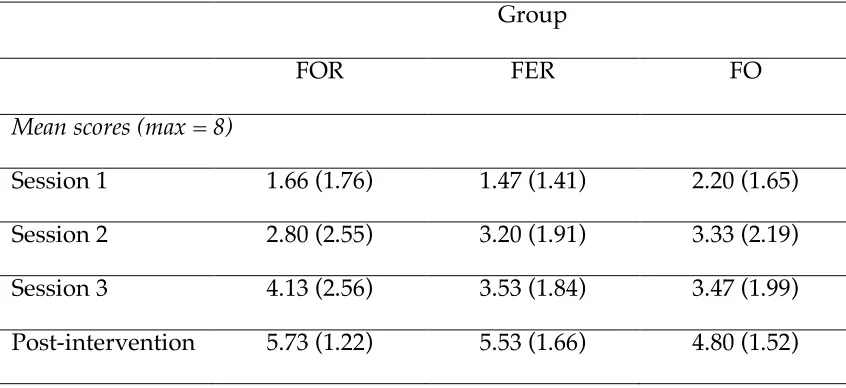
A two-way analysis of variance was conducted on the word definition total scores obtained in each session (one, two, three, post-test) by each group (FER, FOR, FO) to determine whether explanation of definitions promoted the use of context to derive word meanings. The mean scores obtained in these sessions are reported in Table 2. Group was a between-subjects variables and session was a within-subjects variable. The effect of group was not significant, F < 1.0. There was a highly significant and sizeable effect of session, F(3,126) = 42.54, p< .001, ηp2 = .50, but the interaction between group and session did not reach significance, F(6,126) = 1.22, p > .20. Thus, all groups improved their performance across sessions.
The control group started with a higher level of competence on this task than the other two groups (see Table 2). To control for the effects of performance at outset, an additional analysis was conducted on the difference (or improvement) between scores obtained in each pair of sessions (one and two; two and three; three and four) with group as a between-subjects factor. There was a small but significant effect of group, F(2, 42) = 3.41, p < .05 ηp2 = .14,: the FER and FER groups showed the greatest improvement in
performance between pairs of session (Ms=1.36, for both) and the FO group the least (M= .87). No other effects were significant, Fs < 2.0, ps > .15. Thus, the two explanation groups made greater gains in performance across sessions than the feedback only group.
To explore further the benefits of explanation, the performance of the children who were poorest at the meaning derivation task (scoring 0 or 1 point) in the first intervention session was examined. There were 8 children in the FOR group, 9 in the FER group, and 6 in the FO group who met this criterion. The difference in scores obtained in the two sessions was greatest for the FOR group (M=5.37, SD=1.27) and the FER groups (M=4.44, SD=1.89) and smallest for the FO group (M=3.58, SD=1.32). The group sizes were too small for reliable statistical analysis. However, the pattern of the means support the main analyses: the feedback only group had more sophisticated word derivation skills at outset, but explanation led to greater improvements in meaning derivation.
What facilitates improvements in use of context?
To explore the factors that lead to improved use of context, analysis of the types of definition (for all groups) and explanation (FER and FOR groups only) was conducted.
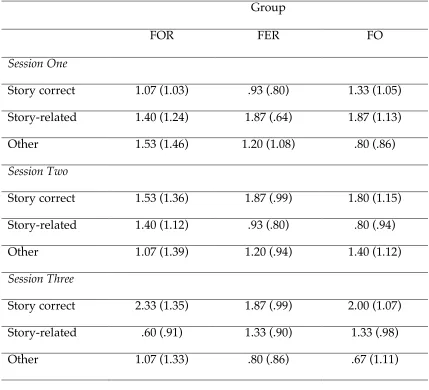
Definitions. The mean numbers of different types of word definition produced during the intervention phase are reported in Table 3. The different response types are not independent so the ‘other’ response category data were excluded from this analysis. The remaining data were analysed in an analysis of variance with group (FER, FOR, FO) as a between-subjects factor and intervention session (1, 2, 3) and definition type (story correct, story related) as within-subjects factors.
There was a main effect of session, F(2,84) = 3.38, p < .05, ηp2 = .08 and a main effect of definition type, F(1,42) = 4.24, p < .05, ηp
2
than story correct responses were made in session one (Ms = 1.11 and 1.71, respectively), but the reverse pattern was found in sessions two (Ms = 1.04 and 1.73) and three (Ms = 1.09 and 2.07). The interaction indicates a specific shift to more accurate analysis of the content of the text, rather than a general shift from external to story-based responses. No other main effects or
interactions reached conventional levels of significance, all Fs < 2.04, ps > .09. Importantly, there was no main effect of group and group was not involved in any interactions with other variables. Thus, the focus onto the text arose for all groups either as a result of practice and feedback, and was not limited to the groups who provided explanations.
_____________________ Table 3 around here _____________________
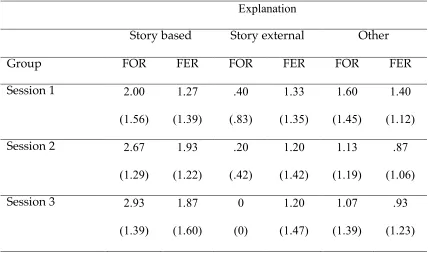
Explanations. The total number of explanations that related a response to the content of the story, whether or not the response was correct (story-related), an external source (story external), the sound of the word and don’t know responses (other) was calculated for each child in the two explanation groups, for responses in the three learning sessions in which explanations were required. There were few ‘sounds like’ explanations so these were included in the ‘other’ category. The mean totals are reported in Table 4.
story-based explanations were the more common, in general. There was also a significant interaction between explanation type and session, F(1,56) = 3.63, p < .05, ηp2 = .15. Tukey posthoc comparisons revealed significant differences in the number of story-based and external explanations in sessions two and three, p < .01, but not in session one. There was also a significant interaction between explanation type and group, F(1,28) = 8.69, p < .01, ηp2 = .24. Tukey posthoc comparisons revealed that the FOR group made a greater number of story-based than external explanations in general, p < .001, but this
comparison was not significant for the FER group. No other effects or interactions reached significance, all Fs < .1.0.
_____________________ Table 4 around here _____________________
Discussion
meanings by the end of the intervention phase. In addition, analysis of the explanations revealed that the group who explained their own definitions appeared to have greater insight into the derivation of the word meanings than the group who explained the experimenter’s correct answer. The key findings and the implications for instruction and practice in vocabulary learning skills will be discussed.
Explanation facilitated children’s performance on the word definition task: children who made the greatest gains on this task were the ones who were asked to explain the reasoning behind either their own definition or the correct definition of the word. Explanation has been successful in developing children’s understanding of number (e.g., Muldoon, et al., in press; Siegler, 1995). The current findings support Brandão and Oakhill’s (2005) suggestion that explanation could be used specifically to improve children’s analysis of text to answer comprehension questions and demonstrate that explanation might be a useful tool for developing language and literacy skills. However, it was notable that the group who received practice and feedback only also improved the quality of their definitions during the course of the study. The analysis of types of definition revealed that all groups shifted attention to the text itself, although the explanation groups were more accurate in their use of this information. Thus, although explanation may help to improve
performance, feedback (or even simply practice) also appears to be a facilitator of change.
A subsidiary aim of this study was to explore in greater detail what drives improvement in performance. The role of explanation will be
greater gains than children whose task was to explain their own response. Provision of the correct answer may have helped the children to consider different strategies or ways of thinking to solve the problems. Similarly, children in the current study who were given the correct answer might have been prompted to consider another source of information for their own (often incorrect) response, such as the text itself or more accurate analysis of the text.
Children who explained their own (often incorrect) response before feedback made comparable gains in overall performance and showed a stronger tendency to use the story information accurately, relative to children who explained the experimenter’s response. Clearly, explanation was not simply reinforcing poor strategies for deriving the meanings of the words in this group. During the explanation process, these children may have
compared the information in the story with their own response and noticed a mismatch between the two. Fukkink (2005) noted that children did not
Analysis of the explanations showed that the group who explained the experimenter’s response provided fewer story-based explanations than those who explained their own response. One possibility, that this group had less insight into how to derive the meanings, was mentioned above. Another possibility is that the quality of their explanations was limited because they were not compelled to explain the superior reasoning of an adult. There was a tendency for this group to give ‘because you’re an adult’ as their explanation for “How do you think I worked out…”. This type of explanation has not been reported in the previous literature although, as noted in the Method section, it was apparent in pilot work for this project. Thus, the difference in the quality of explanations produced by the two groups might simply indicate that one group had a ‘fall-back’ response.
Practice and/or feedback may also facilitate skilled use of context. As stated earlier, the analysis of different types of definition revealed no
evidence that the two explanation groups were increasingly likely to use the story content than were the feedback only group: all groups produced increasing numbers of story-related definitions during the course of the study. This result is surprising, because the two explanation groups obtained significantly higher word definition scores in the post-intervention test. However, the analysis of the story-related definitions included incorrect responses. Explanation may have helped children to select the relevant and appropriate parts of the context to derive more accurate answers.
correct and partially correct word definitions and also the number of story-based definitions in total (whether or not they were correct). So, is practice alone sufficient to increase children’s use of context to derive new word meanings?
Studies of instruction in deriving meaning from context report contradictory effects of practice. Kuhn and Stahl’s (1998) concluded that practice-only and instruction treatments are equally successful; Fukkink and de Glopper (1998) found significant differences between practice-only and control conditions in few of the studies in their meta-analysis. In the current work, the ‘control’ group had both practice and feedback and made
substantial gains on the task. Feedback with repeated practice may have prompted children to consider different ways to derive meanings, because of the mismatch between derived and correct meaning. Again, these findings suggest that an elaborate programme of instruction in how to derive word meanings from context may not be necessary to facilitate this skill. However, practice alone may not bring about such rapid growth and learning. All groups received feedback on the correctness of their response and all groups improved their performance. Further work is needed to determine how effective feedback is for different age groups and on different tasks.
One criticism of this work is that the task was not ecologically valid and, thus, the findings may not be applicable to the classroom in which
children are not required to explain the meanings of several novel words with supportive contexts on repeated trials. Repeated sessions was a crucial feature of the design to accelerate learning and enable the study of change. The
be useful tools to develop children’s awareness of appropriate strategies to aid literacy skills. Literacy differs from counting or number conservation, because it a non-algorithmic domain, one in which no single strategy can guarantee success. For example, there were word definition trials in which the child obtained their response from the story context, but did not select the appropriate information. Fukkink’s (2005) work and this study demonstrates that untrained children are able to engage in appropriate word derivation behaviours, but that they do not do so consistently or effectively. This study shows that children’s ability to derive word meanings from context improves with a very short intervention. Practice and feedback (the control group) facilitates performance and practice with explanation and feedback leads to greater gains. We need to determine what forms of practice and intervention are required to maintain performance levels and lead to consistent use in independent reading. In addition, a wider range of word types should be included in future work. Recent work has shown that children can
successfully acquire meanings of nouns and verbs from supportive contexts (Nash & Snowling, 2006), so it is likely that this method can generalise to other word types.
References
Anderson, R. C., & Freebody, P. (1983). Reading comprehension and the assessment and acquisition of word knowledge. In B. Huston (Ed.), Advances in reading/language research, Vol 2, (pp. 231-291). Greenwich, CT: JAI Press.
Baumann, J. F., Font, G., Edwards, E. C., & Boland, E. (2005). Strategies for teaching middle-grade students to use word-part and context clue to expand reading vocabulary. In E. H. Hiebert and M. L. Kamil (Eds.), Teaching and learning vocabulary: Bringing research to practice, (pp. 179-205). Mahwah, NJ: Lawrence Erlbaum.
Brandão, A. C., & Oakhill, J. (2005). How do you know this answer? Children’s use of text data and general knowledge in story comprehension. Reading and Writing, 687-713.
Cain, K., Oakhill, J., & Elbro, C. (2003). The ability to learn new word meanings from context by school-age children with and without language
comprehension difficulties. Journal of Child Language, 30, 681-694. Cain, K., Oakhill, J., & Lemmon, K. (2004). Individual differences in the
inference of word meanings from context: the influence of reading comprehension, vocabulary knowledge, and memory capacity. Journal of Educational Psychology, 96, 671-681.
Carnine, D., Kameenui, E. J., & Coyle, G. (1984). Utilization of contextual information in determining the meaning of unfamiliar words. Reading Research Quarterly, 19, 188-204.
and reading aloud to children. In E. H. Hiebert and M. L. Kamil (Eds.), Teaching and learning vocabulary: Bringing research to practice, (pp. 45-68), Mahwah, NJ: Lawrence Erlbaum.
Cunningham, A. E., & Stanovich, K. E. (1991). Tracking the unique effects of print exposure in children: associations with vocabulary, general knowledge, and spelling. Journal of Educational Psychology, 83, 264-274. Dunn, L. M., Dunn, L. M., Whetton, C., & Pintillie, D. (1982). British Picture
Vocabulary Scale. Windsor, England: NFER-Nelson.
Fukkink, R. G. (2005). Deriving word meanings from context: A process analysis. Learning and Instruction, 15, 23-43.
Fukkink, R. G., & de Glopper, K. (1998). Effects of instruction in deriving word meanings from context: A meta-analysis. Review of Educational Research, 68, 450-469.
Gombert, J. E. (1992). Metalinguistic Development. New York: Harvester Wheatsheaf.
Jenkins, J., R., Matlock, B., & Slocum, T. A. (1989). Two approaches to
vocabulary instruction: The teaching of individual word meanings and practice in deriving word meaning from context. Reading Research Quarterly, 24, 215-235.
Kuhn, M. R., & Stahl, S. A. (1998). Teaching children to learn word meanings from context: A synthesis and some questions. Journal of Literacy
Research, 30, 19-38.
microgenesis. In E. K. Scholnick & K. Nelson (Eds.), Conceptual development: Piaget’s legacy (pp. 209-239), Mahwah: NJ: Lawrence Erlbaum.
Muldoon, K., Lewis, C., & Francis, B. (in press). Using cardinality to compare quantities: The role of social-cognitive conflict in early numeracy.
Developmental Science.
Nagy, W. E., & Scott, J. A. (2000). Vocabulary processes. In M. L. Kamil, P. B. Mosenthal, P. D. Pearson, R. Barr (Eds.), Handbook of reading research, vol. 3 (pp. 269-284). Mahwah, NJ: Lawrence Erlbaum.
Nagy, W. E., Anderson, R. C., & Herman, P. A. (1987). Learning word meanings from context during normal reading. American Educational Research
Journal, 24, 237-270.
Nash, H., & Snowling, M. (2006). Teaching new words to children with poor existing vocabulary knowledge: a controlled evaluation of the definition and context methods. International Journal of Language and Communication Disorders, 41, 335-354.
Neale, M. D. (1989). The Neale Analysis of Reading Ability - Revised British Edition. Windsor UK: NFER-Nelson.
Siegler, R. S. (2002). Microgenetic studies of self-explanation. In N. Granott & J. Parziale (Eds.), Microdevelopment: Transition processes in development and learning (pp. 31-58), Cambridge: Cambridge University Press.
Siegler, R. S. (1995). How does change occur: A microgenetic study of number conservation. Cognitive Psychology, 25, 225-273.
Siegler, R. S. (1996). Emerging minds: The process of change in children’s thinking. New York: Oxford University Press.
reading: A meta-analysis. Review of Educational Research, 69, 261-285. Swanborn, M. S. L., & de Glopper, K. (2002). Impact of reading purpose on
Acknowledgements
Table 1. Example of story
Ted was being chased by a bull. As he was running away he looked over to the other side of the field and spotted a bope. If he could get to the other side before the bull, he would be able to slip through to the next field. The bull could not follow him there.
Bope = a gap in a fence or hedge (2 points); a fence or hedge (1 point); a gap (1 point).
Table 2. Mean scores for definitions obtained in each session by group Group
FOR FER FO
Mean scores (max = 8)
Table 3. Mean number of definitions (max. = 4) by type obtained in each intervention session by group
Group
FOR FER FO
Session One
Story correct 1.07 (1.03) .93 (.80) 1.33 (1.05) Story-related 1.40 (1.24) 1.87 (.64) 1.87 (1.13)
Other 1.53 (1.46) 1.20 (1.08) .80 (.86)
Session Two
Story correct 1.53 (1.36) 1.87 (.99) 1.80 (1.15) Story-related 1.40 (1.12) .93 (.80) .80 (.94)
Other 1.07 (1.39) 1.20 (.94) 1.40 (1.12)
Session Three
Story correct 2.33 (1.35) 1.87 (.99) 2.00 (1.07) Story-related .60 (.91) 1.33 (.90) 1.33 (.98)
Table 4. Mean number of different types of explanation (max = 4) produced in each intervention session by the two explanation groups
Explanation
Story based Story external Other
Group FOR FER FOR FER FOR FER
Session 1 2.00 (1.56) 1.27 (1.39) .40 (.83) 1.33 (1.35) 1.60 (1.45) 1.40 (1.12) Session 2 2.67
(1.29) 1.93 (1.22) .20 (.42) 1.20 (1.42) 1.13 (1.19) .87 (1.06) Session 3 2.93