Deterministic randomness in a model of
finance and growth
Gomes, Orlando
Escola Superior de Comunicação Social - Instituto Politécnico de
Lisboa
February 2007
Online at
https://mpra.ub.uni-muenchen.de/2888/
Deterministic Randomness in a
Model of Finance and Growth
Orlando Gomes
∗Escola Superior de Comunicação Social [Instituto Politécnico de Lisboa] and Unidade de Investigação em Desenvolvimento Empresarial [UNIDE/ISCTE].
- February, 2007 -
Abstract: Following the literature on growth, cycles and financial development, this paper
develops an endogenous growth model where the source of endogenous business cycles relates to the allocation of credit between productive investment and consumption. An important role is given to consumer sentiment, because this determines the willingness of households in terms of demand for credit; in particular, optimistic beliefs about the economy’s macro performance deviate financial resources from investment in favour of consumption. The dynamic analysis indicates that Neimark-Sacker and flip bifurcations eventually separate stable and unstable manifolds, and as a result a region of nonlinear motion is generated: cycles of various periodicities and chaotic motion characterize the behaviour of the long run time paths of accumulated wealth, output and consumption.
Keywords: Financial development, Endogenous business cycles, Endogenous growth,
Credit to consumption, Local bifurcations, Nonlinear dynamics, Chaos.
JEL classification: O16, E32, C62.
∗ Orlando Gomes; address: Escola Superior de Comunicação Social, Campus de Benfica do IPL,
1549-014 Lisbon, Portugal. Phone number: + 351 93 342 09 15; fax: + 351 217 162 540. E-mail:
1. Introduction
Borrowing constraints have a relevant impact on growth and cycles. This
evidence has been studied, both in theoretical and empirical grounds, by a large group
of economists, from which we can highlight the contributions of Bernanke and Gertler
(1989), Kyotaki and Moore (1997), Levine (1997, 2005), Aghion, Banerjee and Piketty
(1999) and Amable, Chatelain and Ralf (2004), among others. Recently, some authors
have pointed to the idea that, under meaningful and reasonable assumptions, a
prototype growth-finance model is able to generate endogenous business cycles; this is
the path followed by Aghion, Baccheta and Banerjee (2004) and Caballé, Jarque and
Michetti (2006). Mostly in this last paper, the idea is to establish a link between credit
constraints or the level of financial development of an economy and the literature on
deterministic cycles first addressed in the early 1980s [e.g., Benhabib and Day (1981),
Day (1982), Boldrin and Montrucchio (1986), Deneckere and Pelikan (1986)] and
relaunched with the work by Christiano and Harrison (1999), who adapt a deterministic
version of the real business cycles model (RBC) to a scenario of endogenous
fluctuations by including in the setup an externality over the production of physical
goods that allows to consider an aggregate production function exhibiting increasing
returns to scale.
Endogenous cycles have been a strong source of motivation for recent
macroeconomic literature. Several directions are being followed. See, for instance,
Schmitt-Grohé (2000) and Guo and Lansing (2002), who also focus on the RBC setup,
Boldrin, Nishimura, Shigoka and Yano (2001), Mitra, Nishimura and Sorger (2005),
and related literature, who search for extreme conditions in which competitive markets
generate nonlinear motion, Cellarier (2006), who introduces a learning mechanism into
the growth setup to trigger chaotic motion, and Cazavillan, Lloyd-Braga and Pintus
(1998), Aloi, Dixon and Lloyd-Braga (2000), Lloyd-Braga, Nourry and Venditti
(2006), and related literature, where the search for endogenous cycles is based on the
OLG framework in the tradition of Grandmont (1985). For a survey on nonlinear
dynamics in macroeconomics see Gomes (2006).
In this paper, we follow on the footsteps of the work on financial constraints and
endogenous cycles, by proposing a model of endogenous growth (of the AK type) that
considers not only a constraint over credit, but also two alternatives concerning the
between borrowing to invest or borrowing to consume. The shares of credit directed to
one or to the other use are assumed as constant values if the economy performs as
expected (i.e., if the accumulated level of wealth follows a predefined trend).
Deviations from this expected performance are accounted by the representative agent,
who rises the share of credit to consumption when levels of wealth are above the
predicted outcome. In other words, consumer sentiment counts in what concerns how
the economy splits the available credit into the possible utilizations.
The previous ingredients allow to develop a growth model where, from a local
dynamic analysis point of view, bifurcations separating regions of stability and
instability are observable, and from a global dynamics perspective we find, for some
arrays of parameter values, the presence of cyclical and chaotic motion characterizing
the time evolution of the economic aggregates we consider: wealth (the central variable
for which the analysis is conducted) and, also, output, capital, investment, consumption
and even the share of credit allocated to each available use (since all these variables are
dependent on the path of wealth).
The remainder of the paper is organized as follows. Section 2 describes the
model. Sections 3 and 4 respect to the stability analysis, which is undertaken both
locally and globally. Section 5 presents some final comments.
2. The Model: Financing Production vs Financing Consumption
Consider an endogenous growth framework, where output is given by a simple
AK production function, yt=Akt, with A>0 a technological index and yt and kt
representing income and physical capital, respectively, in a given time moment t. In this economy, population does not grow.
Imposing the assumption that capital fully depreciates after each time period,
investment will be equal to the amount of capital, i.e., it=kt. In this economy, there is a
financial sector that allows private agents to borrow intertemporally; the agents (in the
case, we assume a representative agent) may resort to credit in order to finance
contemporaneous production and consumption, and over these loans interests have to be
paid in subsequent time periods. Let bt be the total amount of financial resources that
may be borrowed in period t. A fraction of these resources is borrowed to invest in the production of final goods, vt
⋅
bt, with 0≤vt≤1; hence, 1- vt will correspond to the share ofAssuming that the representative agent makes use of the total borrowing
capabilities, the production function can be presented as yt = A⋅(wt +vt ⋅bt), that is, the resources available to invest are the existing level of wealth (wt), plus the financial
resources that may be borrowed through the financial sector. Wealth dynamics are
characterized by rule (1),
[
t t t]
t t
t y r b c v b
w+1 = − ⋅ − −(1− )⋅ , w0 given. (1)
In difference equation (1), r is the nominal interest rate and, thus, wealth in the following period corresponds to today’s income less interest payment and less the
resources diverted from income to consumption. Total consumption, ct, will be a sum of
two terms: first, a fixed amount of available wealth and, second, the financial resources
borrowed to consume. Letting c be the marginal propensity to consume out of disposable income, consumption is given by ct =c⋅(yt −r⋅bt)+(1−vt)⋅bt.
Information asymmetry problems will imply a constraint on credit that
corresponds to a linear function of wealth: bt=
µ⋅
wt. Parameterµ
>0 represents the levelof financial development of the economy or, in other words, it can be thought as a credit
multiplier. Finally, we take the hypothesis that the share of credit allocated to
consumption or production varies according to the consumer sentiment about the path
followed by macro aggregates. Our assumption is that in periods of recession credit to
consumption falls, while expansions are characterized by relatively higher levels of
credit to consumption. Formally, we consider
⋅ = −
− −
* 1 1
1
t t t
w w f m
v , with m>0 the share
of credit directed to consumption when the economy’s effective level of wealth equals
the potential level of wealth. Variable wt* corresponds to the potential level of wealth.
There is a time lag in the previous expression because we assume that the agent’s
reaction to short run economic performance is not immediate; behaviour is adjusted
according to last period’s economic results. Function f is a continuous and differentiable function that obeys to the following conditions: f’>0, f(0)=0 and f(1)=1. To simplify
computation, we take an explicit functional form:
σ
=
* *
t t
t t
w w w
w
f , with
σ
>0.Recalling that we are working with an endogenous growth setup, variables output,
capital, investment, consumption and wealth grow, in the steady state, at a same
trend, and therefore it is supposed to grow at rate
γ
not only in the steady state but in alltime moments.
The previous set of features allows for rewriting equation (1) as
[
]
tt t t w w w m A r A A c w ⋅ ⋅ ⋅ ⋅ − − ⋅ + ⋅ − = − − + σ
µ
µ
* 1 11 (1 ) ( ) (2)
or, considering a wealth variable that does not grow in the steady state, t t t w w ) 1 ( ˆ
γ
+ ≡ ,[
]
tt t w w w m A r A A c w ˆ ˆ ˆ ) ( 1 1 ˆ * 1 1 ⋅ ⋅ ⋅ ⋅ − − ⋅ + ⋅ + − = − + σ
µ
µ
γ
(3)with w wt t ) 1 ( ˆ * *
γ
+≡ a constant value.
In our framework, we implicitly consider A>r, a condition that guarantees that
investing in production is preferable than investing in financial assets (the marginal
productivity is higher than the interest rate).
A balanced growth path is easily determined by solving (3) under condition
1 1 ˆ ˆ ˆ + = = −
≡wt wt wt
w . A unique steady state point exists:
[
]
* / 1 ˆ ) 1 ( ) 1 ( ) ( ) 1 ( w m A c r A A cw ⋅
⋅ ⋅ ⋅ − + − − ⋅ + ⋅ − = σ
µ
γ
µ
(4)The requirement for a positive wealth level in the long term imposes an upper
bound on the economy’s growth rate,
γ
<(1−c)⋅[
A+µ
⋅(A−r)]
−1. A second boundary condition is 1−v <1, which is equivalent to γ >(1−c)⋅(A−µ⋅r)−1. The double inequality just derived allows for inferring that the economy’s growth rate willbe located inside an interval that is delimited by two values that depend on the marginal
propensity to consume, on the technology level, on the degree of financial development
and on the interest rate.
We now present a second version of the model, in which the economy’s choice
between financing production or financing consumption takes in consideration both
along the following sections that this new assumption has profound effects over the
dynamic behaviour of the model’s endogenous variables. The share of consumption
loans is now given by
σ ρ ⋅ ⋅ = − − − * 1 1 * 1 t t t t t w w w w m
v , with ρ≥0. The particular case ρ=0
take us back to the previous formulation. An equation similar to (3) is straightforward to
obtain,
[
]
tt t t w w w w w m A r A A c w ˆ ˆ ˆ ˆ ˆ ) ( 1 1 ˆ * 1 * 1 ⋅ ⋅ ⋅ ⋅ ⋅ − − ⋅ + ⋅ + − = − + σ ρ µ µ γ (5)
The new steady state is
[
]
* ) /( 1 ˆ ) 1 ( ) 1 ( ) ( ) 1 ( w m A c r A A cw ⋅
⋅ ⋅ ⋅ − + − − ⋅ + ⋅ − = +σ ρ µ γ µ (6)
The boundaries on the economy’s long run growth rate, which are derived from
0
>
w and 0<v <1, are the same as in the first framework.
3. Local Dynamics in a Two-Dimensional Map
The one dimensional systems wˆt+1 =g(wˆt,wˆt−1) discussed in the previous section must be rearranged in order to be possible to proceed with the analysis of local
dynamics. Let us define variables w~t ≡wˆt −w and ~zt ≡wˆt−1−w. Making the proper substitutions, equations (3) and (5) give place to the following two dimensional
[
]
= − + ⋅ + ⋅ + ⋅ ⋅ ⋅ − − ⋅ + ⋅ + − = + + t t t t t t w z w w w w w z w w w m A r A A c w ~ ~ ) ~ ( ˆ ~ ˆ ~ ) ( 1 1 ~ 1 * * 1 σ ρ µ µ γ (8)We begin by looking at the dynamics underlying (7) in the vicinity of w.
Linearizing the system around this point, we get
⋅ − ⋅ = + + t t t t z w z w ~ ~ 0 1 1 ~ ~ 1
1
σ
θ
(9)
with
[
( )]
1 11 ⋅ + ⋅ − −
+ −
≡ c A µ A r
γ
θ . A positive steady state value for wealth requires
θ>0. Thus, the determinant of the Jacobian matrix corresponds to a positive value: Det(J)=σ⋅θ>0; the trace is equal to 1. In figure 1, we display a line that translates the
possible stability outcomes of the model’s dynamics. We can regard that stability and
instability are both admissible, for different values of parameters.1
Proposition 1 states the local dynamics result.
Proposition 1. In the growth-finance model with a consumption credit share
depending on the last period’s level of wealth, local dynamics are characterized by the
following conditions:
i) If σ ⋅θ >1, then the system is locally unstable;
ii) If σ⋅θ =1, then a Neimark-Sacker bifurcation occurs (the eigenvalues of matrix J are a pair of complex conjugate values with modulus equal to one);
iii) If σ ⋅θ <1, then the system is locally stable; here we can distinguish between a stable node (σ ⋅θ ≤1/4) and a stable focus (1/4<σ⋅θ <1).
Any change on the values of parameters σ, c, γ, A, µ and r may imply a transition
from the area of stability to the region of instability (and vice-versa), along the line
drawn in figure 1. The other parameters of the system, namely m and wt*, have no
influence on the local dynamics result. Noticing that ( ) >0
∂ ∂
σ
J Det
, ( ) <0
∂ ∂ c J Det , 1
0 ) ( < ∂ ∂ γ J Det
, ( ) >0
∂ ∂
A J Det
, ( ) >0
∂ ∂
µ
J Det
and ( ) <0
∂ ∂
r J Det
, then we conclude that a
stable outcome becomes more likely to occur in circumstances where the marginal
propensity to consume, the economy’s growth rate and the nominal interest rate rise,
and when elasticity σ, the technological level and the degree of financial development
fall.
Let us concentrate our attention on the parameter concerning the level of financial
development. According to the equilibrium result in (4), we compute the derivative
[
]
* / ) 1 ( ˆ ) 1 ( ) 1 ( ) ( ) 1 ( ) 1 ( ) 1 ( 1 w m A c r A A c A c w ⋅ ⋅ ⋅ ⋅ − + − − ⋅ + ⋅ − ⋅ ⋅ − − + ⋅ = ∂∂ −σ σ
µ
γ
µ
µ
γ
σ
µ
According to the previous result, the balanced growth path level of wealth grows with
the level of financial development if
γ
>(1−c)⋅A−1, which is a true condition under the boundaries previously computed. Therefore, we can state that the level of wealth inthe long term effectively rises with the level of financial development; nevertheless, the
local dynamics analysis demonstrates that
µ
cannot be too high, because then theconvergence to the steady state ceases to occur. Thus, the optimal level of financial
development is the one for which
µ
is close to but below ( ) 1 1 1 r A Ac −
− − + ⋅ +
γ
σ
σ
.2
The mentioned result may be interpreted in the following way: lower constraints
on credit allow for a better intertemporal allocation of resources and therefore turn it
possible to obtain a higher long run level of wealth; nevertheless, excessively low
constraints on credit, that is, a high amount of loans without collateral requirements,
namely in the presence of credit to consumption (non productive credit) can lead to a
state where a stable outcome is absent, what can be interpreted as a situation where the
financial sector loses its capability to maintain a credible credit system. Thus, financial
development is a synonymous of potential to accumulate wealth, but financial
irresponsibility (a too high amount of loans) can cause serious damage on the way
finance may serve growth. Parameter
µ
should be kept on the interval) ( 1
1 1
0 A A r
c −
− − + ⋅ + < <
γ
σ
σ
µ
, and the closest possible to its upper bound. Notethat this boundary can be enlarged by a stronger rate of growth (
γ
).
2
Alternatively to system (7), we can analyze system (8). In section 2, we have seen
that from a steady state perspective there are no significant qualitative changes. A new
parameter is introduced, but the effects we have just described regarding changes in
parameter values are closely related to the first case. However, there are significant
differences in what concerns local dynamics, since now we cannot draw stability
outcomes through a vertical line as in the simplest case, where
ρ
=0. To confirm this,linearize (8) around steady state point (6). The matricial system is
⋅
− ⋅ − ⋅
=
+ +
t t
t t
z w z
w
~ ~
0 1
1 ~
~
1
1
ρ
θ
σ
θ
(10)
We can distinguish system (10) from system (9) only because the element in the
first row and first column is no longer unity, but a value below 1. As a consequence, the
line representing the set of possible dynamic outcomes will now be a negatively sloped
line, which is straightforward to determine. The trace and determinant of the Jacobian
matrix in (10) are, respectively, Tr(J)=1-
ρ⋅θ
and Det(J)=σ⋅θ
. These expressions take usto a relation between the trace and the determinant, as follows, Det(J)= − ⋅Tr(J)
ρ
σ
ρ
σ
.
This line is represented in figure 2.
Figure 2 displays two possible locations for the line describing local dynamics.
First, note that the line stops when it reaches the horizontal axis. In this point, a zero
determinant coincides with a trace equal to one. Second, the dynamics line is negatively
sloped; the slope is, in absolute value, equal to
σ
/ρ
. Third, a Neimark-Sacker and a flipbifurcation may occur depending on the value of the ratio
σ
/ρ
; note that a flipbifurcation will only occur if
σ
/ρ
<1/3, that is, when line Det(J)=−1−Tr(J) is crossed before Det(J)=1. Proposition 2 puts together the relevant stability conditions,Proposition 2. In the growth-finance model with a consumption credit share
depending on sentiments based on today’s and on last period’s levels of wealth, local
dynamics are characterized by the following conditions:
i) For
σ
/ρ
>1/3,a) If σ⋅θ >1, then the system is locally unstable;
c) If σ⋅θ <1, then the system is locally stable;3 ii) For
σ
/ρ
<1/3,a) If σ⋅θ >1, then the system is locally unstable;
b) If σ⋅θ =1, then a Neimark-Sacker bifurcation occurs;
c) If
ρ
⋅θ
−2<σ
⋅θ
<1, then the system has a saddle-path stable local equilibrium;d) If
σ
⋅θ
=ρ
⋅θ
−2, then a flip bifurcation occurs; e) Ifσ
⋅θ
<ρ
⋅θ
−2, then the system is locally stable.4Proposition 2 elucidates that a richer set of results arises when considering that the
representative agent is influenced both by today’s and by last period’s economic
performance, when deciding how to allocate the available credit. Nevertheless, some
fundamental results are true in both frameworks. Mainly, this is the case of the idea that
a higher degree of financial development benefits the accumulation of wealth, until a
given point where a bifurcation changes the qualitative nature of the equilibrium, giving
place to an unstable outcome.
4. The Graphical Analysis of Global Dynamics
The analysis of local bifurcations in section 3 has allowed solely to establish the
frontiers between stability and instability. The study of global dynamics will reveal that
stability areas are in fact the ones computed analytically and presented in propositions 1
and 2. Instability (understood as the divergence from the steady state point) will not,
however, be observable immediately after the bifurcation; in the numerical examples
that follow, the bifurcation gives place to cycles of various periodicities, totally
a-periodic cycles and chaotic motion, before the dynamics become characterized by
instability.
The finding of endogenous cycles, that can be found on other finance and growth models as discussed in the introduction, allows us to state that the present model is able
to furnish an alternative source of fluctuations relatively to the ones generally discussed
in the literature. In this case, it is the reaction of a representative agent to the ability of
3
Condition
θ θ ρ σ (1 )2
4
1⋅ − ⋅
≤ implies node stability; (1 ) 1
4
1 2
< < ⋅ −
⋅ σ
θ θ ρ
refers to a stable focus. 4
the economy to accumulate wealth, when deciding to which use to allocate credit, that
generates endogenous business cycles.
We choose to work with the following indexes: ˆ* =1
w and A=3; other parameters
just take reasonable values, c=0.75,
γ
=0.04, r=0.03 and m=1. Consider, as well,µ
=2.These parameter values satisfy the boundary condition that was derived in section 2,
which limits the value of the growth rate: -0.265<
γ
<1.235. As bifurcation parameters inthe analysis that follows, we choose to work with
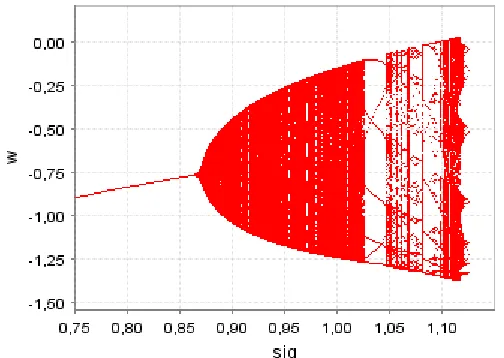
σ
andρ
. Figure 3 presents abifurcation diagram for the first model (
ρ
=0). The Neimark-Sacker bifurcation is clearlypresent, giving place to a region of a-periodic cycles and chaos.5
Note that, in our example,
θ
=1.149, and thus the bifurcation occurs at87 . 0 149 . 1
1 =
=
σ
. To the left of this point, according to proposition 1 (and looking atfigure 3) stability prevails. The bifurcation diagram can, as well, be drawn for variable
vt (figure 4). We regard that cycles have a increasing amplitude and that there is the
possibility of this variable assuming negative values; this circumstance means that not
only all available credit is directed to consumption, but that also part of the current
resources available to invest in production are deviated to credit to consumption;
instability arises when the economic system becomes unable to sustain a situation where
a progressively larger amount of resources are allocated to finance future consumption.
The interpretation of figures 3 and 4 is essentially that if agents give little
importance to past deviations from the benchmark level of wealth (
σ
low), stabilityholds. When this relevance rises, cycles set in and instability will end up by prevailing.
Bifurcation diagrams could be drawn as well for any other parameter, like the level of
financial development. We would have diagrams similar to the ones in the presented
figures, and the conclusion of the transition from stability to cycles and from these to
instability would be the same as the one depicted in the local analysis: instability (and,
before this state, a-periodic cycles) arise for a too high level of credit availability.
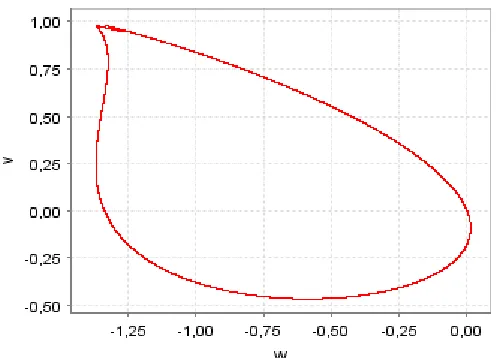
To illustrate further the cyclical nature of the results, we present through figures 5
and 6 the long term time series of wealth and an attracting set that defines the long run
relation between wt and vt; this is done for a value of
σ
for which chaotic behaviour isevident.
Finally, we can close the graphical analysis of this simplest case (
ρ
=0) with adiagram that allows to identify rigorously the areas of chaotic motion. These are the
5
All the figures concerning global dynamics presented in this paper are drawn using IDMC software (interactive Dynamical Model Calculator). This is a free software program available at
ones for which at least one of the two Lyapunov characteristic exponents associated to
our system is positive. Recall that Lyapunov exponents are a measure of exponential
divergence of nearby orbits, that is, a measure of sensitive dependence on initial
conditions, which is a well accepted property of chaotic systems. See figure 7. Note, in
this figure, that for values of parameter
σ
around 0.85 to 1.03 one of the Lyapunovexponents stays equal to zero; this is the result one expects to find in the presence of
quasi-periodic cycles, that is, cycles with no countable order but that are too regular to
be considered chaos (there is not an absolute dependence on initial conditions). Such a
result is the feature that commonly characterizes the state of a system immediately after
a Neimark-Sacker bifurcation. Chaotic motion is undoubtedly present for values of
σ
near 1.1.
To illustrate our second version of the model (
ρ
>0), we draw a diagram revealingwhat kind of cycles one observes in the space of parameters (
σ
,ρ
). We confirm theanalysis of section 3, in the sense that for relatively high values of
σ
, cycles arising froma Neimark-Sacker bifurcation are identified, while relatively high values of
ρ
implycycles originating from a flip bifurcation (figure 8).
Let
σ
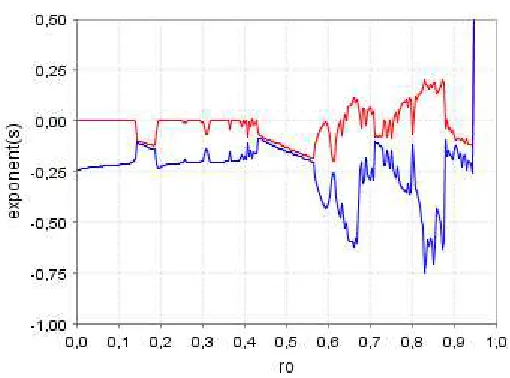
=1. For this value, figure 9 respects to a bifurcation diagram of the wealthvariable for different values of
ρ
, figures 10 and 11 draw time series and an attractor fora specific value of
ρ
and figure 12 relates to Lyapunov exponents. Chaotic motion andcycles of different periodicities are found for the wealth variable, and thus cyclical
motion will also be present in the time trajectories of other economic aggregates,
namely output, investment and consumption. Figure 11 reveals the higher sophistication
of the second considered case, in the sense that a ‘stranger’ (less regular) attractor is
obtained. Lyapunov exponents for different values of parameter
ρ
also show thatquasi-periodicity (one exponent equal to zero), periodic cycles and stability (both exponents
negative) and chaos (one positive exponent) coexist and alternate as we change the
value of the parameter.
The graphical analysis of this section was useful in characterizing the model
beyond local dynamics. The main new result is that an area of cycles and chaotic motion
is identified after the region of stability and before instability. Thus, for some
combinations of parameter values one is able to assert that the behaviour of economic
agents, in the case concerning credit decisions, can produce a situation of self sustained
cyclical motion, which is triggered by no monetary phenomena (Keynesian cycles) or
5. Final Remarks
We have developed a model of growth, cycles and financial development. A
standard growth model involving a constraint on credit was assumed, and over this
setup one has considered that part of the available credit is directed to productive
investment, while a second share is destined to anticipate in time households’
consumption. Under the assumption that the referred share varies with consumer
sentiment, and that this is influenced by contemporaneous and past economic
performance (more accurately, by the gap between effective and potential wealth in the
present and in the previous periods), we were able to furnish an explanation for
endogenous cycles.
Cycles of various periodicities and chaotic motion are observable for given
combinations of parameter values, and we found that the way wealth gaps impact over
credit allocation choices are one of the most relevant determinants of the stability results
(alongside with the level of financial development, the state of technology, the interest
rate, the savings rate and the economy’s growth rate). From a local analysis point of
view, one has concluded that both stability and instability can prevail, and that by
varying some parameters’ values a bifurcation (Neimark-Sacker or flip) is likely to
occur. When we search for the confirmation of these results through an analysis of
global dynamics, we are confronted with a region of cycles and chaos that follows the
point of bifurcation, before instability (divergence to zero or infinity) becomes
dominant.
From a policy point of view, the undertaken analysis is particularly important, in
the sense that it can give some hints on how to balance the allocation of credit to
consumption and to investment, in order to remain in the stability area, and therefore
avoid the welfare costs of cyclical motion.
References
Aghion, P.; P. Bacchetta and A. Banerjee (2004). “Financial Development and the
Instability of Open Economies.” Journal of Monetary Economics, vol. 51, pp.
1077-1106.
Aghion, P.; A. Banerjee and T. Piketty (1999). “Dualism and Macroeconomic
Aloi, M.; H. D. Dixon and T. Lloyd-Braga (2000). “Endogenous Fluctuations in an
Open Economy with Increasing Returns to Scale”, Journal of Economic Dynamics
and Control, vol. 24, pp. 97-125.
Amable, B.; J. B. Chatelain and K. Ralf (2004). “Credit Rationing, Profit Accumulation
and Economic Growth.” Economics Letters, vol. 85, pp. 301-307.
Benhabib, J. and R. H. Day (1981). “Rational Choice and Erratic Behaviour.” Review of
Economic Studies, vol. 48, pp. 459-471.
Bernanke, B. and M. Gertler (1989). “Agency Costs, Net Worth, and Business
Fluctuations.” American Economic Review, vol. 79, pp. 14-31.
Boldrin, M. and L. Montrucchio (1986). “On the Indeterminacy of Capital
Accumulation Paths.” Journal of Economic Theory, vol. 40, pp. 26-39.
Boldrin, M.; K. Nishimura; T. Shigoka and M. Yano (2001). “Chaotic Equilibrium
Dynamics in Endogenous Growth Models.” Journal of Economic Theory, vol. 96,
pp. 97-132.
Caballé, J.; X. Jarque and E. Michetti (2006). “Chaotic Dynamics in Credit Constrained
Emerging Economies.” Journal of Economic Dynamics and Control, vol. 30, pp.
1261-1275.
Cazavillan, G.; T. Lloyd-Braga and P. Pintus (1998). “Multiple Steady-States and
Endogenous Fluctuations with Increasing Returns to Scale in Production.” Journal
of Economic Theory, vol. 80, pp. 60-107.
Cellarier, L. (2006). “Constant Gain Learning and Business Cycles.” Journal of
Macroeconomics, vol. 28, pp. 51-85.
Christiano, L. and S. Harrison (1999). “Chaos, Sunspots and Automatic Stabilizers.”
Journal of Monetary Economics, vol. 44, pp. 3-31.
Day, R. H. (1982). “Irregular Growth Cycles.” American Economic Review, vol. 72,
pp.406-414.
Deneckere, R. and S. Pelikan (1986). “Competitive Chaos.” Journal of Economic
Theory, vol. 40, pp. 13-25.
Gomes, O. (2006). “Routes to Chaos in Macroeconomic Theory.” Journal of Economic
Studies, vol. 33, pp. 437-468.
Grandmont, J. M. (1985). “On Endogenous Competitive Business Cycles.”
Econometrica, vol. 53, pp. 995-1045.
Guo, J. T. and K. J. Lansing (2002). “Fiscal Policy, Increasing Returns and Endogenous
Kyotaki, N. and J. Moore (1997). “Credit Cycles.” Journal of Political Economy, vol.
105, pp. 211-248.
Levine, R. (1997). “Financial Development and Economic Growth: Views and
Agenda.” Journal of Economic Literature, vol. 35, pp. 688-726.
Levine, R. (2005). “Finance and Growth: Theory and Evidence.” in P. Aghion and S. N.
Durlauf (eds.), Handbook of Economic Growth, Amsterdam: Elsevier, pp.
865-934.
Lloyd-Braga, T.; C. Nourry and A. Venditti (2006). “Indeterminacy in Dynamic
Models: When Diamond Meets Ramsey.” Journal of Economic Theory,
forthcoming.
Mitra, T.; K. Nishimura and G. Sorger (2005). “Optimal Cycles and Chaos.” Cornell
University, Kyoto University and University of Vienna working paper.
Schmitt-Grohé, S. (2000). “Endogenous Business Cycles and the Dynamics of Output,
Figures
[image:17.595.176.428.560.739.2]Figure 1 – Local dynamics; ρρρρ=0.
Figure 2 – Local dynamics; ρρρρ>0.
Figure 3 – Bifurcation diagram (w~t;σσσσ);ρρρρ=0.
Tr(J) 1
Det(J)=1 Det(J)
1+Tr(J)+Det(J)=0 1-Tr(J)+Det(J)=0 Tr(J) 1
Det(J)=1 Det(J)
Figure 4 – Bifurcation diagram (vt;σσσσ);ρρρρ=0.
Figure 5 – Long run time series of w~t; σσσσ=1.11, ρρρρ=0.
Figure 6 – Attractor (w~t;vt) ; σσσσ=1.11, ρρρρ=0
[image:18.595.178.426.551.730.2]Figure 7 – Lyapunov characteristic exponents;ρρρρ=0.
Figure 8 – Cycles in the space of parameters; ρρρρ>0.
[image:19.595.179.428.562.745.2]Figure 10 – Long run time trajectory of w~t; σσσσ=1, ρρρρ=0.85.
Figure 11 – Attractor (w~t;vt) ; σσσσ=1, ρρρρ=0.85
(the first 10.000 observations are excluded).
[image:20.595.175.430.560.749.2]