Performance Comparision of AODV and DSR Routing
Protocols using Real Time Test-Bed
Dependra Dhakal, Kiran Gautam, Bishal Pradhan, Ashis Pradhan
CSE Department,
Sikkim Manipal Institute of Technology, East-Sikkim, India
ABSTRACT
A mobile ad-hoc Network is a collection of autonomous wireless nodes without any infrastructure and centralized administration. The main motivation of this work is to analyze AODV and DSR routing protocols based on different performance metrics in a real world environment. This test-bed allows for direct comparisons between ad-hoc routing protocols Though ad hoc network routing protocols, such as DSR and AODV have been extensively studied through simulations, fewer test-bed implementation has been carried out. It is essential in order to understand relative merits or limitations under different network conditions. The test-bed closes the gap between the simulation & real life implementation and allows performance comparison of different ad-hoc routing protocols on a common platform. The goal of this work has been to develop a test-bed such that real world tests of many nodes can be conducted for AODV and DSR protocol and analyze the performance of this protocol with various performance metrics.
Keywords
AODV, DSR, MANET, PDR, ad-hoc.
1. INTRODUCTION
Ad-hoc Networks are wireless multi-hop packet networks without any fixed infrastructure. The main motive of wireless network is to maintain node connectivity in a mobile environment. Most research in the ad-hoc network wireless network has been conducted using simulation software and test bed environment. Each node in a wireless ad-hoc network functions as both as host and a router, and the control of the network are distributed among the nodes without any centralized control. The topology is in general dynamic due to mobility of nodes. Additionally, wireless mobile networks have high error rate, power restrictions and bandwidth limitation [1].
Mobile ad hoc network routing protocols can be divided into proactive, reactive and hybrid routing [17] [19] [25]. A proactive routing protocol is also called "table driven" routing protocol. Using a proactive routing protocol, nodes in a mobile ad hoc network continuously evaluate routes to all reachable nodes and attempt to maintain consistent, up-to-date routing information. The Dynamic Source Routing (DSR) and Ad hoc on-demand Distance Vector routing (AODV) are examples for reactive routing protocols for mobile ad hoc networks.
AODV uses the concept of route discovery and route maintenance of DSR and the concept of sequence numbers and sending of periodic beacons from DSDV [3]. AODV uses three types of control messages. They are Route Request (RREQ), Route Reply (RREP) and Route Error (RERR) messages [5].
When a route does not exist between two nodes i.e., when a route to new destination is required it initiatesthe route discovery process. Route discovery involves flooding of RREQ messages to its neighbor to find the destination node. Route discovery process can also be initiated if the link has expired or broken. An intermediate nodereceiving theRREQ, is required to first setup a reverse path to the source node. It uses sequence number and broadcast ID for loop free routing. When the destination receives a route RREQ, It responds with a RREP message containing the number of hops and latest destination sequence number. RREP is routed back to the source node using the reverse path and forward path to the destination is established. A time to live is associated with each reverse route entry. If no packets are sent over this route within the lifetime it will be removed [19] [17] [18]. In route maintenance phase each node use hello packets to check for the link. When a link failure is detected by a node it sends a route error (RRER) messages to its upstream neighbor on the current route. These error messages propagate to the source node. Intermediate nodes receiving a RERR update their routing table. The source node after receiving RERR starts the route discovery process again [19] [17] [18].
The key feature of DSR is source routing [2] [18] [16]. The source or the sender knows the complete hop-by-hop route to the destination. These routes are stored in route cache. It uses a route discovery process to dynamically determine the unknown route. It does not use periodic hello message unlike AODV. RREQ and RRER message is used to discover the route similar to AODV. Source node broadcast the RREQ message and the receiving neighbor node adds its address to source address and rebroadcast the RREQ message if it does not have the information for destination node. If route to the destination node is known they send a route reply packet to the source node. Every node also maintains a cache to that stores the route information [16]. The advantage of DSR is that it can store multiple routes in their route cache [20]. If any link on a source route is broken, a node that identifies the break sends a route error (RERR) packet to the source node. On receiving the RERR packet source node updates its route information by removing the link from its cache. A new discovery process will be started to find the viable route [5].
The testing of ad-hoc networking protocols using test-bed allows researchers the opportunity to check the behavior of protocol in real world environment [5]. In the modern world mobility has become increasingly important and ad-hoc network routing protocols is distinguished based on how routing information is acquired and maintained by mobile nodes [3].
2. LITERATURE REVIEW
characteristics or mobility pattern. The author used both simulation and real test bed experiments and found that under different wireless network conditions the relative performance was not the same
Erik Nordstrom et al. [5] compared AODV, DSR and OLSR in simulation, emulation and real world. The authors compared the performance of these protocols based on PDR, latency, throughput and hop count. The author found that DSR is efficient in terms of hop countbecause it has automatic route shortening and therefore evaluates therouting each packet. OLSR’s proactive nature makes it always converge to the shortest routes, but until convergence there is a possibility of non-optimal routing [5]. AODV often uses non-optimal routes because it has no dedicated mechanism for optimization and uses the same route until it breaks. In simulation the trend is clear; DSR is the most efficient protocol in terms of shortest path routing [5]. They concluded that simulation results cannot be validated without real world testing.
Rastogi made a comparative study of AODV and OLSR using ORBIT test-bed. The ORBIT test-bed consisting of 400 fixed radio nodes installed indoor, forming a two dimensional array [6]. Placed with a subspace of one meter, each physical node is logically connected to a virtual simulation node in a core network. It was seen that AODV performs better than OLSR in terms of stability [6]. AODV does not allow throughput to increase above saturation and maintains it fairly constant at that level. Thus, if the offered load is increased further, stable throughput can be obtained, but with large packet [8]. It was also observed that AODV protocol performed better in the static traffic, with the number of source and destination pair relatively small for each host [7]. Karygiannis et al. [9] presented a prototype MANET test bed which helps researchers and developers bridge the gap between simulations and actual MANET deployments. mLab includes several tools that can help developers test and verify that their systems can detect malicious activity under realistic conditions.
In [16], Desilva et al. experimentally evaluated the performance of the AODV routing protocol in a test network consisting of six nodes. The nodes are static for repeatability and management reasons. Route breaks are emulated by artificially purging routing table entries. Toh et al. report on a real world experimental setup consisting of five nodes where they remove network cards to mimic mobility [16].
In real world test-beds such as APE [5], Maltz et al. [15] concluded that a precise scenario replay of real device mobility is limited and requires additional tracking mechanism. To overcome the problem of insufficient repeatability, the test-beds TrueMobile [14] and MiNT [18] are based on radio nodes mounted on robots and operated under laboratory conditions.
Johnson [17] recorded traffic traces from laptops, running DSR, mounted in cars whose positions were constantly logged using GPS. Several different traffic types were used and the collected data drove simulations as well as emulations. The author believes that simply comparing the average number of received packets from simulations and real experiments does not provide enough information to answer the question of how closely emulations come to reproducing simulation results. It can even produce an incorrect conclusion. He therefore suggests studying time sequence number plots as well as other performance metrics over time.
Samir R. Das et al [14] et al Compared and analyzed the performance of AODV and DSR using random way point mobility model with variable pause time and found that DSR outperforms AODV in delay and throughput in less stressful situation.
3. TEST-BED TOPOLOGY SET-UP
The experiments are conducted for both the static and mobile scenarios; and repeated for indoor and outdoor environments. The experiments for the outdoor scenario are implemented in a roof top and those for the indoor case are implemented in a main college building. The nodes are located from A block to E block in the third floor initially. The scenario is same for both the protocols. The experiments are conducted with 5 nodes. Following are the three scenarios for which each experiment are carried out. [image:2.595.319.538.276.396.2]Scenario 1: In this scenario all nodes will be static as shown below:
Fig 1: Scenario 1
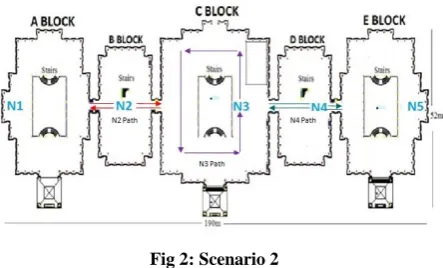
[image:2.595.321.543.456.590.2]Scenario 2: In this scenario source and destination are static (N1 sand N2) while intermediate nodes are mobile in nature as show in the figure below:
Fig 2: Scenario 2
Scenario 3: In this scenario all the nodes are mobile as shown below:
[image:2.595.319.540.620.745.2]For the one hop experiment only one node N1 and N2 will be used. When changing to the two hop experiment additionally node N3 will be activated. Finally all 5nodes will be activated.
3.1
Throughput using TCP Traffic (Inside
Building)
[image:3.595.323.540.146.287.2]The throughput was evaluated using NetPipe. NetPipe uses a simple series of ping-pong tests over a range of message sizes to provide a complete measure of the performance of a network. Throughput was evaluated for all three scenarios as mentioned above for both AODV and DSR. The graph is plotted, throughputversus increasing packet size. Table 1lists the parameters that were used during this experiment.
Table 1: Standard Parameter used for TCP based topology analysis (inside building)
PARAMETERS LEVELS
Utility Software Netpipe
Test-bed Location Hallway
Test-bed Area 190*52m
No. of nodes 5
Routing protocol AODV and DSR
Traffic type TCP
MAC Protocol 802.11
Packet Size 1- 131075 bytes
Mobility Pattern Random Way point
Pause Time 5,10 and15 sec
The throughputs of AODV and DSR for all the scenarios are discussed as bellow:
[image:3.595.48.286.240.501.2]3.1.1 Scenario 1
Fig 4: Throughput comparison AODV and DSR Scenario1
The figure 4 shows the TCP throughput with respect to increasing packet size for AODV-UU and DSR –UU. The average throughput of AODV is 1841 kbps while that of DSR is 727.85 kbps. AODV average throughput was found to be
better for static scenario, as AODV uses the non-optimal routes, and uses the same route until it breaks. DSR quickly changes the route. It often chooses incomplete and unstable routes, causing up and down between longer and shorter route.
3.1.2 Scenario 2
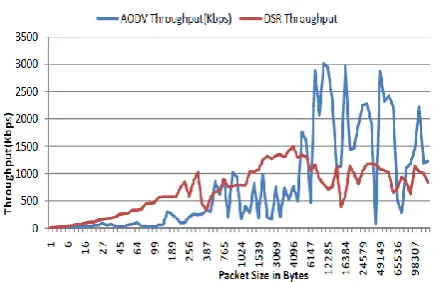
Fig 5: Throughput comparison AODV and DSR Scenario2
The figure 5 shows the TCP throughput with respect to increasing packet size for AODV-UU and DSR –UU for scenario 2 that is the intermediate nodes are mobile. The average throughput of AODV is 767 kbps while that of DSR is 716 kbps. It can be observed that the average throughput decreased with mobility of intermediate nodes. Here DSR outperforms AODV at times when there is large no of link breaks as it caches multiple paths and quickly reroutes the packets through the other path while AODV has to start the route discover process again to find the other path which takes longer time. Automatic route shortening sometimes works to DSR-UU disadvantage at times a longer but more stable route is selected as seen from the figure 5.
[image:3.595.322.542.469.611.2]3.1.3 Scenario 3
Fig 6: Throughput comparison AODV and DSR Scenario3
[image:3.595.58.274.532.699.2]3.2 Throughput using TCP Traffic (Roof
Top)
[image:4.595.320.542.186.311.2]The throughput was evaluated using NetPipe for both AODV and DSR and the experiment was conducted at roof top with very little obstruction. The experiment was evaluated based on all the three scenarios and same mobility pattern as done inside the hallway. But there was no walls and obstruction as in the case of hallway. Table 2 lists the parameters that were used during the experiment.
Table 2: Standard Parameter used for topology analysis (roof top)
PARAMETERS LEVELS
Test-bed Location Rooftop
Test-bed Area 190*52m
No. of nodes 5
Routing protocol AODV and DSR
Traffic type TCP
MAC Protocol 802.11
Packet Size 1- 131075 bytes
Mobility Pattern Random Way point
Pause Time 5,10 and15 sec
3.2.1 Scenario 1
[image:4.595.48.290.201.435.2]The figure 7 shows the TCP throughput with respect to increasing packet size for AODV-UU and DSR –UU for scenario 1. The average throughput of AODV is 9573.70 kbps while that of DSR is 7576.69 kbps. It is clear from the graph that throughput for both the protocol is higher than that of figure 4 because of less obstruction. Initially both the protocols have same throughput but with increasing packet size AODV outperformed DSR. Compared to hallway where there is significant gap between AODV and DSR throughput performance, here both the protocols have better average.
Fig 7: Throughput comparison AODV and DSR Scenario 1(Rooftop)
3.2.2 Scenario 2
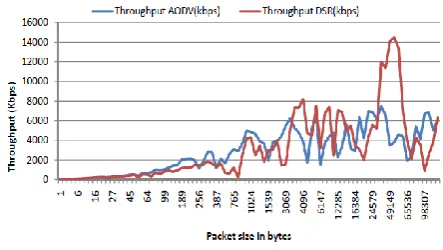
The figure 8 shows the TCP throughput with respect to increasing packet size for AODV-UU and DSR –UU [5] for scenario 2. The average throughput of AODV is 2874.9 kbps while that of DSR is 3077.69 kbps. It is clear from the graph that throughput for both the protocol is higher than that of figure 5 because of less obstruction while it was mobile. Here also the average throughput was found to be better for DSR as it performed better than AODV in mobility. The performance was better than AODV due to cache routing.
Fig 8: Throughput comparison AODV and DSR Scenario 2(Rooftop)
3.2.3 Scenario 3
[image:4.595.320.561.480.616.2]The figure 9 shows the TCP throughput with respect to increasing packet size for AODV-UU and DSR –UU for scenario 2. The average throughput of AODV is 2364.39 kbps while that of DSR is 2400.10 kbps. It is clear from the graph that throughput for both the protocol is higher than that of figure 6 because of less obstruction while it was mobile. Here also the average throughput was found to be better for DSR. In the hallway it was not possible to send all the packets due to high amount of packet loss and delays whereas even in high mobility due to no obstruction and less delaysall the packets was transmitted from sender to the receiver.
Fig 9: Throughput comparison AODV and DSR Scenario 3 (Rooftop)
3.3 Packet Delivery Ratio
Table 3: Standard Parameter used for topology analysis
PARAMETERS LEVELS
Utility Software Ping
[image:4.595.56.281.566.730.2]Test-bed Location Hallway
Test-bed Area 190*52m
No. of nodes 5
Routing protocol AODV and DSR
Traffic type ICMP (UDP)
MAC Protocol 802.11
Packet Size 64, 256, 1024
Mobility Pattern Random Way point
Pause Time 5,10 and15 sec
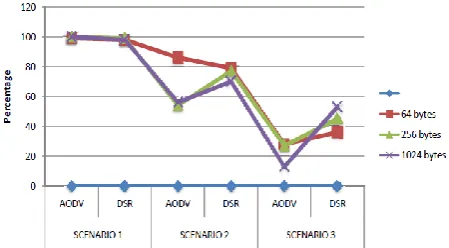
[image:5.595.49.287.70.280.2]The figure 10 shows the Packet Delivery ratio of AODV and DSR for 3 scenarios inside building. The ping utility was used to send data from source to the destination i.e., the last hop 10.0.0.6. Three types of packets size were used 64, 256 and 1024 bytes. It was interesting to observe that PDR for both AODV and DSR were almost same for 64 bytes data in static environment. But with the increase in packets size and mobility as in the case of scenario2 and scenario3 DSR outperformed AODV. It was mainly due to the DSR ability to store multiple paths and quickly find the shortest path. Generally with mobility there are frequent route changes and DSR was found to better adapt to these changes.
Fig 10: PDR comparison AODV and DSR for all three scenarios
3.4 Jitter
Table 4: Standard Parameter used for topology analysis
PARAMETERS LEVELS
Utility Software IPERF
Simulation Time 180 sec
Test-bed Location Hallway
Test-bed Area 190*52m
No. of nodes 5
Routing protocol AODV and DSR
Traffic type UDP
MAC Protocol 802.11
Packet Size 1470 byte
Buffer Size 8 Kbyte
Mobility Pattern Random Way point
Pause Time 5,10 and15 sec
Fig 11: Jitter comparison AODV and DSR for all three scenarios
The Jitter was evaluated using iperf tool for both AODV and DSR. The Figure 11 shows that average jitter is always high for all the three scenarios for DSR protocol because DSR uses more than one route to transfer data packets from source node to destination node. These different routes cause variation in delay to delivering the data packet from source node to destination. When the nodes are mobile then the data packet dropped rate for the AODV protocol increase rapidly as compare to DSR protocol because AODV use only one route to transfer data from source node to destination node.
3.5 End-to-End Delay
Table 5: Standard Parameter used for topology analysis
PARAMETERS LEVELS
Utility Software Netpipe
Test-bed Location Hallway
Test-bed Area 190*52m
No. of nodes 5
Routing protocol AODV and DSR
Traffic type TCP
MAC Protocol 802.11
Packet Size 1- 131075 bytes
[image:5.595.56.281.416.540.2]Pause Time 5,10 and15 sec
Packet Size 1- 131075 bytes
The figure 12, 13, and 14 below shows end-to-end delay comparison of AODV and DSR for all three scenarios. It was interesting to note that DSR end-to-end delay was high in scenario 1 and 2. It is mostly because of DSR caching; buffering also increases delay. AODV employs less buffering compared to DSR [5]. In scenario 3 with increase in mobility there are more link breaks and more hello message is lost due to which the end-to-end delay of AODV was observed to have higher delay than DSR.
[image:6.595.48.286.72.119.2]3.5.1 Scenario1
Fig 12: End-to-end delay comparisons AODV and DSR for scenario 1
[image:6.595.317.541.175.585.2]3.5.2 Scenario2
Fig 13: End-to-end delay comparisons AODV and DSR for scenario 2
[image:6.595.55.272.243.375.2]3.5.3 Scenario3
Fig 14: End-to-end delay comparisons AODV and DSR for scenario 3
3.6 Measurements
The table 6 summarizes the results for each scenario, protocol and traffic for experiment conducted inside the building. And table 7 summarizes the results obtained for TCP throughput outdoor.
Table 6: TCP, Ping and UDP results showing Average Throughput, Packet Delivery Ratio, Jitter and end-to-end
delay indoor.
Table 7 : TCP results showing average throughput outdoor.
[image:6.595.54.275.402.564.2] [image:6.595.54.261.615.747.2]of the protocols changes type of scenario and traffic. Since we have carried out experiment with fewer nodes, in future the experiment can be conducted with more nodes and can be analyzed how the protocol behave with the increase in the number of nodes.
5. REFERENCES
[1] V.B.Narsimaha, “The Performance Comparison of an AODV, DSR, DSDV and OLSR Routing Protocols in Mobile Ad-Hoc Networks”. Journal of Computer Applications (JCA) ISSN: 0974-1925, Volume V, Issue 2, 2012.
[2] Devendra Singh, VandanaDubey, Shipra Sharma “Performance Analysis of DSR And AODV in Manets: Using WLAN Parameters” International Journal of Computer Applications (0975 – 8887) Volume 47– No.3, June 2012.
[3] Amit N. Thakare, Mrs. M. Y. Joshi “ Performance Analysis of AODV & DSR Routing Protocls in Mobile Ad hoc Networks”. Indian Journal of Computer Application (IJCA) Special Issues, 2010.
[4] G.Vijaya Kumar, Y.VasudevaReddyr , Dr.M.Nagendra, “Current Research Work on Routing Protocols for MANET: A Literature Survey”. (IJCSE) International Journal on Computer Science and Engineering, Vol.02,No.03, 2010, 706-713
[5] Erik Nordstr¨om, Per Gunningberg, Christian Rohner, and Oskar Wibling. “Evaluating wireless multi-hop networks using a combination of simulation, emulation, and real world experiments”. In Proceedings of MobiEval’07, June 2007.
[6] Muazzam Ali khan Khattak, Khalid Iqbal, Dr. Sikandar Hayat Khiyal “Challenging Ad-Hoc Networks under Reliable & Unreliable Transport with Variable Node Density”, Journal of Theoretical and Applied Information Technology, 2008.
[7] Davesh Singh Som, Dhananjaya Singh. “Performance Analysis and Simulation of AODV, DSR and TORA Routing Protocols in MANETs.”International Journal of Recent Technology and Engineering (IJRTE) ISSN: 2277-3878, Volume 1, Issue-3, August 2012.
[8] Sapna S. Kaushik& P.R. Desmukh. “Comparision of effectiveness of AODV, DSDV and DSR Routing Protocols in Mobile AD-hoc Networks” International Journal of Information Technology and Knowledge Management ISSN: 499-502, Volume 2, 2009.
[9] V.K.Taksande& Dr. K. D. Kulat “Performance Comparison of DSDV, DSR, AODV Protocol with IEEE 802.11 MAC for Chain Topology for Mobile Ad-hoc network using NS-2 ” IJCA Special Issue on “2nd National Conference- Computing, Communication and Sensor Network”CCSN, 2011.
[10]Rajesh Deshmuklh, AshaAmbhaikarV.K.Taksande& Dr. K. D. Kulat “Performance Evaluation of AODV and DSR with Reference to Network Size” International Journal of Computer Applications (0975 – 8887) Volume 11– No.8, December 2010.
[11]MdSohidul Islam, Md.NaimHaider, Md. TouhidulHaque, LetonMiah “An Extensive Comparison among DSDV, DSR and AODV Protocols in MANET” International Journal of Computer Applications (0975 – 8887) Volume 15– No.2, February 2011.
[12]Devendra Singh, VandanaDubey, Shipra Sharma “Performance Analysis of DSR and AODV in Manets: Using WLAN Parameters” International Journal of
Computer Applications (0975 – 8887) Volume 47– No.3, June 2012.
[13]Prem Chand, S.K.Soni “Performance Comparison of AODV and DSR on-Demand Routing Protocols for Mobile Ad-Hoc networks simulator: Qualnet” International Journal of Computer Applications (0975 – 8887) Volume 49– No.18, July 2012.
[14]Jahangir khan “Based on MANET the Correctness and Efficiency Evaluation of DSR, AODV and TORA Routing Protocols for Best QOS” IJCA Special Issue on “Mobile Ad- hoc Networks” MANETs, 2010.
[15]PradishDadhania, Sachin Patel, “Comparative performance analysis of AODV and DSR routing protocols in MANET” International Journal of Emerging Trends and Technology in Computer Science (IJETTCS) ISSN: 2278-6856 Volume 1, Issue 3, September – October 2012.
[16]Erik Nordstr¨om, Per Gunningberg, Christian Rohner, and Oskar Wibling. “Evaluating wireless multi-hop networks using a combination of simulation, emulation, and real world experiments”. In Proceedings of MobiEval’07, June 2007.
[17]DevashishRastogi and SachinGanu and Yanyong Zhang and Wade Trappe and Charles Graff, “A Comparative Study of AODV and OLSR on the ORBIT Testbed “. IEEE Military Communications Conference, 2007. [18]Parma Nand, Dr.S.C.Sharma, Rani Astya, “ Traffice Load
based Performance Analysis of DSR, STAR And AODV Adhoc Routing Protocol”. International Journa of Advanced Computern Science and Applications, Vo. 1, No 4, October 2010.
[19]KoojanaKuladinithi, AsangaUdugama, Nikolaus A. Fikouras, Carmelita Gorg, “Experimental Performance Evaluation of AODV Implementations in Static Environments”, ComNets, 2005.
[20]Rachit Jain, LaxmiShrivastava, “ Study and Performance Comparision of AODV & DSR on the basis of Path Loss Propagation Models, International Journal of Advanced Science and Technology, Vol.32, July, 2011.
[21]JosipLorincz, NenadUkic, DinkoBegsic, “Throughput Comparision of AODV-UU and DSR-UU Protocol Implementation in Multi-hop Static Environments”. 9th International Conference on Telecommunications- ConTEL 2007.
[22]Rajiv Misra, C.R.Mandal, “Performance Comparison of AODV/DSR On-demand Routing Protocols For Ad Hoc Networks in Constrained Situation”. IEEE International Conference on Personal Wireless communications, ICPWC, 2005.
[23]Mehdi Barati, KayvanAtefi, FarshadKhosravi, YasharAzabDaftari, “Performance Evaluation of Energy Consumption for AODV and DSR Routing Protocols in MANET”, International Conference on Computer & Information Science (ICCIS), 2012.
[24]Richa Agarwal, Rajeev Tripathi, Sudarshan Tiwari, “Performance Evaluation and Comparision of AODV and DSR under Adversarial Environment, ”International Conference on Computational Intelligence and Communication Systems, 2011.