http://dx.doi.org/10.4236/ajps.2014.59146
How to cite this paper: Qader, N.A., Ab Shukor, N.A. and Roseley, A.S.M. (2014) Selection of Plus Tree Based on Growth Performance and Fiber Morphology Characteristics as Improved Sources for Propagation of Eucalyptus camaldulensis. American Journal of Plant Sciences, 5, 1329-1335. http://dx.doi.org/10.4236/ajps.2014.59146
Selection of Plus Tree Based on Growth
Performance and Fiber Morphology
Characteristics as Improved Sources for
Propagation of
Eucalyptus camaldulensis
Nozad Ali Qader1, Nor Aini Ab Shukor1,3*, Adlin Sabrina Muhd. Roseley2
1Department of Forest Management, Faculty of Forestry, Universiti Putra Malaysia, Serdang, Malaysia 2Department of Forest Production, Faculty of Forestry, Universiti Putra Malaysia, Serdang, Malaysia 3Institute of Tropical Forestry and Forest Product, Universiti Putra Malaysia, Serdang, Malaysia
Email: *[email protected]
Received 22 January 2014; revised 17 March 2014; accepted 2 April 2014
Copyright © 2014 by authors and Scientific Research Publishing Inc.
This work is licensed under the Creative Commons Attribution International License (CC BY). http://creativecommons.org/licenses/by/4.0/
Abstract
One of the most successful techniques in planting trees is tree improvement in which trees with high qualities are selected for mass plantation. This study seeks to identify good properties of Eu-calyptus camaldulensis through selective phases. Sixty Eucalyptus camaldulensis trees (30 ten- year-old and 30 five-year-old) were randomly selected through stratified sampling from two plantation sites in Kurdistan region, North of Iraq. The trees were examined for fiber morphology and quality parameters such as height, number of branches, diameter and straightness. In the first phase of property selection, sixteen trees with high rank in growth properties and fiber morphol-ogy were selected. In the final phase of selection, the selected trees were re-examined according to the number of properties and fiber morphology features and seven trees with the highest number of good parameters were chosen. The 7 selected trees had higher qualities in growth characteris-tics and fiber morphology compared with the other trees in the sample. This article reports on a selection method for E. camaldulensis trees through tree improvement techniques. The results of the study indicates that high genotype qualities were identified among both 5- and 10-year-old E. camaldulensis trees as the final selection consisted of three 5-year-old trees and four 10-year-old trees.
Keywords
Eucalyptus camaldulensis; Tree Improvement; Growth Characteristics; Fiber Morphology
*
1. Introduction
The River Red Gum (Eucalyptus camaldulensis) which is an indigenous tree species to Australia plays an im-portant role in paper production industry for different countries all over the world [1]-[3]. This type of tree is cultivated for various purposes such as timber and charcoal production. It has versatile uses and it is an impor-tant forest product. It has some unique features as it is a fast growing tree and produces most durable heaviest and hardest wood [4]. According to Global Eucalyptus Map Website (2009), there are more than 20 million ha of Eucalyptus plantation all over the world (India: 3,942,600 h; Brazil: 3,751,857 h; China: 2,609,700 h; Aus-tralia: 875,000 h) [4]. E. camaldulensis is an economically important tree due to its significant uses. The wood of Red gum has been used in heavy contraction, such as, flooring, fencing, railway sleepers, framing, plywood and wood turning, pulp and paper, fire wood, veneer manufacture and charcoal production [1]. It has versatile uses and it is an important forest product. It has some unique features as it is a fast growing tree and produces most durable heaviest and hardest wood [5]. Furthermore, this tree grows well in various soils and climates [6]. E. camaldulensis is cultivated for pulp and paper production in Iraq. It has also been planted as ornamental tree for landscaping and agroforestry purposes [1]-[7].
E. camaldulensis has been largely planted in vast irrigated plantations in the North of Iraq. It adjusts well to different types of soil and various climatic modifications. It is generally suggested that rotation cycle for E. ca-maldulensis is 10 to 11 years. At this age, the average size of diameter ranges from 25 to 30 cm. 10- or 11-year- old E. camaldulensis has the highest possible wood quantity that is required by pulp market [7]. Moreover, tree improvement has been recognized as a helpful and effective technique for farmers to develop their woodlands farms through selecting the most appropriate and highest genotypes. Thus, this study was conducted to examine the plus tree selection for E. camaldulensis in Iraq.
2. Materials and Method
2.1. Description of Study SiteEucalyptus camaldulensis were selected and screened from 10-year-old and 5-year-old tree plantations of Kha-bat and Pirde, located in Erbil, North of Iraq. KhaKha-bat plantation is situated on a sandy area in the West of Erbil (36˚15N, 43˚38E) with temperatures ranging between 4˚C to 41˚C, and an annual precipitation of 385 - 455 mm/year. Pirde is located on a semi flat land in the South of Erbil (35˚06N, 44˚08E) with a temperature of 9˚C- 45˚C and has annual precipitation about 319 - 402 mm/year.
2.2. Tree Selection Procedure
There are two large E. camaldulensis plantations in Kurdistan, Iraq. In the biggest plantation site, Khabat, there were 5000 trees from which almost 2100 trees were 5-year-old and the rest are 10-year-old. In Pirde, the second biggest plantation, there were 22005 of 5-year-old and 1850 of 10-year-old trees. Each plantation is located by a river from which it is irrigated. The area of plantation was 5 ha (2.6 ha 5-year-old and 2.4 ha 10-year-old), and 4.7 ha (2.7 ha 5-year-old and 2 ha 10-year-old) for Khabat and Pirde respectively. The trees were planted at a space of 3 m × 4 m. A sample of 60 trees was selected from two E. camaldulensis plantations through stratified sampling on July 2012. From each plantation, 15 trees from each age group were selected for this study. The se-lected trees were named based on the age and the site. Kh is referred to Khabat plantation, and Pr is used for Pirde plantation. Numbering of 5 and 10 were used for the age it represents, and X refers to tree numbering (1-15). The same procedure was used for naming the other trees in the sample. The sample was composed of four sub-groups, and there were fifteen trees in each sub-group.
In this study, both qualitative and quantitative characteristics were used as criteria for plus tree selection. The trees in each sub-group were carefully examined and rated in quantitative properties such as height, diameter, crown height, and qualitative properties such as tree shape, branching habits (size and angle) and number of knots. Each tree was given a score ranging from 1 to 15 for a specific property, where 15 indicates the highest rank while 1 shows that the tree has the lowest quality in a specific characteristic compared with the other 14 trees in the sub-group. Each growth characteristic was evaluated separately for each tree.
2.3. Determination of Fiber Dimensions and Derived Values
fiber diameter, cell wall thickness, lumen diameter were separated (Fiberization) and measured according to the Technical Association of Pulp and Paper Industry (TAPPI) standard T233-Su-64 [8]. Derived values such as flexibility, slenderness ratio and Runkel ratio were also calculated using fiber dimensions through these equa-tions:
1) Flexibility fiber lumen diameter fiber diameter
=
2) Slenderness Ratio fiber length fiber diameter
=
3) Runkel Ratio 2 fiber cell wall thickness fiber lumen diameter
× =
Wood samples were split separately into a match stick size of 2 mm in width and 10 - 20 in length, and then placed in the boiling tubes. 25 ml of distilled water was added plus 1.5 g of Sodium chlorite and 2 - 3 drops of Acetic acid for each tube. Then they were boiled in water bath placed under fume hood at 70˚C for about 24 hours. When fibers were turned into silver color, they were washed with distilled water. After washing fibers, they were separated by shaking. The macerated fiber suspensions were stained in 2 - 3 drop of 1% safranin-O for 30 minutes and placed on a slide and covered with a cover slip.
All samples were viewed under Leica Image analyzer (Leitz DMRB). A total of 30 randomly chosen fibers were measured from each slide. There are two treatments: plantation site and tree age. The qualities of Khabat trees were compared with those from Pirde. In addition, the two age groups were compared for the qualities and properties. Scores to these characteristics were added and were later ranked. After data analyzing for the growth parameter (quantitative and qualitative) and fiber morphology, the trees were ranked based on cumulative cha-racteristics; (growth parameter + fiber morphology rank)/2.
2.4. Data Analysis
For data analysis, independent T-test was used to analyze data, first, 5-year-old trees from (Kh) and (Pr) were compared. Then, 10-year-old trees from (Kh) and (Pr) were compared (at 5% level of probability).
3. Results and Discussions
Growth characteristics of the E. camaldulensis trees selected through plus tree procedures is presented in Table 1. The diameter growth and height of the selected tree were compared with those reported on the same species of the age 6-year [9]. The results indicate that height and diameter were 13.66 m and 14.56 cm respectively which were higher than those in [9] study (13.7 m height and 11.2 cm diameter). This is due to better values attributed by those plus trees, whereas the ones that they obtained was based on the overall average growth of 6-year-old Eucalyptus camaldulensis in Napa.
The results show that there is no significant difference between two plantations for 5-year-old trees (p < 0.05) in growth performance characteristics, while there was a significant difference the Khabat and Pirde plantations for 10-year-old trees in growth parameters(at p < 0.05) as shown in Figure 1.
The best two trees were chosen based on growth, fiber morphology and cumulative scores, as summarized in Table 2 Based on the overall growth performance, five trees from Khabat plantation (5Kh-6, 5Kh-8, 10Kh-14 and 10Kh-15) and four trees from Pirde plantation (5Pr-6, 5 Pr -11, 10 Pr -8, 10 Pr -12) were selected.
Besides growth parameters, the mean of fiber morphology characteristics of the selected trees for both age groups in the two plantations are shown in Figure 2. Results show no significant difference between the two plantation sites p < 0.05 for fiber morphology characteristics. In addition, no significant difference was found between two plantations for both 5-year-old trees and 10-year-old trees in fiber morphology (Figure 3). Mean fiber characteristics of both plantations are presented in Table 3.All mean fiber characteristics of 5 years old of the both plantation were compared to those mean fiber characteristics of 5 years old of Leucaena lencocephala that obtained by [10] (Table 4).In fact, the fiber length that obtained from this study was higher than those ob-tained by [10] for tree Leucaena lencocephala. In contrast the runkel ratio of Leucaena lencocephala trees were higher than those obtained in this study for Eucalyptus camaldulensis.
Table 1. Qualitative and quantitative growth data of plus trees of Eucalyptus camaldulensis.
Growth parameter
Khabat Plantation Pirde Plantation Napa Plantation
5-year-old tree 10-year-old tree 5-year-old 10-year-old tree 6-year-old tree
range mean range mean range mean range mean mean
Tree height (m) 11.50 - 15.00 13.66 14.00 - 20.00 16.86 11.00 - 16.00 13.1 15.00 - 19.00 17.06 13.66 m
DBH (cm) 11.50 - 17.00 14.56 17.00 - 23.00 19.53 12.5 - 17.50 14.63 17.00 - 22.00 19.36 14.56 cm
Crown height (m) 3.50 - 7.00 5.15 4.300 - 7.30 5.80 3.50 - 5.00 4.12 5.50 - 7.50 6.54
Clear bole (m) 7.50 - 10.00 8.51 9.70 - 14.00 11.06 7.00 - 11.00 8.95 9.00 - 12.50 10.56
No. of branch 14 - 27 19.8 16 - 26 21.9 12 - 20 19.5 20 - 25 22.40
No. of knot 5 - 12 8.23 7 - 13 10.26 5 - 9 8.7 5 - 12 7.66
Table 2. Superior plus trees based on growth (qualitative and quantitative) fiber morphology, and cumulative scores.
Location
Age
5-year-old tree 10-year-old tree
Growth (Qualitative and Quantitative)
Fiber
Morphology Cumulative
Growth (Qualitative and Quantitative)
Fiber
Morphology Cumulative
Khabat Plantation
5Kh-6 5Kh-10 5Kh-7 10Kh-14 10Kh-3 10Kh-3
5Kh-8 5Kh-14 5Kh-8 10Kh-15 10Kh-7 10Kh-15
Pirde Plantation
5Pr-6 5Pr-3 5Pr-3 10Pr-8 10Pr-7 10Pr-7
5Pr-11 5Pr-5 5Pr-6 10Pr-12 10Pr-12 10Pr-12
*Kh = Khabat; Pr = Pirde.
Figure 1. Growth performance characteristics of 5- and 10- year-old Eucalyptus camaldulensis at Khabat and Pirde planta- tion sites.
strength properties of the unbeaten pulp of hard woods. In addition, Dharm and Tyagi [11] also found that good quality pulp has a Runkel ratio value of below 1.0 which is a good indicator for pulp production. Normally, fi-bers with Runkel ratio of below than 1.0 have thin cell wall indicates good strength properties. Runkel ratio is also related to paper conformity and pulp products. Mean Runkel ratios for Khabat trees are below 1, indicating 0.81 and 0.97 for 5- and 10-year-old trees respectively. As for Pirde trees, the mean Runkel ratio is equal to 1 for both age-groups. Fiber analysis shows that the E. camaldulensis trees from both plantations have considerable strength and are suitable for good paper production.
Figure 2. Fiber morphology (a) 5-year-old Khabat plantation; (b) 10-year-old Khabat plantation; (c) 5-year-old from Pirde plantation; (d) 10-year-old from Pirde plantation.
4. Conclusion
Figure 3. Fiber morphology of 5- or 10-year-old Eucalyptus camaldulensis at Khabat and Pirde plantation sites.
Table 3. Mean fiber characteristics of Eucalyptus camaldulensis.
Fiber dimensions
Khabat Plantation Pirde Plantation
Mean value Mean value
5-year-old tree 10-year-old tree 5-year-old 10-year-old tree
Fiber length (µm) 679.66 682.17 655.31 680.56
Fiber diameter (µm) 10.64 13.41 13.53 13.31
lumen diameter(µm) 5.87 6.80 6.90 6.53
Cell wall thickness(µm) 2.38 3.31 3.32 3.38
Slenderness ratio 63.98 51.05 48.80 51.27
Flexibility 0.55 0.50 0.51 0.49
Runkel ratio 0.81 0.97 1.00 1.00
Table 4. Comparing mean fiber characteristics of 5-year-old Eucalyptus camaldulensis with 5-year-old Leucaenalencoce- phala that obtained by [10].
Fiber dimensions
Eucalyptus camaldulensis Leucaena lencocephala
Mean Value
Mean Value Khabat Plantation Pirde Plantation
Fiber length (µm) 679.66 655.31 652.00
Fiber diameter (µm) 10.64 13.53 15.67
lumen diameter (µm) 5.87 6.90 9.87
Cell wall thickness (µm) 2.38 3.32 2.90
Slenderness ratio 63.98 48.80 41.61
Flexibility 0.55 0.51 0.63
Runkel ratio 0.81 1.00 0.59
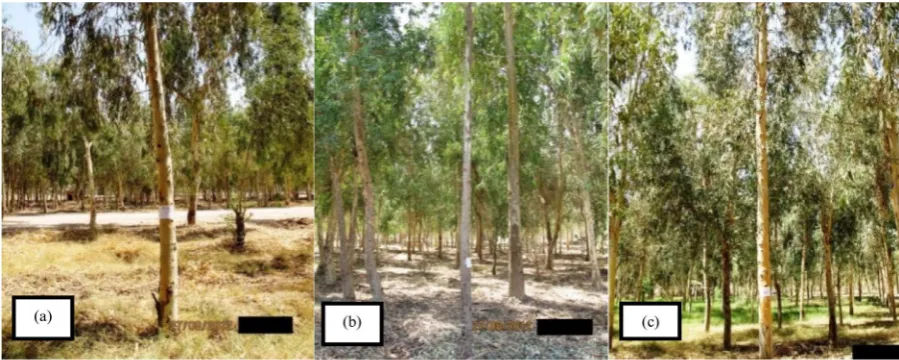
fiber morphology characteristics, there are no significant differences between two groups. Overall, seven trees (four from Pirde and three from Khabat) were selected as sources for propagation of Eucalyptus camaldulensis for paper production. Tree 10Pr-12 is the best source based on overall performances.
Acknowledgements
[image:6.595.173.459.84.220.2] [image:6.595.89.540.452.596.2]Figure 4. Examples of superior plus trees as sources for propagation purposes: (a) Tree no. 5Kh-8 based on the growth parameter; (b) Tree no. 5Pr-3 based on fiber morphology characteristic; (c) Tree no. 10Pr-12 based on cumulative scores (fiber morphology and growth parameter). Scale 1 m.
Department of Forest Management especially Dr Aktar Hossain and Wood Anatomy Laboratory of Faculty of Forestryand Institute of Tropical Forestry and Forest Products of Universiti Putra Malaysia who contributed to valuable discussion on the topics developed in this manuscript as well as for providing support, facilities, assistance and guidance in the laboratory.
References
[1] Sherzad, O. (2003) The Study of Morphological Variation Phenomenon of Eucalyptus camaldulensis Dehnh. Trees in Erbil City/ Iraq. Ph.D. Dissertation. University of Salahaddin, Erbil.
[2] Food and Agriculture Organization of the United Nations (FAO) (2012) http://www.fao.org/
[3] Chen, Z.-Z., Ho, C.-K., Ahn, I.-S. and Chiang, V.L. (2007) Eucalyptus. Methods in Molecular Biology, 344, 125-134.
[4] Map Website. http://git-forestry.com/Global_Eucalyptus_Map.htm
Join the Cartographic Effort. http://gitforestry.com/download_git_eucalyptus_map.htm
[5] Arya, I.D., Sharma, S. and Arya, S. (2009) Micropropagation of Superior Eucalyptus Hybrids FRI-5 (Eucalyptus ca-maldulensis Dehn × E. tereticornis Sm) and FRI-14 (Eucalyptus torelliana F.V. Muell × E. citriodora Hook): A Commercial Multiplication and Field Evaluation. African Journal of Biotechnology, 8, 5718-5726.
[6] Yavuz, S. and Malik, M. (1979) The Effect of Stump Height and Number of Shoots per Stump on the Stump Copping Power, and Growth and Yield of Eucalyptus camaldulensis Grown as an Irrigated Plantation in Northern Iraq. İstanbul
Üniversitesi Orman Fakültesi Dergisi, 29, 1-13.
http://www.orman.istanbul.edu.tr/journal/index.php/ormandergi/article/view/277/191
[7] Adam, B., Timothy, R. and Glyn, A. (2002) Control of Hyperhydricity in Eucalyptus axillary Shoot Cultures Grown in Liquid Medium. Plant Cell, Tissue and Organ Culture, 71, 245-252.http://dx.doi.org/10.1023/A:1020360120020
[8] Gary, A.S. and Michael, J.K. (1982) The Manufacture of Pulp and Paper; A Text Book of Modern Pulp and Paper Mill Practice. Technical Association of the Pulp and Paper Industry, Canadian Pulp and Paper Association.
[9] Dean, R.D., John, W.L., Richard, B.S., Sherri, G., Charles, J.J. and George, E.M. (1988) Seven-Year Performance of Eucalyptus Species Napa County. California Agriculture, 42, 19-20.
http://ucce.ucdavis.edu/files/repositoryfiles/ca4206p19-68813.pdf
[10] Oluwadare, A.O. and Ashimiyu, O. (2007) The Relationship between Fiber Characteristics and Pulp-Sheet Properties of Leucaena leucocephala (Lam.) De Wit. Middle-East Journal of Scientific Research, 2, 63-68.
http://idosi.org/mejsr/mejsr2(2)/5.pdf
[11] Dharm, D. and Tyagi, C.H. (2011) Comparison of Various Eucalyptus Species for Their Morphological, Chemical, Pulp and Paper Making Characters. Indian Journal of Chemical Technology, 18, 145-151.
[image:7.595.88.538.84.264.2]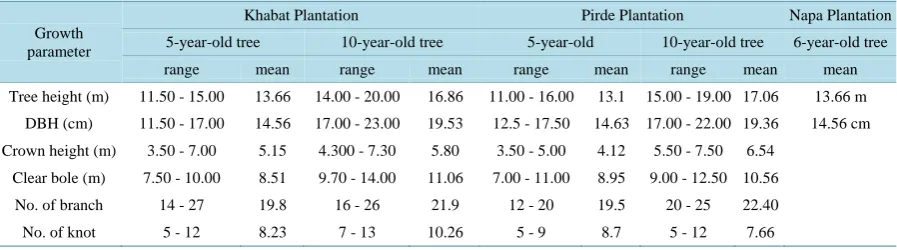

![Table 4. Comparing mean fiber characteristics of 5-year-old Eucalyptus camaldulensis with 5-year-old Leucaenalencoce- phala that obtained by [10]](https://thumb-us.123doks.com/thumbv2/123dok_us/8029165.768231/6.595.89.540.452.596/table-comparing-fiber-characteristics-eucalyptus-camaldulensis-leucaenalencoce-obtained.webp)