http://dx.doi.org/10.4236/jis.2016.73010
Face Recognition across Time Lapse Using
Convolutional Neural Networks
Hachim El Khiyari, Harry Wechsler
Department of Computer Science, George Mason University, Fairfax, VA, USA
Received 12 February 2016; accepted 8 April 2016; published 11 April 2016
Copyright © 2016 by authors and Scientific Research Publishing Inc.
This work is licensed under the Creative Commons Attribution International License (CC BY). http://creativecommons.org/licenses/by/4.0/
Abstract
Time lapse, characteristic of aging, is a complex process that affects the reliability and security of biometric face recognition systems. This paper reports the novel use and effectiveness of deep learning, in general, and convolutional neural networks (CNN), in particular, for automatic rather than hand-crafted feature extraction for robust face recognition across time lapse. A CNN archi-tecture using the VGG-Face deep (neural network) learning is found to produce highly discrimina-tive and interoperable features that are robust to aging variations even across a mix of biometric datasets. The features extracted show high inter-class and low intra-class variability leading to low generalization errors on aging datasets using ensembles of subspace discriminant classifiers. The classification results for the all-encompassing authentication methods proposed on the chal-lenging FG-NET and MORPH datasets are competitive with state-of-the-art methods including com- mercial face recognition engines and are richer in functionality and interoperability than existing methods as it handles mixed biometric datasets, e.g., FG-NET and MORPH.
Keywords
Aging, Authentication, Biometrics, Convolutional Neural Networks (CNN), Deep Learning, Ensemble Methods, Face Recognition, Interoperability, Security
1. Introduction
envi-ronment and lifestyle. Face recognition across time lapse belongs to the general topic of face recognition in un-controlled or wild settings and affects security solutions that involve human biometrics. The challenge is sub-stantial since the appearance of human subjects in images used for training or enrollment can vary significantly from their appearance during the ultimate recognition. To address these challenges, robust age-invariant me-thods must be developed. Age invariance can be implemented either at the feature extraction level or at the training and/or recognition level. At the feature extraction level, the goal is to derive image descriptors that are robust to intra-class aging variation. At the training and testing level, one thrives for low generalization errors in the presence of aging. This paper mostly copes with aging variation at the feature extraction level and leverages a deep learning approach for automatic feature extraction using cascaded convolutional neural networks (CNN). The approach advanced and described in this paper further copes with training and testing aspects using ensem-bles of classifiers driven by such features for authentication and ultimately is shown able to cope with mixed biometric datasets. This is characteristic of interoperability or equivalently of cross-training and testing across mixed datasets [1]. Interoperability is mostly concerned with domain adaptation, in general, and transfer learn-ing, in particular, for cross-modal generalization over features and parameter settings.
Rather than deriving and using hand-crafted features, this paper advances the utility and feasibility of using convolutional neural networks for automatic feature detection for the purpose of face recognition subject to time lapse. Automatic feature extraction using convolutional neural networks (CNN) [2] can provide highly intero-perable descriptors that are robust to aging variations and add much flexibility when deployed and used in bio-metric systems. We show later on that (a) encodings of facial images using CNN compare favorably to existing methods using generic but hand-crafted features such as Gabor-based descriptors, SIFT, or LBP, and that (b) coupling of CNN for feature extraction with ensemble of subspace discriminants (ESD) [3] yields robust and competitive methods for face recognition on the challenging FG-NET [4] and MORPH [5] aging datasets.
The outline of the paper is as follows. Section 2 reviews related work on the biometrics of face aging. Section 3 provides background on CNN. Section 4 presents the overall biometric architecture proposed for face aging subject to time lapse. This includes preprocessing, feature extraction using CNN and classification (for the pur-pose of identification). Section 5 reports on experimental design, datasets used, and results obtained. Section 6 provides a comparative performance evaluation of our CNN-inspired method and current face aging methods. Section 7 discusses the motivation behind CNN, impact of our novel approach, and directions for future R&D on face aging. Section 8 concludes the paper.
2. Related Work
Existing methods for face recognition across time lapse can be divided into two main groups, generative and discriminative. In the generative approach, the system leverages an aging model that can simulate and synthesize the face appearance at various ages. The better the simulation, the better the recognition. Learning such a model can be challenging due to the dependence of the aging process on several uncontrolled external factors. On the other hand, discriminative methods seek to match images directly for authentication without the intermediary step of synthesizing faces, as would be the case in generative methods.
2.1. Generative Methods
genera-tion of wrinkles, the results obtained were similar to those achieved using only 2D models.
2.2. Discriminative Methods
Biswas et al. [10] have proposed a discriminative approach based on the observation that facial appearance changes in a coherent manner and therefore matching can be done by analyzing the coherency of the drift of feature vectors across age progression. They proposed a simple metric to measure the drift between pairs of im-ages. If two images are of the same subject, then the drift will be small and coherent; if they are of different subjects, then the drift will be extreme and incoherent. They measured drift coherency in both children and adults and presented promising preliminary results. Ling et al. [11] used discriminant image descriptors based on Gradient Orientation Pyramids (GOP). They found that GOP representation combined with SVM classifica-tion is more invariant to aging effects compared to other methods, and that the difficulty involved in face verifi-cation saturates for age gaps between 4 years and 10 years. Klare et al. [12] used a discriminative approach to show that training to improve performance in the presence of aging has a negative effect on performance in a non-aging scenario. They suggested that in order to improve performance on a given time lapse, the system should be trained using samples from that specific time lapse. They adopted a technique based on Random LDA subspaces (RS-LDA) [13].
3. Convolutional Neural Networks
Convolutional neural networks (CNN) [2] expand on traditional neural networks by including both fully-con- nected hidden layers and locally-connected convolutional layers. In the traditional neural network, each hidden layer node is fully-connected to all nodes in the preceding layer. For large raw input images, full-connectivity becomes computationally intensive and does not take advantage of the local correlations in natural images. In-spired by the biology of human vision, convolutional neural networks take advantage of the spatial correlation in natural images and restrict the connectivity of each node to a local area known as its receptive field. In addition, convolutional neural networks use parameter sharing, pooling, and dropout to greatly reduce the number of pa-rameters (“features”) learned by the CNN.
In spite of the efficient architecture of convolutional neural networks, they still require a large number of im-ages for training. Using a small dataset for training leads to over-fitting. This requirement restricts the use of convolutional neural networks for classification purposes to large datasets only. However, recent research has shown that the output of the locally-connected convolutional layers produces highly discriminative descriptors. Consequently, a convolutional neural network pre-trained on a large image dataset can be used as a feature ex-tractor for other closely related datasets. Reusing a learned model in another domain or task is known as transfer learning.
Several CNN architectures have been proposed in the literature and some have been shown to produce better results than the most advanced state-of-the-art recognition methods. In our work, we use face descriptors based on the VGG-Face [2] deep architecture described in the next section.
VGG-Face
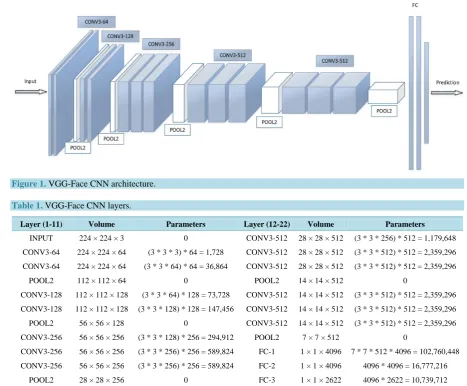
The VGG-Face descriptors are based on the VGG-Very-Deep-16 CNN architecture described in [2]. The net-work is composed of a sequence of convolutional, pool, and fully-connected (FC) layers. The convolutional lay-ers use filtlay-ers of dimension 3 while the pool laylay-ers perform subsampling with a factor of 2. The architecture of the VGG-Face network is shown in Figure 1.
Table 1 provides additional details on the CNN layers. The volume column represents the width, height, and depth or each layer, respectively. The parameters column shows the number of parameters learned in each layer.
Figure 1. VGG-Face CNN architecture.
Table 1. VGG-Face CNN layers.
Layer (1-11) Volume Parameters Layer (12-22) Volume Parameters
INPUT 224 × 224 × 3 0 CONV3-512 28 × 28 × 512 (3 * 3 * 256) * 512 = 1,179,648
CONV3-64 224 × 224 × 64 (3 * 3 * 3) * 64 = 1,728 CONV3-512 28 × 28 × 512 (3 * 3 * 512) * 512 = 2,359,296
CONV3-64 224 × 224 × 64 (3 * 3 * 64) * 64 = 36,864 CONV3-512 28 × 28 × 512 (3 * 3 * 512) * 512 = 2,359,296
POOL2 112 × 112 × 64 0 POOL2 14 × 14 × 512 0
CONV3-128 112 × 112 × 128 (3 * 3 * 64) * 128 = 73,728 CONV3-512 14 × 14 × 512 (3 * 3 * 512) * 512 = 2,359,296
CONV3-128 112 × 112 × 128 (3 * 3 * 128) * 128 = 147,456 CONV3-512 14 × 14 × 512 (3 * 3 * 512) * 512 = 2,359,296
POOL2 56 × 56 × 128 0 CONV3-512 14 × 14 × 512 (3 * 3 * 512) * 512 = 2,359,296
CONV3-256 56 × 56 × 256 (3 * 3 * 128) * 256 = 294,912 POOL2 7 × 7 × 512 0
CONV3-256 56 × 56 × 256 (3 * 3 * 256) * 256 = 589,824 FC-1 1 × 1 × 4096 7 * 7 * 512 * 4096 = 102,760,448
CONV3-256 56 × 56 × 256 (3 * 3 * 256) * 256 = 589,824 FC-2 1 × 1 × 4096 4096 * 4096 = 16,777,216
POOL2 28 × 28 × 256 0 FC-3 1 × 1 × 2622 4096 * 2622 = 10,739,712
implementing CNN architectures for computer vision applications. MatConvNet provides the pre-trained im-plementation of the VGG-Face CNN that we use for feature extraction.
4. Face Recognition Using Convolutional Neural Networks
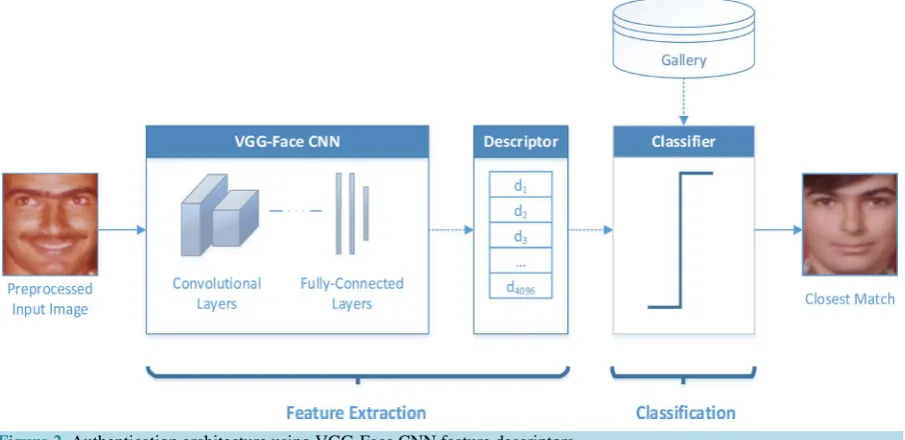
We describe here the modular face aging recognition approach in terms of image preprocessing, feature extrac-tion using CNN (see Figure 1 for the VGG-Face CNN architecture), and classification functional blocks (see Figure 2 for the architecture of our face aging recognition system). Image preprocessing is about face detection and subsequent image normalization in terms of pose and image size. Feature extraction is about capturing face descriptors using CNN rather than hand-crafted features as current face aging methods do. The classification methods used include nearest neighbor (NN), linear discriminant analysis (LDA), and ensemble of subspace discriminants (ESD). Dimensionality reduction for efficiency reasons using principal component analysis (PCA) is done prior to classification using NN and LDA, but not for ESD as PCA was found to degrade its perfor-mance.
4.1. Image Preprocessing
Figure 2. Authentication architecture using VGG-Face CNN feature descriptors.
ages. No additional gray scaling is performed and images are input to the convolutional neural network in their original color channels. A sample of preprocessed images for FG-NET and MORPH is shown in Figure 3 and Figure 4.
4.2. Feature Extraction
We use the VGG-Face network architecture provided by the MatConvNet toolbox [14] for feature extraction. The VGG-Face network described in section 3.1 has a deep architecture composed of 3 × 3 convolution layers, 2 × 2 pooling layers, and 3 fully-connected layers. While the network can perform classification on its own, the output layer of the network is not used in our experiments and 4096-dimensional descriptors are instead ex-tracted from the FC-1 layer shown in Table 1. To extract features from an image, the image is preprocessed and fed to the CNN as a multidimensional array of pixel intensities. For RGB images, the input is a 224 × 224 × 3 array, while for grayscale images the input is a 224 × 224 × 1 array. Each convolutional layer performs a filter-ing operation on the precedfilter-ing layer resultfilter-ing in an activation volume which in turn becomes the input of the following layer. Pooling is used throughout the network to reduce the number of nodes by down sampling the activation maps using the max operation. The fully-connected layers of the network are used for learning the classification function. The feature descriptors are extracted from the output of the first fully-connected layers (FC-1), then L2-normalized by dividing each component by the L2-norm of the feature vector. The normalized features are then used for training and testing.
4.3. Classification Methods
The performance and interoperability of our authentication (“identification”) method is evaluated across a suite of classifiers, which consists of nearest neighbor (NN) [16], linear discriminant analysis [17], and ensemble of subspace discriminant [3] classifiers. The nearest neighbor classifier uses the 1-nearest neighbor rule and Eucli-dean distances. To improve NN performance, we apply principal component analysis (PCA) (see Section 4.3.1) to the extracted features. Linear discriminant analysis (LDA) assumes that images for each subject are drawn from Gaussian distributions and the training data is used to learn linear boundaries that discriminate between human subjects. We again apply PCA to the extracted features prior to LDA to improve performance. The sub-space discriminant method employs an ensemble of 200 weak learners based on decision trees.
Principal Component Analysis (PCA)
X2, …, Xn,one constructs the matrix X = [X1, X2, …, Xn] where each Xi is a 4096-dimension FC-1 feature vec-tor. One computes then the mean vector M and subtracts it from the vectors Xi such that Xi Xi - M. One then
computes the covariance matrix C = XTX where XT is the transpose of X. Finally, one computes the eigenvec-tors of C and selects only the top eigenveceigenvec-tors corresponding to the largest eigenvalues while preserving 95% of the data variability. The top eigenvectors are used to project the CNN features to the low-dimensional PCA subspace.
5. Experimental Results
We evaluate the performance of the proposed approach in the identification of subjects where there is a signifi-cant time lapse between the enrolled and probe images. For each subject, a subset of the corresponding images is used for enrollment while the remaining subset contains the probe images used for testing. In the case of linear and subspace discriminant models, the identity of each subject in the probe dataset is determined directly by the classification model. In the nearest neighbor classifier, probe images are assigned the identity of their respective nearest neighbors based on Euclidean distances. This section details the biometric datasets used, the perfor-mance of CNN descriptors and the classifier methods described earlier (see Sect. 4.3) for face recognition across time lapse, and as a unique characteristic, the ability for interoperability on the mix of FG-NET and MORPH.
5.1. Time Lapse Biometric Datasets
We use the FG-NET [4] (see Figure 3) and MORPH [5] (see Figure 4) datasets, which are publicly available. These datasets contain multiple images per subject reflecting variability in age, in addition to other variability such as pose, illumination and expression. Image normalization and preprocessing includes in-plane rotation and scale. FG-NET contains 1002 images of 82 subjects where subjects’ ages vary between 0 and 69. MORPH con-tains 55,134 images of 13,000 subjects collected over four years. CNN descriptors were extracted from the da-tasets and used for both training and testing.
5.2. Time Lapse Biometric Performance on FG-NET
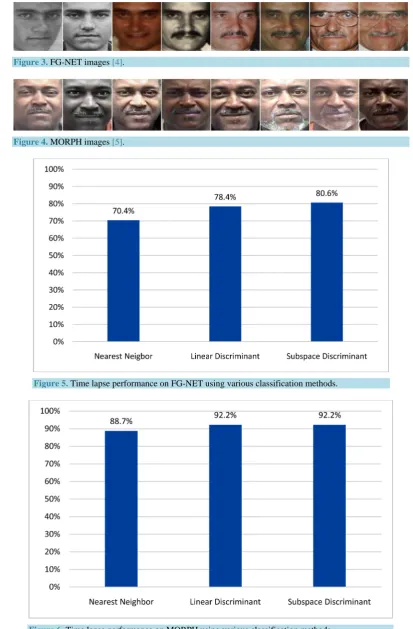
After image preprocessing as described in section 4.1, we extract 4096-dimensional feature vectors from each of the 1002 images in FG-NET, then train the proposed suite of classifiers. We use 5-fold cross-validation such that for each fold, 80% of the images of each subject are used for training and 20% are used for testing. The perfor-mance reported is the average perforperfor-mance found for each fold. Figure 5 shows the recognition performance (“rank-1 identification”) of each of the classifiers described in Section 4.3. The best performance is 80.6% and was achieved using an ensemble of subspace discriminant learners (ESD) [3]. No PCA dimensionality reduction was applied to the ESD learner in order to achieve maximum performance. One of our experiments showed that PCA has a negative effect on the ESD learner performance due to the loss of information. The performance of the linear classifier was slightly lower than ESD, however, it has the additional benefit of requiring significantly less time to train.
5.3. Time Lapse Biometric Performance on MORPH
We repeat the same experimental setting as in the previous subsection (for FG-NET) using a random subset of 1002 images from MORPH corresponding to 267 subjects. The results are shown in Figure 6. The best mance is 92.2% and was achieved again using the ensemble of subspace discriminant classifiers. The perfor-mance on MORPH was better than FG-NET due to lower intra-class variability in the dataset.
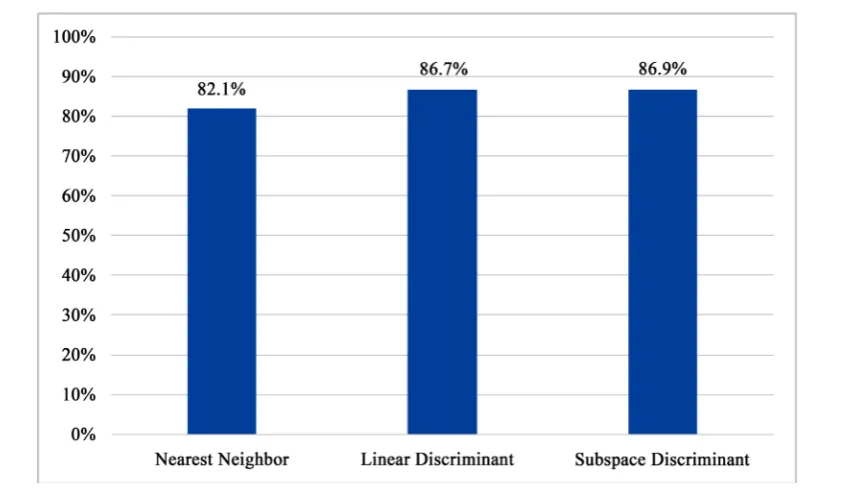
5.4. Time Lapse Interoperability on Mixed (FG-NET and MORPH) Dataset
Figure 3. FG-NET images [4].
Figure 4. MORPH images [5].
[image:7.595.102.516.83.713.2]Figure 5. Time lapse performance on FG-NET using various classification methods.
Figure 7. Time lapse performance on mixed (FG-NET and MORPH) dataset using various classification methods.
6. Comparative Time Lapse Performance Evaluation
Table 2 summarizes the performance results of the 3 classification methods on FG-NET, MORPH, and the mixed (FG-NET and MORPH) dataset. The ensemble of subspace discriminants provides the most robust classi-fication method across all datasets. Despite their simplicity, the nearest neighbor and linear discriminant clas-sifiers achieve reasonably good performance in the presence of variability due to aging and other factors such as pose, illumination and expression.
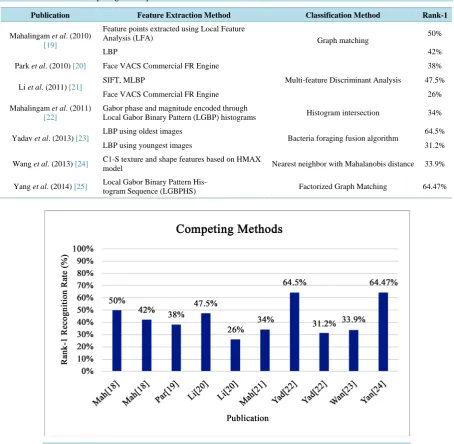
Figure 8 shows the performance of competing methods on the FG-NET dataset. A description of each method is provided in Table 3. It can be observed that our approach consistently outperforms state-of-art methods in-cluding commercial face recognition engines such as FaceVACS commercial face recognition engine. This de-monstrates the effectiveness and interoperability of automatic CNN-based feature extraction across datasets and classification methods.
7. Motivation and Impact and Directions for Future Research
The use of robust age-invariant recognition is important for biometrics-based security applications. Our method uses deep learning for the automatic extraction of CNN features and shows significant improvement in face recognition across time lapse. Age-invariant methods can further reduce the overall operational cost of biome-trics security systems by minimizing the need for reenrollments due to time lapse.
Our methodology is holistic where the face image is considered as a single component rather than a collection of semantically separate parts, e.g., eyes, nose, and mouth. Recent research in parts-based recognition has shown that partitioning the face into distinct components can lead to performance improvement. Future work combin-ing CNN features and recognition-by-parts can significantly enhance performance. Towards that end, one should perform visualization driven ablation and sensitivity studies [26] to assess the relative importance of different parts and intermediate CNN layers.
Table 2.Time lapse performance on FG-NET and MORPH using various classification methods.
FG-NET MORPH FG-NET and MORPH
Nearest Neighbor 70.4% 88.7% 82.1%
Linear Discriminant 78.4% 92.2% 86.7%
Subspace Discriminant 80.6% 92.2% 86.9%
Table 3. Overview of competing time lapse methods on FG-NET.
Publication Feature Extraction Method Classification Method Rank-1
Mahalingam et al. (2010)
[19]
Feature points extracted using Local Feature
Analysis (LFA) Graph matching 50%
LBP 42%
Park et al. (2010) [20] Face VACS Commercial FR Engine 38%
Li et al. (2011) [21] SIFT, MLBP Multi-feature Discriminant Analysis 47.5%
Face VACS Commercial FR Engine 26%
Mahalingam et al. (2011)
[22]
Gabor phase and magnitude encoded through
Local Gabor Binary Pattern (LGBP) histograms Histogram intersection 34%
Yadav et al. (2013) [23] LBP using oldest images Bacteria foraging fusion algorithm 64.5%
LBP using youngest images 31.2%
Wang et al. (2013) [24] C1-S texture and shape features based on HMAX
model Nearest neighbor with Mahalanobis distance 33.9%
Yang et al. (2014) [25] Local Gabor Binary Pattern His-
[image:9.595.86.541.179.623.2]togram Sequence (LGBPHS) Factorized Graph Matching 64.47%
Figure 8. Comparative time lapse performance of competing methods on FG-NET.
8. Conclusion
the interoperability aspect where performance holds steady around 80% - 90% across single source and mixed datasets. Future venues for R&D include the coupling of domain adaptation and transfer learning, on one side and recognition-by-parts rather than holistic biometric authentication, on the other side. Recognition-by-parts will serve as the counterpart to subspace discrimination, weak learners, and ensemble methods.
References
[1] El Khiyari, H., Abate, A.F., De Marsico, M. and Wechsler, H. (2012) Biometric Interoperability across Training, Enrollment, and Testing for Face Authentication. IEEE Workshop on Biometric Measurements and Systems for Secu-rity and Medical Applications (BIOMS), Salerno, 14 September 2012, 1-8.
http://dx.doi.org/10.1109/BIOMS.2012.6345777
[2] Parkhi, O.M., Vedaldi, A. and Zisserman, A. (2015) Deep Face Recognition. Proceedings of the British Machine Vi-sion Conference (BMVC), Swansea, 7-10 September 2015.
[3] Ho, T.K. (1998) The Random Subspace Method for Constructing Decision Forests. IEEE Transactions on Pattern Analysis and Machine Intelligence, 20, 832-844.
[4] Face and Gesture Recognition Working Group (2000) http://www-prima.inrialpes.fr/FGnet/
[5] Ricanek Jr., K. and Tesafaye, T. (2006) MORPH: A Longitudinal Image Database of Normal Adult Age-Progression. IEEE 7th International Conference on Automatic Face and Gesture Recognition, Southampton, 2-6 April 2006, 341- 345.
[6] Lanitis, A., Taylor, C.J. and Cootes, T.F. (1999) Modeling the Process of Ageing in Face Images. Proceedings of the Seventh IEEE International Conference on Computer Vision, 1, 31-136. http://dx.doi.org/10.1109/iccv.1999.791208
[7] Lanitis, A. and Taylor, C.J. (2000) Towards Automatic Face Identification Robust to Ageing Variation. Proceedings of the Fourth IEEE International Conference on Automatic Face and Gesture Recognition, Grenoble, 28-30 March 2000, 391-396.
[8] Lanitis, A., Taylor, C.J. and Cootes, T.F. (2002) Toward Automatic Simulation of Aging Effects on Face Images. IEEE Transactions on Pattern Analysis and Machine Intelligence, 24, 442-455. http://dx.doi.org/10.1109/34.993553
[9] Wang, J., Shang, Y., Su, G. and Lin, X. (2006) Age Simulation for Face Recognition. 18th Int. Conf. Pattern Recogni-tion (ICPR’06), 3, 913-916. http://dx.doi.org/10.1109/ICPR.2006.230
[10] Biswas, S., Aggarwal, G., Ramanathan, N. and Chellappa, R. (2008) A Non-Generative Approach for Face Recogni-tion across Aging. 2nd IEEE InternaRecogni-tional Conference on Biometrics: Theory, ApplicaRecogni-tions and Systems, Arlington, 29 September-1 October 2008, 1-6. http://dx.doi.org/10.1109/btas.2008.4699331
[11] Ling, H., Soatto, S., Ramanathan, N. and Jacobs, D.W. (2010) Face Verification across Age Progression Using Discri-minative Methods. IEEE Transactions on Information Forensics and Security, 5, 82-91.
http://dx.doi.org/10.1109/TIFS.2009.2038751
[12] Klare, B. and Jain, A.K. (2011) Face Recognition across Time Lapse: On Learning Feature Subspaces. 2011 Interna-tional Joint Conference on Biometrics (IJCB), Washington DC, 11-13 October 2011, 1-8.
http://dx.doi.org/10.1109/ijcb.2011.6117547
[13] Wang, X. and Tang, X. (2006) Random Sampling for Subspace Face Recognition. International Journal of Computer Vision, 70, 91-104. http://dx.doi.org/10.1007/s11263-006-8098-z
[14] Vedaldi, A. and Lenc, K. (2015) MatConvNet: Convolutional Neural Networks for MATLAB. Proceedings of the 23rd ACM International Conference on Multimedia, Brisbane, 26-30 October 2015, 689-692.
http://dx.doi.org/10.1145/2733373.2807412
[15] Fasel, I., Fortenberry, B. and Movellan, J.R. (2005) A Generative Framework for Real-Time Object Detection and Classification. Journal of Computer Vision and Image Understanding, Special Issue on Eye Detection and Tracking, 98, 182-210. http://dx.doi.org/10.1016/j.cviu.2004.07.014
[16] Cover, T. and Hart, P. (1967) Nearest Neighbor Pattern Classification. IEEE Transactions on Information Theory, 13, 21-27. http://dx.doi.org/10.1109/TIT.1967.1053964
[17] Belhumeur, P.N., Hespanha, J.P. and Kriegman, D. (1997) Eigenfaces vs. Fisherfaces: Recognition Using Class Spe-cific Linear Projection. IEEE Transactions on Pattern Analysis and Machine Intelligence, 19, 711-720.
http://dx.doi.org/10.1109/34.598228
[18] Jolliffe, I.T. (2002) Principal Component Analysis. 2nd Edition, Springer, New York.
[20] Park, U., Tong, Y. and Jain, A.K. (2010) Age-Invariant Face Recognition. IEEE Transactions on Pattern Analysis and Machine Intelligence, 32, 947-954. http://dx.doi.org/10.1109/btas.2010.5634496
[21] Li, Z., Park, U. and Jain, A.K. (2011) A Discriminative Model for Age Invariant Face Recognition. IEEE Transactions on Information Forensics and Security, 6, 1028-1037. http://dx.doi.org/10.1109/TIFS.2011.2156787
[22] Mahalingam, G. and Kambhamettu, C. (2011) Can Discriminative Cues Aid Face Recognition across Age? IEEE In-ternational Conference on Automatic Face & Gesture Recognition and Workshops, Santa Barbara, 21-25 March 2011, 206-212.
[23] Yadav, D., Vatsa, M., Singh, R. and Tistarelli, M. (2013) Bacteria Foraging Fusion for Face Recognition across Age Progression. IEEE Conference on Computer Vision and Pattern Recognition Workshops (CVPRW), Portland, 23-28 June 2013, 173-179. http://dx.doi.org/10.1109/cvprw.2013.33
[24] Wang, S., Xia, X., Huang, Y. and Le, J. (2013) Biologically-Inspired Aging Face Recognition Using C1 and Shape Features. 5th International Conference on Intelligent Human-Machine Systems and Cybernetics (IHMSC), 2, 574-577.
http://dx.doi.org/10.1109/ihmsc.2013.285
[25] Yang, H., Huang, D. and Wang, Y. (2014) Age Invariant Face Recognition Based on Texture Embedded Discrimina-tive Graph Model. IEEE International Joint Conference on Biometrics (IJCB), Clearwater, 29 September-2 October 2014, 1-8.
[26] Zeiler, M.D. and Fergus, R. (2014) Visualizing and Understanding Convolutional Networks. In: Fleet, D., Pajdla, T., Schiele, B. and Tuytelaars, T., Eds., Computer Vision—ECCV 2014, Springer, Zurich, 818-833.