Volume 2010, Article ID 769780,10pages doi:10.1155/2010/769780
Research Article
Invalid Permutation Tests
Mikel Aickin
Department of Family & Community Medicine, University of Arizona, Tucson, AZ 85724, USA
Correspondence should be addressed to Mikel Aickin,[email protected]
Received 25 December 2009; Accepted 15 March 2010
Academic Editor: Andrei Volodin
Copyrightq2010 Mikel Aickin. This is an open access article distributed under the Creative Commons Attribution License, which permits unrestricted use, distribution, and reproduction in any medium, provided the original work is properly cited.
Permutation tests are often presented in a rather casual manner, in both introductory and advanced statistics textbooks. The appeal of the cleverness of the procedure seems to replace the need for a rigorous argument that it produces valid hypothesis tests. The consequence of this educational failing has been a widespread belief in a “permutation principle”, which is supposed invariably to give tests that are valid by construction, under an absolute minimum of statistical assumptions. Several lines of argument are presented here to show that the permutation principle itself can be invalid, concentrating on the Fisher-Pitman permutation test for two means. A simple counterfactual example illustrates the general problem, and a slightly more elaborate counterfactual argument is used to explain why the main mathematical proof of the validity of permutation tests is mistaken. Two modifications of the permutation test are suggested to be valid in a very modest simulation. In instances where simulation software is readily available, investigating the validity of a specific permutation test can be done easily, requiring only a minimum understanding of statistical technicalities.
1. Introduction
Permutation tests are frequently recommended on two grounds. First, they require fewer
assumptions than corresponding model-based tests, and secondly, their validityas statistical
hypothesis testsis guaranteed by construction. The purpose of this note is to indicate a way
in which the first property undermines the second property. The setting is the usual one in which the Mann-Whitney test is asserted to be appropriate, but going beyond this to the
assertion of a more general permutation principleLehmann1.
the two-sample situation discussed here, the dominant statistical method is thet-test, and although randomization arguments have been used to justify it, it can also be recommended without mentioning randomization. Perhaps the only other analyses that are used with some
frequency are the nonparametric alternatives to the t-tests, and these are often justified
by appealing to a “permutation principle”, giving the impression that these alternatives minimize untestable assumptions. In fact, the often-used Wilcoxon and Mann-Whitney tests do not follow from a permutation principle, but even if they did I will argue here that this principle is invalid.
First, I will present an exaggerated example that indicates in a practical sense how the logic of the general permutation test can break down. Secondly, using the notion of counterfactuals, I will show in a slightly more theoretical way what the source of the problem is. Thirdly, I will suggest two potential alternatives to the permutation test, and argue in their favor on the basis of a small simulation. Finally, I will indicate how Fisher’s exact test fails to follow counterfactual principles, based on an example.
2. Regression Example
The two-sample location problem can be expressed as a model for individual pairsy, xof
the formyθxe,wherextakes the values 1 and−1indicating two groups,eis a chance
perturbation, having mean 0 and being uncorrelated withx,andθis the parameter of interest.
In this paper, I will only consider the case in which half of the observations havex1,and
so the total sample sizenis even. Given data of this form, the conventional estimate ofθis
θ
xy
n . 2.1
The null hypothesis is thatθ0,and the permutation test of this hypothesis is based
on the putative null distribution of the above estimate, obtained in the following way. Letx
denote a random permutation of thex-values. For simulation purposes,y, xis replaced by
y,x,a large number of random permutationsxare generated, withyfixed, and for each
one the corresponding estimate ofθis computed. Finally, this large sample ofθs is taken to
estimate the null hypothesis distribution ofθ.
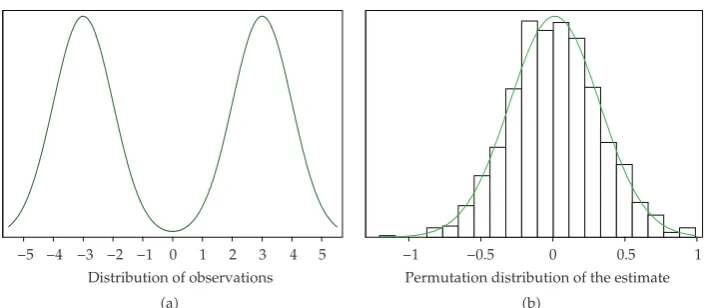
A difficulty with this approach is illustrated in Figures1 and2.Figure 1ashows a
unit Normal distribution, intended as the distribution ofyoreunder the null hypothesis
thatθ0.Half of the values from this distribution are regarded as being cases whenx−1,
the remainder whenx1.Figure 1bshows the simulated permutation null distribution of
the estimate ofθ.Figure 2ashows a another distribution foryore, again under the null
hypothesis.Figure 2bshows the simulated permutation null distribution of the estimate of
θin this case. Both of these cases are correct, in the sense that if the distribution ofeis given
on the left, then the null distribution ofθis validly approximated on the right.
Now let us look at the situation with different eyes. Suppose thatFigure 1ashows
the distribution of e, but that θ is large enough to produce the distribution of y seen in
Figure 2a. The distribution of the parameter estimate under the null hypothesis is still
−5 −4 −3 −2 −1 0 1 2 3 4 5 Distribution of the errorsand observations
a
−1 −0.5 0 0.5 1 Permutation distribution of the estimate
[image:3.600.125.477.98.251.2]b
Figure 1: A null situation for generating a permutation distribution.
−5 −4 −3 −2 −1 0 1 2 3 4 5 Distribution of observations
a
−1 −0.5 0 0.5 1 Permutation distribution of the estimate
b
Figure 2: A situation that can be either null or non-null, for simulating a permutation distribution.
coming from the distribution inFigure 2aappears inFigure 2b. This shows an example
of the following: in the situation where, as a matter of fact, the null hypothesis is false, the permutation estimate of the null distribution can also be false.
3. Counterfactuals
One way of understanding this situation is based on the method of counterfactualsRubin,
2. In the two-sample circumstance, we would write the outcomes as yθ, ψ,considered
as a stochastic process indexed by the parameter of interestθand the nuisance parameter
ψ.Again, in our situation this would beyθ, ψ θxy0, ψ,where nowy0, ψplays
the role of eabove. In the exposition by Lehmann1, the parameterψ would represent a
probability density, andy0, ψwould have densityψ.The valuey0, ψis generated by some
chance mechanism, and thenyθ, ψis generated by the model equation above. The values
we observe are yθ, ψ,but for values of θ and ψ that we do not know. Counterfactuality
comes in because y0, ψis the value we would have observed if the null hypothesis had
[image:3.600.123.477.288.442.2]order statistic is complete and sufficient for the model defined by θ 0 and ψ any
density. It follows that the null conditional distribution of thesample y0, ψgiven the order
statistic {y0, ψ} is based on the permutation distribution, irrespective of the value of ψ.
This is the basis for the permutation test. In practice, however, it is not {y0, ψ} that is
observed, but{yθ, ψ}.The conventional permutation distribution is based on the observed
order statistic, but this is not the order statistic that would have been observed if the null hypothesis had been true. This is the core of the counterfactual objection to the permutation
test; it conditions on the observed order statistic{yθ, ψ}instead of conditioning on the null
order statistic{y0, ψ},which Lehmann used for his proof. Because it is conditioning on
the latter that justifies the test, the argument for conditioning on the former is not obviously correct.
In Lehmann’s theorem where the permutation test is derived, he implicitly considers
only observations of the formy0, ψ,and shows that theunbiasedrejection regionRmust
satisfyPR | {y0, ψ} α,the level of the test. In his examples, he implies thatR can be
found by solvingPR | {yθ, ψ} α. But since his theorem implicitly assumed the null
hypothesis, he did not show thatRmust satisfy this latter equation, and as we have seen in
the example above, it need not be satisfied.
There is yet another way of seeing the problem, which connects it more meaningfully
to the example. The observed order statistic{yθ, ψ}has the same distribution as an order
statistic {y0, ψ0},where ψ0 is a distribution that depends on θ and ψ. The permutation
distribution based on {y0, ψ0} is indeed a possible null distribution, but it is not the null
distribution that would have been obtained ifθhad been 0, andψhad been left unchanged.
Thus, it is precisely the fact that the permutation argument permits different values ofθ, ψ
to produce the same order statistic that creates the problem.
Finally, there is a way of seeing how the sufficiency argument actually misleads
the inference. The argument of Lehmann 1 is that conditional on the order statistic, the
distribution of the sample does not depend on the nuisance parameterψ,in the submodel
whereθ 0.This is perhaps naturally interpreted to mean that the nuisance parameter has
been eliminated from the problem. But this is not the correct interpretation of Lehmann’s
equations. What they really say is that the only influence that the nuisance parameterψhas
on the distribution of the sample is carried by the order statistic. The order statistic completely
mediates the effect ofψon the distribution of the sample. Thus, bothθandψjointly influence
the permutation distribution of the sample, but the permutation test does not separate their individual influences.
4. Better Estimates of the Null Distribution
One obvious strategy to repair the permutation test is to replace the order statistic by
{yθ, ψ− θx }. This is an attempt to estimate the true null order statistic {y0, ψ}. The
potential objection is that the variability of this estimate might be less than the variability of the true null order statistic, producing an invalid test. The permutation test based on this replacement is called the adjusted permutation test.
Another approach is to use a simulation based on a random permutation x, but
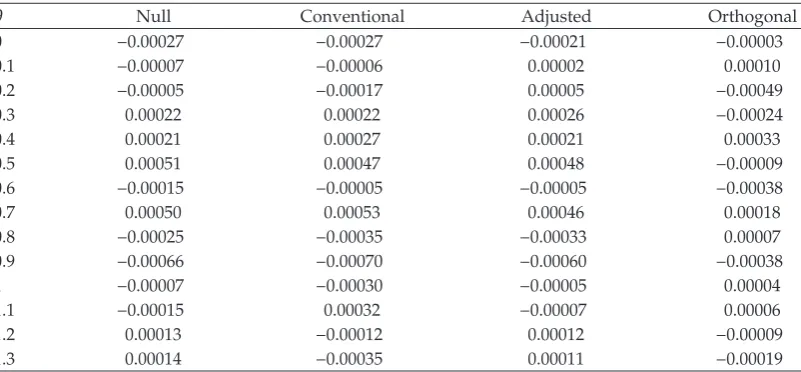
Table 1: Simulated means of effect estimates.
θ Null Conventional Adjusted Orthogonal
0 −0.00027 −0.00027 −0.00021 −0.00003 0.1 −0.00007 −0.00006 0.00002 0.00010 0.2 −0.00005 −0.00017 0.00005 −0.00049 0.3 0.00022 0.00022 0.00026 −0.00024 0.4 0.00021 0.00027 0.00021 0.00033 0.5 0.00051 0.00047 0.00048 −0.00009 0.6 −0.00015 −0.00005 −0.00005 −0.00038 0.7 0.00050 0.00053 0.00046 0.00018 0.8 −0.00025 −0.00035 −0.00033 0.00007 0.9 −0.00066 −0.00070 −0.00060 −0.00038 1 −0.00007 −0.00030 −0.00005 0.00004 1.1 −0.00015 0.00032 −0.00007 0.00006 1.2 0.00013 −0.00012 0.00012 −0.00009 1.3 0.00014 −0.00035 0.00011 −0.00019
Means of the sampling distributions of estimates of the null mean, using four procedures:1null, the usual method when the null is true,2conventional, the usual method when the null is false,3adjusted, subtracting offthe estimate,4
orthogonal, using only orthogonal permutations.
are then of the form
xyθ, ψ
n
xy0, ψ
n . 4.1
The simulated distribution of the estimate is thus based on order statistics that would have counterfactually been seen under the null hypothesis, but with a restriction on the permutations. It is not clear that this procedure is fully justified, because of the orthogonality restriction. Here we call this the orthogonal permutation test.
In the simulation, we call the usual permutation test the conventional permutation test. Because everything is based on a simulation, we know the true null order statistic, and the permutation test based on it is called the null permutation test. This gives us altogether four
permutation tests, of which only the null permutation test iswithin simulation variation
known to be correct.
5. A Simulation
To compare these four tests, I performed a small simulation in the above regression situation. The simulation used sample size 16, since the orthogonal permutation test is only possible for
xtaking values−1 and 1 ifnis divisible by 4. The distribution ofewas Normal0,1, values
ofθwere 0.11.3, the number of simulated tests for each value of the parameter was 1000,
and the number of permutations in each test was 100. The simulation was carried out in Stata
version 9, using a permutation routine that was written specifically for this research.
The results of the simulation are shown in Tables 1–4. Table 1 shows the average
estimateeach based on 1000 replications, verifying that all estimates of the null distribution
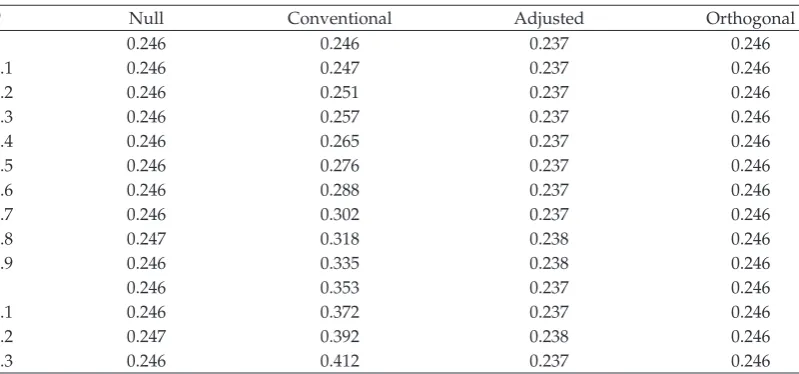
0 0.246 0.246 0.237 0.246
0.1 0.246 0.247 0.237 0.246
0.2 0.246 0.251 0.237 0.246
0.3 0.246 0.257 0.237 0.246
0.4 0.246 0.265 0.237 0.246
0.5 0.246 0.276 0.237 0.246
0.6 0.246 0.288 0.237 0.246
0.7 0.246 0.302 0.237 0.246
0.8 0.247 0.318 0.238 0.246
0.9 0.246 0.335 0.238 0.246
1 0.246 0.353 0.237 0.246
1.1 0.246 0.372 0.237 0.246
1.2 0.247 0.392 0.238 0.246
1.3 0.246 0.412 0.237 0.246
Standard deviations of the estimators inTable 1.
SDEare shown inTable 2. Again the null test values are constant, as they should be within
the simulation variation. The orthogonal test has essentially the same SDEs as the null test, and the adjusted test is only slightly higher. In contrast, the conventional test estimates an SDE that grows with the size of the parameter, another result that can be verified theoretically
see the Appendix.
The probability of rejecting the null hypothesis is shown inTable 3. Again the results
of the orthogonal test are essentially the same as the correct null test, with the adjusted test losing only a small amount of power. Although the conventional test is worse than both
the adjusted and orthogonal tests, the difference is rather small. Note that the adjusted and
orthogonal tests appear to have been slightly larger than nominal levels, suggesting that
possibly some adjustment needs to be made.In the simulations a value equal to the observed
was included in the rejection region, and the number of permutations per test was small, both
of which might account for some of the excess level, but more research is warranted.Table 4
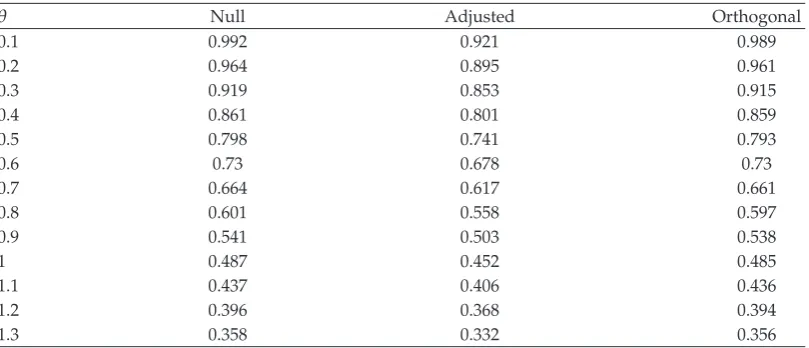
shows the efficiency of the conventional test relative to the others, in terms of sample size.
This is an estimation-based rather than a test-based comparison. Clearly the conventional
test fares poorly relative to the other tests, and the deficit grows with the size of the effect
parameter.
6. Fisher’s Exact Test Example
A similar problem affects the exact test for 2×2 tables. When the margins of a 2×2 table
are indeed fixed by the design of the experiment, then the permutation distribution may well make sense. To the contrary, the exact test has been advocated as a general testing procedure that is valid even when the margins are not fixed. The counterfactual approach
can be portrayed in these cases by defining indicators as follows:brur, βr, βc, βrc indur <
βr, bcuc, βr, βc, βrc induc < βc.brcurc, βr, βc, βrc indurc < βrc, where theu’s are independent uniform chance variables, and “ind” means “indicator variable of”. The row
[image:6.600.103.503.110.297.2]Table 3: Simulated power of tests.
θ Null Conventional Adjusted Orthogonal
0 0.053 0.053 0.067 0.061
0.1 0.112 0.1 0.132 0.123
0.2 0.212 0.186 0.221 0.212
0.3 0.337 0.283 0.34 0.316
0.4 0.487 0.426 0.487 0.47
0.5 0.643 0.574 0.645 0.619
0.6 0.759 0.726 0.768 0.756
0.7 0.857 0.835 0.876 0.862
0.8 0.924 0.913 0.94 0.929
0.9 0.963 0.965 0.978 0.974
1 0.984 0.986 0.991 0.991
1.1 0.996 0.995 0.996 0.996
1.2 0.997 0.998 0.999 0.999
1.3 0.999 0.999 1 0.999
Powers of the tests based on the estimators inTable 1.
Table 4: Simulated sample-size efficiency of the conventional test versus other tests.
θ Null Adjusted Orthogonal
0.1 0.992 0.921 0.989
0.2 0.964 0.895 0.961
0.3 0.919 0.853 0.915
0.4 0.861 0.801 0.859
0.5 0.798 0.741 0.793
0.6 0.73 0.678 0.73
0.7 0.664 0.617 0.661
0.8 0.601 0.558 0.597
0.9 0.541 0.503 0.538
1 0.487 0.452 0.485
1.1 0.437 0.406 0.436
1.2 0.396 0.368 0.394
1.3 0.358 0.332 0.356
Efficiency of the estimators inTable 1.
null hypothesis is independent of row and column, which is the same asβrc0. The nuisance
parameter isβr, βc.
Here is an illustrative example.Table 5shows the result of a single simulation withβr
0.6,βc0.6, andβrc0.3. The one-sidedP-value from Fisher’s exact test is .517according to
Stata. If we eliminatebrccounterfactually imposing the null hypothesis, then the results are
as inTable 6. If we take it that there were 10 observations in the lower-right cellas inTable 5,
but with the margins of Table 6, the one-sided P-value is .0124 again from Stata. This
example makes it clear that the failure of the null hypothesis has an effect on the conditioning
statistic, which in this case consists of the marginal frequencies in the table. The conditioning in Fisher’s exact test is not on the frequencies that would have been seen under the null
[image:7.600.100.505.346.520.2]5 10 15
6 14 20
[image:8.600.181.420.109.152.2]Simulated data based onbr,bc,andbrc, exhibiting dependence of row and column, but withP.517
Table 6: Single simulationindependent.
2 5 7
7 6 13
9 11 20
Data from the simulation inTable 5, but omitting thebrcfactor, thereby correctly estimating the null margins. 10 observations in the lower right cell would result in aP-value of .0124.
null hypothesis in which the actual nonnull value ofβrcimplicitly gives different values toβr
andβc. From the counterfactual standpoint, Fisher’s exact test uses the wrong margins.
7. Discussion
It has become increasingly common in the statistical and biomedical literature to see
assertions that amount to a general “permutation principle”. The issue is whether twoor
morevariables are related, and a test is performed based on an estimated null distribution,
which is produced by permuting oneor moreof the variables while leaving the remainder
fixed. In randomized trials, this is called the “randomization test”, and more recently “re-randomization” has also been used for it, even in situations where no original randomization has been performed. The impression is given that either no or very few assumptions are necessary for the correctness of this procedure.
For example, one now sees the justification for the Wilcoxon one-sample test as the application of this general permutation principle to the signed ranks of the observations, as if no further assumptions were required. The Wilcoxon test is, to the contrary, the consequence
of a careful argumentPratt and Gibbon3that requires the symmetry of the underlying
distribution, the disregard of which has been noted for some timeKruskal4. It is known
that the Wilcoxon test can be invalid in the presence of asymmetry; that is, the test detects the asymmetry rather than a departure from the null hypothesis, when the null hypothesis regarding the mean is true. Thus it is a specific argument based on symmetry and not a general permutation principle that justifies the Wilcoxon test. Similar comments apply to the Mann-Whitney test. There have been some cautionary articles about the general validity of
the permutation principleRomano5, Hayes6, Zimmerman7, Lu et al.8, Zimmerman
9, Modarres et al.10, but the dominant statistical thinking has been to ignore the cautions.
Based on the counterfactual argument and simulation of a regression case presented here, it seems warranted to say that permutation tests need to be revisited. Despite the fact that permutation tests are not widely used in practice, there is a very large literature on them, and several books that explain in detail how they can be used in a wide variety of
situations. This literature is attractive because it seems to offer valid statistical procedures,
[image:8.600.182.418.201.242.2]in favor of using it seems considerable, due to the reduction of untestable assumptions. But when the permutation principle fails, then there is a risk of raising false confidence in an unreliable procedure, with obvious negative consequences. The conclusion is that a substantial amount of new research is required to distinguish between valid and invalid permutation tests, and potentially also to devise modifications of the generally recommended tests that would be appropriate in practice. In any case, it should be recognized that the general assertion of a permutation principle that automatically produces valid tests appears itself to be invalid.
Appendix
The purpose of this appendix is to derive the standard deviation of the permutation estimate
of a regression parameter. Letyii1,2, . . . , n2mbe any collection of numbers. Let vector
xbe chosen at random from among the ordered lists ofnvalues1 and−1,with half being
1 and half being−1.It is obvious that
E
i
xiyi 0, A.1
where the expectation is taken with respect to the distribution of thexi’s. By algebra,
i xiyi
2
i
yi2 i /j
xixjyiyj. A.2
Employing an elementary combinatorial argument
prxixj1
prxixj
2 2m−2
m−2
2m
m
m−1
2m−1 A.3
from which it follows immediately that
prxixj−1
m
2m−1. A.4
Thus
E ⎡
⎣
i /j
xixjyiyj ⎤
⎦ m−1
2m−1 −
m
2m−1 i /jyiyj−
1
2m−1
i /j
yiyj A.5
which after a few additional manipulations gives
E
ixiyi n 2 1 n i
yi−y 2
the observed values ofyi the permutation distribution of the regression estimator has the
correct variance if and only ifθ0,that is, if and only if the null hypothesis is in fact true.
Acknowledgment
This research was supported by Grant AT001906 from the National Institutes of Health.
References
1 E. L. Lehmann, Testing Statistical Hypotheses, John Wiley & Sons, New York, NY, USA, 1959.
2 D. B. Rubin, “Estimating causal effects of treatments in randomized and nonrandomized studies,”
Journal of Educational Psychology, vol. 66, no. 5, pp. 688–701, 1974.
3 J. W. Pratt and J. D. Gibbons, Concepts of Nonparametric Theory, Springer Series in Statistics, Springer, New York, NY, USA, 1981.
4 W. H. Kruskal, “Review of nonparametric and shortcut statistics,” Journal of the American Statistical
Association, vol. 53, pp. 595–598, 1958.
5 J. P. Romano, “On the behavior of randomization tests without a group invariance assumption,”
Journal of the American Statistical Association, vol. 85, no. 411, pp. 686–692, 1990.
6 A. F. Hayes, “Randomization test and the equality of variance assumption when comparing group means,” Animal Behaviour, vol. 59, no. 3, pp. 653–656, 2000.
7 D. W. Zimmerman, “Statistical significance levels of nonparametric tests biased by heterogeneous variances of treatment groups,” Journal of General Psychology, vol. 127, no. 4, pp. 354–364, 2000.
8 M. Lu, G. Chase, and S. Li, “Permutation tests and other test statistics for ill-behaved data: experience of the NINDS t-PA stroke trial,” Communications in Statistics—Theory and Methods, vol. 30, no. 7, pp. 1481–1496, 2001.
9 D. W. Zimmerman, “A warning about the large-sample Wilcoxon-Mann-Whitney test,” Understanding
Statistics, vol. 2, no. 4, pp. 267–280, 2003.