Citation:
Glazzard, J (2017) Assessing Reading Development through Systematic Synthetic Phonics. English in Education, 51 (1). pp. 44-57. ISSN 1754-8845 DOI: https://doi.org/10.1111/eie.12125
Link to Leeds Beckett Repository record:
http://eprints.leedsbeckett.ac.uk/3995/
Document Version: Article
The aim of the Leeds Beckett Repository is to provide open access to our research, as required by funder policies and permitted by publishers and copyright law.
The Leeds Beckett repository holds a wide range of publications, each of which has been checked for copyright and the relevant embargo period has been applied by the Research Services team.
We operate on a standard take-down policy. If you are the author or publisher of an output and you would like it removed from the repository, please contact us and we will investigate on a case-by-case basis.
Abstract
This narrative literature review evaluates the effectiveness of synthetic phonics in comparison with analytic phonics. It presents the key research findings and offers a critical appraisal of this research. Primary schools have developed a variety of assessment processes which assess pupils’ knowledge and skills in synthetic phonics. It is through using these assessment tools that gaps in pupils’ knowledge
and skills are identified and these gaps then form the basis of subsequent synthetic phonics interventions. The paper concludes by arguing that a more detailed
assessment framework may be required for the purpose of assessing children’s
reading development than the model which schools currently adopt.
Assessing reading development through systematic synthetic phonics
This narrative literature review evaluates the effectiveness of synthetic phonics in comparison with analytic phonics. It presents the key research findings and offers a critical appraisal of this research. For over a decade now, and following the
publication of the Rose Review in 2006 (Rose, 2006), educational policy in England has emphasised the need for schools to provide children with a systematic
programme of synthetic phonics instruction. In synthetic phonics children learn to read by identifying the smallest units of sound within a word (phonemes) and
blending these together to read the target word. It is different to other approaches to phonics which focus on blending larger units of sound.
The emphasis on synthetic phonics has been embedded into the Teachers’
Standards (DfE, 2011) in order to ensure that all teachers have good subject
knowledge in relation to synthetic phonics. The Teachers’ Standards were developed
times since 2006 and these revisions have resulted in inspectors paying increasing attention to the teaching of synthetic phonics in schools.
Schools have developed a variety of assessment processes which assess pupils’
knowledge and skills in synthetic phonics. It is through using these assessment tools that gaps in pupils’ knowledge and skills are identified and these gaps then form the
basis of subsequent synthetic phonics interventions. For some children synthetic phonics is highly effective in enabling them to master the skill of decoding. This provides them with a strategy to read unknown words. However, for others the approach is less effective. For example, dyslexics sometimes struggle to master the skill of decoding and instead rely on whole word recognition strategies. This raises a question about whether an alternative approach to learning to read would be more beneficial for pupils who have difficulty processing sound at the level of the
phoneme. For these children alternative methods of assessing their reading development and teaching them may be necessary.
Although logic suggests that one size does not fit all, the emphasis on synthetic phonics in the Teachers’ Standards suggests quite the opposite. Thus, even if early
assessments indicate that the approach is not successful, the political endorsement of synthetic phonics in the Teachers’ Standards suggests that teachers should
persevere with this approach by providing systematic synthetic phonics intervention programmes for those children who are falling behind. This is deeply worrying given that subsequent further failure can impact detrimentally on children’s self-concept.
Definitions
The term ‘synthetic’ is taken from the verb ‘to synthesise’. Beginning readers are
taught grapheme-phoneme correspondences and taught to blend phonemes all through the word right from the outset in order to develop word reading skills (Johnston and Watson, 2007). They are also taught the reverse process of segmenting a spoken word into its constituent phonemes. These are then
represented as graphemes for spelling. Letter sounds are learnt at a rapid pace and the skills of blending and segmenting are taught from the start (Johnston and
Watson, 2007). In contrast analytic phonics introduces blending much later in the process. Children are taught to analyse the common phoneme in a set of words and individual phonemes are not pronounced in isolation (Strickland, 1998).
Evidence for synthetic phonics
The Rose Review in England (Rose, 2006) concluded that:
Having considered a wide range of evidence, the review has concluded that the case for systematic phonic work is overwhelming and much strengthened by a synthetic approach.
(Rose, 2006, para 51: 20)
In this review Rose recommended that synthetic phonics ‘offers the best route to becoming skilled readers’ (p.19) and he argued that teachers should be required to teach synthetic phonics ‘first’ and ‘fast’. This recommendation informed literacypolicy in the England and the content of initial teacher education courses.
spelling and phonemic awareness gains than the other two approaches (Watson and Johnston, 1998).
A longitudinal study reported by Johnston and Watson (2005) has demonstrated that synthetic phonics is particularly effective for boys. This study reported that both boys and girls demonstrated substantial gains in word reading, spelling and
comprehension which were sustained over time when taught through a synthetic phonics approach. However, the gain was larger for boys (Johnston and Watson, 2005). Additionally, the research found that synthetic phonics enabled children from areas of deprivation to overcome social disadvantage by demonstrating gains in reading and spelling which enabled these children to perform above their
chronological age (Johnson and Watson, 2005). More recent research also supports these findings. For example, a study by Johnston et al (2011) compared the
performance of 10-year old boys and girls who had been taught to read by either synthetic or analytic phonics. The study found that the group taught by synthetic phonics had better spelling, word reading and comprehension than the group taught by analytic phonics. Additionally, the results demonstrated that the boys taught by synthetic phonics had better word reading, spelling and comprehension than the girls who had been taught by the same method.
However, the Clackmannanshire research (experiment 2 specifically) has received considerable criticism in the academic literature (Wyse and Goswami, 2008). The study lacked sufficient rigour in its design to establish whether the synthetic
approach is superior to the analytic approach (Wyse and Goswami, 2008). Children in the analytic phonics group were taught fewer letters than children in the synthetic phonics group (Wyse and Styles, 2007) and the groups were given different amounts of teaching (Wyse and Styles, 2007). Additionally, the research design did not
example, factors such as: teacher effectiveness; parents’ educational attainment; the
quality of the literacy environment in the home; remedial help offered outside the intervention and other reading interventions which operated within the school were not controlled and therefore the evidence is insufficiently robust (Ellis and Moss, 2014). The study failed to report information about the time spent on phonics instruction outside the intervention, time spent on other reading activities and the contexts in whichchildren were exposed to phonics (Ellis and Moss, 2014). Given these serious flaws in the reporting of the research and the design of the study Ellis and Moss have concluded that:
The weakness of the research design, including the way the statistical data were analysed and reported, suggest it would be unwise to draw any clear conclusions for pedagogy or policy from this single study.
(Ellis and Moss, 2014: 249)
Despite the methodological weaknesses of the Clackmannanshire research
Johnston and Watson (2005) concluded that ‘synthetic phonics was a more effective
approach to teaching reading, spelling and phonemic awareness than analytic phonics (p.351). However, as Wyse and Styles (2007) point out ‘it is important that gains are shown for comprehension, not just for decoding and related skills’ (p.39).
In the first experiment the reporting of the comprehension outcomes was ambiguous and in the second experiment the comprehension findings were not reported (Wyse and Styles, 2007). The subsequent longitudinal study which was published by
Following the Clackmannanshire studies, the Scottish inspectorate confirmed that Clackmannanshire was “below the average for comparator authorities” (HMIE, 2006,
p. 4), thus discrediting the findings of the research. Given the serious limitations of the research, it is questionable why Rose (2006) who acknowledged the criticisms that were levelled against the research, failed to take any of these into account. The recommendations of the Rose Review were subsequently cemented into English national policy through a political emphasis on synthetic phonics in government White Papers (DfE, 2010; DfE, 2016), the Teachers’ Standards (DfE, 2011) and the
introduction of the phonics screening check in Year 1 of the national
curriculum. Additionally, the results of the phonics screening check were included in data provided to school inspectors, resulting in penalties in inspection outcomes for those schools where children under-performed in this assessment. Schools were also provided with additional funding for purchasing synthetic phonics resources. These strategies served the purpose of raising the profile of synthetic phonics in schools. To launch a policy change on a lack of robust, empirical evidence was both hasty and naïve and not an adequate solution for addressing England’s low position
in the international literacy league tables.
Evidence for analytic phonics
Analytic phonics is often described as processing text by going from whole to part rather than part towhole as is the case in synthetic phonics (Moustafa and Maldonado-Colon (1998). It is a strategy which emphasises the use of larger grain sizes, including the use of rimes.
Goswami (2005) has argued that synthetic phonics is highly effective in
English, one grapheme can be represented by multiple phonemes, whilst in many other languages letters are consistently pronounced in the same way. Additionally, in English one phoneme can be represented by multiple graphemes whilst in most other languages a phoneme is always spelt in the same way.
The complexities of the English language inevitably mean that teaching phonics through small grain sizes will result in confusion for beginning readers, especially when there is inconsistency in the sounds represented by these units in different words. Additionally, the inconsistencies also transfer to spelling in that one sound is represented by different graphemes in different words. Goswami (2005) argues that a developmental teaching sequence based on developing rhyming skills helps children to read by analogy and better suits the irregular orthography of English.
Research suggests that children code switch from small to large grain sizes when learning English depending on the word they are reading (Brown and Deavers, 1999; Goswami et al, 2003). Some words have to be learned as wholes because they have ‘no orthographic neighbours’ (Goswami, 2005: 281). Other words, particularly CVC words, have consistent letter-phoneme recoding and the use of small grain sizes is an effective decoding strategy in these cases (Goswami, 2005). Some words contain rimes that are common to other words (light/ fight) and therefore the use of rimes works particularly well in these cases. This suggests that analytic phonics has an important role to play in learning to read, given the orthographic inconsistencies of the English language. Thus, a combination of approaches may be necessary in order to enable children to develop the skill of word recognition.
Synthesis
According to Torgerson et al., ‘There is currently no strong randomised controlled
one-to-one mappings between letters and sounds (such as in Finland, Greece, Italy and Spain) there is evidence to suggest that synthetic phonics can be extremely effective (Landerl, 2000). However, the phonological complexity of the English language and the inconsistent spelling system mean that there is a need for direct instruction at levels other than the level of the phoneme in order to produce effective readers (Goswami, 2005; Wyse and Goswami, 2008). The inconsistency of English inhibits the automatic correspondences between graphemes and their phonemes (Goswami, 1994; Seymour et al., 2003) and thus it seems logical to suggest that beginning readers should be taught a range of grain sizes rather than focusing solely on the level of the phoneme.
There is now a considerable body of evidence to suggest that no one method of teaching children to read is superior to any other method (Landerl, 2000; Spencer and Hanley, 2003; Torgerson et al, 2006; Walton et al, 2001) and there is no
empirical evidence to justify Rose’s recommendation that the teaching of reading in England should rely on synthetic phonics. Much of his evidence was anecdotal (Wyse and Goswami, 2008) rather than empirical and formulating policy on the basis of anecdotal evidence lacks sufficient rigour to justify its implementation.
However, although the evidence on the most effective approach to teaching phonics is inconclusive, there is clear evidence that a systematic approach to phonics
produces gains in word reading and spelling (Torgerson et al., 2006) irrespective of whether analytic or synthetic phonics is used. Walton et al, (2001) concluded from their research that as long as tuition was systematic, then both approaches
(synthetic or analytic) lead to similar gains and this finding is supported by a range of studies (Landerl, 2000; Spencer and Hanley, 2003; Torgerson et al, 2006; Walton et al, 2001).
Discussion and conclusion: an alternative assessment battery Teaching and assessing reading
Approaches to teaching and assessing reading have moved from a psycholinguistic model to a cognitive model. The National Literacy Strategy in England (DfEE, 1998) advocated the searchlights model of teaching reading. This framework enabled teachers to select different strategies (phonics, grammatical, contextual and graphic) for developing the skill of word recognition. As this framework made phonics an optional strategy, Rose (2006) recommended that this model of teaching reading be reconstructed into the Simple View of Reading (SVOR) which was developed by Gough and Tunmer in the 1980s (Gough and Tunmer, 1986). This model separates out the skills of reading development into word recognition and linguistic
comprehension. Both skills are necessary for effective reading and teachers can use the framework to assess children’s development in each skill to determine what kind of intervention children need.
The separation of the skills is useful in that the SVOR demonstrates that different approaches to teaching are required to develop word recognition skills and linguistic comprehension. By identifying linguistic comprehension as an essential element of reading development the SVOR highlights the importance of oral language and language comprehension in the process of reading development.
Despite its significant strengths the SVOR does not break down the sub-components of word recognition or linguistic comprehension. It is useful in terms of helping
the smallest unit of sound (synthetic phonics) and therefore this is the strategy which teachers use to assess word recognition skills in the SVOR.
There is clear evidence that a systematic approach to phonics produces gains in word reading and spelling. However, there is inconclusive evidence to suggest that no one method of teaching children to read is superior to any other method. This has significant implications for educational practice and particularly in relation to
assessment of word recognition skills. Given that no single instrument can assess all the aspects which need to be examined by practitioners, schools should develop an assessment battery which assesses children’s knowledge and skills in reading development. If the skills of blending and word recognition are not developing
through synthetic phonics schools should consider teaching children analytic phonics through a systematic approach. If the approach to teaching phonics changes schools will also need to develop an alternative assessment battery which matches the gran sizes that are being taught. To use a colloquial phrase, there is little point in flogging a dead horse. If children fail to learn to read through synthetic phonics it is
counterproductive to continue with this approach. Analytic phonics is based on larger grain sizes of sound and the assessment battery would therefore need to include rimes. Continually assessing struggling readers using an assessment tool which is based on synthetic phonics will potentially damage children’s self-concept.
Additionally, given that children with dyslexia and autistic- spectrum conditions often rely on visual strategies, more research is needed on the effectiveness of systematic phonics instruction compared to whole word methods for these learners. Although it must be acknowledged that whole word methods do not give learners strategies for identifying new words it is likely that one size does not fit all. These learners may require a different approach to teaching them how to read and hence a different form of assessment.
reading development. Whether schools adopt a different type of phonics, or indeed a phonics approach at all, should be a question of professional judgement and
depends largely on the specific needs of the individual child. In these cases, it might be more appropriate for schools to develop a different assessment battery which assesses children’s skills in auditory attention, auditory discrimination, visual
discrimination and visual memory. These pre-reading skills form the basis of reading development.
The skill of word recognition requires both auditory and visual discrimination skills. Children need to visually discriminate between the shapes of graphemes and words in addition to enunciating sounds. They also need to develop the skill of committing a grapheme or a whole word to their memory. Children with poor short term memories may struggle to retrieve information from their memory and this will impede children’s development in word recognition. Developing visual skills, including the development of visual memory, might be necessary even if auditory skills are secure. An
assessment battery which assesses visual discrimination might include, for
example, whether children are able to visually discriminate the odd one out from a set of objects. This skill could developmentally be assessed using photographs, line drawing or silhouettes in that sequence. The skill of visual memory could be
assessed in relation to whether children are able to recall two objects which are shown then subsequently hidden from the child. The range of objects could gradually be extended and then finally the skill of visual sequential memory could be assessed to identify whether children are able to memorise the objects and their corresponding order within a set. All of these skill are pre-requisite skills for reading.
The skill of blending at phoneme level (phonemic awareness) is developmentally quite an advanced skill. A focus on assessing phonemic awareness might not target the core areas of deficit. It is possible that poor phonemic awareness is evident because phonological awareness is insufficiently developed. Phonological
for children to process larger grain sizes before moving on the smallest units of sound (i.e. phonemes). Children who are struggling to process sound at the
phoneme level need to be assessed on their ability to process larger grain sizes in order to determine whether they need intervention in the area of phonological awareness. Developmentally the skills which contribute to phonological awareness include compound word blending and segmenting, syllable blending and segmenting and onset and rime blending and segmenting. This is a logical order for skills
progression. After onset and rime blending and segmenting has been established it is then possible to focus on phoneme blending and segmenting.
Phillips,Kelly and Symes (2013) have identified specific skills which need to be assessed in order to determine whether children have reading difficulties. These skills are grouped under broader categories which are summarised below:
Decoding: grapheme-phoneme correspondence; regular and irregular word reading; non-word reading.
Behavioural: passage reading – fluency and comprehension.
Cognitive: short-term memory; working memory and phonological awareness (blending and segmenting).
Reasoning: verbal and non-verbal reasoning.
Processing: auditory processing; visual processing; speed of processing.
(Phillips, Kelly and Symes, 2013)
This framework for assessment could provide a more comprehensive assessment of the components of reading development and would more usefully inform the correct approach to intervention than the phonics screening check which only assesses the skill of decoding. However, it could be argued that the skills of developing
phonological awareness should be sub-divided into compound word blending and segmenting, syllable blending and segmenting, onset and rime blending and
An effective assessment battery in reading should include an assessment of the pre-reading skills identified above. It should include the development of auditory and visual discrimination, phonological awareness and visual memory. It is only through developing a more detailed assessment battery which assesses children’s pre-reading skills that teachers will then be able to target the teaching to match the area of need for those children whose word reading skills are not secure by the age of 7. Within each of these areas there are sub-component skills which need to be
assessed. It is possible that intervention through a phonics-only approach will compound a sense of failure and result in teaching which is not developmentally appropriate. Different types of teaching and more comprehensive
assessment batteries need to be developed to address different stages of development in reading. Given the inconclusive evidence in relation to synthetic phonics an assessment tool which just assesses children’s skills in this aspect of phonics, such as the phonics screening check, is not fit purpose.
Although this suggested assessment battery may usefully support teachers in identifying deficits in pre-reading skills it does not capture the complex process of learning to read. Research has consistently indicated that the effective teaching of reading uses a balance of phonics and meaning-focused approaches to teach children to read (Pressley et al., 2001; Taylor and Pearson, 2002, Hall, 2013). Linguistic comprehension is critically important to reading development and this is developed through access to a broad and rich language curriculum. The role of oral language in reading development has been highlighted by Clemens et al (2016) who have emphasised that early language skills form a building block for subsequent reading development, including the development of phonological and phonemic awareness. They have also emphasised the importance of vocabulary knowledge in facilitating reading comprehension (Clemens et al, 2016). A comprehensive
assessment battery would therefore need to break down the composite skills of linguistic comprehension as well as identifying the component skills of visual
order to provide teachers with diagnostic information which would inform their teaching.
[image:16.595.67.522.206.761.2]
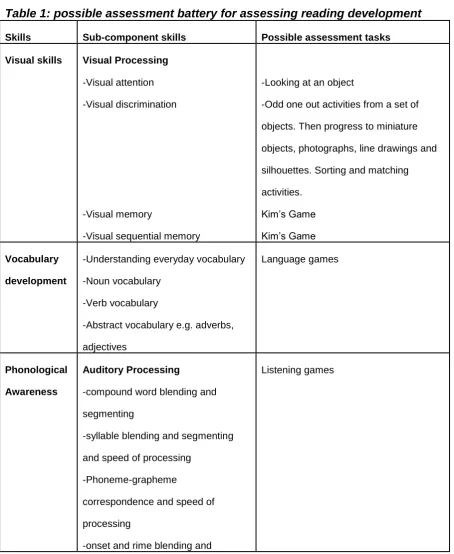
Given the above discussion, a suggested assessment battery for assessing reading development might be presented as follows:
Table 1: possible assessment battery for assessing reading development
Skills Sub-component skills Possible assessment tasks
Visual skills Visual Processing
-Visual attention
-Visual discrimination
-Visual memory
-Visual sequential memory
-Looking at an object
-Odd one out activities from a set of
objects. Then progress to miniature
objects, photographs, line drawings and
silhouettes. Sorting and matching
activities.
Kim’s Game
Kim’s Game
Vocabulary
development
-Understanding everyday vocabulary
-Noun vocabulary
-Verb vocabulary
-Abstract vocabulary e.g. adverbs,
adjectives
Language games
Phonological
Awareness
Auditory Processing
-compound word blending and
segmenting
-syllable blending and segmenting
and speed of processing
-Phoneme-grapheme
correspondence and speed of
processing
-onset and rime blending and
segmenting and speed of processing
-consonant-vowel-consonant
blending and segmenting where
vowels and consonants are digraphs
-consonant-vowel-consonant
blending and segmenting (real and
non-words) including speed of
processing
-Reading irregular words and speed
of processing
Phonological
awareness
Sound identification
-awareness of rhyme
-detection of rhyme
-generation of rhyme
-initial phoneme identification
-final phoneme identification
-medial phoneme identification
-All through the word phoneme
identification
Rhyming games
Phonological
awareness
Rhythm
-keep a steady beat
-copy simple rhythms
-syllable awareness
-Identify number of syllables in words
Clapping a beat
Clapping/ tapping a rhythm
Clapping out words
Counting syllables in words
Fluency
(passage
reading)
-Fluency
-Comprehension
Passage reading and responding to
questions about the text
Miscue analysis for identifying errors and
strategies that children are using.
It is anticipated that this suggested framework will provide a starting point for
discussion and debate amongst the academic community. Whilst it is acknowledged that elements of reading development may not have been captured in this
framework, nevertheless the battery of assessment tasks suggested here offer an approach to assessing reading which acknowledges children’s development in
reading. This is in stark contrast to the phonics screening check which only assesses the skill of decoding, thus neglecting the sub-component skills that contribute to the development of decoding. It is anticipated that academics will debate this model and recommend that elements be added or removed.
References
Brown, G.D.A., and Deavers, R.P. (1999), ‘Units of analysis in nonword reading: Evidence from children and adults’, Journal of Experimental Child
Psychology, 73,(3), 208-242.
Clemens, N., Ragen, K., and Widales-Benitez, O. (2016), ‘Reading difficulties in young children: beyond basic early literacy skills’, Reading, Writing and Language, 3, (2), 177-184.
DfEE, (1998), The National Literacy Strategy: Framework for Teaching, London: DFEE.
Department for Education (DFE) (2010), The Importance of Teaching: The Schools’
White Paper 2010, DfE
Department for Education (DfE) (2011), Teachers’ Standards in England, DfE.
Department for Education (DfE) (2016), Educational Excellence Everywhere, DfE.
Ellis, S., and Moss, G. (2014), ‘Ethics, education policy and research: the phonics question reconsidered’, British Educational Research Journal,40, (2), 241-260.
Goswami, U. (2005), ‘Synthetic Phonics and Learning to Read: A Cross-language Perspective’, Educational Psychology in Practice, 21, (4), 273-282.
Goswami, U., Ziegler, J.C., Dalton, L., and Schneider, W. (2003), ‘Non-word reading across orthographies: How flexible is the choice of reading units? Applied
Psycholinguistics, 24, 235-247.
Hall, K. (2013) Effective Literacy teaching in the early years of school: A review of the evidence In Larson, J. and Marsh, J. The Sage Handbook of Early Childhood Literacy. 2nd edition London: Sage.
Her Majesty’s Inspectorate for Education (HMIE) (2006) Pilot Inspection of the Education Functions of Clackmannanshire Council in October 2005. Edinburgh: SEED.
Johnston, R., and Watson, J. (2005), The effects of synthetic phonics teaching on reading and spelling attainment: a seven-year longitudinal study, Edinburgh, SEED.
Johnston, R., and Watson, J. (2007), Teaching Synthetic Phonics, Exeter, Learning Matters.
Johnston, R., McGeown, S., and Watson, J. (2011), ‘Long-term effects of synthetic phonics versus analytic phonics teaching on the reading and spelling ability of 10-year-old boys’ and girls’, Reading and Writing, 25, 1365-1384.
Landerl, K. (2000), ‘Influences of orthographic consistency and reading instruction on the development of nonword reading skills’, European Journal of Psychology of Education, 15, 239-257.
Moustafa, M., and Maldonado-Colon, E. (1998), ‘Whole-to-parts phonics instruction: building on what children know to help them know more’, The Reading Teacher, 52, 448-458.
Phillips, S., Kelly, K., and Symes, E. (2013), Assessment of Learners withDyslexic-Type Difficulties, London: Sage.
Pressley, M., Wharton-McDonald, R., Allington, R., Block, C.C., Morrow, L., Tracey, D., Baker, K., Brooks, G., Cronin, J., Nelson E. and Woo, D. (2001) A study of effective first grade literacy instruction. Scientific Studies of Reading 5, 35-58
Rose, J. (2006), Independent Review of the Teaching of Early Reading, Nottingham, DfES Publications.
Spencer, L.H., and Hanley, J.R. (2003), ‘Effects of orthographic transparency on reading and phoneme awareness in children learning to read in Wales’, British Journal of Psychology, 94, (1), 1-28.
Strickland, D.S. (1998), Teaching Phonics Today: A Primer for Educators, International Reading Association.
Stuart, M. (2006), ‘Teaching Reading: why start with systematic phonics teaching?’, The Psychology of Education Review, 30, (2), 6-17.
Torgerson, C.J., Brooks, G., and Hall, J. (2006), A systematic review of the research literature on the use of phonics in the teaching of reading and spelling’, London, DfES.
Walton, P.D., Bowden, M.E., Kurtz, S.L., and Angus, M. (2001), ‘Evaluation of a rime-based reading program with Shuswap and Heiltsuk first nations
prereaders’, Reading and Writing, 14, 229-264.
Watson, J.E., and Johnston, R.S. (1998), ‘Accelerating Reading Attainment: the effectiveness of synthetic phonics’, Interchange, 57, Edinburgh, SEED.
Wyse, D., and Goswami, U. (2008), ‘Synthetic phonics and the teaching of reading’, British Educational Research Journal, 34, (6), 691-710.