
Citation:
Akmol Hussain, MD and Sheikh Akbari, A (2017) Max-RGB based Colour Constancy using the Sub-blocks of the Image. 2016 9th International Conference on Developments in eSystems Engineering (DeSE). DOI: https://doi.org/10.1109/DeSE.2016.45
Link to Leeds Beckett Repository record:
http://eprints.leedsbeckett.ac.uk/3152/
Document Version: Article
The aim of the Leeds Beckett Repository is to provide open access to our research, as required by funder policies and permitted by publishers and copyright law.
The Leeds Beckett repository holds a wide range of publications, each of which has been checked for copyright and the relevant embargo period has been applied by the Research Services team.
We operate on a standard take-down policy. If you are the author or publisher of an output and you would like it removed from the repository, please contact us and we will investigate on a case-by-case basis.
Max-RGB based Colour Constancy using the
Sub-blocks of the Image
*Md. Akmol Hussain and Akbar Sheikh Akbari
School of Computing, Creative Technology and Engineering Leeds Beckett University
Leeds, UK
Abstract— Colour constancy refers to the task of revealing the true colour of an object despite ambient presence of intrinsic illuminant. The performance of most of the existing colour constancy algorithms are deteriorated when image contains a big patch of uniform colour. This paper presents a Max-RGB based colour constancy adjustment method using the sub-blocks of the image to significantly reduce the effect of the large uniform colour area of the scene on colour constancy adjustment of the image. The proposed method divides the input image into a number of non-overlapping blocks and computes the Average Absolute Difference (AAD) value of each block’s colour component. The blocks with the AADs greater than threshold values are considered having sufficient colour variation to be used for colour constancy adjustment. The Max-RGB algorithm is then applied to the selected blocks’ pixels to calculate colour constancy scaling factors for the whole image. Evaluations of the performance of the proposed method on images of three benchmark datasets show that the proposed method outperforms the state of the art techniques in the presence of large uniform colour patches.
Keywords- colour constancy; colour balancing; white patch; Max-RGB; average absolute difference
I. INTRODUCTION
Colour constancy of an image capture by a digital camera from a scene is a function of camera parameters and the scene illuminant. An image shot captured under a high illuminant colour temperature often appears to have blue colour cast and reddish colour cast if it is taken under low colour temperature. Human visual system has special features that can distinguish the source illuminant temperature, colour, of the object, therefore a scene illuminated by different colour illuminant; look as if they have been taken under canonical colour lights [1] [2]. The ultimate aim of the colour constancy algorithms is to adopt human colour constancy feature into machine vision so that a captured scene under different light sources looks as if it has been taken under canonical light [3] [4]. The colour constancy adjustment is considered as an under-constrained problem that requires some assumptions to estimate the scene illuminant [5]. Over the years, manifold colour constancy approaches have been proposed. The Grey World [6] algorithm is based on the fact that the average reflectance of colour components of a scene illuminated by a natural light source is a representative of the grey level. The white patch algorithm,
known as the Max-RGB [7] method considers the highest value of each colour channel represents the brightest point of an image and adjusts the image accordingly. A Max-RGB like colour balancing method proposed in [8] gives superior results to that of the Max-RGB technique, by adjusting just the red and blue colour components of the image. The Shades of Grey [9] technique assumes that the generalized mean or power mean known as Minkowski Norm p of a scene is achromatic. Experimental results given in [9] show the merit of this technique to the Grey World, Max RGB and Modified White Patch algorithm. The Grey Edge [10] estimates the illuminant colour by taking the average absolute derivative of image colour components. Gijsenij et al. [11] assume that different types of edges in an image might contain significant information for colour constancy and formulated a weighted Grey Edge hypothesis by incorporating a general weighting scheme. A computationally less intense colour constancy algorithm based on adaptively stretching the histogram information has been proposed in [12]. This method affects the image intensity and hence it is not the preferred technique for many applications. As it can be seen various colour constancy adjustments over the years has been proposed to estimate the scene illuminant. The existing techniques give good estimation of the scene illuminant in the absence of big uniform colour patches, e.g. blue sky, in the image but as the size of the uniform colour patch of the image increases the scene temperature estimation is biased toward the colour of the uniform patch.
In this paper, a colour constancy algorithm is presented that excludes the uniform colour patch from being used for scene image illuminant estimation process by dividing the image into non-overlapping blocks and comparing the AAD values of the colour components with the empirical thresholds. Experimental results on images of three standard image datasets show the proposed method outperforms the state of art techniques. The rest of paper is organised as follows: in Section II, the proposed method will be explained; the experimental results are given in Section III. Finally, Section IV concludes the paper.
II. MAX-RGB BASED COLOUR CONSTANCY USING THE SUB
-BLOCKS OF THE IMAGE
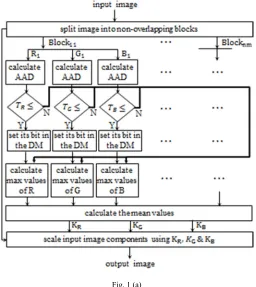
B , as shown in Figure 1(b). Each resulting block’s colour component is then assessed using the Average Absolute Difference of its colour component pixel value to identify if its pixels have a uniform colour distribution. The Average Absolute Difference (AAD) is calculated using equation 1:
P ∑ ∑ |p (x, y) p | (1)
Where i represent block colour component, i ∈ R, G, B ; is the block component i pixel value; P is the AAD value of the block component i; (x, y) is the block pixel component i value at location x and y; p shows the average value of the component i of the block pixels’ values; N and M are the pixel block size and | | sign represents the absolute value.
A binary Decision Matrix for each image colour component is created and initialised with zero values at the starting point. This matrix keeps a record of the pixel colour components, which are selected to be used for image colour adjustment in next stage, where value one in DM points to selected pixel component. The resulting P value for each colour component is compared with the threshold value, which are empirically chosen for that image colour component. If the resulting P is greater than the threshold, the pixels’ components of that block are chosen to be used for image colour constancy adjustment. Hence, bits representing the pixels colour component in its related DM are set to one. The empirically predefined set of threshold values for R, G and B block colour component are named: T , T and T , respectively, as shown in Fig. 1a.
To calculate the scaling factor to adjust the image colour constancy, Max-RGB method [10] is then applied to the selected image colour component pixels as it follows:
I. Calculate the average of the maximum values of the columns of each colour component’s selected pixels, called AVCM , AVCM , and AVCM for colour component R, G and B respectively.
II. Compute the average of the maximum values of the columns of the selected three colour components’ pixels, named AVCM.
III. Determine the scaling factor for R, G and B image colour components, named K , K and K , respectively, using equation 2:
K (2)
where K represents the calculated scaling factor for i image component; i is the image colour component and i ∈ R, G, B .
The colour constancy adjustment is performed by scaling the R, G and B colour component of the input image with the calculated scaling factors: K , K and K , respectively.
Fig. 1 (a) AAD: Average Absolute Difference DM: Decision Matrix
TR, TG and TB: Threshold Values of R, G & B components
KR, KG and KB: R, G & B components scaling factor
Fig. 1(b)
Fig. 1. (a) Block diagram of the proposed colour constancy adjustment using the sub-block of the image blocks and Max-RGB, (b) non-overlapping blocks of the image.
III. EXPERIMENTALRESULTANDEVALUATION
[image:3.612.314.570.57.344.2] [image:3.612.384.500.422.542.2]section B and experimental results are presented in sub-section C.
A. Datasets
The Grey Ball dataset were captured by Ciuera and Funt contains 11340 images of size 240×360, mounting a grey ball in front of the imaging device. The surface area of the grey ball then used to evaluate the scene illuminant. The Futta.NET dataset includes 3000 images of various scenarios taken under different natural lighting conditions. Gehler’s dataset has 568 images collected by Peter Gehler and Shi. Its images cover wide variety of objects in the scene and considered as the most realistic photographic dataset. A MacBeth colour checker chart comprising 24 colour patches is placed in a known location of every scene of the images to evaluate the light source temperature.
B. Performance measure
Image colour constancy quality assessment methods are divided into two categories called objective and subjective methods. Angular error and Euclidean distance are the main two commonly used methods to quantify chromaticity error of the colour balance images. These methods measure the distance between estimated and ground truth illumination. However, Finlayson and Zakizadeh’s [16] investigations on the objective methods showed the angular error is not a reliable method for assessing the colour constancy of an image. Different angular errors are resulted for the same scene viewed under different illuminations and adjusted with the same colour constancy algorithms. Further, Hordley and Finleyson’s [17] investigation on objective methods showed inconsistency of different objective methods, e.g. application of the mean angular error and median angular error for assessing the quality of an image may lead to different conclusions. Considering these significant flaws of the objective colour constancy assessment methods and the fact that the human eyes are the ultimate judge of image quality, researchers mainly use subjective assessment methods to evaluate the quality of the images. Hence, in this paper, subjective evaluation method is used to compare the quality of the colour-balanced images using the proposed method and the state of the art techniques.
C. Experimental Result
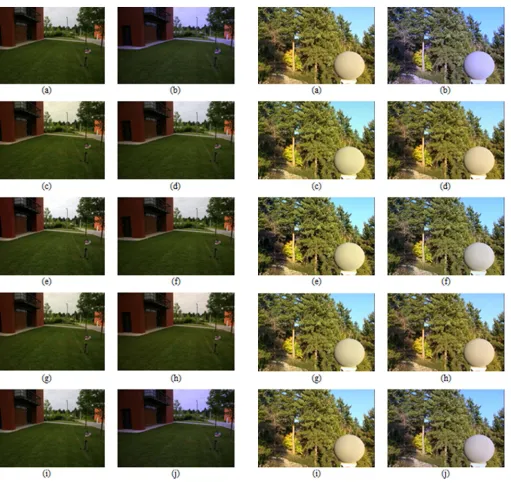
In order to compare the performance of the proposed algorithm with the state of the art techniques, the proposed method and other state of the art algorithms were applied to the three image datasets. Results show that the proposed technique outperforms the state of the art techniques. To illustrate the visual quality obtained by using the proposed method in comparison to the state of the art methods, one image from Gehler [15] and another image from Grey Ball [13] datasets with various visual contents, including uniform patches, are chosen and colour balanced. The resulting images are shown in Fig. 2 and Fig. 3. For accuracy, the observations have been done using a 42-inch full high definition screen of 1920×1080 resolution.
Fig. 2a shows a sample image from Gehler dataset, which is shot with little bright yellow light. It contains a patch of cloudy sky in the background and a large green grass surface
with a colour checker chart on the grass. As it can be seen from the image, the white narrow paths by the buildings are well illuminated. Fig. 2b shows the Grey World image. From this image, a distinct blue tint on the white paths is obvious. Despite improving some white balance on the greenery surface of the image, the image appears to be biased to blue. Fig. 2c illustrates Weighted Grey Edge method‘s image. This image, particularly the buildings and nearby path, demonstrate higher yellow colour casting to that of its original image. The Modified White Patch algorithm’s image is shown in Fig. 2d. This image exhibits lower yellow colour cast on the buildings and wall area compared to its original image and the Weighted Grey Edge method’s image. It is clear that it has less blue tint on paths in comparison to the Weighted Grey Edge method’s image. Fig. 2e shows the Histogram Stretch method’s image. This image illustrates less yellow colour casting on the white path areas but green area of the image still exhibits high level of colour yellowish colour casting. The Shades of Grey method’s image is shown in Fig. 2f.as it can be seen from this image, it demonstrates significant colour balance improvement on the green grass area of the image and a slight yellow colour cast on white paths. In general, it has superior colour balance to those shown in Fig 2a-e. The 1st Order Grey Edge method’s
image is illustrated in Fig. 2g. This image shows highest colour constancy in compared to images of Fig. 2a-f. However, the reference white path exhibit low level of orange colour casting. Fig. 2h illustrates the 2nd Order Grey Edge method’s image.
This image is very similar to that of the 1st Order Grey image,
shown in Fig. 2g. The Max-RGB method’s image is given in Fig. 2i. In this image a noticeable colour correction in the green ground area is obvious. However, the white paths are not convincingly natural. As a very subtle light yellow tint is visible there. The proposed method’s image shown in Fig. 2j. This image demonstrate distinct natural colour on the image objects. More precisely, the white path and the small white square of the colour chart appear truly white at 400% zoom view on a 42-inch LED monitor.
Fig. 3a shows an image taken from the Grey Ball dataset. This image shows woods scenery with patches of blue sky in the background a grey ball with distinct yellow colour cast in the foreground. Moreover, the tree leaves in the background do not demonstrate natural green. Fig. 3b illustrates the Grey World’s image. This image appears to be bluish. The blue colour cast of the image is more visible on the ball. Grey Edge method’s image is shown in Fig. 3c. The grey ball area of this image exhibits over saturation and the greenery area of the image has been to more yellowish tone. Fig 3d shows the Modified White Patch’s image . In this image, the tree branches and the grey ball all appeared to have higher level of yellow colour cast than that of the original image. The Histogram Stretch method’s image is illustrated in Fig. 3e. This image exhibits higher level of intensity than its original image. There is no noticeable colour constancy in this image. Fig. 3f shows the shades of grey algorithm’s image . This image demonstrates significant colour constancy improvement in compared to Fig 3a-e, particularly on the grey ball area of the image. However, a noticeable level of yellow colour cast on the green tree leave is still visible. Fig. 3g and Fig. 3h show the 1st and 2nd Order Grey Edge’s images .These two
Fig. 2. Original and colour balanced images from various techniques: a) Original image from Gehler’s dataset [15 ], b) Grey World , c) Weighted Grey Edge , d) Modified White Patch , e)Histogram Stretch , f)Shades of Grey , g)1st Order Grey Edge, h) 2nd Order Grey Edge , i) Max-RGB and j) Proposed method.
the grey ball area of the images. The colour cast of these images are comparable to those of Grey Edge method and the Modified White Patch’s images shown in Fig. 3.c-d. Fig. 3i shows the Max-RGB method’s image. It can be seen from the image that there is an obvious increase in yellow tint of the grey ball. In addition, the image exhibits a very subtle yellow tone and a mild colour cast on the background greenery area. The proposed Max- RGB based Colour Constancy adjustment method’s image is shown in Fig. 3j. The proposed method’s image has a natural look. There is no noticeable colour cast on this image particularly on the grey ball area of the image. At
Fig. 3. Original and colour balanced images from various techniques: a) Original image from Grey Ball dataset , b) Grey World , c) Weighted Grey Edge , d) Modified White Patch , e)Histogram Stretch , f)Shades of Grey , g)1st Order Grey Edge, h) 2nd Order Grey Edge , i) Max-RGB and j) Proposed method.
[image:5.612.45.296.52.527.2]Fig. 4. Colour chart area of the: a) Original image from colour checker dataset [15 ], b) Grey World , c) Weighted Grey Edge , d) Modified White Patch , e)Histogram Stretch , f)Shades of Grey , g)1st Order Grey Edge, h) 2nd Order Grey Edge , i) Max-RGB and j) Proposed method’s images.
image are yellowish. The proposed method’s chart area has the highest level of colour constancy. A sample part of the grey ball area of the images from Fig. 3 are shown in Fig. 5. As it can be seen from Fig. 5b-i, the presence of different illuminant within the images are evidently visible within these images, while the proposed algorithm’s image, shown in Fig. 5j, demonstrates the natural colour of the grey ball and the presence of any colour casts within this image is hardly visible.
[image:6.612.316.562.51.525.2]It needs to be mentioned that the threshold values were empirically selected by experimenting on the images of the
Fig. 5. Sample area of the grey ball image of the : a) Original image from Grey Ball dataset [ 13], b) Grey World , c) Weighted Grey Edge , d) Modified White Patch , e)Histogram Stretch , f)Shades of Grey , g)1st Order Grey Edge, h) 2nd Order Grey Edge , i) Max-RGB and j) Proposed method’s images.
three datasets. Results showed the values of T =2.50, T =1.75 and T =0.25 generate the best results.
IV. CONCLUSION
used for calculating the colour constancy adjustment scaling factors. The Max-RGB colour constancy algorithm is then applied on the remaining pixels. Results by experimenting on the images of three datasets show the significant colour constancy improvement over the state of the art techniques when image contains uniform colour patches.
REFERENCES
[1] T. Jiang, D. Nguyen, and K. Kuhnert, "Auto white balance using the coincidence of chromaticity histograms," in Signal Image Technology and Internet Based Systems (SITIS), 2012 Eighth International Conference on , pp.201-208, 25-29 November 2012.
[2] R. Lukac, "Refined automatic white balancing," Electronics Letters, vol.43, no.8, pp.445, 446, April 2007.
[3] A. Gijsenij and T. Gevers, "Colour constancy by local averaging," in
Image Analysis and Processing Workshops, 2007. ICIAPW 2007. 14th International Conference on , pp.171-174, 10-13 September 2007. [4] P. Gehler, C. Rother, A. Blake, T. Minka and T. Sharp, “ Bayesian color
constancy revisited”, in Computer Vision and Pattern Recognition.2008.CVPR 2008. IEEE Conference on, pp 1-8, 23-28 June 2008. DOI: 10.1109/CVPR.2008.4587765
[5] S. D. Hordley. Scene illuminant estimation: past, present, and future.
Color Research & Application, 31(4):303–314, 2006
[6] G. Buchsbaum, “A spatial processor model for object colour perception,” Journal of the Franklin Institute, vol. 310, no. 1, pp. 1–26, July 1980.
[7] E. Land, “The retinex theory of colour vision,” Scientific American, vol. 237, no. 6, pp. 108–128, December 1977.
[8] E.Y. Lam, “Combining grey world and Retinex theory for automatic white balance in digital photography,” in Proceedings of the International Symposium on Consumer Electronics, Macau, China, pp. 134–139, June 2005.
[9] G.D. Finlayson and E. Trezzi, “Shades of grey and colour constancy,” Proc. IS&T/SID Color Imaging Conf., pp. 37-41, 2004.
[10] J. van de Weijer, T. Gevers, and A. Gijsenij, "Edge based colour constancy," IEEE Trans on Image Processing, pp.2 207-2217, 2007. [11] A. Gijsenij, T. Gevers, and J. Van de Weijer, "Improving Color
Constancy by Photometric Edge Weighting," IEEE Trans. on Pattern Analysis and Machine Intelligence, vol. 34(5):918-929, 2012.
[12] S. Wang, Y. Zhang, P. Deng, F. Zhou., "Fast automatic white balancing method by colour histogram stretching," Image and Signal Processing (CISP), 2011 4th International Congress on , vol.2, no., pp.979,983, 15-17 October 2011.
[13] F. Ciurea, and B. Funt, "A Large Image Database for Color Constancy Research," Proceedings of the Imaging Science and Technology Eleventh Color Imaging Conference, pp. 160-164, Scottsdale, November 2003.
[14] (2016) Futta.NET website.[Online]. Available: http://www.futta.net/en/ [15] P. Gehler, C. Rother, A. Blake, T. Sharp, and T. Minka, "Bayesian
colour constancy revisited," IEEE Conference on Computer Vision and Pattern Recognition (CVPR), pp. 1-8, June 2008.
[16] G. Finlayson and R. Zakizadeh, “Reproduction angular error: An improved performance metric for illuminant estimation,” Proceedings of the British Machine Vision Conference (BMVA), vol. 301, pp. 1-26, September 2014.
![Fig. 4. Colour chart area of the: a) Original image from colour checker dataset [15 ], b) Grey World , c) Weighted Grey Edge , d) Modified White Patch , e)Histogram Stretch , f)Shades of Grey , g)1st Order Grey Edge, h) 2nd Order Grey Edge , i) Max-RGB](https://thumb-us.123doks.com/thumbv2/123dok_us/13069.1001471/6.612.46.294.47.528/colour-original-checker-weighted-modified-histogram-stretch-shades.webp)
