Case Studies. International Journal of English Studies, 10 (1). 43 - 64. ISSN 1578-7044
Link to Leeds Beckett Repository record:
http://eprints.leedsbeckett.ac.uk/331/
Document Version:
Article
Creative Commons: Attribution-Noncommercial-No Derivative Works 3.0
The aim of the Leeds Beckett Repository is to provide open access to our research, as required by
funder policies and permitted by publishers and copyright law.
The Leeds Beckett repository holds a wide range of publications, each of which has been
checked for copyright and the relevant embargo period has been applied by the Research Services
team.
We operate on a standard take-down policy.
If you are the author or publisher of an output
and you would like it removed from the repository, please
contact us
and we will investigate on a
case-by-case basis.
International Journal of
English Studies
IJES
UNIVERSITY OF MURCIA www.um.es/ijes
Self-directed Noticing for Defossilissation: Three Case Studies
FRANCES BOETTINGER
JUNGHYE PARK
IVOR TIMMIS*
Leeds Metropolitan University
Received: 9 June 2010 / Accepted: 30 July 2010
ABSTRACT
This article discusses three case studies where researchers addressed specific aspects of their second language use which they perceived to be fossilised. The first case deals with a Korean researcher’s perceived lack of progress in speaking skills in English, particularly in active vocabulary; the second case looks at an English researcher’s problem with gender assignment and adjective agreement in German, while the third case looks at an English researcher’s difficulties with French pronunciation. Each researcher devised a treatment for his/her particular problem independently and applied the treatment, for the most part, autonomously. We argue that this kind of approach has the potential to lead to defossilisation but, more importantly, we argue that it is an invaluable way of raising awareness of the range of cognitive and affective strategies that are available to the learner, and the importance of metacognitive knowledge and strategies in deploying these resources to best effect.
KEY WORDS:
Fossilisation; self-directed learning; metacognitive knowledge; task repetition; noticing
RESUMEN
En el presente artículo se analizan tres casos en los que los investigadores plantean aspectos concretos de usos de una segunda lengua percibidos como fosilizados. El primer caso se refiere a un investigador coreano en el que se detecta falta de mejora en la destreza oral del inglés, especialmente en relación con el vocabulario activo; el segundo caso analiza el problema de un investigador inglés en relación con la asignación de género y concordancia de adjetivos en alemán; el tercer caso analiza las dificultades de un investigador inglés en relación con la pronunciación del francés. Cada investigador diseñó un tratamiento para su problema y aplicó el tratamiento de manera mayoritariamente autónoma. Consideramos que este enfoque tiene la potencialidad de lograr la desfosilización, y sobre todo, que es una buena técnica para centrar la atención en las estrategias cognitivas y afectivas disponibles para el aprendiz así como para resaltar la importancia del conocimiento y estrategias metacognitivas al utilizar estos recursos para obtener la máxima eficacia.
PALABRAS CLAVE:
Fosilización, aprendizaje autónomo, conocimiento metacognitivo, repetición de tareas, atención.
_________________
*Address for correspondence: Dr. Ivor Timmis, Reader in English Language Teaching, Macaulay Hall, Headingley Campus, Leeds Metropolitan University, Leeds LS6 3QN. E-mail: [email protected]
I. INTRODUCTION
Introspective studies, such as those reported in this paper, in which teachers or applied
linguists reflect on their own learning are by no means unprecedented. A number of such
studies (Golebiowska, 1985; Gower, 1999; Hyde, 2000; Jones, 1998; Lowe 1987;
McDonough 2002; Ransdell, 1993) have been reported in the literature and the general tenor
of the insights from these reports is that the experience of learning a language is salutary for
teachers and often leads to interesting insights into their own learning preferences and
strategies. As Hyde (2000: 265) notes, reflective studies of this kind “vary along a number of
parameters, consisting of the setting, the type of teacher involved, whether the learning is
individual or in a group, and the use of diaries or journals”. What distinguishes the three
studies reported in this article is that they are focused on a specific aspect of the subjects’
second language use which they perceived to be fossilised. The goal of the research reported
here was, then, to establish whether the three subjects, all teachers of English, could combat
fossilisation autonomously through the application of cognitive strategies to self-selected
problems in three different domains: grammar, vocabulary and pronunciation. A further aim
was to establish what the participants would gain from the process of addressing their
self-selected problems. The paper begins with a discussion of the three main theoretical domains
which inform the research: fossilisation, noticing and autonomy. The participants, their aims
and the research methods are discussed in the methodology section. We then outline the
procedure and results of each study in turn. This is followed by a discussion of the
implications of the results of the three studies, and a conclusion which looks at the wider
implications of this kind of research.
II. THEORETICAL BACKGROUND
II.1 Fossilisation
II.1.1 Defining fossilization
There are a number of definitions of the term “fossilisation”, coined by Selinker in 1972. Han
(2004a: 13) describes fossilisation as the “phenomenon of non-progression of learning despite
continuous exposure to input, adequate motivation to learn, and sufficient opportunity for
practice”. Towell and Hawkins (1994) see fossilisation reflected in the retention of foreign
accents, use of non-native grammatical structures and “non-native intuitions about the
describes fossilisation as “the process by which non-target forms become fixed in
interlanguage”. Although some SLA researchers, (Ellis; Vigil & Oller cited in Han 2004a)
also perceive use of correct forms as subject to fossilisation, most reserve the term
fossilisation to refer exclusively to incorrect forms (Han 2004a:17). In our case, as Park’s case
of stagnation of active vocabulary is a form of non-progression of learning rather than
persistence of error, we will follow Ellis, Vigil and Oller in seeing correct forms as potentially
subject to fossilisation.
It should be acknowledged that the validity of the concept of fossilisation has been
challenged. Tollefson and Firn (1983), for example, argued that the term fossilisation “should
be reserved for something which has become rigid or fixed” like structures which have
“ceased to be modified due to biological factors.” Importantly for this article, such a literal
interpretation would preclude the possibility of defossilisation. Tollefson and Firn (1983) go
on to argue that “cessation of learning as the result of social, psychological and interactive
variables” should not be considered permanent and therefore, cessation of interlanguage
caused by these factors would be better termed “jellification”. Since jellification is not
necessarily an end-state, resumed learning could be called “dejelllification” (1983: 31). While
we accept that learning never comes to an absolutely fixed end, the term fossilisation is
generally recognized in the literature, and for our purposes it is important to note that the three
learners in question perceived themselves as fossilised. For the purposes of this paper, we
could define fossilisation as “a stabilized state in the learning process perceived as long term
and problematic”.
II.1.2 Properties of fossilization
Han (2004b) describes five major properties of fossilisation. Amongst these properties, Han
includes ‘resistance to change’. This seems to us, however, to be a circular argument and to be
already embedded in our definition of fossilisation. Similarly, while Han identifies
interlanguage as a key property of fossilisation, we see it rather as a key concept underpinning
fossilisation. We focus below, therefore, on three properties which are of clear relevance to
the three studies in this paper: backsliding; occurrence in all areas of language; more frequent
occurrence amongst adults.
A feature may be described as fossilised even if learners use it correctly on certain
occasions and incorrectly at other times. Ellis (1994: 694) refers to this phenomenon as
backsliding. Likewise, Bley-Vroman (cited in Han 2004a: 18) notes that learners may
temporarily appear to improve but will end up reverting back to a stabilized imperfect level,
particularly when under stress or involved in communicative activities with heavy mental
correctly in a discrete exercise, but not in a conversation where there is a need to process
content and form at the same time. On the other hand, and this is of relevance to all three
studies, it is also the reason why learners may be able to produce richer and/or more complex
and/or more accurate language when repeating a task, as processing demands for content are
reduced and more attention can be devoted to form.
All areas of language are susceptible to fossilization, though grammatical structures
appear to be particularly resistant to change. This seems to apply particularly to those
structures that are not common to both L1 and L2. An individual learner may not fossilise in
all areas of his interlanguage system and will master some aspects of language learning better
than others (Han 2004a: 7). Linguistic features often fossilise differentially within learners.
For example, vocabulary may be less likely to fossilise than morphology (Fidler 2006: 402).
In our case, all three learners report good progress in aspects of language other than the
fossilised feature.
Although fossilisation is possible in both children and adults, adults are considered
more susceptible to fossilisation. This relates to the critical period hypothesis which suggests
that L2 learners can only acquire an L2 easily and achieve native speaker like competence up
to a certain age after which “L2 acquisition becomes more difficult and is rarely entirely
successful” (Ellis 1994: 699). It is significant for Timmis’s study that pronunciation is
regarded as an area of language particularly relevant for the critical age hypothesis.
Researchers vary, however, in their opinions on the extent of the critical period.
II.1.3 Causes of fossilization
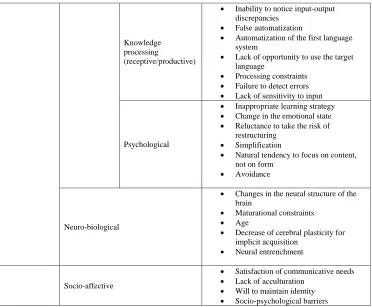
Han (2004a: 29), synthesising findings from research into fossilisation, created a table giving
an overview of potential causes of fossilisation. The modified version below gives examples
of each of the 4 main domains - environmental, cognitive, neurobiological and socioaffective
– rather than the comprehensive list Han presents.
Domain Sub-domain Examples
EXTERNAL Environmental
• Absence of corrective feedback
• Lack of input
• Lack of instruction
• Lack of communicative relevance
• Quality of input
• Instruction
INTERNAL Cognitive Knowledge representation
• L1 influence
• Possession of a mature cognitive system
• Learning inhibiting learning
Knowledge processing
(receptive/productive)
• Inability to notice input-output discrepancies
• False automatization
• Automatization of the first language system
• Lack of opportunity to use the target language
• Processing constraints
• Failure to detect errors
• Lack of sensitivity to input
Psychological
• Inappropriate learning strategy
• Change in the emotional state
• Reluctance to take the risk of restructuring
• Simplification
• Natural tendency to focus on content, not on form
• Avoidance
Neuro-biological
• Changes in the neural structure of the brain
• Maturational constraints
• Age
• Decrease of cerebral plasticity for implicit acquisition
• Neural entrenchment
Socio-affective
• Satisfaction of communicative needs
• Lack of acculturation
• Will to maintain identity
[image:6.482.59.431.55.362.2]• Socio-psychological barriers
Table 1. Potential causes of fossilization (after Han 2004a)
The causes listed in Han’s table show the complexity of fossilisation and suggest that a
particular problem may not simply stem from one cause. Fossilisation in Han’s (2004a: 43)
view is internally determined “due to the constant functioning of maturational and native
language constraints, yet it can be modulated (aggravated or alleviated) by environmental,
social and psychological forces.” We elaborate below on frequently cited causes and those
which seem particularly relevant to these three studies.
One cause frequently cited in this vast list is “satisfaction of communicative needs”. In
other words, once the learner is capable of communicating adequately with others, s/he may,
consciously or subconsciously, lose the motivation to improve. “Lack of acculturation” is also
widely recognized as a problem which affects language competence. Lack of integration into
the target language community may result, for example, in disinterest in learning the L2 along
with decreased exposure to input, particularly if the learner lives in an enclave of immigrants
Other potential causes are less concrete, for example “lack of sensitivity to input” which
maintains, that adult L2 learners are incapable of fully acquiring the sound system of an
additional language having acquired the sound system of their native language because of
inevitable lose of phonetic sensitivity after learning the sounds of the first language (Han
2004a: 33). In addition, there may also be some overlap, particularly for neuro-biological
causes, that could be related to aging, “changes in the neural structure” or “decrease of
cerebral plasticity for implicit acquisition”, for example, which could also affect cognitive
functions.
Han’s list also includes a number of items which, from the standpoint of a practical
language learner or teacher working towards defossilisation, could conceivably be influenced
by teaching or learning methods. If we accept this view, then defossilisation becomes a
possibility. Factors amenable to direct influence by teaching and learning methods are
primarily of an environmental nature e.g. absence of corrective methods, lack of input or poor
quality input, but could also include items such as inappropriate learning strategy and lack of
acculturation which the teacher can influence more indirectly.
II.2 Noticing
A further theme that links all three studies is ‘noticing’. Thornbury (1997), drawing on
Schmidt and Frota (1986), argues that two types of noticing are necessary for acquisition to
take place:
1. Learners must attend to linguistic features of the input that they are exposed to, without
which input cannot become “intake”.
2. Learners must “notice the gap” i.e. make comparisons between the current state of their
developing linguistic system, as realized in their output, and the target language system,
available as input.
Given that the three subjects were not primarily concerned with the acquisition of new
linguistic features, it is the second type of noticing which is prominent in these studies. While
Schmidt (1990: 131) does not conclude that noticing is sufficient for learning, he brought
forth evidence of a “close connection between noticing and emergence in production”.
The role of consciousness in noticing may be a matter of some debate (Schmidt 1990),
but these three studies were designed to promote explicit and conscious noticing and to focus
on the participants’ own output. As Lynch (2001: 125) notes, “although noticing is often
defined in terms of attention to input, there is a growing body of research into learners’
attention to their own output, notably by Merrill Swain and colleagues.” According to
pushes learners to process language more deeply than does input” (Swain 1995: 126). She
suggests that one function of output in second language acquisition is noticing, which is
promoted when “learners do not know how to say (or write) precisely the meaning they wish
to convey.” She also added that “under some circumstances, the activity of producing the
target language may prompt second language learners to consciously recognize some of their
linguistic problems; it may bring to their attention something they need to discover about their
L2” (Swain 1993, cited in Swain 1995:126). Although a focus on output had obvious
potential, it needed to be something more than just general output practice, as all three
subjects had had many opportunities to speak. Three previous studies suggested a way of
focusing more specifically on output.
Bygate (1996) analysed two performances by one student who was shown a video
extract and then asked to retell the story. The exact task was repeated without warning three
days later. Bygate then transcribed and analysed the two recorded speeches. His study found
that task-repetition led to some improvement in fluency, accuracy and repertoire (i.e. range of
language used). The repertoire aspect was particularly relevant to Park’s initial concerns about
her range of active vocabulary. Bygate (1996) argued that when first carrying out the task, the
learner would be initially more concerned with planning the content of the message, and
under pressure of time, with finding sufficient resources to communicate the message. On the
second occasion, on the other hand, the learner would be able to devote more attention to the
form of the message.
Two further studies (Lynch 2001; Mennim 2003) shared the aim of encouraging
learners to focus on form in their own output by getting the learners to transcribe and analyse
their own recorded speech. Mennim (2003) set out to establish whether students could take
advantage of a rehearsal of their final oral presentation in order to make improvements to
their spoken output. The students in this study had a private rehearsal with him two weeks
before their final presentation. The rehearsals were tape-recorded and students were asked to
transcribe a five-minute segment. Students examined and corrected their transcripts before
giving them to him. Mennim then provided further feedback on points that they had missed.
He recorded the final presentation and compared the rehearsal transcripts with the final
presentation transcripts. The final presentation showed improvements in production and
grammar and in the organization of content. With this result, he argued that the transcription
task and making corrections to the transcript encouraged students to focus their attention on
form and improve their oral output.
Lynch (2001) also used transcription as a reflective noticing activity. In his study, pairs
of adult learners of English for Academic Purposes transcribed their own performances of a
transcripts, making a large number of changes for the better. These edited transcripts were
passed on to the teacher, who made further corrections and reformulations, and then discussed
the changes with the learners. Lynch suggested that collaborative transcribing and editing can
encourage learners to focus on form in their output in a relatively natural way.
Although he does not use specific research evidence, Thornbury (1997) argues the case
for reconstruction tasks as a way of promoting noticing through output. Reconstruction tasks,
which are of particular relevance to Boettinger’s study, require the learner to reconstruct a
given text, or elements of a given text, either with prompts or unaided. The rationale for
reconstruction tasks is that: “In reconstructing a text, learners will deploy their available
linguistic competence, which (depending, of course, on the choice of text) is likely to fall
short of the model” (Thornbury 1997: 330). Most pertinently for our purposes, Thornbury
(1997: 330) goes on to note that “the real benefit may be in the matching: the comparison by
learners of their version with the model provides them with positive evidence of
yet-to-be-acquired features…”
II.3 Autonomy
Autonomy has become a fashionable word in recent years with a vast literature which cannot
be summarized within the scope of this paper. We can, however, make a number of
observations about learner autonomy which are of particular relevance to this study. Among
the competing definitions of autonomy, the most apt for our purposes is that learner autonomy
is ‘essentially a matter of the learner’s psychological relation to the process and content of
learning…a capacity for detachment, critical reflection, decision-making and independent
action’ (Little 1991: 4). As Jones (1998) observes, there are degrees of autonomy. He defines
full autonomy as solo instruction where the learners design the syllabus without specially
prepared materials and without involvement either from a teacher or an institution. The three
studies here meet most of these criteria, although all three subjects used an interlocutor and
two had native speaker help with error correction. Jones (1998) summarises the theoretical
benefits of autonomous learning, while acknowledging that there is little empirical evidence
to support the theoretical case. Among the putative benefits outlined by Jones (1998) are
greater intrinsic motivation, greater scope for personalisation of texts and tasks and a sense of
self-empowerment through taking responsibility for one’s own learning. Given that the
participants in this research are at once teachers and learners, the notion of teacher autonomy
is also relevant here, if teacher autonomy can be seen as the ‘capacity for self-directed
III. RESEARCH METHODOLOGY
III.1 The participants and their studies
The profiles of the participants (at the time of the study) and the aims of their studies are
summarised below:
Park
Park is a Korean teacher of English. At the time of the study she was a student on an MA in English
Language Teaching course in the UK. Park began the course with an IELTS level of 6.5 and her study
was motivated by her perception that, despite having spent a number of months in the UK, her range of
active vocabulary had become fossilised.
Boettinger
Boettinger is an American teacher of English resident in Germany. At the time of the study she had
been living in Germany for around 15 years, although English remained the ‘marital’ language with her
German husband. She reported a high level of functional fluency in German, but regarded gender
assignment and adjective agreement as her Achilles heel. She was following an MA course in Language
Education at the time of the study.
Timmis
Timmis is a tutor on an MA in English Language Teaching course at a UK university. He has a degree
in French and at one time had a high degree of fluency. He reported, however, that even when at his
most fluent, his English accent was easily recognisable and undermined his confidence. At the time of
the study, he considered his French pronunciation to be fossilised or even in attrition.
From a methodological point of view, it is also important to understand the sequence of
the studies and the relationship between the participants. Park conducted the initial study
under the supervision of Timmis. Boettinger’s project was also supervised by Timmis and she
was able to draw on Park’s work when conducting her own study. Timmis, in turn, was able
to draw on both Park’s and Boettinger’s work. All three studies were in part inspired by the
well known Schmidt-Frota (1986) experiment in which Schmidt documented his experiences
in a five-week Portuguese course, keeping a journal and taping conversations between himself
and a Portuguese interlocutor at monthly intervals.
III.2 Research methods
Although both Park and Boettinger used quantitative measures, the research is essentially
qualitative: it is primarily concerned with the participants’ perceptions of the strategies which
were effective for them, and their perceptions of their success in addressing their respective
problems. In the sense that each study involved a planned intervention as a response to a
under an action research paradigm. If one takes the broad definition of introspective methods
outlined by Dörnyei (2007), which includes retrospective self-report, then introspection is
clearly a key research method for all three studies. The reliability of retrospective self-report
is often questioned on the grounds that memory is imperfect, but in these three studies, the
participants had recordings and/or transcripts and/or quantitative measures to support their
reflections. A more serious reservation we must acknowledge about the research methodology
employed here is that small scale action research is by definition limited in its generalisability.
This applies all the more so when the participants are not typical of the population to which
the generalization may be applied. In this case, we must keep in mind that, while the three
subjects are language learners, they are also experienced and well qualified language teachers
and likely to have a higher degree of metacognitive awareness than the average learner.
IV. THE THREE STUDIES
IV.1 The causes of the fossilization problems
Park was very unclear about the cause of her problem with active vocabulary. As a student
resident in the UK and attending an MA in ELT course, Park was receiving a great deal of
target language input, and was motivated to improve her English. On the face of it, the
conditions for development were very favourable, but the problem remained. In this respect, it
is interesting that DeKeyser (2007) notes that students on study abroad programmes, contrary
to popular belief, may actually have restricted opportunities for output, input and feedback of
the requisite quality to stimulate acquisition. Environmental factors were a plausible cause for
Park’s problems. In an interview with Timmis conducted for a different research project
(Timmis 2008), lack of strategies emerged as another potential cause.
Boettinger analysed the causes of her problem with gender assignment and adjective
endings in some depth and cited a number of potential factors (from Han’s list) contributing
to the problem. Language complexity was an obvious starting point. Studies of English native
speakers learning German have revealed that even advanced learners of German have
persistent difficulty with gender assignment (Rogers 1987; Tanner 2006). Furthermore,”
acquisition of gender in German as L1 (as well as in other languages) and in German as L2 is
generally thought to be acquired relatively late in the developmental sequence” (Rogers 1987:
70). Boettinger also felt that discontinuing formal instruction and devoting less focused
attention to language improvement had contributed to her fossilisation. A further consequence
of discontinuing formal instruction was that Boettinger received very little corrective
often regarded this as neither timely nor sensitive. In other words, an environmental factor
was in conflict with a socioaffective factor. Boettinger also noted that, after becoming an
English teacher 6 years prior to the study, her interactions in German had been largely limited
to routine exchanges. As we noted above, DeKeyser (2007) has argued, living in the target
environment does not automatically guarantee either quantity or, more importantly, quality of
input or output.
In terms of Han’s table of causes of fossilisation, Timmis sees his problems with French
pronunciation as lying mainly in the socioaffective domain. Timmis has a strong sense of
northern identity, and there is at least a folk linguistic theory that males from northern English
industrial towns find French pronunciation rather effeminate and shy away from adopting it
(consciously or subconsciously). In addition, he also has a stammer which he felt inhibited
him in speaking French. Other potential causes perceived by Timmis are “lack of sensitivity
to input” and age. Timmis considers that he does not have a good ear for accents and
acknowledges that, as an adult learner, achieving a native-like accent is very difficult.
IV.2 Procedures and results of the three studies
IV.2.1 Park’s study
Against the theoretical background discussed in section II, Park decided to conduct a
mini-experiment which incorporated both task repetition and transcription of her own output. An
interview was chosen as a task because it was a real-world task and a good way to generate
the required data (spoken language) from natural conversation. Before the first interview,
Timmis (her tutor) chose the topic and questions, and Park was only told the topic: “How
does the MA course (ELT MD) help non-native students improve their English?” In the first
interview, Park was asked questions about the chosen topic and expected to have the same
questions again three days later. However, on the second occasion, Timmis, the interviewer,
asked the questions slightly differently. In other words, while the topics remained the same,
the questions were not identical and varied somewhat according to Park’s answers. Therefore
it was not the exact task repetition that Bygate (1996) had carried out, but more like task
recycling: the format remained the same – an interview on the same topics – but the prompts
differed.
The data was collected from the two interviews, in the form of transcriptions of the
recordings. This was done by the subject, Park. The key difference between the first and
second interview was that on the second occasion Park was familiar with the topic and the
interviewer, which meant she had more time to think about the answers. Although, as noted
that generally a learner would perform better the second time. The data was divided into two
as follows and analysed separately:
Data 1 - two transcripts from both interviews
Data 2 - selected from questions were identical in both interviews
More specifically Data 1 can be considered as the result of task recycling, whereas Data 2 can
be as the result of task repetition.
Skehan noted (2001: 170) that, when measuring task performance, “in general, there is
some consensus that measures are required in the three areas of complexity, accuracy and
fluency. These three areas are theorised to have important independent functioning in oral
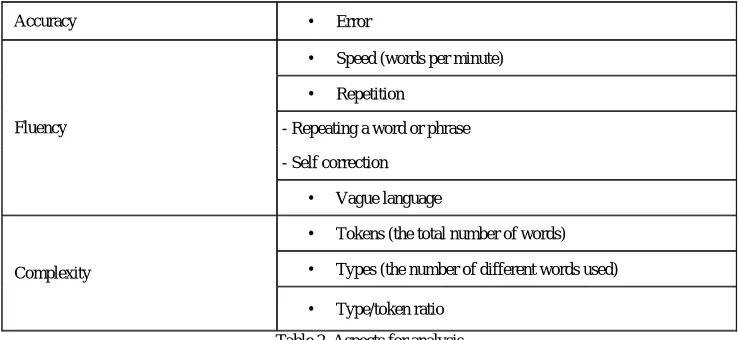
performance.” The specific features to be analysed in this study are listed in Table 2.
Accuracy • Error
Fluency
• Speed (words per minute)
• Repetition
- Repeating a word or phrase
- Self correction
• Vague language
Complexity
• Tokens (the total number of words)
• Types (the number of different words used)
[image:13.482.57.426.229.399.2]• Type/token ratio
Table 2. Aspects for analysis
We look first at analysis based on Data 1(two transcripts from both interviews). It can also be
considered as the result of task recycling.
Accuracy
Grammatical, lexical and overall errors were counted. Contrary to the expectation there was
no improvement regarding errors (see Table 3). An interesting result was that the errors which
Park made most in each performance were not those that she usually thought difficult. In the
first interview Park didn’t put‘s’ at the end of plural words, while in the second one she forgot
to put ‘s’ at the end of the verb for the third person singular. Park reported that she would
rarely, if ever, make those types of errors in written texts. In addition, on both occasions she
repeated non-native collocations which came from Korean translation: feel difficulty (1st
Accuracy 1st interview
2nd interview
• Error
[image:14.482.57.428.73.139.2]57 58
Table 3. Analysis of Data 1: accuracy
Complexity
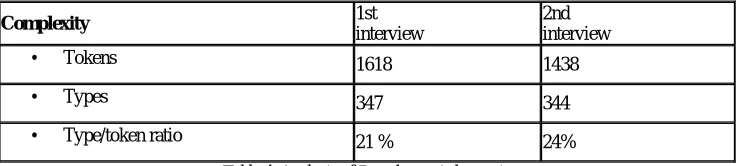
The total number of words (tokens) and the number of different words (types) were compared
between the two performances. Type-token ratio shows the range of vocabulary and a higher
score indicates less repetition. According to Table 4, the 2nd interview has a higher type-token
ratio than the 1st, which means that Park used a wider range of vocabulary in the second
interview.
Complexity 1st
interview
2nd interview
• Tokens 1618 1438
• Types 347 344
• Type/token ratio 21 % 24%
Table 4. Analysis of Data 1: type/token ratio
Fluency
The amount and type of repetition, speed of production and use of fillers (e.g. um, ah) were
calculated. Table 5 shows significant improvement in fluency: faster speech, less repetition
and less use of fillers in the second interview. It was found that Park often repeated the same
words or phrases several times in one sentence and she especially used “and then” a lot
regardless of the meaning e.g. “um be because I have I have uh I have teaching experience but
it wasn’t that long so I had to find out uh the relation between my experience and then the
theory or the things in class.”
Repeating the same word or phrases and using fillers can be a way of gaining time
while you think about what to say next. Compared to the 1st interview, the second time there
was a sharp drop in repetition of the same words or phrases and also the use of vague
language. However, the number of self corrections increased. It seems that on the first
occasion Park paid more attention to producing appropriate content and gained some time to
[image:14.482.58.426.291.374.2]contrast, on the second occasion, with the familiarity of the topic and questions, she was able
to devote more attention to monitoring her output, which might have increased the number of
instances of self correction. It is possible, therefore, that encountering a similar task led to the
sharp drop in repetition of the words and the use of fillers, which in turn led to faster speech.
Fluency 1st interview 2nd Interview
• Speed (w/m) 111/ min 122/ min
• Repetition
-Repeating a word
or phrase 100 70
-Self correction
9 11
[image:15.482.58.427.135.290.2]• Fillers 124 110
Table 5. Analysis of Data 1: fluency
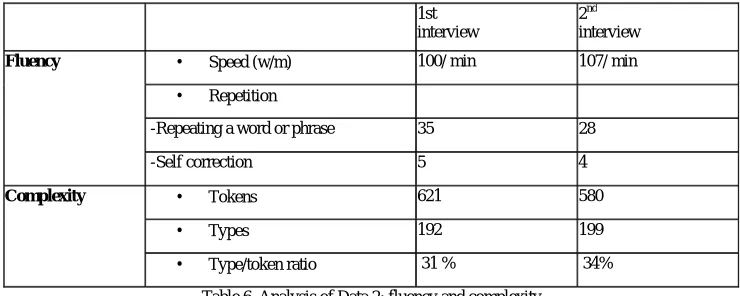
We turn now to the analysis of Data, which came from questions common to both
interviews and could be considered the result of task-repetition. It was also analysed in order
to see if there was any difference from the results obtained from the analysis of Data1. The
results looked similar; there were improvements in fluency and complexity, as seen in Table
6.
1st
interview
2nd
interview
Fluency • Speed (w/m) 100/ min 107/ min • Repetition
-Repeating a word or phrase 35 28
-Self correction 5 4
Complexity
• Tokens 621 580
• Types 192 199
• Type/token ratio 31 % 34%
Table 6. Analysis of Data 2: fluency and complexity
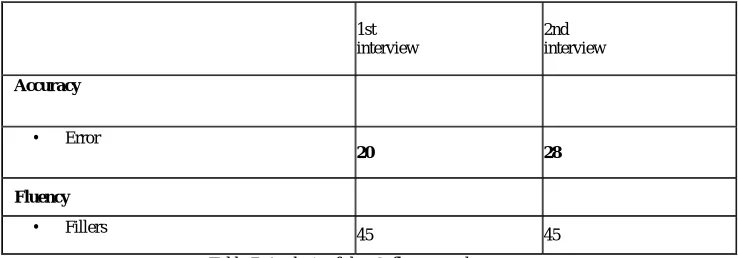
On the other hand, the data in Table 7 shows a noticeable fall in accuracy. Even though
the questions were the same, more errors were made in the second interview. The use of
[image:15.482.56.426.410.558.2]showed that the number of fillers decreased on the second occasion, it remained the same for
data 2 (Compare Table 7 with Table 5).
1st interview
2nd interview
Accuracy
• Error
20 28
Fluency
[image:16.482.57.426.104.233.2]• Fillers 45 45
Table 7. Analysis of data 2: fluency and accuracy
Skehan (2001: 170) provides a possible explanation for this result with his argument
that the three performance domains –accuracy, fluency and complexity– “…enter into
competition with one another, with higher performance in one area seeming to detract from
performance in others”. So, for example, greater accuracy may well be achieved at the
expense of greater complexity, and vice versa. It seems that encountering the same questions
led Park to improve fluency and at the same time to promote risk-taking by paying more
attention to producing better answers. This is seen in the improved complexity. However, this
improvement may have caused her to make more errors.
IV.2.2 Boettinger’s study
In an attempt to further understand and remedy her fossilisation, Boettinger devised a research
project which involved a number of different activities or strategies in two phases.
Phase 1
Boettinger selected topics for a presentation based on her interests and gave the presentation
to a German native speaker, using notes rather than a script. Once the presentation had been
recorded, the learner and tutor listened to the tape and reviewed language errors, with a
particular focus on the target area of gender and adjective ending assignment.
A distinctive feature of Boettinger’s approach was the use of what she termed “coaching
dialogues” inspired by the idea of Voice Dialogues which have been applied, for example, as
a management training technique to help solve complex issues (Sussens-Messerer 2007:
77-79). Essentially, a coaching dialogue was a written internal dialogue between Boettinger as
Learner: Well, I really didn’t prepare very much for this. I think it would have been better if I had rehearsed it in my head.
Coach: Maybe. But it was more spontaneous and gave an indication of typical mistakes. Did you notice anything special?
Learner: Yes, a couple of times I used “In” with the date and a couple of times I caught myself when I was more concentrated. I know it’s wrong but I still say it anyway.
Subsequently, an indicative portion of each taped presentation was transcribed and the
tapescript was reviewed and analyzed for errors.
Phase 2
Based on the findings from phase 1, Boettinger developed a remedial programme of exercises
based on her own output to remedy specific errors. These activities included producing a
written version of the oral presentation; reconstructing the presentation from an outline which
included content words, dates and references, but not articles or adjective endings; gapped
versions of the transcript based on the target grammar (and some other problematic areas for
Boettinger). All three activities are essentially reconstruction tasks. Boettinger then repeated
presentations of the topics on tape. The transcripts of the second presentation series were
analyzed and compared to results of the first presentation series to determine if possible
improvements relative to accuracy or fluency might indicate potential defossilisation. This
was clearly a form of task repetition.
Overall fluency in Phase II improved significantly, there were few pauses in presenting
the texts, pronunciation was clear and the learner did not make any errors with word order or
word choice. The learner’s fluency in Phase II was positively influenced because there were
no interruptions by an interlocutor to break the learner’s train of thought.
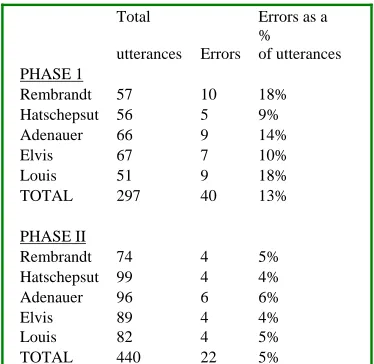
The following table shows that in comparison to Phase 1, errors related to genders and
related articles and/or adjective endings declined overall by 8% although in regarding the
statistics one should also consider that total utterances, and thus possibilities for making more
errors, was considerable higher in Phase II (440 as opposed to 297 in Phase 1). It is also
interesting that results throughout Phase II were more consistent, error percentage varying
Total
utterances Errors
Errors as a %
of utterances PHASE 1
Rembrandt 57 10 18% Hatschepsut 56 5 9%
Adenauer 66 9 14%
Elvis 67 7 10%
Louis 51 9 18%
TOTAL 297 40 13%
PHASE II
Rembrandt 74 4 5%
Hatschepsut 99 4 4%
Adenauer 96 6 6%
Elvis 89 4 4%
Louis 82 4 5%
[image:18.482.140.327.56.238.2]TOTAL 440 22 5%
Table 8. Percentage of errors related to genders and adjective endings
IV.2.3 Timmis’s study
As Timmis was well acquainted with Park’s and Boettinger’s studies, he was able to draw
explicitly on their approaches in formulating his own remedy. As a result, Timmis’s account
subsumes part of the conclusion to the article, since what struck Timmis most about Park’s
and Boettinger’s accounts was that both. Timmis’s approach consisted of three phases:
Phase 1
Timmis regards himself as a highly analytical learner, and initially used a self-study tape to
revise French vowel sounds and distinctive consonants such as the uvular fricative ‘r’. This
practice was highly mechanical, involving repetition of individual sounds, repetition of words
containing the target sounds and discrimination between sounds e.g. the vowel sounds in
“vous” and “tu”. From an affective point of view, Timmis was very conscious at this stage
that he did now want to expose his pronunciation to external appraisal, but he felt even at this
stage that he had identified a key problem: his vowel sounds were simply too long in many
cases, and he needed to make more “facial effort” to produce the vowel in “tu” and
distinguish it from the vowel in “tout”.
Phase 2
Timmis, drawing on Boettinger’s idea of choosing a topic of personal interest, wrote a text
about his experiences during a year abroad in France, a topic he can talk about with
enthusiasm and feeling. He asked a French colleague to record the text. He then listened to the
text and recorded several versions of his own for comparison purposes. In this phase, Timmis
version of the text. This technology allows a reduced speed version of the text to be recorded
without tonal distortion. This version led Timmis to specific insights e.g. he was producing
exaggerated stress on the first syllable of ‘Colmar’ compared to the native speaker version,
and producing a schwa sound at the end of “inoubliable”. Timmis was pleasantly surprised
that, after his preparatory work, his accent didn’t sound as bad as he feared.
Phase 3
Timmis, drawing on Park’s rationale, asked a French friend to interview him about his
experience to see if his pronunciation would hold up under the pressure of real-time
conversation. The questions were not prepared, so there was a certain degree of
unpredictability, although the preparatory work in composing the text would clearly be of
value.
Somewhat paradoxically, Timmis found that focusing on the technicalities of
pronunciation made him a little less self-conscious about speaking French. The interview was
instructive. When he listened to the recording, it was very clear that his pronunciation was
most convincing where he had lifted whole phrases from the prepared text: without the need
to work out the vocabulary and grammar, he had the processing space to focus on the
pronunciation, which doesn’t come naturally and requires concentration. Progress in
pronunciation is difficult to quantify and, having identified the causes of his fossilisation as
being primarily socioaffective, Timmis was content with a positive self assessment of his
progress and a compliment from his interlocutor.
V. DISCUSSION
The research set out to establish whether fossilisation could be combated through the
autonomous application of cognitive strategies and all three subjects reported a degree of
success. Park reported that quantitative results showed some improvements in her fluency and
complexity which suggest that task repetition or task recycling can potentially contribute to
improving learners’ oral output. Boettinger concluded that that partial defossilisation of
grammatical features may be possible through self-directed noticing and execution of targeted
remedial activities involving repetition. Timmis reported that defossilisation of his
pronunciation was possible to a certain extent through repetition and comparison procedures,
but this work would need to go hand in hand with a more general rehabilitation of his French
if it were to have any lasting effect. Boettinger and Timmis both commented that they were
their studies. As Lowe (1987) has noted, it is not unusual for teachers in the position of
language learners to adopt the traditional techniques they shy away from in their own
teaching. While this by no means constitutes a call for a wholesale rehabilitation of
“traditional” techniques, it does seem to suggest that we need to be more discriminating in
abandoning techniques which may still have value for specific purposes. Cumulatively, the
three studies suggest that self-directed noticing has the potential to achieve at least partial
defossilisation. We need, however, to keep in mind our earlier caveat about the limitations of
the study in terms of generalisability.
In terms of the autonomous aspect, Park reported a significant increase in her
motivation to address the targeted area while Park and Timmis both reported a feeling of
self-empowerment through taking responsibility for their own learning. We noted above that the
notion of autonomy can be extended to include teacher autonomy. In this respect, it is
interesting that Boettinger noted that she had become more aware of her own learners’
possible learning processes and had even incorporated specific activities from her study –
recording and transcription – in her own classes.
An interesting but unexpected finding of the research was the role of affective factors.
While Park’s approach was highly cognitive in its use of transcription, error analysis and
calculations of fluency rate and lexical density, it is arguable that the most important outcome
was affective: a sense of empowerment. Boettinger’s approach began as highly cognitive with
rule revision, transcription and error analysis (though an affective element was present from
the outset with the choice of motivating topics). As the research progressed, the affective
element became more prominent with the use of coaching dialogues (and even attempts at
self-hypnosis). Timmis was reluctant to expose his pronunciation to appraisal in the early
stages and the choice of an affectively significant topic was important for him in overcoming
this barrier.
VI. CONCLUSION
In conclusion, the three studies suggest that self-directed noticing has the potential to combat
perceived fossilisation through the application of both cognitive and affective strategies. The
optimum balance of cognitive and affective strategies is likely to depend both on the nature of
the problem involved and the characteristics of the individual learner. However, the research
was also concerned with what the participants would gain from the process of self-directed
fossilisation. In this sense, we would argue that, individually and cumulatively, the three
knowledge” in combating perceived fossilisation. Wenden identifies three main domains of
metacognitive knowledge: person knowledge, task knowledge, and strategic knowledge.
Aspects of each of these domains are highly relevant to the above studies. Person knowledge
includes knowledge of cognitive and affective variables which affect second language
learning, “knowledge about…proficiency in a given area” and “self-efficacy beliefs about
their ability to mobilize and manage the resources necessary to learn and to sustain the effort”
(Wenden 1998: 518). Task knowledge, evident in the remedies chosen by each of the three
subjects, “includes information about a task’s demands, i.e. how to learn in general, how to go
about doing a particular task, and the knowledge and skills needed to do so” (Wenden 1998:
518). Strategic knowledge “refers to general knowledge about what strategies are, why they
are useful, and specific knowledge about when and how to use them” (Wenden 1998: 519).
This latter domain is particularly interesting as Park. commented that she was aware of many
different strategies to improve her English, but initially used none as she felt overwhelmed by
the variety. Similarly, Timmis, though a highly experienced teacher of English, took a long
time to devise his remedial approach.
Wenden (1998) also argues that metacognitive knowledge is a characteristic common to
“expert learners” and that it plays a crucial role in self-regulation in underpinning the
planning, monitoring and evaluation of progress i.e. metacognitive strategies. It is very clear,
then, that metacognitive knowledge and metacognitive strategies are central to language
learning in general, not just to autonomous defossilisation. What we argue, here, however, is
that autonomous defossilisation requires a highly concentrated focus on metacognitive
knowledge and metacognitive strategies, and as such is a valuable tool for raising teachers’
awareness of these important domains. This awareness should then equip teachers to develop
autonomy and reflection in their learners. We would suggest that short, self-directed learning
projects, whether focused on defossilisation or not, might usefully be incorporated in teacher
education courses.
REFERENCES
Bley-Vroman, R. (1989).What is the Logical Problem of Foreign Language Learning? In S. Gass and J. Schachter (Eds.), Linguistic perspectives on second language acquisition (pp. 41-68). Cambridge: Cambridge University Press.
Benson, P. (2006) Autonomy in language teaching and learning. Language Teaching, 40, 21-40. Campbell, D., Meinardi, M., Richardson, B., Coyle, E., Donnellan, O., Leung, P.K., MacDonaill, C.,
Jung, E., Pritchard, C., (2004) DIT-CALL - naturally speaking, but slow. Speak Out!, 32, 28-35.
DeKeyser, R. (2007). Study Abroad as Foreign Language Practice. In R. M. DeKeyser (Ed.), Practice
in a second language: perspectives from applied linguistics and cognitive psychology (pp.
208-225). Cambridge: Cambridge University Press.
Ellis, R. (1985). Understanding second language acquisition. Oxford: Oxford University Press. Ellis, R. (1994). The study of second language acquisition. Oxford: Oxford University. Press. Fidler, A. (2006). Reconceptualizing fossilisation in second language acquisition: a review. Second
Language Research, 22(3), 398-411.
Golebiowska, A. (1985). Once a teacher, always a teacher. ELT Journal, 39(4), 274-278. Gower, R. (1999). Doing as we would be done by. Modern English Teacher, 8(4), 7-15.
Han, Z.H. (2004a). Fossilization in adult second language acquisition. Clevedon, UK: Multilingual Matters.
Han, Z.H. (2004b). Fossilisation: five central issues. International Journal of Applied Linguistics, 14(2), 212-242.
Harder, P. (1980). Discourse as self-expression: on the reduced personality of the second language learner. Applied Linguistics, 1(3), 262–270.
Hyde, B. (2000). Teachers as learners: beyond language learning. ELT Journal,54(3), 265-273. Jones, F. (1998). Self-instruction and success: a learner-profile study. Applied Linguistics,19(3),
378-406.
Lardiere, D. (1998). Case and tense in the ‘fossilised’ steady state. Second Language Research, 14:1/1
Little, D. (1991). Learner autonomy 1: Definitions, issues and problems. Dublin: Authentik.
Lowe, T. (1987). An experiment in role reversal: teachers as language learners. ELT Journal, 41(2), 89-96.
Lynch, T. (2001). Seeing what they meant: transcribing as a route to noticing. ELT Journal, 55(2), 124-132.
Lynch T. (2007).Learning from the transcripts of an oral communication task. ELT Journal, 61(4), 311-320.
McDonough, J. (2002).The teacher as language learner: worlds of difference. ELT Journal, 56(4), 404-411.
MacWhinney B. (2006).Emergent Fossilisation. In Z-H Han & T. Odlin (Eds.), Studies of fossilisation
in second language acquisition (pp.134-156). Clevedon, UK: Multilingual Matters.
Mennim, P. (2003). Rehearsed oral L2 output and reactive focus on form. ELT Journal,57(2), 130-138.
Odlin, T., Alonso R. and C. Alonso-Vazquez (2006).Fossilisation in L2 and L3. In Z-H Han, & T. Odlin (Eds.), Studies of fossilisation in second language acquisition (pp. 83-99). Clevedon, UK: Multilingual Matters.
Ransdell, D. R. (1993). Creative writing is Greek to me: the continuing education of a language teacher. ELT Journal, 47(1), 40-45.
Rogers, M. (1987).Learners' difficulties with grammatical gender in German as a foreign language.
Applied Linguistics, 8(1), 48-74.
Schmidt, R. (1990).The role of consciousness in second language learning. Applied Linguistics, 11(2), 129-158.
Schmidt, R. and Frota, S.N. (1986). Developing Conversational Ability in a Foreign Language: A Case Study of an Adult Learner of Portuguese. In Day, R., (Ed.). Talking to learn:
conversation in SLA (pp. 237-326).Rowley, MA: Newbury House.
Segalowitz, N. (2003). Automaticity and Second Languages. In Doughty C. and Long M. (Eds.), The
handbook of second language acquisition (pp. 382-408). Blackwell Publishing.
Selinker, L. (1972).Interlanguage. International Review of Applied Linguistics, 10(2), 209–31. Selinker, L. (2006). Afterword: Fossilisation ‘or ‘Does your Mind Mind? In Han, Z-H and Odlin, T.
(Eds.), Studies of Fossilisation in Second Language Acquisition (pp. 201-210). Clevedon, UK: Multilingual Matters.
Skehan, P. (2001). Tasks and Language Performance Assessment. In M. Bygate, P. Skehan, & M. Swain (Eds.), Researching pedagogic tasks: second language learning, teaching and testing
(pp. 167-185).Harlow, Essex: Addison Wesley Longman.
Sussens-Messerer, V. (2007). Managing ourselves. Business Spotlight, 6(7), 77-79.
Swain, M. (1995). Three functions of output in second language learning. In G. Cook and B. Seidlhofer (Eds.), Principles and practice in applied linguistics: studies in honour of H.G.
Tanner, D. (2006).Agreeing that agreement isn’t the problem: selective fossilisation in L2. [Internet] Available from: http: students.washington.edu/dstanner/Genderpaper.pdf [Accessed 16 June 2007].
Thornbury, S. (1997).Reformulation and reconstruction: tasks that promote ‘noticing’. ELT Journal, 51(4), 326-35.
Timmis, I. (2008) DIY EAP: Is it really possible? IATEFL Research, 22, 14-17.
Tollefson J. and Firn, J. (1983).Fossilisation in second language acquisition: an inter-model view.
RELC Journal ,14(19), 19-34.
Vigil, N. and J. Oller (1976). Rule fossilisation: a tentative model. Language. Learning, 22(5), 281-295.