International Journal of Mathematics and Mathematical Sciences Volume 2011, Article ID 328197,17pages
doi:10.1155/2011/328197
Research Article
A Variable Step-Size Exponentially Fitted Explicit
Hybrid Method for Solving Oscillatory Problems
F. Samat, F. Ismail, and M. B. Suleiman
Department of Mathematics, Faculty of Science, Universiti Putra Malaysia (UPM), Selangor, 43400 Serdang, Malaysia
Correspondence should be addressed to F. Samat,[email protected]
Received 24 May 2011; Revised 9 September 2011; Accepted 9 September 2011
Academic Editor: Naseer Shahzad
Copyrightq2011 F. Samat et al. This is an open access article distributed under the Creative Commons Attribution License, which permits unrestricted use, distribution, and reproduction in any medium, provided the original work is properly cited.
An exponentially fitted explicit hybrid method for solving oscillatory problems is obtained. This method has four stages. The first three stages of the method integrate exactly differential systems whose solutions can be expressed as linear combinations of{1, x,expμx,exp−μx}, μ∈C, while
the last stage of this method integrates exactly systems whose solutions are linear combinations of
{1, x, x2, x3, x4,expμx,exp−μx}. This method is implemented in variable step-size code basing
on an embedding approach. The stability analysis is given. Numerical experiments that have been carried out show the efficiency of our method.
1. Introduction
There has been great interest in the research of new methods for numerically solving the second-order initial value problems of the form
yx fx,yx,yx
0 y0,yx0 y0 1.1
whose solution exhibits specific oscillatory behavior. Such problems arises in celestial mechanics, in quantum mechanical scattering problems, and elsewhere, and they can be solved by using general purpose methods or by using codes specially adapted to the structure or to the solution of the problem. In the case of adapted hybrid methods, particular algorithms have been proposed by several authorse.g., see1–3to solve these classes of problems.
This paper concerns derivation of a new method for the numerical integration of1.1
of frequency and step size, thus the method can only be applied when a good estimate of the dominant frequency of the solution is known in advance. The exponential-fitting technique is generally described in the context of linear multistep methods as follows.
Consider lineark-step methods of the form
k
j1
αjyn jh2 k
j1
βjyn j, 1.2
whereαk1, α0, andβ0do not both vanish. Associate with the method is the linear operator
Lh,ayx k
j0
αjyx jh−h2 k
j0
βjyx jh, 1.3
where a α0, α1, . . . , αk, β0, β1, . . . , βk. The linear operator L is said to integrate exactly
the functionyx if Lh,ayx 0. We now impose the requirement that the operatorL integrates exactly the following functions:
1, x, x2, . . . , xK, e±μx, xe±μx, x2e±μx, . . . , xPe±μx 1.4
withK 2P M−3. Then, we solve the algebraic equations forαj andβj,j 0,1, . . . , k. In particular, the step-by-step exponential-fitting procedure is described as follows.
Step 1. Find the maximal M such that L integrates exactly the set of power functions
{1, x, x2, . . . , xM−1} and that the resulting coefficients have the same value as those of a classical method. The classical method is the method with constant coefficients.
Step 2. Consider this set of functions
1, x, x2, . . . , xK, e±μx, xe±μx, x2e±μx, . . . , xPe±μx 1.5
with K 2P M−3. Using M obtained from Step 1, we find suitable P and K which correspond to a finite set consisting of power functions and exponentials. Then, solve equations obtained by assuming thatLintegrates exactly elements of this set.
2. Embedded Pairs of Hybrid Methods
For the numerical solution of1.1, we consider the explicit hybrid method which has been established by Franco6:
Y1yn−1, Y2yn,
Yi 1 ciyn−ciyn−1 h2
i−1
j1
aijfxn cjh, Yj, i3, . . . , s,
yn 12yn−yn−1 h2
b1fn−1 b2fn
s
i3
bifxn cih, Yi
,
2.1
where fn−1 and fn representfxn−1, yn−1and fxn, yn, respectively. The method requires
s−1 function evaluations or stages at each step of integration. The explicit hybrid method can be represented by the Butcher tableau:
−1 0 0 0 · · · 0
0 0 0 0 · · · 0
c3 a31 a32 0 · · · 0
..
. ... ... . .. ... ...
cs as1 as2 · · · as,s−1 0
b1 b2 · · · bs−1 bs
c A
bT 2.2
Adopting the concept of embeddedpqpair of Runge-Kutta-NystromRKNmethodssee
7,8, we define an embeddedpqpair of hybrid methods to be based on the hybrid method
c,A,bof orderpand another hybrid method c,A,bof orderq < p, represented by the following tableau:
c A
bT
bT
2.3
Embedded pairs of explicit hybrid methods are used in variable step-size algorithm because they provide cheap error estimation. A local error estimation is determined by the formula
LTEyn 1−yn 1, 2.4
where yn 1 and yn 1 are solutions obtained using the higher-order and the lower-order formula, respectively. The LTE is used to control the step-size of which the procedure is given by
iif tol/div<LTE<div·tol, thenhn 1hn,
iiif LTE≤tol/div, thenhn 12hn,
where, from numerical experiments, div is chosen to be 217. We do not allow step-size change after each step because it would contribute to unnecessary rounding errors. If the step is acceptablei.e., tol/div<LTE<div·tol and LTE≤tol/div, then we adopt the widely used of performing local extrapolation: although the LTE is the error estimation for the lower-order formula, the solutions obtained by using the higher-order formula are actually accepted at each point.
3. Construction of Hybrid Methods
3.1. The Sixth-Order Hybrid Method of Franco
In this section, we consider the sixth-order hybrid method which is zero dissipative and dispersive of order six derived in6. The interval of periodicity of the method is0, 2.75. In order for the method to be implemented in variable step-size code as described inSection 2, we derive a three-stage order explicit hybrid method. Order conditions for the fourth-order hybrid methods withs4 as given in9are listed as follows.
Order conditions:
4
i1
bi1,
4
i1
bici0,
4
i1
bic2i
1 6,
4
i1
4
j1
biaij 121 ,
4
i1
bic3i 0,
4
i1
4
j1
biciaij 121 ,
4
i1
4
j1
biaijcj0.
3.1
The two-step explicit hybrid methods2.1are a subclass of the two-step hybrid methods considered by Coleman9by takingc1 −1, c20,a210, andaij0j ≥i. Substituting
c1 −1, c2 0,a21 0, and aij 0j ≥ i together with coefficients ci and aij of the
sixth-order formula into3.1, we get the following values of coefficients b for the three-stage fourth-order method:
b1 5
68, b2
47
42, b3−
5
12, b4
80
The embedded 64pair of hybrid methods is denoted as EHM64method and represented by the tableau:
−1 0 0 0 0 0
0 0 0 0 0 0
1 5
4 125
11
125 0 0 0
7 10
119 2000
1071
2000 0 0 0
−1
2 −
11
204 −
7 144 −
7 144
4 153 0 1
68 11 42
25 84
50 357
2 7 5
68 47
42 −
5 12
80 357
3.3
3.2. Variable Step-Size Exponentially Fitted Explicit Hybrid Method
We consider the four-stage explicit hybrid method given by the following tableau:
−1 0 0 0 0 0
0 0 0 0 0 0
1
5 a31 a32 0 0 0
7 10
119
2000 a42 a43 0 0
−1
2 −
11 204 −
7
144 a53 a54 0
b1 b2 b3 b4 b5
3.4
Note that the c-values and some of the A-values are taken from the sixth-order hybrid method of Franco as described briefly in Section 3.1. The formula of a four-stage explicit hybrid method is
Y1yn−1, Y2yn, 3.5
Y3 1 c3yn−c3yn−1 h2
a31fn−1 a32fn
, 3.6
Y4 1 c4yn−c4yn−1 h2
a41fn−1 a42fn a43fxn c3h, Y3 , 3.7
Y5 1 c5yn−c5yn−1 h2
a51fn−1 a52fn a53fxn c3h, Y3 a54fxn c4h, Y4 ,
3.8
yn 12yn−yn−1 h2
b1fn−1 b2fn b3fxn c3h, Y3 b4fxn c4h, Y4 b5fxn c5h, Y5 .
Associate with3.6,3.7, and3.8the linear operatorL, we have
Lh,ayx yx cih−1 ciyx ciyx−h−h2
i−1
j1
aijyx cih, i3,4,5.
3.10
Note that the operator L integrates exactly 1 and x for any x and h. The coefficients of the variable step-size exponentially fitted hybrid method are obtained by solving equations arising from the choice of integersM,K, andPdescribed as follows.
Step 1. Consider the linear operatorLthat associated with3.6. Solving equations obtained
by assuming thatc3 1/5 and imposingLto integrate exactly x2 and x3, we obtaina31 4/125 anda3211/125 which is the same value as the coefficients of EHM64method. This means thatM4. ChoosingK1,P 0 gives us{1, x, e±μx}. Settingc31/5 and imposing Lto integrate exactlye±μxleads the following equations:
exp
1 5μh
−6
5
1 5 expμh −
h2a 31μ2 expμh −h
2a
32μ2 0,
exp
−1
5μh
−6
5 1 5exp
μh−h2a
31μ2exp
μh−h2a
32μ20.
3.11
Solving these equations, we get coefficientsa31anda32.
Step 2. Consider the linear operatorLthat associated with3.7. Solving equations obtained
by assuming thatc31/5, c47/10,a41 119/2000 and imposingLto integrate exactlyx2 andx3, we obtaina
42 1071/2000 anda430 which are of the same value as the coefficients of EHM64method. This means thatM 4. Choosing K 1,P 0 gives us {1, x, e±μx}. Setting c3 1/5,c4 7/10,a41 119/2000, and Lh,ae±μx 0, we get the following equations:
exp
7 10μh
− 17
10
7 10 expμh−
119h2μ2 2000 expμh−h
2a
42μ2−h2a43μ2exp
1 5μh
0,
1
exp7/10μh− 17 10
7 10exp
μh− 119
2000h
2μ2expμh−h2a 42μ2−
h2a 43μ2
exp1/5μh 0.
3.12
Solving these equations, we geta42anda43.
Step 3. Consider the linear operatorLthat associated with3.8. Solving equations obtained
by assuming thatc31/5,c47/10, c5 −1/2,a51−11/204,a52 −7/144 and imposing Lto integrate exactlyx2 andx3, we obtaina
andP 0 gives us{1, x, e±μx}. Settingc3 1/5, c4 7/10,c5 −1/2,a51 −11/204, a52
−7/144, andLh,ae±μx0 leads to the following equations:
exp
−1
2μh
− 1
2− 1 2 expμh
11h2μ2 204 expμh
7 144h
2μ2−h2a
53μ2exp
1 5μh
−h2a
54μ2exp
7 10μh
0,
1
exp−1/2μh− 1 2−
1 2exp
μh 11
204h
2μ2expμh 7 144h
2μ2− h2a53μ2 exp1/5μh
− h2a54μ2
exp7/10μh 0.
3.13
Solving these equations, we geta53anda54.
Step 4. The linear operator associating with3.9is given as
Lh,ayx yx h−2yx yx−h
−h2b
1yx−h b2yx b3yx c3h b4yx c4h b5yx c5h ,
3.14
where a b1, b2, b3, b4, b5. Solving equations obtained by assuming that c3 1/5, c4 7/10,c5−1/2 and imposingLto integrate exactlyx2, x3, x4, x5andx6, we obtain
b1 1
68, b2
11
42, b3
25
84, b4
50
357, b5
2
7 3.15
which are of the same value as the coefficients of EHM64method. This means thatM7. ChoosingK 4 andP 0 gives us{1, x, x2, x3, x4, e±μx}. Settingc
3 1/5, c4 7/10,c5
−1/2,Lh,ax2 0,Lh,ax3 0, Lh,ax4 0 andLh,ae±μx 0, the following equations
are obtained:
x h2−2x2 x−h2−h22b
1 2b2 2b3 2b4 2b5 0,
x h3−2x3 x−h3−h2
b16x−6h 6b2x
b3
6x 6 5h
b4
6x 21 5 h
b56x−3h
x h4−2x4 x−h4−h2
12b1x−h2 12b2x2
12b3
x 1
5h
2
12b4
x 7
10h
2
12b5
x− 1
2h
2
0,
expμh−2 1
expμh−
h2b 1μ2 expμh−h
2b
2μ2−h2b3μ2exp
1 5μh
−h2b
4μ2exp
7 10μh
−h2b
5μ2exp
−1 2μh 0, 1
expμh −2 exp
μh−h2b 1μ2exp
μh−h2b 2μ2
− h2b3μ2
exp1/5μh−
h2b 4μ2 exp7/10μh −
h2b 5μ2
exp−1/2μh 0.
3.16
Solving these equations, we getb1, b2, b3, b4, andb5.
Step 5. Consider
yn 12yn−yn−1 h2
b1fn−1 b2fn b3fxn c3h, Y3 b4fxn c4h, Y4
. 3.17
Associate with3.17is the linear operatorL:
Lh,ayx yx h−2yx yx−h
−h2b
1yx−h b2yx b3yx c3h b4yx c4h
, 3.18
where a b1, b2, b3, b4. Solving equations obtained by assuming thatc3 1/5,c4 7/10 and imposingLto integrate exactlyx2, x3, x4, andx5, we obtainb
1 5/68, b2 47/42, b3
−5/12, b480/357 which are of the same value as the coefficients of EHM64method. This means thatM 6. ChoosingK 3 andP 0 gives us{x2, x3, e±μx}. Setting c3 1/5,c4 7/10 andLh,ax20, Lh,ax3 0, Lh,ae±μx 0, the following equations are obtained:
x h2−2x2 x−h2−h22b
1 2b2 2b3 2b4
0,
x h3−2x3 x−h3−h2
b16x−6h 6b2x b3
6x 6 5h
b4
6x 21 5 h
0,
e xpμh−2 1
expμh −
h2b 1μ2 expμh−h
2b
2μ2−h2b3μ2exp
1 5μh
−h2b
4μ2exp
7 10μh
1
expμh−2 exp
μh−h2b 1μ2exp
μh−h2b
2μ2−h2b3μ2exp
−1
5μh
−h2b
4μ2exp
− 7 10μh 0. 3.19
Solving these equations we getb1, b2, b3andb4.
Let z μh. The Taylor series expansions for coefficients of the variable step-size exponentially fitted explicit hybrid method:
a31 4 125 − 172 46875z 2 1352 3515625z
4− 24188
615234375z
6 2763464
692138671875z
8− · · ·,
a32 11 125 − 737 187500z 2 11099 28125000z
4− 1557853
39375000000z
6 354282923
88593750000000z
8− · · ·,
a42 1071 2000−
14399 800000z
2− 1716269 480000000z
4− 793137431 5760000000000z
6− 9029960159
3456000000000000z
8− · · ·,
a43 65807 2400000z 2 2424421 1440000000z 4 220890061 5760000000000z 6 4729553527 10368000000000000z
8 · · · ,
a53− 7 144 127 7200z 2 117733 21600000z 4 125191559 362880000000z 6 141838603 14515200000000z
8 · · · ,
a54 4 153 −
413 28800z
2− 42091 43200000z
4− 3046063
207360000000z
6− 127567
691200000000z
8 · · · ,
b1 1 68− 1 4760z 2 41 23990400z
4− 473
49392000000z
6 1359917
4231906500000000z
8− · · ·,
b2 11 42− 3 980z 2 41 1646400z
4− 8041
57624000000z
6 1359917
2904249600000000z
8 · · ·,
b3 25 84
1 392z
2− 41 1975680z
4 8041
69148800000z
6− 1359917
3485099520000000z
8− · · ·,
b4 50 357 − 1 3332z 2 41 16793280z
4− 473
34574400000z
6 1359917
29623345920000000z
8 · · ·,
b5 2 7
1 980z
2− 41 4939200z
4 8041
172872000000z
6− 1359917
8712748800000000z
8− · · ·,
b1 5 68−
21 6800z
2 5141
53550000z
4− 4567 1912500000z
6 469816672
98960400000000000z
8− · · ·,
b2 47 42
13 1400z
2− 40051
132300000z
4 24539
2700000000z
6− 25871517139
122245200000000000z
8 · · ·,
b3− 5 12−
1 400z
2 263
2700000z
4− 12433
2700000000z
6 1177701697
8731800000000000z
8− · · ·,
b4 80 357 −
11 2975z
2 122933
1124550000z
4− 48097
22950000000z
6 30430643147
1039084200000000000z
8− · · ·.
It is noted that, ifz → 0 then the coefficients of EHM64method will be recovered. This is the important feature of the new method which will be denoted by EEHM64method. In our program code, we useμas an imaginary number and thus,zcan be written asziwh. We first convert all coefficientswhich are in term ofzμhto trigonometric form by using computer algebra package Maple. Then, we substituteμiwinto the resulting expressions. For smallz, the coefficients are subject to heavy cancellations. Sincezvaries throughout the integration, therefore it is convenient to use Taylor series expansions for the coefficients of the method.
4. Stability
Now our interest lies in the stability analysis for an exponentially fitted explicit hybrid method of the form2.1in which its coefficients are functions of one frequencyμand the step-lengthh. Applying this method to the test problem
y −λ2y, λ >0, 4.1
we obtain
Y e cyn−cyn−1−H2AY, 4.2
yn 12yn−yn−1−H2bTY 4.3
which is written in vector form whereHλh, Y Y1, . . . , YsT, and e 1, . . . ,1T. Solving
for Y in4.2and then substitute it into4.3leads to the following recursion:
yn 1−S
H2, zy
n P
H2, zy
n−10, 4.4
whereSH2, z 2−H2bTI H2A−1e candPH2, z 1−H2bTI H2A−1c. The characteristic equation associated with4.4is
ξ2−SH2, zξ PH2, z0. 4.5
The subsequent definitions are introduced to provide the stability concept for exponentially fitted hybrid methods corresponding to the characteristic equation4.5. Here, we follow the main ideas given by Coleman and Ixaru3.
Definition 4.1. For exponentially fitted hybrid methods corresponding to the characteristic
20
15
Im
(
z
)
10
5
0
7.5 5
0 2.5 10
Re(z)
a
20
15
Im
(
z
)
10
5
0
7.5 5
0 2.5 10
Re(z)
b
20
15
Im
(
z
)
10
5
0 5 7.5
0
2.5 10
Re(z)
[image:11.600.155.444.92.413.2]c
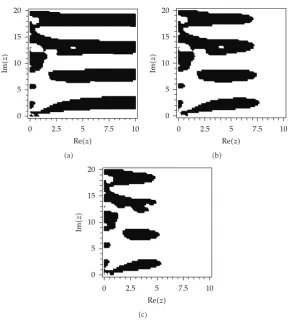
Figure 1: Stability region of the exponentially fitted method which is based on the higher-order formula of
EHM64method.a H0.1,z∈C,b H0.5,z∈C,c H1,z∈C.
Definition 4.2. For exponentially fitted hybrid methods corresponding to the characteristic
equation 4.5 and satisfying|PH2, z| < 1, a region of stability Ωis a region of the H-z plane such that, for everyH, z∈Ω,
SH2, z< PH2, z 1. 4.6
Any closed curve defined byPH2, z 1 and|SH2, z|PH2, z 1 is a stability boundary.
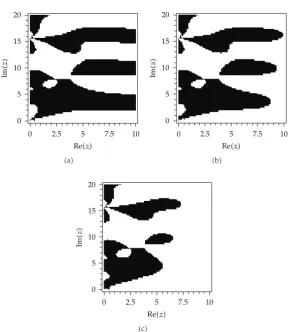
InFigure 1, we illustrate the stability region of the exponentially fitted method which
is based on the higher-order formula of EHM64method whereas, inFigure 2, we show the stability region of the exponentially fitted method which is based on the lower-order formula of EHM64method. From Figures1and2, it is observed that the stability regions get smaller asHincreases.
5. Numerical Experiments
20
15
Im
(
z
)
10
5
0
7.5 5
0 2.5 10
Re(z)
a
20
15
Im
(
z
)
10
5
0
7.5 5
0 2.5 10
Re(z)
b
20
15
Im
(
z
)
10
5
0
7.5 5
0 2.5 10
Re(z)
[image:12.600.155.448.88.421.2]c
Figure 2: Stability region of the exponentially fitted method which is based on the lower-order formula of
EHM64method.a H0.5,z∈C,b H1,z∈C,c H2,z∈C.
iEEHM64: Variable step-size exponentially fitted explicit hybrid method derived in this paper. This method requires four function evaluations at each step.
iiEHM64: Embedded explicit hybrid method 64pair derived in this paper. This method requires four function evaluations at each step.
iiiFRKN43: Modified embedded explicit RKN 43pair proposed by Van de Vyver
10. This method requires three function evaluations at each step.
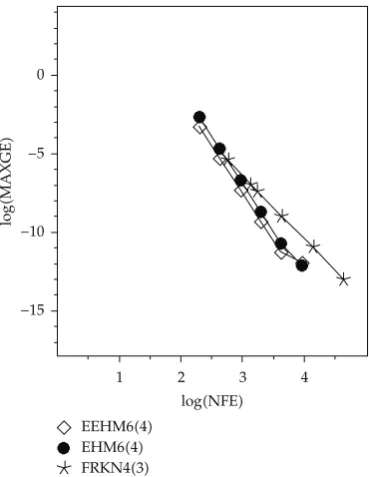
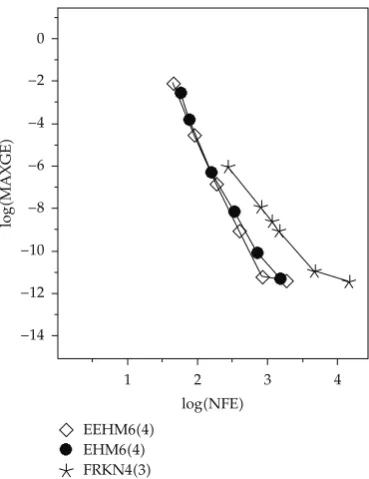
We have applied all the above codes to four problems to evaluate their efficiency. For controlling the step-size in FRKN43code, we use the step-size control procedure discussed in 10. In Figures 3, 4, 5, and 6, the efficiency curves of natural logarithm of maximum global errorMAXGEversus the computational effort measured by the natural logarithm of number of function evaluationsNFEare depicted. The maximum global errorMAXGE is given by this formula
1 2 3 4 5
−20
−15
−10
−5 0 5
EEHM6(4) EHM6(4) FRKN4(3)
log
(
MAXGE
)
[image:13.600.207.392.96.333.2]log(NFE)
Figure 3: Efficiency curves for Problem1.
where yxn is the true solution and yn is the computed solution. In the following test
problems, the tolerances used are tol 10−2i,i 1, . . . ,6. The exact solutions are used to obtain all the starting values.
Problem 1perturbed system. Source: Franco11:
y
1 100y1
2y1y2 y2
1 y22
f1x, y10 1, y10 ε,
y
2 25y2 y2
1−y22 y2
1 y22
f2x, y20 −ε, y20 5
5.2
withε10−3and
f1x 2 cos10xsin5x 2εsin5xsinx−cos10xcosx−ε
2sin2x
cos210x sin25x 2εsinxcos10x−cosxsin5x ε2 99εsinx,
f2x
cos210x−sin25x 2εsinxcos10x cosxsin5x−ε2cos2x
cos210x sin25x 2εsinxcos10x−cosxsin5x ε2 −24εcosx.
5.3
Solution:
1 2 3 4
−15
−10
−5 0
EEHM6(4) EHM6(4) FRKN4(3)
log
(
MAXGE
)
[image:14.600.208.393.95.334.2]log(NFE)
Figure 4: Efficiency curves for Problem2.
For EEHM64and FRKN43 codes, we choose z 10i for the first component whereas
z5ifor the second component.
Problem 2linear oscillatory problem. Source: Franco6:
y
1−13y1 12y2 9 cos2x−12 sin2x, y10 1, y10 −4, y
212y1−13y2−12 cos2x 9 sin2x, y20 0, y20 8
5.5
with the theoretical solution:
y1x sinx−sin5x cos2x, y2x sinx sin5x sin2x, 0≤x≤10 5.6
For EEHM64and FRKN43codes, we choosez5i.
Problem 3perturbed system. Source: Hans Van de Vyver10:
y
1 25y1 ε
y2 1 y22
εf1x, y10 1, y10 0,
y
1 25y2 ε
y2 1 y22
εf2x, y20 ε, y10 5
1 2 3 4 5
−15
−10
−5 0
EEHM6(4) EHM6(4) FRKN4(3)
log
(
MAXGE
)
[image:15.600.208.391.97.333.2]log(NFE)
Figure 5: Efficiency curves for Problem3.
withε10−3and
f1x 1 ε2 2εsin
5x x2 2 cosx2 25−4x2sinx2,
f2x 1 ε2 2εsin
5x x2−2 sinx2 25−4x2cosx2.
5.8
Solution:
y1x cos5x εsin
x2, y
2x sin5x εcos
x2, 0≤x≤5 5.9
For EEHM64and FRKN43codes, we choosez5i.
Problem 4the undamped Duffing equation. Source: Van de Vyver10:
y−y−y3 Bcosvx, y0 0.200426728067, y0 0, 5.10
whereB1/500 andv1.01. The exact solution computed by the Galerkin method with a precision 10−12of the coefficients is given by
yx A1cosvx A3cos3vx A5cos5vx A7cos7vx A9cos9vx, 0≤x≤20,
5.11
1 2 3 4
−14
−12
−10
−8
−6
−4
−2 0
EEHM6(4) EHM6(4) FRKN4(3)
log
(
MAXGE
)
[image:16.600.208.393.95.335.2]log(NFE)
Figure 6: Efficiency curves for Problem4.
From Figures 3–5, it is obvious that EEHM64 performs more efficiently than EHM64and FRKN43 codes for solving Problems 1–3. For Problem 4, EEHM64is as efficient as EHM64code.
6. Conclusions
The embedding approach for hybrid methods has been devised by adopting the embedding concept in RKN methods. By using this embedding approach, we present Franco’s sixth-order explicit hybrid method for variable step-size code, denoted as EHM64method. Based on EHM64 method, the new variable step-size exponentially fitted hybrid method has been developed and it is denoted as EEHM64method. The numerical results show that EEHM64method is efficient for the numerical solution of oscillatory problems. Further-more, EEHM64method is preferable to handle perturbed oscillators.
References
1 T. E. Simos and J. Vigo-Aguiar, “A dissipative exponentially-fitted method for the numerical solution of the Schr ¨odinger equation and related problems,” Computer Physics Communications, vol. 152, no. 3, pp. 274–294, 2003.
2 T. E. Simos and P. S. Williams, “P-stable hybrid exponentially-fitted method for the numerical inte-gration of the Schrodinger equation,” Computer Physics Communications, vol. 131, no. 1, pp. 109–119, 2000.
3 J. P. Coleman and L. Gr. Ixaru, “P-stability and exponential-fitting methods fory fx, y,” IMA Journal of Numerical Analysis, vol. 16, no. 2, pp. 179–199, 1996.
5 R. D’Ambrosio, E. Esposito, and B. Paternoster, “Exponentially fitted two-step hybrid methods for
y
fx, y,” Journal of Computational and Applied Mathematics, vol. 235, no. 16, pp. 4888–4897, 2011. 6 J. M. Franco, “A class of explicit two-step hybrid methods for second-order IVPs,” Journal of
Computational and Applied Mathematics, vol. 187, no. 1, pp. 41–57, 2006.
7 J. R. Dormand, M. E. A. El-Mikkawy, and P. J. Prince, “Families of Runge-Kutta-Nystr ¨om formulae,” IMA Journal of Numerical Analysis, vol. 7, no. 2, pp. 235–250, 1987.
8 S. Filippi and J. Graf, “New Runge-Kutta-Nystr ¨om formula-pairs of order 87, 98, 109and 1110 for differential equations of the formy fx, y,” Journal of Computational and Applied Mathematics, vol. 14, no. 3, pp. 361–370, 1986.
9 J. P. Coleman, “Order conditions for a class of two-step methods fory fx, y,” IMA Journal of Numerical Analysis, vol. 23, no. 2, pp. 197–220, 2003.
10 H. Van de Vyver, “A Runge-Kutta-Nystr ¨om pair for the numerical integration of perturbed os-cillators,” Computer Physics Communications, vol. 167, no. 2, pp. 129–142, 2005.
Submit your manuscripts at
http://www.hindawi.com
Hindawi Publishing Corporation
http://www.hindawi.com Volume 2014
Mathematics
Journal ofHindawi Publishing Corporation
http://www.hindawi.com Volume 2014 in Engineering
Hindawi Publishing Corporation http://www.hindawi.com
Differential Equations
International Journal of
Volume 2014
Applied MathematicsJournal of
Hindawi Publishing Corporation
http://www.hindawi.com Volume 2014
Probability and Statistics Hindawi Publishing Corporation
http://www.hindawi.com Volume 2014
Journal of
Hindawi Publishing Corporation
http://www.hindawi.com Volume 2014
Mathematical PhysicsAdvances in
Complex Analysis
Journal ofHindawi Publishing Corporation
http://www.hindawi.com Volume 2014
Optimization
Journal of Hindawi Publishing Corporationhttp://www.hindawi.com Volume 2014
Combinatorics
Hindawi Publishing Corporation
http://www.hindawi.com Volume 2014
International Journal of
Hindawi Publishing Corporation
http://www.hindawi.com Volume 2014 Operations Research
Journal of
Hindawi Publishing Corporation
http://www.hindawi.com Volume 2014
Function Spaces
Abstract and Applied Analysis
Hindawi Publishing Corporation
http://www.hindawi.com Volume 2014
International Journal of Mathematics and Mathematical Sciences
Hindawi Publishing Corporation http://www.hindawi.com Volume 2014
The Scientific
World Journal
Hindawi Publishing Corporationhttp://www.hindawi.com Volume 2014
Hindawi Publishing Corporation
http://www.hindawi.com Volume 2014
Algebra
Discrete Dynamics in Nature and Society
Hindawi Publishing Corporation
http://www.hindawi.com Volume 2014
Hindawi Publishing Corporation
http://www.hindawi.com Volume 2014
Decision Sciences
Discrete Mathematics
Journal ofHindawi Publishing Corporation
http://www.hindawi.com Volume 2014
Hindawi Publishing Corporation
http://www.hindawi.com Volume 2014