IRRIGATION INFRASTRUCTURE DEVELOPMENT IN TAMIL
NADU:WITH SPECIAL REFERENCE TO RURAL INFRASTRUCTURE
DEVELOPMENT FUND
1K. Sivasubramaniyan
Associate Professor, Madras Institute of Development Studies, Chennai - 600020.
ABSTRACT
That irrigation is the sine-quo-non for agricultural development especially in India is beyond
doubt. Although three important sources – canals, tanks and wells – contribute for the
development of irrigation sector, the combined effect of these sources is not up to the satisfactory
mark. This is because, irrigation performance requires multitude efforts starting from the
beneficiary farmers to managing the larger irrigation system by the state functionaries such as
the Public Works Department. In the case of common source irrigation systems such as canal
and tank irrigation users participation has been gradually diminishing in the last few decades.
Consequently, the maintenance and management part of the system became weak leading to very
poor performance of irrigation. In this context, to develop irrigation system in Tamil Nadu, the
National Bank for Agriculture and Rural Development has funded throughRural Infrastructure
Development Fund to develop a few canal and tank irrigation systems in Tamil Nadu. To what
extent this funding helped to achieve the distributional efficiency and productivity efficiency of
irrigation systems is briefly discussed in this paper. The outcome of the project shows that due to
poor involvement of beneficiaries in the upkeep of the system and poor functioning of irrigation
1This paper is based on a larger study, “Impact Evaluation Study of RIDF Projects in Tamil Nadu funded by the International Research Journal of Human Resources and Social Sciences
ISSN(O): (2349-4085) ISSN(P): (2394-4218) Impact Factor- 5.414, Volume 4, Issue 8, August 2017
Website- www.aarf.asia, Email : [email protected] , [email protected]
institutions led to average outcome from the investments undertaken in irrigation projects is put
forth in the paper.
Key Words: Development, Implementation, Irrigation, Maintenance, Stakeholders 1. Introduction
This paper attempts to highlight the status and significance ofNational Bank for Agriculture and
Rural Development (NABARD) funded Rural Infrastructure Development Fund (RIDF) minor
irrigation projects in Tamil Nadu.
1.1 Status of AgricultureSector in Tamil Nadu State
Irrigation is one of the basic inputs in agriculture sector. Although there are four sources of
irrigation, viz. canals, tanks, wells and other sources, Tamil Nadu has mainly three sources and
the contribution of „other sources‟ is negligible. Canals are the major sources of irrigation, in
which the State has 81 reservoirs with a present net capacity of 216.4 Thousand Million Cubic
Feet (TMCft). The total storage capacity of 15 major reservoirs is 198.4 TMCft. Area irrigated
by canal command in Tamil Nadu in 2012-13 is 5.9 lakh hectares, which is about 60 % of its
registered command area. The remaining sources are considered as minor irrigation sources, in
which the State has 41,127 tanks with a net capacity of 178.9 TMCft. Total number of wells in
the State is 18.21 lakh in 2012-13 that contribute a net irrigated area of 16.3 lakh hectares. Due
to negligence and less importance given to rehabilitation and maintenance of tanks its
contribution in the state has drastically come down from a little more than a million ha (original
registered ayacut of tanks) to about 4.20 lakh hectares in 2012-13 (Tamil Nadu an Economic
Appraisal, 2011-12 to 2013-14 [1] and K. Sivasubramaniyan and Gandhiraj 2009 [2]). Since
irrigated agriculture enhances productivity of land 3 to 4 times that of unirrigated land more
importance is given to rehabilitate /restore canal and tank systems through RIDF projects.
1.2RIDF Genesis, Status and Share of Rural Connectivity
Genesis of RIDF - Government Initiatives: The liberalization / globalization policies adopted by
the Govt. of India since early nineties have helped to attract direct foreign investments in the
infrastructure sector. But such investments are flowing into the core sectors like ports, power,
Governments. There are many infrastructure projects, which have been started but are lying
incomplete for want of resources. Even though there is an urgent need for creating adequate
employment opportunities in rural areas through development of infrastructure, there had been
virtually no institutional arrangements for financing rural infrastructure. In this background, the
Hon‟ble Finance Minister in the Union Budget Speech 1995-96 announced that “Inadequacies of
public investment in agriculture is today a matter of general concern. This is an area, which is the
responsibility of States. But many States have neglected investment in infrastructure for
agriculture. There are many rural infrastructure projects, which have been started but are lying
incomplete for want of resources. They represent a major loss of potential income and
employment to rural population.” The Government of India announced in the Budget of
1995-1996, the scheme for setting up of Rural Infrastructure Development Fund to be
operationalisedfrom 1995 by NABARD for financing of on-going and new infrastructure
projectswith a corpus fund Rs 2000 crores. Subsequently, RIDF was made available for new
projects as well and its ambit was broadened to cover other important areas ofrural infrastructure.
1.3 Statusof Rural Infrastructure Development Fund
Presently as many as 32 diversified activities aresupported underRIDF.These activities with
varying end use could be broadly classified underthree sectors viz., Agriculture (including allied
activities and rural warehouses) Social and Connectivity.“Of the cumulative RIDF loans
sanctioned as on 31 March 2013, agriculture and related sectors accounted for 42 percent
(including 29 percent for irrigation), rural roads 32 percent, and bridges 12 percent. The balance
14 percent of the loans was sanctioned under social sector projects”(Brief details of RIDF Loan –
notes circulated to Common methodology workshop of RIDF Project, NABARD, Mumbai,
November 2014).
1.4Implementation
Implementation of RIDF projects assumes greater importance as the process involves multiple
government agencies at ground level and their coordination for its success. The quantum of loan
to be sanctioned under each tranche and eligible activities under a tranche are decided by the GoI
on an annual basis. Rate of interest and period of loan are as decided by the RBI.
The projects are sanctioned with General Terms and Conditions as well as project specificspecial
against the actuals incurred in execution of specific sanctioned projects. Notwithstanding the
above, mobilisation/start up advance is also released, if requiredby the State Govt. on acceptance
of the terms and conditions by the State Govt. to speed up the implementation of the projects.
1.5Rules, Regulations, Instructions, Manuals and Records held by NABARD or under its Control or Used by its Employees for Discharging of its Functions
1. Checklists have been made available to all the State Govt‟s for preparation of Detailed
Project Report (DPR).
2. Operational Guidelines are issued every year under RIDF.
Budget allocated to each of its agency, indicating the particulars of all plans, proposed
expenditures and reports on disbursements made:The corpus of RIDF is announced in the Union
Budget by the Hon‟ble Finance Minister every year. Under the tranche RIDF XX for 2014-15, the
corpus is 25000 crore. The RIDF loan is generally phased up to 3 years and the loans are
released by Regional Offices (RO). The reports of disbursements are maintained at RO as well as
Head Office.
1.6Tamil Nadu State Policy and SectorPlan
The ‟vision 2023‟ the policy paper of government of Tamil Nadu state will be “to achieve in
class productivity in key agricultural produce and to be a global supplier with robust
infrastructure.” This vision imperative calls for setting up of robust support rural infrastructure
forplanning, production, processing, storage, distribution, marketing and sales of agricultural
produce etc. Also, the Vision 2023 has envisaged doubling of infrastructure spending 11.5 % of
GSDP by 2014 (Source: Tamil Nadu an Economic Appraisal 2011-12 to 2013-14).
All the policy directives and vision statements amply demonstrate the significance of agriculture
sector and the need for resources for financing those involving principally commercial banks in
the context of development through credit. In this context, strengthening of
irrigationinfrastructurein Tamil Nadu, would be useful for studying their contribution in the
1.7Literature Review
A review of earlierstudies on the subject helps basic understanding of issues connected to
irrigation infrastructure from the perspective of stakeholders and facilitates enriching the current
exercise in the overall assessment of multi-disciplinary impact of RIDF projects in Tamil Nadu.
The study,which had been assigned to IIM, Bangalore to carry out ‘A Macro Level Policy, Programme and Performance Evaluation of RIDF [3]‟ brings out the following findings.
In terms of sectoral allocations, Irrigation and Road Sector got the major share of the fund.
Classification of investments into assets based/sector based showed that in all classifications,
these sectors got fair share. The sectoral and projects thrust have been sticking to the broad
objectives and guidelines of the fund. NABARD‟s role in project financing and management was
considered as contributory for the better condition of the roads. In both road and irrigation
projects the officials as well as the local representatives mentioned that NABARD projects are
completed faster than other projects as the NABARD‟s systems are streamlined.
One significant finding which might be of interest to planners is that it has led to better access to
services provided by states and better delivery of services as functionaries find it easy to visit
these places. In the irrigation sectors, similar observations were made. Streamlined fund flow
comes out as a significant factor in ensuring timely completion of projects. Land value has gone
up tremendously due to these projects. It was observed from the study that the agricultural and
other credits significantly went up after the implementation of the projects.
People‟s participation may help overcome their apathy towards the projects and maintenance and
help their upkeep. For this aspect, their involvement is required at project initiation and
formulation. The second aspect of people‟s participation is their involvement during
implementation. Social monitoring and beneficiary participation will definitely help in better
maintenance and usage of resources. It was observed that Water User Associations (WUAs) are
rarely established and even where they operate they are ineffective. NABARD has to do further
analysis and come up with areas where it can be of help and suggest methods for ensuring this.
Presently it is observed that there is no clarity on what it can achieve. User charges are rarely
1.8The Focus and Coverage of the Paper
In the first, earlier study, referred to above brings out useful facts onthe impact of RIDF but
covering either in limited area with limited sample confining to specific sector. However, this
paper based on evaluation study involves primary data collection and public opinion. The paper
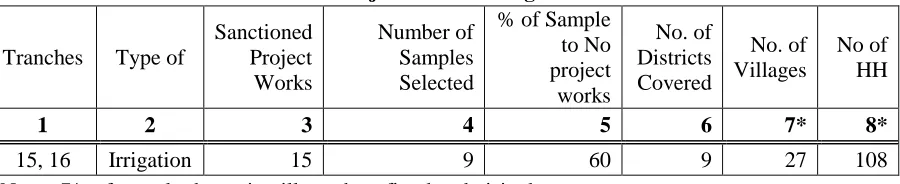
covers Minor Irrigation(MI) RIDF projects of 9 sample minor irrigation works (60% samples)
implemented by PWD (WRO), spread over9districts in Tamil Nadu state.
Second, the RIDF project area in the selected districts in Tamil Nadu covering MI projects under
agricultural sector can portray both tangible and intangible multidisciplinary benefits to the
people at large in the command area served villages.
2. Scope and Objectives of the Paper
The paper covers minor irrigation (MI) works in „agriculture‟ sector in 9 districts of Tamil Nadu.
The reference period for the impact evaluation works undertaken are from 2008-09 to 2010-11covering RIDF tranches XIV, XV and XIV. Since trench XIV has no sanctioned projects, the study has covered only the remaining two trenches.The paper is set to have the following
objectives.
1. To present an overview on the significance of RIDF in the context of development
through capital formation;
2. To critically study the process of implementation of RIDF investments in minor irrigation
projects with special reference to Tamil Nadu state;
3. To evaluate the overall socio-economic impact of RIDF intervention at ground level from
rural development perspectives;
4. To assess the implication of RIDF assets on credit absorption capacity and rural bank
business in rural area; and
5. To draw some learning points and prescribe policy intervention and action points for
different stakeholders.
2.1Methodology
Methodology covers criteria for selection of sample size of projects, sources of data, estimation
of various parameters and reference year of the study. The sample coverage is furnished in Table
Table 1 RIDF Project wise Coverage in Tamil Nadu
Tranches Type of
Sanctioned Project Works Number of Samples Selected
% of Sample to No project works No. of Districts Covered No. of Villages No of HH
1 2 3 4 5 6 7* 8*
15, 16 Irrigation 15 9 60 9 27 108
Note: 7* refers only the main villages benefitted and visited.
*8 no. of hhs refer those who are present during the interview as well as focussed group discussions. Source: Tabulated from data given by NABARD regional office, Chennai (column 1 to 6).
Details of sanctioned MI projects and sample size covered in the state are furnished in table 2. A
total of 15 projects in which 9 of them are selected in the study. The number of sample command
area villages and households benefitted by MI projects account for 27 and 108 respectively.
2.2Method of Selection of Samples
In Tamil Nadu, there are 12 districts in which 15 MI projects have been sanctioned under
Trenches XV and XVI. For evaluation purpose, 9 MI works in 9 districts have been purposively
selected. The tranche wise details of the sanctioned and samples selected are given in Table 2.
Table 2 Trenche wise RIDF Projects Sanctioned and Selected for Impact Survey Sl. No Type of structures
covered in the study
No of Projects Sanctioned No of Projects selected for study
RIDF- 15 RIDF -16 RIDF-17 RIDF-18 RIDF- 15 RIDF -16 RIDF-17 RIDF-18
1 Flood Control - - nt nt - - nt nt
2 Irrigation 7 8 nt nt 6 3 nt nt
3 Others- - - nt nt - - nt nt
4 Total 7 8 nt nt 6 3 nt nt
5 No. of districts covered
6 6 nt nt 6 3 nt nt
6 No of Farmers Covered
na na nt nt 25,417 7,024 nt nt
Note: „-„indicates nil. nt = As per ToR, not taken up, na = not available.
Source: Data provided by NABARD, RO, Chennai [4].
2.3Criteria for Sample Selection
a. Total works completed in tranches 15 and 16 (in tranche 14 no irrigation work was
[image:7.612.54.558.406.556.2]of works were sanctioned, 60% sample has been considered, which comes to9 works in 9
districts.
b. In each district at least one work was selected purposively. Wherever, the same type of
work was repeated in other districts that work /district was not considered for selection,
to avoid duplication.
2.4 Sources of Data (Primary &Secondary)
Primary data: For the RIDF survey, from each of the nine sample projects, primary data have been collected from 108 farmers by using questionnaire representing 36 farmers each from head,
middle and tail reaches for in-depth study. Besides primary data collection, opinion of members
of Panchayats, Self Help Groups (SHGs), Water Users Associations(WUA) members and other
villagers through focussed group discussions were solicited. The 108 farmers of 9 projects have
been distributed as: 12 farmers in each project representing 4 farmers each from head reach,
middle reach and tail reach of the command area.
Secondary data: Before canvassing the sample farmers the following details were collected from the respective Village Administrative Officers as well as the respective PWDs at district
level.
Initially, the Detailed Project Report (DPR) and Project Completion Report (PCR) for each one
of the selected RIDF project were collected. Specific details of the selected irrigation systems
such as number of districts / taluks covered, command area map, details of RIDF works
executed; actual command area and present command area served by the irrigation system; total
project cost; water requirement of crops for one irrigation season; present cropping pattern;
number of irrigation wells available in the command area; number of years water available to the
command area after completion of the RIDF project were collected.
2.5 Criteria Used for Selection of Households
The impact information was collected from the beneficiaries and other stakeholders of the
projects. Care was taken to select the respondents from different socio-economic groups. For
which, details from ayacut / command area farmer groups such as large, medium and small
more specific, for irrigation, in addition to Panchayat officials / VAOs, command area
beneficiaries were contacted.
2.6 Procedures for Data Collection and Method of Conducting the Survey
For collecting primary data and collective opinion form the group discussions on sample RIDF
asset at village level, the following procedure has been followed.
The benefits from RIDF assets are captured subjectively based on the field observations. In
addition to that the rural bank branches located nearest to the sample work were approached and
discussed with the bank staff on the impact of RIDF work on credit absorption in their service
area and collected business data in terms of savings and advances. The following are other
considered views on the limitations of the household surveys.
1. The RIDF works like precast retaining wall, repairing right abutment, de silting, lining
etc, is more for protective investment mainly for renovation and improvement of irrigation structures and no immediate productive impact could be precisely envisaged in the absence of adequate rainfall in the project command area.
2. The protective and productive use distinction: The details on these kinds of usages of MI asset contained in the Detailed Project Report (DPR) are only based on theoretical
assumptions considered at the time of project estimation. But, after completion of MI
works real situation at the site observed during visit after 3-4 years gives different picture
nullifying the assumptions made earlier.
Even then, to capture the water distribution effect fairly the head, middle and tail approach of the
irrigation system,was adopted and had interviews with WUAs members and other beneficiaries.
2.7Methodology Followed in Estimation of Various Parameters
1. Estimation of Internal Rate of Return (IRR) for Minor Irrigation Projects for the Parameters
viz., income and production: The discount rate often used in capital budgeting that makes the net
present value of all cash flows from a project equal to zero. That is, the higher a project‟s IRR,
the more desirable it is to undertake the project. Assuming all other factors remain constant
among various projects, the project with the highest IRR would probably be considered the best
The IRR to public investments on sustained high rates of return to irrigation suggest that
investment in the productivity enhancing activities should be increased.”
2.8 Limitations: The following are the limitations of the study:
1. The Minor Irrigation under agricultural sector is more dependent on rainfall. Reportedly
due to inadequate rainfall during the last two years (2013-14 and 2014-15) in sample area
like Dharmapuri, Salem and Pudukkottai no tangible impact could be captured.
2. Although IRR is an effective tool to assess the outcome of RIDF investment for
rehabilitation / improvements in the distribution system connected to MI projects, it has
some limitations, because of presence of difficulties in accessing required field data for
IRR calculation. For IRR, production cost data have been collected only from owner
cultivation regardless of the location of the farm in the command area and size of
holdings.
3. Whateverthe rainfall pattern occurred in the agro climatic regions covered in the sample
MI projects, the distribution of water is assumed normal. That is, the irrigation water is
fairly shared among different reaches of the irrigation system. The pre-project cropped
area is sustaining the given marginal addition due to RIDF project investments.
4. Difficulties are found in application of IRR tools uniformly in all the projects spread over
in different agro-climatic zones, due to the following problems:
a. Poor execution of required infrastructure works – eg. Tiruchirappalli RIDF MIproject.
b. Ineffective O & M – It is observed almost in all districts irrespective of zones.
c. Lackof ownership of stakeholders and inactive WUAs in most of the districts covered
for the study regardless of the Agro Climatic Zones in protecting the RIDF structures.
5. For IRR calculation, only tangible direct benefits in terms of values of crop production
have been considered. However, it is admitted that there are intangible social benefits
also accrued from the RIDF projects, and if the imputed values of such benefits are
considered, the total socio-economic benefits would be still more than the one arrived at
in the study.
3 Results of the Study
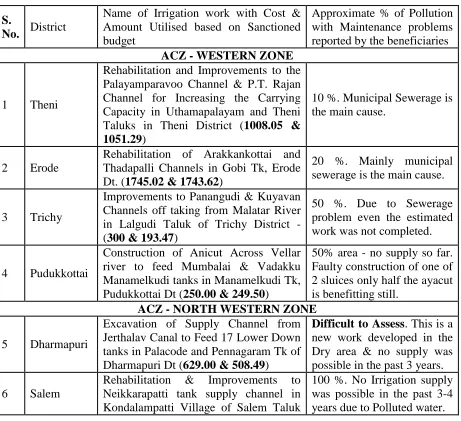
3.1 Operation & Maintenance of Assets and Over Exploitation of Groundwater Resources In majority of the RIDF projects, six out of nine surveyed, inadequate and poor maintenance of
the irrigation systems causes inefficiency in their full utilization of irrigation benefits coupled
with less active functioning of WUAs that creates poor strengthening of local irrigation
institutions to work efficiently in managing the sample MI projects. Likewise, the same number
of 6 MI projects (Table 3) face severe drainage and municipal sewage problems that create water
[image:11.612.75.536.264.685.2]quality problem leading to less productivity in the command areas served by them.
Table 3 Agro-Climatic Zone Wise Pollution and Maintenance Problems Reported by Beneficiaries under RIDF Project (Cost Rs in lakh)
S.
No. District
Name of Irrigation work with Cost & Amount Utilised based on Sanctioned budget
Approximate % of Pollution with Maintenance problems reported by the beneficiaries ACZ - WESTERN ZONE
1 Theni
Rehabilitation and Improvements to the Palayamparavoo Channel & P.T. Rajan Channel for Increasing the Carrying Capacity in Uthamapalayam and Theni Taluks in Theni District (1008.05 & 1051.29)
10 %. Municipal Sewerage is the main cause.
2 Erode
Rehabilitation of Arakkankottai and Thadapalli Channels in Gobi Tk, Erode Dt. (1745.02 & 1743.62)
20 %. Mainly municipal sewerage is the main cause.
3 Trichy
Improvements to Panangudi & Kuyavan Channels off taking from Malatar River in Lalgudi Taluk of Trichy District -
(300 & 193.47)
50 %. Due to Sewerage problem even the estimated work was not completed.
4 Pudukkottai
Construction of Anicut Across Vellar river to feed Mumbalai & Vadakku Manamelkudi tanks in Manamelkudi Tk, Pudukkottai Dt (250.00 & 249.50)
50% area - no supply so far. Faulty construction of one of 2 sluices only half the ayacut is benefitting still.
ACZ - NORTH WESTERN ZONE
5 Dharmapuri
Excavation of Supply Channel from Jerthalav Canal to Feed 17 Lower Down tanks in Palacode and Pennagaram Tk of Dharmapuri Dt (629.00 & 508.49)
Difficult to Assess. This is a new work developed in the Dry area & no supply was possible in the past 3 years.
6 Salem
Rehabilitation & Improvements to Neikkarapatti tank supply channel in Kondalampatti Village of Salem Taluk
& District – (270.00 & 237.97)
ACZ - CAUVERY DELTA
7 Thanjavur
Construction of Grade wall across Kudamurutty River to feed Serumakkanallur and Chakkarapalli Channels in Papanasam TK, Thanjavur Dt – (402.28 & 480.54)
30 %. Municipal Sewerage & ayacut land for Real estate led to severe problems.
ACZ - SOUTHERN 8 Ramnad
Modernization of Ramnad Big Tank in Ramnad Block of Ramnad Dt (973.20 & 1033.66)
20 %. Severe maintenance & Real estate problems.
9 Thoothukudi
Rehabilitation of South Main Channel and its System Tanks in Srivaikuntam Anicut (1000.00 & 997.16)
15 %. Municipal Sewerage and maintenance problems.
Source: Project Completion Reports & Direct Visits & Discussions by the Evaluation Team,
March to May 2015.
Beyond pollution issue, another kind of problem like over exploitation of groundwater has been
witnessed in Thanjavur district falling in Cauvery delta zone thereby affecting the overall
potential of water resources available for agricultural sector. In this regard the DDM of
Thanjavur district opined that in ten out of 14 blocks, over exploitation of groundwater takes
place with the involvement of the farmers availing bank loans since sanction of loan was done
without adhering the norm or groundwater rules, by the banks for lending scheme for the means
of taping groundwater resources like bore wells/tube wells.
3.2 Impact of RIDF Projects Socio-Economic Benefits
A consolidated observation on the impact of RIDF MI projects is given under three heads:
1. Social benefits to the stakeholders
2. Economic benefits – quantitative & qualitative and
3. Benefits to Banking Sector in the Command Area
3.3 Impact on Social Status
Nearly three-fourth of the sample respondents belong to BC and MBC and equal percentage (13
%) belong to Forward and Scheduled Castes communities in the project areas. The opinion of the
without any profitability in the farm activities in the past couple of decades in the project areas.
Eventually, a major shift in young agricultural as well as non-agricultural population seeking
studies / employment to urban centres is visible in the RIDF irrigation projects.
However, it could be seen that the cropping pattern practised in the sample projects, apart from
sustainability in a few already developed canal comments, improvements in crop pattern and
yield level have been reported. In the case of paddy, the major crop sown in all RIDF project
areas, yield level has increased from up to 20% than the normal level. This is due to assured
water supply and other agronomic and cropping practises adopted by the farmers. As a result,
income level in some of the projects has improved up to 15%. Moreover, crop failure during lean
irrigation supply period is averted due to adequate water available to lands after implementation
of the RIDF projects.
So, the RIDF project investment in the 9 sample irrigation projects has given a mixed picture of
impact on social status and income generation in the project areas
3.4 Economic Impact
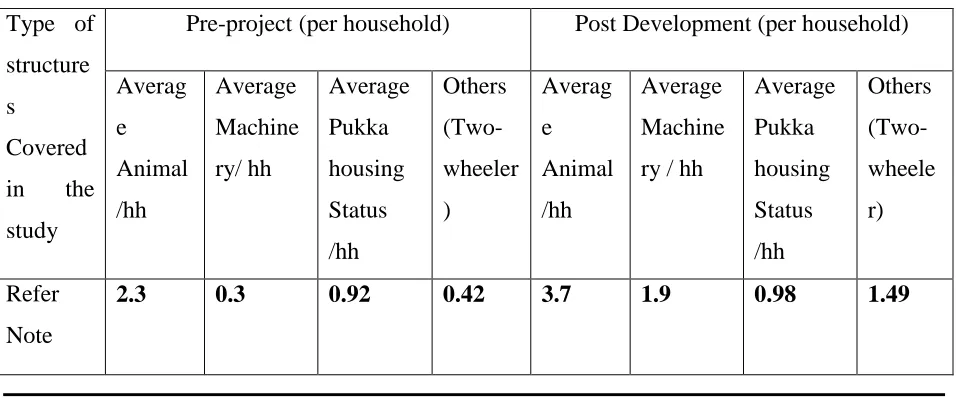
The changes in the level of asset, income and employment during pre-and post project periods
are furnished in Table 4. Consequent to the RIDF projects in agricultural sector the status in all types of assets viz livestock, machinery, pukka houses, cattle population among the sample
households has increased positively to a higher level although in varying degree among them
[image:13.612.69.547.496.695.2]during pre-project to post project period.
Table 4 Asset Creation - Stabilization during Pre and Post Project Period Type of
structure
s
Covered
in the
study
Pre-project (per household) Post Development (per household)
Averag e Animal /hh Average Machine ry/ hh Average Pukka housing Status /hh Others (Two-wheeler ) Averag e Animal /hh Average Machine
ry / hh
Average Pukka housing Status /hh Others (Two-wheele r) Refer Note
Note: hh- households. Animals are Bullock, cow, goat and sheep only. Machinery includes
Tractor, Harvest Combiner and Power tiller only.
Note: * Type of structures covered (above 10% of project cost in each item indicated) in the study: 1. Clearing scrub and related earth works; 2. Lining and Cement Concrete; 3. Improvements to canals & tanks and supply channels; 4. Lining and repairing the outlets for
rehabilitation; 5. Reconstruction of Regulator; 6. Reconstruction of falling shutters; 7.
Standardisation main bund and desilting of supply channels; construction of anicut, head sluice
& scour sluice; 8. Formation of flood banks and protection works of supply channel.
Source: RIDF Field Survey March-May 2015.
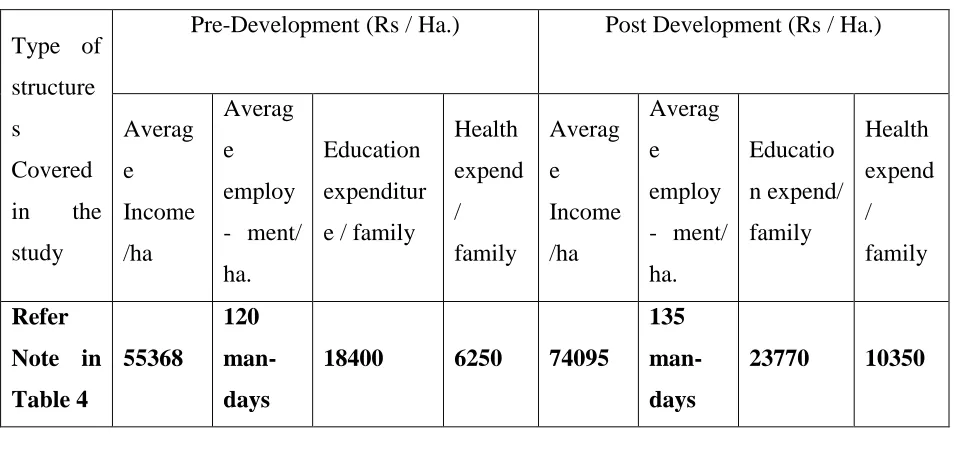
Similarly, upward trend in the changes for income and employment of the stakeholders is
evidently observed in the sample projects studied (Table 5). It may be evident from the table that
post development period has helped the farmers to achieve a higher status in their income,
employment and health expenditure. This is what considered necessary in a project where
investment, especially under RIDF, has been made on development orientation purpose.
3.5 Outcome of Economic Returns
3.6 Internal Rate of Return (IRR) - Impact Analysis
While examining the economic impact of MI projects in terms of income and employment in the
Table 5 Impact on Income and Employment of Sample Farmers Type of
structure
s
Covered
in the
study
Pre-Development (Rs / Ha.)
Post Development (Rs / Ha.)
Averag e Income /ha Averag e employ
- ment/
ha.
Education
expenditur
e / family
Health expend / family Averag e Income /ha Averag e employ
- ment/
[image:14.612.71.548.460.692.2]ha. Educatio n expend/ family Health expend / family Refer Note in Table 4
55368
120 man-days
18400 6250 74095
135 man-days
Note: Average income per working day @: Pre-development - Rs. 461 Post devpt - Rs. 549.
Employment in man-days per ha in a year.
Source: RIDF Field Survey March-May 2015.
sample districts as presented above, it will be interesting to observe the inter district variance in
the results of IRR analysis in the given different characteristics features of 7 agro-climatic zones
in Tamil Nadu (Refer figure 1).
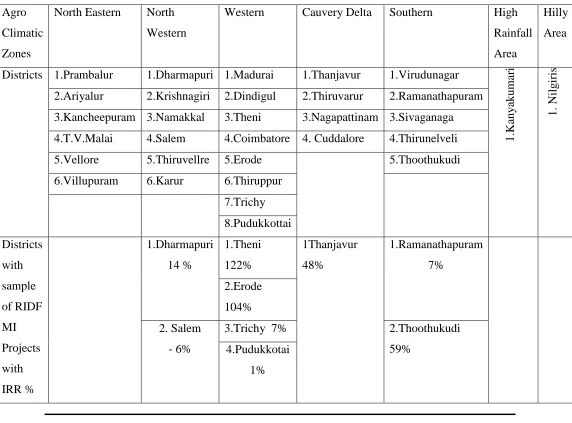
Table 6 reveals the distribution of 31 districts in 7 agro-climatic zones in Tamil Nadu. Of these 7
[image:15.612.26.598.279.702.2]zones, the RIDF sample MI projects are found in 4 zones namely western zone (Theni, Erode,
Table 6 Agro-Climatic Zone Wise Distribution of RIDF MI Projects and IRR (in %) Agro
Climatic
Zones
North Eastern North
Western
Western Cauvery Delta Southern High
Rainfall
Area
Hilly
Area
Districts 1.Prambalur 1.Dharmapuri 1.Madurai 1.Thanjavur 1.Virudunagar
1.Ka nya kuma ri 1. Nilgi ris
2.Ariyalur 2.Krishnagiri 2.Dindigul 2.Thiruvarur 2.Ramanathapuram
3.Kancheepuram 3.Namakkal 3.Theni 3.Nagapattinam 3.Sivaganaga
4.T.V.Malai 4.Salem 4.Coimbatore 4. Cuddalore 4.Thirunelveli
5.Vellore 5.Thiruvellre 5.Erode 5.Thoothukudi
6.Villupuram 6.Karur 6.Thiruppur
7.Trichy 8.Pudukkottai Districts with sample of RIDF MI Projects with IRR % 1.Dharmapuri 14 % 1.Theni 122% 1Thanjavur 48% 1.Ramanathapuram 7% 2.Erode 104% 2. Salem - 6%
3.Trichy 7% 2.Thoothukudi
59% 4.Pudukkotai
Note: The sample MI works are distributed in 4 zones, viz., North Western (sl. nos. 1 and 4),
Western
(sl. nos. 3, 5, 7 and 8), Cauvery delta (sl. no. 1) and Southern (sl. nos. 2 and 5)
The Percentage figures represent the IRR of respective districts.
[image:16.612.136.507.138.508.2]Source: Agro Climatic Regions – NABARD RO, State Focus Paper 2015-16 p 62. [5]
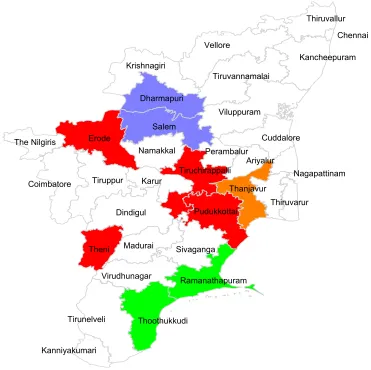
Figure 1Agro Climatic Zone Wise District wise Distribution of RIDF MI Sample Works
Tiruchirappalli and Pudukkottai), North western (Dharmapuri and Salem), Southern zone
(Ramanathapuram and Thoothukudi) and one in Cauvery delta (Thanjavur). For calculating IRR
for all 9 MI works in Tamil Nadu an attempt has been made to explore a critical analysis that
examines the associated implications or causal relationship between agro-climatic characteristics
3.7 Rationale and Hypotheses
1. Geographically with the given natural endowments, the districts in Tamil Nadu have been
classified under seven different agro climatic characteristics as portrayed in table 6
showing maximum number of 8 districts falling under western zone. The four main
factors, considered for such classification include a) rainfall distribution, b)
irrigationpattern (tank or canal), c) soil characteristics (black & red majority) and d)
cropping pattern. Since the output (assured water and additional area under crop
cultivation area) and outcome (incremental production & income) of RIDF MI
project works in sample area are directly influenced by these external factors, eventually
the annual returns in terms of IRR % is bound to respond to these external agro climatic
[image:17.612.56.585.309.672.2]factors variably (Table 7).
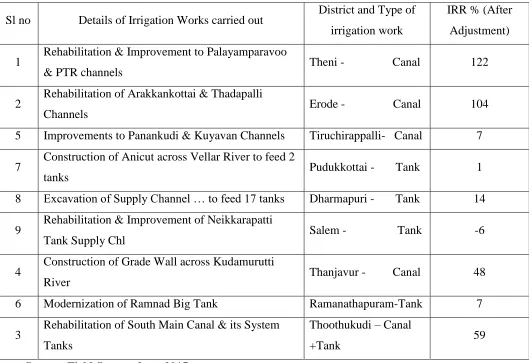
Table 7 IRR Results in the Sample Minor Irrigation Projects Sl no Details of Irrigation Works carried out District and Type of
irrigation work
IRR % (After
Adjustment)
1 Rehabilitation & Improvement to Palayamparavoo
& PTR channels Theni - Canal 122
2 Rehabilitation of Arakkankottai & Thadapalli
Channels Erode - Canal 104
5 Improvements to Panankudi & Kuyavan Channels Tiruchirappalli- Canal 7
7 Construction of Anicut across Vellar River to feed 2
tanks Pudukkottai - Tank 1
8 Excavation of Supply Channel … to feed 17 tanks Dharmapuri - Tank 14
9 Rehabilitation & Improvement of Neikkarapatti
Tank Supply Chl Salem - Tank -6
4 Construction of Grade Wall across Kudamurutti
River Thanjavur - Canal 48
6 Modernization of Ramnad Big Tank Ramanathapuram-Tank 7
3 Rehabilitation of South Main Canal & its System Tanks
Thoothukudi – Canal
+Tank 59
2. Given the rationale, inter zone variations in IRR% in RIDF sample districts, driven by the said external factors is arguably acceptable as the range of such variations starting
from 1% in Pudukkottai to plus 50% in Theni and Erode is perceived among RIDF
sample districts. However, witnessing a wide variation in intra zone districts having similar agro climatic features in the study area is causing concern – for example in
western zone – IRR % ranges from plus 50 % in Theni to 1 % in Pudukkottai. Therefore,
an academic probe on the causative factors for such skewed IRR in the western zone has
become inevitable.
3. The field data on RIDF MI works falling in the jurisdiction of western agro climatic zone,
reveals that the intra zone variance in IRR is principally caused by the internal factors
such as poor execution (Tiruchirappalli, Pudukkottai), ineffective O&M (Tiruchirappalli,
Pudukkottai, Dharmapuri, Thanjavur, Ramanathapuram, Thoothukudi) and lack of
ownership of stakeholders and inactive WUA (in all districts except Erode) are not driven
by the aforesaid external factors.
4. The key point from the above analysis is that internal management for proper
implementation of improvement works under RIDF MI project in the supply side and
users‟ ownership/participation in the demand side assumes significance than the covariant
risks caused by external factors for sustaining the economic impact at village level..
3.8Benefits to Banking Sector in Command Area of RIDF- MI Projects
The RIDF Irrigation development project has contributed positive impact in different spheres in
the rural bank branches as evidenced in Table 8. Table 8 reveals the impact on three aspects such as loans issued, number of accounts opened and deposits mobilized between 2008 and 2014.
Apparently, an upward trend showing 40.2% increase in issuance of agricultural loans; 75.8%
increase in opening of bank accounts and 158% increase in deposit mobilization could be
Table 8 Impact on Credit Flow in Rural Banks in the Sample Villages Sr N o Name of Branches Covered Location of Branch
Agri Loan issued
(Rs. lakh) No of Accounts
Deposits
mobilised (Rs in
Lakh) Pre (2008) develo p-ment Referen ce year (2014) Pre (2008) develo p-ment Referen ce year (2014) Pre develo p-ment 2008 Referen ce year 2014
1 SBI-Erode Kodumu
di 3026 3115 4868 6086 2085 3688
2
Indian
Bank
Dharma-puri 1839 2213 2577 5135 831 1174
Dharmapu ri 3 Canara Bank Theni
ND Patti nil 21.54 nil 7500 nil 133
4 IOB Theni KK Patti nil 1484 nil 6917 nil 132
5 IB Puduk-kottai
Maname
l-kudi 30.26 31.15 4868 6086 20.85 36.88
Average - 4895.2
6 6864.69 12313 31724
2936.8
5 5163.88
% increase between
2008-14 - 40.23 - 75.83 - 157.65
Note: nil indicates branches were opened only after the year 2008.
Source: State Level Bankers Committee, Annual Reports, Background Papers, IOB, Chennai [6].
4 Conclusion and Policy Interventions
Agriculture remains a basic sector of state economy which absorb RIDF assistance productively
for development of irrigation works. The present RIDF impact study on MI projects involving
evaluative evidences to appreciate the complexities of capital formation in the development
process. The major concern in the process of implementation that poses hazards for execution of
work as scheduled and for effective utilization of the benefits accrues are uncontrolled pollution
and misuse of MI assets studied. Arguably, therefore, following are evidence based suggestions
for policy considerations.
4.1Towards RIDF Planning from Below
In the context of presence of variance in geophysical feature of human habitation in the district,
it is imperative from equity perspective, to adopt bottom up planning for RIDF investment in the
area at block level which remains excluded persistently as identified as priority locally.
4.2Monitoring Branch Level Credit Flow
It was observed from the field observations as well the discussion with rural bank officials and
Lead District Manager/District Development Manager that the flow of credit to agricultural and
allied activities significantly went up after the implementation of the projects both at district and
service area levels. A development axiom, therefore, emerges that building of rural infrastructure
more particularly MI projects in the sample districts, helps in making the local area credit worthy
in terms of enhanced collateral values of the land and market access for assured sale of proceeds.
4.3A Concern on the Widening Inequity Gap in Rural Area
In the context of presence of skewed development within district level with most developed
block and the most backward block lying cheek by jowl at sub district level, any new
development intervention ignoring the persisting inequality situation at sub district level would
only facilitate further widening the inequality gap both among the blocks and people. Although
normative principles and pro poor policies are adhered to at macro level, the lingering question
remains is „who gets ultimately the benefits from the various capital formation created‟ in
agricultural sector in the rural areas?
In Irrigation projects, it is the progressive farmers who reap the benefits. It provides insignificant
help in raising the levels of living of the people who live below poverty line as well in
period – from 37.5 % in 2004-5 to 15.8% in 2011-12 – the widespread inequality among the
rural population still threatens the growth of the rural areas of the state as well as the country.
This point may be authenticated in the case of development activities put forth under irrigation
works of agriculture sector, where the progressive farmers who reap more benefits than the
(small & marginal) farmers living at the lower stratum.
There are many factors depend crucially on organizations outside the purview of agriculture.
Deficiencies in the functioning of organizations –both public and private- responsible for these
activities have contributed significantly to dampening both the pace of expansion in growth
potential and its actual exploitation.
In view of the above fact on distributive justice on the accrued benefits from capital formation
through RIDF investment in rural area, a micro level study on the nature and causes for
exclusion of vulnerable people in RIDF project area is needed for suggesting for inclusion plan
that suits the excluded.
References
[1] Tamil Nadu an Economic Appraisal 2011-12 to 2013-14. EARD, Kuralagam, Chennai.
[2] Sivasubramaniyan K. and V. Gandhiraj (2009), Irrigation in Tamil Nadu: with Special Reference to Tank Irrigation, Monograph 8, August 2009, MIDS.
[3] IIM, Bangalore (2008), Rural Infrastructure Development Fund – An Evaluation Study Report. [4] NABARD (2015) Data compiled from soft copy provided by R.O., Chennai.
[5] Agro Climatic Regions of Tamil Nadu – NABARD RO, State Focus Paper 2015-16. [6] State Level Bankers Committee, Annual Reports and Background Papers, IOB, Chennai. RIDF Project Implementation Procedures - NABARD website.