AWARENESS OF EMPLOYEES TOWARDS CSR ACTIVITIES – A
STUDY WITH REFERENCE TO ASHOK LEYLAND
Dr. J. Vimal Priyan,
Assistant Professor, Department of Management, Kristu Jayanti College, Bangalore.
ABSTRACT
CSR is not just about getting involved in some charitable practices or having biological
responsibility and a recycling policy. It is about the whole representation of the company which
is to be considered, from internal practices to their clients, taking in every step that a business
takes during its usual operations. Corporate social responsibility is sustainable which involves
companies to take up activities without having negative impact on their business. In India
several companies have started realizing that it is a sensible move to take up CSR activities and
amalgamate it with their business process. The present research work is undertaken to
understand the awareness of employees towards CSR activities of Ashok Leyland ltd. Hosur.
Engaging the employees in CSR activities boosts employees’ work ethics and performance. CSR
creates an impact on employee attitude and level of awareness. It enhances their sense of
direction, integrity, and cultivates positive perception. It is found that there is significant level of
awareness among the employees about the CSR activities undertaken by Ashok Leyland
Company, Hosur. It creates a positive image about the company in the minds of the employees. It
leads them to work for the company with more loyalty and sincerity.
INTRODUCTION
Corporate Social Responsibility or CSR is a corporation‟s initiatives to assess and take responsibility for company‟s effects on environmental and social wellbeing. CSR is not just
about getting involved in some charitable practices or having biological responsibility and a International Research Journal of Management and Commerce
ISSN: (2348-9766) Impact Factor- 5.564, Volume 4, Issue 10, October 2017 Website- www.aarf.asia, Email : [email protected] , [email protected]
from internal practices to their clients, taking in every step that a business takes during its usual operations. It is a continuous commitment that companies should have towards the economic, social and environmental development of the community in which they operate. Several companies have now passionately taken up to the cause of CSR in countries with rising economies such as India. Corporate social responsibility is sustainable which involves companies to take up activities without having negative impact on their business. In India several companies have started realizing that it is a sensible move to take up CSR activities and amalgamate it with their business process.
Corporations are becoming increasingly aware of their role towards the society. They are responsible bodies that feel a sense of duty towards the common welfare and the environment. This comes with a growing realization that they, as an integral part of this society themselves, can contribute to its upliftment and empower of the entire country in turn. Thus Companies now are setting up specific departments and teams that develop policies, strategies and goals which are for their CSR programs and assign separate budgets to support them. These programs are based on well-defined social beliefs. In the modern era, the new generation of corporate leaders considers optimization of profits as the key, rather than the maximization of profit
A properly implemented CSR concept can bring along a variety of competitive advantages, such as enhanced access to capital and markets, increased sales and profits, operational cost savings, improved productivity and quality, efficient human resource base, improved brand image and reputation, enhanced customer loyalty, better decision making and risk management processes. (CSR) is a useful tool to promote economic development.CSR provides a platform for corporations to be involved in economic development in ways that can be much more powerful. Economic development means improving the well-being of disadvantaged people wherever they may be.
STATEMENT OF THE PROBLEM
than about straight forward gifts to charity. Seen that way, donation, large or small are not the main things.
Employees in an organization are important resources that need to be taken care of. They are asset of an organization & they are key to success. Organizations have started giving importance to bring in CSR as a major tool to motivate and inspire the employees to perform better. They are employees who leave the organization because of lack of policies and program that enable them to grow professionally.
Many organizations are now giving importance for welfare measure and they believe that if better environment and adequate welfare measure are provided, there is a chance for the employee to stay in the organization. The organization should ensure that the employees are provided comfort required wage and good working condition. So, that the morale and motivation of the employees are high. So, the research work on awareness of employees towards CSR is undertaken.
REVIEW OF LITERATURE
A few studies have been made on this field and are indirectly helpful to this research. A review of such study is presented below.
Jean-pascal and et al (2010)1 in their research paper titled “Corporate Social Responsibility„s (CSR) influence on employees” studied & analyzed that how employees‟
perceptions of CSR trigger attitudes and behavior in the workplace which affect organizational, social and environmental performance. They concluded that CSR can influence social exchange dynamics as well as social identification processes within the corporation. It integrates these two mechanisms in a new framework explaining how CSR perceptions stimulate the adoption of workplace attitudes and behaviors that may ultimately foster corporate performance.
RichaGautam and Anju Singh (2010)2 in their research paper titled “Corporate Social Responsibility Practices in India: A Study of Top 500 Companies” studied the theoretical
1
Jean-Pascal Gond and et al, “Corporate Social Responsibility Influence on Employees”, International Centre for Corporate Social Responsibility, No.54, 2010, ISSN 1479-5124, pp 1-46.
concepts expounded by various researchers and the deployment of current CSR practices in India. India‟s top 500 companies view, and conduct their CSR, identify key CSR practices and
maps these against Global Reporting Initiative standards. They suggested that the Many companies were making token gestures towards CSR and only a few companies had a structured and planned approach. Several companies spread their CSR funds very thinly across many activities. Every company defines CSR in their own ways as per their needs. CSR is on an upward learning curve and was primarily driven by philanthropy.
Sanjay Pradhan and AkhileshRanjan (2010)3 in their paper titled “Corporate Social responsibility in Rural Development Sector: Evidences from India” explored Corporate Social responsibility (CSR) practices particularly in the context of rural development. They evaluated impacts of CSR actions on the socio-economic development of rural people. For the purpose, fourteen public and private Indian companies/firms had selected to study their CSR practices in the context of rural development. They concluded that the social responsibility is regarded as an important business issue of Indian companies irrespective of size, sector, business goal, location of the company. Because Indian companies were realizing that without socio-economic development of the local communities, there can be no stability and sustainability for doing business so as tocompete with the global market.
ShwetaVerma (2011)4 in her research paper titled “Why Indian companies indulge in CSR” analyzed the motives and benefits of Corporate Social Responsibility initiatives of Indian
companies. She concluded that the interest of investors in SRI fund or CSR and it was found that there is lack of awareness of such funds among Indian investors; secondly, investors were not keen to invest in social active companies their major interest was to make profit from their investment. Thus, clear policy should be drawn in this respect. Companies should also take
3Sanjay Pradhanand AkhileshRanjan, “Corporate Social Responsibility in Rural Development Sector:
Evidences from India”, School of Doctoral Studies (European Union) Journal, 2010, pp 139-147.
initiative in producingtimely and quantitative reports of their CSR practices so that its importancecan be compared.
Chung Hee KIM and Hugh scullion (2013)5 in their research paper titled “The effect of Corporate Social Responsibility (CSR) on employee motivation: A cross-national study” examined the importance of employee-centered corporate Social Responsibility (CSR) considerations in exploring CSR‟s effect on employee work motivation contention that beyond CSR‟s link to external factors (e.g. Public Relation, philanthropy, Environment and NGOs)
predominantly. They suggest that although businesses seldom initiate CSR mainly with the aim of facilitating staff motivation, when businesses evaluate the results, the issue of individual motivation emerges as one of the main benefits for engaging in CSR. More importantly, empirical analysis revealed the importance of complex cultural, institutional and political factors which influences the link between CSR and motivation across nations.
Majid Khan and et al (2013)6 in their research paper titled “Corporate Social Responsibility and Corporate Reputation: A Case of Cement Industry in Pakistan” exploredthe relationship between corporate social responsibility and corporate reputation in the context of Pakistan. Interest of business organizations in CSR had increased significantly in recent years. . The notion of CSR had not only received academic attention but it is becoming mainstream practice for business organizations all round the world. The four dimensions of CSR have been studied: environment oriented responsibilities, customer oriented responsibilities, community oriented responsibilities, and legal responsibilities. They concluded that most of the respondents were familiar with the term corporate social responsibility. Findings of their study further indicated that business organizations can obtain financial and non-financial benefits from
5Chung Hee KIM and Hugh scullion, “The Effect of Corporate Social Responsibility (CSR) on Employee
Motivation: A Cross-national Study”, Poznan University of Economics Review, Volume.13, No.2, 2013, pp 5-29.
6
adequately implementing CSR efforts for the relevant stakeholders. It is also observed that managers of the business organizations can obtain benefits such as enhanced corporate reputation by the implementation of CSR.
Rohini S. Nair (2015)7 in her research paper titled “A Review of the Cause-Effect relationship between CSR and HR” studied that the cause and effect relationship that exist
between CSR and HR. Both the concepts must be equally valued and appreciated by the firms as both CSR and HR are supposed to supplement and complement each other and are considered to be the essentials for the success of the organizations. She concluded that it not only helps in establishing effective relationships with external stakeholders, but also acts as a driving force in transforming the employees and the organization towards a socially responsible behavior. This is clear indication of how one concept strongly complements the other, in many ways. Organizations must, thus, pay attention to ensure that social responsibility is deeply rooted in their culture.
Sanie DODA and et al (2015)8 in their paper titled “The Importance of Corporate Social Responsibility” suggested that Corporate Social Responsibility strategies can develop sustainable
competitive advantages, to enhance social and financial performance and therefore increase organizational performance beyond numbers and bottom lines and CSR oriented organizational values reinforces CSR strategies of each company which in turn brings added value strengthening beyond bottom line or beyond finance.
Teo Lam Chew (2015)9 in his research paper titled “The Impact of Employee Perception of CSR Practices on Organizational Commitment and Role Behaviors: A Study of SMEs Sector
7
Rohini S. Nair, “A Review of the Cause-Effect Relationship between CSR and HR”, International Journal of Business and Management (IJBM), Volume.3, No.12, ISSN 2321–8916, pp 63-67.
8
in Penang” examined the mediating role of the three dimensions of organizational commitment
which are affective commitment (AC), continuance commitment (CC), and normative commitment (NC) in the relationship between the four dimensions of CSR practices, namely marketplace, workplace, community and environment, and the two dimensions of role behaviors which are in-role behavior (IRB) and extra-role behavior (ERB). He utilized a non-probability sampling method in the forms of purposive sampling. He concluded that Employee perception of CSR practices in SMEs will not exactly indication an advanced level of role behavior through organizational commitment effects. However, good environment dimension of CSR practice will be able to increase the employee in-role behavior through the effects of affective commitment.
Dr. ReenaShyam (2016)10 in her research paper titled “an analysis of corporate social responsibility in India” analyzed the development of CSR in India. She highlighted the policies
governing CSR in India and CSR initiatives in Indian firms including SMEs role in CSR. There are several challenges facing CSR in India. She concluded that in the current social situation in India, it is difficult for one single entity to bring about change, as the scale is enormous. Corporate have the expertise, strategic thinking, manpower and money to facilitate extensive social change. Effective partnerships between corporate, NGOs and the government will place India‟s social development on faster track.
Richamartolia (2016)11 inher research paper titled “Effectiveness of CSR in public and private enterprise” analysed the significance of CSR in India for the sustainable growth of the
country, and makes a comparative study of the pattern of CSR expenditure between companies in the public and private sectors. She concluded that Corporate Social responsibility is essential
Organizational Commitment and Role Behaviors: A Study of SMEs Sector in Penang”, International Journal of Recent Advances in Organizational Behaviour and Decision Sciences (IJRAOB), Volume. 1, No. 4, 2015, ISSN- 2311-3197, pp 617-631.
10
Dr. ReenaShyam, “An Analysis of Corporate Social Rresponsibility in India”, International Journal of Granthaalayah Management, Volume.4, No.5, May 2016, ISSN- 2350-0530, pp 56-64.
11RichaMartolia, “Effectiveness of CSR in Public and Private Enterprises”, Abhinav National Monthly
in India as more than 65 per cent of population is living in rural areas. There are huge differences between urban and rural India in terms health care facilities, education levels, infrastructure, housing, nutritious food, awareness on their rights of protection, etc. She concluded that the CSR spending as a percentage of Profit after tax of the Indian Companies is not equal to 2 per cent.
Suresh kumarmahajan (2016)12 in his research paper titled “corporate social responsibility (CSR) science in India with reference to company act-2013” studied the main drivers for CSR have been the shrinking role of government, demands for greater disclosure, increased customer interest, growing investor pressure, competitive labor markets, and supplier relations. The companies enjoy several benefits like improved financial performance, lower operating costs, enhanced brand image and reputation, increased sales and customer loyalty, product safety, material recyclability, and greater use of renewable resources etc. He concluded that Companies must generate awareness to the various stakeholders regarding its contribution to corporate social responsibility through its affiliation with social cause through event management (Mumbai marathon events) and company websites as it is directly related to increase in sales and brand loyalty.
ŽanaPrutina and DževadŠehić (2016)13in their research paper titled “Employees
perception of corporate social responsibility: A case study of award recipient” explored employee perceptions of company‟s behavior towards relevant stakeholders, and the extent to which such behaviors are seen as commendable, taking into consideration the company‟s reputation. Analyzing CSR orientation, through employees‟ perceptions can help distinguish between company‟s genuine CSR orientation and simple window dressing. Their findings on other companies who received similar awards to explore employees‟ perceptions of CSR for the
purpose of comparison. Finally, the sample in their study was quite homogenous in terms of
12
Suresh Kumar Mahajan, “Corporate Social Responsibility (CSR) Science in India with Reference to Company Act-2013”, International Journal of Business Quantitative Economics and Applied Management Research, Volume.2, No.8, January 2016, ISSN: 2349-5677, pp 108-125.
13ŽanaPrutina and DževadŠehić, “Employees‟ Perceptions of Corporate Social Responsibility: A Case
gender and level of education, but in future studies they would suggest using correlation analysis that can tell us more about perceptions of different groups of employees.
OBJECTIVES OF THE STUDY The objectives of the present study are
1. To analyze the awareness of employees about the concept of Corporate Social Responsibility.
2. To offer suggestions based on the findings of the study.
HYPOTHESIS OF THE STUDY
The following hypothesis is framed based on the objectives of the study.
1. There is no significant association between the demographic profile of employees and their awareness about Corporate Social Responsibility.
METHODOLOGY
The present study is case study method. The descriptive and analytical research design has been used. The descriptive research is marked by a clear statement of the problem, specific hypothesis, detailed information needs, sample selection, data collection and processing and analysis of the collected data to get valid inference in the form of findings. The present study deals with the perspective of customers towards service quality offered by the bank. Hence the present study is purely descriptive and analytical in nature.
Sources of Data
The required data for the present study has been collected from primary and secondary data sources.
Primary Data
Primary data was collected with the help of questionnaire from 60 employees of Ashok Leyland ltd.
Secondary Data
Sampling Design
In order to study the perception of employees towards the CSR practices in Ashok Leyland ltd, 60 employees were surveyed. There are 1500 employees working in Ashok Leyland ltd, PLANT- 1 Hosur. Due to time and cost constraints only 60 employees are selected by using convenience sampling method.
TOOLS OF ANALYSIS
The data collection was analyzed by keeping in view the objective of the study. For the purpose of presentation, tables are used. For the purpose of analysis, the following statistical tools were used.
PERCENTAGE ANALYSIS, MEAN, STANDARD DEVIATION, ANOVA,
GARRETT RANKING.
AREA OF THE STUDY
The present study has been undertaken to study the perception of employees of Ashok Leyland ltd in Hosur.
PERIOD OF THE STUDY
The data was collected between December 2016 and January 2017. The report was prepared during February 2017 and March 2017.
PROFILE OF THE RESPONDENTS
Table 1
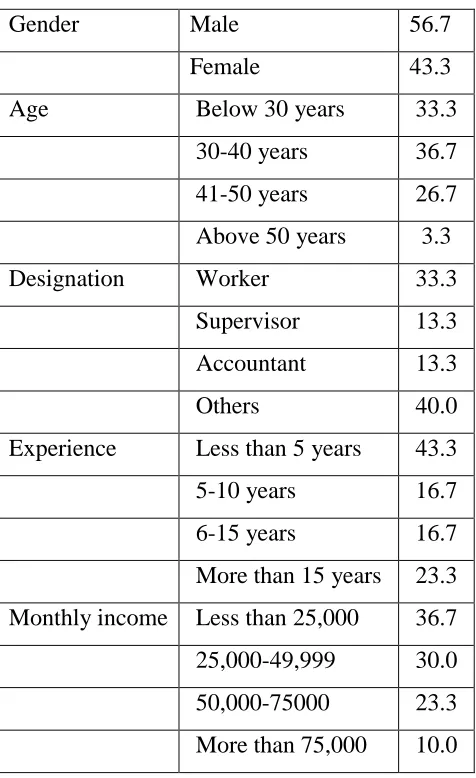
Socio- economic profile of the respondents
Gender Male 56.7
Female 43.3
Age Below 30 years 33.3
30-40 years 36.7
41-50 years 26.7
Above 50 years 3.3
Designation Worker 33.3
Supervisor 13.3
Accountant 13.3
Others 40.0
Experience Less than 5 years 43.3
5-10 years 16.7
6-15 years 16.7
More than 15 years 23.3 Monthly income Less than 25,000 36.7 25,000-49,999 30.0 50,000-75000 23.3 More than 75,000 10.0 Source: Primary data
AWARENESS OF EMPLOYEES ABOUT CORPORATE SOCIAL RESPONSIBILITY OF ASHOK LEYLAND LTD
Awareness of Corporate Social Responsibility Term
Table 2
Awareness of CSR term Particulars Number of
respondents
Percentage
Awared 42 70.0
Not awared 18 30.0
Total 60 100.0
Source: Primary Data
Table2 reveals that 70 per cent of the respondents are aware of the CSR as a terminology and the 30 per cent are not aware of the term CSR.
It is understood that 70 per cent of the respondents are aware of the term CSR as a terminology.
As shown in the Figure 1:
FIGURE 1
AWARENESS OF CSR TERMINOLOGY
0
10
20
30
40
50
Awared
Not awared
Channels of Corporate Social Responsibility
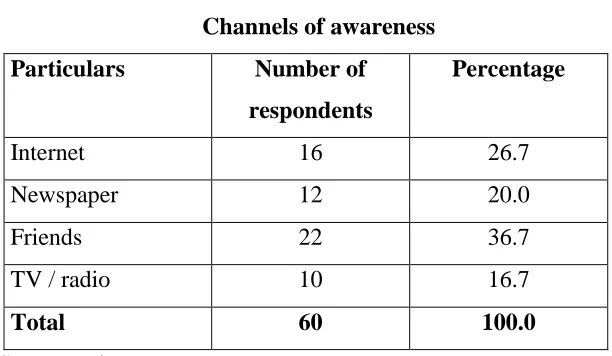
The CSR communication related to basic CSR- information sharing, personal relevance, third party endorsement presence, cost related information sharing, and through media channels and sources. Thus, Table 3 shows the channel through which the employees have heard CSR.
Table 3
Channels of awareness Particulars Number of
respondents
Percentage
Internet 16 26.7
Newspaper 12 20.0
Friends 22 36.7
TV / radio 10 16.7
Total 60 100.0
Source: Primary Data
Table 3 reveals that out of 60 respondents who are aware of various channels, 22(36.7 per cent) got awareness through friends, 16(26.7 per cent) is through internet, 12(20 per cent) got awareness through newspaper/magazine, and the remaining 10(16.7 per cent) is through TV/radio.
[image:13.612.127.433.185.363.2]As shown in the Figure2:
FIGURE 2
CHANNELS OF AWARENESS
0
5
10
15
20
25
Internet
Newspaper
Friends
TV / radio
Community Actions of Company
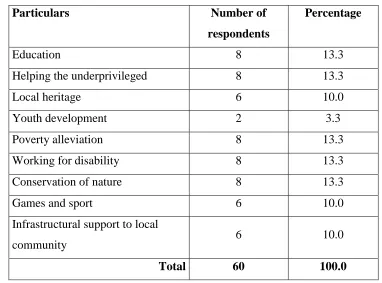
[image:15.612.87.469.238.521.2]It is one of the participatory tools used to build the capacity of community members in taking action in accordance with the problem, needs, and potential of the community by the company people working together to address what matters to them and accomplish the priority in problems and needs for future development. Table 4 displays the concrete actions towards community in which company operate.
Table 4
Community actions carried out by company
Particulars Number of
respondents
Percentage
Education 8 13.3
Helping the underprivileged 8 13.3
Local heritage 6 10.0
Youth development 2 3.3
Poverty alleviation 8 13.3
Working for disability 8 13.3
Conservation of nature 8 13.3
Games and sport 6 10.0
Infrastructural support to local
community 6 10.0
Total 60 100.0
Source: Primary Data
towards conservation of nature, 6(10 per cent) towards games and sport, and the remaining 6(10 per cent) action towards the infrastructural support to local community.
It is found that 13.3 per cent, of the respondents carried out by the company people regarding the community actions towards education, helping the underprivileged, poverty alleviation, working for disability, conservation of nature, all these are given equal importance carried down by the company to implement the needs for community development.
Raising awareness within the company in relation to above issues
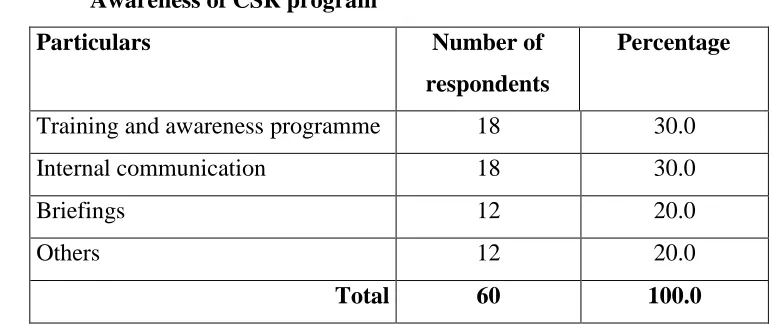
To increase awareness and initiate change of behavior of citizens, employers and employees, towards energy efficiency subjects, communication of key messages have to be carried out as complex combination of promotional, informational and educational activities carefully planned and precisely coordinated in conduction and implementation within the organization. Thus, Table 5 represent that the prioritization needs to be done in order to prepare an actual implementation plan in relation to above issue.
Table 5
Awareness of CSR program
Particulars Number of
respondents
Percentage
Training and awareness programme 18 30.0
Internal communication 18 30.0
Briefings 12 20.0
Others 12 20.0
Total 60 100.0
Source: Primary Data
[image:16.612.81.467.416.579.2]through internal communication, 12(20 per cent) through briefings, followed by the remaining 12(20 per cent) through others.
It is clear that 30 per cent, of the employees are informed about CSR through the training and awareness programme and internal communication.
Allocation of Funds
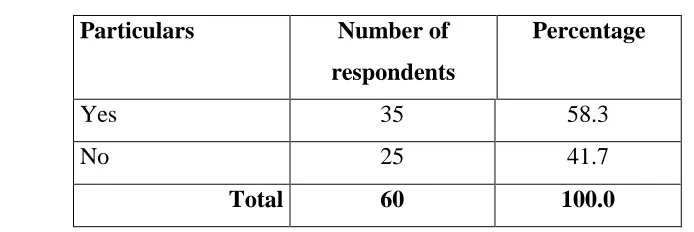
[image:17.612.78.425.339.455.2]Companies undertaking CSR activities in the vicinity of their offices or manufacturing units. CSR policies, strategies, clauses are finalized, companies will have adequate information related to the terms of permissibility of the expenses that will be counted as CSR and possible thematic areas and activities that could be considered for CSR. Table 6 shows the allocation of funds for CSR activities by Ashok Leyland.
Table 6
Allocation of funds
Particulars Number of respondents
Percentage
Yes 35 58.3
No 25 41.7
Total 60 100.0
Source: Primary Data
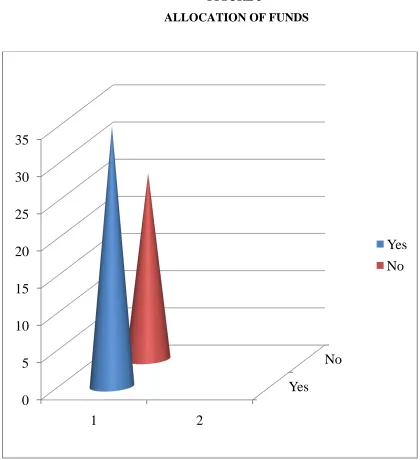
Table 6 reveals that out of 60 respondents said that the funds are allocated to CSR, 35(58.3 per cent) said that funds are allocated and contributed by employees; where as the remaining 25(41.7 per cent) said that the funds are not allocated for implementation in Ashok Leyland.
It is clear that 58.3 per cent of the respondents said that funds are allocated and contributed by Ashok Leyland for economical development of community.
FIGURE 3
ALLOCATION OF FUNDS
Yes
No
0
5
10
15
20
25
30
35
1
2
Yes
Encouragement towards participation in Community activities
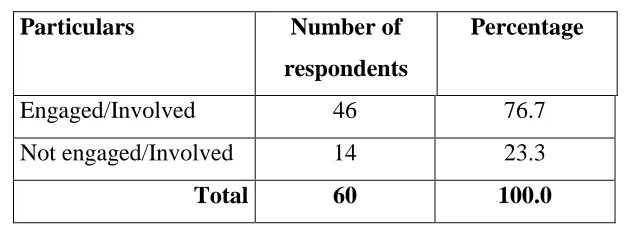
[image:19.612.120.433.196.310.2]The company has been encouraging its employees to participate in the employee social option programme, to drive positive change in society, through health checkup camps, tree plantation, and vocational guidance to school children, etc. Table 7 shows the encouragement towards participation in community activities.
Table 7
Participation in community activities
Particulars Number of
respondents
Percentage
Engaged/Involved 46 76.7
Not engaged/Involved 14 23.3
Total 60 100.0
Source: Primary Data
Table 7 reveals that out of 60 respondents, 46(76.7 per cent) of the employees are encouraged to participate in community activities, and the remaining 14(23.3 per cent) are not engaged in community activities.
It is clear that 76.7 per cent of the employees are encouraged to participate in community activities for welfare and sustainable development of the community at large.
ANALYSIS AND INTERPRETATION OF AWARENESS ABOUT CSR OF ASHOK LEYLAND
The researcher has tried to analyze the association between awareness of employees about CSR and their demographic variable. It is discussed in the following sections.
H01: There is no significant association between demographic profiles of the respondents and their awareness about the corporate social responsibility of Ashok Leyland.
ONE WAY ANOVA was used to test the hypothesis and the results were discussed in the following section.
Gender and their awareness about CSR Terminology
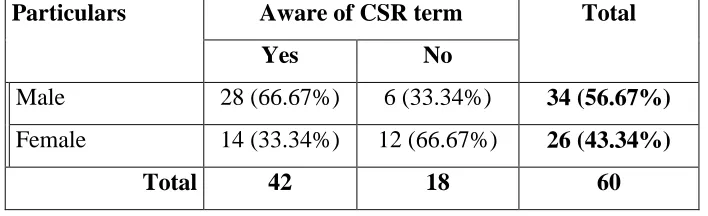
[image:20.612.130.484.324.432.2]The level of awareness of male and female employees about CSR may differ. The researcher has analyzed the gender and the level of awareness in CSR terminology and is presented in the Table 8.
Table 8
Gender and their awareness in CSR terminology
Source: Computed Data
Table 8 reveals that out of 42 respondents who are aware of CSR terminology, 28(66.67%) were male and the remaining 14(33.34%) were female. Out of 18 respondents who are not aware of CSR terminology, 6(33.34%) were male and the remaining 12(66.67%) were female.
In order to test the association between gender and their of CSR terminology the following hypothesis was formulated as follows.
HO: There is no significant association between gender and their awareness in CSR terminology of Ashok Leyland.
Particulars Aware of CSR term Total
Yes No
Male 28 (66.67%) 6 (33.34%) 34 (56.67%)
Female 14 (33.34%) 12 (66.67%) 26 (43.34%)
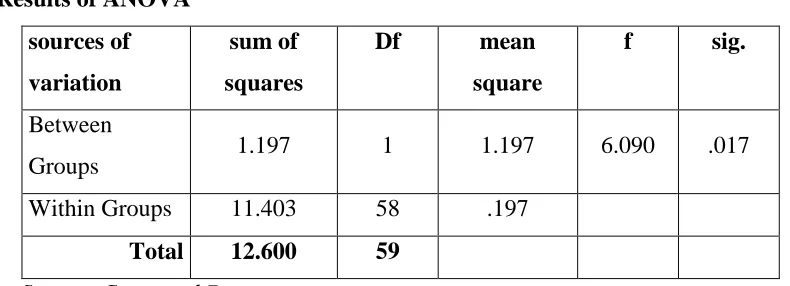
ONE WAY ANOVA was applied to test the hypothesis. Table 9 shows the results of ANOVA.
Table 9
Results of ANOVA sources of variation
sum of squares
Df mean
square
f sig.
Between
Groups 1.197 1 1.197 6.090 .017
Within Groups 11.403 58 .197
Total 12.600 59 Source: Computed Data
Table 9 makes it clear that P value is less than 0.05. Hence, it is concluded that the hypothesis formulated is rejected. There is significant association between gender and their awareness in CSR terminology of Ashok Leyland. The level of awareness is different with reference to gender.
Age and their Awareness in CSR Term
The level of awareness in CSR term may differ according to age group. The researcher has analyzed the age and their level of awareness towards CSR term and is presented in Table 10.
Table10
Age and their awareness in CSR terminology
Source: Computed Data
Particulars Aware of CSR term Total
Yes No
Below 30 years 16 (38.09%) 4 (22.23%) 20 (33.34%)
30-40 years 16 (38.09%) 6 (33.34%) 22 (36.67%)
41-50 years 8 (19.04%) 8 (44045%) 16 (26.67%)
Above 50 years 2 (4.76%) 0 (0%) 2 (3.34%)
Table 10 reveals that out of 42 respondents who are aware of CSR term, 16(38.09%) were below 30 years of age, followed by 16(38.09%) were 30-40 years, 8(19.04%) were 41-50 years and the remaining 2(4.76%) were above 50 years. Out of 18 respondents who are not aware of CSR term, 4(22.23%) were below 30 years, followed by 6(33.34%) were 30-40 years, and the remaining 8(44.45%) were 41-50 years.
In order to test the association between age and their awareness in CSR term the hypothesis was formulated as follows.
HO: There is no significant association between age and their awareness in CSR terminology.
[image:22.612.85.472.365.495.2]One way ANOVA was applied to test the hypothesis Table 11 shows the result of ANOVA.
Table 11
Results of ANOVA sources of
variation
sum of squares
Df mean
square
f sig.
Between
Groups 1.036 3 .345 1.673 .183
Within Groups 11.564 56 .206
Total 12.600 59 Source: Computed Data
Occupation and their awareness in CSR Term
[image:23.612.103.510.205.352.2]The awareness in CSR terminology may differ on the basis of the occupation. The researcher has analyzed the occupation and their awareness in CSR term and is presented in Table 12.
Table 12
Occupation and their awareness in CSR terminology Source: Computed Data
Table 12 reveals that out of 42 respondents who are aware of CSR terminology, 20(47.61%) were workers, 2(4.76%) were supervisor, 2(4.76%) were accountant, and the remaining 18 (42.85%) were others. Out of 18 respondents who are not aware of CSR terminology, 6 (33.33%) were supervisors, 6(33.33%) were accountant, and followed by
6 (33.33%) were others.
In order to test the association between occupations and their awareness in CSR terminology, the hypothesis was formulated as follows.
HO: There is no significant association between occupation and their awareness in CSR terminology.
One way ANOVA was applied to test the hypothesis. Table 13 shows the results of ANOVA.
Particulars Aware of CSR term Total
Yes No
Worker 20 (47.61%) 0 (0%) 20 (33.33%)
Supervisor 2 (4.76%) 6 (33.33%) 8 (13.33%)
Accountant 2 (4.76%) 6 (33.33%) 8 (13.33%)
Others 18 (42.85%) 6 (33.33%) 24 (40%)
Table 13 Results of ANOVA
Sources of variation
Sum of Squares
Df Mean
Square
F Sig.
Between
Groups 5.100 3 1.700 12.693 .000
Within Groups 7.500 56 .134
Total 12.600 59 Source: Computed Data
Table 13 makes it clear that P value is less than 0.05. Hence, it is concluded that the hypothesis formulated is rejected. There is significant association between occupation and their awareness in CSR terminology of Ashok Leyland. Level of awareness varies according to their occupation.
Experience and their awareness in CSR Term
[image:24.612.83.523.464.613.2]The awareness in CSR terminology may differ on the basis of the experience. The researcher has analyzed the experience and their awareness in CSR term and is presented in Table 14.
Table 14
Experience and their awareness in CSR terminology
Source: Computed Data
Table 14 makes it clear that out 42 respondents, 22 of them accounting for 52.38 per cent
Particulars Aware of CSR term Total
Yes No
Less than 5 years 22 (52.38%) 4 (22.22%) 26 (43.33%)
5-10 years 4 (9.52%) 6 (33.33%) 10 (16.66%)
6-15 years 2 (4.76%) 8 (44.44%) 10 (16.66%)
More than 15 years 14 (33.33%) 0 (0%) 14 (23.33%)
were the employees for 5-10 years, 2 of them accounting for 4.76 per cent were employees for 6-15 years, and the remaining 14 of them accounting for 33.33 per cent were the employees for more than 15 years.
In order to test the association between experiences and their awareness in CSR terminology, the hypothesis was formulated as follows.
HO: There is no significant association between experience and their awareness in CSR terminology.
One way ANOVA was applied to test the hypothesis. Table 15 shows the results of ANOVA.
Table 15
Results of ANOVA
Source: Computed Data
Table 15 makes it clear that P value is less than 0.05. Hence, it is concluded that the hypothesis formulated is rejected. There is significant association between experience and their awareness in CSR terminology of Ashok Leyland. Experience is the criteria for dealing different level of awareness in CSR terminology.
Monthly income and their awareness in CSR term Sources of
variation
Sum of Squares
Df Mean
Square
F Sig.
Between
Groups 5.215 3 1.738 13.183 .000
Within Groups 7.385 56 .132
[image:25.612.110.500.351.479.2]The awareness in CSR terminology may differ on the basis of the income. The researcher has analyzed the monthly income and their level of awareness in CSR term and is presented in Table 16.
Table 16
Monthly income and their awareness in CSR Terminology
Particulars Aware of CSR term Total
Yes No
Less than 25,000 20 (47.61%) 2 (11.11%) 22 (36.66%)
25,000-49,999 10 (23.80%) 8 (44.44%) 18 (30%)
50,000-75000 6 (14.28%) 8 (44.44%) 14 (23.33%)
More than 75,000 6 (14.28%) 0 (0%) 6 (10%)
Total 42 18 60
Source: Computed Data
From Table 16 it is revealed that out of 42 respondents, 20 of them constituting 47.61 per cent were in the income group of below Rs.25000 per month, 10 of them constituting 23.80 per cent in the income group between Rs.25000-49,999 monthly, 6 of them constituting 14.28 per cent between in Rs.50000-75000, and remaining 6 of them constituting 14.28 per cent in income above Rs.75000.
In order to test the association between monthly incomes and their awareness in CSR terminology, the hypothesis was formulated as follows.
HO: There is no significant association between monthly income and their awareness in CSR terminology.
[image:26.612.78.506.159.311.2]Table 17
Results OF ANOVA Sources of
variation
Sum of Squares
Df Mean
Square
F Sig.
Between
Groups 2.909 3 .970 5.603 .002
Within Groups 9.691 56 .173
Total 12.600 59 Source: Computed Data
Table 17 makes it clear that P value is less than 0.05. Hence, it is concluded that the hypothesis formulated is rejected. There is significant association between monthly income and their awareness in CSR terminology. The level of awareness of CSR terminology may vary according to their income levels.
CONCLUSION
CSR can be measured in different ways. Over time standards have been established, but it is not uncommon to still judge companies‟ social responsibility based mostly on its philanthropy. To fully understand the extent of companies‟ commitment to CSR, it is necessary to examine
their relationships with different stakeholders. Engaging the employees in CSR activities boosts an employees‟ work ethics and performance. CSR creates an impact on employee attitude and
[image:27.612.86.473.77.207.2]REFERENCES
1. Jean-Pascal Gond and et al, “Corporate Social Responsibility Influence on Employees”, International Centre for Corporate Social Responsibility, No.54, 2010, ISSN 1479-5124, pp 1-46.
2. RichaGautam and Anju Singh, “CSR Practice in India : A Study of Top 500 Companies”, Volume.2, No.1, 2010, pp 41-56.
3. Sanjay Pradhanand AkhileshRanjan, “Corporate Social Responsibility in Rural Development Sector: Evidences from India”, School of Doctoral Studies (European Union) Journal, 2010, pp 139-147.
4. ShwetaVerma, “Why Indian Companies Indulge in CSR”, Journal of Management & Public Policy, Volume.2, No.2, June 2011, pp 52-69.
5. Chung Hee KIM and Hugh scullion, “The Effect of Corporate Social Responsibility (CSR) on Employee Motivation: A Cross-national Study”, Poznan University of Economics Review, Volume.13, No.2, 2013, pp 5-29.
6. Majid Khan, “Corporate Social Responsibility and Corporate Reputation: A Case of Cement Industry in Pakistan”, Interdisciplinary Journal of Contemporary Research in Business, Volume.5, No.1, May 2013, pp 843-857.
7. Rohini S. Nair, “A Review of the Cause-Effect Relationship between CSR and HR”, International Journal of Business and Management (IJBM), Volume.3, No.12, ISSN 2321–8916, pp 63-67.
8. Dr. SanieDoda and et al, “The Importance of Corporate Social Responsibility”, Journal of Sociological Research, Volume.6, No.1, 2015, ISSN 1948-5468, pp 86-91.
9. Teo Lam Chew (JackiTeo), “The Impact of Employee Perception of CSR Practices on Organizational Commitment and Role Behaviors: A Study of SMEs Sector in Penang”,
International Journal of Recent Advances in Organizational Behaviour and Decision Sciences (IJRAOB), Volume. 1, No. 4, 2015, ISSN- 2311-3197, pp 617-631.
11.RichaMartolia, “Effectiveness of CSR in Public and Private Enterprises”, Abhinav National Monthly Refereed Journal of Research in Commerce & Management, Volume.5, No.3, March 2016, ISSN-2277-1166, pp 1-7.
12.Suresh Kumar Mahajan, “Corporate Social Responsibility (CSR) Science in India with Reference to Company Act-2013”, International Journal of Business Quantitative Economics and Applied Management Research, Volume.2, No.8, January 2016, ISSN: 2349-5677, pp 108-125.