International Research Journal of Management and Commerce Vol. 3, Issue 5, May 2016 IF- 3.861 ISSN: (2348-9766)
© Associated Asia Research Foundation (AARF)
Website: www.aarf.asia Email : [email protected] , [email protected]CORPORATE SOCIAL RESPONSIBILITY PRACTICES: A COMPARATIVE STUDY ON SELECTED INDIAN AND FOREIGN MNCS
Dr. G.S. Gireesh Kumar1, Arun Ajith K2, Angel Blossom Gonsalvaz3
1
P G and Research Department ofCommerce, Nirmala College,
Muvattupuzha, Kerala, India.
2
P G and Research Department ofCommerce, Nirmala College,
Muvattupuzha, Kerala, India.
3
P G and Research Department ofCommerce, Sacred Heart College,
Thevara, Kerala, India.
ABSTRACT
Studies have shown that Multinational companies are doing good Corporate Social
Responsibility (CSR) practices in India. A decade ago the top most MNCs working in India
had foreign origin. But now the scenario has changed and many Indian MNCs has risen to
meet the challenges of foreign competition. They also have sufficient funds to invest in CSR
activities. The research gap we found here was to study whether MNCs with Indian origin
are also keen to make greater investments in CSR as their counterparts. We have chosen
various areas for suitable investment in social activities to see if they have diversified their
CSR investments.
KEY WORDS
Corporate Social Responsibility, CSR Policies, Multinational Corporation, Sustainable
INTRODUCTION
Corporate Social Responsibility (CSR) is the continuous commitment of businesses to
contribute to sustainable economic development by working with employees, their families,
the local community and society at large to improve their lives in ways that are good for
business and for development (World Bank). The emerging concept of CSR goes beyond
charity and requires the company to act beyond its legal obligations and to integrate social,
environmental and ethical concerns into company’s business process. Business has today,
emerged as one of the most powerful institutions on the earth. Some of the biggest companies
in the world are in fact, bigger in size than some of the developing countries of the world.
The Ministry of Corporate Affairs, Government of India, have issued guidelines that the
companies should disseminate information on CSR policy, activities, and progress in a
structured manner to all their stakeholders and the public at large through their website,
annual reports, and other communication media. Accordingly, many organizations are
actively involved in CSR activities to project their corporate brand in the minds of consumers
and other stakeholders. This study tries to analyse the above mentioned CSR disclosure
practices and reporting by selected MNCs with Indian and foreign origin.
OBJECTIVES
1. To compare CSR practices of Indian and Foreign Multinational Companies.
2. To analyse the diversified social responsibility areas covered by these companies.
LITERATURE REVIEW
1. Esben Rahbek Pedersan, Peter Neeraand(2009) What matters to managers? The whats,
whys and hows of CSR in a multinational corporation. Management Decision, Vol.no.47,
issue 8, pp 1261-1280. The purpose of this paper is to analyse how managers in a
multinational corporation experience CSR concept, the reasons for dealing with it and its
integration in everyday practices. Study concludes that even in an organisation with a long
CSR tradition and formalised CSR policies and procedures, managers hold different, and not
necessarily convergent views of CSR.
2. Lok yiu chan, Business, june 2014, CSR of Multinational Companies. This study
demonstrate the significance of CSR and explore what companies have done to contribute to
study analyses the two companies code of conduct of CSR and they also strive to achive
some social mission in order to do business ethically and minimize negative impacts.
RESEARCH METHODOLOGY
For comparative analysis of CSR disclosure by Indian and foreign MNCs secondary data
from CSR reports of the companies and information from various websites have been
selected. 7 companies with Indian origin and 7 with foreign origin from industries including
IT, Fast Moving Consumer Goods, Pharmaceuticals etc have been selected. CSR practices for
a time period of 2010-15 is considered for the study.
MULTINATIONAL COMPANIES
A Multinational Corporation is a corporation or enterprise that manages production or
delivers services in more than one country. The International Labour Organisation (ILO) has
defined MNC as a corporation that has its management headquarters in one country (home
country), and operates in several other countries (host countries). A multinational corporation
consists of a group of geographically dispersed and goal disparate organizations that include
its headquarters and subsidiaries in different countries. There are two major characteristics
for MNCs. One is they coordinate economic production among a number of different
enterprises and internalise this coordination within a single firm structure. Second is, a major
portion of the economic transactions connected with the coordinated activity take place
across national border.
Such organizations now wish to concentrate on their core activities in order to increase
market penetration and become more competitive. Therefore, it becomes essential for
businesses to concentrate on what they do best and where they can add value in their value
chains. With this, outsourcing has become a strategy for forward thinking by multinational
firms. It is not only useful for reducing costs, but also can be used as a tool for adding value
to business activities. It enables organizations to concentrate on their core business, carry out
business re- engineering and provide information that is valid, timely and adequate to assist
decision making at the top management level and quality and cost control at the middle and
lower levels.
The first modern multinational corporation is generally thought to be the East India firm.
Multinational corporations started to appear at the beginning of the 1960s. Multinational
international relations and globalization. In fact, multinational firms have become one of the
most important mechanisms through which countries exchange goods, capitals, ideas, and
technologies.
Though the American firms are the majority of the MNC in India, accounting for about 37%
of the turnover of the top 20 firms operating in India, the scenario has changed a lot off late.
More enterprises from European Union like Britain, France, Netherlands, Italy, Germany,
Belgium and Finland have come to India or have outsourced their works to this country. Post
globalisation several Indian companies have also put up huge efforts to meet up to the
standards of their foreign competitors. Some of the major private corporations like Tata have
emerged as powerful competitors for their foreign counterparts. Public corporations like
ONGC have also been able to do operations in 16 countries.
CSR ACTIVITIES OF FOREIGN MNCS
PROCTER & GAMBLE
P &G is an American multinational consumer goods company with a product mix of cleaning
agents and personal care products. It is one of the largest and fastest growing consumer goods
companies in India established in 1964.
Health: Parivartan programme for girl children.
Education: project Shiksha for more than 280,000 underprivileged children (140 schools).
Adoption of a school in Mandideep, Madhya Pradesh.
Environment: Reduction of carbon footprint (40%) eg: Baddi plant, Himachal Pradesh.
Water conservation in Bhilwadi plant, Rajasthan (13.3 million ltrs). Recycling of scrap in
Goa plant (4000 tonnes).
Energy Conservation: Reduction of energy consumption in Mumbai Head Office (27%)
and saving 500 gigajoules in Bhilwadi plant in 2 years.
Disabled people: Associations with NGOs for supporting special schools.
Disaster Relief: Rebuilding Army school in Ladakh.
Women Empowerment: Helping NGOs to provide quality education for girls in rural areas.
PEPSICO
It is an American multinational food, snacks and Beverage Corporation. PepsiCo entered in
India 1989and in short period has grown into one of the largest MNC.
Community Development: Water conservation projects in Mudhalwadi, Rahatgaon etc
helped 12000 community members to bring additional cultivation in Rabi season increasing
Education: Providing Pepsico Foundation Grants for children.
Health: New products with cholesterol and sodium reduction for consumers.HIV/AIDS
awareness initiatives.
Environment: Construction of 13 check dams with NGOs in villages. Waste to Wealth
programme for urban waste management.
Energy Conservation: Reduction in use of natural resources in factories.
Rural Development & Agriculture: Providing high yielding crops to farmers in 9 states
(45% small and medium farmers) thereby increasing their income. Direct seeding of paddy,
conserving energy.
Others: Contribution to Akshaya Pathra programme by Government.
NESTLE
It is a Swiss transnational food and beverage company with a product mix include baby food,
medical food, bottled water, dairy products and snacks.
Health: Nutrition training, awareness about personal hygiene for school students in
association with NGOs and universities. Infant protection and awareness programmes in
slums.
Environment: Drilling water wells and constructing storage tanks. Student awareness
programmes about conservation of water resources. Waste management programmes in
collaboration with local communities.
Agriculture: Awareness among farmers regarding benefits of direct seeding and water
conservation in collaboration with NGOs and universities.
Women Empowerment: Sanitation facilities for girls in rural schools to reduce drop-out
rates.
Others: Contributions to Relief Funds of Government for upbringing of Scheduled Tribes.
IBM
It is an American multinational technology and consultancy corporation which manufactures
and markets computer hardware, software etc. It is formed in India in the year 1992.
Community Development: Impact Grants to NGOs to serve the development of
communities, Project Saksham, to provide consultancy for finding gaps in economic
development, skill development etc.
Health: Desire Society to care for children abandoned due to HIV/AIDS.
Education: Young Explorer units for new interactive learning for kinder garden implemented
in 13 states targeting low socio-economic community, ‘Teachers Try Science’ program
technology, implemented in 8 states, focusing on Government schools, IBM Reinventing
Education (RE) implemented in Rajasthan and Tamil Nadu, ‘Friends of Children’ programme
implemented in 5 states, Shared University Research (SUR) programme for collaborative
research projects that bring value to IBM, providing opportunities within IBM.
Training Programme: Workshops for setting up business for student entrepreneurs.
Disaster Relief: Supporting Cyclone Relief/ Reconstruction Programme to Odisha State
Disaster Management Authority, creation of plans for communities to reduce the
vulnerability to disasters.
Women Empowerment: Workshops about challenges faced by women entrepreneurs,
Mahila Seva Trust, an IT roadmap on social service and women empowerment,
Disabled People: Cheshire Home India Bangalore unit for physically challenged women and
children in the weaker sections of society, supporting Deepa Academy for differently abled to
provide quality education and overall development, supporting Hindu Seva Pratisthana for
children with multiple disabilities etc.
Others : SME Toolkits for entrepreneurs to provide information in critical areas in business.
CITI BANK
It is the consumer division of financial services multinational Citi group. It was established in
New York in 1812. It entered India in 1902. It deals with financial products and services.
Community Development: Joined hands with Appropriate Technology India (NGO)
offering mountain community in Uttarakhand innovative alternatives to subsistence
agriculture, grants for agriculture facilities for marginalised farming communities in West
Bengal, training for Applique, Khadi artisans in West Rajasthan.
Health: Supporting Society for Nutrition, Education and Health Action
Education: Aflatoun workshops conducted for teachers to introduce them to progressive
teaching methodologies for the active participation of students.
Environment: Green for Green- Investor Forum to empower environmental entrepreneurs,
NGO partner with WRI (World Resources Institute) for New Venture India programme for
promoting small environment friendly businesses.
Art & Culture: Citi-NCPA Aadi Anand Festival of Indian Music, Desert Pastorale
Programme for resurrecting heritage artisan skills of West Rajasthan Desert region, joining
NGOs for uplifting 100 group of marginalised artisans in Odisha, Bihar, North Eastern States
Rural Development and Agriculture: Joining NGOs for the upliftment of farmers and
artisans in rural Rajasthan, Odisha, Bihar etc, Cashpor Micro Credit facilities focussing
women in rural Bihar and Uttar Pradesh having 200 branches in 11 districts.
Training Programmes: Employability education for Indian Youth Program, donations to
NGOs for the same, started from Eastern Uttar Pradesh and Bihar.
Women empowerment: Citi Women Leadership Award for leadership potential for young
women from business schools, joining Sarba Shanthi Ayog for artisans in rural and
semi-urban West Bengal, Odisha, Bihar, North Eastern States, with 70% for women, funding
women entrepreneurs in silk production, honey and organic spices etc.
Disabled People: Supporting Society for Rehabilitation of Crippled Children and Victory
Arts Foundation for underprivileged, specially challenged and visually impaired children.
Others: Contribution to Akshay patra Mid-day meal programme for schools, Refurbishing
old computers and donating it to NGOs.
MICROSOFT
It is an American multinational technology company that develops, manufactures, licenses
and sells computer software, personal computers etc.
Education: Free Office 365 software for students and teachers to provide access to technical
tools that power learning and collaboration, teachers training programmes helping 7.5 lakh
teachers in government schools to develop modern teaching techniques.
Energy Conservation: Responsible use of resources in operations across offices.
Training Programmes and Community Development: Digital Saksharata programme to
help people employ software in day-to-day life (eg: Chikanari Weavers in Uttar Pradesh,
fishermen in Tamil Nadu etc), Project Jyothi for youth from marginalised communities to
develop IT skills, personality development etc.
Disaster Relief: Assistance at the time of natural disasters like Uttarakhand flash floods,
Jammu and Kashmir more recently by providing shelters, safe water, medical aid etc.
Women Empowerment: Digi Girlz India programme providing opportunities for high
school girls to participate in workshops and connect with Microsoft employees to take up
careers in IT.
Disabled people: Innovative accessibility solutions to make computing easy for disabled
along with government and NGOs.
COCA COLA
It is an American multinational beverage corporation set up in 1886. It is a manufacturer,
retailer and marketer of non-alcoholic beverages.
Health: Support My School program aimed at providing healthy environment at schools,
with 413 schools revitalised under the programme, active and healthy life style promotion in
villages through NPOs.
Education: Providing proper infrastructure facilities to schools under Support My School
program.
Environment: Coca Cola Foundation sanctioned 22 projects related to water replenishments
and 5 about solar electrification, check dams constructed in 5 villages in Dholpur for water
conservation, restoration of ‘Shivra Taal’ rain water storage system in Soda village, Rajasthan, ‘Doh-Bin’ initiatives to create awareness about segregation of house hold wastes,
reduced green house gas emission in entire logistics chain.
Energy Conservation: Solar Lighting Projects in 3 districts in Bihar, improved efficient
energy use while manufacturing beverages.
Rural Development & Agriculture: Pragati programme for training rural retailers on the
aspect of pertaining retailing, Unnati programme which teaches modern farming techniques
and good agricultural practices for mango famers leading to double crop yield and income of
these farmers, eKOcool solar cooler distribution providing opportunities for women retailers
in electricity deficit rural India, laser levelling of 58.5 acres of land in Punjab to increase
irrigation facilities.
Training Programmes: ‘5 by 20’ programme providing business skill training and financial
services for women, Career Development Centres providing job oriented vocational training
for educated unemployed and undeserved youth,
Sports: Promoting sports events at grass root level through events like Coca Cola U 15
Football Cup.
Women empowerment: Programmes like 5 by 20, Parivartan, Pragati, Unnati, and Career
Development Centres are mainly targeted at women candidates.
Disabled People: Project VEER providing recognition for people with disabilities who have
overcome odds, raises funds for skill training and employment of such people, 425 were
CSR ACTIVITIES OF INDIAN MNCS
TATA STEEL COMPANY
It is an Indian multinational steel making company and a subsidiary of Tata group, founded in
1907.
Community and Rural Development: One to one meeting by the top management with the
representatives of backward communities surrounding the companies operational areas to
capture their social and material aspirations, helping them safeguard their intellectual
property and land rights, prioritising local and marginalised communities for their workforce
(5864 SC/ST labourers in 2012-13), business entrepreneurs from socially disadvantaged
communities in the companies supply chain, promoting Self Help Groups.
Health: Tata Hospital in Jamshedpur, 5 society hospitals for the under privileged, outreach
clinics in Jamshedpur focusing on maternal and child care, joined with Medica Hospitals to
set up multi speciality hospital at Sitalapulli village in Odisha.
Education: ‘Jyothi Fellowship’ for students from backward community to continue
education and career aspirations, coaching for high school students for 10th grade exams,
residential schools for children from vulnerable tribal communities, Tata Interactive system
for modern and interactive teaching techniques.
Environment: Implementation of Environment Management System at all key sites involved
in mining and manufacturing (certified under EMS ISO 14001 international standard), carbon
accounting system (MoniCA) for monitoring and benchmarking carbon dioxide emission, Sir
Dorabji Tata Park in Jamshedpur with a wide variety of flora and fauna.
Energy Conservation: Reduced use of natural resources in manufacturing units.
Art & Culture: Teaching youth tribal scripts, sports and musical instruments as an attempt to
popularise their culture.
Agriculture: System of Rice Intensification (SRI) method of paddy cultivation rolled out in
1100 acres of land, dry land farming in collaboration with International Crop Research
Institute for Semi Arid Tropic developed in more than 200 acres of land, Collaborated with
National Horticulture mission converting 1600 acres of wasteland into mango and cashew
farms, 152 irrigation facilities in Jharkhand and Odisha.
Disaster Relief: Employee participation in disaster management programs Tata relief
committee which made active participation in rehabilitation programs across India.
Sports: JRD Tata sports complex for football, handball, tennis etc and international standard
Women Empowerment: Collaboration with Jharkhand Educational projects to bring tribal
girls into schools through a 9 month bridge course.
Others: Mid day meal program in collaboration with Jharkhand government and ISKCON
Food Relief Foundation in 387 government schools.
HINDALCO
It is an Aluminium manufacturing company. It is a subsidiary of Aditya Birla group
established in 1958.
Health: Providing mobile medical units to remote areas, setting up professionally manned
health centres at several locations, providing family planning, awareness about HIV/AIDS
etc.
Education: Providing primary education for underprivileged children, contributing uniforms,
textbooks and classroom equipments and undertaking school buildings construction in rural
areas.
Environment: Irrigation schemes and watershed development programs such as hydel
towers, drainage canals, checkdams etc in rural areas.
Rural development and training programmes: Aditya Birla Rural Technology Park in
Uttar Pradesh running over 70 training programs in industrial as well as agricultural subjects,
Yashogami Skill Training centre in Maharashtra to train women in handicraft, fashon
designing electronics etc,.
Agriculture: Field schools training local farmers in modern agriculture techniques for higher
crop yield, pest management systems, horticulture, floriculture etc.
Women Empowerment: Self Help groups for over 11000 from rural communities in around
Hindalco units, merit scholarships for female students for their educational endeavour, health
and awareness building programmes for women.
ONGC
It is an Indian multinational oil and gas company founded in 1956. It is a public sector
undertaking under the administrative control of ministry of petroleum and natural gas.
Community and Rural Development: Project Utkarsh livelihood project in Sibasagar
providing opportunities for 400 household, training elderly people in goatery, piggery,
mushroom cultivation etc which helps in income generation Project PURA (Providing Urban
Health: Varisthya Jana Swasthya Sewa Abhiyan providing healthcare at doorsteps for elderly
through Mobile Medical Units functional across 8 states, ONGC hospitals at Assam, Gujarat
and Uttar Pradesh.
Education: Financial assistance to Anganwadis in Western India.
Environment: Joined with NGOs for creating ‘Harit Moksha’ energy efficient and
environment friendly wood based crematorium, ONGC- Eastern Swamp Deer Conservation
Project in Kaziranga National Park, Project Saraswathi to recover deep aquifers in North
Western Rajasthan.
Art and Culture: ONGC-NSTFCD Hathkargha Prashikshan with an aim to economically
empower tribal handloom artisans in Assam.
Training for Youth: ONGC-GICEIT computer centres for employment related computer
training for underprivileged youth, in 2012, 1400 candidates received free training.
Disaster Relief: Post Orissa cyclone relief programmes, Post Tsunami relief measures in
Karaikal, Nagapattinam etc.
Sports: Working with numerous NGOs for supporting sports and sports persons.
Women Empowerment: Training of rural women with in tailoring and toy making with a
linkage of income generation under Project Utkarsh.
Disabled People: Supporting Tamana special school with computer centres for supporting
disabled children, donating Braille machine for blind children in North-Eastern states,
supporting Asha Deep charitable trust for supporting and training mentally impaired children
and also helping aged people.
DR. REDDY’S LAB
It is an Indian multinational pharmaceutical company founded in 1984.
Community Development: IKP- Urban (UPADHI) Labs were set up through MoU with
Mission of Elimination of Poverty in Municipal Areas (MEPMA), Government of Andhra
Pradesh and impaired skill training for livelihood under UPADHI (Urban Programme for
Advancement of Household Income).
Health: Addressing health care needs and patient education activities through Dr. Reddy’s
Foundation for Health Education, NICE Foundation for improving maternal health and
decreasing infant mortality.
Education: Dr. Reddy’s Foundation supports educational needs for children engaged in child
labour and helps them enrol in schools, language transition course materials for shifting
children to English medium schools, Residential Bridge Centres set up in Andhra Pradesh for
Agriculture and Rural Development: Livelihood Advancement Business School for
Farmers launched in 2010 to provide small farmers with latest technology for agriculture,
local skills in rural economies are identified and linked to local jobs thus reducing
dependency on fragmented household lands.
Training Programmes: Short term skill development training programme by Livelihood
Advanced Business Schools (LABS) for youth and also for people with disability between
age of 18 and30, providing training in emerging sectors, over 2,90,000 trained so far with avg
70% placement per year.
Others: Nandi Foundation for providing clean drinking water and mid day meal for children.
SUN PHARMACEUTICALS
It is an Indian multinational pharmaceutical company headquartered in Mumbai and sells
pharmaceutical formulations and ingredients.
Health: Distribution of certain critical life saving drugs like Istavel, Decitabile etc at
significant discount to the poor, regular distribution of medicines to monasteries in Sikkim,
blood donation camps with employee participation, Ranbaxy Community Healthcare Society
Programme aimed at HIV awareness and reduction in infant mortality, Ranbaxy Sanjeevan
Swasthya Sewa aimed at early cancer detection, Maatra Shishu Swasthya Sewa to reduce
maternal/infant mortality, Mobile medical unit in Ahmedabad.
Education: Promotion of education by School Infrastructure Development along with NGOs,
benefited 164 students by providing furniture, fixtures and education programmes.
Environment: Using innovative and greener technologies in production, applying ‘3 R’ in
waste management, switching from conventional furnace oil boilers to eco-efficient biomass
boilers to reduce carbon emission.
Energy: Optimised use of natural resources, using wind energy in one of the facilities.
Community and Rural Development: Medical facilities made available to rural areas near
Ahmednagar, collection of biomass from rural areas providing them income, construction of
Public Distribution Centres.
Training Programmes: Community upliftment models for skilling people and also
providing them jobs in the company factories.
ITC
It is an Indian conglomerate established in 1910. Its diversified business include FMCG,
hotels, paper boards and packaging, Agri- business and IT.
Health: ITC’s Health & Sanitation initiatives, mobilising empowered grass root institutions
Education: Primary Education Programme helping over 4,20,000 rural children,
infrastructure assistance to government schools, ‘Roaming laptop’ programme to promote
computer skills.
Environment: Reduction in carbon dioxide emission for 10 years in a row, over 2 times rain
water harvesting potentials than net consumption, solid waste recycling, Integrated
Watershed Development Programme for local community with the support of NGOs,
environment friendly ‘Green Building’ offices and hotels (LEED Platinum certified).
Energy: Renewable resources and carbon neutral fuels to over 43% of energy consumption,
use of wind energy in packaging and printing centres, use of waste wood biomass.
Art & Culture: ITC Sangeet Research Academy for supporting Hindustani Classical Music.
Agriculture and Rural Development: ‘ITC e- choupals’ helping marginal farmers in rural
India, providing technological knowledge and real time market knowledge, ‘Farm to Food products’ value chain eliminating intermediaries between farmers and the company, ITC
Social & Farm Forestry Programme (over 1,98,000 hectares) for wasteland owners, ITC
Livestock Development Programme (nearly 12,00,000 cattle).
Training Programmes: Vocational training initiatives targeting marginalised communities
and providing technical skills in various sectors, training around 10,000 youth per year.
Women Empowerment: Assistance for over 45000 women to form micro credit self help
groups.
Disabled people: Providing suitable jobs in the company in par to their skills.
INFOSYS
It is an Indian MNC that provides business consultancy, IT and outsourcing services
established in 1981.
Community Development: Sponsoring Navajeevana Mahila Okoota empowering
marginalised Devadasi communities.
Health: Blood donation camps by employees, Clean India campaign for making local
community aware of personal hygiene, executed at Bengaluru, Bhubaneswar, Chennai etc.
Education: Gnanapeeda programme in Mysore, training mid school teachers in advanced
teaching in math and science (630 participants from 34 districts), sponsoring Agasthya
Foundation for teacher training programme promoting experimental learning, ‘Aspiration 2020’ programming contest to create innovative ideas among youth, Rural Reach programme to create awareness about IT among rural children, ‘Spark Guru’ programme focussing on
Environment: LEED Platinum certified offices, reduced water wastage and gas emission,
diversity of flora and fauna grown in office premises (planting over 89,000 saplings), rain
water reservoirs in campuses, reduction in carbon emission by 4.32% (2014-15).
Energy: Use of natural light and radiant panel based cooling system in offices, reducing per
capita consumption of power by 4.34% (2014-15), 29.11% overall electricity required from
renewable sources.
Art & Culture: Restoration of archaeological complex at Lakshmeshwara, sponsoring
cultural programmes organised by BVB, providing funds, computing infrastructure and
digitizing system for museums.
Rural Development: Rural development programmes volunteered by employees in Maddur
and Marballi, through education, women empowerment and social entrepreneurship.
Training Programmes: ‘Catch Them Young’ programme which exposes bright urban youth
to the scope of IT.
Women empowerment: Scholarship for girls for higher education, sponsoring Navajeevana
Mahila Okoota, promotion of local women entrepreneurs by employees.
Others: Sponsoring mid day meal programme for schools, sponsoring air tickets for
housemaids who were ill-treated in their workplaces in Middle East countries to return to
their homeland.
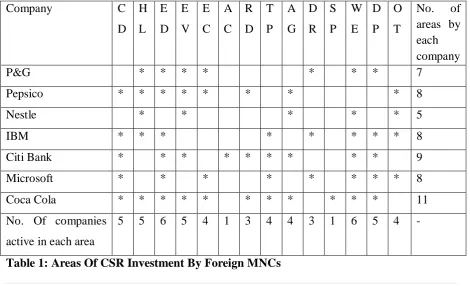
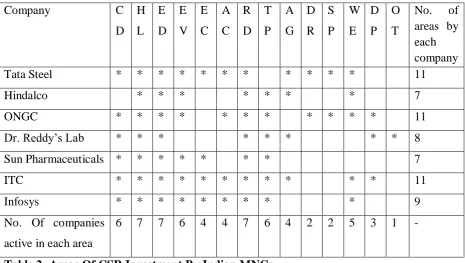
The following tables and graphs will show the major CSR investment areas in India and the
number of sample companies active in these areas.
Company C
D H L E D E V E C A C R D T P A G D R S P W E D P O T
No. of
areas by each company
P&G * * * * * * * 7
Pepsico * * * * * * * * 8
Nestle * * * * * 5
IBM * * * * * * * * 8
Citi Bank * * * * * * * * * 9
Microsoft * * * * * * * * 8
Coca Cola * * * * * * * * * * * 11
No. Of companies
active in each area
[image:14.595.66.537.470.756.2]5 5 6 5 4 1 3 4 4 3 1 6 5 4 -
Abbreviations
CD- Community Development HL- HealthCare ED- Education
EV Environment EC- Energy Conservation AC- Art & Culture
RD- Rural Development TP- Training Programmes AG- Agriculture
DR- Disaster Relief SP- Sports WE- Women Empowerment
DP- Support for Disabled OT- Others
Company C
D H
L E
D E
V E
C A
C R
D T
P A
G D
R S
P W
E D
P O
T
No. of
areas by each company
Tata Steel * * * * * * * * * * * 11
Hindalco * * * * * * * 7
ONGC * * * * * * * * * * * 11
Dr. Reddy’s Lab * * * * * * * * 8
Sun Pharmaceuticals * * * * * * * 7
ITC * * * * * * * * * * * 11
Infosys * * * * * * * * * 9
No. Of companies
active in each area
[image:15.595.68.534.199.462.2]6 7 7 6 4 4 7 6 4 2 2 5 3 1 -
Figure 1: Diversified Areas Of Investment By Foreign MNC
Figure 2: Diversified Areas Of Investment By Indian MNCs 0
2 4 6 8 10 12
P &G Pepsico IBM Nestle Citi Bank Microsoft Coca Cola
No. of Areas
No. of Areas
0 2 4 6 8 10 12
Tata Steel Hindalco ONGC Dr.
Reddy's Lab
Sun Pharma
ITC Infosys
No. of Areas
[image:16.595.74.508.348.598.2]CONCLUDING COMMENTS
Multinational corporations are very powerful organisations who have the capacity for
adapting to the diversified environments in which they function. Around the world,
corporations have come to the understanding that mere profit maximisation alone will not
contribute to the long term success of business and they must satisfy every stakeholder for the
long term survival. India is one of the first country were CSR is made mandatory. Under this
circumstance, every major corporation whether Indian or foreign are keen on performing
good CSR practices in India. It is this scenario that lead us to the comparison between CSR
practices of Indian and foreign companies in this study. The study showed that, when
comparing the two sections Indian MNCs have a diversified portfolio of CSR investment
than their foreign counterparts. Overall participation in CSR is higher for Indian companies
than the foreign companies. Among the Indian MNCs majority of them focused on health
care, education and rural development with all the sample companies taking part in them
while they give least focus on disaster relief and promotion of sports. Among the foreign
MNCs major focus is on health care, education and environmental protection and least focus
is given on art and culture and sports. Indian companies give a better contribution to art and
culture of the country than the foreign companies. The same happens in the case of
agricultural and rural development too. But when it comes to supporting disabled people and
women empowerment the number of foreign companies contributing to the causes is higher
than the number of Indian companies. Among the foreign companies Coca Cola is the one
having the most diverse CSR investment. When it comes to Indian companies Tata Steel,
ONGC and ITC are all making very diverse contribution. Thus we can conclude that Indian
Companies are keener on bringing diversified CSR investment than their foreign counterparts
doing business in India.
REFERENCE
Garriga E and Mele, D(2004) Corporate social Responsibility theories, Mapping the territory.
Journal of business Ethics, vol.53, pp 51-72.
Enquist B jhonson M and Skalen P.(2006) Adoption of Corporate Social
Responsibility-Incorporating a stakeholder perspective. Qualitative research in accounting and management.
Jamali D(2007) The case for strategic social responsibility in developing countries. Business
and society Review, vol.112(1), pp 1-27.
Andrew, Crane. Dirk, Mattan and Laura. J, Spence . (2008). Corporate Social Responsibility
and Cases in a Global Context, Rutledge Publication, London and New York.
Arora, B. and R, Puranik. (2004), A Review of Corporate Social Responsibility in India, in:
Development: Journal of the Society for International Development, 47(3), pp. 93–100
Boli, J. and D. Hartsuiker. (2001), World Culture and Transnational Corporations: Sketch of
a Project, In (ed.), International Conference on Effects of and Responses to Globalization.