www.ijsrp.org
Developing and Easing the Brazing Method
Vishesh Garg*, Ankit Gupta**
*Netaji Shubas Institute of Technology (DU), **Delhi Institute of Tool Engineering (GGSIPU) [email protected], [email protected]
Abstract- Brazing generally require cumbersome apparatus be it induction, vacuum or torch brazing. In torch brazing, metals are joined by using the oxyacetylene cylinder. It thus becomes difficult to carry out brazing at the places where it is not possible to take heavy gas cylinders and brazing apparatuses. So it is tried to figure out the method to carry out brazing at places where conventional brazing is not feasible. And thus Brazing was done by usual Shielded Metal Arc Welding, by developing the electrode composition for the joining process of three different kinds of metals and alloys, without using the oxyacetylene cylinder and other heavy brazing apparatus. The results show that this newly developed brazing method gave almost same appropriate welding results as it is given by the conventional brazing method.
Flux composition is determined to braze three combinations of metals and alloys Aluminium and Copper
Galvanized iron and copper Galvanized iron and aluminium
Index Terms- Brazing filler material, base metal, Flux compositions, welding
I. INTRODUCTION
razing is a joining process wherein metals are bonded together using a filler metal with a melting (liquidus) temperature greater than 450 °C (840 °F), but lower than the melting temperature of the base metal. To melt the filler material a heating source is required. To carry out this operation, a welding transformer is chosen. Not only it is a good source of heat, but also easy to carry at different places. Amount of heat required can be easily controlled by setting the amperage of the welding transformer.
A series of experiments were conducted to do brazing with the help of a welding transformer.
II. PROCEDURE Experiment No. 1:
Firstly, brazing was performed by holding filler metal (bronze) as an electrode and setting voltage to 45 – 50 V and current to 54 to 60 A. Work piece here taken was iron. But it does not lead to positive results because filler metal does not deposit on the work piece and started running away on the work piece. Small droplets of filler material are being formed.
Challenges Faced:
It was found that filler metal does not deposit on work piece due to the following reasons:
1. The work piece was not cleaned prior to brazing to remove dust and paint impurities.
2. Flux was not used which allow the removal of surface oxides and thus facilitating metal deposition.
It was necessary now to find a flux composition to braze different sets of metal combinations. Various flux materials commonly available are:
Borates are useful in formulating the fluxes at higher temperatures. They have good oxide dissolving power and provide protection against oxidation for longer periods. Most borates melt and are effective at a temperature range of 7600C or higher. They have relatively high velocity in molten state, therefore it should be mixed with other minerals to increase its fluidity. (Na, K, Li )
Elemental Boron powder is added to increase flux action. Silver brazing fluxes that contain Boron offer protection on carbides and on materials that form refractory oxides such as chromium, nickel and cobalt.
www.ijsrp.org Fluoborates are similar to borates. They flow better in molten state and helps in removing oxide layers. But they are less effective as compared to borates.
Fluorides react wildly with metallic oxides at high temperatures and thus act as cleansing agents. They help in removing refractory oxides such as aluminium oxide. They are also added with borates because of their high fluidity in molten state. But they can generate dangerous fumes thereby limiting its use in some cases.
Chlorides are similar to fluorides but are used at temp below that of used in fluoride fluxes. So they are use to depress the melting pint of fluoride base fluxes.
Boric Acids is principal constituent as helps in removing the glass like flux residue left after brazing. Fluoride content to these fluxes is low usually 2-3%.
Alkalies such as sodium hydroxide and potassium hydroxide elevate useful working temperature of flux. The major drawback of using alkalies is that they are deliquescent in nature. So they absorb water if exposed to humid water.
Table 1: Melting Point of Different Flux Minerals.
Wetting Agents are usedin paste and liquid fluxes to facilitate spread of flux.
Based on the properties of these flux constituents various composition of flux combination are tried experimentally. Finally a suitable flux composition is found for various combinations of base metals.
Extraction:
Composition of the electrode for the brazing of different metals was evaluated using the concept and chemical equations evolved during the extraction of the respective metal.
Extraction of Iron:
Important aspect for brazing in the iron extraction is Reduction of ore in Blast furnace:
Charge fed up from top, preheated air at 1500oC. C + O2 = CO2 + Heat
Temperature Rises to 1900oC. CO2 + C = CO – Heat
Temperature falls to 1100oC. CO is main reducing agent. Reaction in blast furnace.
Fe2O3 + 3C = CO + Fe Fe3O4 + C = CO2 + Fe
carbonate chloride nitrate sulphate nitrite oxalate flouride borates
Ammonium NH4+ 58 338 169 235 60 70 100 110
Calcium Ca2+ 825 772 561 1460 42.7 200 1418
Iron Fe2+ 667 47 400 970
Iron Fe3+ - 306 47 480 -
Magnesium Mg2+ 540 714 88 1124 100 1263 1360
Potassium K+ 891 770 334 1069 440 160 858 815
Sodium Na+ 851 801 308 884 271 260 993 743(borax)
lithium 723 605 255 859 222 255 360 917
zinc 292
www.ijsrp.org C02 + C = CO
Overall, Fe2O3 + CO = Fe+ CO2
Extraction of Aluminium:
Purified Al2O3 is mixed with Na3AlF6 and CaF2 which lowers melting and increase conductivity. Anode- Steel or Graphite used for reduction
Al2O3 + C = Al + CO2
02 liberated at anode degrade or burn carbon to
form CO and CO2. Cathode : Al3+ + 3e- = Al
Anode: C + O2- = CO + 2e- C + O2- = CO2 + 4e-
Description:
Alumina extracted by Bayer’s Process NaOH + Al2O3.xH2O= 2NaAlO2 + (x+1)H2O
Extraction of Copper:
Getting Copper from Chalcapyrite, CuFeS2
CuFeS2 + SiO2 + O2 = Cu2S + FeSiO3 + SO2 Cu2S +O2 = Cu + SO2
From Cuprous Oxide: Cu2S + O2 = Cu2O + SO2 Cu2S + C = Cu + CO
Another Method: FeS + O2 = FeO + SO2 FeO + SiO2 = FeSiO3 Cu2S + O2 = Cu2O + SO2 Cu2O + Cu2S = Cu + SO2
Equations:
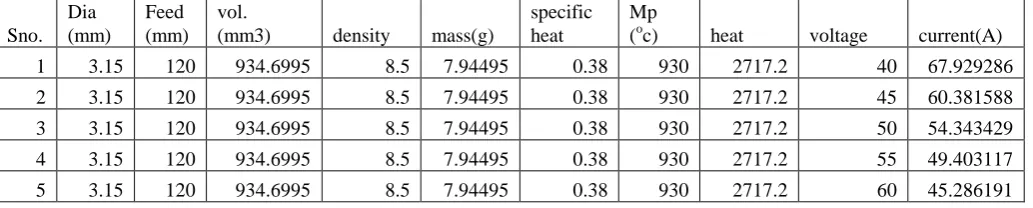
Following equations and calculations has been made to calculate the exact mass of deposition layer for the brazing and the current required to do the appropriate brazing at particular voltage, density, diameter of the electrode and the feed.
Feed= 120 mm/min.
Diameter of electrode: 3.5 mm Density: 8.5 g/mm3
[image:3.595.37.554.645.749.2]Volume: [3.14* (Dia)2*(Feed)]/4 Table 2: Welding Parameters
Sno. Dia (mm)
Feed (mm)
vol.
(mm3) density mass(g)
specific heat
Mp
(oc) heat voltage current(A)
1 3.15 120 934.6995 8.5 7.94495 0.38 930 2717.2 40 67.929286
2 3.15 120 934.6995 8.5 7.94495 0.38 930 2717.2 45 60.381588
3 3.15 120 934.6995 8.5 7.94495 0.38 930 2717.2 50 54.343429
4 3.15 120 934.6995 8.5 7.94495 0.38 930 2717.2 55 49.403117
www.ijsrp.org = (3.14*3.5*3.5*120)/4
= 934.6995 gm/mm3
Mass= Volume*Density = 934.6995*8.5 = 7.9449 gm.
Q=m*c*(Change in Temperature) = 7.9449*0.380*900
= 2718.9 For Voltage = 40V Current= Q/V = 2718.9/40 Current = 67A
1. To braze Aluminium and Copper
Some facts were found out for brazing these alloys:
If elemental P is present in copper alloys, than self fluxing because alloy is capable of reacting with oxygen. Lithium has high affinity for oxygen.
[image:4.595.32.524.399.472.2] Lithium salts helps in dissolving stubborn aluminium oxide. For aluminium oxide, sodium fluoride is generally used.
Table 3: Chemical Composition of the electrode for Brazing of Aluminium and Copper
Melting point of various oxides : Copper oxide – 1201 C Copper carbonate – 200 C Aluminium sulphide – 1130 C Aluminium oxide – 2072 C
2. To braze Galvanized Iron and Copper Some facts were found out for brazing these alloys:
A mixture of borax and ammonium chloride is used as a flux when welding iron and steel.
It lowers M.P. of iron oxide allowing it to run off.
Molecular hydrogen can be used to reduce surface oxides of tin and indium at temp above 430 and 470C respectively. Whereas zinc at temp above 500 C.
HCl acid and zinc chloride is also used for soldering galvanized iron.
Self fluxing copper based brazing alloys contain P thereby Faciliating brazing on Cu to Cu in air without use of flux. Composition Potassium borate
Boric acids
Potassium fluoborate
Sodium Aluminium fluoride
Lithium chloride
Zinc chloride
www.ijsrp.org Table 4: Chemical Composition of electrode for Brazing of Galvanized Iron and Copper
Table 5: Chemical Composition of Electrode for Brazing of Galvanized Iron and Aluminium
3. To braze Galvanized Iron and Aluminium Melting point of various oxides:
zinc oxide – 1975 C iron oxide – 200 C
Experiment No. 2:
In second experiment, filler metal is first coated with brazing flux. Current used was A.C. It was chosen because A.C. current facilitates the removal of oxide layer. All other conditions were kept same. This time a strong joint was achieved, contrary to last time where filler metal did not even deposit on the work piece. But another problem was encountered here. Filler metal flow was not there. Therefore continuous brazing was difficult to perform. The reason behind this was found to be lack of hold time at high temp. Therefore another experiment was conducted. Few more things were considered this time.
Time for which molten metal remain in molten state should be increased. It can be observed from the brazing cycle that the hold at the liquidous temperature of the filler metal is between 0-60 min. While using welding transformer, hold at liquidous temp is just for few seconds. It can be increased by heating the work piece or using D.C. transformer so that more heat is produced at the work piece instead of filler metal.
There are two important things required in order to get good brazing joints. First, it should be clean thoroughly. Flux is used to remove the surface oxide but effective only when it is cleaned from surface contaminants like dust materials, paint etc. These surface contaminants can be removed by physical or mechanical methods like scrubbing by sandpaper. Secondly, proper braze join should be made. A joint clearance of 0.0010 to 0.0029 inches is given to get good strength and filler metal penetration.
Considering these two factors, brazing was again performed with welding transformer. Filler metal flow was comparatively more this time.
III. CONCLUSION
We achieved a required strength in joints. However application is limited. We can only join metals where deep penetration of molten metal is not required.
REFERENCES
[1] Brazing by Mel.M. Schwartz
[2] Principles of Brazing by David M.Jacobson
[3] Active-Metal-Brazing-Zirconia-Correlation Between-Post-B [4] Design and strength by M.H.Soloboda
[5] Sandia Brazing Research and Modeling Capabilities by F. Michael Hosking [6] http://en.wikipedia.org/wiki/Brazing
[7] http://www.technologystudent.com/joints/braz2.htm [8] http://www.ignou.ac.in/upload/Unit-6.pdf
[9] http://bqqh1c.pen.io/
[10]http://www.gasflux.com/paste.html
[11]http://www.sapagroup.com/pages/522511/Answer%20Book/10_Brazing.pdf Composition Boric acid Borax Aluminium Chloride Zinc Chloride
Wt% 60% 20% 15% 5%
Composition
Ammonium
Chloride Borax
Potassium chloride
Sodium Flouride
Lithium Chloride
Zinc chloride
www.ijsrp.org [12]http://www.alueurope.eu/talat/lectures/4601.pdf