PITCH AND YAW ANGLE CONTROL DESIGNIN SOLAR PANEL SYSTEM
USING PSO-FUZZY METHOD
Imam Abadi and Karina Aryanti Permatasari
Departmentof Physics, Faculty of Industrial Technology, Institut Teknologi Sepuluh Nopember (ITS) Arief Rahman Hakim, Surabaya, Indonesia
E-Mail: [email protected]
ABSTRACT
Recently, Indonesia has seen an increase in its overall energy consumption. While the current supply is still meeting the demand, one may wonder how to address the rapid growth of the the needs of the country overall. Alternative sources of energy that have been developed in the world such as solar energy are a great opportunity for Indonesia and its important population.Of course, the development of such utilities need a good technological and engineering approach.One way to utilize alternative sources is by making solar panel system with controlling two degrees freedom for pitch and yaw angle. To build a solar panel system, DC motors parameters, LDR data retrieval sensor, and panel data collection are required. Solar tracking system is designed by 3 controllers which are PID controller, Fuzzy Logic and PSO-Fuzzy. This research is using MATLAB/SIMULINK as a simulator by applying different total membership functions, which are 3 and 5 for Fuzzy logic control and PSO-Fuzzy. From the research performed, it could be deduced that the solar panel system has been designed and simulated using PSO-Fuzzy control mode with the input error angle and delta error of elevation angle is from -180° to 180°and azimuth angle is from -360° to 360°. Moreover, the output of fuzzy in the form of PWM DC Motor is from -255 to 255. Build upon all the PID Controller, Fuzzy Logic Controller, and PSO-Fuzzy based on the performance index that responding; basically the designed system is able to work well. The optimum result gained from PSO-Fuzzy by looking at its performance index for pitch angle are 15°, 30°, 45°with maximum overshoot (Mp) = 0%, 0%, 0%; settling time (ts) = 21.95 seconds, 21.95 Seconds, 23.86 seconds; Error Steady State (ESS) = 0.001%, 0.001%,0.0007%. and for the yaw angle 30°, 60°, 90°, and the maximum overshoot (Mp) = 0%, 0%, 0%; settling time (ts) = 38.18 seconds, 41.52 seconds, 43.47 seconds; Error Steady State (ESS) = 0.009%, 0.005%,0.003%.
Keywords: PSO-fuzzy, solar panel system.
INTRODUCTION
The need of alternatives sources such as renewable energy aligns with the augmentation of electricity consumption in Indonesia. Nowadays, electricity are produced partially by utilizing existing resources i.e. Hydroelectric Power Plant (PLTA), Steam Power Plant (PLTU), Nuclear Power Plant (PLTN), etc. However, the utilization of natural resources for power generation is not sufficient. Hence, renewable sources are needed in order to balance the energy demand. Sunlight can be utilized as an alternative energy source. Sun or solar energy has several advantages such as unlimited energy sources can be obtained freely, cleanly, and economically. But the utilization of solar energy also has a weakness caused by the uncertain solar radiation and sunlight intensity that changes every day. Besides, there are also the time limit between the sunrise and the sunset. To obtain high efficiency, solar panel system is designed to follow the direction of sun motion from sunrise to sunset. The solar panel system converts sunlight into electricity. It uses fuzzy logic control based on the mathematical modelling. Using fuzzy logic approach can improve system performance and simplify applications. In this case, the system performs using fuzzy logic control and optimized by Particle Swarm Optimization (PSO) method as of solar panel system can be more effective and responsive. Before the solar panel system is applied in hardware form, “Pitch and Yaw Angle ControlSystem Design in Solar Panel Using PSO-Fuzzy Method” using MATLAB / SIMULINK Software are required.
SUPPORTING THEORY
Solar panel system
[image:1.595.336.530.638.747.2]Solar cells are designed to optimize the absorption of solar energy. Solar panel system is a set of motor motion’s control to enhance the sunlight intensity received by solar cell. The movement of solar panel should be parallel to the sun's angle. In the morning, motor will move from east to west following the direction of the sun. LDR are placed in each direction, to detect east, west, north or south side. This system consists of two permanent DC magnet motors (PMDC) to drive the pitch and yaw. Figure below shows the architecture of solar panel system for one direction. This number represents the vertical control architecture; the horizontal control of the architecture is also the same.[1]
Light Dependent Resistor (LDR)
In order to track the sun trajectory, dual axis solar tracking mechanism allows the solar panels to achieve two motions. In the solar panel system, the sensor used is LDR (Light Dependent Resistor). LDR is a type of resistor that changes its resistance due to the influence of light. When the light is less, the resistance gets bigger while the light is bright the value becomes smaller. LDRis a type of resistor commonly used as a light detector. Solar tracking system uses 4 pieces of LDR to detect the movement of the sun in north, east, west, and south[2]
Figure-2. Position of 4 pieces LDR and detector function on solar panel system [2].
DC Motor
DC motors are commonly used for solar panel systems. Selection of the suitable motor and the combination of motor drive can save the energy and improve the performance of the solar panel system. Some advantages of DC motor are having a large rpm, large torque (depending on type), low power applications and linear performance, therefore it suitable for solar tracking system. [3]
Figure-3. Electronic circuit of DC motor[1].
A motor coil can be modelled as a resistor in series with inductor. When the motor has zero velocity, the result voltage is the EMF voltage. The EMF voltage is proportional to the velocity. According to the Kirchhoff Voltage Law [1]:
𝑉 = . + . 𝐼 𝑡𝑡 + 𝐸 (1)
Where V is the voltage applied to motor
𝐸 = . ɷ (2)
Torque obtained from motor is proportional to current.
Newton II Law:
= ɷ 𝑡𝑡 + 𝑚. 𝜔 (3)
Where Tm is motor torque.
= . (4)
Details:
Va = Armature Voltage [V] Ra = Armature Resistance [R] La = Armature Inductance [H] Ia = Armature Current [A] Eb = Back EMF [V]
ω = Angular Velocity [rad/s] Tm = Motor Torque [Nm]
Θ = Angular Position of Rotor Shaft [rad] Jm = Motor inertia [Nm.s2]
Bm = Viscous Friction Coefficient [Nm.sec/rad] Kt = Torque Constants [Nm/A]
Kb = Back EMF constants [Vs/rad]
Equations (1) and (3) describe the dynamic behaviour of motor. Equations (1), (2), (3) and (4) can be rearranged as in equations (5) and (6) for making block diagrams.
𝑉 = . + . 𝐼𝑎𝑡
𝑡 + . ɷ (5)
𝑡. = 𝑚 𝜔 𝑡𝑡 + 𝑚. 𝜔 (6)
Transformation Laplace from equations (5) and (6) are
𝑉 = . + . + . ɷ (7)
𝑡. = 𝑚. 𝜔 + 𝑚. 𝜔 (8)
The current obtained from equation (8) and be substituted to equation (7).
𝑉 = 𝜔 .𝐾
𝑡. [ . 𝑚. + . 𝑚+ . 𝑚 +
. 𝑚+ . 𝑡 ] (9)
The relationship between the rotor shaft speed and the use of armature stress can be represented in the following transfer functions.
ω s V s =
Kt
[L . Jm. s + R . Jm+ L . Bm s + R . Bm+ K . Kt]
Relation between position and velocity as follow:
𝜃 = 𝜔
The transfer functions between the shaft position and armature voltage without load as follow:
θ s V s =
Kt
[L . Jm. s + R . Jm+ L . Bm s + R . Bm+ K . Kt s]
Figure-4. Simulink Model [1].
Particle Swarm Optimization-Fuzzy (PSO-Fuzzy) The conventional design of membership functions and the basic rules of the fuzzy inference system are based on the experience of the operator or system designer. Various techniques have been proposed to improve the design and performance of this fuzzy inference system including the Particle Swarm Optimization-Fuzzy (PSO-Fuzzy) method. [7] In fuzzy logic control, the PSO plays a role in optimizing the membership function of input and output fuzzy. PSO is very important since the membership function in fuzzy logic control is made based on a trial and error therefore to be optimal, PSO can change the membership function (membership function).The following is a PSF diagram. [2]
Figure-5. Systematic of Particle Swarm Fuzzy.
RESEARCH METHODOLOGY
Control block diagram
Figure-6 is a pitch and yaw angle control system on solar tracking. To explain the process of system work and its components can be described in the following block diagram.
Figure-6. The control block diagram.
Data sensor collection
On the solar tracking system, 4 LDR sensors are used to detect north, south, west and east direction based on the sun movement. The retrieval of LDR sensor data is performed to determine the linearity between the sunlight intensity received by the LDR compared to the resistance generated also the voltage generated by the voltage divider circuit.
The data retrieval required some supporting tools, which are multimeter, 5 VDC adapters, Lux meter, and voltage divider circuit. The following are graph obtained from LDR; the luminance is proportional to the voltage on voltage divider circuit. As well as luminance proportional to resistance.
Figure-7. Time-based luminance propositional to the voltage.
Figure-8. Time-based luminance proportional to the resistance.
DC Motor data collection
Parameters from data retrieval of DC motor will be used for modelling. The parameters sought are Constant Voltage (To), Torque Constant (Kt), Inertia Motor (Jm), Motor Resistance (R), Motor Inductance (L), and Viscous Friction Coefficient (Bm). To collect the data, several supporting tools are used, such as lathe machine (CNC), multi-meter, RLC meter, and DC lamp.
Voltage Constants (Ke)
[𝑉 . ] = 𝑉 [ [𝑉]/ ]
Torque Constants (Kt)
To get the value of Torque Constant (Kt) the following formula is used:[5]
[𝑁 ] = ,
Motor Inertia (Jm)
To get the value of motor inertia (Jm) the following formula is used:[5]
[𝑁 . ] = 𝑖 𝑖
Where:
Acceleration a =∆ω∆t =ωt − t−ω
𝑖 = ∆Ʈ
= 𝑥 𝑥 − 𝑥 𝑖
To retrieve data, DC motor is connected not only to an automatic CNC but also a DC lamp of 0.3 V to obtain the current generated on a DC motor in a certain RPM. [5]
Motor Resistance (R) and Motor Inductance (L) To get the motor resistance value (R) and motor inductance (L) are by connecting positive and negative pole DC motor to RLC meter. After that, calculating the average from 32 times repetition. [5]
Viscous Friction Coefficient (Bm)
To obtain Viscous Friction Coefficient (Bm) use the following formula: [6]
𝜔
+ 𝜔 =
Where:
Jm = Motor Inertia [Nm.Sec2] B = Viscous Friction [Nm.Sec/rad] ω = Angular Velocity of DC motor [rad/s] Tm = Motor torque [N.m]
DC Motor is connected to a gear box with ratio 1:407,1675. From the equations (1) to (6) the Voltage Constants (Ke), Torque Constants (Kt), Motor Inertia
(Jm), Motor Resistance (R), Motor Inductance (L), and Viscous Friction Coefficient (Bm) are obtained as follows:
Table-1. DC Motor parameters.
Motor parameters Value
Ke 11,2958 Volt.sec/rad
Kt 11,2869 Nm/A
R 17.72 Ω
L 0,00353 Henry
Jm 0,028035 Nm.s2
Bm 1,8392 Nm.sec/rad
Sensor modelling
The pitch angle of DC motor corresponds to the sun's elevation angle where the pitch angle output value must be equal to the sun's elevation angle. There are 2 inputs for the pitch angle, which are the sun’s elevation angle and the intensity of south LDR. In order to obtain the effective intensity required the following formula. [7]
Figure-9. Effective Intensity on solar tracking[7].
The following are the calculation on how to obtain the effective intensity on solar tracking [7]
𝑖 ∝= = . 𝑖 ∝
Where:
α = Elevation Angle Ieff = Effective Intensity I =Intensity
DC Motor modelling
Based on the Khirchhoff’s II Law on equations (1), (2) and Newton's II Law (rotation) in equation (3), (4) obtain the laplace transform function of equations (7) and (8) as follows: [1]
Equation (7)
𝑉 = . + . + . ɷ
𝑉 − . ɷ = +
=𝑉 − . ɷ+
= 𝑉 − . ɷ . +
Equation (8)
𝑡. = 𝑚. 𝜔 + 𝑚. 𝜔
𝜔 = 𝑡.
𝑚 + 𝑚
𝜔 = 𝑡. .
𝑚 + 𝑚
Based on the equations (7) and (8), it can be illustrated into MATLAB/SIMULINK for DC motors.
Figure-11. Simulink model for DC motor.
Controller modelling
PID controller
In the solar tracking system, the parameters such as Kp, Ti, and Td on the PID Controller, done using auto tuning.
Figure-12. Value of Kp, Ti, Td on PID controller (Pitch Angle).
Figure-13. Value of Kp, Ti, Td on PID controller (Yaw angle).
Fuzzy logic controller
Solar tracking system using 2 inputs, which are pitch and yaw angle error, and delta error of angel pitch and yaw (Δerror). Method used is Sugeno. Both 2 inputs are defined as following. [5]
= 𝑃 − 𝑃𝑉
Δ = − −
Both input are using 3 and 5 memberships function and also triangle membership function. Range membership function used for pitch angle is -180° to 180°. Here is the input or fuzzification error angle and delta error angle.
Figure-14. MF Pitch angle error and 3 MF delta errors pitch angle.
Figure-15. 5 MF pitch angle error and 5 MF Pitch angle delta error.
Figure-16. 3 MF Yaw angle error and 3 MF Yaw angle error.
Figure-17. 5 MF Yaw angle error and 5 MF Yaw angle delta error.
Output or defuzzification used in this system is PWM 8 bit DC motor that has range -255 to 255. Defuzzification is used for pitch and yaw angle. The minus value (-) in the parameter only indicates the direction of DC motor rotation.
Figure-18.Defuzzification of 3 MF DC motor PWM.
Figure-19.Defuzzification of 5 MF DC motor PWM.
PSO-Fuzzy
Figure-20. PSO flowchart for membership function.
In the solar tracking system using the objective function approach through performance index. [9]
Fitness = tr + ts + OS +SSE ………. (26)
Where,
tr = rising time ts = settling time OS = overshoot
SSE = Steady State Error
The constraint used in the solar tracking system is the range of angel error. For pitch is from -180° to 180° meanwhile for yaw is -360° to 360°. The following are 5 memberships functions before and after being optimized by PSO on the pitch angle.
Figure-21. Membership function on pitch angle before and after optimization by PSO.
The following are 3 membership functions before and after being optimized by PSO on the pitch angle.
Figure-23. Membership function on pitch angle before and after optimized by PSO.
Figure-24. Membership function on yaw angle before and after optimized by PSO.
Below is the parameter initialization to get the membership function form with a more optimal response result.
Table-2. Parameter initialization.
Parameter Value
Swarm 30
Iteration 50
Inertia 1
C 2
DATA analysis
To verify the response on the solar tracking system, there are several test methods which are set point
testing with the tracking test to determine the control of the design and modelling of the solar tracking system.
Figure-25. Circuit on MATLAB/SIMULINK forset point test.
Figure-26. Circuit on MATLAB/SIMULINK for setpoint test.
Controller using 3 membership function
Set point test
For the sun’s elevation angle the set point used are 15°, 30°, and 45° while for the azimuth angle of sun usedare30°, 60°, 90°.
Table-4.Performance indexcomparison of Yaw angle.
Table-5. Performance index comparison between output voltageon north and south.
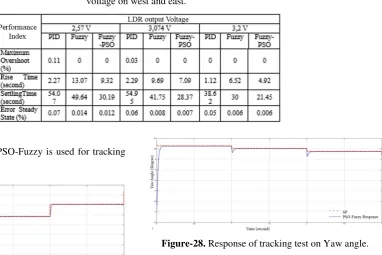
Table 6. Performance index comparison between output voltage on west and east.
Tracking test
[image:8.595.161.544.402.657.2]Control mode of PSO-Fuzzy is used for tracking test.
Figure-27. Response of tracking test on pitch angle.
[image:8.595.53.290.585.686.2]Figure-29. Response of tracking test on LDR's output voltage in north and south.
Figure-30. Response of tracking test on LDR's output voltage in north and south.
Controller using 5 membership function
Set point test
15°, 30°, and 45° are the set point used in the sun elevation. While for sun azimuth angle, 30°, 60° and 90° are used for the set point.
Table-7.Performance index comparison of pitch angle.
Table-8.Performance index comparison of Yaw angle.
Table-10. Performance index comparison between output voltage on west and east.
Tracking test
Control mode PSO-Fuzzy is used for tracking test.
Figure-31. Response of tracking test on pitch angle.
Figure-32. Response of tracking test on yaw angle.
Figure-33. Response of tracking test of LDR output voltage on North and South.
Figure-34. Response of tracking test of LDR output voltage on West and East.
From the overall response, there is an error for the test tracking response following the set point voltage. The error can be caused by the membership function, rule base on the controller which is less precise. The PSO plays a role in optimizing the range of the membership function in fuzzy. With the result that trial and error still used in the establishment of rule base and number of membership function. Some pitch angle responses can follow the set point without oscillation, but there is also an overshoot and undershoot. This indicates that the solar tracking system can do tracking and find the best position from the elevation angle and the sun azimuth properly.
By looking at the index performance (Tables 11 and 12), solar tracking system using fuzzy and PSO-Fuzzy with 5 membership function are more optimal comparing with 3 membership functions.
Table-12. Number of membership function comparison on 15° Yaw angle.
Based on the table comparison of performance index above, could be deduced that the use of membership function on fuzzy and PSO-Fuzzy affected to the system response.
CONCLUSION AND SUGGESTION
Conclusion
From this research of solar tracking system with two degrees of freedom can be concluded that:
a) The solar panel system has been designed and simulated using PSO-Fuzzy control mode with the input of angle error and delta error of elevation that is -180° to 180° and azimuth angle of the sun -360° to 360°. And the output of fuzzy is PWM of DC Motor between -255 to 255.
b) Based on the 3 control modes that have been designed, the best performance and optimal for the solar panel system is PSO-Fuzzy based on the performance index obtained for pitch angle 15°, 30°, 45° with maximum overshoot (Mp) = 0%, 0% 0%; Settling time (ts) = 21.95 seconds, 21.95 seconds, 23.86 seconds; Error Steady State (ESS) = 0.001%, 0.001%, 0.0007%.
c) 3. Using the PSO-Fuzzy control mode for yaw angles 30°, 60°, 90° with maximum overshoot (Mp) = 0%, 0%, 0%; Settling time (ts) = 38.18 seconds, 41.52 seconds, 43.47 seconds; Error Steady State (ESS) = 0.009%, 0.005%, 0.003%.
Suggestion
a) Tuning modified PSO are required to obtain better Pbest
b) The variation of membership function could be done, examples, Gaussian, Trapezoidal etc.
REFERENCES
[1] ManafeddinNamazov.2010. DC Motor Position Control Using Fuzzy Proportional-Derivative Controllers with Different Defuzzification Methods. Turkish Journal of Fuzzy Systems (eISSN:1309-1190), Turkey.
[2] Li. Hengyu, Zhao. Chongyang, Wang. Hao, Xie. Shaorong, Luo. Jun 2014. An Improved PV System Based on Dual Axis Solar tracking and MPPT. Proceedings of 2014 IEEE International Conference on Mechatronics and Automation, China.
[3] Balabel. Ashraf, A. M. Ahmad, A. S. Farhan.2013.Design and Performance of Solar tracking Photo-Voltaic System; Research and Education. International Journal of Control, Automation and Systems. 1(2) ISSN 2165-8277.
[4] L. Lawrence K, M. Josiah L, H. Alex, F’SATI.2010. Particle Swarm Optimization T-S Fuzzy Logic Controller for Maximum Power Point Tracking in a Photovoltaic System. Proceedings of 2014 IEEE International Conference on Mechatronics and Automation, South Africa.
[5] Control Technology Coorporation.2013.Measuring Motor Parameter. Hopkinton: USA.
[6] Ivan Virgala, Michal Kelemen.2013.Experimental Friction Identification of DC Motor. Facult y of mechanical engineering, Technical universit y of Košice: Slovakia.
[7] C. S. Chin. 2012. Model-Based Simulation of an Intelligent Microprocessor-Based Standalone Solar tracking System. INTECH Open Science.
[8] Fawzi M Al-Naima, Ramzy S Ali, Ahmed J Abid.2013. Solar tracking System Design Based on GPS and Astronomical Equations. IT-DREPS Conference & Exhibition.
[9] Ilham Pakaya, Pressa Perdana. 2014. Particle Swarm Optimizaton-Fuzzy Logic Controller Untuk Penyearah Satu Fasa. Jurnal Ilmiah Edutic/Vol. 1, No. 1/ISSN 2407-4489, Indonesia
![Figure-1. Architecture of solar panel control for one direction [1].](https://thumb-us.123doks.com/thumbv2/123dok_us/9053575.976879/1.595.336.530.638.747/figure-architecture-solar-panel-control-direction.webp)