An Overview of the Application of Artificial
Intelligence in Education
Murtala Hashimu*, Nura Abubakar Anka **
School of Science, Department of Computer Science, Federal Polytechnic, Kaura Namoda, Zamfara State, Nigeria.
DOI: 10.29322/IJSRP.9.09.2019.p93112 http://dx.doi.org/10.29322/IJSRP.9.09.2019.p93112
Abstract- With the current speedy development of computer technology, scholars have attempted to accept artificial intelligence on education. Computer networks have been developed by both scientists and educationist using computer-aided instruction systems to develop programs to test and improve the educational performance of students. A long-sought goal in education is being sought by instruction and integrating sound assessment. Current advances in educational measurement and artificial intelligence have positioned this aim within reach of people. Leveraging assessment information could improve intelligent education systems information that is collected from different sources (e.g., formative and summative information), hence, reporting useful approach in accomplishing the expected goals in education. Therefore, this article provided evidence on the role of different artificial intelligence in the educational sector, summarises the uniqueness of successfully, used intelligent educational systems, and provides an evidence-based approach. This paper is divided into four sections. The first section is the introduction of the study. Next is followed by the literature review of AIEDs. Next section three, the contributions of AIED for the development of education and lastly, section four the conclusion of the study.
Index Terms- Artificial Intelligence, Scholars, Computer Technology, Education, Educationist, Scientist.
I. INTRODUCTION
t the beginning of computer technology, there are several claims that computers can assist in educational instructional practice and can, therefore, improve learning among students. Computer Technology is not only seen as a simple tool for human interaction, but it is also, a performer in the human technological environments (Levy, 1993, 1998) which not only supports it but also change the mindset and reorganizes human thinking(Gadanidis, 2017). Since the development of computer technology in education in the early 1960s, its usefulness in teaching has been on the increase (Voogt & Fisser, 2015). One of the best factors of the computer at its early development is the security, ability to compute, intercepting decrypting messages, gunnery tables' generation, and military application.
Currently, the usage has gone beyond that, because computers have now been shrunk to a point it can be used for several other activities from education to medicine and engineering (Gollmann, 2010). It is difficult to deny the fact that the computer has taken a prominent role in our society at the
present day. This quest for according to Jay and Lukers (2018) has made man to have a desire to understanding the present and predicting the future better. The use of algorithms to assist in achieving this knowledge have been around for many years, together with artificial intelligence (AI) approaches to enable computers to motive about effects that usually need human intelligence. Hence, the growth in the usage of computer gives rise to the development of Artificial Intelligence (AI).
The word Artificial intelligence is a broad advanced discipline which is on the increase, and a significant study direction in the various fields of technology and computer science (Liu, 2010). According to Hamet and Tremblay (2017), AI implies the use of a computer system to form intelligent actions with the least human interference. Also, Krittanawong, Zhang, Wang, Aydar, and Kitai (2017) looks at AI as a field of computer science that has an objective that imitates the thought of human processes, knowledge storage, and learning capacity. Therefore, using AI in the field of education is an opportunity to improve the educational sector like that field of science and technology. The field of AI in education uses systems or techniques from cognitive science and AI for a proper understanding the characteristics of teaching and learning thereby, building systems to assist learners in having a new understanding of concepts and skills (Du-Boulay, 2016). The study on AI Artificial Intelligence in Education (AIED) has significantly undergone changes and developments over many decades (Roll & Wylie, 2016).
Mostly, the intelligent systems that are used in AIED that used the computer system as well as other devices are mainly designed for personal use or businesses and not particularly for educational purposes (Timms, 2016). The development of AIED has generated several other software that are used in the educational system. The acceptance of AI in our educational system has improved the standard of our educational system. The AIED used are categories' into many parts that are depending on the usage. Although, this study will consider four of the AIED from the nine identify to look at the differences and usage in educational sector. For instance, the Virtual Facilitator, Automated Grader, ChartBot, Chat Campus, Adaptive Learning, Smart Content, Data Accumulation, Personalized Learning, Proctoring, and Crafter AIEDs.
II. LITERATUREOFTHESTUDY
One of the most important subjects in computer science is the AI which have been studied for many decades (Benko & Sik Lányi, 2011). This section provides the literature on the AIED
softwares used in various educational developments. The section is divided into four subsections. These sub-sections are (i) automated grader, (ii) Adaptive learning, (iii) chatbot, and (iv) virtual facilitator.
2.1.1 Automated Grader (AG) AIED
This is a smart computer technology used in educational learning environment in evaluating and scoring of students. The concept AG is the basic principles of AI and machine learning that is quick, cheap, and without bias like human beings. There is virtually no denial task conducted using manual grading takes longer time, and making the process highly expensive. The Automated Essay (Grader) Scoring (AES), according to Dikli (2006) is a technology using the computer to score and evaluate the written prose of students. Students to be assessed and make academic excellent among them, the essential element is essay writing. Grader in education is reported to be the most important and useful tool in determining outcomes of learning (Zupanc & Bosnić, 2017). Automated easy in the evaluation of student represents a useful and practical solution to the task. However, Zupanc and Bosnić (2017 identifies the weakness of automated grader is focusing on the vocabulary, limited consideration of text semantics and text syntax.
The AI that is powered automated grader is one of the newest advanced technologies that schools and colleges are using heavily. This system does not only reduce the over delay and
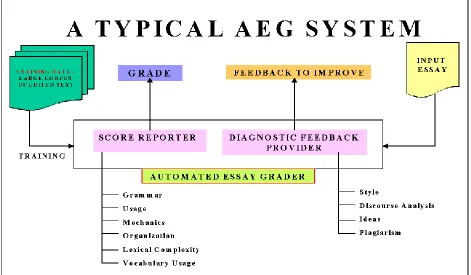
[image:2.612.72.543.369.644.2]workload of lecturers, but it also provides less time for making assessments of easy and making the scoring system less complicated. Furthermore, testing of other frameworks has sparked more interest in new approaches to the development of automated grading, using different methods mainly aiming to provide good feedback on the testing skills of the software (Edwards & Pérez-Quiñones, 2007). This has made tutors to consider adding testing techniques using their own courses, in the classroom and making an automated grading system more valuable. Geigle, Zhai, and Ferguson (2016) the automatic grading is an important technology in scaling up learning at all levels. Figure 1 below is the automated grader that work and provide predictions that are closely matched to those made by man graders. The software is fast and proves to be reliable when put in used (Sil, Ketelhut, Shelton, & Yates, 2012). The usage of the machine in advance statistical technique is proved to be efficient. The result obtains from the grader is found to be similar to that of a human being. In addition, linear regression techniques is mostly used for model training along with ensuring the use of different other classification and put clothing techniques or assessing and easy. Automated grader represents a practical solution to statistical modeling among teachers and students (Zupanc & Bosnic, 2014). Also, processing of natural language, automatic plagiarism detection, smart techniques is applicable using automated grader.
Figure 1: Automated Easy Grading System
2.1.2 Adaptive Learning AIED
Adaptive learning in the previous work on improving student learning focuses only on a single source of information personalization, like learning style, learning achievement, and
technologies which can respond to interactions of students in real-time by providing automatic respond with individual support. Therefore, adaptive learning is becoming increasingly significant when it comes to m-learning (Garcia-Cabot, De-Marcos, & Garcia-Lopez, 2015). The tools for adaptive learning collect information that is specific about students' behavior individually through tracking the way they answer questions. Games that are
[image:3.612.76.534.144.415.2]computer oriented tends to adjust difficulty in adaptive learning, thereby, continuously challenge other players in accordance with their abilities(Sampayo-Vargas, Cope, He, & Byrne, 2013).
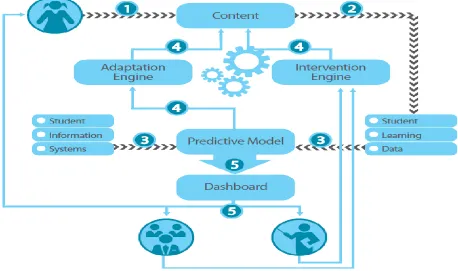
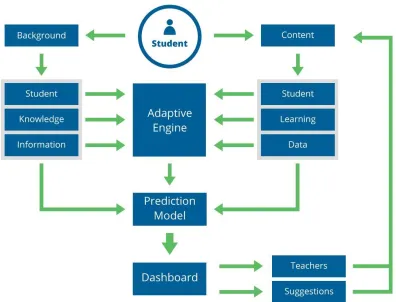
Figure 2.3 Adaptive Learning Environments
Figure 1 and 2 above are the adaptive learning used for educational purposes. They provide a relationship between learning and student-teacher communication.
2.1.3 Chatbots Artificial Intelligence
Today, the existence of intelligent agents imitating human characteristics is more relevant than ever.
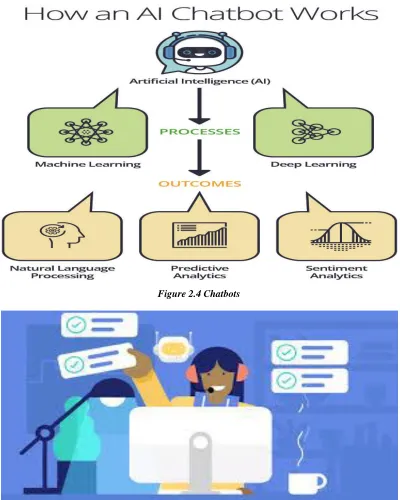
The word chatbots were initially coined by Michael Mauldin in 1994 to describe conversational programs. Currently, it is one of the most relevant programs used for human imitating(Neururer, Schlögl, Brinkschulte, & Groth, 2018). Chatbots Is a computer program that allows a conversation via textual or auditory systems. The conversational system in AI is on the increase and bringing more significance to the educational sector, thorough chatbots. This is because Chatbots enables easy or simple interaction between computers and humans(Yan, 2018). The promising alluring and potential of social chatbots commercial values it is used as virtual assistants in many educational settings. Today, the use of chartbots existence is
relevant than ever in imitating characteristics of human(Neururer et al., 2018). The programs are designed to realistically simulate how a man would have the behavior of a conversational partner. Chartbots are usually used in a dialog system for different practical conditions, which include information acquisition or customer service. In some cases, chatbots have sophisticated processing system, but several others are simple to use using keywords at the point of input, thereby, allow for a reply within the closest matching words, or the highest similar word pattern stored in a database.
Figure 2.4 Chatbots
Figure 2.4 Cahrtbots
2.1.4 Virtual Facilitator AIED
In the real world, there is fear that AI will soon replace lecturers by a robot. Within the educational sector, computers have generated a new criterion of differentiation between those who have an issue of becoming included in the technocratic inclination deriving from the day by day use of computer and those who turn out to be isolated by not using them. This dissimilarity improves when computer science and communications come together to bring in virtual educational areas(García & García, 2005). This will happen when the combination of pupil and teacher in the space-time measurement is no longer a requirement, and where the digital text complements the written text, and then the virtual facilitator will take over (Mayer, Warmelink, & Bekebrede, 2013).
Figure 2.5 Virtual Facilitator
Figure 2.6 Virtual Facilitator Touchless Technology
III. CONCLUSION
The field of computer as a science has been trying to mimic human thought of learning, processes, knowledge storage and capacity for many decades. The introduction of AI in the field of computer science has gain entrance been recognised to take human activity in education and other fields. In the future as provided by the scientist and what is happening currently, human capabilities in the different field has been taken over by AI. The area of AI has become more popular nowadays and is improving for the last decades, shifting attention to it by the computer scientist (Pannu & Student, 2015). Even though scientist measured significant positive effects of AI, some scholars are afraid that mongering is on the higher side to affect the AI development. However, AI
philosophers of the future would also strictly put efforts as the ‘dark age' of human development (Gurkaynak, Yilmaz, & Haksever, 2016).
REFERENCES
[1] Benko, A., & Sik Lányi, C. (2011). History of Artificial Intelligence. In Encyclopedia of Information Science and Technology, Second Edition. https://doi.org/10.4018/978-1-60566-026-4.ch276
[2] Dikli, S. (2006). An overview of automated scoring of essays. Journal of Technology, Learning, and Assessment.
[3] Du Boulay, B. (2016). Artificial intelligence as an effective classroom assistant. IEEE Intelligent Systems. https://doi.org/10.1109/MIS.2016.93 [4] Edwards, S. H., & Pérez-Quiñones, M. A. (2007). Experiences using
[image:6.612.70.550.318.542.2][5] Gadanidis, G. (2017). Artificial intelligence, computational thinking, and mathematics education. International Journal of Information and Learning Technology. https://doi.org/10.1108/IJILT-09-2016-0048
[6] Garcia-Cabot, A., De-Marcos, L., & Garcia-Lopez, E. (2015). An empirical study on m-learning adaptation: Learning performance and learning contexts. Computers and Education. https://doi.org/10.1016/j.compedu.2014.12.007 [7] García, F. J., & García, J. (2005). Educational hypermedia resources
facilitator. Computers and Education. https://doi.org/10.1016/j.compedu.2004.02.004
[8] Geigle, C., Zhai, C., & Ferguson, D. C. (2016). An Exploration of Automated
Grading of Complex Assignments.
https://doi.org/10.1145/2876034.2876049
[9] Gollmann, D. (2010). Computer security. Wiley Interdisciplinary Reviews: Computational Statistics. https://doi.org/10.1002/wics.106
[10] González-Calero, P. A., & Gómez-Martín, M. A. (2011). Artificial intelligence for computer games. Artificial Intelligence for Computer Games. https://doi.org/10.1007/978-1-4419-8188-2
[11] Gurkaynak, G., Yilmaz, I., & Haksever, G. (2016). Stifling artificial intelligence: Human perils. Computer Law and Security Review. https://doi.org/10.1016/j.clsr.2016.05.003
[12] Hamet, P., & Tremblay, J. (2017). Artificial intelligence in medicine. Metabolism: Clinical and Experimental. https://doi.org/10.1016/j.metabol.2017.01.011
[13] Jay, B., Lucas, W. (2018) CIO, "Enterprise AI: The Ongoing Quest for Insight and Foresight," accessed July 2019
[14] Krittanawong, C., Zhang, H. J., Wang, Z., Aydar, M., & Kitai, T. (2017). Artificial Intelligence in Precision Cardiovascular Medicine. Journal of the American College of Cardiology. https://doi.org/10.1016/j.jacc.2017.03.571 [15] Liaw, S. Y., Chan, S. W. C., Chen, F. G., Hooi, S. C., & Siau, C. (2014). Comparison of virtual patient simulation with Mannequin-based simulation for improving clinical performances in assessing and managing clinical deterioration: Randomized controlled trial. Journal of Medical Internet Research. https://doi.org/10.2196/jmir.3322
[16] Liu, X. (2010). Artificial intelligence and modern sports education technology. In Proceedings - 2010 International Conference on Artificial Intelligence and Education, ICAIE 2010. https://doi.org/10.1109/ICAIE.2010.5641441
[17] Maddox, T. M., Rumsfeld, J. S., & Payne, P. R. O. (2019). Questions for Artificial Intelligence in Health Care. JAMA - Journal of the American Medical Association. https://doi.org/10.1001/jama.2018.18932
[18] Mayer, I., Warmelink, H., & Bekebrede, G. (2013). Learning in a game-based virtual environment: A comparative evaluation in higher education. European
Journal of Engineering Education.
https://doi.org/10.1080/03043797.2012.742872
[19] Neururer, M., Schlögl, S., Brinkschulte, L., & Groth, A. (2018). Perceptions on Authenticity in Chat Bots. Multimodal Technologies and Interaction. https://doi.org/10.3390/mti2030060
[20] Pannu, A., & Student, M. T. (2015). Artificial Intelligence and its Application in Different Areas. International Journal of Engineering and Innovative Technology. https://doi.org/10.1155/2009/251652
[21] Roll, I., & Wylie, R. (2016). Evolution and Revolution in Artificial Intelligence in Education. International Journal of Artificial Intelligence in Education. https://doi.org/10.1007/s40593-016-0110-3
[22] Sampayo-Vargas, S., Cope, C. J., He, Z., & Byrne, G. J. (2013). The effectiveness of adaptive difficulty adjustments on students’ motivation and learning in an educational computer game. Computers and Education. https://doi.org/10.1016/j.compedu.2013.07.004
[23] Sil, A., Ketelhut, D., Shelton, A., & Yates, A. (2012). Automatic grading of scientific inquiry. In Proceedings of the Seventh Workshop on Building Educational Applications Using NLP.
[24] Tan, E., & Pearce, N. (2012). Open education videos in the classroom: exploring the opportunities and barriers to the use of YouTube in teaching introductory sociology. Research in Learning Technology. https://doi.org/10.3402/rlt.v19s1/7783
[25] Timms, M. J. (2016). Letting Artificial Intelligence in Education out of the Box: Educational Cobots and Smart Classrooms. International Journal of Artificial Intelligence in Education. https://doi.org/10.1007/s40593-016-0095-y
[26] Tseng, J. C. R., Chu, H. C., Hwang, G. J., & Tsai, C. C. (2008). Development of an adaptive learning system with two sources of personalization information. Computers and Education. https://doi.org/10.1016/j.compedu.2007.08.002
[27] Voogt, J., & Fisser, P. (2015). Computer-Assisted Instruction. In International Encyclopedia of the Social & Behavioral Sciences: Second Edition. https://doi.org/10.1016/B978-0-08-097086-8.92027-0
[28] Winograd, T. (2006). Shifting viewpoints: Artificial intelligence and human-computer interaction. Artificial Intelligence. https://doi.org/10.1016/j.artint.2006.10.011
[29] Yan, R. (2018). “Chitty-chitty-chat bot”: Deep learning for conversational AI. In IJCAI International Joint Conference on Artificial Intelligence. [30] Zupanc, K., & Bosnic, Z. (2014). Automated Essay Evaluation Augmented
with Semantic Coherence Measures. In Proceedings - IEEE International Conference on Data Mining, ICDM. https://doi.org/10.1109/ICDM.2014.21 [31] Zupanc, K., & Bosnić, Z. (2017). Automated essay evaluation with semantic
analysis. Knowledge-Based Systems.
https://doi.org/10.1016/j.knosys.2017.01.006
AUTHORS
First Author – Murtala Hashimu, School of Science,
Department of Computer Science, Federal Polytechnic, Kaura Namoda, Zamfara State, Nigeria.
Second Author – Nura Abubakar Anka, School of Science,