Journal of Chemical and Pharmaceutical Research, 2016, 8(11):129-134
Research Article
CODEN(USA) : JCPRC5
ISSN : 0975-7384
129
Development of Fuel Cell by Using the Bucky Paper as an Electrode Material
Hind Murad
1*, Abdulla Suhail
2and Asama Naje
31Department of Physics, College of Science, Baghdad University, Baghdad, Iraq, 2
Professor, Department of Optics techniques, Dijlah University College, Baghdad, Iraq,
3Asst. Professor, Department of Physics, College of Science, Baghdad University, Baghdad, Iraq,
___________________________________________________________________________________
ABSTRACT
The development of fuel cell electrodes technique was demonstrated. The replacement of the carbon fiber paper (CFP) by a Bucky Paper (BP) give an advantage in the fuel cell technique. The two major advantages in the replacement of carbon fiber paper (CFP) by the Bucky Paper (BP) are; the carbon fiber paper was brittle whereas the BP is flexible. The other major advantage point is that the Platinum (Pt) film can be deposited direct on the Bucky Paper through the deposition of Copper without needing to the deposition of the Gold (Au) on the substrate. The result out of this work shows that the x-ray photoelectron spectroscopy (XPS) spectrum of 1, 3, and 5 monolayer of Pt deposited on Bucky paper with no need to the Au as a substrate. The two peaks of Pt at 122ev and 160ev are clear, and shows that the Pt is stable at 3 and 5 monolayer. The Cyclic Voltammetry (CV) test shows that at 5 monolayer the Pt surface is completed through the reduction noticed at 0.15V which is due to hydrogen adsorption/desorption
Keywords: Bucky paper; Fuel cell; X-ray photoelectron spectroscopy (XPS); Cyclic Voltammetry (CV)
___________________________________________________________________________________
INTRODUCTION
The effect of the Au-carbon fiber paper (CFP) morphology was explored on the structural and chemical properties of Pt catalyst films and determining how changes in these properties influence the electrochemical performance and durability of the catalyst architecture as a whole, the ultrathin platinum over layers were prepared on two types of Au structures grown on CFP [1]. This work is considered as a future work for developing the Fuel cell electrodes by replacing the Carbon Fiber Paper (CFP) with Bucky Paper (BP). This replacement gives an advantage in the deposition of Pt on the electrode of the fuel cell. However, the replacement of the CFP by the BP is considered to be a great improvement, since the carbon fiber paper, as compared to the flexible Bucky paper, is brittle. Another very important reason is that the platinum (Pt) film can be directly deposited on the Bucky paper through the deposition of copper (Cu) with no need to the deposition of gold (Au).
We are going to demonstrate the deposition of Platinum (Pt) on Bucky Paper, and we studying for different monolayers (1, 3 and 5) [2,3]. The Bucky paper is a thin sheet made from an aggregate of carbon nanotubes or carbon nanotube grid paper [4]. Among the possible uses for the Bucky paper are those; Fire protection: covering material with a thin layer of Bucky paper significantly improves its fire resistance due to the efficient reflection of heat by the dense, compact layer of carbon nanotubes or carbon fibers [5]. If exposed to an electric charge, Bucky paper could be used to illuminate computer and television screens [6]. It could be more energy-efficient, lighter, and could allow for a more uniform level of brightness than current cathode ray tube (CRT) [7] and liquid crystal display (LCD) technology [8].
130
which mixed with MWCNTs and pouring in glass container on ultra-sonication for 24 hour. After that the mixing were casting in Buchner funnel which contain the Teflon filter paper dispersed effectively in the surfactant solution. They are filtered using Buchner Filtration, as shown in Figure (1). [11,12]
[image:2.612.163.448.345.530.2]This method, published in 2008, optimizes the alluring properties of Bucky paper, using multi-walled carbon nanotubes (MWNTs) [11,12]. In this process, chemical vapor deposition (CVD) is used to form a forest of vertical CNTs. Then, a microporous membrane is placed on top of the array of CNTs as a cylinder, pushed at a constant pressure, flattens the array of CNTs. With the help of Van der Waals forces, the CNTs align to form a Bucky paper. After the array is flattened with the microporous membrane, the Si substrate is removed first, and the microporous membrane is removed next by applying ethanol, which permeates the membrane and makes the membrane easily removable. [13]
Figure 1: A set up of Buchner filtration to filter suspended solution of dispersed CNTs in surfactant solution [12]
131
Figure 2: Bucky Paper Sheet
The external cell shown in figure 3 was checked and the Cu UPD was run to start the sweep for one cycle to deposit one layer of Cu on a Bucky paper piece. This sample was insert in 1 mM H2PtCl6 solution for replacement the Cu
layer with the Pt when the three electrodes were connected and the external cell was checked to run the Pt deposition. This procedure was taken about 10 minutes. The deposition produced 0.3 monolayer of Pt on Bucky paper sample, and 1 monolayer of Pt was deposited on Bucky paper when reaerate this process (Cu UPD and Pt deposition) for 3 times. So for 1, 3 and 5 monolayer of Pt deposited on Bucky paper samples we repeat this process 3, 9 and 15 times respectively.
Figure 3: Illustration of electrochemical cell geometry employed to Cu UPD step and Pt deposition
The Pt-BP samples were rinsed in DI water for washing and inserted in Sulfuric acid solution (H2SO4) to clean off
the sample from the chemical residual when the three electrodes were connected and the external cell was checked to begin the sweep for one cycle. After 1, 3 and 5 monolayers of Pt deposited on BP samples; these samples were cleaned by H2SO4 solution. Finally, the samples were rinsed in DI water, dried by nitrogen gas, and kept in small
containers.
X-ray Photoelectron Spectroscopy (XPS) for the Pt-BP samples were explored and the Cyclic Voltammetry (CV) data were collected using a Solartron 1287 potentiostat and a pine WaveNano potentiostat.
RESULTS AND DISCUSSIONS
The Bucky Paper (BP) was used as a substrate instead of Carbon Fiber Paper (CFP) because the Pt can be deposited on the BP directly through the Cu nano film without deposition of the Au. So, BP was given more interest especially at high temperatures in the (100-400) °C range. At high temperatures, the problem which has been persisted with the Au diffusion in CFP has now been eliminated in the BP. This advantage is currently being used in fuel cell operation. The disadvantages of the BP reside in its mechanical properties which can be improved through the research.
[image:3.612.151.465.341.482.2]132
electron doublet (4f7/2, 5/2) at ~ 122 and 160ev. This means that at 1 ML selected incident photon energy of 400 eV is
still able to penetrate past the deposited Pt over layer deposited on BP, these results agree with the reference[1].
[image:4.612.133.482.296.453.2]However, for 3 and 5 ML samples, photon energies around 400 eV can only provide information of the Pt over layer; electrons from the underlying BP don’t have enough energy to eject from the sample.
Figure 4: XPS spectrum for 1, 3, and 5 ML samples of Pt deposited on Bucky paper (BP)
Cyclic voltammetry (CV)
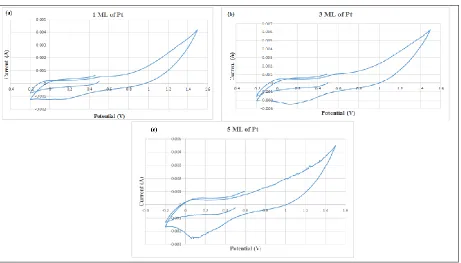
To further investigate the catalyst surface, the Pt coverage of samples was also examined via cyclic voltammetry (CV). Voltammograms were conducted in N2-saturated 0.1 M H2SO4 by sweeping from -0.2 to 1.5 V at a scan rate
of 20 mV/s. The electrolyte was chosen to match the CuSO4 solution used during electrochemical layer-by-layer
synthesis. CV is a surface-sensitive technique where the observed currents are generated from reactions at the metal−electrolyte interface. Changes in Pt surface area can be tracked by either the Pt oxide reduction feature near 0.45 V or the hydrogen adsorption/desorption curve from -0.2 to 0.0 V against an Ag/AgCl reference electrode. These methods of tracking Pt coverage on another material have often been employed [15-18].
The results of 1, 3 and 5 ML of Pt can be seen in figure 5 a-c. CV is a surface sensitive technique where the current seen are generated from reactions at the metal – electrolyte interface. Changes in Pt surface area can be tracked by either the Pt oxide reduction feature near 0.15 V or the hydrogen adsorption / desorption curve from – 0.2 to 0.0 V against an Ag/AgCl reference electrode. These results agree with other researcher reports [19].
133
Figure 5: CV spectrum for 1,3 and 5 ML samples of Pt deposited on Bucky paper (BP);(a) 1 ML of Pt-BP. (b) 3 ML of Pt-BP. (c) 5 ML of Pt-BP
CONCLUSIONS
The development of fuel cell electrodes technique was studied. The replacement of Carbon Fiber Paper (CFP) by Bucky Paper (BP) give rise to more advantage in the fuel cell industry. The brittle CFP is replaced by flexible BP can be solve an industrial problem in the fuel cell technology. The deposition of Pt on the BP at different layers (1, 3 and 5) layers are studied. The deposition was easier than the deposition of Pt on CFP. These two points can be considered as a developing stage in the fuel cell technology. The result of this work shows that the x-ray photoelectron spectroscopy (XPS) spectrum of 1, 3, and 5 monolayer of Pt deposited on Bucky paper by Cu under Potential Deposited Cu (UPD) which appear two clear peaks of Pt at 122ev and 160ev. The Cyclic Voltammetry (CV) test shows that at 5 monolayer the Pt surface is completed through the reduction noticed at 0.15V which is due to hydrogen adsorption/desorption. The deposition of Pt on Bucky paper can be reduced effects of metal catalyst constituents and is worth further exploration.
REFERENCES
[1]. Shuang Cheng,, Robert E. Rettew, Marc Sauerbrey, and Faisal M. Alamgir, 2011, " Architecture-Dependent Surface Chemistry for Pt Monolayers on Carbon-Supported Au ", ACS Appl. Mater. Interfaces, 3, 3948– 3956.
[2].Mauricio J. Prieto and Germano Tremiliosi-Filho, 2013, "Surface restructuring of Pt films on Au stepped surfaces: effects on catalytic behavior", Phys. Chem. Chem. Phys.,15: 13184-13189.
[3]. Juan A. Santana, Sven Krüger, and Notker Rösch, 2014, "Monolayer Nanoislands of Pt on Au and Cu: A first Principles Computational Study ", J. Phys. Chem., 118: 22102-22110.
[4]. "Future planes, cars may be made of Bucky paper ", Tech News. 2008-10-17. Retrieved 2008-10-18.
[5]. Zhao, Zhongfu; Gou, Jan, 2009, "Improved fire retardancy of thermoset composites modified with carbon nanofibers", Science and Technology of Advanced Materials, 10: 015005.
[6]. James B. Lewis, 2008, "Nanotechnology to soon provide paper stronger than steel for commercial uses" , the Foresight Institute.
134
lengths and conditions required for their valid use in overlayer/substrate experiments", Surface and Interface Analysis,25 (6): 430-446.
[15]. Cheng, S.; Rettew, R. E.; Sauerbrey, M.; Alamgir, F. M., 2011,"Architecture-Dependent Surface Chemistry for Pt Monolayers on Carbon-Supported Au", ACS Appl. Mater. Interfaces, 3 (10) PP: 3948-3956.
[16]. Abdelhafiz, A.; Vitale, A.; Joiner, C.; Vogel, E.; Alamgir, F. M., 2015, "Layer-by-Layer Evolution of Structure, Strain, and Activity for the Oxygen Evolution Reaction in Graphene-Templated Pt Monolayers", ACS Appl. Mater. Interfaces, 7 (11): 6180-8.
[17]. Zhai, J.; Huang, M.; Dong, S., 2007, "Electrochemical designing of Au/Pt core shell nanoparticles as nanostructured catalyst with tunable activity for oxygen reduction", Electroanalysis,19 (4): 506-509.
[18]. Tang, H.; Chen, J. H.; Wang, M. Y.; Nie, L. H.; Kuang, Y. F.; Yao, S. Z., 2004, "Controlled synthesis of platinum catalysts on Au nanoparticles and their electrocatalytic property for methanol oxidation", Applied Catalysis a-General, 275 (1-2): 43-48.
[19]. Robert E. Rettew,* James W. Guthrie, and Faisal M. Alamgir, 2009, "Layer-by-Layer Pt Growth on Polycrystalline Au: Surface-Limited Redox Replacement of over potentially Deposited Ni Monolayers", Journal of
![Figure 1: A set up of Buchner filtration to filter suspended solution of dispersed CNTs in surfactant solution [12]](https://thumb-us.123doks.com/thumbv2/123dok_us/8737950.889210/2.612.163.448.345.530/figure-buchner-filtration-suspended-solution-dispersed-surfactant-solution.webp)