CHAPTER 3
KNOWLEDGE MANAGEMENT MODELS
Adibah Abdul Kadir1, Mariam Abdul Hamid2, Noor Dina Md Amin3, Khadijah Maulad Bahrol4, Fadillah Ismail5
1,4,5
Faculty of Technology Management Business, Universiti Tun Hussein Onn Malaysia
2
Centre for Diploma Studies 3
Faculty of Civil and Environmental Engineering, Universiti Tun Hussein Onn Malaysia
[email protected] [email protected]
3.0 INTRODUCTION
Knowledge is basic in regular work. Everybody realizes how to complete his work and this learning can be reused later in comparative undertakings by embracing this information to another circumstance. The universally useful of Knowledge Management (KM) is to make learning usable for more than one individual, for example for an association in general; that is, to share it. New learning put together perspectives with respect to associations recommend that it is information that holds association’s together (Brown & Duguid, 1998).
to child by a long procedure of learning. With the coming up of collaboration, individuals should work nearer together to profit by the cooperative energy of their joint learning. The present endeavours go for information being shared among huge association which might be topographically spread over the world and dynamic in various types of zones. First cases play out this sharing even among various associations, for example utilize characterized interfaces to intervene information inside one explicit association as well as offer pieces of it among accomplices.
Another change impacting information securing and sharing is the consistently expanding rate with which new advancements are developing. These dependably require new or refreshed information and permit new working practices. For instance, there is a developing number of new forms of programming frameworks/applications and new or reconsidered benchmarks. Fruitful associations need to assimilate and use an expanding measure of information to stay aware of this advancement. In the meantime, information ends up obsolete quicker. As Kevin Marler put it: "You never again should be deal with a complex research lab for your kin to be on the precarious edge of innovative change" (Marler, 1999). This stresses both the requirement for new information as a rule and the need to deal with the concurring procedures to empower one to manage a lot of learning in a shorter time.
association and innovation. This structure, displays that learning the executives envelops a wide scope of orders that incorporate; intellectual science, correspondence, individual and authoritative conduct, brain research, fund, financial aspects, human asset, the board, key arranging, framework considering, process re-building, framework designing, PC advancements and programming and library sciences.
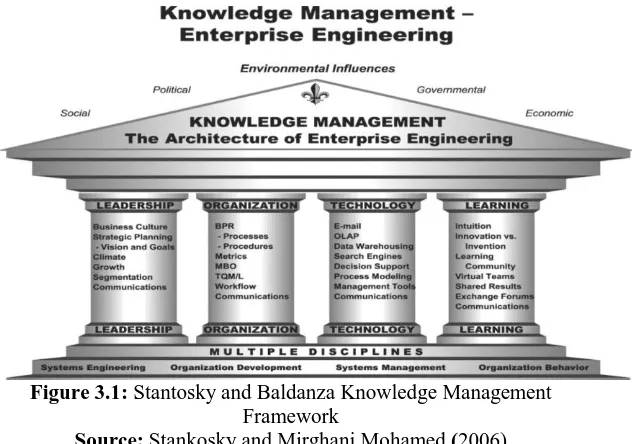
[image:3.432.79.395.200.422.2]In an organization context, these areas can be classified under four major foundations of an organization and a few of them fall into more than one category (Figure 3.1).
Figure 3.1: Stantosky and Baldanza Knowledge Management Framework
Source: Stankosky and Mirghani Mohamed (2006)
The four major foundation of an organization which each pillar is important for knowledge management are; leadership, organization structure, technology infrastructure and learning.
Leadership is in charge of rehearsing key arranging and system thinking approaches, making best utilization of assets, cultivating a culture that supports open exchange and group learning and for empowering and remunerating hazard taking, learning and information sharing. Key component for initiative is vital arranging, correspondence, framework considering and business culture.
and bolster networks of training to catch inferred and express information inside the organization. Organization structure in an organization ought to impart trust among individuals inside the organization and support free trade of learning. It ought to likewise be worried about overseeing change so as to accomplish better outcomes. The key components of organizational structure are process, procedures, performance management system and communication. Technology infrastructure that makes it conceivable to trade data without formal structures. Technology infrastructure ought to advance the productive and powerful catch of both implicit and express information. It ought to likewise bolster information partaking in the whole association. Correspondence, electronic mail, intranet, web, information warehousing and choice emotionally supportive networks are a portion of the key components.
Learning is a key idea in utilizing information. The job of learning is to oversee data so as to construct undertaking wide information and utilize that information to hierarchical learning, change and execution improvement. Learning people group, virtual groups, correspondence and a culture of trust can be distinguished as a portion of the key components.
3.2 THE KNOWLEDGE MANAGEMENT ASSESSMENT TOOL FRAMEWORK BY ARTHUR ANDERSON
Figure3.2: Knowledge Management Assessment Tool (KMAT) Framework
Source: (Coukos-Semmel, 2002)
3.3 THE STRATEGIC KNOWLEDGE MANAGEMENT MODEL BY SHELDA DEBOWSKI
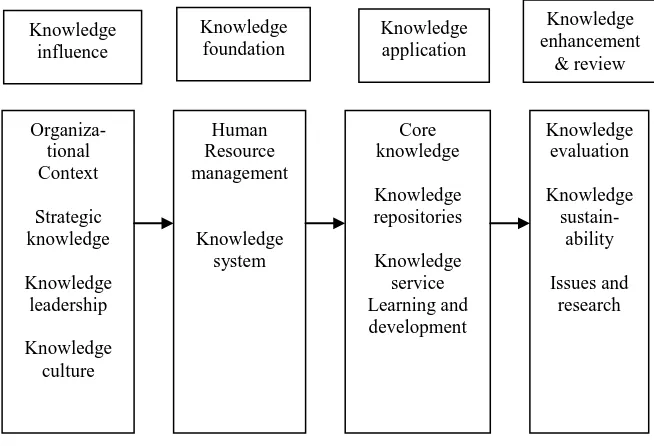
Debowski (2006), states that strategic knowledge management model emphasis on various elements which support and influence overall adaptation of a knowledge management philosophy in organizations as shown in Figure 4.3.
The model presents four major themes in building a knowledge culture in organizations. These themes are as follows;
1. Knowledge Influences:
Knowledge influences presents the elements that influence knowledge in organization such as; organizational context, strategic knowledge, knowledge leadership and knowledge culture. Organizational context comprising the internal and external context of knowledge management operates. Strategic knowledge comprising elements that explore the key principles and methods by which knowledge management may be linked to the major strategic directions of the organization. Knowledge leader is the one who outlines some of the issues of knowledge leadership and its enactment in knowledge – intensive communities. Developing and sustaining a knowledge
Measurement
Leadership
Culture Technology
Share Organize
Apply
Adapt Collect
Create
Identity
culture involve examining some of the facts of knowledge culture and explore the challenge associated with building a knowledge culture, particularly where this requires significant changes to the exiting values and attitudes.
2. Knowledge Foundation:
Effective knowledge management relies on strong system such as; structural process and well aligned policies and practices. Human resource management practices showed supports knowledge management where people are encouraged to support knowledge agendas and examine the concept of knowledge architecture, explores how supportive knowledge qualities and values can be nurtured through human resources practices. Technology supporting knowledge management by identifying the systems and technologies which enable effective knowledge management.
3. Knowledge Applications:
Knowledge applications are the ways organizational knowledge is deployed, protected and nurtured. Knowledge application begins with developing a core knowledge framework. Followed by knowledge repositories; which describe the ways strategic knowledge can be identified, shared, protected and managed. The knowledge services explore the way the knowledge user integrate knowledge into core work practices and seek new and improved strategies through a range of supportive services and agencies. Finally, learning and development in a knowledge setting and present ways that knowledge workers can be supported in a knowledge intensive community which needs people to learn and continually build new expertise and competencies.
3.4 KNOWLEDGE ENHANCEMENT AND REVIEW
Figure 3.3: Strategic Knowledge Management Model Source: Debowski, (2006), Knowledge Management
3.5 THE KNOWLEDGE MANAGEMENT MODELS BY DEMEREST
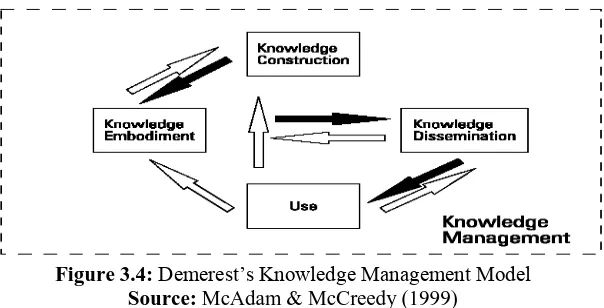
Demerest’s (in McAdam & McCreedy, 1999), states that knowledge management model demonstrate accentuation the development of knowledge inside the organization. This development isn't constrained to logical information sources however is viewed as including the social development of learning. The model expects that built learning is then exemplified inside the association, through express projects as well as through a procedure of social exchange. Figure 3.4 demonstrated that there is a procedure of scattering of the embraced learning all through the organization and its encompassing. Eventually the information is viewed as being of financial use with respect to hierarchical yields. The strong bolts in Figure 3.4 demonstrate the essential stream course while the plain bolts demonstrate the more recursive streams. The model is alluring in that it doesn't accept any given meaning of learning yet rather welcomes a progressively all-encompassing way to deal with information development. Maybe the strong bolts or fundamental stream is a confinement in that it suggests that recursive streams are less vital. It
additionally suggests a shortsighted procedure approach while, in all actuality, the streams of information exchange might be amazingly fast and circulatory, as for the situation for certain types of activity learning.
Figure 3.4: Demerest’s Knowledge Management Model Source: McAdam & McCreedy (1999)
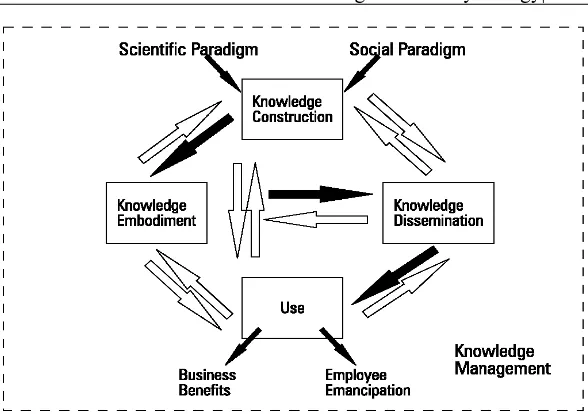
Demerest's model has been marginally adjusted of which looks to address these impediments by unequivocally demonstrating the impact of both social and logical ideal models of learning development. The model likewise broadens the "utilization" component to cover both business and representative advantages. On the off chance that learning the executives is to have the help and responsibility of all partners in an association then representative liberation must be tended to alongside the business benefits. These issues ought not be viewed as fundamentally unrelated but rather as correlative. Likewise, increasingly recursive bolts are added to Figure 3.4 to demonstrate that information the executives isn't viewed as a basic successive procedure.
Figure 3.5 Demerest’s Knowledge Management Model (Modified) Source: McAdam & McCreedy (1999)
3.6 THE KNOWLEDGE MANAGEMENT FRAMEWORK BY FRID
As indicated by Frid's (2003) learning the executives system, the information the executives development evaluation levels and information the board usage can be isolated into five dimensions. The five development levels are:
Level One-Knowledge Chaotic
Associations at this dimension are understanding and usage of Frid system for teach the executives which incorporates information the board vision, learning the executives goals and learning the board files. Associations should concentrate on pushing and adjusting departmental information the board vision and objectives just as playing out Frid's system learning the executives’ development appraisal.
Level Two-Knowledge Aware
departmental information the executives vision and objectives; and performing Frid system development appraisal, associations now should concentrate on building up an information the board guide and working cooperatively with the learning the executive’s office.
Level Three-Knowledge Focused
At this dimension, associations ought to have secured the implantation viewpoints as in the lower two dimensions and begin concentrating on five new exercises. Associations now ought to implant learning the executives into procedure building; give starting information the board foundation, administrations and preparing; bolster early adopters and information network; screen and provide details regarding the board records lastly incorporate information the executives in spending plans.
Level Four-Knowledge Managed
Associations in this dimension should endeavor to insert information the board in execution audits and furthermore in marketable strategies separated from receiving the essential exercises as featured in level 1, 2 and 3.
Level Five-Knowledge Centric
Information driven dimension is the most elevated of all learning administration usage development level dependent on Frid's model. The unmistakable exercises that associations should concentrated on which separate from other lower levels are regulating effective activities and esteeming scholarly resources. At this dimension, all learning administration exercises ought to be given equivalent accentuation.
CONCLUSION
REFERENCES
Basili, V. R., & Rombach, H. D. (1991). Support for comprehensive reuse. Software engineering journal, 6(5), 303-316.
Brown, J. S., & Duguid, P. (1998). Organizing knowledge. California management review, 40(3), 90-111.
Carneiro, A. (2000). How does knowledge management influence innovation and competitiveness?. Journal of knowledge management, 4(2), 87-98.
Coukos-Semmel, E. D. (2002). Knowledge management: processes and strategies used in United States research universities (Doctoral dissertation, Florida Atlantic University).
Davenport, T. H., & Prusak, L. (1998). Working knowledge: How organizations manage what they know. Harvard Business Press.
Debowski, S. (2006), Knowledge Management, John Wiley & Sons, Milton, QLD.
Frid, R. (2003). A common KM framework for the Government of Canada: Frid framework for enterprise knowledge management. Canadian institute of knowledge management, Ontario.
Marler, K. (1999). Rapid emerging knowledge deployment. Crosstalk: The Journal of Defense Software Engineering, 12(11), 14-16. McAdam, R., & McCreedy, S. (1999). A critical review of knowledge
management models. The learning organization, 6(3), 91-101. Mohamed, M., Stankosky, M., & Murray, A. (2006). Knowledge management and information technology: can they work in perfect harmony? Journal of knowledge management, 10(3), 103-116.
O'Dell, C. S., O'dell, C., Grayson, C. J., & Essaides, N. (1998). If only we knew what we know: The transfer of internal knowledge and best practice. Simon and Schuster.