DESIGN AND IMPLEMENTATION OF MIMO-LONG TERM
EVOLUTION-ADVANCED TO SUPPORT LARGER BANDWIDTH
AWS ZUHEER YONIS ALASHQER
A thesis submitted in
fulfillment of the requirement for the award of the
Doctor of Philosophy
Faculty of Electrical and Electronic Engineering
Universiti Tun Hussein Onn Malaysia
VI
ABSTRACT
VII
ABSTRAK
VIII
TABLE OF CONTENTS
TITLE I
DECLARATION III
ACKNOWLEDGEMENT V
ABSTRACT VI
TABLE OF CONTENTS VIII
LIST OF FIGURES XIII
LIST OF TABLES XVII
LIST OF PUBLICATIONS AND AWARDS XIX
LIST OF ABBREVIATIONS XXIII
CHAPTER 1 INTRODUCTION 1
1.1 Problem Statement 2
1.2 Objectives of the Research 3
1.3 Scope of the Research 3
1.4 Contributions of the Research 4
IX
CHAPTER 2 LTE AND LTE-ADVANVACED 6
2.1 Introduction 6
2.2 System Requirements for LTE and LTE-Advanced 9
2.3 Long Term Evolution Standard 11
2.4 Key Enabling Technologies and Feature of LTE 12 2.4.1 Downlink of Long Term Evolution 13 2.4.2 Uplink of Long Term Evolution 24 2.5 Long Term Evolution-Advanced Standard 26
2.5.1 Carrier Aggregation 27
2.5.2 Peak Data Rates and Throughput 29
2.5.3 Peak Spectral Efficiency 31
2.5.4 Mobility 34
2.5.5 Latency 35
2.6 LTE-Advanced Technologies 35
2.6.1 Multiple Input Multiple Output (MIMO) 36 2.6.2 Coordinated Multi-Point transmission (CoMP) 39
2.6.3 Relaying 40
X
CHAPTER 3 Carrier Aggregation for LTE-Advanced 43
3.1 Introduction 43
3.2 Carrier Aggregation Schemes in LTE and LTE-Advanced 44 3.2.1 Intra-band Aggregation with Contiguous Component
Carriers
52
3.2.2 Intra-band Aggregation with non-Contiguous Component Carriers
52
3.2.3 Inter-Band Aggregation with non-Contiguous Component Carriers
54
3.3 Band Combinations for LTE-CA 61
3.4 Summary 64
CHAPTER 4 Methodology 65
4.1 Introduction 65
4.2 MIMO Physical Downlink of LTE-A System 66 4.3 Design of the Carrier Aggregation in LTE-Advanced
System
70
4.4 Design of the Proposed LTE-Advanced System 72 4.5 MIMO Wideband Mobile Channel Model 80 4.6 Analysis of the Proposed LTE-Advanced System 84 4.7 Operating Bands of LTE-Advanced 97
XI
CHAPTER 5 RESULTS AND DISCUSSIONS 99
5.1 Introduction 99
5.2 Simulation of Proposed LTE-A Bandwidth using MATLAB Program
99
5.2.1 LTE-Advanced Downlink Intra Band Contiguous Component Carriers to Support Channel Bandwidth 40 MHz
102
5.2.2 LTE-Advanced Downlink Intra Band Contiguous Component Carriers to Support Channel Bandwidth 60 MHz
103
5.2.3 LTE-Advanced Downlink Intra Band Contiguous Component Carriers to Support Channel Bandwidth 80 MHz
104
5.2.4 LTE-Advanced Downlink Intra Band Contiguous Component Carriers to Support Channel Bandwidth 100 MHz
105
5.2.5 LTE-Advanced Downlink Intra Band Contiguous Component Carriers to Support Channel Bandwidth 120 MHz
106
5.2.6 LTE-Advanced Downlink Intra Band non-Contiguous Component Carriers to Support Channel Bandwidth 40 MHz
107
5.2.7 LTE-Advanced Downlink Intra Band non-Contiguous Component Carriers to Support Channel Bandwidth 60 MHz
108
5.2.8 LTE-Advanced Downlink Intra Band non-Contiguous Component Carriers to Support Channel Bandwidth 80 MHz
109
5.2.9 LTE-Advanced Downlink Intra Band non-Contiguous Component Carriers to Support Channel Bandwidth 100 MHz
XII
5.2.10 LTE-Advanced Downlink Intra Band Non-Contiguous Component Carriers to Support Channel Bandwidth 120 MHz
111
5.3 Throughput Analysis of Proposed LTE-A 112 5.3.1 Throughput of Proposed LTE-A with QPSK Modulation 113 5.3.2 Throughput of Proposed LTE-A with 16 QAM Modulation 117 5.3.3 Throughput of Proposed LTE-A with 64 QAM Modulation 120 5.4 Simulation of Proposed LTE-A Bandwidth using
SystemVue Program
124
5.4.1 LTE-Advanced Downlink Intra Band non-Contiguous Component Carriers
125
5.4.2 LTE-Advanced Downlink Intra Band Contiguous Component Carriers
131
5.5 SystemVue and Matlab Differences in Execution of Proposed LTE-Advanced System
139
5.6 Comparison of Proposed LTE with the LTE and LTE-Advanced
140
5.7 Summary 141
CHAPTER 6 CONCLUSIONS AND FUTURE WORK 142
6.1 Conclusions 142
6.2 Future Works 146
REFERENCES 148
XIII
LIST OF FIGURES
2.1 The release of 3GPP specifications for LTE 7
2.2 Block diagram for OFDMA 14
2.3 Frequency domain illustration of OFDM 15
2.4 OFDM symbol in the time domain 16
2.5 OFDMA downlink transmitter 17
2.6 OFDMA downlink receiver for user 1 18 2.7 Principles of OFDMA for downlink transmission 21
2.8 Block diagram for SC-FDMA 25
2.9 Carrier aggregation scenarios 28
2.10 Improvement in downlink spectral efficiency going from 2G to 4G system
33
2.11 Mobility in LTE-Advanced technology 34 2.12 Illustration of SU and MU MIMO systems 37 2.13 MIMO for LTE-Advanced DL and UL transmission 38 2.14 Cooperative MIMO on the LTE-Advanced downlink 40 2.15 Configuration of the relaying network 41 3.1 Types of carrier aggregation for LTE-Advanced 45
3.2 Examples of carrier aggregation 47
XIV
3.6 Definitions for intra band carrier aggregation RF parameters, for an example with two aggregated carriers
54
3.7 The channel bandwidth for one RF carrier and the corresponding transmission bandwidth configuration
55
4.1 OFDMA and SCFDMA 66
4.2 LTE-A downlink transmitter for 8x8 MIMO 68 4.3 LTE-A downlink receiver for 8x8 MIMO 69 4.4 Block diagram of downlink data aggregation 71
4.5 Proposed LTE-A system design 73
4.6 Aggregated channel bandwidth for contiguous carrier aggregation 74
4.7 Non-contiguous intra band CA 75
4.8 Interference effects on the system with 7 CC: (a) Schematic design, (b) Contiguous carrier aggregation, (c) Non-contiguous carrier aggregation.
77
XV
5.5 LTE-A with channel bandwidth 100 MHz 105 5.6 LTE-A with channel bandwidth 120 MHz 106 5.7 LTE-A non-contiguous CCs with channel bandwidth 40 MHz 107 5.8 LTE-A non-contiguous CCs with channel bandwidth 60 MHz 108 5.9 LTE-A non-contiguous CCs with channel bandwidth 80MHz 109 5.10 LTE-A non-contiguous CCs with channel bandwidth 100MHz 110 5.11 LTE-A non-contiguous CCs with channel bandwidth 120MHz 111 5.12 Throughput diagram with MIMO technique 112 5.13 Throughput of 2x2 MIMO LTE-A using QPSK modulation 114 5.14 Throughput of 4x4 MIMO LTE-A using QPSK modulation 115 5.15 Throughput of 8x8 MIMO LTE-A using QPSK modulation 116 5.16 Throughput of 2x2 MIMO LTE-A using 16 QAM modulation 118 5.17 Throughput of 4x4 MIMO LTE-A using 16 QAM modulation 119 5.18 Throughput of 8x8 MIMO LTE-A using 16 QAM modulation 120 5.19 Throughput of 2x2 MIMO LTE-A using 64 QAM modulation 122 5.20 Throughput of 4x4 MIMO LTE-A using 64 QAM modulation 123 5.21 Throughput of 8x8 MIMO LTE-A using 64 QAM modulation 124 5.22 Schematic design of non-contiguous CCs with aggregated channel
bandwidth 20 MHz
125
5.23 Non-contiguous CCs with aggregated channel bandwidth 20 MHz 126 5.24 Schematic design of non-contiguous CCs with aggregated channel
bandwidth 80 MHz
127
5.25 Non-contiguous CCs with aggregated channel bandwidth 80MHz 127 5.26 Schematic design of non-contiguous CCs with aggregated channel
bandwidth 100 MHz
128
XVI
bandwidth 120 MHz
5.29 Non-contiguous CCs with aggregated channel bandwidth 120 MHz
130
5.30 Schematic design of contiguous CCs with aggregated channel bandwidth 40 MHz
131
5.31 Contiguous CCs with aggregated channel bandwidth 40 MHz 132 5.32 Schematic design of contiguous CCs with aggregated channel
bandwidth 60 MHz
133
5.33 Contiguous CCs with aggregated channel bandwidth 60 MHz 133 5.34 Schematic design of contiguous CCs with aggregated channel
bandwidth 80 MHz
134
5.35 Contiguous CCs with aggregated channel bandwidth 80 MHz 135 5.36 Schematic design of contiguous CCs with aggregated channel
bandwidth 100 MHz
136
5.37 Contiguous CCs with aggregated channel bandwidth 100 MHz 136 5.38 Schematic design of contiguous CCs with aggregated channel
bandwidth 120 MHz
137
XVII
LIST OF TABLES
2.1 3GPP specification release for LTE and LTE-A 8 2.2 Major system requirement for Rel.8 LTE 10 2.3 System Performance Requirements for LTE-A compared to those
achieved in Rel.8 LTE
11
2.4 Requirements of LTE-Advanced 30
3.1 Deployment scenarios of LTE-Advanced 50 3.2 UE Carrier Aggregation Bandwidth Classes 56 3.3 Nominal channel spacing between contiguously aggregated CCs 57 3.4 Minimum channel spacing between contiguously aggregated CCs 58
3.5 Definition of Foffset 59
3.6 Intra band contiguous CA 62
3.7 Inter band non-contiguous CA 63
4.1 Coding rates for QPSK, 16QAM and 64 QAM 88 4.2 Transmission bandwidth configuration NRB in E-UTRA channel
bandwidths
89
XVIII
4.4 Throughput of 4x4 MIMO 91
4.5 Throughput of 8x8 MIMO 91
4.6 Enhancement of data rate with different modulation techniques 92 4.7 Proposed one-layer to four-layer TBS translation 94 4.8 Throughput and efficiency for 8x8 MIMO LTE-A 95 4.9 Operating bands for LTE-Advanced (E-UTRA operating bands) 97 5.1 Highlights the main points of differences between LTE and the
proposed system
XVIII
LIST OF ABBREVIATIONS
1G - First Generation 2G - Second Generation 3G - Third Generation
3GPP - Third Generation Partnership Project 4G - Fourth Generation
ACLR - Adjacent Channel Leakage Ratio AIM - Advanced Interference Management
B.W - Bandwidth
BER - Block Error Rate BS - Base Station
BTS - Base Transceiver Station BWGB - Bandwidth Guard Band
CA - Carrier Aggregation CB - Coding Blocks CCs - Component Carriers
CDF - Cumulative distribution function CDMA - Code Division Multiple Access CM - Cubic Metric
CoMP - Coordinated Multi Point CP - Cyclic Prefix
XIX
CRC - Cyclic Redundancy Check CRS - Cell-specific Reference Symbol CSI - Channel State Information
CSI-RS - Channel State Information -Reference Signal CSIT - Channel State Information at the Transmitter DC - Direct Current
DFT - Discrete Fourier Transform
DFT-S-OFDM - Discrete Fourier Transform–Spread–OFDM
DL - Downlink
DRX - Discontinuous Reception
EDGE - Enhanced Data Rates for GSM Evolution eNB - enhanced Node B
EPC - Evolved Packet Core
E-UTRA - Evolved Universal Terrestrial Radio Access E-UTRAN - Evolved UMTS Terrestrial Radio Access Networ EVM - Error Vector Magnitude
FDD - Frequency Division Duplex
FDMA - Frequency Division Multiple Access FEC - Forward Error Correction
FFS - For Further Studies FFT - Fast Fourier Transform GPRS - General Packet Radio Service GPS - Global Positioning System GSM - Global System for Mobile
HARQ - Hybrid Automatic Repeat Request
HeNB - Home eNodeB
XX
HSPA - High Speed Packet Access
HSUPA - High-Speed Uplink Packet Access IDFT - Inverse Discrete Fourier Transform IFFT - Inverse Fast Fourier Transform IM3 - Third-order Inter Modulation IMD - Inter Modulation Distortion
IMT-Advanced - International Mobile Telecommunications - Advanced IP - Internet Protocol
ISI - Inter Symbol Interference
ITU - International Telecommunications Union ITU-R - ITU-Radiocommunication
JP - Joint Processing
LTE - Long Term Evolution
LTE-A - Long Term Evolution-Advanced MA - Multiple Access
MAC - Medium Access Control MBRs - Maximum Bit Rates MIMO - Multi Input Multi Output MISO - Multiple Input Single Output
MU-MIMO - Multi User- Multi Input Multi Output OCC - Orthogonal Cover Codes
OFDM - Orthogonal Frequency Division Multiplexing OFDMA - Orthogonal Frequency Division Multiple Access
P - Power
P/S - Parallel to Serial PA - Power Amplifiers
XXI
PCC - Primary component carrier Pe - Error Probability
PHY layer - Physical layer
PRB - Physical Resource Block PS - packet-switching
PUCCH - Physical Uplink Control Channel QAM - Quadrature Amplitude Modulation
QoS - Quality of Service
QPSK - Quadrature Phase Shift Keyed RBs - Resource Blocks
Rel-10 - Release-10 Rel-11 - Release-11 Rel-12 - Release-12 Rel-8 - Release-8 Rel-9 - Release-9
RF - Radio Frequency
RRC - Radio Resource Control RS - Reference Signal
S/P - Serial to Parallel
SAE - System Architecture Evolution
SC-FDMA - Single Carrier Frequency Division Multiple Access SDM - Spatial Division Multiplexing
SEM - Spectrum Emission Mask SIMO - Single Input Multiple Output SISO - Single Input Single Output SNR - Signal to Noise Ratio
XXII
TBs - Transport Blocks
TDD - Time Division Duplexing
TD-LTE - Time Division -Long Term Evolution TDMA - Time Division Multiple Access
TD-SCDMA - Time Division-Synchronous Code Division Multiple Access
TSG RAN - TSG Radio Access Network UE - User equipment
UL - Uplink
UMTS - Universal Mobile Telecommunications System U-Plane - User-Plane
WCDMA - Wideband Code Division Multiple Access
CHAPTER 1
INTRODUCTION
The specifications of Long Term Evolution (LTE) in 3rd Generation Partnership Project (3GPP) (Release-8) has recently been completed when work began on the new Long Term Evolution- Advanced (LTE-A) standard (Release-9 and beyond). LTE-A meets or exceeds the requirements imposed by International Telecommunication Union (ITU) to Fourth Generation (4G) mobile systems. These requirements were unthinkable a few years ago, but are now a reality. Peak data rates of 1 Gbps with bandwidths of 100 MHz for the downlink, very low latency, more efficient interference management and
operational cost reduction are clear examples of why LTE-A is so appealing for
operators. Moreover, the quality breakthrough affects not only operators but also end
users, who are going to experience standards of quality similar to optical fiber.
In order to reach these levels of capacity and quality, the international scientific
community, in particular the 3GPP are developing different technological enhancements
on LTE. The most important technological proposals for LTE-Advanced are support of
wider bandwidth (carrier aggregation), advanced Multiple Input Multiple Output
(MIMO) techniques, Coordinated Multipoint transmission or reception (CoMP),
relaying and enhancements for Home eNodeB (HeNB) by Cardona, Monserrat and
Cabrejas (2013).
2
multiple contiguous or non-contiguous Component Carriers (CCs). Each Component Carrier (CC) takes a maximum bandwidth of 20 MHz to be compatible with LTE Release 8 (Dahlman, Parkvall, Sköld and Beming, 2008). In addition to the peak data rate, another motivation for carrier aggregation is to facilitate efficient use of fragmented spectrum. In LTE-Advanced carrier aggregation, each component carrier can take any of the channel bandwidths of 1.4, 3, 5, 10, 15, and 20 MHz that are supported by LTE. Component carriers do not have to be of the same frequency (Taha, Hassanein and Abu Ali, 2012). Operators with a fragmented spectrum can also provide high data rate services through carrier aggregation technology. Carrier aggregation also allows advanced features such as multi-carrier scheduling, interference coordination, quality of service (QoS) differentiation, carrier load balancing, and heterogeneous deployment to be used to further increase the spectral efficiency of the system. For instance, with QoS differentiation, different subscription classes can be created whereby users are assigned a bandwidth and a preferred carrier on the basis of their level of service agreement. Multi carrier scheduling can also be used to schedule users in a carrier that is experiencing less interference, thus improving throughput. Similarly, carrier aggregation can be used with inter-cell interference coordination techniques to ensure that users are scheduled in a manner that will generate less interference with surrounding cells.
1.1Problem Statement
LTE-A has peak data rate limitations, its maximum reaches 1 Gbps due to number of component carriers which is five. Proposed LTE-Advanced offers considerably higher data rates than it in the current release of LTE-A. In addition, the spectrum usage efficiency also has been improved.
3
carriers and in this way increase the overall transmission bandwidth. Proposed LTE-Advanced bandwidth for both types: contiguous and non-contiguous needs a suitable band which covers the whole bandwidth depending on the standard bands from 3GPP organization.
1.2Objectives of the Research
The main objectives of this research are:
1. To improve LTE-A disadvantages by increasing the bandwidth at both sides (transmitter and receiver), where the current bandwidth is 100 MHz.
2. To increase peak data rate of the proposed system more than 1 Gbps which represents the peak data rate of LTE-A.
3. To apply MIMO technology on the proposed LTE-A system with 8x8 antennas. 4. To increase the efficiency of the proposed system comparing to efficiency of
LTE and LTE-A systems.
1.3Scope of the Research
4
system depends on carrier aggregation technique to expand bandwidth and achieve the main objectives of this research. Finally; the performance and the results of the proposed algorithm had been compared with LTE and LTE-A technologies (current and new developed) to highlight the features of the new design.
1.4Contributions of the Research
LTE-Advanced is an intriguing technology which promises better performance than LTE, larger bandwidth in proposed LTE-Advanced is the main aim of this study, easily deployment in the network, increase user throughput for fully multi-media feature services to exceed 4 Gbps, achieve spectrum flexibility, support scalable bandwidth up to 120 MHz using spectrum aggregation, achieve backward compatibility includes inter-working of LTE with 3GPP legacy systems, enable extended multi-antenna deployments up to 8x8 MIMO and denser infrastructure in a cost-efficient way.
There are two basic solutions for the large bandwidth transmission in mobile communication systems: the first is to design a large bandwidth system; the second is to construct a system with a larger transmission bandwidth through collaboration between different systems. The two solutions coexist and have an effect on each other in the evolution of mobile communications. These enhancements can be appeared in Rel-11 and Rel-12 of 3GPP and will offer better user experience, lower cost per bit, greener LTE-A base stations, and efficient self-organizing networks.
1.5Outline of The Thesis
5
6
CHAPTER 2
LTE AND LTE-ADVANVACED
2.1 Introduction
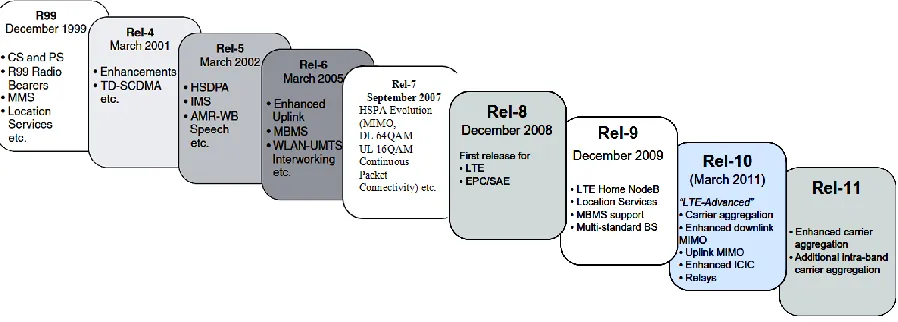
The first release of WCDMA Radio Access developed in Radio Access Network (TSG RAN) was called release-993 and contained all features needed to meet the IMT-2000 requirements as defined by the International Telecommunications Union (ITU).
7
[image:26.612.101.550.157.318.2]since then continued on LTE, with new features added in each release refer to Dahlman, Parkvall and Sköld (2011).
Figure 2.1: The release of 3GPP specifications for LTE (Dahlman, et al., 2008), (Dahlman, et al., 2011).
8
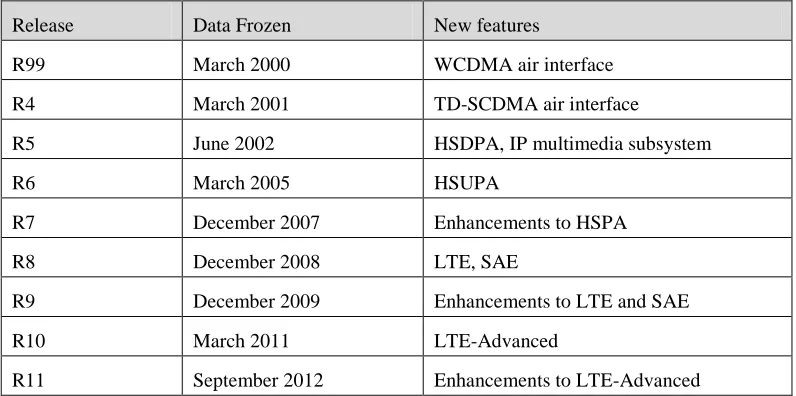
[image:27.612.129.527.408.606.2]The specifications for LTE are produced by the Third Generation Partnership Project according to Cox (2012), in the same way as the specifications for UMTS and GSM. They are organized into releases, where each of which contains a stable and clearly defined set of features. The use of releases allows equipment manufacturers to build devices using some or all of the features of earlier releases, while 3GPP continues to add new features to the system in a later release. Within each release, the specifications progress through a number of different versions. New functionality can be added to successive versions until the date when the release is frozen, after which the only changes involve refinement of the technical details, corrections and clarifications (3GPP Releases. 2011). Table 2.1 lists the releases that 3GPP have used since the introduction of UMTS, together with the most important features of each release. Note that the numbering scheme was changed after Release-99, so that later releases are numbered from 4 through to 11 (LTE-A).
Table 2.1: 3GPP specification release for LTE and LTE-A (Cox, 2012)
Release Data Frozen New features
R99 March 2000 WCDMA air interface
R4 March 2001 TD-SCDMA air interface
R5 June 2002 HSDPA, IP multimedia subsystem
R6 March 2005 HSUPA
R7 December 2007 Enhancements to HSPA
R8 December 2008 LTE, SAE
R9 December 2009 Enhancements to LTE and SAE
R10 March 2011 LTE-Advanced
9
2.2 System Requirements for LTE and LTE-Advanced
10
Table 2.2: Major System Requirement for Rel.8 LTE (Sawahashi, Taoka, Tanno, and Nakamura, 2009)
Bandwidth Support of scalable bandwidths
(1.4, 3, 5, 15 and 20 MHz )
Peak data rate DL 100 MHz
UL 50 MHz
Spectrum efficiency
(vs. Rel. 6 HSDPA/HSUPA)
DL 3- 4 times (avarge)
UL 2- 3 times (cell edge)
User throughput
(vs. Rel. 6 HSDPA/HSUPA)
DL 2- 3 times (avarge)
UL 2- 3 times (cell edge)
The requirements for LTE-Advanced are specified by Fazel and Kaiser (2008). The following general requirements for Advanced were agreed upon. LTE-Advanced will be an evolution of Release-8 LTE. Hence, distinctive performance gains from Release-8 LTE are requested. Moreover, LTE-Advanced will satisfy all the relevant requirements for Release-8 LTE.
LTE is requested in LTE-Advanced. Thus, a set of User Equipment (UE) for LTE-Advanced must be able to access Release-8 LTE networks, and LTE-Advanced networks must be able to support Release-8 LTE UEs. LTE-Advanced shall meet or exceed the IMT-Advanced requirements within the ITU-R time plan.
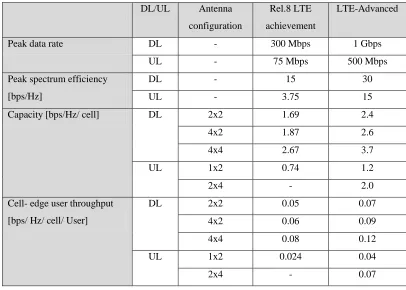
In Table 2.3, the requirements and target values for LTE-Advanced are listed with those achieved in the Release-8 LTE. The summary of the major issues which depend on MIMO channel transmissions is highlighted, with respect to the peak data rate.
11
[image:30.612.123.529.199.489.2]and cell-edge user throughput are expected from Release-8 LTE for each antenna configuration.
Table 2.3: System Performance Requirements for LTE-A compared to those achieved in Rel.8 LTE (Sawahashi, et al., 2009)
DL/UL Antenna
configuration
Rel.8 LTE
achievement
LTE-Advanced
Peak data rate DL - 300 Mbps 1 Gbps
UL - 75 Mbps 500 Mbps
Peak spectrum efficiency
[bps/Hz]
DL - 15 30
UL - 3.75 15
Capacity [bps/Hz/ cell] DL 2x2 1.69 2.4
4x2 1.87 2.6
4x4 2.67 3.7
UL 1x2 0.74 1.2
2x4 - 2.0
Cell- edge user throughput
[bps/ Hz/ cell/ User]
DL 2x2 0.05 0.07
4x2 0.06 0.09
4x4 0.08 0.12
UL 1x2 0.024 0.04
2x4 - 0.07
2.3 Long Term Evolution Standard
The 3GPP Long Term Evolution (LTE) release 8 defines the basic functionality of a new, high-performance air interface providing high user data rates in combination with low latency based on MIMO, OFDMA, and an optimized system architecture evolution (SAE) as main enablers.
12
peak data rates of 300 Mbps and 75 Mbps respectively. For comparison, the peak data rate of WCDMA, in Release-6 of the 3GPP specifications, is 14 Mbps in the downlink and 5.7 Mbps in the uplink. It cannot be stressed too strongly, however, that these peak data rates can only be reached in idealized conditions, and are wholly unachievable in any realistic scenario. A better measure is the spectral efficiency, which expresses the typical capacity of one cell per unit bandwidth. LTE is required to support a spectral efficiency three to four times greater than that of Release-6 WCDMA in the downlink and two to three times greater in the uplink.
Another important issue is latency time, particularly for time critical applications such as voice and interactive games. There are two aspects to this. Firstly, the requirements state that the time taken for data to travel between the mobile phone and the fixed network should be less than five milliseconds, provided that the air interface is uncongested. Secondly, mobile phones can operate in two states: an active state in which they are communicating with the network and a low power standby state. The requirements state that a phone should switch from standby to the active state, after an intervention from the user, in less than 100 milliseconds.
There are also requirements on coverage and mobility. LTE is optimized for cell sizes up to 5 km, works with degraded performance up to 30 km and supports cell sizes of up to 100 km. It is also optimized for mobile speeds up to 15 km/hr, works with high performance up to 120 km/hr and supports speeds of up to 350 km/hr. Finally, LTE is designed to work with a variety of different bandwidths, which range from 1.4 MHz up to a maximum of 20 MHz according to 3GPP TS 25.912 (2006).
2.4 Key Enabling Technologies and Feature of LTE
13
directions, the main LTE enabling technologies can be presented in downlink physical layer (OFDMA) and uplink physical layer (SC-FDMA).
2.4.1 Downlink of Long Term Evolution
At this point, the structure of OFDMA and the main principles of downlink transmission with the main calculations of system capacity are discussed as in the following:
A-Downlink System Model of LTE
14
Figure 2.2: Block diagram for OFDMA (Khlifi and Bouallegue, 2012).
OFDMA, frequency-domain scheduling and MIMO processing techniques can be used. An example of frequency-domain scheduling techniques is frequency-selective scheduling. In frequency-selective scheduling, users are assigned data only on good frequency bands (i.e. bands with large gain), which are determined on the basis of channel quality feedback from the UE. For broadcast services, single-frequency broadcast networks can be supported. In this case, multiple base stations transmit the same broadcast signals. The signals are coherently combined at the user, thus improving performance at the cell edge substantially.
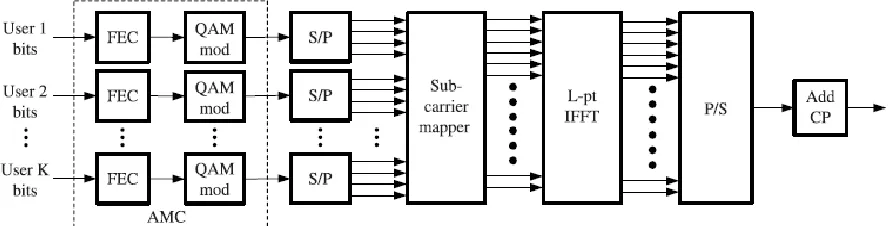
A basic block diagram illustrating OFDMA signal generation for one OFDM symbol is shown in Figure 2.2 where data symbols from different users are mapped to different subcarriers depending on the frequency bands assigned to those users. This is done in the frequency domain. The information is then subjected to an Inverse Fast Fourier Transform (IFFT) to convert the frequency domain subcarriers into time-domain signals. A cyclic prefix is then added, and the signal is ready for transmission.
Note that the basic transmission unit for data is a subframe that spans multiple OFDM symbols. At the receiver, the reverse operation is performed. The cyclic prefix is removed, and then the time-domain signal is subjected to a Fast Fourier Transform (FFT)
Symbol
Mapping S/P P/S
Append CP M-point IFFT Subcarrier Mapping Channel Subcarrier Demapping P/S Symbol De-Mapping M-point FFT Remove
15
[image:34.612.135.536.192.289.2]so that the modulation symbols on each subcarrier can be extracted. Each user then extracts the frequency resource units corresponding to its assigned subcarriers. Equalization is performed and the data is passed onward for decoding.
Figure 2.3: Frequency domain illustration of OFDM (Ghosh and Ratasuk, 2011).
16
[image:35.612.161.490.288.376.2]Doppler shift is caused by UE movement with larger shift as UE velocity increases. This causes inter-carrier interference whose degradation increases as the subcarrier spacing decreases. Phase noise is caused by fluctuations in the frequency of the local oscillator, and will cause inter-carrier interference as well. In order to minimize performance degradation from phase noise, the subcarrier spacing should be greater than 10 kHz. Furthermore, to support UE up to a speed of 350 km/h, the subcarrier spacing should be around 9–17 kHz. As a result, a subcarrier spacing of 15 kHz was chosen for LTE.
Figure 2.4: OFDM symbol in the time domain (Preben, Koivisto, Pedersen, Kovács, Raaf, Pajukoski and Rinne, 2009).
In LTE, frequency resource is assigned in units of resource blocks. Several factors must be considered in the selection of the resource block size in frequency. First, it should be small enough that the frequency selective scheduling (i.e. scheduling data transmission on good frequency subcarriers) gain is large. Small resource-block size ensures that the frequency response within each resource block is similar, thus enabling the scheduler to assign only good resource blocks. However, since the eNB does not know which resource blocks are experiencing good channel conditions, the UE must report this information back to the eNB. Thus, the resource-block size must be sufficiently large that the feedback overhead is not too high. It also should be sufficiently large to minimize downlink control signaling, which must be used to inform the UE of its resource allocation. In 3GPP R1-050720, (2005), performance analysis of frequency
CP
Data
CP
17
selective scheduling was performed. It was found that a resource block of size 200–900 kHz provides good performance. Since, in LTE, a subframe size of 1 ms is used to ensure low latency, the resource block size in frequency should be small so that small data packets can be efficiently supported. As a result, 180 kHz (12 subcarriers) was chosen as the resource-block bandwidth.
A cyclic prefix is needed for OFDMA transmission in order to prevent inter-symbol interference from previously transmitted OFDM inter-symbols. The OFDM inter-symbol with cyclic prefix and data is shown in Figure 2.4. Note that the cyclic prefix does not carry useful data and is removed at the receiver prior to processing. As a result, it is desirable to have a small cyclic prefix as possible in order to minimize the overhead. In general, the length is chosen on the basis of the expected delay spread of the propagation channel plus some margin to allow for imperfect timing alignment.
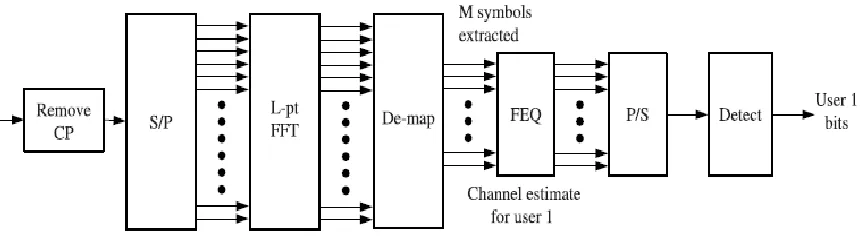
[image:36.612.121.566.493.606.2]The block diagram for a downlink OFDMA are shown in Figure 2.5 and Figure 2.6 where the basic flow is very similar to an OFDM system except for now K users share the L subcarriers, with each user being allocated MK subcarriers. Although in theory it is possible to have users share subcarriers, this never occur in practice, so ∑k Mk = L and each subcarrier only has one user assigned to it (Ghosh, Zhang, Andrews & Muhamed, 2011).
18
[image:37.612.132.563.247.368.2]In OFDM, all subcarriers are assigned to a single user. Hence, for multiple users to communicate with the BS, the set of subcarriers are assigned to each in a Time Division Multiple Access (TDMA) fashion. Alternatively, an OFDM-based multiple access mechanism, namely the OFDMA, assigns sets of subcarriers to different users. In particular, the total available bandwidth is divided into M sets, each consisting of L subcarriers.
Figure 2.6: OFDMA downlink receiver for user 1(Ghosh, et al., 2011).
In order to analysis the performance of OFDMA, the transmitted signal of one user with M allocated subcarriers is expressed as (Zhang, Huang, Liu and Zhang, 2006):
D=[d0 d1 … dM-1]T (2.1)
where [.]T represents transpose operation and di is the modulated symbol. After IFFT modulator, the signal vector S will be:
19
where TN,M
the mapping matrix for subcarrier assignment and its element values
are decided by either distributed subcarrier allocation or localized subcarrier allocation. F*N is the N point IFFT matrix and [.]* represents conjugate operation. Moreover,FN=[flT , f2T, …., fNT ]T (2.3)
f1= (2.4)
After fading channel and FFT process, the received signal in frequency domain is:
R= H TN,M D+n (2.5)
where
H = diag(HK) (2.6)
and Hk is the frequency channel response at subcarrier k. n is the AWGN noise vector and
R = [r(O),r(l),..., r(N -1)]T
(2.7)
in which r(k) is the received signal at subcarrier k .
20
diversity is exploited through assigning contiguous sets of subcarriers to users experiencing good channel conditions a study by Yang (2010). Another important advantage of OFDMA is its inherent adaptive bandwidth assignment. In the Jiang, Song and Zhang (2010), OFDMA subcarrier structure can support a wide range of bandwidths, since the transmission bandwidth consists of a large number of orthogonal subcarriers that can be separately turned on and off; wider transmission bandwidths, as high as 100 MHz, can be easily realized (Dahlman, et al., 2008).
B-Downlink Data Transmission of LTE
For transmission of data over the air interface, it was decided to use a new transmission scheme in LTE which is completely different from the Code Division Multiple Access (CDMA) approach of UMTS. Instead of using only one carrier over the broad frequency band, it was decided to use a transmission scheme referred to as Orthogonal Frequency Division Multiple Access (OFDMA). OFDMA transmits a data stream by using several narrow-band subcarriers simultaneously, for example 512, 1024, or even more, depending on the overall available bandwidth of the channel (e.g. 5, 10, 20 MHz).
21
[image:40.612.134.523.282.568.2]Figure 2.7 shows how the input bits are first grouped and assigned for transmission over different frequencies (subcarriers). For example, 4 bits (representing a 16-QAM modulation) are sent per transmission step per subcarrier. A transmission step is also referred to as a symbol. With 64-QAM modulations, 6 bits are encoded in a single symbol, raising the data rate further. On the other hand, encoding more bits in a single symbol makes it harder for the receiver to decode the symbol if it was altered by interference. This is the reason why different modulation schemes are used depending on transmission conditions.
22
In theory, each subcarrier signal could be generated by a separate transmission chain hardware block. The output of these blocks would then have to be summed up and the resulting signal could then be sent over the air. Because of the high number of subcarriers used, this approach is not feasible. Instead, a mathematical approach is taken as follows.
As each subcarrier is transmitted on a different frequency, a graph which shows the frequency on the x-axis and the amplitude of each subcarrier on the y-axis can be constructed. Then, a mathematical function called Inverse Fast Fourier Transformation (IFFT) is applied, which transforms the diagram from the frequency domain to the time domain. This diagram has the time on the x-axis and represents the same signal as would have been generated by the separate transmission chains for each subcarrier when summed up. The IFFT thus does exactly the same job as the separate transmission chains for each subcarrier would do, including summing up the individual results.
On the receiver side, the signal is first demodulated and amplified. The result is then treated by a Fast Fourier Transformation (FFT) function which converts the time signal back into the frequency domain. This reconstructs the frequency/amplitude diagram created at the transmitter. At the center frequency of each subcarrier a detector function is then used to generate the bits originally used to create the subcarrier.
23
C-Downlink Capacity of LTE
Unlike Time Division Multiple Access (TDMA), OFDMA allows sharing resources among multiple users accessing the system by allocating to a user only a fraction of the total bandwidth therefore multiple users can transmit simultaneously on orthogonal subcarriers. The transmissions from multiple users are orthogonal as long as the relative delay between the received transmissions is within the Cyclic Prefix (CP) length. In general, the CP length is several microseconds, to account for the multi-path delay spread, and therefore makes the timing synchronization within the CP length feasible. This is in contrast to synchronous WCDMA where sub-chip level synchronization (generally a small fraction of a microsecond depending upon the chip rate) is required to guarantee orthogonal transmissions (Khan, 2009). The uplink capacity limit for an OFDMA system can be written as:
(2.8)
where βi is the fraction of bandwidth allocated to user i. For the case where the bandwidth is equally divided among the K users transmitting simultaneously, P is received power for a user, background noise N0 and f ratio between other-cell and own-cell signal the above formula can be simplified as below:
24
There is no intra-cell (multiple access) interference or Inter Symbol Interference (ISI) due to orthogonal subcarriers used by different users and 1-tap OFDM subcarrier equalization.
However, cyclic prefix (guard interval) overhead (typically around 10%) needs to be taken into account for the OFDM case. Therefore, the capacity of an OFDMA system can be scaled-down to account for CP overhead as below:
(2.10) where Ts is the OFDM symbol duration and Δ is the cyclic prefix duration.
2.4.2 Uplink of Long Term Evolution
In the uplink, Single Carrier Frequency Division Multiple Access (SC-FDMA) is selected due to its ability to provide similar advantages to OFDM, such as orthogonality among users, frequency domain equalization, and robustness with respect to multipath operation while maintaining a low power amplifier back-off or de-rating requirement according to Khan (2009). The key characteristic of single-carrier transmission is that each data symbol is transmitted using the entire allocated bandwidth. This is different than OFDM, where each data symbol is transmitted using only one subcarrier.
148
REFERENCES
3GPP Technical Report 36.913. Requirements for Further Advancements for Evolved Universal Terrestrial Radio Access (E-UTRA) (LTE-Advanced). www.3gpp.org.
3GPP Technical Report R1-050720 (2005). Frequency selective scheduling resource block size for EUTRA downlink. Motorola. RAN1#42. San Diego. CA.
3GPP Technical Report R1-060385 (2006). Cubic Metric in 3GPP-LTE. 3GPP Motorola. Denver. USA.
3GPP Technical Report R1-084469. Cubic Metric comparison of OFDMA and Clustered-DFTS-OFDM/NxDFTS-OFDM. 3GPP.
3GPP Technical Report R4-101062 (2010). LTE-A deployment scenarios; TSG-RAN WG4 Meeting. CA. USA.
3GPP Technical Report RP-100661(2010). Revised Carrier Aggregation for LTE WID. Nokia Corporation. Seoul. South Korea.
3GPP Technical Report TR 36.814 (2011). Evolved Universal Terrestrial Radio Access (E-UTRA) further advancements for E-UTRA physical layer aspects, Release 9.
Section 8.1.
3GPP Technical Report TR 36.815. Further advancements for E-UTRA; LTE-Advanced feasibility studies in RAN WG4. (Release 9). 3GPP. v9.1.0.
3GPP Technical Report TR 36.819 (2011). Coordinated multi-point operation for LTE physical layer aspects. Release 11.
3GPP Technical Report TR 36.912 Release 10 (2011). LTE; Feasibility study for Further Advancements for E-UTRA (LTE-Advanced) Technical Report. ETSI TR
149
3GPP Technical Report TR-36.808. Technical specification group radio access network; Evolved Universal Terrestrial Radio Access (E-UTRA); carrier aggregation; base
station (BS) radio transmission and reception (Release 10).
3GPP Technical Report TS 25.912 (2006). Feasibility study for evolved Universal Terrestrial Radio Access (UTRA) and Universal Terrestrial Radio Access Network
(UTRAN). V 5.2.0.
3GPP Technical Report TS 25.913 (2009). Requirements for Evolved UTRA (E-UTRA) and Evolved UTRAN (E-UTRAN). Release 8.
3GPP Technical Report TS 36.101 Release 8 (Dec. 2009) .3rd Generation Partnership Project; Evolved Universal Terrestrial Radio Access (E-UTRA) Radio
Transmission and Reception (Release 8). Technical specification group radio
access network. pp.14 V6.6.0.
3GPP Technical Report TS 36.101. User Equipment (UE) radio transmission and reception. Technical specification group radio access network.
3GPP Technical Report TS 36.104. Base Station (BS) radio transmission and reception. Technical specification group radio access network.
Ahmadi, S. (2009). An overview of next-generation mobile WiMAX technology. Intel Corporation-Communications Magazine. IEEE.
Akyildiz, I. F., Gutierrez-Estevez, D. M. & Reyes, E. C. (2010). The evolution to 4G cellular systems: LTE Advanced. Journal of Physical Communication. Vol. 3. No.
4. Elesevier. pp. 217–44.
Cardona, N., Monserrat, J. F. & Cabrejas, J. (2013). LTE-Advanced and next generation wireless networks: channel modelling and propagation. John Wiley. pp. 13-26.
Cox, C. (2012). An introduction to LTE: LTE, LTE-Advanced, SAE and 4G mobile communications. John Wiley. UK. pp. 12-288.
150
Dahlman, E., Parkvall, S., Sköld, J. & Beming, P. (2008). 3G evolution : HSPA and LTE for mobile broadband. Elsevier pp.543.
Fazel K. & Kaiser, S. (2008). Multi-Carrier and Spread Spectrum Systems: From OFDM and MC-CDMA to LTE and WiMAX. A John Wiley and Sons, Ltd.
Publication: Second Edition. pp. 218-220.
Forsberg, D., Horn, G., Moeller, W. & Niemi, V. (2010). LTE security. John Wiley and Sons. UK. pp. 255.
Ghosh, A. & Ratasuk, R. (2011). Essentials of LTE and LTE-A. Cambridge wireless essentials series. UK. pp. 3-161.
Ghosh, A., Zhang, J. & Andrews, J. G. (2011). Fundamentals of LTE. Pearson education inc. USA. pp.168-245.
Hashimoto, A., Yoshino, H. & Atarashi, H. (2008). Roadmap of IMT-advanced development. NTTDoCoMo Inc., Tokyo- Microwave Magazine. IEEE.
Holma, H. & Toskala, A. (2007). WCDMA for UMTS – HSPA evolution and LTE. Fourth edition: John Wiley and Sons. pp.473.
Holma, H. & Toskala, A. (2009). LTE for UMTS –OFDMA and SC-FDMA based radio access. John Wiley & Sons. pp.4.
Holma, H. & Toskala, A. (2011). LTE for UMTS: Evolution to LTE-Advanced. Second edition. John Wiley and Sons. pp.13-14.
Holma, H. & Toskala, A. (2012). LTE-Advanced: 3GPP Solution for IMT-Advanced. John Wiley and Sons: First edition. pp. 5-66.
Hossain, E., Kim, D. I. & Bhargava, V. K. (2011). Cooperative cellular wireless networks. Cambridge. New York. First published. pp. 427.
Huang, H., Papadias, C. B. & Venkatesan S. (2012). MIMO communication for cellular networks. Springer. New York. Dordrecht Heidelberg London. pp. 290-295.
151
Khan, F. (2009). LTE for 4G Mobile broadband air interface technologies and performance. Cambridge. USA. pp. 79-148.
Khlifi, A. & Bouallegue, R. (2012). Comparison between performances of channel estimation techniques for CP-LTE and ZP-LTE downlink systems. Int. Journal of
Computer Networks & Communications Vol.4. No.4. pp. 223-228.
Korowajczuk, L. (2011). LTE, WiMAX and WLAN network design, optimization and performance analysis. John Wiley. USA. First edition. 2011. pp.440-443.
Kreher, R. & Gaenger, K. (2011). LTE Signaling, troubleshooting, and optimization. John Wiley and Sons. pp.46.
Lescuyer, P. & Lucidarme, T. (2008). Evolved packet system (EPS): the LTE and SAE evolution of 3G UMTS. John Wiley and Sons. England. pp.126-127.
Molisch, A. F. (2011). Wireless communications. John Wiley and Sons: Second Edition. pp.465-670.
Osseiran, A., Monserrat, J. F., Mohr W. (2011). Mobile and wireless communications for IMT-Advanced and beyond. John Wiley and Sons. pp. 46-47.
Pagès, A. S. (2009). A Long Term Evolution link level simulator. Universitati Politècnica de Catalunya. pp. 23.
Parkvall, S., Englund, E., Furuskär, A., Dahlman, E., Jönsson, T. & Paravati, A. (2010). LTE Evolution towards IMT-Advanced and Commercial Network Performance. Proc. IEEE Ericsson Research. Sweden. pp. 153.
Penttinen, J. T. (2012). The LTE / SAE deployment handbook. John Wiley and Sons. UK. pp. 300-305.
Preben, M., Koivisto, T., Pedersen, I., Kovács, I., Raaf, B., Pajukoski K. & Rinne M. (2009). LTE-Advanced: the path towards Gigabit/s in wireless mobile communications. Proc. Int. Conference on Wireless Communication, Vehicular
152
Sauter, M. (2009). Beyond 3G – Bringing networks, terminals and the web together LTE, WiMAX, IMS, 4G devices and the mobile Web 2.0. John Wiley. UK.
pp.51-54.
Sawahashi, M., Taoka, Y. H., Tanno, M. & Nakamura, T. (2009). Broadband radio access LTE and LTE-Advanced. Proc. IEEE Int. Symposium on Intelligent Signal
Processing and Communication Systems (ISPACS). pp. 224-225.
Schoenen, R. (2009). Long Term Evolution: 3GPP LTE radio and cellular technology. Taylor & Francis Group. LLC. pp.284.
Sesia, S., Toufik, I. & Baker, M. (2009). LTE – The UMTS Long Term Evolution: from theory to practice. First edition John Wiley and Sons. pp.8-624.
Sesia, S., Toufik, I. & Baker, M. (2011). LTE – The UMTS Long Term Evolution: from theory to practice-including Release 10 for LTE-Advanced. Second edition John
Wiley and Sons pp. 623-624.
Taha, A. M., Hassanein, H. S. & Abu Ali, N. (2012). LTE, LTE-Advanced and WiMAX: towards IMT-Advanced networks. John Wiley. pp. 25-136.
Uhrer, C. M., Wrulich, M., Ikuno, J. C., Bosanska, D. & Rupp, M (2009). Simulating the long term evolution physical layer. Proc. 17th European Signal Processing Conference (EUSIPCO 2009) Glasgow. Scotland. pp.1.
Yahiya, A. (2011). Understanding LTE and its performance. Springer Dordrecht Heidelberg. New York. pp. 9-14.
Yang, S. (2010). OFDMA system analysis and design. First edtion Boston. Artech house. USA.
Yonis, A. Z. & Abdullah, M. F. L. (2012). Simulation of novel non-adjacent component carriers in LTE-Advanced. Proc. IEEE Int. Conf. on electronic devices. system and
application (ICEDSA). pp. 293-298.
Yonis, A. Z., Abdullah, M. F. L. & Ghanim, M. F. (2012) .Design and implementation of intra band contiguous component carriers on LTE-A. Int. Journal of Computer
153
Zemede, M. (2011). LTE-Advanced physical layer design and test challenges: carrier aggregation. Microwave Journal. UK. pp. 20.
Zhang, X. & Zhou, A. (2013). LTE-Advanced air interface technology. CRC press Taylor & Francis group. Parkway. pp.1-37.