Journal of Chemical and Pharmaceutical Research, 2018, 10(4): 138-150
Research Article
CODEN(USA) : JCPRC5
ISSN : 0975-7384
138
Theoretical Study of Chlorpropamide Drug and it's Derivatives by using Quantum
Mechanics Method
Qabas M AL Makhzumi
*, Hussein I Abdulah and Ramzie R AL Ani
Chemistry Departmentt, College of Science, Mustansiriyah University, Baghdad , Iraq
_____________________________________________________________________________
ABSTRACT
Accurate quantum chemical computational calculation is a valuable tool for estimating the (geometry, total energy, Dipole moment ,charge distribution ) on a series of Chlorpropamide derivatives .Thermodynamics properties like entropy ,heat capacity ,Zero point energy have been calculated for the molecule. The calculated HOMO and LUMO energies showed that charge transfer occurs in Chlorpropamide molecule and it derivatives which have been systematically studied using (HF,DFT/B3LYP) at the level of 6-31G and Semi empirical (AM1,PM3) methods , the method calculations have been performed using Gaussian 09 program with GUI(Graphical User Interface) called Gauss View 5.08. On the basis of vibrational analysis . The activity characters of the drug and its derivatives can be predicted through calculated HOMO – LUMO, energy gap and the dipole moments. The correlation between the drug characters and its derivatives can predict an expectation for the best drug derivatives.
Keywords: Chlorpropamide; AM1; PM3; DFT; HF; Thermodynamic properties
_____________________________________________________________________________
INTRODUCTION
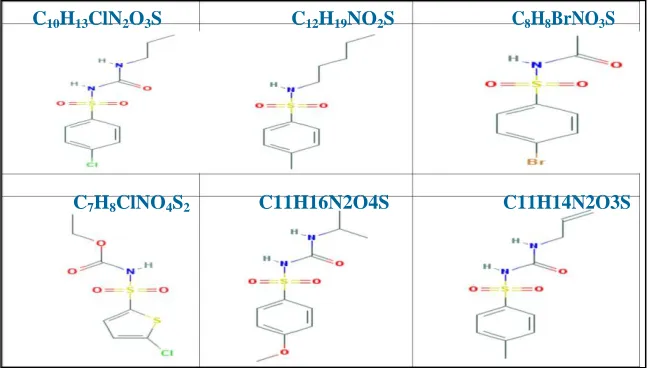
Chlorpropamide C10H13ClN2O3S (Figure 1) is an antidabetic drug , Chlorpropamide is an oral hypoglycemic drug belonging with
a sulfonylurea group and is used for the treatment of type Π diabetes mellitus in adults when not complicated [1-5] .Along-acting first generation sulfonylurea with hypoglycemic activity [6,7].Compared to other sulfonylureas, Chlorpropamide has an increased risk of prolonged hypoglycemic because of its long half – life [8].therapy with sulfonylurea drugs was instituted in type п diabetic patients at the beginning of the 1950, Chlorpropamide, is sulfonylurea derivative presenting prolonged pharmacological action [9]. Chlorpropamide belongs to class п of the biopharmaceutical classification exhibiting poor solubility which causes problems during absorption. The polymorphic character of Chlorpropamidum was first reported by Simmons [3].
However, in the medicinal chemistry literature Chlorpropamide derivatives (Figure 1) are always presented as structure which leads to a misleading perception [8-10]. Especially when molecular modeling – based studies are being increasingly employed for the study of theoretical computational. It is important to identify the appropriate structures and the detailed electronic charge distribution. Dipole moment , total energy and other properties in Chlorpropamide and derivatives. Amide bonds are indeed pre sent in a huge array of molecules, including major marketed drugs [11-13]. Hence amides and their derivatives have attracted continuing interest over the years.
C10H13ClN2O3S C12H19NO2S C8H8BrNO3S
[image:1.595.100.425.587.771.2]
C7H8ClNO4S2 C11H16N2O4S C11H14N2O3S
139
MATERIAL AND METHODS
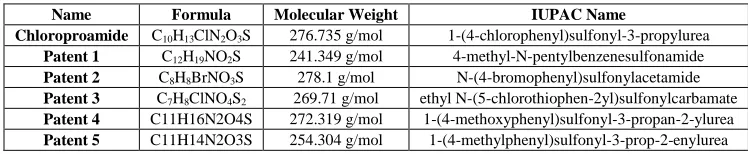
[image:2.595.110.484.135.212.2]Figure 2 shows the structural formula and the atomic position numbers assigned in this work, the molecular structures of Chlorpropamide and derivatives are presented in (Figure 2) and Table 1 respectively.
Table 1: Chlopropamide data with derivatives
Name Formula Molecular Weight IUPAC Name
Chloroproamide C10H13ClN2O3S 276.735 g/mol 1-(4-chlorophenyl)sulfonyl-3-propylurea
Patent 1 C12H19NO2S 241.349 g/mol 4-methyl-N-pentylbenzenesulfonamide
Patent 2 C8H8BrNO3S 278.1 g/mol N-(4-bromophenyl)sulfonylacetamide
Patent 3 C7H8ClNO4S2 269.71 g/mol ethyl N-(5-chlorothiophen-2yl)sulfonylcarbamate
Patent 4 C11H16N2O4S 272.319 g/mol 1-(4-methoxyphenyl)sulfonyl-3-propan-2-ylurea
Patent 5 C11H14N2O3S 254.304 g/mol 1-(4-methylphenyl)sulfonyl-3-prop-2-enylurea
The program that used in the search:
Gaussian 09
An electronic structural package capable of predicting many properties of atoms, molecules, reactive system[14], e.g. : Molecular energies
Structures
Vibrational frequencies Electron densities
Utilizing ab -initio, density functional theory, semi-empirical, e.g.
Gauss View 5.08
Graphical interface for Gaussian 09 [14-16] Sketch molecules
Setup Gaussian 09 input files Graphically examine results
Molden
A graphical interface for Gaussian 09 and other program Setup Gaussian 09 input files
Graphically examine results
Computational Details
The molecular geometry optimization ,calculations of total energy, Vibration frequencies ,IR intensities, dipole moment, charge distribution , bond length ,and HOMO- LUMO energy for Chlorpropamide and its derivatives by Gaussian 09 software package [17] using (HF,DFT/B3LYP functional ,AM1, PM3) method [17-20]. The first step of the calculation, of the total energy of drug at (AM1,PM3),(HF/6-3IG level of theory and (DFT/B3lyp/6-31G) methods. For the lowest energy conformer, the geometric structure was reoptimized at the four methods. Then the vibrational frequencies, IR intensities were also calculated at the four methods [21,22]. The vibrational frequency calculations at the same methods of theory revealed no imaginary frequencies, indicating that an optimal geometry at this level of approximation was found for the title compound [23,24].
140
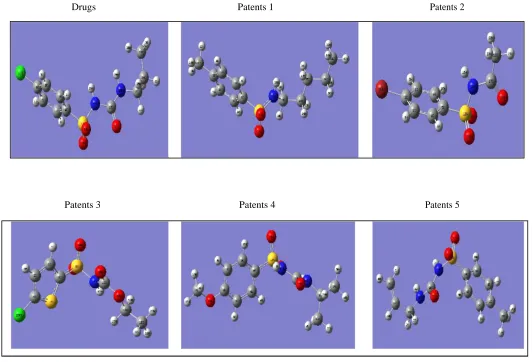
Drugs Patents 1 Patents 2
[image:3.595.57.589.42.404.2]Patents 3 Patents 4 Patents 5
Figure 2: 3D Structure of several of Chlorpropamidum and derivatives in Gaussian 09 program
RESULT AND DISCUSSION
Molecular Structure
The schematic depiction of the drug with its derivatives by structure optimization are shown in
Figure 2 and the optimized bond length of Chlorpropamide and its derivatives which were calculated by using four methods with different basis set are shown in Table 2. By compares the calculated geometric parameters for the drug and its derivatives, the bond length shows a good relationally agreement for the different methods [25,26]. The geometry optimization of bond length for the derivatives shows a slightly difference from the drug bond lengths Table 2 . Due to the fact that the theoretical calculation deals with an isolated molecule in water solvent and 310k temperature. The mean values of (S- O), ( S- N),(C- S) ,bond length which calculate by (AM1,PM3) were shorter than that of (HF,DFT ) which used force field theory. It's not possible to predict the activity of a compound depending on the bond length character alone, on other bond derivatives (2, 3) give the most similarity in bond length with drug for four methods.
Bond Length( G 09)
Bond Drug 1
Patent
1 Patent 2 Patent 3 Patent 4 Patent 5 AM1 PM3 AM1 PM3 AM1 PM3 AM1 PM3 AM1 PM3 AM1 PM3
S12 =
O13 1.40 1.45 1.42 1.48 1.41 1.45 1.41 1.45 1.41 1.46 1.41 1.46 S12
=O18 1.40 1.45 1.42 1.48 1.41 1.46 1.45 1.40 1.41 1.46 1.41 1.46 S12 –
N14 1.64 1.76 1.59 1.75 1.64 1.76 1.63 1.74 1.63 1.76 1.64 1.76 C4– S12 1.67 1.76 1.67 1.76 1.67 1.76 1.64 1.73 1.65 1.75 1.66 1.75
C16 =
[image:3.595.137.466.612.770.2]141 C16 –
N14 1.41 1.42 1.43 1.48 1.39 1.42 1.38 1.41 1.38 1.43 1.40 1.42
Bond Length( G 09)
Bond Drug 2 Patent 1 Patent 2 Patent 3 Patent 4 Patent 5
HF DFT HF DFT HF DFT HF DFT HF DFT HF DFT
S12 =
O13 1.64 1.63 1.64 1.64 1.64 1.63 1.64 1.63 1.63 1.63 1.63 1.63 S12
=O18 1.64 1.63 1.64 1.64 1.64 1.63 1.64 1.63 1.64 1.65 1.64 1.64 S12 –
N14 1.72 1.75 1.72 1.81 1.73 1.81 1.78 1.82 1.72 1.81 1.72 1.80 C4– S12 1.82 1.86 1.82 1.85 1.82 1.86 1.79 1.80 1.82 1.85 1.82 1.86
C16 =
O17 1.23 1.25 ….. …. 1.86 1.79 1.22 1.24 1.23 1.25 1.23 1.25 C1 -Cl11 1.80 1.82 …. …. 1.22 1.24 1.76 1.78 …. …. …. …..
C16 –
[image:4.595.137.466.41.219.2]N14 1.40 1.40 1.47 1.48 1.37 1.38 1.36 1.38 1.33 1.34 1.38 1.39
Table 2: Bond length for the drug and its derivatives in water solvent at 310 k temperature
Thermodynamic Parameters and Molecular Properties
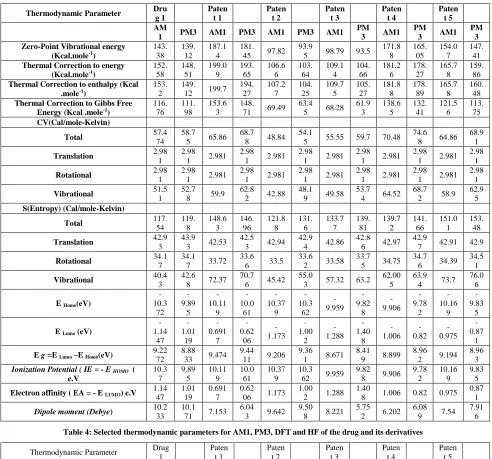
To evaluate the energetic behavior of the title compound in water solvent media theoretical calculations were Carried out at 310 k. Total energies and dipole moments have been calculated in solvent media with (AM1,PM3) and (HF,DFT/B3LYP/6-31G) level for Chlorpropamide drug and its derivatives . Tables 3,4 lists the calculated values of some thermodynamic parameters (such as zero-point vibrational energy, enthalpy, EHOMO, ELUMO, Gibbs free energy).
Thermal corrections to (energy, enthalpy, entropy and Gibbs free energy). Chlopropamide and its derivatives. were obtained using( AM1,PM3) methods, showed that the patent 1,4 have higher energy which means that both compounds were than the drug, on other hand patent 2,3 is less stable due to lower energy, the only patent has similar energy is patent 5. The result obtained using (HF.DFT) method predicts the same evaluation. The value of dipole moment (D.M) for drugs was also calculated in Tables 3,4. Dipole moment is a measure of the molecular charge distribution. Direction of the (D.M) in a molecule depends on the centers of positive and negative charges. As a result of calculations, the highest dipole moment was observed for drug in HF/6-31G (13.0890) whereas the smallest one was observed for drug in PM3 (10.1718) the value of dipole moment due to their effect on the charge density of the molecule. The value of the (D.M) for the compounds is a characters for the polarity of the compounds mostly, the higher the compound polarity the higher that activity of it. As Tables 3,4 shows that Patent 2 was the only derivative has a (D.M) similar to that of the drug. Tables 5,6 shows effective atomic charge calculations which have an important role in the application of quantum chemical calculation to the molecular system the atomic charge levels to the dipole moment, molecular polarization, electronic structure of drug, and the comparison of the different methods to describe the electron distribution of the drugs with its derivatives. Milliken charge distributions were calculated by determining the electron population of each atom as defined by the four methods. The results in the (AM1, PM3, HF, and DFT) were in Tables 5,6. The charge change with method, basis set presumable occurs due to polarization. In the atomic charge calculation O12, O13, N14, and
C26 atoms exhibit a substantial negative charge, which are donor atom. S11 and C16 atoms exhibits a positive charge,
which is an acceptor atom Tables 5,6. These atoms may also play an important role in the biological activity of drugs. The vibration entropy and CV are found considerably change by changing the methods. The DFT/B3LYP/6-31G result
have been given the biggest value for Chlorpropamide for vibrational entropy (69.482) (Cal/mole-Kelvin) and the biggest vibrational CV (61.430) (Cal/mole-Kelvin) value whereas the five derivatives have been given the more stability
for patents 2 and 3. Mostly, (DFT) method is more professional way to evaluate the methods characters due to its modern and complex calculations, there its results more reliable that other method. DFT method give a relatively similar results for the energy evaluations but not for the HOMO, LUMO energies and the Dipole moment which give relativity different results as Tables 3,4 shows. Because the study is correlation study, there the different in results will not affect the study. Tables 3,4 shows that all the methods evaluate D.M results ,and patent. 2 has D.M in a good agreement with drug.
HOMO and LUMO analysis
142
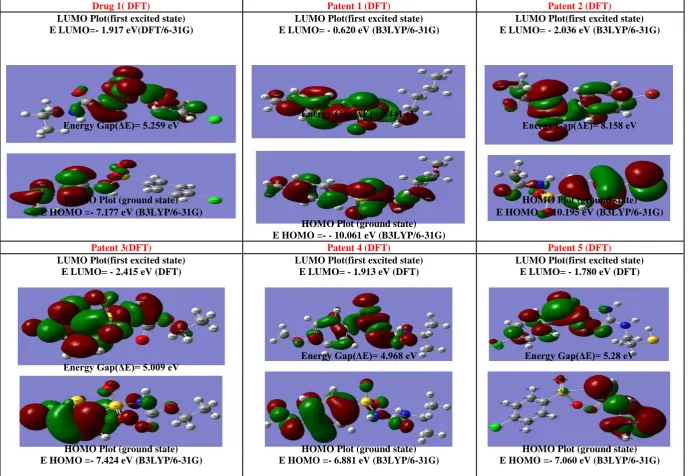
electron; HOMO represents the ability to donate an electron. The LUMO-HOMO energy gap of drugs shows that the energy gap reflects the chemical reactivity of the molecule. That is the smaller value of Eg, the easer electron transfers from HOMO orbital to LUMO orbital. According to the results obtained by methods (AM1, PM3, HF, DFT ) of E HOMO, E LUMO, and Eg for the drug and its derivatives , it was found that patent 2,3,4 in a good a agreement with drug characters (Tables 3,4 and Figures 3-5) .
Table 3: Selected thermodynamic parameters for AM1, PM3, DFT and HF of the drug and its derivatives
Thermodynamic Parameter Dru g 1 Paten t 1 Paten t 2 Paten t 3 Paten t 4 Paten t 5 AM
1 PM3 AM1 PM3 AM1 PM3 AM1
PM
3 AM1
PM
3 AM1
PM 3 Zero-Point Vibrational energy
(Kcal.mole-1)
143. 38 139. 12 187.1 4 181. 45 97.82
93.9
5 98.79 93.5 171.8 8 165. 05 154.0 7 147. 41
Thermal Correction to energy (Kcal.mole-1)
152. 58 148. 51 199.0 9 193. 65 106.6 6 103. 64 109.1 4 104. 66 181.2 6 178. 27 165.7 8 159. 86
Thermal Correction to enthalpy (Kcal .mole-1)
153. 2
149. 12 199.7
194. 27 107.2 7 104. 25 109.7 5 105. 27 181.8 8 178. 89 165.7 8 160. 48
Thermal Correction to Gibbs Free
Energy (Kcal .mole-1) 116.76 111.98 153.63 148.71 69.49 63.45 68.28 61.93 138.65 132.41 121.56 113.75
CV(Cal/mole-Kelvin)
Total 57.474 58.75 65.86 68.7 8 48.84
54.1
5 55.55 59.7 70.48 74.6
8 64.86 68.9
1
Translation 2.98
1 2.98
1 2.981 2.98
1 2.981 2.98
1 2.981 2.98
1 2.981 2.98
1 2.981 2.98
1
Rotational 2.98
1 2.98
1 2.981 2.98
1 2.981 2.98
1 2.981 2.98
1 2.981 2.98
1 2.981 2.98
1
Vibrational 51.51 52.78 59.9 62.8 2 42.88
48.1 9 49.58
53.7 4 64.52
68.7 2 58.9
62.9 5
S(Entropy) (Cal/mole-Kelvin)
Total 117.54 119.8 148.63 146.96 121.88 131.6 133.77 139.81 139.72 141.66 151.01 153.48
Translation 42.9
3 43.9
3 42.53 42.5
3 42.94 42.9
4 42.86 42.8
6 42.97 42.9
7 42.91 42.9
Rotational 34.1
7 34.1
7 33.72 33.6
6 33.5
33.6 2 33.58
33.7 5 34.75
34.7 6 34.39
34.5 1
Vibrational 40.4
3 42.6
8 72.37 70.7
6 45.42 55.0
3 57.32 63.2 62.00
5 63.9
4 73.7 76.0
6
E Homo(eV)
-10.3 72 -9.89 5 -10.11 9 -10.0 61 -10.37 9 -10.3 62 -9.959 -9.82 8 -9.906 -9.78 2 -10.16 9 -9.83 5
E Lumo (eV)
-1.14 47 -1.01 19 -0.691 7 -0.62 06 -1.173 -1.00 2 -1.288 -1.40 8 -1.006 -0.82 -0.975 -0.87 1
E g =E Lumo –E Homo(eV)
9.22 72
8.88 33 9.474
9.44 11 9.206
9.36 1 8.671
8.41 9 8.899
8.96 2 9.194
8.96 3
Ionization Potential ( IE = - E HOMO (
e.V 10.3 7 9.89 5 10.11 9 10.0 61 10.37 9 10.3 62 9.959
9.82 8 9.906
9.78 2 10.16 9 9.83 5
Electron affinity ( EA = - E LUMO) e.V
1.14 47 1.01 19 0.691 7 0.62 06 1.173
1.00 2 1.288
1.40
8 1.006 0.82 0.975 0.87
1
Dipole moment (Debye) 10.2
33 10.1
71 7.153 6.04
3 9.642 9.50
8 8.221 5.75
2 6.202 6.08
9 7.54 7.91
[image:5.595.58.550.116.575.2]6
Table 4: Selected thermodynamic parameters for AM1, PM3, DFT and HF of the drug and its derivatives
Thermodynamic Parameter Drug 1 Paten t 1 Paten t 2 Paten t 3 Paten t 4 Paten t 5
HF DFT HF DFT HF DFT HF DFT HF DFT HF DFT
Zero-Point Vibrational energy (Kcal.mole-1)
153.7 5 143.2 5 198.6 2 185. 96 103.2 8 96.93
103.1 5 95.3 3 181.8 9 169. 79 163.3 9 151. 82 Thermal Correction to energy (Kcal.mole
-1) 162.12 155.48 210.26 189.22 112.41 103.89 113.58 106.54 194.17 182.77 174.76 164.05
Thermal Correction to enthalpy (Kcal .mole-1)
162.7 3 155.4 7 210.8 7 189. 83 113.0 2 104.5 1 114.2
107. 15 194.7 9 183. 39 174.7 6 164. 67 Thermal Correction to Gibbs Free Energy
(Kcal .mole-1)
127.4 1 110.5 4 164.9 9 153.
12 74.96 71.95 72.79 63.2
3 149.7
6 137.
03 131.6 119.
1 CV (Cal/mole-Kelvin)
Total 50.67 67.39 63.76 68.1
7 49.67 41.32 55.57 59.3
8 68.73 73.1
6 62.67 67.6
3
Translation 2.981 2.981 2.981 2.98
1 2.981 2.981 2.981 2.98
1 2.981 2.98
1 2.981 2.98
1
Rotational 2.981 2.981 2.981 2.98
1 2.981 2.981 2.981 2.98
1 2.981 2.98
1 2.981 2.98
1
Vibrational 44.71 61.43 57.8 62.2
1 43.71 35.35 49.61 53.4
2 62.77 67.2
1 56.72 61.6
143
Total 113.94 146.93 148.01 147.45 122.76 105.04 133.57 141.7 145.24 149.55 141.23 146.99
Translation 42.93 42.93 42.53 42.5
3 42.94 42.94 42.86 42.8
6 42.89 42.8
9 42.69 42.6
9
Rotational 34.17 34.51 33.65 33.7
6 33.63 33.44 33.84 33.9 34.3 34.1
4 33.7
33.7 9
Vibrational 36.83 69.48 71.82 71.1
6 46.18 28.65 56.87 64.9
2 68.04 72.5
2 64.83 70.5
E Homo(eV)
-10.40 8 -7.177 -9.902 8 -7.20 8 -10.22 8 -10.19 5 -10.36 6 -7.42 4 -9.588 -6.88 1 -9.926 -7.06
E Lumo (eV)
1.918 9 -1.917 2 -2.461 2 -1.37 7 1.894 9 -2.036 4 1.388 8 -2.41 5 -2.393 -1.91 3
2.258 -1.78
E g =E Lumo –E Homo(eV)
12.32 6 5.259 7 12.36 4 5.83 09 12.12 2 8.058 6 11.75 4 5.00 87 11.98 1 4.96 83 12.18 4 5.27 97
Ionization Potential ( IE = - E HOMO(e.V 10.40 8 7.177 4 9.902 8 7.20 81 10.22 8 10.19 5 10.36 6 7.42 4 9.588
6.88 1 9.926 5 7.06 07
Electron affinity ( EA = - E LUMO) e .V
-1.918 9 1.917 2 2.461 2 1.37 7 -1.894 9 2.036 4 1.388 8 2.41 5 2.303
1.91
3 2.258 1.78
Dipole moment (Debye) 13.08 9 11.88 8 9.477 7 8.48 68 12.64 9 11.42 9 8.100 9 7.36 54 11.42 1 8.28 47 10.50 2 9.21 31
Table 5: Selected atomic charges of drugs with derivatives in AM1, PM3
NO Atoms Drugs Patents 1 Patents 2 Patents 3 Patents 4 Patents 5
PM3 AM1 PM3 AM1 PM3 AM1 PM3 AM1 PM3 AM1 PM3 AM1
1 C -0.082 -0.004 -0.136 -0.166 -0.107 -0.132 -0.320 -0.412 -0.210 -0.233 -0.138 -0.169
2 C -0.132 -0.153 -0.136 -0.166 -0.072 -0.108 -0.161 -0.182 0.157 0.157 -0.137 -0.168
3 C 0.035 0.007 -0.008 0.004 -0.107 -0.131 0.062 -0.012 -0.182 -0.197 -0.004 0.014
4 C -0.573 -0.852 -0.548 -0.854 -0.563 -0.838 -0.802 -1.284 -0.616 -0.911 -0.577 -0.873
5 C 0.035 0.008 0.010 0.009 -0.028 -0.002 ……… ………. 0.030 0.026 0.020 -0.001
6 C -0.131 -0.153 -0.136 -0.166 -0.029 -0.002 ……… ……… 0.061 0.038 0.020 0.001
7 H 0.133 0.169 0.123 0.153 0.138 0.169 0.152 0.183 0.138 0.166 0.124 0.154
8 H 0.126 0.166 0.121 0.155 0.138 0.169 0.144 0.186 0.133 0.166 0.124 0.154
9 H 0.126 0.167 0.120 0.153 0.127 0.167 ……… ……… 0.131 0.161 0.122 0.162
10 H 0.133 0.169 0.123 0.153 0.127 0.167 ……… ……… 0.122 0.162 0.120 0.158
11 S 2.318 2.907 2.217 2.893 2.307 2.888 2.376 2.951 2.308 2.905 2.363 2.900
12 O -0.867 -0.967 -0.884 -0.987 -0.868 -0.968 -0.844 -0.959 -0.865 -0.978 -0.866 -0.965
13 O -0.866 -0.970 -0.881 -0.986 -0.867 -0.968 -0.854 -0.961 -0.862 -0.966 -0.866 -0.968
14 N -0.474 -0.853 -0.469 -0.896 -0.486 -0.852 -0.468 -0.841 -0.471 -0.861 -0.466 -0.848
15 H 0.144 0.277 0.134 0.263 0.146 0.278 0.152 0.280 0.149 0.277 0.194 0.276
16 C 0.312 0.422 ……….. ………. 0.354 0.359 0.440 0.444 0.326 0.436 0.312 0.422
17 O -0.472 -0.458 ……… …… -0.434 -0.402 -0.459 -0.403 -0.445 -0.445 -0.467 -0.449
18 N -0.022 -0.329 ……… …… ……….. ………. ……… ……… -0.080 -0.353 -0.034 -0.336
19 H 0.090 0.242 ……… ……… ………. ……….. ……… ……… 0.106 0.250 0.099 0.242
20 C -0.074 -0.036 -0.024 -0.008 ………. ……….. 0.061 -0.027 -0.043 0.019 -0.041 -0.013
21 H 0.064 0.113 0.069 0.104 ………. ………. 0.054 0.103 0.079 0.116 0.071 0.116
144
23 C -0.114 -0.907 -0.129 -0.175 ………. ………. ……… ……… ……… ……… -0.151 -0.198
24 H 0.061 0.090 0.064 0.096 ………. ………. ……… ……… ……… ……… 0.108 0.137
25 H 0.059 0.098 0.063 0.089 ………. ………. ……… ……… ……… ……… ……….. ……….
26 C -0.114 -0.219 -0.106 -0.162 -0.136 -0.242 -0.123 -0.221 -0.137 -0.221 -0.162 -0.217
27 H 0.042 0.079 0.055 0.083 0.077 0.128 0.050 0.091 0.048 0.084 0.090 0.121
28 H 0.040 0.075 0.053 0.081 0.070 0.120 0.059 0.106 0.053 0.092 0.088 0.116
29 H 0.080 0.080 ………. ………. 0.078 0.127 0.050 0.091 0.050 0.084 …….. ……..
30 Cl 0.093 0.008 ……… ……….. ………. ………. 0.209 0.082 ……… ……… …….. ……..
31 C ……… ………. -0.096 -0.160 ………. ………. ……… ……… ……… ……… …….. ……..
32 H ……… ………. 0.055 0.083 ………. ………. ……… ……… ……… ……… …….. ……..
33 H ……… ………. 0.053 0.081 ………. ………. ……… ……… ……… ……… …….. ……..
34 O ……… ………. …….. ……….. ………. ………. -0.247 -0.255 -0.196 -0.214 …….. ……..
35 S ……… ………. ……… …… ………. ………. 2.376 2.951 ……… ……… …….. ……..
36 C ……… ………. -0.110 -0.213 ………. ………. ……… ……… -0.125 -0.242 …….. ……..
37 H ……… ………. 0.038 0.073 ………. ………. ……… ……… 0.053 0.083 …….. ……..
38 H ……… ………. 0.038 0.073 ………. ………. ……… ……… 0.047 0.084 …….. ……..
39 H …… ………. 0.039 0.073 ………. ………. ……… ……… 0.049 0.092 …….. ……..
40 C ………
. ………. -0.080 -0.200 ………. ………. ……… ……… -0.048 -0.085 -0.082 -0.202
41 H ………
. ………. 0.059 0.103 ………. ………. ……… ……… 0.042 0.093 0.060 0.097
42 H ………
. ………. 0.054 0.095 ………. ………. ……… ……… 0.057 0.119 0.056 0.099
43 H ………
. ………. 0.055 0.098 ………. ………. ……… ……… 0.040 0.092 0.056 0.105
44 Br …… ………. ……… ……… 0.018 0.074 ……… ……… ……… ……… …….. ……..
Table 6: Selected atomic charges of drugs with derivatives in HF, DFT
N Ato Drugs Patents 1 Patents 2 Patents 3 Patents 4 Patents 5
O ms
HF DFT HF DFT HF DFT HF DFT HF DFT HF DFT
1 C -0.293 -0.225 -0.224 -0.156 -0.146 -0.083 -0.641 -0.565 0.238 -0.131 -0.230 -0.160 2 C -0.154 -0.090 -0.111 -0.090 -0.361 -0.287 -0.076 -0.008 0.438 0.306 0.021 0.118 3 C -0.091 -0.066 -0.235 0.157 -0.146 -0.083 0.014 0.022 -0.241 -0.128 -0.238 -0.164 4 C -0.530 -0.342 -0.509 -0.313 -0.533 -0.347 -0.836 -0.639 -0.515 -0.316 -0.501 -0.301 5 C -0.091 -0.066 0.017 0.115 -0.091 -0.064 ……… ……… -0.072 -0.080 -0.082 -0.063 6 C -0.154 -0.090 -0.105 -0.082 -0.091 -0.064 ……… ……… -0.101 -0.092 -0.107 -0.085
7 H 0.281 0.202 0.244 0.165 0.274 0.197 0.296 0.231 0.263 0.185 0.245 0.167
8 H 0.301 0.216 0.243 0.164 0.274 0.197 0.315 -0.609 0.254 0.178 0.245 0.166
9 H 0.301 0.216 0.285 0.194 0.300 0.215 ……… ……… 0.286 0.205 0.283 0.198
10 H 0.281 0.202 0.285 0.196 0.300 0.215 ……… ……… 0.289 0.207 0.283 0.201
11 S 1.816 1.332 1.758 1.245 1.807 1.326 1.822 1.353 1.820 1.292 1.819 1.326
12 O -0.744 -0.595 -0.786 -0.624 -0.744 -0.593 -0.742 -0.571 -0.795 -0.568 -0.758 -0.602 13 O -0.744 -0.595 -0.775 -0.633 -0.744 -0.593 -0.726 -0.790 -0.776 -0.587 -0.775 -0.635 14 N -1.128 -0.846 -0.985 -0.707 -1.081 -0.792 -1.081 -0.411 -1.119 -0.814 -1.117 -0.824
15 H 0.472 0.299 0.427 0.360 0.475 0.404 0.485 0.766 0.469 0.385 0.470 0.395
16 C 1.147 0.779 ……… ……… 0.795 0.559 1.141 0.182 0.150 0.715 1.141 0.767
17 O -0.684 -0.523 ……… ……… -0.622 -0.478 -0.618 -0.472 -0.692 -0.514 -0.682 -0.522
145
19 H 0.419 0.359 ……… ………. ………. ………. ……… ……… 0.414 0.375 0.420 0.358
20 C -0.073 -0.096 -0.104 -0.149 ………. ………. ……… ……… 0.045 0.049 -0.102 -0.142
21 H 0.205 0.171 0.219 0.185 ………. ………. ……… ……… 0.212 0.164 0.214 0.179
22 H 0.197 0.162 0.217 0.187 ………. ………. ……… ……… …….. …….. 0.223 0.194
23 C -0.300 -0.232 -0.320 -0.257 ………. ………. 0.017 -0.022 ……….. ……… -0.142 0.065
24 H 0.171 0.142 0.174 0.144 ………. ………. 0.210 0.182 ……… ……… 0.195 0.142
25 H 0.168 0.140 0.176 0.153 ………. ………. 0.210 0.182 …….. ……… ………. ……….
26 C -0.463 -0.415 -0.298 -0.239 -0.538 -0.475 -0.470 -0.422 -0.432 -0.391 -0.376 -0.308
27 H 0.154 0.137 0.156 0.131 0.230 0.201 0.182 0.162 0.169 0.147 0.178 0.139
28 H 0.159 0.139 0.155 0.124 0.226 0.191 0.183 0.163 0.160 0.141 0.177 0.136
29 H 0.162 0.141 ……….. ………. 0.230 0.201 0.182 0.162 0.165 0.144 ………. ………
30 Cl 0.109 0.081 ……… …… ………. ………. 0.171 0.155 ……. …….. ………. ………
31 C
……
… ……… -0.299 -0.238 ………. ………. ……… ……… ……. ……. ………. ………
32 H
……
… ……… 0.154 0.129 ………. ………. ……… ……… ……. ……. ………. ………
33 H
……
… ……… 0.154 0.129 ………. ………. ……… ……… ……. ……. ………. ………
34 O
……
… ……… …… ………. ………. ………. -0.736 -0.519 -0.795 -0.568 ………. ………
35 S
……
… ……… ……….. ……… ………. ………. 0.694 0.218 ……. ……. ………. ………
36 C
……
… ……… -0.457 -0.412 ………. ………. ……… ……… -0.456 -0.418 ………. ……….
37 H
……
… ……… 0.154 0.133 ………. ………. ……… ……… 0.174 0.150 ………. ……….
38 H
……
… ……… 0.151 0.134 ………. ………. ……… ……… 0.176 0.152 ………. ……….
39 H
……
… ……… 0.152 0.134 ………. ………. ……… ……… 0.165 0.146 ………. ……….
40 C
……
… ……… -0.480 -0.483 ………. ………. ……… ……… -0.146 -0.191 -0.479 -0.483
41 H
……
… ……… 0.194 0.177 ………. ………. ……… ……… 0.187 0.178 0.198 0.178
42 H …… ……… 0.191 0.165 ………. ………. ……… ……… 0.209 0.189 0.188 0.164
43 H
……
… ……… 0.185 0.163 ………. ………. ……… ……… 0.187 0.178 0.187 0.165
44 Br ……
… ……… ……… ……… 0.186 0.155 …….. …….. …….. …….. …….. ……..
Assignment of Vibration Spectra
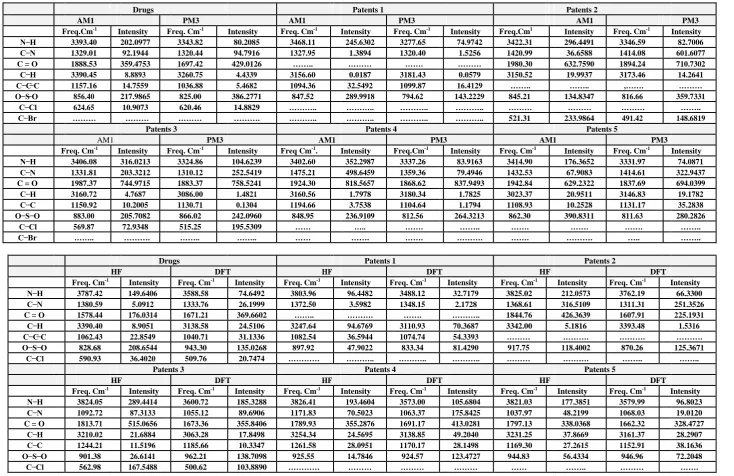
The observed and calculated frequencies using four methods (AM1, PM3, HF/6-31G, DFT/B3LYP/6-31G) with their absolute intensities were shown in Tables 7, 8. In order to facilitate assignment of the observed peaks we have analyzed some vibrational frequencies, and compared our calculated results of the Chlopropamide with their five derivatives which shown in Tables 7,8. In present study, theoretical calculations of vibrational spectra using different methods and different basis sets were compared drugs with the derivatives to obtain a com. The best frequencies calculated by DFT which was in a good agreement with drug frequencies results.
s
Stretching type vibrations of amine functional group has 3300-3500 cm-1 characteristic absorption fre uencies. stretching modes have been calculated as (3343-3393) cm-1 (AM1, vibrations for Chlorpropamide, stretching modes, the longer NH intermolecular hydrogen bonds because of some interesting effect, such as, the temperature and water solvent and different theoretical methods.
PM3) and (3588 – 3787) cm-1(HF, DFT) .We have assigned the stretching modes to the
frequency of the (3371cm-1) [1] in the experimental spectra. The high wavenumber fundamental
CH3,CH2 -Vibrations
In the frequency range (2800-3000) [1] cm-1 .As shown in Table 7,8 ,calculated CH2 have been assigned at (3260-3390)
cm-1 in (AM1,PM3) and (3183-3390) cm-1 in (HF,DFT) are observed in the IR-spectra of the Chlorpropamide. It can be interpreted as a consequence of the Fermi-resonance between the fundamental vibrations (CH2) and (CH3), combination
146
can be assigned to the stretching vibrations of theCH3- and CH2- groups(derivatives), in a good agreement with the
theoretical calculation for chloropropamide ,the disappearance of the resonance condition.
SO2 Vibrations
The observed bands at (1358- 1130) cm-1 in IR spectrum. We have assigned the SO2 –group as stretching antisymmetric and symmetric vibrations, but it is necessary to take into account, that these vibrations affected by the C C C and amide groups . he C stretching ibration is assigned at ( M M ) ( ) and the stretching modes at (AM1,PM3,HF) (820,779, 811) in our present study, the very strong band observed in FT-Raman at 721 by B3LYP/6-31G method which is in good agreement with the recorded spectral data.
n our present wor theoretical high alues in spectrum ha e been assigned to C stretching ibrations of Chlorpropamide (1329, 1320,1380 ,1333) in (AM1, PM3, HF,DFT), because the amide group with the main contributions coming from deformational in –plan C… … and stretching C ibration [29]. After compared the drugs in theoretical with experimental results, the assignment of the vibrational bands was made on the basis of the theoretical calculations for drugs and a comparison of the drugs measured vibrational spectra of the five derivatives and shown to be the derivatives 2.3 similarities with the Chlorpropamide.
C = O Vibrations
147
Drug 1( DFT) Patent 1 (DFT) Patent 2 (DFT)
LUMO Plot(first excited state) LUMO Plot(first excited state) LUMO Plot(first excited state)
E LUMO=- 1.917 eV(DFT/6-31G) E LUMO= - 0.620 eV (B3LYP/6-31G) E LUMO= - 2.036 eV (B3LYP/6-31G)
E e gy G p(ΔE)= 5.259 e
E e gy G p(ΔE)= 9.441 e
E e gy G p(ΔE)= 8.158 e
HOMO Plot (ground state) HOMO Plot (ground state)
E HOMO =- 7.177 eV (B3LYP/6-31G)
HOMO Plot (ground state)
E HOMO =- 10.195 eV (B3LYP/6-31G)
E HOMO =- - 10.061 eV (B3LYP/6-31G)
Patent 3(DFT) Patent 4 (DFT) Patent 5 (DFT)
LUMO Plot(first excited state) LUMO Plot(first excited state) LUMO Plot(first excited state)
E LUMO= - 2.415 eV (DFT) E LUMO= - 1.913 eV (DFT) E LUMO= - 1.780 eV (DFT)
E e gy G p(ΔE)= 5.009 e E e gy G p(ΔE)= 4.968 e E e gy G p(ΔE)= 5.28 e
HOMO Plot (ground state) HOMO Plot (ground state) HOMO Plot (ground state)
[image:10.842.74.768.36.512.2]E HOMO =- 7.424 eV (B3LYP/6-31G) E HOMO =- 6.881 eV (B3LYP/6-31G) E HOMO =- 7.060 eV (B3LYP/6-31G)
148
Drug 1 AM1 Patent 1AM1 Patent 2 AM1
Patent 3AM1 Patent 4 AM1 Patent 5 AM1
Drug 1 DFT Patent 1 DFT Patent 2 DFT
149
[image:12.842.54.789.63.539.2]Figures 4,5: Calculated theoretical IR- spectra of the chloropropamide in four methods (AM1, DFT)
Table 7,8: Theoretically calculated spectra of Chloropropamide and its derivatives
Drugs Patents 1 Patents 2
AM1 PM3 AM1 PM3 AM1 PM3
Freq.Cm-1
Intensity Freq. Cm-1
Intensity Freq. Cm-1
Intensity Freq. Cm-1
Intensity Freq.Cm1
Intensity Freq. Cm-1
Intensity 3393.40 202.0977 3343.82 80.2085 3468.11 245.6302 3277.65 74.9742 3422.31 296.4491 3346.59 82.7006 1329.01 92.1944 1320.44 94.7916 1327.95 1.3894 1320.40 1.5256 1420.99 36.6588 1414.08 601.6077
C = O 1888.53 359.4753 1697.42 429.0126 …….. ……… ……. ……… 1980.30 632.7590 1894.24 710.7302
3390.45 8.8893 3260.75 4.4339 3156.60 0.0187 3181.43 0.0579 3150.52 19.9937 3173.46 14.2641
1157.16 14.7559 1036.88 5.4682 1094.36 32.5492 1099.87 16.4129 …….. …….. ,……. ………
856.40 217.9865 825.00 386.2771 847.52 289.9918 794.62 143.2229 845.21 134.8347 816.66 359.7331
624.65 10.9073 620.46 14.8829 ……….. ……….. ……….. ……….. ……… ……… ……… ……..
……… ……… ……… ………. ……….. ……….. ……….. ……….. 521.31 233.9864 491.42 148.6819
Patents 3 Patents 4 Patents 5
AM1 PM3 AM1 PM3 AM1 PM3
Freq. Cm-1
Intensity Freq. Cm-1
Intensity Freq Cm-1.
Intensity Freq.Cm-1
Intensity Freq. Cm-1
Intensity Freq. Cm-1
Intensity 3406.08 316.0213 3324.86 104.6239 3402.60 352.2987 3337.26 83.9163 3414.90 176.3652 3331.97 74.0871 1331.81 203.3212 1310.12 252.5419 1475.21 498.6459 1359.36 79.4946 1432.53 67.9083 1414.61 322.9437 C = O 1987.37 744.9715 1883.37 758.5241 1924.30 818.5657 1868.62 837.9493 1942.84 629.2322 1837.69 694.0399 3160.72 4.7687 3086.00 1.4821 3160.56 1.7978 3180.34 1.7825 3023.37 20.9511 3146.83 19.1782 1150.92 10.2005 1130.71 0.1304 1194.66 3.7538 1104.64 1.1794 1108.93 10.2528 1131.17 35.2838 883.00 205.7082 866.02 242.0960 848.95 236.9109 812.56 264.3213 862.30 390.8311 811.63 280.2826
569.87 72.9348 515.25 195.5309 …… ….. ……. …….. ……. ……. ……. ……..
…….. ………. …….. …….. …… ……. ……. ………. ……. ………. ….. ……..
Drugs Patents 1 Patents 2
HF DFT HF DFT HF DFT
Freq. Cm-1 Intensity Freq. Cm-1 Intensity Freq. Cm-1 Intensity Freq. Cm-1 Intensity Freq. Cm-1 Intensity Freq. Cm-1 Intensity
3787.42 149.6406 3588.58 74.6492 3803.96 96.4482 3488.12 32.7179 3825.02 212.0573 3762.19 66.3300 1380.59 5.0912 1333.76 26.1999 1372.50 3.5982 1348.15 2.1728 1368.61 316.5109 1311.31 251.3526
C = O 1578.44 176.0314 1671.21 369.6602 …….. ………. ……. ……….. 1844.76 426.3639 1607.91 225.1931
3390.40 8.9051 3138.58 24.5106 3247.64 94.6769 3110.93 70.3687 3342.00 5.1816 3393.48 1.5316
1062.43 22.8549 1040.71 31.1336 1082.54 36.5944 1074.74 54.3393 ……… ………. ………. ……….
828.68 208.6544 943.30 135.0268 897.92 47.9022 833.34 81.4290 917.75 118.4002 870.26 125.3671
590.93 36.4020 509.76 20.7474 ………… ……….. ……….. ……….. ……… ………. …….. ……..
Patents 3 Patents 4 Patents 5
HF DFT HF DFT HF DFT
Freq. Cm-1 Intensity Freq. Cm-1 Intensity Freq. Cm-1 Intensity Freq. Cm-1 Intensity Freq. Cm-1 Intensity Freq. Cm-1 Intensity
3824.05 289.4414 3600.72 185.3288 3826.41 193.4604 3573.00 105.6804 3821.03 177.3851 3579.99 96.8023 1092.72 87.3133 1055.12 89.6906 1171.83 70.5023 1063.37 175.8425 1037.97 48.2199 1068.03 19.0120 C = O 1813.71 515.0656 1673.36 355.8406 1789.93 355.2876 1691.17 413.0281 1797.13 338.0368 1662.32 328.4727
3210.02 21.6884 3063.28 17.8498 3254.34 24.5695 3138.85 49.2040 3231.25 37.8669 3161.37 28.2907 1244.21 11.5196 1185.66 10.3347 1261.58 28.0951 1170.17 28.1498 1169.30 27.2615 1152.91 38.1636 901.38 26.6141 962.21 138.7098 925.55 14.7846 924.57 123.4727 944.83 56.4334 946.96 72.2048
150 CONCLUSION
From theoretical studies method (AM1,PM3,HF,DFT) were used to measure the physical and chemical characters of the drug chloropropamide and its five derivatives. The characters stability, activity and the polarity were used as correlation factors for the drug and its derivatives to choose the best derivative as drug.The evaluation of the different kind of energy point to the patents which has similar stability to the drug. By comparing the energy gap which is the character four activity , patent 2 has an activity close to the one of the drug. The calculation was done using high value solvent (water) then the polarity is an important factor. By compare the (D.M) for the drug and its derivatives, patent 2 is the only derivative which has an (D.M) similar to that of drug. From above results its can said that patent 2 are the only derivatives which ability to be an possible drug.
REFERENCES
[1] YA Chesalov; VP Baltakhinov; TN Drebushchak; EV Boldyreva; NV Chukanov; VA Drebushchak. J Molecular Structure. 2008, 891, 75-86.
[2] FD Freire; CFS Aragão; FN Raffin. J Thermal Analysis Calorimetry. 2009, 97, 355. [3] D Simmons; R Ranz; N Gyanchandani. Canadian J Pharm Sci. 1973, 8, 125-127. [4] A Burger. Sci Pharm. 1975, 43, 152-161.
[5] E Kichano ; Kozlen o; J Wąsic i; W awroci ; L ubro ins y; Liermann; W Morgenroth; B a en o. J Pharm Sci. 2015, 104, 81-86.
[6] MA Root; MV Sigal; R Anderson. Diabetes. 1959, 8, 7-13. [7] M Fitzgerald; R Gaddie. J Malins. Diabetes. 1962, 11, 40.
[8] LS Goodman. Goodman and Gilman's the pharmacological basis of therapeutics, McGraw-Hill New York, 1996. [9] A Ayala; M Caetano; S Honorato; J Mendes Filho; H Siesler; S Faudone; S Cuffini; F Martins; C da Silva; J Ellena. J
Raman Spectroscopy. 2012, 43, 263-272.
[10] TN Drebushchak; NV Chukanov; EV Boldyreva. Acta Crystallographica Section C: Crystal Structure Communications. 2007, 63, o355-o357.
[11] N Choudhary; S Bee; A. Gupta; P Tandon. Computational Theoretical Chem. 2013, 1016, 8-21. [12] E Valeur; M Bradley. Chem Society Reviews. 2009, 38, 606-631.
[13] AA Patchett. J Med Chem. 1993, 36, 2051-2058.
[14] M Khosrow-Pour. Contemporary Advancements in Information Technology Development in Dynamic Environments, IGI Global, 2014.
[15] V Barone, J Bloino, M Biczysko. Vibrationally-resolved electronic spectra in GAUSSIAN 09, Revision a, 2 , 2009. [16] CK Carter; R Kohn. Biometrika, 1996, 83, 589-601.
[17] RJ Xavier; E Gobinath. Spectrochimica Acta Part A: Molecular and Biomolecular Spectroscopy. 2012, 91, 248-255. [18] M Frisch; GW Trucks; HB Schlegel; GE Scuseria; MA robb, Jr Cheeseman; BB Stefanov. J Chem Phy. 2004, 82,
69-83.
[19] M Remko. J Molecular Structure: Theochem. 2009, 897, 73-82.
[20] A Klamt; G Schüürmann. J Chem Society: Perkin Transactions 2. 1993, 799-805. [21] C Lee; W Yang; RG Parr. Physical Review B. 1988, 37, 785.
[22] M Cossi; N Rega; G Scalmani; V Barone. J Computational Chem. 2003, 24, 669-681. [23] AD Becke. J Chem Phys. 1993, 98, 5648-5652.
[24] C Çıra ; Y ert; Ucun. Spectrochimica Acta Part A: Molecular and Biomolecular Spectroscopy. 2012, 92, 406-414. [25] E aşal; M Kumalar. Spectrochimica Acta Part A: Molecular and Biomolecular Spectroscopy. 2012, 96, 548-562. [26] S Ricken; M Schürmann; H Preut; P Eilbracht. Acta Crystallographica Section E: Structure Reports Online. 2006, 62
o1435-o1436.
[27] M Amalanathan; V Rastogi; IH Joe; M Palafox; R Tomar. Spectrochimica Acta Part A: Molecular and Biomolecular Spectroscopy. 2011, 78, 1437-1444.
[28] S Sagdinc; H Pir. Spectrochimica Acta Part A: Molecular and Biomolecular Spectroscopy. 2009, 73, 181-194. [29] RA Nyquist, RO Kagel. Handbook of infrared and raman spectra of inorganic compounds and organic salts: infrared
spectra of inorganic compounds, Academic press, 2012.