Journal of Chemical and Pharmaceutical Research, 2015, 7(1):411-415
Research Article
CODEN(USA) : JCPRC5
ISSN : 0975-7384
Characteristic and analysis of silicon germanium material as MEMS
pressure sensor
S. Maflin Shaby
Dept of Electronics and Telecommunication Engineering, Sathyabama University, Chennai, India
_____________________________________________________________________________________________
ABSTRACT
The silicon based pressure sensor is one of the major applications of the piezoresistive sensor. This paper focuses on the structural design and optimization of the MEMS piezoresistive pressure sensor to enhance the sensitivity. A finite element method (FEM) is adopted for designing the performance of a silicon based piezoresistive pressure sensor. Thermal as well as pressure loading on the sensor is applied to make a simulation results. In order to achieve better sensor performance, a parametric analysis is performed to evaluate the system output sensitivity of the pressure sensor. The design parameters of the pressure sensor include the location of piezoresistors and the new structural material used for designing of the piezoresistors in the membrane is poly-Silicon Germanium in which germanium is about 60%. The findings depict that proper selection of the piezoresistors location and the new structural material of the piezoresistors in the membrane can enhance the sensor sensitivity.
Keywords: Piezoresistors, sensor, parametric analysis, silicon germanium, piezoresistivity, sensitivity
_____________________________________________________________________________________________
INTRODUCTION
The silicon based pressure sensor is one of the major applications of the piezoresistive sensor. Nowadays, silicon piezoresistive pressure sensor is a matured technology in industry and its measurement accuracy is more rigorous in many advanced applications. The fundamental concept of piezoresistive effect is the change in receptivity of a material resulting from an applied stress. This effect in silicon material was first discovered by Smith, C.S.[1] in the 1950’s and was applied extensively in mechanical signal measurement for years. Smith proposed the change in conductivity under stress in bulk n-type material and designed an experiment to measure the longitudinal as well as transverse piezoresistance coefficients. Pfann, W.G., and Thurston,R.N.[ 2] presented the shear piezoresistance effect, designed several types of semiconductor stress gauges to measure the longitudinal, transverse, shear stress and torque, and employed a Wheatstone bridge type gauge in mechanical signal measurement.
PIEZORESISTIVE PRESSURE SENSOR
The pressure sensor is a device, which can be used to measure static pressure or a pressure in moving fluids [8].There are three types of pressure measurements: (1) Absolute pressure, (2) Differential pressure and (3) Gauge pressure. Piezoresistivity is a common sensing principle for micromachined sensor. The choice of the piezoresistive transducer element was purely guided by the specific application needed. Piezoresistive sensing method utilizes piezoresistors where these resistors are varied through external pressure, in order to measure the physical parameters such as pressure, force and flow rate. The sensor needs to withstand the pressure that was intended to be measured and at the same time provide an accurate value of the pressure. A piezoresistive pressure sensor consists of a thin monocrystaline silicon membrane supported by a thick silicon rim as shown in Figure 1. The diaphragm is fabricated by etching away the bulk silicon on a defined region until a required thickness is reached. Piezoresistors are made by diffusing or implanting into the membrane typically close to the edges. The diaphragm of the pressure senor acts like a mechanical stress amplifier. The silicon is not only used as a substrate for the diffused resistors but also as an elastic material [9].
Figure 1.Pressure Sensor
When a pressure difference is applied across the device, the thin diaphragm will bend downward or upward, indicating traction or compression on the piezoresistors. The resistance change caused by this stress can be easily measured. The latest piezoresistive pressure sensors are up to ten times more sensitive than old transducers and with response times as rapid as a millisecond. These sensors are used for applications as automotive, hi-fi, aerospace and medical equipment industries. More than a dozen applications for pressure sensors have been identified and silicon thin-diaphragm piezoresistive sensors are responsible for many of these systems needs. These sensors are used in vehicles to control the ignition and the composition of the petrol mixture, in audio systems to compensate for loudspeaker resonance and in medical for dialysis, middle ear diagnosis, and disposable blood pressure meters [9].
EXPERIMENTAL SECTION
Silicon wafer (100) covered with SiO2 were used as the starting material. The poly-Silicon Germanium layer has
Figure 2.Resistivity versus doping concentration
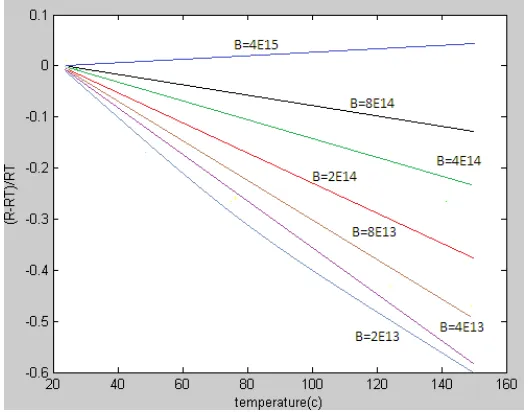
[image:3.595.173.479.63.290.2]At higher doping levels the barrier height is small and the effect of the grain boundaries is negligible compared to the resistivity of the grains. Within the grains the current transport is by carrier drift, resulting in a positive TCR [12] as the mobility decreases with temperature (thermal scattering), and the resistivity of the grain region increases.
Figure 3. Dependence of resistivity on temperature for poly-Silicon Germanium
DETERMINATION OF PIEZORESISTIVITY
The finite element simulations were performed as given by Gonzalez et al[13] to find the value of stress induced in the piezoresistors placed on the diaphragm of the pressure sensor. The Young’s modulus is assumed to be 146GPa (for Germanium 60%).The value is based on the weighted average values of poly-Silicon and poly-Germanium given by Franke et al[14].Finite element simulation is carried out to find the resistance change and the value of stress induced in the diaphragm. The values were substituted in the equation (1) given by Leci [15] and the piezoresistive coefficient were calculated.
(
π
ϕ
π
ϕ
π
ϕ
ϕ
)
σ
lcos
2 tsin
2 ltcos
sin
R
R
=
+
−
∆
(1)
[image:3.595.174.439.366.572.2]Co-efficient1011[Pa-1] Poly-SiGe60 Mono-SiGe Poly-Si Si[110] Si0.1Ge0.9[110]
Πl +13 +4.25 +53.1 +56 +76
Πt +0.9 +0.125 -18.1 -48 -60
PARAMETRIC STUDY FOR SENSOR SENSITIVITY
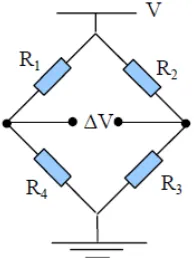
A piezoresistive pressure sensor is studied as a first possible application of piezoresistors which was made of polycrystalline silicon germanium in which the germanium content is 60%.The device consists of a thin square poly-Silicon Germanium membrane with four poly-Silicon Germanium piezoresistors placed on top in a Wheatstone bridge configuration as shown in Figure 4.
When pressure is applied to the diaphragm of the pressure sensor, the diaphragm deflects creating a change in resistance in the piezoresistors. The piezoresistors are connected as a Wheatstone bridge. The four piezoresistors in the Wheatstone bridge are assumed to be ideally balanced (R2/R4=R3/R1) under zero-pressure. Thus, the bridge
output voltage is zero in a zero-pressure condition. When pressure is applied to the diaphragm, the membrane will deform and induce bending stress, which changes the resistance in the wheatstone bridge circuit due to the piezoresistive effect.
Figure 4. Wheatstone bridge configuration of the four piezoresistor
The piezoresistive coefficients can be related to the fractional change in resistance to the applied stress and is given by the formula:
t t l l
R
R
=
π
σ
+
π
σ
∆
(2)
Where πl and πt are the longitudinal and transverse piezoresistive coefficients, while σl and σt represent the
longitudinal and transverse stress components. The resistance changes translate into a variation in the output voltage of the bridge as shown by the expression
∆
−
∆
+
∆
−
∆
+
=
∆
4 4 3 3 2 2 1 1 2)
1
(
R
R
R
R
R
R
R
R
r
r
V
V
(3)Where r is given by
4 3 1 2
R
R
R
R
r
=
=
(4) [image:4.595.260.357.313.442.2]Figure 5.The five location of piezoresistors
Due to the positive transversal piezoresistive coefficient (πt), it is best to place the transversal piezoresistors in the
centre of the membrane where the stress is negative instead of on the edge. From the parametric study it was found that case 3 is the best suitable position to place the poly-Silicon Germanium piezoresistors on the diaphragm. The piezoresistors placed on the diaphragm of the pressure sensor as in case 3 gives a sensitivity of about 39 mV/V/bar and it was found that the best material for piezoresistors was poly-Silicon Germanium.
CONCLUSION
The piezoresistive properties of poly-Silicon Germanium with 60% Germanium were studied as a function of doping concentration and resistivity. This poly-Silicon Germanium film has a low temperature coefficient of resistance, which is ideal for piezoresistive sensors. The optimum positions of the poly-Silicon Germanium piezoresistors were found to be towards the center and sides of the square diaphragm. The simulation work showed that, a pressure sensor with poly-Silicon Germanium as the piezoresistive material gave a maximum sensitivity of 39 mV/V/bar.
REFERENCES
[1]Smith C.S., Physical Review, 1954, 94, 42-49.
[2]Pfann W.G. and Thurston R.N., Journal of Applied Physics, 1961, 32, 2008 – 2018. [3]Kanda Y., IEEE Transactions on Electron Devices, 1982, ED-29(1), 64-70.
[4]Lund E.; Finstad T., Advances in Electronic Packaging-ASME, 1999,26 (1), 215-218. [5]French P.J; Evans A.G.R., Solid-State Electronics, 1989, 32(1), 1-10.
[6]Jaeger R.C; Suhling J.C, Carey M.T, and Johnson R.W, IEEE, 1993, 686-692. [7]Kanda Y., Sensor and Actuators. 1997, A62, 539-542.
[8]Bicking.R.E., Sensors, 1998,30. [9]Shankland.E.P., Sensors, Aug. 1991,22.
[10]Bang D., Applied Physics Letters, 1995,66 (2), 195-197. [11]Jiang L., Meas. Sci. Technol., 1999, 10, 653-664 .
[12]Bhat K. N., Journal of the Indian Institute of Science, 2007, 87(1).
[13]Gonzalez P., Evaluation of Piezoresistivity and 1/f Noise of Polycrystalline SiGe for MEMS sensors applications, Proceedings Eurosensors ’08
[14]Franke A., Post-CMOS integration of germanium microstructures, Proc. MEMS ’99
[15]Lenci S., Determination of the piezoresistivity of microcrystalline Silicon-Germanium and application to a pressure sensor, Proc. MEMS ’08, 427-430
[16]Witvrouw A., Poly SiGe: a Superb Material for MEMS, proc. MRS, 2004,782. [17]Sedky S, IEEE Trans.Electron Devices,2001,48 (2),1-9.
[18]Bang D., Applied Physics Letters, 1995,66 (2), pp. 195-197.