Journal of Chemical and Pharmaceutical Research, 2019, 11(9):37-44
Research Article
CODEN(USA): JCPRC5
ISSN: 0975-7384
37
Assessment of Hydroxycinnamic Acids Potential for Use as
Multifunctional Active Ingredients in Sunscreens, Via a Comparative UV
Spectroscopy Analysis
Geetha Surendran
*, Mackenzie McAteer, Peter Zanchelli and Ilirian Dhimitruka
School of Health and Natural Sciences, Mercy College, Dobbs Ferry, NY 10522, USA
_________________________________________________________________
ABSTRACT
There is a need to identify non-toxic UV filters of natural origin for use in sunscreen products due to concerns about
potential health and environmental toxicity of synthetic UV filters. Hydroxycinnamic acids (HCAs) are plant
metabolites that exhibit excellent antioxidant properties, and absorb efficiently solar UV radiation. A comparative
UV spectroscopy analysis of HCAs was performed to determine the feasibility of their use as multifunctional UV
filters with simultaneous antioxidant capacities. Sun protection factor (SPF) values were calculated using the
Mansur equation. The UVA/UVB ratio and critical λ, which are indicators of sunscreen ability to offer broadband
UVB/UVA protection, were calculated from UV spectra. Our analysis indicates that each of HCAs, specifically
caffeic acid, ferulic acid, and sinapic acid absorb efficiently and simultaneously in multiple regions of UV solar
radiation, specifically UVB (290 320 nm), UVA II (320 340 nm), and to some extent in the UVA I (340
nm-400 nm) region. We concluded that HCAs incorporating at least one catechol moiety, such as sinapic acid, caffeic
acid, and ferulic acid, could provide broadband UVB/UVA screening comparable or superior to commercial UV
filters, in addition to antioxidative capabilities. Thus, HCAs, if properly modified to ensure emulsification into
sunscreens, have the potential to provide an alternative to multiple current UV filters suspected of health and
environmental toxicity.
Keywords: Hydroxycinnamic acids; Caffeic acid; Ferulic acid; Sinapic acid; SPF; UVA/UVB; Critical ;
Sunscreens; Mansur equation
_____________________________________________________________________________
INTRODUCTION
The use of sunscreens is deemed indispensable by dermatologists to protect skin from prolonged exposure to UV
solar radiation [1,2]. Sunscreens are formulated with UV filters, which are lipophilic aromatic compounds that
38
solar radiation, which is the cause of erythema (sunburn), basal carcinoma, and melanoma. UVA filters absorb the
320 nm-400 nm band, which is the cause of ROS generation, lipid peroxidation, and DNA photosensitized products
[3,4]. Concerns have been raised about the toxicity of sunscreens active ingredients [5-7]. Studies confirm that UV
filters diffuse into blood stream within two hours upon sunscreen’s application, and are present in concentrations
higher than 0.5 ng/ml threshold established by FDA for waiving toxicity studies [8]. UV filters can pose a risk of
skin carcinogenicity, developmental, and embryofetal toxicity because of their endocrine disruption action [9,10].
The environmental impact of UV filters is another area of great concern [11]. Studies have confirmed widespread
presence of oxybenzone, octocrylene, octinoxate, and octisalate in marine waters around the world [12]. UV filters
are not easily removed by wastewater treatment, often forming toxic byproducts with chlorine [13]. Oxybenzone,
4-methylbenzylidene camphor, octocrylene, and octinoxate are identified in species of fish worldwide, thus could be
present in the food chain [14]. Oxybenzone is implicated as the potential cause of coral reef bleaching [15]. The
environmental concerns are real. The state legislature of Hawaii passed a bill on May 1st 2018 that bans the sale and
distribution of sunscreens containing oxybenzone and octinoxate, which will go into effect in 2021. Nevertheless, it
must be noted that sunscreen usage is an absolute necessity, and sunscreens are a safe precaution to prevent the
advent of skin cancers as result of exposure to UV radiation, according to the American Academy of Dermatology
Association [3].
On average 15-20% of sunscreens weight consists of UV filters. On average, at least three or four UV filters are
combined to provide an efficient protection against UVB/UVA radiation. In addition sunscreens are formulated with
additional aromatic compounds to provide antioxidant capabilities to sunscreens [16]. To address issues of
environmental impact, and potential toxicity to humans, a two directional strategy can be considered. First, the
concentration of UV filters in sunscreens could be minimized, without loss of UV protection. This can be achieved
by replacing combination of UV filters and antioxidants with one multifunctional UV filter. Second, multifunctional
UV filters could be chosen to be biodegradable, derived from natural products, thus most likely to be non-toxic.
Multi functionality is defined as the ability of one UV filter to simultaneously 1) absorb efficiently UVB (290
nm-320 nm), UVAII (nm-320 nm-340 nm), UVAI (340 nm-400 nm) radiation, and 2) reduce at a fast rate reactive oxygen
species in vivo. The FDA ruling of 2011 is another way multi functionality can be defined. It states that a broadband
sunscreen must have a sun protection factor in vivo SPF ≥ 15, and a critical λc ≥ 370 nm, such that:∫ ( )
∫ ( ) .
Nature once again can provide a solution to this problem. Plants, fruits, and vegetables contain medicinal
compounds, phenolic antioxidants that absorb efficiently UV radiation [17]. Hydroxycinnamic acids (HCAs), such
as caffeic acid, ferulic acid, and sinapic acid can be used as primary sources of biodegradable and multifunctional
UV filters [18-20]. HCAs absorb in the combined UVB/UVA spectral range, are considered photostable, and
efficient antioxidants [21-23].
The question we want to answer through a comparative UV spectroscopy study is the following: Can HCAs, if used
in high concentrations that are typical for UV filters in sunscreens, provide broadband UV protection similar to
commercial UV filters? There is literature precedent to support the above assumptions. Caffeic acid, and ferulic acid
39
antioxidant capacities, an increased SPF was observed as result of the presence of HCAs [20,24]. In addition, there
is ample literature data on antioxidant capacities of HCAs, and their inhibitory effects on reactive oxygen species
(ROS) [18,25]. We found very interesting the fact that esters of HCAs are reported to be more reactive toward ROS
than their corresponding free HCAs [26,27]. Esterification is used routinely to improve lipophilic behavior of
aromatic UV filters, to ensure emulsification. Moreover, polyphenolic HCAs are found to react fast with ROS, in
rates comparable to vitamin E, and Trolox. All literature data indicates that HCAs could be useful aromatic core
[image:3.612.180.436.211.321.2]structures for use as multifunctional UV filters with intrinsic antioxidant properties.
Figure 1. Structures of naturally occurring hydroxycinnamic acids (HCAs). (1) Caffeic Acid. (2) Ferulic Acid. (3) Sinapic Acid. (4) p-Coumaric Acid. (5) m-p-Coumaric Acid. (6) o-p-Coumaric Acid.
MATERIALS AND METHODS
UV spectra were recorded on UVV 5 Mettler Toledo spectrophotometer, using quartz 1 cm length cuvettes.
Chemicals were purchased from commercial suppliers, Sigma Aldrich and Fisher Scientific, and used without
further manipulation. UV spectroscopy grade absolute ethanol was used for measurements. Each value is an average
of three individual measurements. Sun protection parameters were calculated for six HCAs (Figure 1), six
commercial UV filters (Figure 2), and three commercial sunscreen emulsions.
Figure 2. Commercial UV filters. (7) Octinoxate. (8) Octocrylene. (9) Oxybenzone. (10) Homosalate. (11) Octisalate. (12) Avobenzone.
Absorbance values are obtained from UV spectra of pure compounds at the appropriate dilutions, which satisfy the
Mansur equation [28]. For pure compounds the stock solution was prepared by dissolving in 100 ml of ethanol the
amount in mg equal to the desired (or allowed) % concentration in sunscreen multiplied by a factor of 10. For
sunscreen emulsions the stock solution was prepared by dissolving 1 g of sunscreen in 100 ml of ethanol, and
filtering through number 1 filter paper. The stock solution was diluted 50 times. The final dilution was used to
[image:3.612.173.439.474.581.2]40
UVA/UVB area under the curve ratios, and critical λ. Critical is the wavelength that satisfies the equation
∫ ( ) ∫ ( ) .
SPF values were estimated from UV spectra of pure HCAs, pure commercial UV filters, or sunscreens using the
Mansur equation. In this equation EE(λ)=erythema effect spectrum, I(λ)=solar intensity spectrum, Abs (λ)
=absorbance of sunscreen product, and CF is a correction factor (=10). Normalized values of EE x I used for
calculations were determined by Sayre et al. [29].
∑ ( ) ( ) ( )
RESULTS AND DISCUSSION
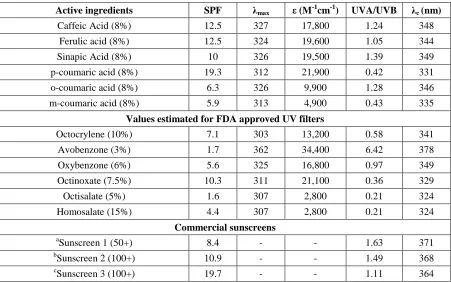
Estimated values of sun protection parameters for HCAs, commercial UV filters, and three broadband commercial
sunscreen emulsions are summarized in Table 1. SPF in vivo indicates the ability to block the UVB radiation. SPF in
vivo is defined, as the ratio of radiation exposure requires to achieving a persistent minimal skin erythema, with or
without the application of sunscreen [30]. The Mansur equation is used to approximate the SPF values from UV
absorbance spectra of sunscreens solutions in ethanol. The SPF by Mansur estimates the ability to absorb the
radiation relative to the % weight of the UV filter in sunscreen, but does not correlate well with the ability of the
sunscreen film to physically block, scatter and reflect UV radiation. As such it underestimates values relative to the
SPF in vivo. However, our aim is to compare HCAs with commercial UV filters and sunscreen, therefore all other
factors being equal, SPF by Mansur is a suitable choice to compare aromatic structures for their ability to offer
protection against UVB solar radiation. We have estimated the SPF values for HCAs assuming 8% concentration in
sunscreens. This is close to 7.5% concentration allowed for the commercial UV filter octinoxate, which incorporates
a p-hydroxycinnamic acid aromatic structure. A better estimate of protection is offered by a comparison of UV
spectral shape and molar absorption coefficients () in the UVB/UVA range. The absorption efficiency in the UVA
range is estimated through comparison of critical λc, and UVA/UVB area under the UV curve. Higher c coupled
with higher UVA/UVB ratios imply better protection in the UVA region. Commercial UV filters were used to
[image:4.612.184.424.555.675.2]provide benchmark values for comparison purposes.
41
Table 1. Estimated SPF, critical λ, UVA/UVB, for select active ingredients and sunscreens.
Active ingredients SPF λmax ε (M-1cm-1) UVA/UVB λc (nm)
Caffeic Acid (8%) 12.5 327 17,800 1.24 348
Ferulic acid (8%) 12.5 324 19,600 1.05 344
Sinapic Acid (8%) 10 326 19,500 1.39 349
p-coumaric acid (8%) 19.3 312 21,900 0.42 331
o-coumaric acid (8%) 6.3 326 9,900 1.28 346
m-coumaric acid (8%) 5.9 313 4,900 0.43 335
Values estimated for FDA approved UV filters
Octocrylene (10%) 7.1 303 13,200 0.58 341
Avobenzone (3%) 1.7 362 34,400 6.42 378
Oxybenzone (6%) 5.6 325 16,800 0.97 349
Octinoxate (7.5%) 10.3 311 21,100 0.36 329
Octisalate (5%) 1.6 307 2,800 0.21 324
Homosalate (15%) 4.4 307 2,800 0.21 324
Commercial sunscreens
aSunscreen 1 (50+) 8.4 - - 1.63 371
bSunscreen 2 (100+) 10.9 - - 1.49 368
c
Sunscreen 3 (100+) 19.7 - - 1.11 364
Active ingredients: a) Avobenzone 3%, Homosalate 10%, Oxybenzone 6%; b) Avobenzone 2%, Octocrylene 8%,
Oxybenzone 3%; c) Avobenzone 3%, Homosalate 15%, Octisalate 5%, Octocrylene 10%, Oxybenzone 6%.
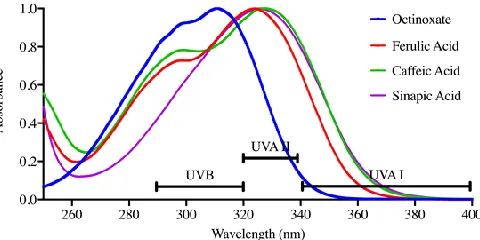
Figure 3 summarizes normalized UV spectra for a collection of polyphenolic hydroxycinnamic acids (HCAs) and
octinoxate. HCAs can be thought of as derivatives of p-coumaric acids, formed by introduction of additional
hydroxyl groups. Octinoxate is a very efficient, and one of the most used UVB-only commercial UV filter. Note that
octinoxate is an highly alkylated derivative of p-coumaric acid; thus two compounds have the same aromatic core,
and identical UV absorption profiles with λmax=311 nm. Introduction of one 3-ortho hydroxyl group (caffeic acid),
or 3-ortho methoxy group (ferulic acid) leads to a shift of the UV profile in UVA II range, with λmax~327 nm. The
UV spectra of caffeic acid and ferulic acid exhibit two overlapping bands, covering the UVB and the UVA II region
respectively. In spite of the 20% drop in molar absorption coefficients () compared to octinoxate in the UVB
region, HCAs still exhibit excellent absorption in the UVB region with SPF≈12 for both caffeic and ferulic acids.
Caffeic acid, ferulic acid, and sinapic acid offer much better protection in the UVB range compared to other
UVB-only filters, homosalate and octisalate, as demonstrated by their molar absorption coefficients at max, and SPF
values (Table 1). Perhaps most significant is the excellent multiband absorption in the UVB/UVA II range between
290 nm-350 nm offered by HCAs. The critical λc≈348 nm, and UVA/UVB1.2-1.4 for both caffeic and ferulic acids
imply excellent protection in the UVA II range, besides very efficient protection in the UVB range. By comparison
42
that offer protection only in the UVB range. Sinapic acid is a very interesting compound. Because of the presence of
two methoxy groups ortho to para-hydroxyl group, the UV spectra is symmetric with λmax=326 nm. It nevertheless
exhibits efficient absorption in the UVB range with high SPF 10 comparable to caffeic and ferulic acid. Due to the
symmetric spectral profile, the bulk of the UV absorption curve is more shifted towards UVA range. This is
illustrated by the UVA/UVB =1.39 and critical λc=349 nm, which means sinapic acid offers even better protection in
[image:6.612.199.417.179.294.2]the UVA II range compared to caffeic and ferulic acid.
Figure 4. Normalized UV spectra of commercial filters and caffeic acid.
The sun protection parameters of o-coumaric acid and m-coumaric acid do not compare well with the values of their
isomer p-coumaric acid, or any of the HCAs, ferulic acid, caffeic acid, and sinapic acid. However, SPF and values
of coumaric acid, and m-coumaric acid compare well with those of homosalate and octisalate. In addition
o-coumaric acid could provide UVA II coverage, as shown by its UVA/UVB=1.28 and critical c=349 nm.
Commercial sunscreens use a combination of oxybenzone and octocrylene to provide UVB/UVAII protection.
Usually octinoxate and avobenzone are added to provide UVB-only and UVA-only protection respectively. In
Figure 4, we have superimposed the normalized UV spectra of these four, very common, commercial UV filters
with the spectrum of caffeic acid. Caffeic acid, ferulic and sinapic acid, absorb UV solar radiation more efficiently
than oxybenzone and octocrylene, in the UVA region as demonstrated by their higher critical , UVA/UVB ratios
and molar absorption coefficient () at max, as well as in the UVB region as demonstrated by higher SPF and
values. Finally we calculated the SPF values, UVA/UVB ratios, and critical c of three broadband commercial
sunscreens, which use a combination of at least 3 synthetic UV filters to achieve broadband protection in the
UVB/UVA range. The SPF by Mansur is consistent with the % concentrations of the UV filters contained in the
sunscreen. It is obvious that avobenzone is absolutely necessary to provide broadband protection deep in the UVA
region, according to the FDA established threshold of c ≥ 370 nm. All three commercial sunscreens use
combinations of avobenzone with octocrylene or oxybenzone to provide broadband protection in the UVB/UVAII
range, where the avobenzone coverage is limited. The bulk of UVB protection is provided by a combination of
octinoxate, octisalate, and homosalate. The UVA/UVB ratio of 1.11-1.6 for three tested sunscreens is similar to that
of sinapic acid, ferulic acid, and caffeic acid. Note the SPF value any of the sunscreens could be easily achieved by
using one, or a combination of HCAs.
CONCLUSION
Due to health and environmental concerns, there is a need to minimize the use of synthetic active ingredients such as
43
used as health-conscious alternative to synthetic active ingredients. HCAs, such as caffeic acid, ferulic acid, and
sinapic acid, are naturally occurring antioxidants, with known beneficial medicinal properties. Our UV spectroscopy
analysis of sun protection values indicate that either one of caffeic acid, ferulic acid, or sinapic acid could be capable
of providing an excellent protection against UVB/UVA solar radiation, comparable or better than a combination of
commercial UV filters, octinoxate, oxybenzone, octocrylene, octisalate, and homosalate. Therefore, HCAs would be
ideal lead compounds to start a search for truly multifunctional UV filters in the broadband UVB/UVA region, with
simultaneous antioxidant capabilities. HCAs are not particularly soluble in either aqueous or oil phase. Work needs
to be done to produce non-toxic alkylated derivatives of HCAs that are easily emulsified, and can be incorporated in
high % concentrations, which are typical of sunscreen formulations.
Acknowledgment
The authors thank the School and Health and Natural Sciences of Mercy College for financial support of these
studies.
REFERENCES
1) LC Harber; VA DcLeo; A Prystowsky. Photosensitivity Diseases, Principles of Diagnosis and Treatment.
B. 1989, Decker, Publ., Toronto.
2) J Boger; OE Araujo; F Flowers. South Med J. 1984, 77(11), 1421-1427.
3) CM Olsen; LF Wilson; AC Green; N Biswas; J Loyalka; DC Whiteman. Photodermatol Photoimmunol
Photomed. 2017, 33(3), 135-142.
4) J Cadet; T Douki; JL Ravanat; P Di Mascio. Photochem Photobiol Sci. 2009, 8(7), 903-911.
5) JA Ruszkiewicz; A Pinkas; B Ferrer; TV Peres; A Tsatsakis; M Aschner. Toxicol Rep. 2017, 4, 245-259.
6) M Lorigo; M Mariana; E Cairrao. Steroids. 2018, 131, 46-58.
7) JF Nash; PR.Tanner. Photodermatol Photoimmunol Photomed. 2014, 30(2-3), 88-95.
8) MK Matta; R Zusterzeel; NR Pilli; V Patel; DA Volpe; J Florian; L Oh; E Bashaw; I Zineh; C Sanabria; S
Kemp; A Godfrey; S Adah; S Coelho; J Wang; LA Furlong; C Ganley; T Michele; DG Strauss. JAMA.
May 2019.
9) M. Krause; A Klit; JM Blomberg;T Søeborg; H Frederiksen; M Schlumpf; W Lichtensteiger; NE
Skakkebaek; KT Drzewiecki. Int J Androl. 2012, 35(3), 424-436.
10) AR Heurung; SI Raju; EM Warshaw. Dermatitis. 2014, 25(6), 289-326.
11) SL Schneider; HW Lim. J Am Acad Dermatol. 2019, 80(1), 266-271.
12) KI Ekpeghere; UJ Kim; SH O, HY Kim; JE Oh. Sci Total Environ. 2016, 542(no. Pt A), 121-128.
13) T Manasfi; B Coulomb; S Ravier; JL Boudenne. Environ Sci Technol, 2017, 51(23), 13580-13591.
14) JM Brausch; GM Rand. Chemosphere. 2011, 82(11), 1518-1532.
15) CA Downs; E Kramarsky-Winter; R Segal; J Fauth; S Knutson; O Bronstein; FR Ciner; R Jeger; Y
Lichtenfeld; CM Woodley; P Pennington; K Cadenas; A Kushmaro; Y Loya. Arch Environ Contam
Toxicol. 2016, 70(2), 265-288.
16) C Souza; P Maia Campos; S Schanzer; S Albrecht; SB Lohan; J Lademann; ME Darvin; MC Meinke. Skin
44
17) M Działo; J Mierziak; U Korzun; M Preisner; J Szopa; A Kulma. Int J Mol Sci. 2016, 17(2), 160.
18) H Kikuzaki; M Hisamoto; K Hirose; K Akiyama; H Taniguchi. J Agric Food Chem. 2002, 50(7),
2161-2168.
19) C Chen. Oxid Med Cell Longev. 2016, 2016, 3571614.
20) A Saija; A Tomaino; D Trombetta; A De Pasquale; N Uccella; T Barbuzzi; D Paolino; F Bonina. Int J
Pharm. 2000, 199(1), 39-47.
21) O Taofiq; AM González-Paramás; MF Barreiro; IC Ferreira. Molecules. 2017, 22(2), 281.
22) MD Horbury; LA Baker; WD Quan; SE Greenough; VG Stavros. Phys Chem Chem Phys, 2016, 18(26),
17691-17697.
23) DP Rivelli; CA Filho; RL Almeida; CD Ropke; TC Sawada; SB Barros. Photochem Photobiol. 2010,
86(5), 1005-1007.
24) DD Peres; FD Sarruf, CA de Oliveira; MVR Velasco; AR Baby. J Photochem Photobiol B. 2018, 185,
46-49.
25) JC Dean; R Kusaka; PS Walsh; F Allais; TS Zwier. J Am Chem Soc. 2014, 136(42), 14780-14795.
26) MC Foti; C Daquino. J Org Chem. 2004, 69(7), 2309-2314.
27) N Nićiforović; T Polak; D Makuc; N Poklar Ulrih; H Abramovič. Molecules. 2017, 22(3), 375.
28) EA Dutra; DAG da Costa e Oliveira; ERM Kedor- Hackmann; MIRM Santoro. Brazilian Journal of
Pharmaceutical Sciences. 2004, 40(2), 381-385.
29) RM Sayre; PP Agin; GJ LeVee; E Marlowe. Photochem Photobiol. 1979, 29(3), 559-566.