International Journal of Emerging Technology and Advanced Engineering
Website: www.ijetae.com (ISSN 2250-2459,ISO 9001:2008 Certified Journal, Volume 3, Issue 2, February 2013)
192
Development of Efficient Intra Frame Coding in Advanced
Video Standard Using Horizontal Prediction Mode.
Manjanaik.N
1, Dr.Manjunatha.R
2 1Electronics and Communication Engineering, Jain University, Bangalore, India.
2Senior Domain Specialist, Philips Company, Bangalore, India.
Abstract-- This paper proposes simulation of Intra frame coding in Advanced Video Coding Standard using Intra Prediction. The simulation results of Compression ratio and PSNR for with and without prediction are presented using Matlab. To perform Intra frame coding in AVC requires intra prediction in intra prediction there are nine prediction modes such as vertical, horizontal, dc,diagonal down left, diagonal down right, vertical right, vertical right, horizontal down and horizontal up etc. in this paper we are used horizontal prediction mode for intra frame coding. The simulation is capable of bringing about compression of video sequences as per user specification and processes low and high resolution pictures. The compression ratio and PSNR achieved for different quantization parameter of frame size (1024x768) was presented.
Keywords -- Intra prediction, horizontal prediction mode, PSNR.
I. INTRODUCTION
H.264/AVC is the latest video coding standard jointly developed by the ITU-T and ISO/IEC. It provides significantly better compression efficiency with good picture quality compared to previous video coding standards. Due to advanced features of AVC it provide high compression ratio and picture quality. H.264/AVC intra encoding achieve higher compression ratio and picture quality compared with the latest still image coding standard JPEG2000[1].intra prediction is the first process of advanced video coding standard. It predicts a macro block by referring to its previous macro blocks to reduce spatial redundancy. Intra prediction supports nine modes for 4x4 block and four modes for 16x16 blocks. There are threeprofiles in H.264 (MPEG-4 Part 10/AVC for Advanced Video Coding) namely; Baseline Profile, Main Profile, Extended Profile. The base line profile supports intra and inter –coding and context-based adaptive variable length coding. Main profile supports interlaced video; intercoding and context based arithmetic coding. The extended is for SP-and SI slices and data partitioning [2-3].
II. METHODOLOGY
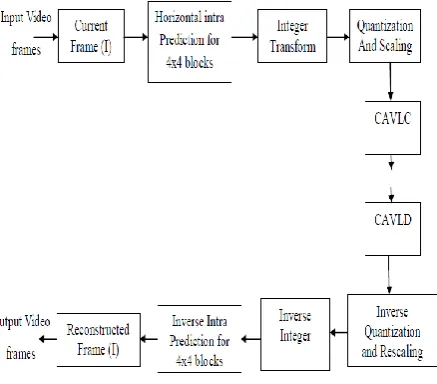
A raw recorded video in avi format is used as an input file. The video is then decomposed into frames. Each frame is processed in terms of 4x4 macro block.
For each frame processing is done in order to get high video quality and more compression ratio as compared to other video coding standards. For without applying intra prediction, each frame processing includes frame conversion i.e. RGB to YCBCR format down sampling i.e. (4:4:4 to 4:2:0), 4x4 segmentation integer transformation, quantization, scaling and entropy encoding. For verification purpose the video is reconstructed by doing inverse process. For with applying intra prediction, each frame processing includes frame conversion i.e. RGB to YCBCR format down sampling i.e. (4:4:4 to 4:2:0), 4x4 segmentation, horizontal intra prediction mode, integer transformation, quantization, scaling and entropy encoding. For verification purpose the video is reconstructed by doing inverse process.
III. BLOCK DIAGRAM
International Journal of Emerging Technology and Advanced Engineering
Website: www.ijetae.com (ISSN 2250-2459,ISO 9001:2008 Certified Journal, Volume 3, Issue 2, February 2013)
[image:2.595.51.270.146.338.2]193
Fig. 1 Block diagram of advanced video codecAt the decoder side the exact reverse process of encoding is takes place i.e., the quantized coefficients are rescaled, inverse quantized and inverse transformed to produce a difference block. The prediction block P is added to the difference block to get the reconstructed block
.
IV. HORIZONTAL PREDICTION MODE
The prediction in advanced video coding standard is done in spatial domain by referring previously encoded and reconstructed pixels or blocks which are above and or left of the block. The prediction of 4x4 blocks is predicted based on the previously reconstructed pixels labelled (A-M) shown in Fig.2 the pixels (A-M) are reconstructed previously and consider as reference pixels for current block. The pixels labeled (a-m) are prediction pixels. [4].Fig.3 shows the horizontal prediction mode for processing of current block. The arrow mark represents direction of prediction. A frame is processed in terms of macroblocks.a macro block consists of 16x16 pixels, these pixels are divided into 4x4 pixel sub blocks. The working principle of horizontal prediction are the previously reconstructed pixels
(
MABCDEFGH) are not used for horizontal prediction, only the previously reconstructed pixels(IJKL) are used for horizontal i.e. last column of previously reconstructed subblock.the reconstructed pixel I serves as prediction forpixels(abcd) of current sub block ie a=b=c=d=I. similarly e=f=g=h=J, i=j=k=l=K and m=n=o=p=L.
in horizontal prediction mode last column of previously reconsucted sub block serves as prediction for current sub block. The difference between the actual value of the pixel and its predicted value known as the residual pixel.The last column pixels of previously reconstructed sub block is subtract with pixels of current sub block to get residual pixel value, which is transformed, quantized and encoded
Fig. 2 labeling of 4x4 prediction samples
Fig.3 Horizontal Prediction Mode
V. STEPS INVOLVED
The following steps give the information about intra frame coding
1.A raw recorded video in avi format is used as an input file.
2.The video is decomposed into frames.
3.Each frame is processed in terms of macro block; macro block consists of 16x16 pixels.
4.A 16x16 macro block is further divided into a 4x4 sub macro block.
5.A 4x4 sub block is processed directly without using horizontal prediction mode followed by integer transform, quantization, entropy encoding at encoder and reverse process at decoder.
6.A 4x4 sub block is processed using horizontal prediction mode.
7.Residual of 4x4 sub block is integer transformed, quantized and entropy encoded at encoder and reverse process at decoder.
8. Finally measure compression ratio and PSNR for quantization parameter of various picture sizes.
VI. IMPLEMENTATION
The proposed work is implemented using Matlab. The input to this system is raw avi format video file which is obtained by total video convertor software which converts compressed video file to uncompressed raw video file. This uncompressed raw video is then decomposed into frames. In the long process of H.264/AVC video processing the very first job is to convert the video into its separate frames.
M A B C D E F G H
I a b c d
J e f g h
K i j k l
L m n o p
M A B C D E F G H
I
J K
International Journal of Emerging Technology and Advanced Engineering
Website: www.ijetae.com (ISSN 2250-2459,ISO 9001:2008 Certified Journal, Volume 3, Issue 2, February 2013)
194
For test purpose we have recorded a video of resolution 1024x768 and following are the frames extracted from the test video. There are a total of 130 frames, captured at a rate of 25 fps (frames per
second).
Hence the time of video sequence is 5.2 seconds in length and total size of the video is 306MB (1024x768x25x5.2). A Matlab program is written, which reads the video file, extracts information, stores the video as movie structure and separates each frame as a separate image file
.
The next process involves reading a true RGB colour image and convert into ycbcr format down sampling (4:4:4 to 4:2:0) to reduce bits of image.ycbcr image is divided into 4x4sub block and processed with horizontal predication mode, quantization, context adaptive variable length coder(CAVLC) to get compressed bit at AVC encoder. At AVC decoder the same way reverse process is done in order to reconstruct the original image and finally the video file.The following give the detail about compression. Image resolution: 1024x768 pixels
Total number of bits required in 4:4:4 format is 18874368 bits.
Total number of bits in ycbcr (4:2:0) format is 9437184 bits
The ycbcr format is further is transformed, quantized and entropy encoded then compression achieved for different quantization parameter.
The quality of the reconstructed image is assessed by peak signal to noise ratio (PSNR) value defined as follows:
PSNR=10.log10 (2n-1)/MSE, Where n is number of
bits per image.MSE is mean squared between corresponding pixel values of the original frame and
impaired image is MSE=1/MxN
m
1
n
1
r P0
-
p
)2
(
dBWhere p0 is the original pixel intensity and pr is the
corresponding reconstructed pixel intensity [5].
VII. RESULTS &DISCUSSIONS
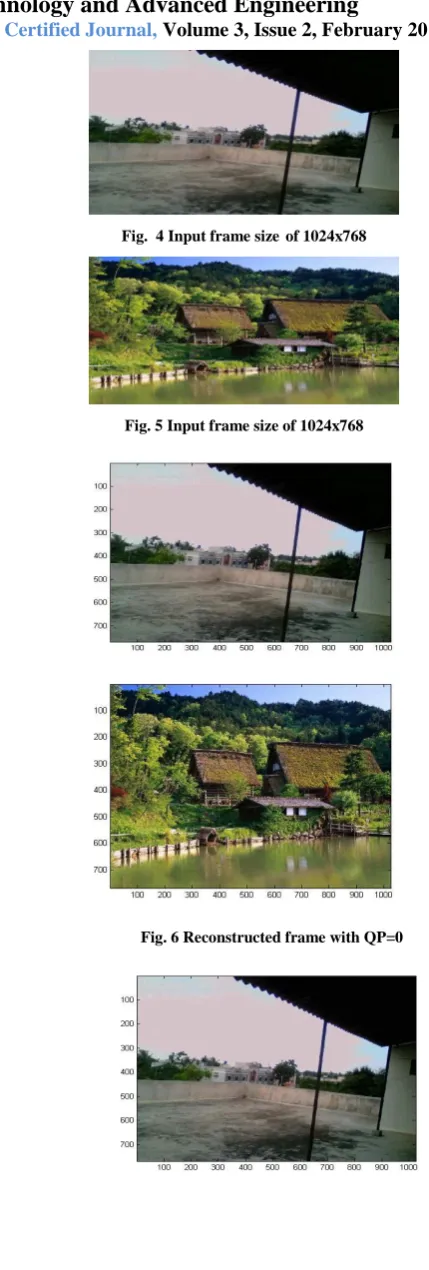
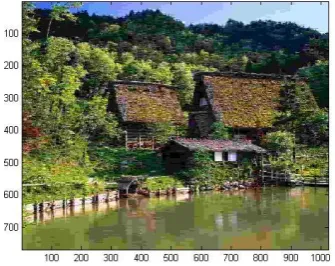
[image:3.595.309.524.110.746.2]The efficient intra frame coding was implemented in Matlab. The results obtained for the frames of different values of quantization parameter step sizes and corresponding quantization parameter values as specified in the table I and table II. Fig. 4&5 shows original input frames size of 1024x768 of test recorded video. Fig 6 to 10 shows the reconstructed frames for different QP (0, 24, 34,40 and 45).
Fig. 4 Input frame size of 1024x768
Fig. 5 Input frame size of 1024x768
Fig. 6 Reconstructed frame with QP=0
International Journal of Emerging Technology and Advanced Engineering
Website: www.ijetae.com (ISSN 2250-2459,ISO 9001:2008 Certified Journal, Volume 3, Issue 2, February 2013)
[image:4.595.87.240.145.254.2] [image:4.595.347.515.146.279.2]195
Fig. 7 Reconstructed frame with QP=24 [image:4.595.347.511.313.476.2] [image:4.595.343.519.506.659.2]Fig. 8 Reconstructed frame with QP=34
Fig. 8 Reconstructed frame with QP=34
Fig. 9 Reconstructed frame with QP=40
Fig. 10 Reconstructed frame with QP = 45
International Journal of Emerging Technology and Advanced Engineering
Website: www.ijetae.com (ISSN 2250-2459,ISO 9001:2008 Certified Journal, Volume 3, Issue 2, February 2013)
[image:5.595.40.288.163.248.2]196
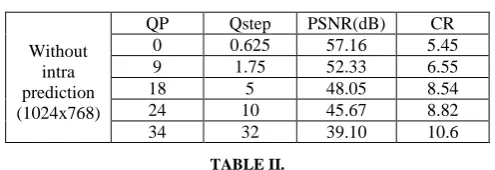
TABLE I.PSNR and Compression Ratio achieved for intra frame coding for different quantization parameter without intra prediction.
Without intra prediction (1024x768)
QP Qstep PSNR(dB) CR 0 0.625 57.16 5.45
9 1.75 52.33 6.55
18 5 48.05 8.54
24 10 45.67 8.82
34 32 39.10 10.6
TABLE II.
PSNR and Compression Ratio achieved for intra frame coding for different quantization parameter with intra prediction.
With intra prediction (1024x768)
QP Qstep PSNR CR
0 0.625 56.67 7.3
9 1.75 49.03 9.78
18 5 45.26 16.24
24 10 41.11 18.44
34 32 36.35 21.09
VIII. CONCLUSIONS
The development of intra frame coding in advanced video coding standard using horizontal intra prediction mode was presented and implemented using Matlab. The results show that the reconstructed picture quality (PSNR) and compression ratio achieved for frame size 1024x768 for different quantization parameter with and without prediction.
Comparing intra prediction with without intraprediction, intra prediction gives good picture quality and compression ratio. The implementation is capable of achieved good PSNR and compression ratio using horizontal prediction mode.
REFERENCES
[1] Youn-Long Steve Lin, Chao-Yang Kao Hung-Chih Kuo VLSI Design for Video Coding, Springer-2010.
[2] Iain E.Richardson,The H.264 and MPEG-4 Video Compression :Video coding for Next-generation Multimedia,Johan Wiley& Sons, first edition 2003.
[3] Iain E. Richarson, The H.264 Advanced Video Compression Standard, Johan Wiley& Sons, Second edition 2010
[4] N.Keshaveni, S. Ramachandran, K.S. Gurumurthy, Design and FPGA inpmlementation of Integer Transform and Quantization Processor and their inverses for H.264 video encoder,IJCSC,Vol No.1 2010 pp 43-50.
[5] Chaminda Sampath Kannangara, Complexity Management of H.264/AVC Video Compression, the Robert Gordon University 2006.
[6] Thomas Wiegand, GaryJ. Sullivan, Seniour Member, IEEE, Gisle Bjontegaard and Ajay Luthra, Overview of the H.264/AVC Video Coding Standard, IEEE Transations on circuits and systema for video Technology, Vol. No 7 2003
[7] http://www.vcodex.com
[image:5.595.41.287.273.354.2]