Journal of Chemical and Pharmaceutical Research, 2014, 6(6):1902-1909
Research Article
ISSN : 0975-7384
CODEN(USA) : JCPRC5
A mechanical analysis and research of the bouncing process of the
table tennis
Fu Mingping
The School of Sports, Chuzhou University, Anhui, China
_____________________________________________________________________________________________
ABSTRACT
As sports activities are gaining a more and more important position in the mind of Chinese people, the table tennis has got an increasing amount of attention. This thesis shows that the movement of the table tennis is decided by two forms of motion trails and analyzes the impacts of different forces on the trails by conducting an in-depth analysis of the moving process of the table tennis and building and solving the mechanical model of the whole bouncing process of the table tennis through the combined usage of theories of mechanics.
Keywords: Table tennis, applied mechanics, mechanical model, vertical stress analysis, horizontal stress analysis _____________________________________________________________________________________________
INTRODUCTION
Table tennis is very popular among the Chinese people. With the consecutive successes of Chinese athletes in table tennis in Olympics, this sport has become not only the domain of the athletes, but a favorable choice of every Chinese. However, table tennis is a greatly difficult sport which requires the player’s agility and flexibility, thus, only after a long period of constant training can a player win his opponent in details like consciousness, pace, action and so on.
In this aspect, many scholars have made their efforts and gained some rewards, which provides favorable conditions for scholars from all sectors of the society to do research on table tennis and motives for some people to develop the sport of table tennis. For example, in their paper, Zhao Lei and other scholars analyze the flight process of table tennis and the simulation application in Matlab, build a model for the whole process of table tennis’s landing on the table after being hit by the racket and then flight away from the table and they also analyze this model. Besides, they draw a curve graph by using the Matlab which reflects the motion trails of table tennis in a more direct way. Mu Zhiyong writes a paper analyzing table tennis’ kinematic mechanics and analyzes the influences of sport mechanics on the moving process of table tennis from the perspective of physics. In their thesis A Mechanical Analysis on the Improvements of Forehand Techniques to Pull the Ball Close to the Table, Feng Jie and others study the close-table forehand defensive techniques of table tennis, find the restraining factors and their corresponding solutions through analysis and their great effects in table tennis competitions.
MECHANICAL ANALYSIS MODEL OF TABLE TENNIS STRESS ANALYSIS MODEL OF TABLE TENNIS’S FILIGHT PROCESS
[image:2.595.219.418.429.619.2]The rotational angular velocity direction of table tennis after its collision with the racket is as shown in Picture 1:
Figure 1 Table tennis course
When table tennis collides with the racket, if the flight speed directions do not coincide with each other, then a lateral force and a curve are produced. The curve’s pressure difference caused by rotation is called the lift force
F
L, there is a correlation between the rotational frequency of the ball and the kinematic velocity, the corresponding equation is:fv
D
C
F
L=
Lρ
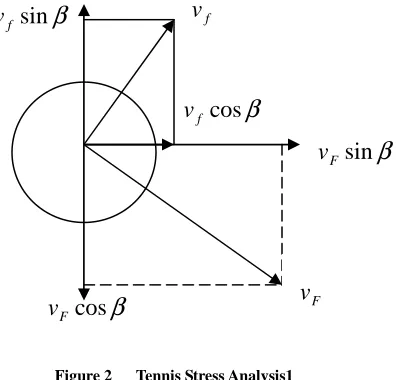
3 (1)The size of the air resistance that table tennis is under is related to the maximum cross-section area and the wind velocity as shown in Picture 2:
Figure 2 Tennis Stress Analysis1
Assuming the airflow that has not reached the ball is “state 1”, while the airflow that has already reached the ball is “state 2”, and
v
2=
0
, according to the theory we can get the following equation:2 2 2
2 1 1
2
1
2
1
v
P
v
P
+
ρ
=
+
ρ
(2)this is the air pressure per unit volume,
v
1=
v
,0
2=
v
,β
sin
f
v
β
cos
F
v
β
cos
f
v
f
v
β
sin
F
v
then:
2 2
1
2
1
v
P
P
−
=
ρ
When the positive state 1 of the ball is under pressure P1, the air pressure is in a perfect condition, if P1 multiply by the maximum cross-section area A, then its corresponding resistance is:
2 1
2
2
1
)
(
P
P
A
Av
F
d=
−
=
ρ
(3)But considering the influence of other factors, the resistance coefficient is taken into consideration, then the final formula is:
2
2
1
Av
C
F
d=
dρ
(4)If the trail analysis of gravity influence is not taken into consideration, the stress condition of table tennis is as shown in the following picture:
Figure 3 Tennis Stress Analysis2
From this, the following dynamic equation can be obtained: 2
2
1
Av
C
dt
dv
m
=
dρ
(5)fv
D
C
R
v
m
L 32
ρ
=
(6)When the formula is deformed by using diameter d to replace the maximum cross-section area A, and
)
(t
v
v
=
, a radius of curvature formula can be obtained:)
(
)
(
3v
t
f
d
C
m
t
R
R
L
ρ
=
=
(7)THE STRESS DECOMPOSITION MODEL OF TABLE TENNIS
When conducting an orthogonal decomposition of table tennis’s stress conditions, the case is as shown in G
d
F
L
F
v
F
Picture 3:
Figure 4 Tennis Stress Analysis3
VERTICAL STRESS ANALYSIS
The initial velocity in the vertical direction is
v
sin
β
,the downward force of the direction isF
G
d
sin
β
+
,and its distance from the ground is
S
0。During the ball’s upward moving process:
t
a
v
v
垂=
sin
β
−
垂(8)
m
G
F
a
=
dsin
β
+
垂
(9)
the rise time is:
G
F
m
v
t
d
+
⋅
=
β
β
sin
sin
1 (10)
the rise displacement is:
G
F
m
v
S
d
+
=
β
β
sin
sin
2
1
2 21 (11)
the total vertical displacement:
1 0
S
S
S
=
+
(12)When the ball is moving downward:
2
2
1
at
S
=
(13)the fall time is:
2 2 2 2 0
2
)
sin
(
sin
sin
2
G
F
m
v
G
F
mS
t
d
d
+
+
+
=
β
β
β
(14)the time of the ball moving in the air is:
2 1
t
t
t
=
+
(15)
v
θ
cos
v
θ
sin
v
θ
d
F
G
θ
sin
d
F
θ
cos
d
HORIZONTAL STRESS ANALYSIS When the ball moves horizontally:
t
a
v
v
水=
cos
β
−
水(16)
m
F
a
=
dcos
β
水
(17)
2 1
t
t
t
=
+
(18)Horizontal motion displacement is: 2
cos
2
1
cos
t
m
F
t
v
S
=
β
⋅
−
dβ
⋅
水
(19)
THE TRAJECTORY MODEL OF TABLE TENNIS
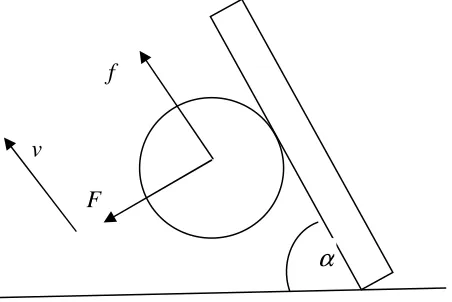
There are two interactive forces---friction and the vertical impact force F---when the ball collides with the racket. Assuming the diameter of the ball is d, quality is m, the initial angle is 0, the initial velocity is 0, the time is
t
1,the speed of the racket isv
,the corresponding parameter analysis is as shown in Picture 4:
the impulse of f is
I
f,then the corresponding impulse of F isI
F,therefore, the torque that the friction isproduced on the ball is
2
df
, and as a result of it, the impulse is
2
dfI
, when the rotational inertia of table
tennis is in the barycenter:
2
3
2
mr
I
c=
(2
d
r
=
) (20)on the basis of relevant theorems:
0
−
=
FF
mv
I
(21)0
−
=
Ff
mv
I
(22)f
F
[image:5.595.193.419.354.505.2]α
v
0
2
I
f=
I
cω
−
d
(23)
ω
is the final velocity of the angular velocity,v
fmeans the final velocity is in the direction of f,v
Fmeans the final velocity is in the direction of F.From the above, we can get:
m
I
v
Ff
=
(24)m
I
v
F=
f (25)md
I
I
dI
f C f3
2
=
=
ω
(26)The component velocities along the horizontal and vertical axes are:
β
β
β
β
cos
sin
cos
sin
m
I
m
I
v
v
v
F ff F
x
=
+
=
+
(27)β
β
β
β
cos
sin
cos
sin
m
I
m
I
v
v
v
f FF f
y
=
+
=
+
(28)(27)(28)refer to the corresponding initial velocities of table tennis.
In its moving process, the ball is also under the impact of rotations of the axis due to the resistance, the gravity and the buoyancy force. The gravity can be inferred by using the formula:
mg
G
=
(29)the buoyancy force of the ball is: 3
6
1
d
g
F
浮
=
ρ
π
(30)the resistance is: 2
2
1
v
G
F
d=
dρ
(31)Thus, its kinematic equations are:
+
−
+
=
+
=
mg
d
g
Av
C
v
d
C
dt
y
d
m
Av
C
fv
d
C
dt
x
d
m
d L d L 3 2 3 2 2 2 3 2 26
1
sin
2
1
cos
cos
2
1
sin
ρπ
β
β
γ
ρ
β
β
ρ
(32)
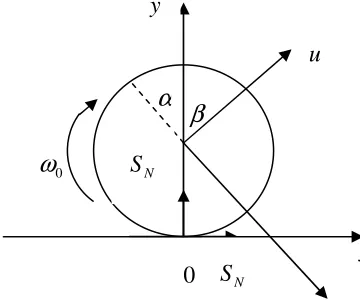
THE CONTACT MODEL OF TABLE TENNIS AND THE DESKTOP
Assuming the velocity of the centre of the ball is
v
e. When the ball hits the desktop, this velocity can be categorizedinto two directions both horizontally and vertically, namely,
v
ex、ey
v
,its corresponding friction impulse isNdt
From the above formula, it is known
v
0=
v
ex−
r
ω
0 and the velocity at the point of 0 isv
0 .If
v
0<
0
,
thenv
ex>
r
ω
0,the ball relatively slides forward, or, the ball is moving along the negative direction ofx axis. On the contrary, when
v
ex>
r
ω
0,the ball will move along the positive direction of x axis, therefore, weshould take these two conditions into consideration:
If
v
0>
0
,
we can get the following equations according to the collision theory of rigid body motion:f ex
x
mv
s
mu
−
=
−
(33)N ey
y
mv
s
mu
−
=
−
(34)r
s
I
I
x−
ω
0 c=
fω
(35)Since the rotational inertia of the ball is 2
3
2
mr
I
c=
,then we can know the following equation with the help of therecovery coefficient:
ey y
ev
u
=
−
(36)And we can get the following formulas based on the above formula:
+
+
=
+
−
=
′
−
=
)
1
(
)
1
(
4
3
e
v
v
u
e
v
r
ev
u
ey ex x ey ey yµ
π
µ
γ
γ
(37)(1)if
v
0<
0
,
the equations can be solved by using the collision theory of rigid body motion:
+
−
=
+
+
=
′
−
=
)
1
(
)
1
(
4
3
e
v
v
u
e
v
r
ev
u
ey ex x ey ey yµ
π
µ
γ
γ
(38)The above-mentioned two equations are similar in their formulations and thus a correlation can be build between them since the ball is under the gravity, the buoyancy force, the air resistance and the Magnus force caused by rotation.
CONCLUSION
This thesis conducts an in-depth mechanical research of table tennis by building a mechanical model and analyzes the moving process of table tennis. It also analyzes every procedure from the ball’s release from the hand to its return and the influencing factors by using some mechanical theories. The mechanical models it has built are not
[image:7.595.204.384.74.228.2]0
ω
α
β
0
x
u
y
NS
NS
only applicable to table tennis, but also to other forms of sports like football. This paper will have a profound influence on the development of table tennis.
Acknowledgment
Awarded quality project of Anhui Provincial Department of Education "Study on the Practice of Sports Classroom Teaching Strategies in Anhui Colleges and Universities."Project number: 2013jyxm233
REFERENCES
[1]Wu Huanqun. Qin Zhifeng. Xu Shaofa. A Quantitative Research of the Rotation of Table Tennis. 2000. (01) [2].HINDS WILLIAM C Aerosol Technology:properties,behavior,and measurement of airborne particles.1982 [3].GOLDSTEIN S Modern developments in fluid dynamic.1938
[4]. Tang Jianjun. Journal of Beijing Sport University. 2006(02)
[5].Zhao Lei. Xiao Hui. He Renjie. Li Cheng. Mechanical Analyses of Table Tennis’s Flight Process and A Matlab
Simulation. [Journal]—Journal of Jiujiang college (natural science edition)