ASSESSMENT FOR SELECTING CONTENT ADAPTATION SERVICES
JULIANA BINTI MOHAMED
This thesis is submitted as a fulfillment of
the requirement for the award of the degree of
Master in Information Technology
Faculty of Computer Science and Information Technology
Universiti Tun Hussein Onn Malaysia
iv
ABSTRACT
ABSTRAK
vi
CONTENT
TITLE i
DECLARATION ii
ACKNOWLEDGEMENT iii
ABSTRACT iv
ABSTRAK v
CONTENT vi
LIST OF TABLES ix
LIST OF FIGURES x
LIST OF FORMULAS xii
LIST OF PUBLICATIONS xiii
CHAPTER 1 INTRODUCTION 1
1.1 Introduction 1
1.2 Problem Statement 3
1.3 Research Question 4
1.4 Objectives 5
1.5 Scope of Study 5
1.6 Research Methodology 6
CHAPTER 2 LITERATURE REVIEW 8
2.1 Introduction 8
2.2 Content Adaptation Systems 9
2.3 Service Level Agreement in
Content Adaptation 11
2.3.1 Service-oriented Content
Adaptation architectures 12
2.3.2 Service Level Agreement in
other fields 14
2.4 SLA strategies in Content Adaptation
System 16
2.5 Framework of One-to-Multiple
Negotiation Model 19
2.6 SLA assessor algorithm 21
2.7 Summary 23
CHAPTER 3 RESEARCH METHODOLOGY 24
3.1 Introduction 24
3.2 Scope of Study 24
3.3 Selection of Methodology 25
3.4 System architecture 26
3.4.1 Negotiation strategy 28
3.4.2 Data analysis 30
3.5 Conclusion 32
CHAPTER 4 DESIGN AND ANALYSIS 33
viii
4.2 SOCA framework descriptions 34
4.3 Framework of One-to-Multiple
Negotiation model 35
4.4 SLA Assessor algorithm 37
4.5 Analysis of waiting time factor 39
4.5.1 Performance evaluation 43
4.6 Conclusion 44
CHAPTER 5 RESULT AND DISCUSSION 45
5.1 Introduction 45
5.2 SLA Acceptance Rate 46
5.3 SLA Rejection Rate 50
5.4 Communication Step 54
5.5 Conclusion 55
CHAPTER 6 CONCLUSION 57
6.1 Introduction 57
6.2 Contribution 58
6.3 Limitation 59
6.4 Future work 59
REFERENCES 60
LIST OF TABLES
3.1 Scatter plot between two variables for
each situation 31
4.2 List of commonly used notation 37
4.3 Function of the checker 39
x
LIST OF FIGURES
2.1 Multimedia content components 9
2.2 Service-oriented content adaptation
framework 12
2.3 SLA Typical Utility Computing
System Architecture 15
2.4 Content adaptation strategies 16
2.5 QoS negotiation model 18
2.6 example of content adaptation request 21
3.1 Methodology 26
3.2 A negotiation context communications 27
3.3 QoS negotiation model 28
3.4 example of SLA settlement rate versus
number of requests simulated data 32 4.1 SLA framework for service-oriented
content adaptation 34
4.2 One-to-multiple Negotiation
strategy model 36
4.3 Algorithm of SLA assessor 38
4.4 Offered E(W) versus Actual E(W)
against three tasks based on server load 41 4.5 Actual E(W) versus Offered E(W) against
three tasks based on server load 42
5.1 SLA acceptance rate versus server load
5.2 SLA acceptance rate against number
of tasks 47
5.3 SLA acceptance rate against number
of services 49
5.4 Rejection rate versus server load
variations (N=60) 50
5.5 Rejection rate against number of
tasks 52
5.6 Rejection rate against number of
services 53
5.7 Communication step against number
xii
LIST OF FORMULAS
3.1 Pollaczek-Khintchine formula 29
3.2 Waiting time QoS E(W) formula 29
3.3 A Bounded Pareto formula 29
4.1 Checker notation (no negotiation) 39
4.2 Checker notation (negotiation required) 39
4.3 Waiting time QoS E(W) formula 40
4.4 A Bounded Pareto formula 40
4.5 Mean service time formula 40
4.6 SLA acceptance rate formula 43
LIST OF PUBLICATIONS
1 Mohamed, J., Fudzee, M. F. M, & Ismail, M. A. (2014). Incorporating Human Psychological Factor in Assessing the Deliverability of Quality of Service (QoS) for Multimedia Content Adaptation Services. In Knowledge
Management International Conference, Langkawi, Malaysia.ISI Indexed
2 Fudzee, M. F. M., Mohamed, J., Abawajy, J., Kasim, S., & Ismail, M. N. (2014). An SLA Evaluator for Multimedia Content Adaptation Services. In
Information Science and Applications (ICISA), 2014 International Conference on (pp. 1-4). Scopus Indexed
INTRODUCTION
1.1 Introduction
In recent years, mobile documents has been revolutionized with the variety of uploading and downloading methods since the grandeur of current browser technology. The impact of the upcoming technology can influence the quality of service that should be acknowledged by the end users. Some of the mobile technology, including the advanced wireless technology and ubiquitous Internet access that is high in quality. As the heterogeneity of mobile devices such as smart phones and tabs grows, surfing and browsing websites through mobile devices has also become very popular. The recent trend is the content adaptations that are notoriously demanded, and has become profitable mobile contents of its quality to the Internet as one of the third party services (Arai & Tolle, 2010).
Content adaptation is particularly used to bridge the disproportionate the resources by providing users with contents that is appropriate to the given contexts, e.g., device capability or network bandwidth. Content adaptation in multimedia is
sometimes, encounter limited adjustment functionality, get overload when too many users connected, and even may lead to failure. Thus, it will cut the limitation of information of the services (Yang & Shao, 2007).
In utilizing the World Wide Web environment, the concept of ‘establishing a content adaptation as a service that allows the use of a huge number of adapted content located in many places in the network’ has recently been advocated. Nowadays, there are many service providers offer a variety of content adaptation that can be loosely coupled. Therefore, the solution for these services is to cooperate with each other through service composition to completely serve the request that they cannot attain individually.
Service-oriented Content Adaptation (SOCA) is formed based from the service oriented architecture (SOA) (Tsai et al., 2010). SOCA presents a model that enables the content adaptation to be consumed as Web services (Fudzee & Abawajy, 2011b). However, current solutions, according to Alhamad et al., (2010), do not take into account the human psychology factor in negotiating with services. One of these factors is of how long that user can wait for the output to be displayed. In addition, response time is a ‘de facto’ of the quality of service (QoS), and it should be highly considered in accessing the content adaptation service delivery.
3
Egger et al., 2012). Due to this matter, we have decided to address this problem by taking into account user’s waiting time factor for content adaptation services.
1.2 Problem Statement
Service Oriented Content Adaptation (SOCA) framework enables the adapted content to be delivered to a number of services based on the advertised QoS. Users are willing to pay for the service, thus leads to demanded for good service quality. One of the factors considered by the QoS adaptation is the maximum time that user can wait for the output to be displayed. In addition, response time is an important issue to be considered in assessing the deliverability of content adaptation services.
Existing solution presents a single evaluation of Service Level Agreement (SLA). An example of an important QoS is waiting time. The service provider offers one waiting time QoS during the advertisement, based on the fair load. However, the advertised response time may not be deliverable accordingly during the actual service execution due to a heavy load. Practically, the service provider should be able to estimate a current deliverable response time before the SLA settled.
1.3 Research Question
This research addresses two key issues; (1) how to enable the quality assurance in term of service level agreement (SLA model); and (2) how to enable the negotiation of quality of service (QoS negotiation) for content adaptation services, by taking into
account the acceptable waiting time for adapting content based on human psychology.
To enable the quality assurance, a framework is used to manage the service agreement between users and service providers. Hence, SOCA has enabled an adapted content to deliver a number of services based on QoS, a service composition known as a practical solution. A mechanism, that enables the delivery of these interconnected content adaptation services that conform the agreed QoS, is indeed required. However, most of the current frameworks (Alhamad et al., 2010) do not take into account user’s waiting time factor in negotiating with services.
5
1.4 Objectives
The objective of this study is to establish the basis for managing the content adaptation services’ QoSs through the authorization of SLA. Specifically, we plan:
(a) to identify how SLA can be used in SOCA framework by utilizing an SLA model in relation to content adaptation services.
(b) to propose an appropriate strategy to evaluate the quality of services (QoS) by taking into account user’s waiting time.
(c) to simulate and analyze the proposed SLA model in terms of SLA acceptance and request rejection within the simulated environment.
1.5 Scope of Study
There are many content adaptation approaches introduced by previous researchers. They had discovered many parts in content adaptation in terms of SLA. However, current solutions, according to Alhamad et al., (2010), do not take into account human psychological factor in negotiating with the services. One of these factors is of how long a user can wait for the output to be displayed. The main factor to be discussed on to this study is the response time of QoS, and it should be highly considered in accessing the content adaptation service delivery.
Previously, there was an existed research complementing the SLA layers of SOCA, presented by Fudzee (2011). These layers included five interrelated of client, broker, middle layer, server, and provider (Fudzee, 2011). Basically, this architecture demonstrated the flow of the services that were being delivered in sequential. Unfortunately, the previous study had discovered that the service provider offers only one waiting time QoS during the advertise process (Fudzee & Abawajy, 2011c). In addition, if the server experiences a heavy load, it may not be able to accept all of the incoming requests within the offered waiting time.
in doing the job. From here, the analysis will cover the acceptance rate, the rejection rate, and the communication step for several tasks. The study will conduct more approaches on how to determine the quality of service (QoS) thru SLA by presenting the proposed one to multiple negotiation strategy. The cumulative data will be used in one to many negotiation strategies by innovating the SLA assessor.
1.6 Research Methodology
In this research, the methodology used are concept” and “proof-of-performance” that includes data acquisition, solution modeling and validation, and implementation and analysis stages. This methodology used due to the experimental computer science method in Snyder et al. (1994).
In proof-of-concept, the research study will be gathered by critically reviewed to provide the overview that leads to the formulation of valid problem statements. Then, the data set will be gathered from a reliable server. Next, this data will be validated by the proposed model and an algorithm.
In proof-of-performance concept, the implementation of the algorithm will be executed. From here, the analysis will be processed to obtain a valid result. A detailed explanation of the methodology will be presented in Chapter 3.
1.7 Structure of Thesis
7
LITERATURE REVIEW
2.1 Introduction
Mobile documents are increasing from the aspect of content, and varied in structure and format. At the same time, user’s priority varies towards the contents, and their devices are getting increasingly varied in its capabilities. The disproportionate between rich contents and user’s requirement, along with their device’s capability, presents a challenge in providing ubiquitous access to these contents. Nowadays, people prefer to use mobile devices (e.g., smartphones, tablets and etc.) rather than desktop devices (e.g., laptops and desktops). By the increasing variety of platforms and applications, peoples can surf the internet anytime and anywhere. Peoples demanding the ubiquitous computing to get unlimited information and access.
Content adaptation is a potential solution for web content, delivered to the user through heterogeneous devices when arising the acceptable result. In establishing the content adaptation as a service to allow using huge number, the idea of adapting the content located in several places in a network should be supported. There are several service providers that offer a variety of content adaptation services. Each of the service providers advertises their own QoS to represent their information to the clients.
9
2.2 Content Adaptation Systems
Content adaptation is used to adapt the content to the given contexts required by the user (Adzic et al., 2011; Chen et al., 2012). Content adaptation usually related to mobile devices that includes selecting, generating and modification process of multimedia content (text, images, audio and video) in adapting to the human-computer interaction to the environment and context utilization (Das, 2010; Lee et al., 2014). The modification process can be applied to transform the content within
the same media types (e.g. compressing the image size), and across different media types (e.g. converting pronunciation to a text or from the video element to image montage) (Zhao & Jin, 2011). This process enables the existence of the content adaptation systems such as client-side and server-side. This content adaptation system sometimes encounters limited adjustment functionality, overloads when too many users are included, and it may lead to failure. Consequently, it will cut the limitation of information of the services (Yang & Shao, 2007).
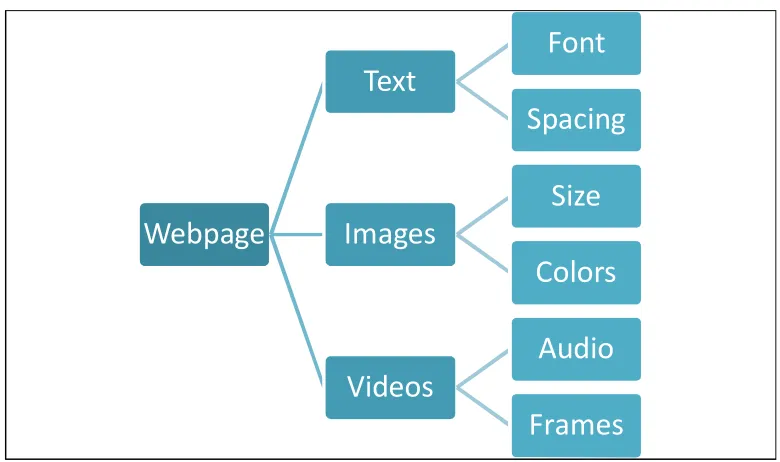
[image:20.612.130.520.455.686.2]The information transforms into three layers of nature for the content. Figure 2.1 illustrates the concepts of components (Adzic et al., 2011). Basically, all web page contents will include the three elements; text, images and videos. A text can further be grouped by two; font and spacing. The images can be divided into two; size and colors. As for videos, it includes two of audio and frames.
Figure 2.1: Multimedia content components
Webpage
Text
Font
Spacing
Images
Size
Colors
Videos
Audio
The element of the text includes the font that usually related to typography. The typography contains the styles of fonts, types of fonts, and its sizes. Each text includes the spacing in order to be meaningful for each paragraph. Spacing helps a website to be readable and efficient in every text. In images element, a size difference may influence every picture and icon. The size contains vector and bitmap that usually influence the quality of images. An image will be meaningful for viewers when colors are added to the images. The pixel of the image will be influenced for every color added. A web page can be attractive to the users when colors are used to emphasize each area. Another important element in multimedia is video. Without utilizing a video, a web page can be dull. The video contains audio that works with sound and visual component. Video is a series of frames that contains lots of pictures and sound and it is played back at a fast rate. It comes from a single frame with a picture of specific actions. When the sequential pictures are grouped together and played back, the picture will give some movements of impressions.
Mobile devices have become popular nowadays, especially with the teenagers. While some of the new applications were invented to suit the mobile devices, users’ behavior are also changed (Maurer et al., 2010). Some of these new applications exploit text, audio, video, graphic and animation elements in gaining and enticing users’ attention (Kosinski et al., 2013; Ahmad & Hong, 2012). The structure of the applications contains different view of content and format (Hsiao et al., 2008; Nimmagadda et al., 2010). There are several issues that are related to the
11
2.3 Service Level Agreement in Content Adaptation
In recent years, Service Level Agreement (SLA) has been investigating methods to reduce problems between users and service provider. SLA guarantees that both of them shall understand and work with each other in giving the best services for a good delivery web service. These should be measured based on several factors. The management of SLA replicates the real-time situation, like handling much information that are usually requested by clients. These are some main issues highlighted by SLA management. The issues to be discussed in this study are the definition of SLA, and the QoS in content adaptation.
SLA is defined as the ability of a provider to deliver the information and expectation from clients; the result should be shown together with the measurement and reporting mechanism (Leopoldi, 2002). Wu & Buyya (2011) and Cuomo et al., (2013) mentioned that SLA is a formal agreement between service providers and the customers to guarantee that the quality of service can be achieved by customers. Meanwhile, Kandukuri et al., (2009) stated that the SLA should monitor the information on the services, meaning that the information should be accurate, and contains detailed specifications of exactly what is being delivered.
SLA is implemented effectively through the existence of QoS adaptation and context diversity. The QoS adaptation plays an important role for service providers in selecting the QoS adaptation approach (Sun et al., 2011).Service provider always offers low waiting time, high reliability and availability for users to successfully operate the services (Liu et al., 2010; Bala & Chana, 2011). Kuyoro Shade et al., (2012) emphasized that QoS adaptation is a set of nonfunctional attributes that may impact the quality of the service offered by a service. The set of nonfunctional attributes for QoS adaptation refers to response time, availability, price, reputation and data quality (Alaa et al., 2013;Filieri et al., 2012).This study covers along the QoS adaptation by taking into account the waiting time factor. Before the agreement between users and provider being enclosed, the QoS needs to be negotiated based on the specific adaptation requirements determined by the users.
information that can characterize an entity’s situation or state. The purpose of the context is to adapt the content to the entity. The context diversity could be a device, network, user or client or combination of them.
2.3.1 Service-oriented Content Adaptation Architectures
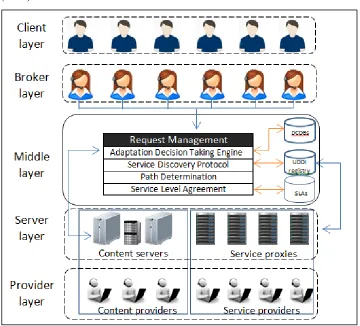
[image:23.612.132.492.318.644.2]Every content adaptation system has different components of its system architecture. The architecture of content adaptation provides an important knowledge before making any choices and decisions upon the existing content adaptation systems. There are five main layers of function that play roles in the systems. Figure 2.2 demonstrates the five layers of content adaptation systems introduced by Fudzee (2011).
Figure 2.2: Service-oriented content adaptation framework
13
which has been characterized by the logical view of an actual entity, message oriented with service description, and platform neutral. The purpose of the SOCA framework is to give out user expectation by offering added value content, and also to provide flexible and scalable service-based content delivery mechanism (Fudzee, 2011). The five layers of the SLA architecture include; client layer, broker layer, middle layer, server layer and provider layer. The framework is made of components that provide access to content servers, develop user requests to source format, and to manage and provide content description (Fudzee et al., 2010; Garg et al., 2013). In this situation, a client has made a request using the heterogeneous devices (e.g., smartphones and tablets). The service provider is responsible in receiving the information that stores the content, and later to distribute it through the Internet. There are several service providers located in many places in the network that provide a variety of content adaptation services.
Both of the client and broker layer will inspect methods used by the broker in handling the requests from clients. The content adaptation requirements need to be analysed by the broker using Adaptation Decision Taking Engine (ADTE). Another mechanism, known as Device Capability Database (DCDB) stores the device profile that contains the specific information of the device to accurately render the output page of display at the client’s devices. HTTP protocol is used to get the incoming client request from the broker. The requesting device will later be identified in DCDB by the user-agent header. The capabilities of all devices are retrieved from the database to the identified device. World Wide Web Consortium (W3C) introduces the composite capabilities or preference profile specification that is represented from the client’s device capability. This device should be activated, and it will be detected through Bluetooth configuration. DCDB should be synchronized regularly, and placed on distributed location. Users may have their own preference in choosing the version of the content. Hence, the broker should identify and analyse the explicitness of this preference.
service suited for each task by using the QoS criteria. The broker, later, will be dealing with the provider in handling the selected services. The SLA then is settled when the provider agrees to serve the request according to the advertised QoS, otherwise the QoS may or will be negotiated.
A platform is installed at the server, and it will, in this layer, help in providing the content and its adaptation services. Clients will be provided with a content version for the service. The web content consists of content of the server. UDDI registry will be published, and will update the service provider. The service registry will maintain the description that includes service provider, adaptation function types with typical formats, available bandwidth, availability status, cost and time adapted.
2.3.2 Service Level Agreement in other fields
Service Level Agreement is also being explored in other fields of study. The purpose of the inspection is to compare and elaborate the other strategy in improving the cloud computing technology in SLA. In this area, Wu & Buyya (2011) and Cuomo
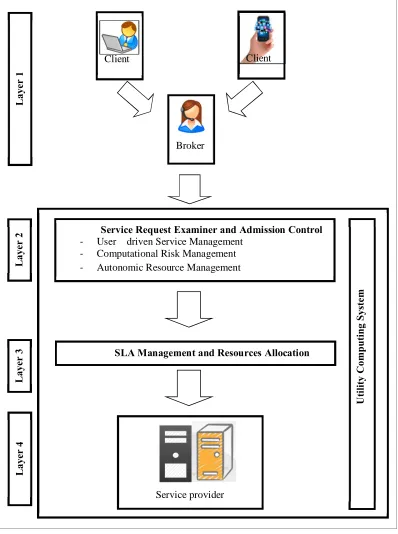
et al., (2013) have investigated the SLA architecture, which is described using a
typical utility computing system based on the layered architecture in Figure 2.3. There are four possible layers in this framework. The first layer contains a User or Broker, whom will submit their requests by using various applications to the utility computing system. The second layer contains Service Request Examiner which is responsible for admission control. In the third layer, SLA Management balances workloads, and a Resource or Service Provider offers resources or services. Users or Brokers, who are acting on behalf of the as users, will send their requests and applications, from their devices, to be processed by the utility computing systems.
15
[image:26.612.113.511.145.679.2]the required steps, the continue stage, which is at layer four, will start playing their roles. In this layer, the service provider will process the information and give the best resource or service back to the User or Broker-on-behalf.
Figure 2.3: SLA Typical Utility Computing System Architecture
Layer 1
Layer 2
Layer 3
Layer 4
Broker B
Client Client
Utility Computing System
Service Request Examiner and Admission Control - User – driven Service Management
- Computational Risk Management - Autonomic Resource Management
SLA Management and Resources Allocation
2.4 SLA Strategies in Content adaptation system
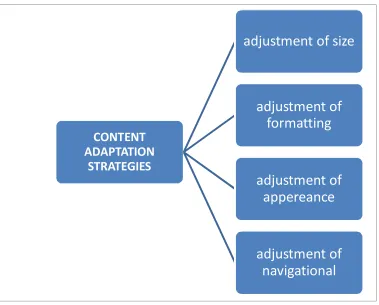
[image:27.612.138.517.295.600.2]Content adaptation has already gained considerable importance in today's multimedia communications, and will certainly become an essential functionality of any service, application or system in the near future. The continuity of the advancement in technology will only emphasize the great heterogeneity that exists in current modern devices, systems, services and applications. Likewise, this will also bring out the desires of consumers for more choices, better quality, and more personalization options (Carreras et al., 2009). Typically, content adaptation will include several strategies, as illustrated in Figure 2.4. These strategies will adopt the component of the content, especially from the heterogeneity of mobile devices.
Figure 2.4: Content Adaptation Strategies
Web-based usually will include some images and videos to support their content so that it can appeal to the users. Normally, an image size can viewed to the desktop area. This will give a constraint to the mobile display due to the actual size
CONTENT
ADAPTATION
STRATEGIES
adjustment of size
adjustment of
formatting
adjustment of
appereance
17
of the images. The size adaptation can be adjusted by scaling and resizing the images.
Different mode of media represents different view of formats. An image can be displayed in different formats (e.g., PNG, JPEG, GIF) and in different color scheme (e.g., grayscale, 16-bits color). The adjustment of formatting can be performed by transforming the mismatch content into the appropriate format in the same media. For instance, the application of Whatsapp versus the network. Nowadays, many users own a high quality of camera on their smartphone. Users often send or upload their picture via this application. Some of the users upload the image using the mode of data transfer (e.g., mobile data, wifi). If some of them are using mobile data, the transmitting process may consume several minutes.
The adjustment of appearance deals with the web layout while preserving the content and functionality. Some of the web pages are designed with a fixed width and centered column where the main text resides. In order to overcome this, a multi column web is altered into a single column while surfing with mobile devices.
The content provides the user a tailored content by keywords rather than the whole content segment. The adjustment of navigation provides users with some guidance on how to access the content based on their knowledge and interest. After clicking the keyword, it will navigate the user to their desired content.
Sometimes, users are frustrated when page loading process exceeds over 7 to 10 seconds without getting any feedback (Szameitat et al., 2009). The type of connections, user’s characteristics, and the importance of tasks are some of the factors of users’ willingness to wait for any result (Kohrs et al., 2014; Thomaschke
et al., 2014). In the client-side approach, adaptation is demanded to the client’s
device itself, particularly when the adaptation is performed by the Web browser.
Server-based approaches, initially, consist of adding content adaptation services to traditional Web server functionalities. Multimedia content transformation is usually generated off-line at the content creation time, often involving a human designer to hand-tailor the content to the specific requirements of few classes of devices (Malandrino et al., 2010).
sending probe requests (i.e., test requests that are similar to real requests). Combining these two approaches will be very helpful in achieving the SLA needs effectively (Michlmayr et al., 2009).
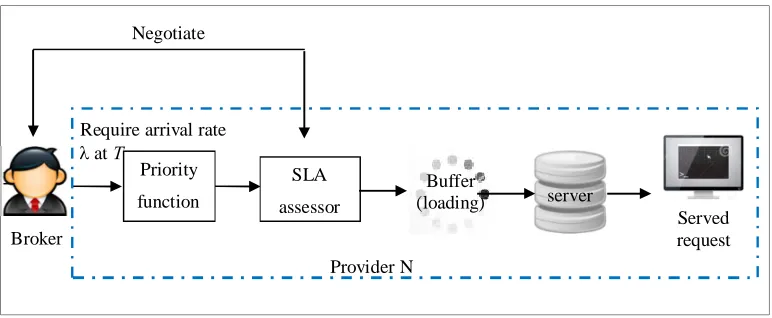
Fudzee & Abawajy (2011c) have proposed a negotiation strategy by allowing a single broker to a single service provider modeled as an M/G/I queue. The model is developed based on queuing theory to show the relationship between a service received by the provider, and the manner the request is served. Figure 2.5 shows the flow of this model.
[image:29.612.132.518.243.402.2]1.
Figure 2.5: QoS Negotiation Model
From the figure, the waiting time is used to reflect the response time. The broker reaches the requested service by searching through the priority function. The current server load will be checked by SLA assessor, and it will estimate the number of requests that can be served within the offered waiting time. The SLA assessor will negotiate between one to one parties. Starting from the broker as on behalf of the user, they reach the requested service by searching the priority function. From there, the SLA assessor will process the loading time that broker should be considered to wait, for example three seconds. Later, if the loading time declares the desirable time by the user, it will focus to the server to process the output data, and the served requested will hire the information result (Raimondi et al., 2008).
Broker
lat T
Require arrival rate
Priority
function
SLA
assessor server
Negotiate
Served request Provider N
19
2.5 Negotiation Strategy
SLA has raised many issues in several aspects, especially in Web services. Due to this matter, many researchers have come out with lots of ideas, and have addressed the issues to inquire the problem regarding the QoS, and the negotiation of web services provided. In recent work, Elgazzar et al., (2011) has proposed the Web service discovery framework. The idea of the framework has gained lots of advantage in offering better services in a mobile environment. We can figure out the problems that are recently raised by producing a framework, especially when it can be implemented both from service providers and end user. Elgazzar et al., (2013) and Arango (2013) also agreed that this framework helps to perform mobile applications as a service of context-aware platform. Moreover, Goh et al., (2011) has proposed the same issue regarding the mobile device in reducing encumber of user navigation in the huge number of media content by allowing context-aware personal content adaptation and efficient metadata processing.
Aijaz et al., (2010) has planned to enhance the quality of service introduced by SLA, focusing on a framework to offer, the negotiations of SLA, and managing the QoS of the provisioned mobile web services. Aijaz et al., (2010) claimed that there are four primary architectural components, and have classified their functions into four fundamental of SLA life cycles. These methods are similar with Badidi (2011). They proposed a novel framework for Web service provisioning, which relies on brokered SLA, between clients and service providers, and a publish model to handle notifications on essential changes in QoS offerings. Meanwhile, Fudzee (2011) claimed that the negotiation model by focusing on waiting time as QoS adapted to the services. So through this approach, service providers can provide several typed and level of services. In addition, the proposed model allows service brokers to be aware of its essential changes in the QoS offerings of service providers, and able to monitor the execution of SLA (Balakrishnan & Somasundaram, 2011).
On the other hand, Michlmayr et al. (2009) has presented a framework that merges the benefits to client-side and the server-side that are monitored by QoS. The framework was developed upon the event processing to inform interested subscribers of current QoS values and possible violations of SLA (Leitner et al., 2010a; Leitner
that the QoS separates the web services by the quality of the service on functional and non-functional web service. They allow clients to know the quality of the offered web services by selecting an optimal correlation between quality and price which client should pay for. This method has been followed by Sha et al., (2013) which presents an architecture by focusing on to the cost dependence by user’s satisfactions. This method will report the performance of the web service separately. Besides that, Nurika et al., (2014) and Aziz (2014) have proposed a consumer oriented framework by developing a performance based on simultaneous service level negotiations. This framework offers the maximum price or minimum resource consumption to users, especially for new user who clueless in cloud web service. This framework will facilitate the multiple SLA negotiations (Mukhopadhyay et al., 2013).
Recently, Zheng & Lyu (2013) and Li et al., (2014) have implemented a great strategy to manage the QoS effectively by proposing Basic Fault Tolerance strategy. The strategy called Dynamic Parallel strategy, is the combination of an n-Version Programming (NVP) (Avizienis, 1995) and Active (Salatge & Fabre, 2007)
strategies, to purposely improved the QoS especially the quality in providing the services through user perceptions. Sim (2010) and Venticinque et al., (2011) have discovered the complex Cloud negotiation mechanism designed to support complex negotiation activities in interrelated markets in which the negotiation outcomes between broker and provider agents in a Cloud resource market can potentially influence the negotiation outcomes of broker and consumer agents in a Cloud service market (Son & Sim, 2012).
21
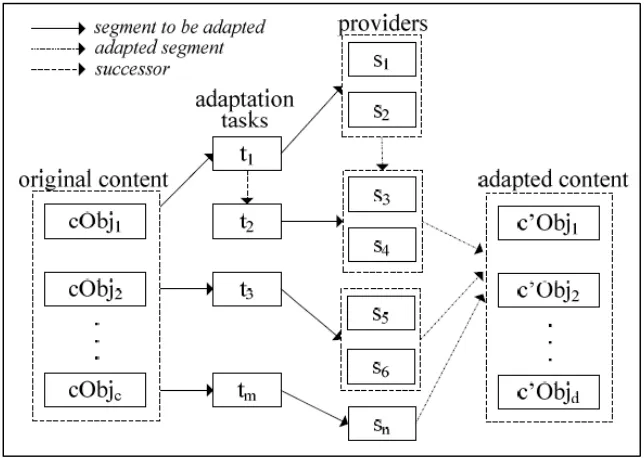
[image:32.612.166.488.67.296.2]Figure 2.6: example of content adaptation request
Assume that a situation of browsing a certain topic from Internet. This topic will return a heterogeneous result with unstructured text, the data source of web that is deeper, web services, images and other multimedia resources. In this case, a content object may require one or more content adaptation tasks that can be simplified by a few of service providers (Fudzee, 2011).
In improvising the research study, we have viewed some of the potential strategies by providing several tasks to do the job are being evaluated simultaneously instead of single task in the existed research done by Fudzee (2011). The study will be discussing on how to determine the quality of service (QoS) thru SLA by presenting the proposed one to multiple negotiation strategy. The cumulative data will be used in one to many negotiation strategies by innovating the SLA assessor.
2.6 SLA Assessor Algorithm
the service provider has given the best services, there are few steps available that allow the services get to the end user. The steps are classified as an algorithm.
The proposed algorithm is focusing on SLA assessor from the proposed framework model for the improvement of the settlement rate of waiting time factor, considered by QoS adaptation. Fudzee et al., (2014) has suggested a single negotiation algorithm at SLA as an evaluator by considering waiting time factor. For the enhancement of this strategy, we will propose a negotiation for multiple task strategy by presenting an SLA assessor algorithm at the broker side. This algorithm enables to receive multiple requests if the actual time exceeded the offer time. This step will be conducted by a checker. The similarity between these two strategies is that both are focusing on the QoS provision multimedia content adaptation (Luo & Shyu, 2011). Meanwhile, Čović et al., (2012) has discovered the Mobile Detection Algorithm Based on Tera-Wurfl (MDABTW) as an approach, suitable for the heterogeneousness of mobile devices to encounter the content of such web sites. This approach allows all of the handheld devices for accessing all viewed web sites (Barsomo & Hurtig, 2014).
Rajendran et al., (2010) proposed an approach of specifying the functional and QoS requirements by reducing the complexity of matching user requests. This approach includes the broker by performing the process of selecting the web services (Rajendran & Balasubramanie, 2010). This algorithm is agreed with Liu et al., (2010) and Bala & Chana (2011) which surveyed the different types of workflow scheduling algorithms and tabulated their various parameters along with tools and scheduling factors. Workflow scheduling is one of the key issues during the workflow execution especially in SLA management (Son & Sim, 2012). This workflow is followed by Verma & Kaushal (2012) whom realized that this algorithm can minimize execution cost while encounter timeframe for delivering results, and analyze the behavior of the algorithm (Arya & Verma, 2014; Verma & Kaushal, 2013; Alkhanak et al., 2015). Nurika et al., (2014) and Aziz (2014) proposed a genetic algorithm to calculate the specific quality of service of the available providers. This algorithm negotiates with multiple providers that are suitable for users who are concerned more on the quality of the service rather than the affordability through negotiating (Yassa et al., 2013; Duerden et al., 2014).
23
execution, and based on the budget-constrained schedule according to the user’s preferences. Their algorithm estimates the budget for the case study investigated with the user-selected schedule that is executed within the given budget limitations (Oprescu et al., 2012; Frincu & Craciun, 2011; Frîncu, 2014; Son et al., 2013). By demonstrating the proposed algorithm that guarantees the workflow execution conforming to the deadline, Cui et al., (2013) has set lodgers, and reduced the mean execution time for lodgers in a high priority while saving the execution cost for service providers.
2.7 Summary
Service Level Agreement (SLA) has a wide area of study. Hence, there are lots of areas that can be figured out to increase the potential agreement between the two parties. This chapter presents some parts of this study; performing the content adaptation strategy, the framework architectures, and the solution for the study.
This chapter conveys the SLA management generally in the content adaptation system and its relationship with the SLA environment. The chapter is concluded with the strategy in content adaptation by performing the framework architecture, and the solution of an algorithm to this study. SLA will be completed in settling with content adapted strategy after referring to the several of the QoS. Without the prior agreement, the SLA could not be implemented, and the end user could be frustrated in gaining the information in real-time.
RESEARCH METHODOLOGY
3.1 Introduction
The scope of this study is to establish an efficient and scalable basis for developing content adaptation solutions. In demonstrating this, a model of negotiation strategy will be facilitated to improvise the existed SOCA in Web Services (SOCA) (Fudzee, 2011). This framework shows the rules and the flow of the user to the service provider.
This research focuses on two main issues; 1) how to formalize quality assurance in term of service level agreement (SLA model); and 2) how to formalize negotiation of quality of service (QoS negotiation) for content adaptation services, by taking into account the acceptable waiting time for adapting content based on human psychology. This chapter will further discuss the details of the methodology used in this research study.
3.2 Scope of Study
60
REFERENCES
Adzic, V., Kalva, H., & Furht, B. (2011). A survey of multimedia content adaptation for mobile devices. Multimedia Tools and Applications, 51(1), 379-396. Ahmad, Z., & Hong, J. L. (2012, January). Mobile web browsing techniques. In
Neural Information Processing (pp. 283-291). Springer Berlin Heidelberg.
Aijaz, F., Shaikh, S. J., & Walke, B. (2010, November). A framework for multi-interfaced service level agreements on mobile devices. In Communication
Systems (ICCS), 2010 IEEE International Conferenceon (pp. 527-533).
Alaa, G., Menshawi, M., & Saeed, M. (2013, November). Design criteria and software metrics for efficient and effective Web-enabled mobile applications. InComputer Engineering & Systems (ICCES), 2013 8th International
Conference on (pp. 295-300). IEEE.
Alhamad, M., Dillon, T., & Chang, E., 2010. Sla-based trust model for cloud computing. In Network-Based Information Systems (NBiS), 2010 13th International Conferenceon (pp. 321-324).
Al-Jaljouli, R., & Abawajy, J. (2012). Negotiation strategy for mobile agent-based e-negotiation. In Principles and Practice of Multi-Agent Systems (pp. 137-151). Springer Berlin Heidelberg.
Alkhanak, E. N., Lee, S. P., & Khan, S. U. R. (2015). Cost-aware challenges for workflow scheduling approaches in cloud computing environments: Taxonomy and opportunities. Future Generation Computer Systems.
Arai, K., & Tolle, H. (2010). Automatic e-comic content adaptation. International Journal of Ubiquitous Computing, 1(1), 1-11.
Arango, M. (2013, June). Mobile QoS management using complex event processing: (industry article). In Proceedings of the 7th ACM international conference on
Distributed event-based systems (pp. 115-122).
Arapakis, I., Bai, X., & Cambazoglu, B. B. (2014, July). Impact of response latency on user behavior in web search. In Proceedings of the 37th international ACM
SIGIR conference on Research & development in information retrieval(pp.
103-112). ACM.
Arya, L. K., & Verma, A. (2014, March). Workflow scheduling algorithms in cloud environment-A survey. In Engineering and Computational Sciences (RAECS),
2014 Recent Advances in (pp. 1-4). IEEE.
Avizienis, A. (1995). The methodology of n-version programming. Software fault tolerance, 3, 23-46.
Aziz, I. A. (2014). Quality of Service-based Service Level Agreement Management Framework for Hydrocarbon Exploration and Discovery Operation. Deakin
University: Master’s Thesis
Badidi, E. (2011, October). A framework for brokered Service Level agreements in SOA environments. In Next Generation Web Services Practices (NWeSP),
20117th International Conferenceon (pp. 37-42).
Bala, A., & Chana, I. (2011). A survey of various workflow scheduling algorithms in cloud environment. In 2nd National Conference on Information and
Communication Technology(NCICT).
Balakrishnan, P., & Somasundaram, T. S. (2011). SLA enabled CARE resource broker. Future Generation Computer Systems, 27(3), 265-279.
Barsomo, M., & Hurtig, M. (2014). Device-aware Adaptation of Websites.
Carreras, A., Barbosa, V., Kodikara Arachchi, H., Dogan, S., Andrade, M. T., Delgado, J., ... & Kondoz, A. M. (2009). Context-aware and DRM-enabled content adaptation platform for collaboration applications. IEEE Multimedia.
Chen, J. F., Wang, Y. H., Liao, J. C., & Wang, C. A. (2012). Content Adaptation for
Context-Aware Service. Journal of Software, 7(1), 176-185.
Chua, Y. P. (2014). Asas Statistik Penyelidikan – Analisis Data Skala Likert. Mc Graw Hill Education.
Cioca, M., Buraga, S. C., & Cioranu, C. (2014). Disaster prevention integrated into commonly used web rendered systems with GIS capabilities. International
62
Cohen, J., Cohen, P., West, S. G., & Aiken, L. S. (2013). Applied multiple
regression/correlation analysis for the behavioral sciences. Routledge.
Čović, Z., Ivković, M., & Radulović, B. (2012). Mobile detection algorithm in
mobile device detection and content adaptation. Acta Polytechnica
Hungarica,9(2), 95-113.
Cuomo, A., Di Modica, G., Distefano, S., Puliafito, A., Rak, M., Tomarchio, O., ... & Villano, U. (2013). An SLA-based broker for cloud infrastructures. Journal
of grid computing, 11(1), 1-25.
Cui, L. Z., Zhang, T. T., Xu, G. Q., & Yuan, D. (2013). A scheduling algorithm for multi-tenants instance-intensive workflows. Appl. Math, 7(1L), 99-105.
Das, S. (2010). Content Adaptation in Mobile Device. Jadavpur University Kolkata: Ph.D. Dissertation.
Duerden, C., Shark, L. K., Hall, G., & Howe, J. (2014). Genetic Algorithm based Modification of Production Schedule for Variance Minimisation of Energy Consumption. In Proceedings of the World Congress on Engineering and
Computer Science (Vol. 1).
Egger, S., Hossfeld, T., Schatz, R., & Fiedler, M. (2012, July). Waiting times in quality of experience for web based services. In Quality of Multimedia
Experience (QoMEX), 2012 Fourth International Workshop on (pp. 86-96).
IEEE.
Elgazzar, K., Ejaz, A., & Hassanein, H. S. (2013). AppaaS: offering mobile applications as a cloud service. Journal of Internet Services and Applications,
4(1), 1-12.
Elgazzar, K., Hassanein, H., & Martin, P. (2011, October). Effective web service discovery in mobile environments. In Local Computer Networks (LCN), 2011
IEEE 36th Conference on (pp. 697-705). IEEE.
Filieri, A., Ghezzi, C., & Tamburrelli, G. (2012). A formal approach to adaptive software: continuous assurance of non-functional requirements. Formal
Aspects of Computing, 24(2), 163-186.
Frîncu, M. E. (2014). Scheduling highly available applications on cloud environments. Future Generation Computer Systems, 32, 138-153.
constraints in multi-cloud environments. In Utility and Cloud Computing
(UCC), 2011 Fourth IEEE International Conference on (pp. 267-274). IEEE.
Fudzee, M. F. M., & Abawajy, J. H. (2011a). QoS-based adaptation service selection broker. Future Generation Computer Systems, 27(3), 256-264.
Fudzee, M. F. M., & Abawajy, J. H. (2011b). A protocol for discovering content adaptation services. In Algorithms and Architectures for Parallel Processing (pp. 235-244). Springer Berlin Heidelberg.
Fudzee, M. F. M., & Abawajy, J. H. (2011c). A Strategy of Negotiating QoS for Content Adaptation Services. Deakin University, School of Information Technology.
Fudzee, M. F. M., (2011). Broker-based service-oriented content adaptation framework. Deakin University: Ph.D thesis.
Fudzee, M. F. M., Abawajy, J., & Deris, M. M. (2010, May). Multi-criteria content adaptation service selection broker. In Cluster, Cloud and Grid Computing (CCGrid), 2010 10th IEEE/ACM International Conferenceon (pp. 721-726).
Fudzee, M. F. M., Mohamed, J., Abawajy, J., Kasim, S., & Ismail, M. N. (2014, May). An SLA Evaluator for Multimedia Content Adaptation Services. In
Information Science and Applications (ICISA), 2014 International Conference on (pp. 1-4).
Gibbon, D. C., 2008. Multimedia Content Adaptation. AT&T Labs Research, Middletown, NJ, USA
Garg, S. K., Versteeg, S., & Buyya, R. (2013). A framework for ranking of cloud computing services. Future Generation Computer Systems, 29(4), 1012-1023. Goh, K. H., Tham, J. Y., Zhang, T., & Laakko, T. (2011, April). Context-Aware
Scalable Multimedia Content Delivery Platform for Heterogeneous Mobile Devices. In MMEDIA 2011, The Third International Conferences on
Advances in Multimedia (pp. 1-6).
Hsiao, J. L., Hung, H. P., & Chen, M. S. (2008). Versatile transcoding proxy for internet content adaptation. Multimedia, IEEE Transactions on, 10(4), 646-658.
Joselli, M., Junior, J. R. S., Zamith, M., Clua, E., Soluri, E., & Tecnologias, N. (2012). A content adaptation architecture for games. Proceedings of SB
64
Kandukuri, B. R., Paturi, V. R., & Rakshit, A., (2009). Cloud security issues. In Services Computing, 2009. SCC'09. IEEE International Conference on (pp. 517-520).
Khazaei, H., Misic, J., & Misic, V. B. (2012). Performance analysis of cloud computing centers using m/g/m/m+ r queuing systems. Parallel and
Distributed Systems, IEEE Transactions on, 23(5), 936-943.
Knight, D., & Angelides, M. C. (2008). Multimedia Content Adaptation.Multimedia
Technologies: Concepts, Methodologies, Tools, and Applications,3, 85.
Ko, H., Bae, K., Choi, J., Kim, S. H., & Choi, J. (2015). Similarity recognition using context-based pattern for cyber-society. Soft Computing, 1-9.
Kohrs, C., Hrabal, D., Angenstein, N., & Brechmann, A. (2014). Delayed system response times affect immediate physiology and the dynamics of subsequent button press behavior. Psychophysiology, 51(11), 1178-1184.
Kosinski, M., Stillwell, D., & Graepel, T. (2013). Private traits and attributes are predictable from digital records of human behavior. Proceedings of the
National Academy of Sciences, 110(15), 5802-5805.
Kuyoro Shade, O., Frank, I., Awodele, O., & Okolie Samuel, O. (2012). Quality of service (Qos) issues in web services. IJCSNS International Journal of
Computer Science and Network Security, 12(1), 94-97.
Lee, M., Bak, C., & Lee, J. W. (2014). A prediction and auto-execution system of smartphone application services based on user context-awareness. Journal of
Systems Architecture, 60(8), 702-710.
Lee, S., Rho, S., & Park, J. H. (2014). Multimedia contents adaptation by modality conversion with user preference in wireless network. Journal of Network and
Computer Applications, 37, 25-32.
Leitner, P., Ferner, J., Hummer, W., & Dustdar, S. (2013). Data-driven and automated prediction of service level agreement violations in service compositions. Distributed and Parallel Databases, 31(3), 447-470.
Leitner, P., Michlmayr, A., Rosenberg, F., & Dustdar, S. (2010a). Monitoring, prediction and prevention of sla violations in composite services. InWeb
Services (ICWS), 2010 IEEE International Conference on (pp. 369-376).
IEEE.
composite services. In Service-Oriented Computing. ICSOC/ServiceWave 2009
Workshops (pp. 176-186). Springer Berlin Heidelberg.
Leopoldi, R. (2002). IT Services Management, A Description of Service Level Agreements. White Paper, RL Consulting.
Li, G., Liao, L., Song, D., & Zheng, Z. (2014). A fault–tolerant framework for QoS– aware web service composition via case–based reasoning. International Journal of Web and Grid Services, 10(1), 80-99.
Li, X., Wu, J., & Lu, S. (2013, July). Qos-aware service selection in geographically distributed clouds. In Computer Communications and Networks (ICCCN),
2013 22nd International Conference on (pp. 1-5). IEEE.
Liu, K., Jin, H., Chen, J., Liu, X., Yuan, D., & Yang, Y. (2010). A compromised-time-cost scheduling algorithm in SwinDeW-C for instance-intensive cost-constrained workflows on cloud computing platform. International Journal of
High Performance Computing Applications.
Lobo, D., Kaskaloglu, K., Kim, C. Y., & Herbert, S. (2011). Web usability guidelines for smartphones: A synergic approach. International journal of
information and electronics engineering, 1(1), 33-37
Luo, H., & Shyu, M. L. (2011). Quality of service provision in mobile multimedia-a survey. Human-centric computing and information sciences, 1(1), 1-15.
Malandrino, D., Mazzoni, F., Riboni, D., Bettini, C., Colajanni, M., & Scarano, V. (2010). MIMOSA: context-aware adaptation for ubiquitous web access.
Personal and Ubiquitous Computing, 14(4), 301-320.
Maurer, M. E., Hausen, D., De Luca, A., & Hussmann, H. (2010, October). Mobile or desktop websites?: website usage on multitouch devices. In Proceedings of
the 6th Nordic Conference on Human-Computer Interaction: Extending Boundaries (pp. 739-742). ACM.
Michlmayr, A., Rosenberg, F., Leitner, P., & Dustdar, S. (2009, November). Comprehensive QoS monitoring of web services and event-based SLA violation detection. In Proceedings of the 4th international workshop on
middleware for service oriented computing (pp. 1-6).
Mukhopadhyay, D., Chathly, F. J., & Jadhav, N. N. (2013). Qos based framework for effective web services in cloud computing. arXiv preprint
66
Nimmagadda, Y., Kumar, K., & Lu, Y. H. (2010). Adaptation of multimedia presentations for different display sizes in the presence of preferences and temporal constraints. Multimedia, IEEE Transactions on, 12(7), 650-664. Nurika, O., Paputungan, I. V., & Hassan, M. F. (2014). Performance Oriented
Genetic Algorithm Framework of Concurrent SLA Negotiations in Cloud. idosi.org.
Oprescu, A. M., Kielmann, T., & Leahu, H. (2011). Budget estimation and control for bag-of-tasks scheduling in clouds. Parallel Processing Letters, 21(02), 219-243.
Oprescu, A. M., Kielmann, T., & Leahu, H. (2012, November). Stochastic tail-phase optimization for bag-of-tasks execution in clouds. In Proceedings of the 2012
IEEE/ACM Fifth International Conference on Utility and Cloud Computing
(pp. 204-208). IEEE Computer Society.
Pathan, M., & Buyya, R. (2009). Architecture and performance models for QoS-driven effective peering of content delivery networks. Multiagent and Grid Systems, 5(2), 165-195.
Petrova-Antonova, D. (2010). Cost dependent QoS-based discovery of web services. Sofia University.
Pocatilu, P., Ivan, I., Zamfiroiu, A., & Boja, C. (2015). An aggregate indicator for mobile application quality assessment. Turkish Journal of Electrical
Engineering & Computer Sciences, 23(4).
Raimondi, F., Skene, J., & Emmerich, W. (2008). Efficient online monitoring of web-service SLAs. In Proceedings of the 16th ACM SIGSOFT International Symposium on Foundations of software engineering (pp. 170-180).
Rajendran, T., & Balasubramanie, P. (2010). An Efficient Architecture for Agent-Based Dynamic Web Service Discovery with QoS. Journal of Theoretical &
Applied Information Technology, 15.
Rajendran, T., Balasubramanie, P., & Cherian, R. (2010). An efficient WS-QoS broker based architecture for web services selection. International Journal of
Computer Applications, 1(9), 79-84.
Sha, M. M., Baig, I. S., Rajalakshmi, C., Balaji, P., & Vivekanandhan, D. R. K. (2013). WSLA Based Dynamic Monitoring and Pricing of Web Services. Int J Sci Eng Res, 2(4), 1-5.
Sim, K. M. (2010). Towards complex negotiation for cloud economy. In Advances in Grid and Pervasive Computing (pp. 395-406). Springer Berlin Heidelberg.
Son, S., Jung, G., & Jun, S. C. (2013). An SLA-based cloud computing that facilitates resource allocation in the distributed data centers of a cloud provider.The Journal of Supercomputing, 64(2), 606-637.
Son, S., & Sim, K. M. (2012). A price-and-time-slot-negotiation mechanism for cloud service reservations. Systems, Man, and Cybernetics, Part B:
Cybernetics, IEEE Transactions on, 42(3), 713-728.
Sun, Q., Wang, S., Zou, H., & Yang, F. (2011). QSSA: A QoS-aware service selection approach. International Journal of Web and Grid Services, 7(2), 147-169.
Sundareswaran, S., Squicciarini, A., & Lin, D. (2012, June). A brokerage-based approach for cloud service selection. In Cloud Computing (CLOUD), 2012
IEEE 5th International Conference on (pp. 558-565). IEEE.
Snyder, L., Baskett, F., Caroll, M., Colemanm, D., Estrin, D., Furst, M., Hennessy, J., Kung, H., Maly K., and Reid B., (1994). Academic Careers for Experimental Computer Scientists and Engineers. National Academy Press: Washington.
Szameitat, A. J., Rummel, J., Szameitat, D. P., & Sterr, A. (2009). Behavioral and emotional consequences of brief delays in human–computer interaction. International Journal of Human-Computer Studies, 67(7), 561-570.
Thomaschke, R., Kunchulia, M., & Dreisbach, G. (2014). Time-based event expectations employ relative, not absolute, representations of time.Psychonomic bulletin & review, 1-6.
Tong, M. W., Yang, Z. K., & Liu, Q. T. (2010). A novel model of adaptation decision-taking engine in multimedia adaptation. Journal of Network and
Computer Applications, 33(1), 43-49.
Tsai, W. T., Sun, X., & Balasooriya, J. (2010, April). Service-oriented cloud computing architecture. In Information Technology: New Generations (ITNG),
68
Venticinque, S., Aversa, R., Di Martino, B., Rak, M., & Petcu, D. (2011, January). A cloud agency for SLA negotiation and management. In Euro-Par 2010
Parallel Processing Workshops (pp. 587-594). Springer Berlin Heidelberg.
Verma, A., & Kaushal, S. (2012, April). Deadline and budget distribution based cost-time optimization workflow scheduling algorithm for cloud. In of the
IJCA on International Conference on Recent Advances and Future Trends in Information Technology (iRAFIT’12) (pp. 1-4).
Verma, A., & Kaushal, S. (2013, September). Budget constrained priority based genetic algorithm for workflow scheduling in cloud. In Communication and
Computing (ARTCom 2013), Fifth International Conference on Advances in Recent Technologies in (pp. 216-222). IET.
Wang, S., Hsu, C. H., Liang, Z., Sun, Q., & Yang, F. (2014). Multi-user web service selection based on multi-QoS prediction. Information Systems Frontiers, 16(1), 143-152.
Wang, W. J., Chang, Y. S., Lo, W. T., & Lee, Y. K. (2013). Adaptive scheduling for parallel tasks with QoS satisfaction for hybrid cloud environments. The
Journal of Supercomputing, 66(2), 783-811.
Weber, F., Haering, C., & Thomaschke, R. (2013). Improving the Human–Computer Dialogue with Increased Temporal Predictability. Human Factors: The
Journal of the Human Factors and Ergonomics Society, 55(5), 881-892.
Woźniak, D., Rumian, S., & Szpytko, J. (2011). Transport device operator stress features analysis. Journal of KONES, 18, 577-586.
Wu, L., & Buyya, R., (2011). Service Level Agreement (SLA) in utility computing systems. Performance and Dependability in Service Computing: Concepts,
Techniques and Research Directions, 1-25.
Yang, S. J., & Shao, N. W. (2007). Enhancing pervasive Web accessibility with rule-based adaptation strategy. Expert Systems with Applications, 32(4), 1154-1167. Yassa, S., Sublime, J., Chelouah, R., Kadima, H., Jo, G. S., & Granado, B. (2013). A genetic algorithm for multi-objective optimisation in workflow scheduling with hard constraints. International Journal of Metaheuristics, 2(4), 415-433. Zhang, Y., Zheng, Z., & Lyu, M. R. (2011, October). Exploring latent features for
memory-based QoS prediction in cloud computing. In Reliable Distributed
Zhao, X., & Jin, Q. (2011, July). A service-oriented architecture for context-aware ubiquitous learning delivery. In Fuzzy Systems and Knowledge Discovery
(FSKD), 2011 Eighth International Conference on (Vol. 4, pp. 2461-2465).
IEEE.
Zheng, Z., & Lyu, M. (2013). Selecting an Optimal Fault Tolerance Strategy for Reliable Service-Oriented Systems with Local and Global Constraints. ieeexplore.ieee.org
Zheng, Z., & Lyu, M. R. (2013). QoS management of web services. Springer Science & Business Media.
Zheng, Z., Zhang, Y., & Lyu, M. R. (2010, July). Distributed qos evaluation for real-world web services. In Web Services (ICWS), 2010 IEEE International
Conference on (pp. 83-90). IEEE.
Zhou, J., Zhu, H., Ylianttila, M., & Rautiainen, M. (2014). Mobile Multimedia Cloud Computing. Cloud Computing and Digital Media: Fundamentals,