• No results found

Modelling and simulation of drying process for ceramic membrane fabrication

N/A
N/A
Protected

Academic year: 2020

Share "Modelling and simulation of drying process for ceramic membrane fabrication"

Copied!
58
0
0

Loading.... (view fulltext now)

Full text

(1)

MODELLING AND SIMULATION OF DRYING PROCESS FOR CERAMIC

MEMBRANE FABRICATION

ONG TZE CHING

A thesis submitted in

fulfillment of the requirement for the award of the

Doctor of Philosophy

Faculty of Mechanical and Manufacturing Engineering

Universiti Tun Hussein Onn Malaysia

(2)

v

ABSTRACT

For ages, ceramic properties and structure is known for its brittleness and its failure

such as cracking and warping. This weakness also relates to the high sensitivity of

ceramic to any thermal gradient effects. Therefore, processing steps of green body of

ceramic is crucial especially in membrane fabrication that has a multilayer structure to

ensure the efficiency of its applications. Thus, every step of ceramic membrane

preparation and fabrication needs careful control and monitoring to fulfil these aims.

Drying is one of the main problems that is always associated with the cracks and

leakages of the ceramic membrane. In fact, the drying process is one of the longest

steps corresponding to various evolutions of parameters during the evaporation

process. Due to the limitation in experimental or empirical ability to determine the

changes of dynamic critical variables during drying, modelling and simulation seems

to be the right option to determine and investigate these nonlinear and dynamic

variables and will be the focus of this study. This two-dimensional mathematical

modelling approach is able to predict the changes of variables in heat and mass transfer

during the drying process. The governing system of fully coupled non-linear partial

differential equations of the model was derived from a mechanistic approach where

the mass and energy conservation laws are defined for a particular phase into which

Darcy’s law and Fick’s law are substituted. A fully implicit algorithm has been

employed for numerical solution using the finite element method in which the Galerkin

weighted residual method is used in the spatial discretization and a backward finite

difference time-stepping scheme is employed for time integration. The ability of this

improved model is not restricted to a single homogenous layer of hygroscopic and

non-hygroscopic material, but on the novelty to incorporate multilayer heterogeneous

material properties as a membrane structure. A good agreement obtained by respective

validation works suggested that the model development and implementation are

satisfactory. Subsequently, case studies involving single layer and multilayer have

produced reasonable accuracy at all times. The application of the model at various

case studies involves a convective and enhanced intermittent drying mode which

demonstrates the robustness and trustworthiness in predicting and optimising the

(3)

vi

ABSTRAK

Ciri-ciri dan struktur seramik dikenali dengan sifat kerapuhan dan kegagalannya

seperti keretakan dan meleding sejak berzaman lagi. Kelemahan ini juga dikaitkan

dengan sensitivitinya terhadap sebarang perubahan haba. Oleh itu, langkah-langkah

pemprosesan jasad hijau seramik adalah penting terutamanya dalam fabrikasi

membran yang mempunyai pelbagai struktur lapisan dalam memastikan kecekapan

aplikasinya. Justeru, langkah-langkah penyediaan dan fabrikasi membran seramik

memerlukan kawalan dan pemantauan yang teliti bagi mencapai matlamat tersebut.

Pengeringan adalah salah satu masalah utama yang seringkali dikaitkan dengan

keretakan dan kebocoran membran seramik. Tambahan pula, proses pengeringan

melibatkan tempoh masa yang sangat lama rentetan daripada pelbagai evolusi

parameter semasa proses penyejatan. Disebabkan batasan keupayaan eksperimen atau

empirikal untuk menentukan perubahan pembolehubah kritikal dinamik semasa

pengeringan, pemodelan dan simulasi menjadi pilihan yang betul dalam menentukan

dan menyiasat pembolehubah tidak sejajar serta dinamik dan akan menjadi fokus

kajian ini. Pendekatan pemodelan matematik dua dimensi ini dapat meramalkan

perubahan pembolehubah dalam haba dan pemindahan jisim semasa proses

pengeringan. Sistem pengolahan dengan persamaan pembezaan separa bukan linear

penuh yang diperoleh daripada pendekatan mekanistik dimana hukum pemuliharaan

jisim dan tenaga ditakrifkan untuk fasa tertentu untuk digantikan dengan hukum Darcy

dan hukum Fick. Satu algoritma tersirat penuh digunakan untuk penyelesaian berangka

yang menggunakan kaedah unsur terhingga dimana kaedah pemberat Galerkin

digunakan dalam diskritasi ruang dan skim perbezaan terhingga masa-loncatan ke

belakang digunakan untuk integrasi masa. Kemampuan model ini tidak terhad kepada

satu lapisan homogen bahan higroskopik dan bukan higroskopik, tetapi pada

keupayaan yang novel dalam menggabungkan sifat heterogen bahan pelbagai lapisan

sebagai struktur membran. Satu persetujuan yang baik telah dicapai daripada

kerja-kerja pembuktian yang mencadangkan pembangunan dan pelaksanaan model adalah

memuaskan. Sejurus itu, kajian kes yang melibatkan lapisan tunggal dan berlapis telah

menghasilkan ketepatan yang munasabah pada setiap masa. Aplikasi model dalam

pelbagai kajian kes melibatkan pengeringan perolakan serta mod pengeringan sekala

yang dimajukan menunjukkan keteguhan dan kebolehpercayaan dalam meramal dan

(4)

vii

CONTENTS

TITLE

i

DECLARATION

ii

DEDICATION

iii

ACKNOWLEDGEMENT

iv

ABSTRACT

v

ABSTRAK

vi

CONTENTS

vii

LIST OF TABLES

xii

LIST OF FIGURES

xiii

LIST OF ABBREVIATIONS

xviii

LIST OF SYMBOLS

xix

LIST OF APPENDICES

xxiv

CHAPTER 1 INTRODUCTION

1

1.1

Research background

1

1.2

Problem statement

7

1.3

Research objective

8

1.4

Scopes

8

1.5

Research contributions

9

1.6

Structure of the thesis

10

CHAPTER 2 LITERATURE REVIEW

12

2.1

Introduction

12

2.2

Membrane structure

13

2.3

Preparation of ceramic membrane

14

2.4

Importance of drying process in ceramic membrane

preparation

16

(5)

viii

2.5.1 Drying period

17

2.5.2 Kinetic of dynamic drying diffusivity

21

2.5.3 Drying in non-hygroscopic and hygroscopic

materials

22

2.5.4 Drying shrinkage

23

2.5.5 Drying mode: stationary versus intermittent

26

2.6

Transport properties of porous material

29

2.6.1 Material properties

30

2.6.1.1 Density

30

2.6.1.2 Porosity

30

2.6.1.3 Liquid and vapour permeability

31

2.6.1.4 Thermal conductivity and specific

heat

31

2.6.1.5 Physical properties of hygroscopic

and non-hygroscopic ceramic

32

2.6.1.6 Physical properties of liquid water

33

2.6.1.7 Physical properties of gas

33

2.6.1.8 Capillary mechanism

34

2.6.1.9 Water retention curve

35

2.6.2

Various transport mechanism in porous

media

40

2.6.2.1 Darcy flow for liquid due to gas

and capillary pressures

40

2.6.2.2 Darcy flow for gases due to gas

pressure

41

2.6.2.3 Fick diffusion for vapour flow

41

2.6.2.4 Bound water flow

42

2.6.2.5 Fourier conduction heat transfer

42

2.6.2.6 Convective heat transfer

43

2.6.2.7 Latent heat transfer

43

2.6.2.8 Dry gas transfer

44

2.7

Mathematical drying model

44

(6)

ix

CHAPTER 3 THEORETICAL FORMULATION AND

NUMERICAL

METHOD

NUMERICAL METHOD

50

3.1

Introduction

50

3.2

Limitations and assumptions

51

3.3

Conservation of mass for water flow

52

3.4

Conservation of heat transfer

61

3.5

Dry Gas Transfer

65

3.6

Numerical solution

67

3.6.1 Spatial Discretisation using the Finite

Element Method

68

3.6.2 Incorporation of Boundary Conditions

75

3.6.3 Temporal Discretisation - Time Stepping

Algorithms

77

3.7

Algorithm flow chart

79

3.8

Background and model set-up

81

3.8.1 Case 1: Drying study on capillary suction

82

3.8.2 Case 2: Drying validation with Hall et al.[7]

work

82

3.8.3 Case 3: Drying validation with

Stanish et al. [46] work

83

3.8.4 Case 4: Drying study on bound water equation

84

3.8.5 Case 5: Drying validation with

Zhang et al. [10] work

85

3.8.6 Case 6: Drying validation with Przesmycki

and Strumillo[117] work

86

3.8.7 Case 7: Drying study on effect of material

parameter sensitivity

87

3.8.8 Case 8: Drying study on drying variables

evolution

88

3.8.9 Case 9: Drying validation with Or et al.[102]

work

89

3.8.10 Case 10: Drying study on membrane side

(7)

x

3.8.11 Case 11: Drying study on membrane top

surface drying

91

3.8.12 Case 12: Drying study on stationary drying

shrinkage

91

3.8.13 Case 13: Drying validation with Kowalski

and Pawlowski [16], [69] work

95

3.8.14 Case 14: Drying validation with

Manel et al. [68] work

96

3.8.15 Case 15: Drying study on intermittent

drying shrinkage

97

3.8.16 Case 16: Drying study on mesh sensitivity

99

CHAPTER 4 RESULTS AND DISCUSSION

102

4.1

Introduction

102

4.2

Case 1: Capillary suction for drying of hygroscopic

and non-hygroscopic material

104

4.3

Single layer ceramic

107

4.3.1 Drying of non-hygroscopic model

107

4.3.1.1 Case 2: Drying validation with

experimental

experimental data

data

108

4.3.1.2 Case 3: Drying validation with

experimental

experimental data and mathematical

model matica

model

109

4.3.2 Drying of hygroscopic model

111

4.3.2.1 Case 4: Bound water equation based

on different m

on different model

111

4.3.2.2 Case 5: Drying validation with

experimental

experimental data and mathematical

model above

model above irreducible level

112

4.3.2.3 Case 6: Drying validation with

mathematical

model below

mathematical model below

irreducible level

ucible level

irreducible level

114

4.3.3 Case 7: Effect of material parameter

sensitivity towards

(8)

xi

4.3.4 Case 8: Drying variables evolution for

hygroscopic and non-hygroscopic material

121

4.3.5 Drying diffusivity for hygroscopic and

non-hygroscopic material

124

4.4

Multilayer ceramic: membrane

126

4.4.1 Case 9: Drying validation with experimental

data: drying front movement

127

4.4.2 Case 10: Drying of side surface

129

4.4.3 Case 11: Drying of top surface

137

4.4.4 Case 12: Shrinkage: case study in stationary

drying technique

144

4.5

Intermittent drying technique

147

4.5.1 Case 13: Drying validation with experimental

data and mathematical model: with a varied

parameter and a fixed parameter

148

4.5.2 Case 14: Drying validation with mathematical

model: varying both parameters

150

4.5.3 Case 15: Shrinkage: case study in intermittent

drying technique

152

4.6

Case 16: Mesh sensitivity: coarse and finer mesh

domain

156

4.7

Summation of results

164

CHAPTER 5 CONCLUSIONS AND RECOMMENDATIONS

165

5.1

Conclusions

165

5.2

Recommendations

166

REFERENCES

168

APPENDIX A

181

LIST OF PUBLICATIONS

Error! Bookmark not defined.

(9)

xii

LIST OF TABLES

2.1

Physical properties of hygroscopic and

non-hygroscopic ceramic

33

2.2

Physical properties of liquid water

33

2.3

Physical properties of vapour and air

34

2.4

Fitting parameters in VG equation [83]

40

3.1

Fitting parameters in VG equation

82

3.2

Physical properties of the brick material

86

3.3

Physical properties of ceramic body and transport

parameter

89

3.4

Material properties of a clay material

92

3.5

Material properties

95

3.6

Physical properties of the Bentonite material

96

Table 2.2: Physical properties of liquid water1

33

Table 2.3: Physical properties of vapour and air2

34

Table 2.4: Fitting parameters in VG equation [83] 3

40

Table 3.1: Fitting parameters in VG equation 4

82

Table 3.2: Physical properties of the brick material 5

86

Table 3.3: Physical properties of ceramic body and transport parameter 6

89

Table 3.4: Material properties of a clay material 7

92

Table 3.5: Material properties 8

95

(10)

xiii

LIST OF FIGURES

1.1

Several stages in removal of water from between

clay particles during the drying process. (a) Wet

body. (b) Partially dry body. (c) Completely dry

body [11]

3

1.2

Schematic diagram of the drying of a ceramic

green body showing the weight loss and shrinkage

with time [12]

4

1.3

Warpage from drying a tile [13]

5

1.4

Contribution of current work {the insert figure is

contribution of previous work}

10

2.1

SEM micrograph of layered ceramic membrane

[1]

13

2.2

Schematic representation of an asymmetric

membrane [1]

14

2.3

Three step procedure for ceramic membranes [1]

15

2.4

Schematic view of phase exists in a porous

medium [23]

17

2.5

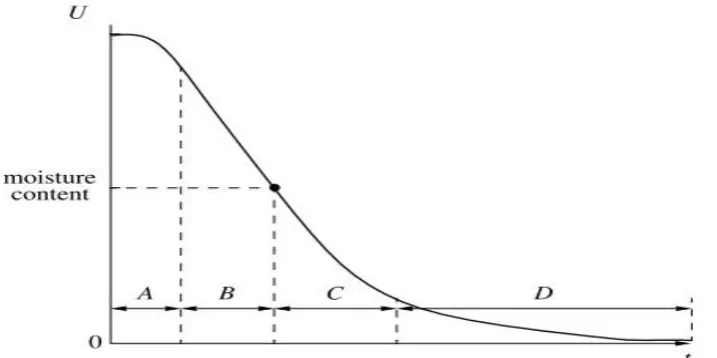
A typical moisture content profile. (A) Warm-up

period. (B) Constant rate period. (C) First falling

rate period. (D) Second falling rate period. [37]

18

2.6

Drying model [10]

20

2.7

Variations of effective diffusivity with moisture

content [43]

22

2.8

Volume shrinkage and drying rate of a ceramic

body [62]

25

2.9

Schematic drawing of ceramic crack initiation

process. (a) Initial fully saturated matrix. (b)

(11)

xiv

Water

air interface meniscus developed between

particles. (c) Tensile stress developed in the upper

layer. (d) Surface crack initiated.[63]

2.10

WRC for soils of different texture [79]

37

3.1

Eight-node quadratic quadrilateral element[95]

70

3.2

Overall model setup

80

3.3

Detail setup of AX

81

3.4

Mesh sample of the slab

88

3.5

Mesh of the ceramic membrane

90

3.6

Measured volume shrinkage results from

experiment for constant rate period

93

3.7

Measured volume shrinkage results from

experiment for falling rate period

93

3.8

Mesh of the slab

94

3.9

Intermittent drying configuration condition 1

(denoted as Bi)

98

3.10

Intermittent drying configuration condition 2

(denoted as Bii)

98

3.11

Domain used for single layer ((a),(b)), two layers

((c),(d)) and fine interlayer (e

100

4.1

Water retention curve: (a) comparison between

hygroscopic, non-hygroscopic and reference; (b)

comparison of clay and sand {the insert Figure is

typical WRC from [70]}

104

4.2

Sample plots: (a) with n = 0.6 and m = 2 (α

varies); (b) with m = 2 and α = 46 (n varies); (c)

with n = 0.6 and α = 46 (m varies)

106

4.3

Drying curve

109

4.4

Saturation curve

109

4.5

Temperature curve

110

4.6

Saturation curve for both model

112

4.7

Drying curve

113

(12)

xv

4.9

Water pressure distribution as a function of depth

and time; slab X, b) slab Y, c) slab Z

116

4.10

Gas pressure distribution as a function of depth

and time; a) slab X, b) slab Y, c) slab Z

118

4.11

Water saturation distribution as a function of

depth and time; a) slab X, b) slab Y, c) slab Z

120

4.12

Pore water pressure distribution as a function of

time

123

4.13

Temperature distribution as a function of time

123

4.14

Gas pressure distribution as a function of time

124

4.15

Variations of diffusivity with time. (a) Vapour

diffusivity. (b) Bound water diffusivity. (c) Liquid

diffusivity

125

4.16

(a) Initial condition for generated by current

model. (b) Saturation contour after 7 hours by

current model. (c) Initial condition of drying front

from experiment by Or et al [102]. (d) Drying

front movement after 7 hours by experiment by Or

et al [102]

128

4.17

Movement of drying from the top surface

129

4.18

Saturation contour at drying times of (a) 0 hour,

(b) 1 hour, (c) 2 hours, (d) 3 hours, (e) 4 hours (f)

5 hours 20 min

130

4.19

Pore gas pressure contour at drying times of (a) 0

hour, (b) 1 hour, (c) 2 hours, (d) 3 hours, (e) 4

hours (f) 5 hours 20 min

132

4.20

Temperature contour at drying times of (a) 0 hour,

(b) 1 hour, (c) 2 hours, (d) 3 hours, (e) 4 hours (f)

5 hours 20 min

134

4.21

Pore water pressure contour at drying times of (a)

0 hour, (b) 1 hour, (c) 2 hours, (d) 3 hours, (e) 4

hours (f) 5 hours 20 min

(13)

xvi

4.22

Variations of diffusivity with time for multilayer

system. (a) Liquid diffusivity. (b) Vapour

diffusivity

137

4.23

Pore water pressure distribution as a function of

depth and time (a); pore pressure water at 1hour

(b); 10hours (c)

138

4.24

Temperature distribution as a function of depth

and time (a); temperature at 1hour (b); 10hours (c)

140

4.25

Gas pressure distribution as a function of depth

and time (a); gas pressure at 1hour (b); 10hours (c)

141

4.26

Saturation distribution as a function of depth and

time (a); saturation at 1hour (b); 10hours (c)

142

4.27

Difference in moisture as a function of time

144

4.28

Volume shrinkage as a function of time; (a)

hygroscopic layer, (b) non-hygroscopic layer, (c)

differential

146

4.29

Drying shrinkage as a function of time; (a)

hygroscopic layer, (b) non-hygroscopic layer, (c)

differential

147

4.30

Temperature distribution

149

4.31

Saturation distribution

149

4.32

Temperature distribution

150

4.33

Saturation distribution

150

4.34

Temperature evolution

151

4.35

Saturation evolution

151

4.36

(a) Volume shrinkage as a function of time; (b)

differential in volume shrinkage; (c) drying

shrinkage; (d) differential in drying shrinkage

152

4.37

(a) Volume shrinkage as a function of time; (b)

differential in volume shrinkage; (c) drying

shrinkage; (d) differential in drying shrinkage

(14)

xvii

4.38

Dimensionless moisture gradient in solid matrix

(a) hygoscopic layer (denoted as 1) (b)

non-hygroscopic layer (denoted as 2)

155

4.39

Comparison of saturation level at 0

seconds((a),(b)), 30 minutes((c),(d)), 1

hour((e),(f)), 4 hours((g),(h)) and 8 hours((i),(j))

for both meshes

157

4.40

Comparison coarse and fine mesh saturation

evolution at node 22(fine) and 12(coarse) over 8

hour drying time for single layer structure.

159

4.41

Comparison of saturation level at 0

seconds((a),(b)), 30 minutes((c),(d)), 1

hour((e),(f)), 4 hour((g),(h)) and 8 hour((i),(j)) for

both meshes.

160

4.42

Comparison of saturation loss between fine mesh

and coarse mesh at node 22, 54(fine) and 12,

29(coarse) over 8 hour drying time for two layer

structure.

162

4.43

Difference in saturation and temperature for

interlayer at node 82, 92 and 102 (fine interlayer);

18, 23 and 28(coarse interlayer) over 8 hour

drying time for two layer structure.

163

Figure 1.1 : Several stages i n rem oval of water from 2.6between clay particles during the dry ing process. (a) Wet body . (b) Partially dry body . (c) Com pletely dry body [11]...3

Figure 1.2 : Schem atic diagram of the dry ing of a ceram ic green body showing the weig ht lo ss and s hrin kage with tim e [12]...4

Figure 1.3 : Warpage from dry ing a tile [13]...5

Figure 1.4 : Co ntribu tion of current work { the insert fig ure is contrib ution of previous w or k}...10

Figure 2.1 : SE M m icrograph of lay ered ceram ic m em brane [1]5...13

Figure 2.2 : Schem atic representation of an asy m metric m em brane [1]6...14

Figure 2.3 : Three step procedure for ceram ic m em branes [1]7...15

Figure 2.4 : Schem atic view of phase exis ts in a p orous m edium [23]8...17

Figure 2.5 : A ty pical m oisture content profile. (A) Warm -up period. (B) Cons tant rate period. (C) First fall ing rate period. (D) Second falling rate period. [3 7]9...18

Figure 2.6 : Dry ing m odel [10]10...20

Figure 2.7 : Variations of effective diffusivity with m oi sture content [43]11...22

Figure 2.8 : Volum e shrin kage and dry ing rate of a ceram ic body [62]12...25

Figure 2.9 : Schem atic drawing of ceram ic crack ini tiatio n process. (a) Initial ful ly saturated m atrix. (b) Water–air interface m eniscus developed between particles. (c) Tensile stress developed in the upper lay er. (d) Surface crack init iated.[63]13 ...25

Figure 2.10 : WRC for soi ls of d ifferent texture [79]14...37

Figure 3.1 : Eigh t-node quadratic quadrilateral elem ent[95]...70

Figure 3.2 : Overall m odel setup 2...80

Figure 3.3 : Detail set up of AX3...81

Figure 3.4 : Mesh sam ple of the slab 4...88

Figure 3.5 : Mesh of the ceram ic m em brane 5...90

Figure 3.6 : Measured volum e shrin kage resul ts from experim ent for constant rate period 6...93

Figure 3.7 : Measured volum e shrin kage resul ts from experim ent for falling rate period7...93

Figure 3.8 : Mesh of the slab 8...94

Figure 3.9 : Interm ittent dry ing configurati on condi tion 1 (denoted as bi)9...98

Figure 3.10 : Interm ittent dry ing config uration cond itio n 2 (denoted as b ii)10...98

Figure 3.11 : Dom ain used for si ngle lay er ((a),(b)), two lay ers ((c),(d)) and fine interlay er (e).11...100

Figure 4.1 : Water retention curve: (a) com parison between hy groscopic, non-hy groscopic and reference; (b) com parison of clay and sand {the insert Fi gure is ty pical WRC from [70]}12...104

Figure 4.2 : Sam ple plo ts: (a) with n = 0.6 and m = 2 (αvaries); (b) with m = 2 andα= 46 (n varies); (c) wit h n = 0.6 andα= 46 (m varies)13...106

Figure 4.3 : Dry ing curve 14...109

Figure 4.4 : Saturat ion curve15...109

Figure 4.5 : Tem perature curve 16...110

Figure 4.6 : Saturat ion curve for both m odel 1 7...112

Figure 4.7 : Dry ing curve18...113

Figure 4.8 : Dry ing curve19...114

Figure 4.9 : Water pressure distribu tion as a funct ion of dep th and t im e; slab X, b) slab Y, c) s lab Z 20...116

Figure 4.10 : Gas pressure dis tribu tion as a functi on of depth and tim e; a) slab X, b) s lab Y, c) slab Z21 ...118

Figure 4.11 : Water saturation d istri butio n as a function of depth and t im e; a) slab X, b) slab Y, c) slab Z22...120

Figure 4.12 : Pore water pressure distribut ion as a functi on of tim e 23...123

Figure 4.13 : Tem perature distribut ion as a functio n of tim e 24...123

Figure 4.14 : Gas pressure dis tribu tion as a functi on of t im e 25...124

Figure 4.15 : Variation s of diffusi vity with tim e. (a) Vapour diffusivity . (b) Boun d water diffusiv ity . (c) Liquid diffus ivity 26...125

Figure 4.16 : (a) Initial cond itio n for generated by current m odel. (b) Saturation contour after 7 hours by current m odel. (c) Initial condit ion of dry ing front from experim ent by Or et al [102]. (d) Dry ing front m ovem ent after 7 hours by experiment by Or et al [102]27...128

Figure 4.17 : Mo vem ent of dry ing from the top surface 28...129

Figure 4.18 : Sat uration con tour at dry ing tim es of (a) 0 hour, (b) 1 hour, (c) 2 hours , (d) 3 hours, (e) 4 hours (f) 5 hours 20 m in 2 9...130

Figure 4.19 : Pore gas pressure contour at dry ing tim es of (a) 0 hour, (b) 1 hour, (c) 2 hour s, (d) 3 hours, (e) 4 hour s (f) 5 hours 20 m in 3 0...132

Figure 4.20 : Tem perature contour at dry ing tim es of (a) 0 hour, (b) 1 hour, (c) 2 hours, (d) 3 hours , (e) 4 hours (f) 5 hours 20 m in 31...134

Figure 4.21 : Pore water pressure contour at dry ing tim es of (a) 0 hour, (b) 1 hour, (c) 2 hours, (d) 3 ho urs, (e) 4 hours (f) 5 hours 2 0 m in 32...135

Figure 4.22 : Variation s of diffusi vity with tim e for m ultilay er sy stem . (a) Liquid diffusiv ity . (b) Vapour diffusivi ty 33...137

Figure 4.23 : Pore water pressure distribut ion as a functi on of depth and tim e (a); pore pressure water at 1hour (b); 10hours (c)34...138

Figure 4.24 : Tem perature distribut ion as a functio n of depth and tim e (a); tem perature at 1hour (b); 10hours (c)35...140

Figure 4.25 : Gas pressure dis tribu tion as a functi on of depth and tim e (a); gas pressure at 1hour (b); 10h ours (c)36...141

Figure 4.26 : Sat uration d istrib utio n as a function of depth and t im e (a); saturation at 1hour (b); 1 0hours (c)37...142

Figure 4.27 : Difference in m oisture as a function of t im e 38...144

Figure 4.28 : Volum e shrin kage as a functi on of t im e; (a) hy groscopic lay er, (b) non-hy groscopic lay er, (c) differential 39...146

Figure 4.29 : Dry ing shrin kage as a functio n of tim e; (a) hy groscopic lay er, (b) non-hy groscopic lay er, (c) differential 40...147

Figure 4.30 : Tem perature distribut ion 41...149

Figure 4.31 : Sat uration d istrib utio n 42...149

Figure 4.32 : Tem perature distribut ion 43...150

Figure 4.33 : Sat uration d istrib utio n 44...150

Figure 4.34 : Tem perature evolution 45...151

Figure 4.35 : Sat uration evo lutio n 46...151

Figure 4.36 : (a) Volum e shrin kage as a function of tim e; (b) differential in vo lum e shrin kage; (c) dry ing shrin kage; (d) differential in dry ing s hrin kage 47...152

Figure 4.37 : (a) Volum e shrin kage as a function of tim e; (b) differential in vo lum e shrin kage; (c) dry ing shrin kage; (d) differential in dry ing s hrin kage 48...154

Figure 4.38 : Dim ension less m ois ture gradient in s olid m atrix (a) hy goscopic lay er (denoted as 1) (b) non-hy groscopic layer (denoted as 2)49...155

Figure 4.39 : Com parison of saturatio n level at 0 second s((a),(b)), 30 m inutes((c),(d)), 1 hour((e),(f)), 4 hours((g),(h)) and 8 hours((i),(j)) for both m eshes 50...157

Figure 4.40 : Com parison coarse and fine m esh saturation evolu tion at node 22(fine) and 12(coarse) over 8 hour dry ing tim e for single lay er structure.51...159

Figure 4.41 : Com parison of saturatio n level at 0 second s((a),(b)), 30 m inutes((c),(d)), 1 hour((e),(f)), 4 hour((g),(h)) and 8 hour((i),(j )) for both m eshes.52...160

Figure 4.42 : Com parison of saturatio n los s between fine m esh and coarse m esh at node 22, 54(fine) and 12, 29(coarse) over 8 hour dry ing tim e for two lay er structure.53...162

(15)

xviii

LIST OF ABBREVIATIONS

A

Sample A

AEV

Air entry value

AX

‘Main’ part of the flow chart in Figure 3.2

B

Sample B

BC

Brook-Corey

C

Sample C

diff

Differential

h

Hours

hg

Hygroscopic

i

Intermittent drying setup as in Figure 3.9

ii

Intermittent drying setup as in Figure 3.10

mins

Minutes

nhg

Non-hygroscopic

WRC

Water retention curve

VG

Van Genuchten

1

Top layer

(16)

xix

LIST OF SYMBOLS

a

Coefficient in equation (2.12)

N/m

∙K

b

Coefficient in equation (2.12)

N/m

∙K

C

Concentration of moisture content

-C

ga

Molar concentration of dry air

mol m

-3

C

pga

Specific molar heat capacity of dry-air

J mol

-1

K

-1

C

pl

Specific heat capacity of liquid water

J kg

-1

K

-1

C

pv

Specific molar heat capacity of water vapour

J kg

-1

K

-1

C

ps

Specific heat capacity of ceramic solid

J kg

-1

K

-1

C

Defined in equation (3.91)

C

ij

Capacity coefficient

D

Parameter in equation (2.23)

-D

atm

Molecular diffusivity

m

2

/s

D

BT

Diffusion coefficient of bound liquid

m

2

/s

H

Heat capacity of ceramic

J m

-3

K

-1

H

Heat content of ceramic

J m

-3

İ

Volumetric rate of evaporation

m

3

/s

J

Defined in equation (3.92)

(17)

xx

k

Permeability

m

2

k

i

Intrinsic permeability of ceramic

m

2

k

eff

Thermal conductivity

W m

-1

K

-1

K

g

Gas permeability

m

2

Pa

-1

s

-1

k

rg

Relative gas permeability of ceramic

-k

rl

Relative hydraulic conductivity

-K

l

Saturated hydraulic conductivity

s

-1

K

Defined in equation (3.90)

K

ij

Kinetic coefficients

L

Latent heat of vaporisation

J kg

-1

M

Moisture content

-M

a

Molar mass for air

g/mol

M

v

Molar mass for vapour

g/mol

m

van Genuchten coefficient

-n

van Genuchten coefficient

-N

r

Shape function of residual error

-N

s

Shape function of system variables

-P

g

Total gas pressure

Pa

P

gs

Nodal values of total gas pressure

Pa

g

^

P

Approximate values of total gas pressure

Pa

P

l

Pressure of pore-water

Pa

(18)

xxi

l

P

^

Approximate values of pore-water pressure

Pa

q

Heat source

W/m

2

q

b

Mass flux for bound water

Kg/m

2

s

q

cond

Conduction heat flux

W/m

2

q

conv

Convection heat flux

W/m

2

q

L

Latent heat flux

W/m

2

q

l

Mass flux for liquid

Kg/m

2

s

q

g

Mass flux for gas

Kg/m

2

s

q

ga

Mass flux for dry gas

Kg/m

2

s

q

v

Mass flux for vapour

Kg/m

2

s

R

v

Gas constant for water vapour

J kg

-1

K

-1

R

Universal gas constant

J mol

-1

K

-1

r

Relative humidity

%

S

g

Degree of gas saturation

-S

l

Degree of water saturation

-t

Time

s

T

Temperature

K

Th

Temperature

°C

T

r

Reference temperature

K

T

s

Nodal values of total temperature

K

^

T

Approximate values of temperature

K

(19)

xxii

V

l

Velocity of liquid

m s

-1

V

0

Initial volume

m

2

V

t

Final vomue

m

2

V

v

Velocity of water vapour

m s

-1

x

Global co-ordinates

m

y

Global co-ordinates

m

z

Global co-ordinates

m

Z

elevation head

m

van Genuchten coefficient

-

Defined in equation (3.10)

kg m

-3

K

-1

β

1

Constant in equation (2.1)

2

Constant in equation (2.1)

-

Local co-ordinate

m



Local co-ordinate

m

e

Element boundary surface



Volumetric water content

-

a

Volumetric dry-air content

-

l

Volumetric liquid content

-

v

Volumetric vapour content

r

Residual water contents

s

Saturated water contents

(20)

-xxiii

a

Thermal conductivity of dry-air

W m

-1

K

-1

s

Thermal conductivity for solid matrix

W m

-1

K

-1

l

Thermal conductivity of liquid water

W m

-1

K

-1

v

Thermal conductivity of water vapour

W m

-1

K

-1

a

Dynamic viscosity of dry-air

N s m

-2

v

Dynamic viscosity of water vapour

N s m

-2

φ

b

Matrix potential at air entry

Pa

φ(T)

Matrix potential

Pa

Mass flow factor

-

l

Liquid water density

kg m

-3

o

Density of saturated vapour

kg m

-3

s

Density of ceramic

kg m

-3

v

Density of water vapour

kg m

-3

Porosity

-

Defined in equation (3.93)

.

Defined in equation (3.94)

e

Element domain



Relaxation factor

(21)

xxiv

LIST OF APPENDICES

APPENDIX

TITLE

PAGE

(22)

1

CHAPTER 1

INTRODUCTION

1.1

Research background

Membrane technology is an emerging interdisciplinary technology. Its application has

produced a significant change since 1960 as it is not only used in laboratory tools but

also on industrial sides. Membrane processes have become an accepted unit operation

for a variety of separations in industries for various purposes such as gas separation,

reserve osmosis, nanofiltration, ultrafiltration, microfiltration, dialysis, reactors,

contractors and others [1]. With increasing demand at 9% annual rate [2] especially in

water and wastewater industry, new technologies and new processing techniques on

membrane production are constantly being discovered and invented. Since membrane

technologies are energy intensive, defect-free and quality final products are essential

to the applications of membranes in the industry field. Thus, a good understanding of

all of the membrane fabrication steps is vital.

Generally, the membrane fabrication process starts from powder formation of

the right material combinations. Then it is in the form of slurry or paste to be ready for

various ceramic membranes preparation techniques such as slip casting, tape casting,

extruding or pressing. Before the precursor formulation forms into the final products,

it needs to be dried. The different moisture gradient in this segregated membrane

structure will definitely create a difference in thermal gradient effect during the drying

process[3]. Eventually, the process will end with the consolidation of membrane by a

heat treatment procedure at high temperature. As can be noticed, the drying step will

crucially determine the quality of the product before the final consolidation stage. The

consequences of improper drying process can lead to the initiation of defects and

(23)

2

dried product. On top of that, the drying step is essential for ceramic membrane as this

component is a porous structure that consists of a unique separation structure with a

multilayer system which leads to a different moisture gradient.

Drying is widely applied in industries such as food, textile, paper, wood,

ceramics, minerals, wastewater sludge, pharmaceutical products or biotechnological

products [4]. Most of the drying industry uses a convective mechanism as it is more

flexible and has low energy consumption [5]. However, the losses due to convective

drying defects alone can be up to the order of 10% in industrial production [6]. Hence,

optimisation of the drying process in terms of energy usage and production time,

without compromising the defects of the product quality such as cracking or warping,

requires a comprehensive study and good understanding of the controlling parameters

that evolve during the drying process. Generally, drying means the transfer of liquid

(normally water) from the pores of a solid material to the surrounding air [7], [8].

Basically, are several stages in removing the water from a solid to the surrounding air

as shown in Figure 1.1. The initial wet body evaporates from the drying surface at a

constant rate corresponding to liquid flux. The evaporation rate is similar to that from

an open dish of liquid where there is a continuous supply of water from the interior of

the solid matrix to the evaporation surface [9]. As drying progresses, the fraction of

the wet area at the surface decreases with a decreasing open dish liquid. When the

water content reaches critical free water content, the surface evaporation will form

discontinued wet patches. Thus, this stage of drying has a decreasing evaporation rate

while the interior free water supply to the evaporation surface is restrained by the

decrease of the free water content. Eventually, the drying surface will recede into the

interior of the solid matrix, dividing the solid matrix into two regions, a wet region and

a dry region [10]. During this stage, vapour flux substitutes the previous liquid flux as

a dominant driving force for moisture transfer. Finally, as drying proceeds, the water

content decreases gradually to zero and subsequently vapour flux slows down and

decays toward the atmosphere as internal vapour pressure and external vapour pressure

(24)

3

[image:24.595.122.516.73.198.2]

(a)

(b)

(c)

Figure 1.1: Several stages in removal of water from between clay particles during

the drying process. (a) Wet body. (b) Partially dry body. (c) Completely dry body

[11]

Accordingly, there are various mechanisms and controlling variables

corresponding to different stages of the drying period that occur concurrently for

moisture evaporation to happen. Thus, it is necessary to carefully control the decisive

factors in the drying process in order to avoid defects in the dried product.

Unfortunately, drying is often associated with common failures due to improper

control of the drying process, such as cracking and warping. Those defects are closely

attributed to the non-uniform shrinkage mechanism that happens during the drying

process. Figure 1.2 illustrates the progress of the drying green body shrinkage with

respect to the weight loss and drying time. In the early stage of the drying process, the

moisture weight decreases at a constant rate. Thus the drying rate is at a constant rate

and this period of drying is often called the constant rate period. During this period,

the surface of the green body is always wet by the flow of liquid to the surface as a

consequence of the rearrangement of particles in the green body attributed to the

compressive capillary pressure at the surface of the green body. This phenomenon is

corresponding to the shrinkage and deformation of the solid as particles come into

contact to maintain an expelling of liquid flow to the surface at a constant rate [6].

Subsequently, the drying reaches the decreasing drying rate period when the

liquid-vapour interface starts to recede into the solid matrix. During this period, shrinkage is

limited when the particles come into contact with liquid filling the pores. Eventually,

drying will slow down and end when the moisture content inside the matrix and

(25)
[image:25.595.122.514.71.291.2]

4

Figure 1.2: Schematic diagram of the drying of a ceramic green body showing the

weight loss and shrinkage with time [12]

Cracking is a defect that attributes to the shrinkage phenomenon. Severe

cracking could lead to fracture of the material particularly in brittle materials such as

ceramic. Critical free moisture content is the initiation point of the cracking

mechanism where shrinkage is restricted as particles are closely in contact with each

other. The formation of the wet and dry regions in the matrix body eventually causes

uniform shrinkage on the upper and lower cores of the solid body. The

non-uniform shrinkage induces a non-homogeneous drying stress in the solid matrix. Once

the drying stress exceeds the maximum tensile strength of the material, surface

cracking is likely to happen. Meanwhile, warping often occurs when drying involves

one surface drying only as this generates uneven shrinkage. Figure 1.3 demonstrates

the warping phenomenon during the drying process of tile. When the drying starts, the

upper face dries up faster and creates tensional force caused by compression of the

particles. This causes the tile to curl up when the upper face is smaller than the lower

face. Upon entering the late stage of drying, the liquid retreats into the solid, and the

drying process will be completed. The dry curls remain as the body is too rigid to

completely straighten out. Thus, improper control of the drying process can cause

non-uniform shrinkage, resulting in failure of the dried product. These defects can be

avoided by obtaining a better understanding of the underlying physics of the drying

(26)
[image:26.595.169.469.73.231.2]

5

Figure 1.3: Warpage from drying a tile [13]

As has been emphasised earlier, an understanding of the drying process is

essential to produce quality defect-free products. The drying phenomenon of moist

porous solids is a complicated process involving simultaneous, coupled mass and heat

transfer phenomena. Accordingly, drying behaviour can be influenced by a large

variety of independent factors, such as ambient conditions, air velocity, relative

humidity and saturation as well as material properties such as density, porosity,

permeability, hygroscopic and others. Therefore, extensive characterisation of drying

behaviour using a strictly experimental approach constitutes a formidable challenge

due to the excessively large number of variables that must be considered. However,

the task becomes more manageable nowadays with the help of a reliably realistic

computational modelling of the drying phenomenon.

The advanced computational modelling is an evolutionary step in pushing the

conventional drying process towards optimisation, conceptualisation or designing the

next generation drying process. In past decades, computational methods in drying

process engineering have been in emerging trend, motivated by its several advantages

[14]. Computational modelling seems to be the most convenient method due to its low

cost, speed, complete information, the ability to simulate realistic and actual

conditions, and ability to simulate ideal conditions [15], [16]. Additionally,

simulations lead to deeper physical insight by actually having virtual sensors in nearly

each point (using computational meshing). As such, the information on distribution

and evolution of all variables within the product can easily be determined, which can

feed new ideas for designing or optimising drying processes [14]. Furthermore,

modelling has the ability to measure or determine small changes and also has no

(27)

6

fact that accurate predictions of computational modelling is essential in many

engineering applications; one example being optimisation of industrial drying

processes with respect to energy and time consumption and product quality [6], [16]

[18]. For that reason, computational modelling has a large potential in both the

research level and in the industrial context to develop the next-generation sustainable

and green drying technology.

Essentially, the ceramic industry contributes about 10-25% of the national

energy consumption for industrial processes [4], [14]. Drying constitutes an essential

and energy-intensive unit operation, as most ceramics require drying of at least a part

of the product at some stage during processing. Due to these reasons, any initiative

work devoted to improve the ceramic drying operation, via saving energy, improving

product quality as well as reducing the environmental effect, would be most welcomed

and appreciated. Therefore, the computational modelling approach towards this aim

has indeed flourished over recent years. However, modelling the most perplexing

problems of the ceramic industry are amongst the most challenging in computational

modelling, attributed to their complexity, large range of multi-physics transport

processes that occur during drying, and their inherent large material characteristic

variability. The multi-physics transport and exchange processes involve the coupled

heat and mass occurring simultaneously inside the material and also with the

environment. Thus, a unique modelling approach must be based on fundamental heat

and mass transfer relationships and thermodynamic equilibrium applied on desired

drying techniques and specified materials of interest. This provides a tool that is

effective in predicting drying behaviour and is also useful in exploring and

understanding the impact of important variables in the drying process. In this way, the

impact of the many variables on the drying behaviour for a specific material of interest

and applied drying technique can be examined and interpreted without having to resort

to an extensive program of experimental testing. Additionally, this mathematical

modelling normally results in a set of governing equations which need to be

numerically solved using a specialized solver and an adaptive mesh scheme.

Subsequently, comparisons of model predictions with experimental drying data will

then help to verify the drying model.

Despite substantial efforts being devoted to the mathematical modelling of

drying phenomenon, the science remains far from perfect and therefore, interest in the

(28)

7

limited to specific applications with regards to either the material being dried or the

particular drying regime or mechanism at work. The lack of carefully obtained

experimental data, primarily due to the often complicated nature of the process and the

difficulty of making the necessary detailed measurements, is currently hampering the

development of the model for the drying process in membrane fabrication. It is quite

possible that perhaps the numerical predictions are almost as reliable as experimental

data. Hence, the motivation of this study is devoted to develop a tool to simulate drying

behaviour of ceramic materials and subsequently allow it to be extended to the

fabrication of ceramic membrane. Furthermore, the proposed model is enhanced to

accommodate an improved intermittent convective drying technique.

1.2

Problem statement

Fabrication of ceramic porous membrane is very complex and crucial since it involves

the development of very thin and dense layers which act as separators in the multilayer

structure. Failure to produce defect-free membrane will lead to the failure of the

filtering mechanism, especially when the top surface layer is the decisive factor to

ensure the perfect functionality of the membrane separation processes. In fabricating

a good quality solid porous membrane from the slurry or loose ceramic particles, the

drying stages play an important role (besides the other processing parameters). Based

on previous studies, most of the failures in the ceramic structure and component are

exhibited during different drying stages due to the stresses caused by various gradient

effects [12], [19], [20]. Further complications arise when drying involves materials in

a multilayer structure that exhibits different drying behaviour. Basically, this is

influenced by the shrinkage mechanism as the water removes from the porous structure

network in the ceramic body. Hence, it is crucial to control the drying process and this

can be achieved by having a better understanding of the dynamic behaviour of the

underlying physics during the process for each stage at a fundamental level. With this

focus in mind, the experimental approach (uncertainty in dynamic measured results

can be as high as 115% [21]) seems to have limited ability for materials with a wide

range of interest. Therefore, the development of a mathematical model for the purpose

of computational method will provide sufficient generality to evaluate drying

(29)

8

1.3

Research objective

Motivated by the outline problem statement, this present research effort was

undertaken with the following objectives:

i.

To develop and establish a theoretical formulation model that integrates

hygroscopic and non-hygroscopic material properties with governing

equations to investigate the transport variables and mechanisms in drying

phenomena for stationary and non-stationary (intermittent) drying techniques

that accommodate single layer structure and multilayer structure of the

membrane.

ii.

To determine and investigate the most relevant saturation curve for

hygroscopic and non-hygroscopic materials which are integrated with critical

material properties in establishing drying for ceramic membrane.

iii.

To implement a numerical solution towards fully coupled theory integrated

with Finite Element Analysis (FEA) in predicting the variation of critical and

measured parameters during the drying process of the ceramic membrane.

iv.

To validate and simulate the theoretical formulation model developed by

FORTRAN source code that integrates with all the variables and material

properties based on the particular cases of the proposed drying ceramic

membrane.

1.4

Scopes

The model was constructed based on drying theories with basic fundamental physical

laws as given in the relevant literature on the convective drying technique. The

utilisation of the derived relationships requires knowledge of the properties and

characteristics of the material to which the analysis will be applied. In spite of the

uncertainties associated with ceramic material, it has become an acceptable procedure

for most practical problems to approximate ceramic properties for the development of

models and analysis. This assumption is corroborated by various models in literature.

(30)

9

subsequent sensitivity studies can be carried out in order to establish the effects these

parameters have on the performance of convective drying.

1.5

Research contributions

This model is developed based on a continuum approach to provide a systematic way

to incorporate fully coupled heat, mass and gas transport equations for convective and

diffusive mechanisms. The main working parameters in the derivation of the transport

equations are temperature, gas pressure and pore water pressure. The initial

contribution involves the introduction of bound water flux into the mass conservation

equation, coupled with heat and gas transfer as derived in the proposed model for

hygroscopic material. Further extension was conducted in this work by developing and

applying a comprehensive model that can be used not only in a single layer or

homogenous multilayer structure but also in a heterogeneous multilayer structure. This

model is also able to accommodate the materials selection of heterogeneous physical

properties besides the hygroscopic and non-hygroscopic behaviours which is not

established in previous work (insert figure in Figure 1.4). Furthermore, this model is

successfully implemented in both stationary and intermittent convective drying

techniques. Figure 1.4 demonstrates the simplified contributions of the current model

when compared with previous work. The numerical simulation was benchmarked

(31)
[image:31.595.121.500.72.529.2]

10

Figure 1.4: Contribution of current work {the insert figure is contribution of previous

work}

1.6

Structure of the thesis

The research work documented in this thesis is organized to have the following

structure: the first chapter consists of a short introduction that includes the problem

statement, objectives, scopes and contribution of the current works that have been

conducted. The second chapter explains the theory and literature review of the

membrane structure, fabrication process of ceramic membrane, the importance of the

drying process in the membrane fabrication, drying process theory, transport

Work

Hygroscopic

Single layer

Multilayer

Stationary

Intermittent

Non-hygroscopic

Shrinkage

Saturation curve

Drying model

Single

layer

Multilayer

Heterogeneous

Drying front

Material

properties

effect

Homogenous

Variable

diffusivity

Membrane

Variable

(32)

11

properties of porous material and mathematical model of drying. Subsequently,

chapter three contains the model governing equations to be derived and incorporated

with finite element and numerical solution to solve the nonlinear partial differential

equation. Also the background and model set-up for every case study are stated in this

chapter. Chapter four includes the validation of the improved proposed model before

all the results generated based on different aims for multiple cases will be presented.

In every case, the model set-up used and the results, together with the discussion of

the results, are presented as independent tasks unless stated otherwise. The major

findings of these different cases will be summaries in the final conclusion along with

the suggestion of future work to enhance the model (Chapter 5). The Appendices

(33)

12

CHAPTER 2

LITERATURE REVIEW

2.1

Introduction

Traditionally, ceramic membranes are widely used in wastewater engineering. While

ceramic membranes also can be used in any other industries, current trends show they

have expended their application in gas application, chemical industry, biotechnology

and the food and beverage industry due to their advantages compared to their

competitors, where filtration processes are superior to other separation processes [1].

This is mainly due to ceramic membranes possessing many sterling characteristics as

compared to the polymeric membranes, such as much higher chemical and thermal

stability. These features enable ceramic membranes to be operated at higher

temperatures and in the highly reactive compounds present in either acidic or alkaline

surroundings. They also have better physical mechanical stability. Ceramic supported

membranes are much harder than the thin polymer structure of the polymeric

membranes. Relatively, ceramic membranes will have a longer lifespan compared with

polymeric membranes. Overall, these features will save the operation costs for

industries without compromising the quality of the products [11]. With those unique

characteristics, the efficiency and performance of the filtration system using ceramic

membrane also facilitates the membrane structure itself. Thus, understanding the

essential features of the membrane structure is crucial for their application and usage

in various ranges.

This chapter starts with membrane structure introduction before preparation of

ceramic membrane will be discussed. Next, the importance of the drying process is

emphasised. Eventually, the drying theory and transport in porous material are

(34)

13

2.2

Membrane structure

In general, a ceramic membrane can be described as a permselective barrier or a fine

sieve [1]. The two most important performance indicators for a ceramic membrane is

permeability and separation factor. Physical properties such as density, porosity and

permeability play an important role when it comes to their applications and separation

mechanisms. Typically, ceramic membrane is categorised into four types, namely

macroporous, mesoporous, microporous and dense, corresponding to their pore size

[1]. Their applications also match with type of ceramic membranes where

macroporous and mesoporous ceramic membranes are mainly used in microfiltration

(MF) and ultrafiltration (UF) for water treatment industries, while microporous and

dense are used in gas separation industries.

Typically, ceramic membranes are often multilayer with one or more different

type of ceramic materials. They generally consist of a main microporous (or a dense)

top layer, one or two mesoporous intermediate layers and a macroporous support layer.

Theoretically, the membrane can be divided into several layers as shown in Figure 2.1

[image:34.595.181.459.442.677.2]

with an illustrated schematic representation in Figure 2.2.

Figure 2.1: SEM micrograph of layered ceramic membrane [1]

5

The top layer generally has fine and dense pore structure and is used as a filter

(35)

14

bottom layer, consist of mesoporous and macroporous ceramic materials respectively,

and are fabricated in the form of a porous structure to support the membrane itself and

also to ease the permeation process. The pore sizes of the bottom, intermediate and top

layers are in the range of 10µm, 0.2-0.7µm and 6nm [1] respectively. Their pore sizes

are associated with their aforementioned purpose. The commonly used materials for

commercialized ceramic membranes are Al

2

O

3

, ZrO

2

, SiO

2

, TiO

2

and also a

combination of these materials. Obviously, the top separation layer with a microporous

and dense ceramic material possesses a hygroscopic property compared to the

intermediate and bottom layers that have to be a porous structure and tend to have

[image:35.595.138.496.305.473.2]

non-hygroscopic behaviour.

Figure 2.2: Schematic representation of an asymmetric membrane [1]

6

2.3

Preparation of ceramic membrane

Normally, the preparation of ceramic membranes involves three main steps: (1)

formation of particle suspensions; (2) packing of the particles in the suspensions into

a membrane precursor with a certain shape such as flat sheet, monolith or tube, and (3)

consolidation of the membrane precursor by a heat treatment at high temperatures [1].

The generalised flow for ceramic membranes preparation is depicted in Figure 2.3.

The process starts with the determination of the raw materials corresponding

with their applications. The materials selection can consist of a single material or a

combination of two or more materials for the multilayer membrane structure. Usually

the raw materials are in the form of powder. Then the powder formation goes through

Figure

Figure 1.1: Several stages in removal of water from between clay particles duringthe drying process
Figure 1.2: Schematic diagram of the drying of a ceramic green body showing theweight loss and shrinkage with time [12]
Figure 1.3: Warpage from drying a tile [13]
Figure 1.4: Contribution of current work {the insert figure is contribution of previous
+7

References

Related documents

Selection of the surgical procedures for reconstruction of the alveolar ridge defect depends on many factors; site and size of the defect, intermaxillary relationships, donor

Virus incidence dynamic on tomato, cucumber and weeds The incidence dynamics of ToCV and CCYV were deter- mined on tomato, cucumber and the weeds nearby: In four growth

The uninitialized simulations of MPI-ESM-LR show considerably weaker trends for most regions (Fig- ure 2 (b)). At least in part, this is likely to be a result of sampling effects

Androgen Reduction Treatment (ART)- Gonadotropin Releasing Hormone (GnRH) Analogues—Intensity of Sexual Desire and.

The research could be split into the following aspects to examine:(a) the age differences in news media usage and political participation; (b) the effects of using

Castillo and Montoro (2008) formally introduce an informal sector in a DSGE model developed from Blanchard and Gali (2007) and model a labour market economy with formal and

Glede na to, da so nekatere evropske države, še posebej tiste na periferiji, zgodovinsko problematiče kadar gre za fiskalno disciplino, je bilo pričakovati, da bodo

Nakon što je prevodilac proizveo bytecode verziju programa Hello.class, možete ga pokrenuti u Java Virtual machine tipkanjem:.. java