The role of knowledge engineering in
information management on the
construction site
Koskela, LJ, Kähkönen, K and Salo, E
Title
The role of knowledge engineering in information management on the
construction site
Authors
Koskela, LJ, Kähkönen, K and Salo, E
Type
Conference or Workshop Item
URL
This version is available at: http://usir.salford.ac.uk/30229/
Published Date
1987
USIR is a digital collection of the research output of the University of Salford. Where copyright
permits, full text material held in the repository is made freely available online and can be read,
downloaded and copied for noncommercial private study or research purposes. Please check the
manuscript for any further copyright restrictions.
THE ROLE OF KNOWLEDGE ENGINEERING IN INFORMATION
MANAGEMENT ON THE CONSTRUCTION SITE
Lauri Koskela. Kalle Kahkonen, Esko Salo
Technical Research Centre of Finland (VTT)
Laboratory of Urban Planning and Building Design
Section of Construction Management and Economics Itatuulentie 2, SF-02100 Espoo, Finland
1 Introduction
During 1984-1986, a study on information management on building sites was made in the Technical Research Centre of Finland. As one result guidelines for the development of computerized information systems were presented (Salo & Tyrvainen 1985, 1986a, 1986b, Tyrvainen et al. 1987). In the ongoing study "Expert systems on the building sites", further analysis has been carried out as regards the role of knowledge engineering in the enhancement of site information systems. This paper considers both the needs for and possibilities of knowledge engineering in the context of site information management.
2 State of the art in site information management systems
2.1 Problems of information management on site
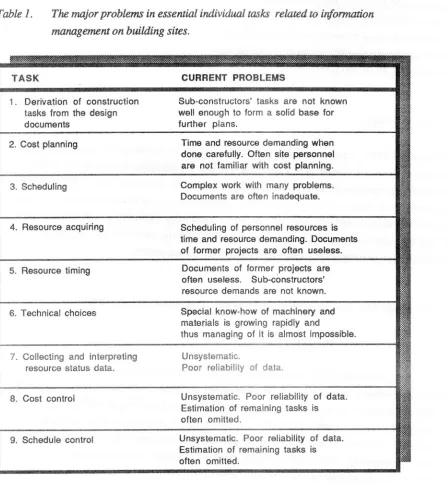
In the above mentioned empirical study on information management on site, it was found that the main problem lies is the lack of production planning. The plans made are poorly documented, and the input data must be generated anew when updating or detailing them. The updating of various interdependent plans is too laborious manually, and consequently is not carried out. Because of the lack of up to date and detailed plans, there is a poor basis for progress monitoring. Data for actual productivity is collected in small amounts and it is not utilized to any great extent in production planning (Table 1).
always appropriate in respect of coding, contents and function. In large projects, the
relationships between temporal, economic and technical plans become so complex, that they are
[image:3.611.68.516.155.651.2]anyway difficult to manage manually.
Table 1. The major problems in essential individual tasks related to information management on building sites.
TASK CURRENT PROBLEMS
Derivation of construction Sub-constructors' tasks are not known tasks from the design well enough to form a solid base for documents further plans.
2. Cost planning
3. Scheduling
4. Resource acquiring
5. Resource timing
6. Technical choices
7. Collecting and interpreting resource status data.
8. Cost control
9. Schedule control
Time and resource demanding when done carefully . Often site personnel are not familiar with cost planning.
Complex work with many problem; Documents are often inadequate.
Scheduling of personnel resources is time and resource demanding . Documents of former projects are often useless.
Documents of former projects
often useless . Sub-constructors' resource demands are not known.
Special know-how of machinery and materials is growing rapidly and
thus managing of it is almost impossii
Unsystematic Poor reliabili
Unsystematic. Poor reliability of data. Estimation of remaining tasks is often omitted.
Unsystematic. Poor reliability of data. Estimation of remaining tasks is
Analyses carried out in other countries, e.g. United States, do not indicate that the situation be any better or more straightforward. In the Business Roundtable study (Blough 1983), the lack of use of modern management methods was found to be the primary cause for delays and cost overruns. However, in a MIT Roundtable meeting (Brink 1986), many industry representatives claimed that the productivity has been negatively affected by the increased procedures and paperwork brought about by computerized systems.
The sluggish proliferation of computerized systems and the varied experiences gained from
them indicate that computerization is no solution as such to the situation. Indeed, these
observations indicate that there are some fundamental inconsistencies between the reality on site
and the leading ideas in information system development - be they manual or computerized.
2.2 Characteristics of information processing on site
It is self-evident that construction is different, also as regards conditions of information management, from the manufacturing or service industries. However, these differences have not systematically been taken as a starting point when developing information systems for construction. Without any claim as to completeness, the following characteristics seem to be relevant.
As regards the nature of information to be managed: - a great mass of varied data, information and knowledge
- complex relationships between various information items - uncertain or probabilistic data
- data difficult to capture, because of dynamic and changing site conditions.
As regards the situation of the site management team:
a specific construction culture which can be described by such keywords as papyrophobia, viva voce, ad hoc and in situ (Bjorklof 1986)
time pressure
unfamiliar problems frequently arise, because of the uniqueness of projects - there are complex procedures to follow.
As regards the project level:
insufficient time made for information activities with objectives beyond the present
project
- uniqueness of the project leads to uniqueness of the project data base
- project organization separately configured for each project.
2.3 Information systems - their development methodology and applications in
construction management
There have been four major approaches in the development of information systems (M ikelin & Hannus 1986). These approaches are often implicit frames of reference behind development
methods.
The routine (or function) orientated approach has taken as its goal the automation or rationalization of work routines or company functions by computerization and related elimination of redundant operations. Usually, this has represented the starting point in the introduction of computers.
The information orientated approach stresses information as a resource for the organization. In the development methods of this approach (e.g. Business Systems Planning method), information flows and needs are studied, especially from the point of view of company wide control and management.
The user orientated approach has recently been the most important driving force in the proliferation of information technology. Here, useful and mostly small systems are created to assist individual users in their daily work. The development is user initiated.
The customer orientated approach is the newest one. Here the goal is to create radically new products, services or production chains, which offer competitive benefits. The major focus is on enhancing the service for customers.
All these approaches are relevant for site information processing. Even here the routine orientated approach has been used to introduce computers to the sites. A typical problem has been that the existing manual systems have not been thoroughly thought-out, and a direct computerization is doomed to fail.
For further progress, a user orientated approach is needed; however, creating user friendly
systems meets with major difficulties, at least presently. This is because the situational and
cultural factors, referred to above, would require a rather advanced and complete system,
capable of providing access to information in a rapid, concrete and easy to learn way. For
example, interpretation of the large data volumes in project control into meaningful information
would be requisite.
The information orientated approach may have been a major cause of the problems of the present day site information systems. When the system has been planned in respect of the goals of control, the consideration of the requirements of the site may have remained too slight. On the other hand, the information resources are not optimally accumulated by the systems, because there is usually no facility for storing qualitative information (e.g. about risks) or quantitative information concerning the impact of special conditions.
The customer orientated approach is evident in the experiments concerning project data bases, which will be owned by customers (Burrows 1986).
It is appropriate to point out two other incompatibilities between site conditions and present day computing. In the production planning systems, deterministic and precise data is required. However, because of the characteristics of construction, the productivity data, for example, can only be probabilistic and with a wide range of variation. In the production control, site information systems require complete and disaggregated data. This is difficult to attain on site, where some data tends to be aggregate and some difficult to ascertain in time.
3 The new generation system for site information management
3.1 Required features
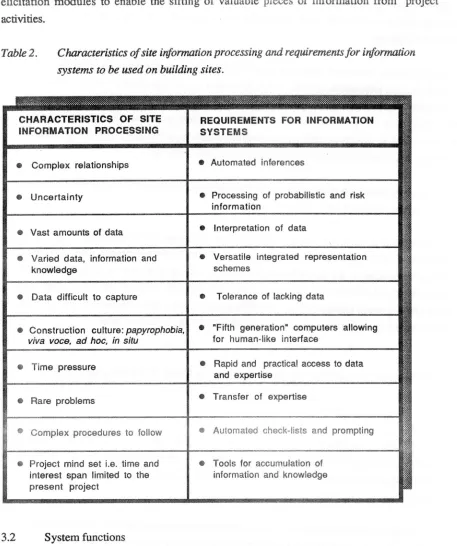
In Table 2, the salient characteristics of site information processing are summarized, along with respective requirements for information systems. For most requirements, knowledge engineering or other advanced software concepts are needed. Here, two major features are amplified.
First, a major general requirement is that of enhanced project transparency: The system should
provide up to date and meaningful status information on the project, as well as a mechanism for
studying the effects of a change in some part of the project on other parts.
Secondly, from each project, knowledge gained by experience and data should be added to the
informational resources of the organization. Thus, the system should have built-in knowledge
elicitation modules to enable the sifting of valuable pieces of information from project
[image:7.611.62.519.89.635.2]activities.
Table 2. Characteristics of site information processing and requirements for information
systems to be used on building sites.
- -- ---- ---
-------C HARA---CTERISTI---CS OF SITE REQUIREMENTS FOR INFORMATION
INFORMATION PROCESSING SYSTEMS
• Complex relationships • Automated inferences
• Uncertainty • Processing of probabilistic and risk information
• Vast amounts of data • Interpretation of data
• Varied data, information and • Versatile integrated representation
knowledge schemes
• Data difficult to capture • Tolerance of lacking data
• Construction culture: papyrophobia, • "Fifth generation" computers allowing
viva voce, ad hoc, in situ for human-like interface
• Time pressure • Rapid and practical access to data and expertise
• Rare problems • Transfer of expertise
• Complex procedures to follow • Automated check-lists and prompting
• Project mind set i.e. time and • Tools for accumulation of interest span limited to the information and knowledge present project
3.2 System functions
The following sections describe the new generation system for site management from the point of view of expert system technology.
3.2.1 Construction project planning
Many key tasks in project planning are knowledge intensive ones. These tasks consist of decision making problems such as: determining which are the most suitable and economic work tasks and machinery for a particular project or whether or not all necessary aspects have been taken in account while planning. In order to solve these problems, project planners need to acquire new knowledge and apply their own expertise. Furthermore, typical construction project planning and also management problems depend on broad and often ill-structured soft knowledge in the sense of there being many various aspects to be taken into account. Systematic and exact weighting of all decision alternatives is thus a very difficult, cumbersome and time consuming task.
As a result of project planning, a project description including all necessary tasks and their characteristics is attained. The description should contain all necessary data and project knowledge which could be useful in creating various reports and for updating the model itself.
It seems that expert system technology may considerably help and improve the performance of
the planners' work. The following section describes some expert systems or knowledge
representation schemes.
3.2.1.1 Assisting expert systems
Assisting expert systems could be useful, particularly in the early stages of project planning when major decisions are taken concerning main construction methods, work tasks, machinery etc. These expert systems could:
- make suggestions on possible decision alternatives
- establish a good, exact and systematic way to draw comparisons between all decision alternatives
- form an intelligent interface in order that various programs needed during planning may be used easily or even automatically e.g. for accessing data bases, performing calculations and optimization procedures. Thus, assisting expert systems could combine different tools into an integrated planning system.
3.2.1.2 Representation structure for the project description
A great deal of project knowledge is created over the planning process, which today is not usually recorded in plan documents. The project knowledge e.g. relationships between
building tasks, features of work tasks and conditions derived from circumstances and
presumptions would be very useful to project personnel in their daily work.
Object oriented programming and its applications in knowledge engineering seem to provide
enough flexibility for creating an application to represent project specific information and
knowledge of great diversity. Some prototype and demonstration systems based on this
principle have already been built (Levitt & Kunz 1985).
3.2.1.3 Risk analysis expert systems
The role of risk analysis expert systems is primarily to find risks associated with the planned tasks in the project, secondly to advise how to eliminate those risk factors, and thirdly to forecast the overall impact of the ascertained risks on the overall project performance. Risk expert systems provide an example of the possibility to codify entirely new types of information by means of knowledge engineering.
Work on these lines has been carried out in Japan (Koskela 1985) and in the USA (Nay & Logcher 1985).
3.2.2 Construction project control
Construction project control is defined as covering all management activities needed whilst the building process is underway. In practice, important activities are the collection of project data, continuous updating of project plans and replanning and decision making concerning actions affecting project performance.
Problems in this area are related to the shortfalls within construction project planning, as a consequence of which project control is often carried out unsystematically. Typically, collection of project performance data is either insufficient or concentrates on unessential matters. This leads to problems in the updating of plans and to difficulties in getting useful reports on time. The decision making strategy concerning various actions affecting the overall building process similarly lacks systematic methods to create and compare different
alternatives.
The importance of these expert systems is even more acute since in project control , where a
great deal of essential tasks culminate in updating the model and drawing conclusions from it.
Such expert systems are now discussed.
3.2.2.1 Collection of project performance data
These expert systems could form an intelligent interface between the computerized project
model and project personnel . The systems could offer a way of readily collecting sufficient
useful project data on time. For example, an expert system could remind the user of the need
to capture data at a certain time and assist in the collection and storing of that data.
3.2.2.2 Intelligent report generation
Expert systems could substantially ease the load on project personnel concerning the acquisition
of useful information from reports made by means of a computerized project management
system. In the Massachusetts Institute of Technology , an expert system for interpreting the
meaning of relevant data of such reports has been developed (Chandra & Logcher 1986). This
kind of expert system could:
- output short summaries of project status from the desired point of view; the summaries could be written in natural language
- make comments on reports produced by project management systems
- give an insight into arguments and project data behind the reports.
3.2.2.3 Selection of the most appropriate action to improve project performance
How to improve project performance is a common problem on building sites . Here, expert
systems which include knowledge gained from the experience of preceding projects and which employ systematic methods for interpreting project data and decision making could:
help detect the cause behind a noted change in project performance or even alert a probable serious change in project performance
predict the consequences of changes in project performance
assist in the determination and selection of a set of recommended actions.
3.2.3 Other areas of site management
A great deal of useful information for project personnel is available , in general , either from company data bases, handbooks or from various folders on costs, building methods,
materials, machinery and legal aspects, such as building regulations or codes. Problems are
often encountered however, in trying to readily find such relevant data and then interpret and
apply it. Expert systems could effectively combine expertise on using, interpreting and
applying data from such sources.
3.2.3.1 Interpreting legal expertise
Problems related to legal aspects are usually extremely time consuming in that they inevitably
necessitate project personnel having to directly contact and discuss with a lawyer, or an expert
in collective agreements, at least once. The most frequently occurring legal problems could
be effectively solved by means of experts systems, the knowledge bases of which would
constitute the regulations themselves, case precedents and other related knowledge.
3.2.3.2 Front-ends to data bases
These expert systems could interpret a problem or the information need of the user and provide
suitable key words for retrieval from a company or general data base.
4 Implementation
The present situation is curious in that just as it is time to introduce a first generation of site information management systems, the contours of the next generation are already discernable. Such a situation leads to great uncertainty since no technological 'guideposts' have yet emerged. In the literature on technological innovation, the notion of technological guideposts refers to one early model of a technique, the design of which becomes the foundation of subsequent innovations and is copied by proceding organizations (Sahal 1981).
It seems probable, that the majority of construction sites will computerize only after the introduction of the new generation system. Thus, the crucial question becomes one of how to organize and realize the extensive development process needed.
waiting . Still another important argument is provided by the advantage of continuous learning
which develops one's capabilities for adopting new applications. For this reason, a wide and
rapid computerization may be indispensable . In any case, it becomes essential that companies
draw up a long term plan for the development of information systems for sites as well as for the
main office.
From the point of view of research , an interesting vista is opening. It is important to
acknowledge that research and development for different time spans is becoming more
prominent. Basic, long-term research into the better understanding of activities on site and into devising systems with superior information and knowledge architecture will be needed. In
addition , further research and development geared towards present day applications is
imperative.
The development of on site information systems is at least partially hardware driven . The new generation of micro computers , announced in 1987, provide an adequate infrastructure for many system features, possible until now only on expensive AI machines. Thus, the capability to create implementable software remains the only bottleneck to progress.
REFERENCES
Bjorklof, S. 1986. Byggbranschens innovationsbenagenhet . Doctoral thesis . Linkoping,
Sweden. 253 p. + app.
Blough , R.M. 1983. More Construction for the Money: summary report of the construction industry Cost effectiveness project. New York. The Business Roundtable. 96 p.
Brink, A. 1987. Roundtable Meeting: Productivity and Competitiveness. Construction
(Magazine of Department of Civil Engineering at Massachusetts Institute of Technology). Winter 1987. pp. 8-12.
Burrows, J.H. 1986. Report from The 1985 Workshop on Advanced Technology for Building
Design and Engineering . Washington. National Academy Press. 54 p.
Chandra, N. & Logcher, R. 1986. Steps towards automatic interpretation of Project Data: A
knowledge based systems approach . Microcomputers in Engineering . Swansea . England.
De La Garza J.M. & Ibbs W. 1986. A Knowledge Engineering Approach to the Analysis and
Evaluation of Vertical Construction Schedules . CIB.87 , 10th Triennial Congress of the International Council for Building Research , Studies and Documentation . Washington.
September 22-25, 1986. Maryland, USA. Center for Building Technology , National Bureau
of Standards . Gaithersburg. pp. 683-691.
Koskela, L. 1985. Construction Industry Towards the Information Society, The Japanese
Example . Espoo, Finland. Technical Research Centre of Finland. FACE Report 7. 91 p.
Levitt, R.E. & Kunz, J.C. 1985. Using Knowledge of Construction and Project Management
for Automated Schedule Updating . Project Management Journal. pp. 57-76.
Logcher, R. 1987 . Research at M.I .T. on Application of Knowledge Based Systems to the Project Control Process . A workshop on Expert Systems for Construction Scheduling.
Champaign . Illinois. March 23-24, 1987 . Illinois. U.S. Army CERL. 5 p.
Logcher, R. 1987 . Adding Knowledge Based Systems Technology to Project Control Systems . Conference on Integrated Project Controls for Design and Construction. Lincolnshire. June 8 -9, 1987 . ASCE. 12 p.
Makelin , M. & Hannus, J. 1986 . Yhdentyva tietotekniikka yrityksen menestystekijana. Weilin +Goos, Espoo. 240 p.
Reinschmidt , K. 1987. Expert systems development at Stone & Webster Engineering Corporation . A workshop on Expert Systems for Construction Scheduling . Champaign. Illinois. March 23-24, 1987. Illinois . U.S. Army CERL. 3 p.
Sahal, D. 1981. Patterns of Technological Innovation . Addison-Wesley, Reading. 381 p.
Salo, E. & Tyrvainen , H. 1985 . Talonrakennustyomaan tietojenkasittelytoiminnot. Espoo, Finland. Technical Research Centre of Finland . Research notes 488. 86 p.
Salo, E . & Tyrvainen, H. 1986b. Talonrakennustyomaan tietojenkasittelyn kehittaminen.
Espoo, Finland. Technical Research Centre of Finland . Research notes 584. 85 p. +
app. 21 p.
Tyrvainen, H., Salo, E. & Koskela, L. 1987 . Information Management on Building Sites.
Symposium on "The Organization and Management of Construction ". The Chartered Institute