Journal of Chemical and Pharmaceutical Research, 2016, 8(2):319-323
Research Article
CODEN(USA) : JCPRC5
ISSN : 0975-7384
Synthesis and characterization of binary nanoparticle BaCrO
4via
preparation of inorganic complex
Niloufar Akbarzadeh T.* and Akbar Tati
Department of Chemistry, University of Sistan and Baluchestan, Zahedan, Iran
_____________________________________________________________________________________________
ABSTRACT
In this research we report synthesis of new Barium- Chromium precursor complex with 2, 6- pyridine dicarboxylic acid (dipic) and o-phenylenediamine(opd) ligands. The complex [Ba(opd)3(H2O)2][Cr(dipic)2]2(1) has been
characterized using FT-IR, UV–Vis, elemental analysis and Cyclic voltammetric (CV) method. Also in this study we report thermal decomposition of inorganic precursor complex (1). Characterization of the binary oxide nanoparticle was carried out using Fourier Transform infrared (FT-IR) spectroscopy, X-ray powder diffraction (XRD), Scanning electron microscopy (SEM) and energy dispersive X-ray (EDX) techniques. The X-ray diffraction pattern at room temperature revealed that, highly pure and crystallized BaCrO4in orthorhombic structure.
Keywords: Precursor complex; Cyclic Voltammetry; Thermal Decomposition; X-ray; Orthorhombic
_____________________________________________________________________________________________
INTRODUCTION
The unique properties of nano-sized metal oxides accelerate wide activities of research and open a series of technical applications, such as in electronics, optics and catalysis [1]. Current research interest in inorganic nanomaterials synthesis has focused more on controlling and tailor- making materials into nanoparticles, nanorods, nanotubes, nanoplates, etc. with the aim of streamlining their applications and efficiency[2, 3]. Among them, nanoparticles have been prepared by various physical and chemical techniques such as combustion method, microwave irradiation, hydrothermal, solvothermal method, sol–gel process, chemical spray pyrolysis, sonochemical method and so on [4-18] Among various soft chemical methods for preparing nanoscale materials, the thermal decomposition method is widely used due to the process simplicity [19-21]. This technique offers several unique advantages over other methods including easy work-up, low temperature processing, short reaction time, and production of inorganic nanomaterials with narrow size distribution.
In this paper we describe preparation of the Barium- Chromium nano oxide particle via synthesis of precursor complex of these metals with organic ligands. The precursor complex was characterized by use of spectroscopic studies such as FT-IR, UV–vis and elemental analysis. Cyclic voltammetric (CV) method was used to investigate the electrochemical behavior of the complex (1). The produced nanoparticle was characterized using FT-IR, XRD, SEM and EDX analyses. The results are presented and discussed.
EXPERIMENTAL SECTION
1.1.Materials and physical measurements
diffractometer of Philips Company with graphite monochromatic Cu Kα(λ= 0.1540 nm) radiation at room temperature in the 2θ range of 0-90°. The sample was characterized by using scanning electron microscopy (SEM) and energy dispersive X-ray (EDX) techniques (Philips XL30) with gold coating.
1.2. Preparation of [Ba(opd)3(H2O)2][Cr(dipic)2]2 (1)
For the synthesis of this complex, the cationic and anionic parts were prepared separately, then added together and the final product was obtained. To prepare cationic part: To an aqueous solution (5 mL) of Barium Nitrate (0.261g, 1mmol) was added an ethanol solution of opd (0.324 gr, 3 mmol). The mixture was refluxed at 100°C for 2 hours to give a yellow solution.
To prepare anionic part: To a solution of CrCl3.6H2O (0.532 g, 2 mmol) in double distilled deionized water (5 mL)
was added (NH4)2(dipic) (0.804 g,4mmol) in ethanol solution (10 mL). The mixture was refluxed at 100°C for 2
hours to give a violet solution.
Then a solution mixture of cationic and anionic part was refluxed for 10 hours. Crystals from complex (1) were obtained by slow evaporation of solvents and kept for further characterization. Yield 69%. Anal. Calc. for C46H40BaCrN10O16: C, 46.97; H, 2.86; N, 4.41; Found: C, 26.52; H, 2.88; N, 4.45%. FT-IR (KBr, cm-1) νmax:
2600-3000 ν (O-H), 1614ν (-COO-), 1400–1550ν (C=C) and ν (C=N), 454ν (Cr-O), 409ν (Cr-N), 542 ν (Ba-O), 600 ν
(Ba-N) [22-24] Fig 1
N O O O O N O O O O Cr Ba NH2 NH2
H2N NH2
H2N
H2N
OH2 H2O
2
Fig. 1. Recommended structure of precursor complex (1)
1.3. Electronic excitation study
The UV–visible spectra of the title complex, acquired in aqueous solution. Several absorption bands in the UV visible region have been observed. In the visible region, the band at 417 nm is ascribed to LMCT transition dipic ligand to Cr (III) in complex (1) that overlap with d-d transitions. Absorption bands in the UV regions have been observed at approximately 207-259 nm for compounds (1) attributed to intra-ligand transitions [25-26].Two absorption bands at 270 nm and 404 nm are dueto d–d transitions that can be attributed to the transition terms:
4
A2g→ 4
T1g (F) and 4
A2g→ 4
T1g (P)respectively[27]. Fig. 2.
[image:2.595.131.445.536.708.2]
Fig. 2. UV–visible absorption spectra of [Ba (opd) 3(H2O) 2] [Cr (dipic) 2]2 (1)
1.4.Electrochemical Studies
Cyclic voltammograms (CV) were performed in DMF solution of [Ba (opd) 3(H2O) 2] [Cr (dipic) 2]2(1)with 0.1 M
approximately -0.53 V versus the Fc/Fc+ couple attributed to reduction of Cr (III)/Cr (II). A quasi reduction wave at negative potential (-1.2 V ~ -2 V) assign to reduction of ligands[28, 29]. Fig.3.
Fig.3. Cyclic voltammogram of [Ba (opd) 3(H2O) 2] [Cr (dipic) 2]2 (1)
1.5. Preparation of Barium-Chromium nanoparticle oxide BaCrO4
Barium- Chromium nanooxide particle was prepared from title compound (1) using the physical method. First 1.0 g of compound dissolved in oleic acid solution (5mL) as a surfactant. Then precursor complex calcinated at 1100˚C for 4h in the furnace. Nano oxide (BaCrO4) obtained by thermal decomposition[30, 31].The final product was
collected and washed with distilled water and absolute ethanol several times, dried in air and kept for further characterization.
RESULTS AND DISCUSSION
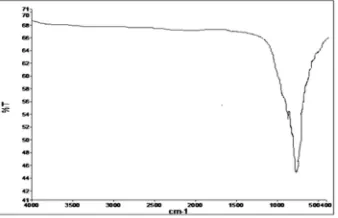
[image:3.595.206.375.413.522.2]FT-IR spectrum of Barium- Chromium nanooxide particle, BaCrO4 obtained via solid state thermal decomposition show reduce of mentioned peaks in spectrum (after being calcined). The intense peak approximately at 700 cm-1 is assigned to stretching mode of Barium- Chromium oxide obtained from (1), that gave clear evidence about the presence of the metal oxide structure[22]Fig.4.
Fig. 4. FT-IR spectrum of BaCrO4 after calcined of complex (1) in 1100 ˚C
Figure 5show the XRD pattern of the BaCrO4. The diffraction peaks in Fig.5 can be indexed to pure nanoparticle
with orthorhombic phase.The crystallite size of the title nanoparticle, was calculated using the Debye-Scherre formula from the major diffraction peak of the corresponding particle[32]. Specifically, the position and relative intensities of all peaks confirm well with standard XRD pattern BaCrO4 (JCPDS card No.00-001-1221). The average diameter the BaCrO4 calculated 54 nm. Maximum diffraction is in 2θ=41.35 and (210) as miller indices.
[image:3.595.142.440.633.758.2]The distance between crystalline planes is d=2.7 .
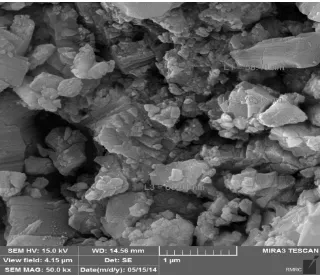
The surface morphology, structure and size of the nanoparticle were carried out using SEM image. The SEM image of title nanoparticle is clear. So provided in the form of nanoparticle and almost the morphology and uniformity in the image of them, relatively spherical and porous and beneath the high porosity for use as a catalyst for much is suitable. Fig. 6 show the SEM image of the prepared BaCrO4 nanoparticle.
Fig...6. SEM images of BaCrO4
[image:4.595.158.454.141.306.2]To further confirm the chemical composition, EDAX spectrum was recorded. The very strong peaks related to Cr, Ba and O are found in the spectrum (Fig. 7.) and no impurity was detected. So this method was also verified the formation of title nanoparticle by measuring of ingredient atoms which can be observed in percent of them. Table1.
Fig.7. EDX pattern of the nano crystalline of BaCrO4
Table 1. EDX data of BaCrO4
CONCLUSION
In summary, we have successfully synthesized precursor Barium- Chromium complex with 2, 6- pyridinedicarboxylic acid (dipic) and o-Phenylenediamine (opd) as ligands.BaCrO4 nanoparticle prepared from complex using thermal decomposition method. The size of the BaCrO4nanoparticle was measured using XRD and SEM and the results were in very good agreement with each other. XRD reveals the pure phase formation of title nanoparticle, which is further confirmed by FT-IR. All results reveal that thermal decomposition method can be employed successfully as a simple, efficient, low cost, environmentally friendly and very promising method for the synthesis of nanoscale materials without a need for special conditions, such as long reaction times, and high pressure. This method may be extending to synthesize other metal Oxide nanoparticles, nanowires, nanodisks, and even nanotubes.
El W% A%
[image:4.595.210.371.374.512.2]Acknowledgements
The authors sincerely thank the university of Sistan & Baluchestan for providing financial support of this work.
REFERENCES
[1] R Strobel;F Krumeich; S E Pratsinis; ABaiker, J. Catal., 2006, 243, 82-99.
[2] Y G Zhang;H Y He; B C Pan, The Journal of Physical Chemistry C., 2012, 116, 23130–23135.
[3] A Sternig; S Klacar; J Bernardi; M StoGer-Pollach; H GroNbeck; O Diwald, The Journal of Physical Chemistry C., 2011, 115, 15853- 15861.
[4]J Jiu; Y Ge; X Li; L Nie, Mater Lett., 2002, 54, 260- 263.
[5]F Gu, C Li;Y Hu; L Zhang, J. Cryst. Growth.,2007, 304, 369- 373.
[6]G Merino; M C Palermo; M Belda; R Fernandez De Rapp; ME Lascalea; GE Vazquez, Mater. Sci., 2012, 1, 588- 593.
[7]LH Ai; J Jiang, Rapid Powder Tech., 2009, 195, 11-14. [8]L Li; J Ren, Mater Res Bull., 2006, 41, 2286- 2290.
[9]AS Bhatt; DK Bhat; C-W Tai; MS Santosh, Mater ChemPhys, 2011,125, 347. [10]J Ma; S Zhang; W Liu; Y Zhao, J Alloys Compd., 2010, 490, 647-651.
[11]E Lester; G Aksomaityt; J Li; Gomez, J. Poliakoff, Cryst. Growth Charact. Mater., 2012, 58, 3-13.
[12]ME Baydi; G Poillerat; JL Rehspringer; JL Gautier; JF Koenig; P Chartier, J. Solid State Chem., 1994, 109, 281-288.
[13]DY Kim; SH Ju; HY Koo; SK Hong; YC Kangf, J Alloys Compd., 2006, 417, 254. [14]RV Kumar; Y Diamant; A Gedanken,Chem Mater., 2000, 12, 2301-2305
[15]X Wang; XY Chen; LS Gao; HG Zheng; Z Zhang; YT Qian, J PhysChem B., 2004, 108, 16401. [16]S Fan; X Liu; Y Li; E Yan; C Wang; J Liu; Y Zhang, Mater Lett., 2013, 91, 291-293.
[17]J Jiang; L Li, Mater Lett, 2007, 61, 4894.
[18]D Zou; C Xu; H Luo; L Wang; T Ying, Mater Lett.,2008, 62, 1976-1978. [19]E Traversa; M Sakamoto; Y Sadaoka, Part Sci Techno., 1998, 16, 185. [20]S Farhadi; N Rashidi, Polyhedron, 2010, 29, 2959-2965.
[21]S Farhadi; Z Roostaei-Zaniyani, Polyhedron 2011, 30, 1244-1249.
[22]K Nakamoto, Infrared and Raman Spectra of Inorganic and Coordination Compounds. PartB: Application in Coordination, Organometallic, and Bioinorganic Chemistry, fifth ed., John Wiley & Sons Inc., New York, 1997. [23]Z Razmara; ARezvani; H Saravani. Journal of Chemical and Pharmaceutical Research., 2015, 7(12), 170-177. [24]MV Kirillo a, J. Inorg chem. Acta.,2007, 360(2),506-512
[25]H Park, J. Inorg. Chim. Acta.,2007, 360(8), 2819-2823.
[26] S Petoud,, et al, J. Am. Chim. Soc., 2003,(44) 125,13324-13325.
[27]S Faulkner; J Matthews, Comprehensive Coordination ChemisytryII.Elsevier: Oxford, UK,. 9:. PP. 913, 2004. [28] CGZoski, Electroanalysis., 2002,14, 1041-1051.
[29] ACGonzalez-baro, J polyh., 27, 2008. 502-512.
[30] H Cui; Y Feng; W Ren; T Zeng; HLv; Y Pan; Strategies of Large Scale Synthesis of Monodisperse Nanoparticles, Recent Patents on Nanotechnology, Vol 3, pp.32-41, 2009.
[31] BL Cushing; VL Kolesnichenko; C. J. O'Connor; Chemical Reviews, 2004, 104, 3893-3946.
![Fig. 2. UV–visible absorption spectra of [Ba (opd) 3(H2O) 2] [Cr (dipic) 2]2 (1)](https://thumb-us.123doks.com/thumbv2/123dok_us/8745829.890742/2.595.131.445.536.708/fig-uv-visible-absorption-spectra-ba-opd-dipic.webp)