Safer built environment for climate
impacts in Malaysia
Kulatunga, U, Thayaparan, M, Sulaiman, N, Ingirige, MJB and Masram, H
Title
Safer built environment for climate impacts in Malaysia
Authors
Kulatunga, U, Thayaparan, M, Sulaiman, N, Ingirige, MJB and Masram, H
Type
Monograph
URL
This version is available at: http://usir.salford.ac.uk/38847/
Published Date
2016
USIR is a digital collection of the research output of the University of Salford. Where copyright
permits, full text material held in the repository is made freely available online and can be read,
downloaded and copied for noncommercial private study or research purposes. Please check the
manuscript for any further copyright restrictions.
Acknowledgements
The project team would like to acknowledge the British Council’s Newton Institutional Links Programme for the financial assistance. The contents are the sole responsibility of the authors and can under no circumstances be regarded as reflecting the position of British Council.
The authors would also like to acknowledge the following members for their valuable contributions and feedback based on which the CLIMATISE framework has been developed.
1. Mdm Herlina Ab Aziz, PeerConsult Sdn Bhd
2. Ir Dr Zuhairi Abdul Hamid, Construction Industry Development Board 3. Datin Rohani Ahmad, Department of Irrigation and Drainage
4. Sr Norjariah Arif, Universiti Tun Hussein Onn Malaysia 5. Mohd Ariff Baharom, National Disaster Management Agency 6. Veronica Cheah Kia Sheng, SP Setia Berhad Group
7. Ms Kunthi Herma Dwidayati, Linggis Design Studio
8. Dr Hjh Selasawati Ghazali, Hospital Raja Perempuan Zainab (II), Kelantan 9. Mr Shaharin Hashim TIF3M Consortium
10. Y.Bhg. Dato' Dr.Ghazali Hasni bin Md. Hassan, Hospital Raja Perempuan Zainab (II), Kelantan 11. Dr Hartini Kasmin, Universiti Tun Hussein Onn Malaysia
12. Dr Norpadzlihatun Manap, Universiti Tun Hussein Onn Malaysia 13. Mr Indera Syahrul Mat Redzuan, Universiti Tun Hussein Onn Malaysia 14. Sr. Saifullizan Mohd Bukari, Universiti Tun Hussein Onn Malaysia 15. Ahmad Sha`rainon Md Shaarani, TIF3M Consortium
16. Ir Dr Azuhan Mohamed, National Disaster Management Agency 17. Mohd Lokman Mohd Lasim, ,Kuala Lumpur City Council 18. Ar Prof Datuk Dr Amer Hamzah Mohd Yunus, JKR Malaysia
19. Zuhami Omar, Ministry of Women, Family and Community Development 20. Ms Marina Osman, Universiti Tun Hussein Onn Malaysia
21. Mr Ahmad Farhan Roslan , Construction Industry Development Board 22. Ir Hew See Sang, Kuala Lumpur City Council
23. Mdm Suprihartati Murni Lestari Sutekno, Universiti Tun Hussein Onn Malaysia
Suggested Citation
Kulatunga, U., Thayaparan, M., Sulaiman, N., Ingirige, B., Masram, H. (2016), Safer Built Environment for Climate Impacts in Malaysia, Centre for Disaster Resilience, University of Salford, Salford, UK.
Copyright
UK Partner: Centre for Disaster Resilience, School of the Built Environment, University
of Salford
Malaysian Partner: Department of Real Estate, Universiti Tun Hussein Onn Malaysia
Associate and Professional Partners
1. Herlina Ab Aziz, PeerConsult Sdn Bhd
2. Ir Dr Zuhairi Abdul Hamid, Construction Industry Development Board 3. Datin Rohani Ahmad, Department of Irrigation and Drainage
4. Mohd Ariff Baharom, National Disaster Management Agency 5. Veronica Cheah Kia Sheng, SP Setia Berhad Group
6. Dr Hjh Selasawati Ghazali, Hospital Raja Perempuan Zainab (II), Kelantan 7. Will Horsfall, Salford flood forum, Salford City Council, UK
8. Ahmad Sha`rainon Md Shaarani, TIF3M Consortium
9. Ir Dr Azuhan Mohamed, National Disaster Management Agency 10. Mohd Lokman Mohd Lasim, Kuala Lumpur City Council
11. Ar Prof Datuk Dr Amer Hamzah Mohd Yunus, JKR Malaysia
12. Zuhami Omar, Ministry of Women, Family and Community Development
Dr.Udayangani Kulatunga
Principal Investigator CLIMATISE
Dr.Bingunath Ingirige
Co-investigator CLIMATISE
Dr.Menaha Thayaparan
Research Fellow CLIMATISE
Dr. Noralfishah Sulaiman
Principal Investigator CLIMATISE
Haidaliza Masram
Co-investigator CLIMATISE
Hanisah Mohameed Soid
Researcher CLIMATISE
Executive Summary
5
Scientific Background
6
CLIMATISE Overview
7
Objectives and Methodology
7
CLIMATISE Framework development 8 CLIMATISE Framework validation 8Technical visit to the United Kingdom 9
CLIMATISE Workshop in UK 10
Research disseminations 11
Research Findings
12
Gap Analysis between level of importance and implementation of strategies 12
Gap Analysis between level of readiness and desirability to implement the strategies 13
Implementation of Strategies 14
CLIMATISE Framework
15
References
17
This report provides built environment specific adaptation and mitigation strategies for climate impacts with particular reference to Extreme Weather Events in Malaysia based on a collaborative research project funded by the British Council Newton Fund Institutional Links programme.
The report provides the gaps between importance and implementation of various adaptation and mitigation strategies for climate impacts in Malaysia. The report presents the CLIMATISE framework, which has been developed by identifying the barriers for effective implementation of mitigation and adaptation strategies and by recommending good practices that can be used to improve the resilience of cities from climate impacts.
Climate change is predicted to endanger human health, the global food security, economic development and the built and natural environment. Concerns on the potential impact due to climate change on human beings, natural and built environment are ever increasing. Studies carried out in Malaysia have revealed that increased temperature due to climate change is often resulted in increased storms and rainfall intensity (Siwar, et. al., 2009). The large variations of the rainfall in frequency and intensity have prone to fluctuations in the river flows that have resulted in extreme weather events (EWEs) such as floods, landslides, and soil erosion in Malaysia creating unfavourable results for socio-economic systems in the country. Accordingly, it is argued that climate change has introduced an additional layer of complexity and uncertainty into planning and preparedness for EWEs.
As it is difficult to completely eliminate the impacts from EWEs, it is important that cities are resilient against them. Within this context, the ability of the built environment to withstand the impacts of EWEs plays a direct role in determining how resilient the cities are. Failures and destruction of the built environment facilities due to EWEs could hamper the regular functioning of the society; severely hinder economic growth; and further increase the vulnerability of communities to future hazards (Dempsey and Jenks, 2010; Bosher et al, 2007; Comfort, 2006). Therefore, improving the resilience of the built environment through planned early adaptation and mitigation could lead to successfully manage the impacts of EWEs. However, evidence around the world and specifically with reference to
Malaysia suggests that most of the cities are still not resilient to withstand the impacts of EWEs (Kader et al., 2012).
In this context the CLIMATISE aims to create safer future cities through a resilient built environment from climate impacts, especially from extreme weather events in Malaysia.
In general, there are two different strategies when it comes to dealing with climate change. We can try to stop future warming (mitigation of climate change) or we can find ways to live in our warming world (adaptation to climate change).
• Mitigation involves attempts to slow the process of global climate change, usually by lowering the level of greenhouse gases in the atmosphere. Planting trees that absorb CO2 from the air and store it is an example of one such strategy.
• Adaptation involves developing ways to protect people and places by reducing their vulnerability to climate impacts. For example, to protect against sea level rise and increased flooding, communities might build seawalls or relocate buildings to higher ground.
In the context of Built Environment, mitigation refers how to minimise the damages to environment when creating buildings and structures whereas adaptation refers how the built environment can protect people and places by reducing vulnerabilities and impact from the climate change.
CLIMATISE (Climate Impacts in Malaysia: Attenuation Through Integrated Safer built Environment) is a collaborative research project jointly undertaken by University of Salford (USAL), UK and Universiti Tun Hussein Onn Malaysia (UTHM), and funded by the British Council Newton fund through Institutional Links programme. CLIMATISE developed built environment specific strategies for adaptation and mitigation of climate impacts with particular reference to EWEs through the involvement of national and international collaboration of academics, practitioners and professional bodies.
The overall aim was to evaluate and develop built environment specific mitigation and adaptation strategies for extreme weather events in Malaysia.
Focus group discussions were conducted with industry practitioners and academics in Malaysia from 17th to 21st August 2015, in Putrajaya and Johor, in order to gather the importance of built environment specific adaptation and mitigation strategies. 21 members have participated in 4 focus group discussions to answer some key questions related to mitigation and adaptation strategies in Malaysian context.
The main issues captured through the focus group discussions were
1. The importance for Malaysia to have BE specific adaptation and mitigation strategies
2. Existing BE specific mitigation and adaptation strategies for EWEs in Malaysia
3. Barriers for effectively implementation of the BE specific mitigation and adaptation strategies in Malaysia 4. Ways to minimise the barriers to
improve the implementation of the strategies in Malaysia
In addition, a questionnaire survey was also conducted to contextualise the strategies derived from the literature to Malaysia. A comprehensive list of key mitigation and adaptation strategies available in building sectors based on IPCC fourth assessment report: Climate change 2007
(https://www.ipcc.ch/report/ar4/) was
presented to the participants to get the following information through the questionnaire.
1. Level of importance of each strategy to the Malaysian context
2. The extent of implementation of each strategy in Malaysia
3. If not available or implemented, the level of desirability and level of readiness to implement the strategy
CLIMATISE Overview
Objectives and Methodology
CLIMATISE Framework development
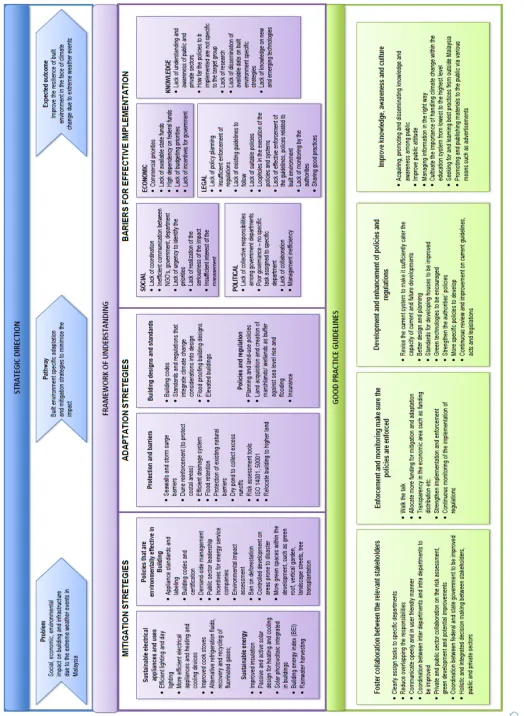
An initial version of the CLIMATISE framework was developed based on the findings derived from the primary data analysis of interviews and questionnaire survey. The framework explains the built environment specific mitigation and adaptation strategies to Malaysia within 3 sections as outlined below.
1. Strategic directions: explains the research problem and the identified pathway to achieve a solution
2. Framework of understanding: state of the art which identifies the BE specific mitigation and adaptation strategies used / to be used in Malaysia and the barriers associated with the effective implementation of such strategies
3. Good practice guidelines: provides recommendations in terms of foster collaboration between the relevant stakeholders; enforcement and monitoring; development and enhancement of policies and regulations; and improve knowledge, awareness and culture.
CLIMATISE Framework validation
A validation workshop was conducted from 25th to 27th January 2016 at The Everly Putrajayah in Malaysia. The validation workshop was facilitated by the project coordinators from UK and Malaysia. The main purpose of the workshop was to validate the results obtained through the primary data collection conducted as part of the CLIAMTISE workshop in August 2015 at Putrajaya and Johor. The progress and
achievement of CLIMATISE project were shared and the initial version of the CLIMATISE framework was presented. The participants securitised the initial framework and contributed immensely in suggesting further improvement to framework. All their contributions incorporated within the final CLIMATISE framework that has been disseminated to a wider audience in May 2016.
Technical visit to the United Kingdom
A group of Malaysian delegates representing various government and public organisations in Malaysia visited the UK on a week’s programme, as part of the CLIMATISE research project. The visit was paid from 22nd to 27th February 2016. The visit consisted a one-day workshop, meeting with Malaysian students from University of Salford, several other meetings with partners, research center directors and with Dean of School of the Environment. The meetings further
confirmed the sustainability of the partnership and collaboration between the UK and Malaysia partners.
The delegates also met the Malaysian students from School of the Built Environment, University of Salford on 23rd February. The delegates represented the organisations such as Construction Industry Development Board Malaysia (CIDB), Disaster Management Agency, SP Setia Berhad Group, Department of Irrigation and Drainage, TIF3M Consortium, Civil Engineering & Urban Transport Department, JKR Malaysia, Peer Consultant Sdn Bhd, Hospital Raja Perempuan Zainab, Universiti Tun Hussein Onn Malaysia.
There were presentations from both Salford students and Malaysian representative addressing various disaster resilience issues, as a way of knowledge exchange.
There were 2 technical site visit organised on the 26th of February where the delegates were taken to Broughton Trust Community development and Riverview School which were built with flood defense systems.
CLIMATISE Workshop in the UK
A one-day workshop was organised on 24th February 2016 at the University of Salford, MediaCityUK as part of the CLIMATISE project. The workshop consisted of interesting presentations delivered by the representatives from Salford city council, Hospital Raja Perempuan Zainab II, Malaysian Public Works Department, National Disaster Management Agency (Malaysia), UK Environmental Agency, Broughton Trust, Extremis Technology Ltd., AGMA Civil Contingencies and Resilience Unit: Greater Manchester Police.
Headquarters, Grantham Institute of the London School of Economics, and PEERS Consult Malaysia. The impacts of extreme weather event and good practices to manage them were shared during the workshop between the UK and Malaysian speakers.
Research disseminations
• A joint paper titled ‘Impact of Flood Disaster in Malaysia: A Case Study on Public Hospitals’ has been published on the Book of working papers which was published as part of the Special Themed Session on Cities, Infrastructure and Cascading Natural Disasters, at the 11th International Conference of the International Institute for Infrastructure Resilience and Reconstruction (I3R2): Complex Disasters and Disaster Risk Management, University of Seoul, August 27-29, 2015. Dr.Noralfishah Sulaiman from UTHM, Malaysia presented this paper at the special themed session.
• Dr. Bingunath Ingirige from Centre for Disaster Resilience, University of Salford attended the InterMET Asia 2016 conference from 16th-17th March in Singapore to deliver a presentation on built environment specific adaptation and mitigation strategies for climate impacts in Malaysia.
• CLIMATISE Dissemination and CPD workshop was held in May 2016 to disseminate the project findings to a wider audience in Malaysia.
Gap Analysis between level of importance and implementation of strategies
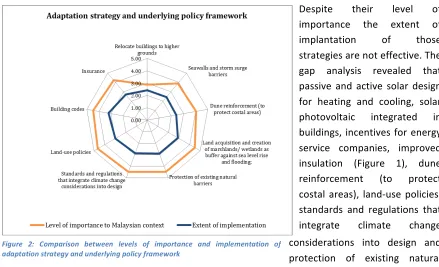
Research findings based on the quantitative data analysis indicates the gap between the level of importance and the extent of implementation of the mitigation and adaptation strategies within the Malaysian context. It is clear from Figures 1 and 2 that most of the BE specific strategies are recognized as important to the Malaysian context, where relocate buildings to higher ground is comparatively gained the least importance as per Figure 2.
Despite their level of importance the extent of implantation of those strategies are not effective. The gap analysis revealed that passive and active solar design for heating and cooling, solar photovoltaic integrated in buildings, incentives for energy service companies, improved insulation (Figure 1), dune reinforcement (to protect costal areas), land-use policies, standards and regulations that integrate climate change considerations into design and protection of existing natural barriers (Figure 2) are the main strategies less effectively implemented when compared to the level of importance in the Malaysian context.
[image:13.595.202.513.167.391.2]Research Findings
Figure 1: Comparison between levels of importance and implementation of key mitigation technologies, practices, policies and measures in building sector
[image:13.595.69.508.431.698.2]Figure 4: Comparison between levels of desirability and level of readiness of adaptation strategy and underlying policy framework
Gap Analysis between level of readiness and desirability to implement the strategies
To improve the effectiveness in implanting the strategy it is vital to evaluate the desirability of accommodating the strategies. Merely having the desirability is not sufficient to improve the implementation; therefore further investigation was carried out on the level of readiness or capacity for Malaysia to incorporate these strategies to the local context. As depicted in Figures 3 and 4, the overall results indicate that the level of readiness is comparatively less than the desirability across the majority of the strategies.
The gap analysis revealed that improved insulation, integrated design of commercial buildings including technologie, more efficient electrical appliances and heating and cooling devices, passive and active solar design for heating and cooling (Figure 3), land-use policies, standards and regulations that integrate climate change considerations into design, land acquisition and creation of marshlands/ wetlands as buffer against sea level rise and flooding, protection of existing natural barriers, building codes (Figure 4) are the main strategies where the readiness is low compared to the desirability.
[image:14.595.74.520.413.694.2]A close look at these strategies further reveals that the readiness is far too low with adaptation rather than mitigation. The gap is very minimal when it comes to mitigations strategies such as public sector leadership programmes including procurement and incentives for energy service companies (Figure 3).
The above analysis implies that despite the desire to have these strategies, whether Malaysia is ready to implement those is still questionable. This is linked with their existing capacity and barriers for effective implementation. The focus groups interviews were conducted in order to capture the reasons behind the less effectiveness in implementing the adaptation and mitigation strategies in Malaysia. The focus group participants have also suggested some recommendations to reduce or minimize such barriers. The focus group findings are discussed in the next section.
Implementation of Strategies
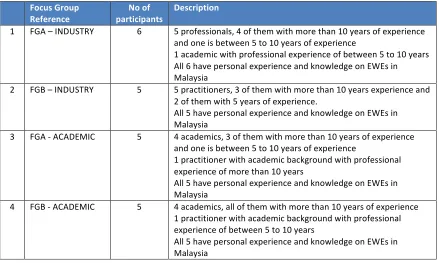
[image:15.595.74.513.337.600.2]This section provides the data analysis and findings from the 4 focus groups conducted. Table 1 provides the profile of the 4 focus groups. The analyzed data and the findings of the focus group discussions informed the CLIMATISE framework for Malaysia, which was further, validated through validation workshop.
Table 1: Profiles of the focus groups
Malaysia is subject to various hazards and risks of destruction due to the impacts from natural disasters caused by global warming and extreme weather events, high urbanization rate and increase of population, hence protecting the people, properties, buildings and infrastructure from such impact is of paramount importance. The focus group participants emphasise that the adaptation and mitigation strategies are very important to minimize the loss of lives, properties and services including the social, economic, environmental impact on building and infrastructure.
Focus Group
Reference participants No of Description
1 FGA – INDUSTRY 6 5 professionals, 4 of them with more than 10 years of experience and one is between 5 to 10 years of experience
1 academic with professional experience of between 5 to 10 years All 6 have personal experience and knowledge on EWEs in Malaysia
2 FGB – INDUSTRY 5 5 practitioners, 3 of them with more than 10 years experience and 2 of them with 5 years of experience.
All 5 have personal experience and knowledge on EWEs in Malaysia
3 FGA - ACADEMIC 5 4 academics, 3 of them with more than 10 years of experience and one is between 5 to 10 years of experience
1 practitioner with academic background with professional experience of more than 10 years
All 5 have personal experience and knowledge on EWEs in Malaysia
4 FGB - ACADEMIC 5 4 academics, all of them with more than 10 years of experience 1 practitioner with academic background with professional experience of between 5 to 10 years
In addition to the strategies identified through questionnaire, the focus group participants have shared their knowledge on the strategies that are currently used and to be used in Malaysia to improve the resilience of the built environment in the face of climate change. All the strategies identified were classified into various groups as indicated in Table 2.
Table 2 : Classification of mitigation and adaptation strategies
Mitigation strategies Adaptation strategies
Sustainable electrical appliances and uses Protection and barriers
Sustainable energy Building designs and standards
Policies that are environmentally effective in Building Policies and regulation
While acknowledging the fact that Malaysia is using built environment specific mitigation and adaptation strategies, it was claimed that such strategies are still at minimal implementation. The effectiveness in implementing such strategies needs to be improved in order to enjoy the maximum benefits such strategies could bring into create a safer built and human environment. The challenges and barriers that affect the effective implementation of mitigation and adaptation strategies were identified and the barriers are classified under economical, political, social, knowledge and legal categories.
Through the focus groups, recommendations to address some of these barriers are also identified. These recommendations were further validated in order to make them more achievable by expanding them with
specific actions to be undertaken. Good practices to improve the implementation of mitigation and adaptation strategies within the Malaysian context are also identified. The validation workshop in Malaysia, which was held from 26-27 January 2016, provided further input towards the recommendations suggested.
Recommendations to minimize barriers for effective implementation of the strategies in Malaysia were suggested under the following main headings.
• Foster collaboration between the relevant stakeholders
• Enforcement and monitoring
• Development and enhancement of policies and regulations
• Improve knowledge, awareness and culture
Based on the analysis of questionnaire and focus group discussions, and the findings summarised above the CLIMATISE Framework for the mitigation and adaptation strategies in Malaysia has been developed and presented in Figure 5.
Principal Investigator Malaysia:
Dr. Noralfishah Sulaiman
KANZU Research,
Universiti Tun Hussein Onn Malaysia, Malaysia
Tel: +6074533954
Email: [email protected]
Web: https://community.uthm.edu.my/nora
Principal Investigator UK:
Dr. Udayangani Kulatunga
Centre for Disaster Resilience School of the Built Environment,
4th Floor Maxwell Building, University of Salford,
Salford, Greater Manchester M5 4WT, UK Tel: +44(0) 161 295 4943
Email: [email protected]
Web: www.seek.salford.ac.uk/profiles/U.KULATUNGA.jsp
Bosher, L., Dainty, A., Carrillo, P. and Glass, J., 2007. Built-in resilience to disasters: a pre-emptive approach. Engineering, Construction and Architectural Management, 14(5), pp.434-446.
Comfort, L.K., 2006. Cities at risk hurricane katrina and the drowning of new orleans. Urban Affairs Review, 41(4), pp.501-516.
Dempsey, N. and Jenks, M., 2010. The future of the compact city. Built environment, 36(1), pp.116-121.
Kader, S.A., Zubaidah, S., Mustafa, M. and Sufian, A., 2012. Climate change adaptation and mitigation through land use decision making in Malaysia.
Siwar, C., Alam, M.M., Murad, M.W. and Al-Amin, A.Q., 2009. A review of the linkages between climate change, agricultural sustainability and poverty in Malaysia. International Review of
Business Research Papers, 5(6), pp.309-321.