International Journal of Emerging Technology and Advanced Engineering
Website: www.ijetae.com (ISSN 2250-2459, ISO 9001:2008 Certified Journal, Volume 4, Issue 6, June 2014)
730
A Study on MCD Officials Perception Towards Present
Information Sharing Potential in MCD
Dr. Sanjay Kumar Gupta
1, Vilender Kumar
21
School of Studies in Computer Science & Applications, Jiwaji University, Gwalior-474002
2
Associate Professor-Computer Science, IITM New Delhi-110058
Abstract-- In this work, Municipal Corporation of Delhi (MCD) existing information sharing capabilities are analyzed to improve overall business performance to make MCD more competitive organization to face global challenges. MCD official are asked to provide their responses through questionnaire about their perceptions regarding various aspects of information sharing potential in using software applications in MCD. Objective of this is to know MCD for timely and accurate information sharing available present potential in digital age, and therefore requirement of implementing ERP in MCD by more customer focus processes to deliver better services to citizens.
Keywords-- HR, Information sharing, Database, Inter department communications
I. INTRODUCTION
MCD is a one among many vast service provider organization in India and delivering various services to different customers. Presently, it has around thirty four different departments providing services to Delhi citizens but many different departments had their own software system to meet their requirements [5,6]. This resulted in a crumbling of information, as all of the information was stored separately on different systems spread across Delhi. Almost all citizens are common service users for, more than one MCD departments, but same citizen if approaches any other MCD department for availing of different services; the respective department again asks to feed citizen personal details. This increases time, effort, and size of replicate data and that makes it impossible to get accurate information on time. Moreover, globalization led to immense competition and thus realized the need for more customer focus services and shortened service life cycle. This generates the need of an integration of various service departments with other functional areas like accounting, marketing, HR, etc. to address the diverse needs of customers by tightly integrating all departments and functions to make MCD a single system to serve general as well as particular needs of customers by managing all customer records/data. For that Enterprise Resource planning (ERP) is a solution which has gained prominence to combine all discrete information into a single, integrated, real-time database.
Therefore, present potential of software applications to share information and possibilities of driving demand for ERP solutions for information sharing in MCD of its functionalities are analyzed through responses of MCD officials to get citizens faster delivery, highly customized services, and enhanced support services in future.
The outline of this paper is as follows. We begin with introduction of problem of study of MCD in section 1. Section 2; contain the literature review of various models practically implemented & in use at present for information sharing across the world. In section 3 we describe research methodology to carry on research work involves gathering data and then organizes, and describes the data. Hypothesis to test on the basis of MCD officials’ response about present database system is in section 4. In section 5, MCD officials’ responses on various motivational factors are illustrated. Section 6 represents statistical tests results and significant findings to make MCD more competitive organization to face global challenges. In Section 7, we give our concluding remark.
II.REVIEW OF LITERATURE
International Journal of Emerging Technology and Advanced Engineering
Website: www.ijetae.com (ISSN 2250-2459, ISO 9001:2008 Certified Journal, Volume 4, Issue 6, June 2014)
731
The research discussed various options available for orchestrating e-government on a countrywide scale from the vantage point of a nodal authority. Gupta and Kumar et al. [5] described issues involved with MCD functionality, ERP software, and identify the basic motivational requirements and concerns of ERP implementation for MCD to enable improved services.III. RESEARCH METHODOLOGY
Research methodology comprises of various steps adopt by researcher along with the logic behind it. The study undertaken was descriptive and non-probabilistic in nature, which aims at gathering the preliminary data from MCD officials who are using present software applications to throw the light on real nature of the issue. To collect the data in a systematic manner, a detail data sheet covering communication setup related option were used.
A sample design is definite plan for obtaining a sample from the sampling frame. It refers to technique or the procedure the researchers would adopt in selecting some sample unit from which inference about the information sharing is drawn.
The method of data collection is quite popular particularly questionnaire is prepared and given to the respondent who are MCD officials and expected to read and mark their reply in the space meant for the purpose given in sheet, but rarely spare time to share their experience using new technology. In all 60 questionnaires were distributed but only 42 questionnaires were returned and 35 responses were finally considered. This number is quite low but sufficient to attain the basic objective to find the inclination for information sharing potential in MCD.
IV. HYPOTHESIS
In order to test the perception of the MCD officials about the current status of databases and its information sharing aspect H01 hypothesis is derived.
H01: The present MCD information system follows the
single database management for sharing the records of their entire citizen’s services.
V. ANALYSIS AND INTERPRETATION
The responses as shown in the Figure-1 represents that more than eighty percent of MCD officials disagree with the statement “MCD present database system integrated for information sharing”.
Figure-1
Figure-2 as shown below represents responses of MCD officials related to the statement “MCD present software
International Journal of Emerging Technology and Advanced Engineering
Website: www.ijetae.com (ISSN 2250-2459, ISO 9001:2008 Certified Journal, Volume 4, Issue 6, June 2014)
732
Figure-2
Figure-3 as shown below represents the responses of MCD officials related to the statement “Present MCD
software using at various departments has ability to timely track and control services information”.
Figure- 3
Figure-4 as shown below represents the responses of MCD officials related to the statement “Present MCD
International Journal of Emerging Technology and Advanced Engineering
Website: www.ijetae.com (ISSN 2250-2459, ISO 9001:2008 Certified Journal, Volume 4, Issue 6, June 2014)
733
Figure-4
Figure-5 as shown below represents the responses of MCD officials related to the statement “MCD require single enterprise information system”.
Figure-5
Figure-6 as shown below represents the responses of MCD officials related to the statement “There is urgent
requirement to implement ERP at Delhi MCD for information sharing to improve citizen services”.
International Journal of Emerging Technology and Advanced Engineering
Website: www.ijetae.com (ISSN 2250-2459, ISO 9001:2008 Certified Journal, Volume 4, Issue 6, June 2014)
734
VI. RESULT AND DISCUSSION
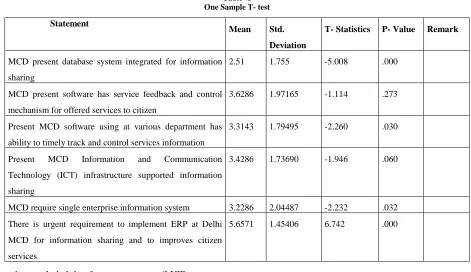
The result as shown in table-1 all probability values are accepted in the second statement (MCD present software has service feedback and control mechanism for offering
[image:5.612.69.540.198.470.2]services to citizens) is less than five percent level of significance, hence with ninety five percent confidence level.
Table -1 One Sample T- test
Statement
Mean Std.
Deviation
T- Statistics P- Value Remark
MCD present database system integrated for information
sharing
2.51 1.755 -5.008 .000
MCD present software has service feedback and control
mechanism for offered services to citizen
3.6286 1.97165 -1.114 .273
Present MCD software using at various department has
ability to timely track and control services information
3.3143 1.79495 -2.260 .030
Present MCD Information and Communication
Technology (ICT) infrastructure supported information
sharing
3.4286 1.73690 -1.946 .060
MCD require single enterprise information system 3.2286 2.04487 -2.232 .032
There is urgent requirement to implement ERP at Delhi
MCD for information sharing and to improves citizen
services
5.6571 1.45406 6.742 .000
It can be concluded that for statement one (MCD present database system integrated for information sharing), three (Present MCD software using at various department has ability to timely track and control services information), four (Present MCD Information and Communication Technology (ICT) infrastructure supported information sharing) and five (MCD require single enterprise information system) the MCD official are found to disagree with the statement because of disintegrated nature of MCD database management system and lack of regular IT infrastructure up-gradation. Moreover, MCD cannot timely deliver and monitor the various services to the citizen, hence hypothesis H01 is rejected. However for the
statement six (There is urgent requirement to implement ERP at Delhi MCD for information sharing and to improves citizen services) they are found to significantly agree with the statement because after MCD database integration of different departments the citizen service delivery time and work efficiency of MCD will defiantly improve. In case of the statement number two they are neither disagree nor agree i.e. they are neutral with the statement.
VII. CONCLUSION
International Journal of Emerging Technology and Advanced Engineering
Website: www.ijetae.com (ISSN 2250-2459, ISO 9001:2008 Certified Journal, Volume 4, Issue 6, June 2014)
735
REFERENCES[1] Brehm L and Markus M L (2000), The Divided Software Life Cycle
of ERP Packages, available at : Proceedings of the 1st Global Information Technology Management (GITM) World Conference, Memphis (Tennessee, USA), June 11- 13, 2000, pp. 43-46.
[2] Bhatnagar S (2002), E-government: Lessons from Implementation in
Developing Countries, available at:
www.iimahd.ernet.in/~subhash/pdfs/RDDAutumn2002.pdf, Published in Regional Development Dialogue, Vol. 24, UNCRD, Autumn 2002.
[3] Batini C, Lenzerini M and Navathe S B (1986), A Comparative
Analysis of Methodologies for Database Schema Integration C. available at: ACM Computing Surveys, Vol. 18, No. 4, December 1986.
[4] Guntamukkala Vamsidhar , H. Joseph Wen and J. Michael Tarn
(2006), An empirical study of selecting software development life cycle models, available at : Human Systems Management 25 (2006) 265–278 IOS Press.
[5] Gupta Sanjay Kumar, Kumar Vilender, Chhabra Susheel (2012), A
WINDOW VIEW ON PROSPECTS OF ERP IMPLEMENTATION
IN MUNICIPAL CORPORATION OF DELHI, International
Journal of Emerging Technology and Advanced Engineering Website: www.ijetae.com, Volume 2, Issue 9, September 2012, pp.252-260
[6] http://www.mcdonline.gov.in/
[7] Reddy M P, Prasad B E, Gupta A and Reddy M G (1994),