International Journal of Emerging Technology and Advanced Engineering
Website: www.ijetae.com (ISSN 2250-2459, ISO 9001:2008 Certified Journal, Volume 7, Issue 2, February 2017)
47
Irrigation Scheduling Methods: A Review
S. T. Dhotre
1, Dr. Gunwant Sharma
2, Dr. Rohit Goyal
3, S K Parikh
41Research Scholar, 2,3Professor, Department of Civil Engineering, MNIT, Jaipur, Pin – 302017, India
4Ex. Assistant Professor, College of Engineering, Pune, India
Abstract—The main challenge for irrigation engineers and water management department in semi-arid region is to improve water use and its application efficiency. The objective of irrigation is to keep sufficient water supply available to crop. Several irrigation scheduling means are available now a days to assist irrigation water manager. Some of the few techniques are discussed in this present work.
Keywords— Irrigation scheduling, soil moisture, water budget model and dynamic model.
I. INTRODUCTION
Application of irrigation water to the crop is the most important recurring aspect in crop water management which needs careful consideration. A crop gets its water by its roots. Irrigation water is required when the soil is unable to supply moisture to the crop. The objective of irrigation is to keep sufficient water supply available to crop. If water is in short supply, whatever is available needs to be supplied most effectively and efficiently [15]. Determination of an irrigation schedule or time of application of water is a tedious process. The evolutions in computer programs have made it simple and easy. Water can be applied to farm fields according to the water requirement of the crops. In the beginning the amount of water supplied is small as root depth is in developing stage. During the mid-season, the irrigation water applied need to be larger as root depth is deep. Thus, it reveals that irrigation water depth and the irrigation interval varies with the crop development stage. In arid and semi-arid regions, where rainfall is scarce, providing irrigation is very critical. There is no substitute for water. It is indispensable for human, animal and plant life. Hence, it is necessary to develop, conserve, utilize and manage this precious resource economically and efficiently so as to meet the growing demand for agriculture and other human developmental activities. The main challenge for irrigation engineers and water management department in semi-arid region is to improve water use and its application efficiency. Several irrigation scheduling means are available now a days to assist in irrigation scheduling. Some of the few techniques are as follows:
Soil Moisture estimation by feel and appearance Cropping Pattern as indicator
Soil Moisture measuring devices
Models
Quantifying Evapotranspiration
II. SOIL MOISTURE ESTIMATION BY FEEL AND
APPEARANCE
United States Department of Agriculture (USDA) has presented detailed information (http: //www.nrcs. usda.gov
/wps/ portal/nrcs/detail/wy/soils/? cid=nrcs
142p2_026830) about feel and appearance method used in
irrigation water application scheduling. Feel and
appearance method involves the following steps:
Firstly, the soil sample is collected from study area by using a probe, auger or a shovel.
Second activity is firmly squeezing collected sample in a hand several times to form an irregularly shaped ball.
Third step is to form ribbon by squeezing sample between thumb and forefinger.
Observation like soil texture, ability to form ribbon, firmness, surface roughness of ball, water glistering, loose soil particles, soil/ water staining on fingers and soil colour are noted.
At last observations are compared with available charts and photographs to estimate the water available and the soil moisture in mm depleted below the field capacity.
III. USING CROPPING PATTERN AS INDICATOR
International Journal of Emerging Technology and Advanced Engineering
Website: www.ijetae.com (ISSN 2250-2459, ISO 9001:2008 Certified Journal, Volume 7, Issue 2, February 2017)
48 IV. SOIL MOISTURE MEASURING DEVICES
At present several instruments and devices are available for monitoring or measuring soil moisture. The most commonly used in the field are tensiometers and various electronic soil probes.
A. Tensiometers
A tensiometer is a device sealed water-filled tube with a porous ceramic tip on the lower end and a vacuum gauge on the upper end. It is installed in the soil profile with the ceramic tip placed at the desired root zone depth with the gauge above ground. In dry soil water comes out of the instrument. The depleting water in the tube creates a partial vacuum. This vacuum is registered on the gauge. The drier the soil, the higher is the reading. When the soil receives water or moisture the action is reversed.
B. Electrical Resistance Meters
Electrical resistance meters determine soil moisture by measuring the electrical resistance between two wire grids embedded in a block of gypsum or similar material. These are permanently embedded in the field. The electrical resistance varies with its moisture content. As the soil dries, the block loses water and the electrical resistance increases. The resistance changes within the block is measured by the meter and interpreted in terms of soil water content.
V. MODELS
Models have been developed in research with a large variation in degree of complexity. Empirical models display simple relationship between input and output, this model is treated as ―black box‖ model. Other types of models are mechanistic models which simulate physical, chemical and physiological processes that take place within the system. De Jong and Kabat [7] stated that in practice, mechanistic models make use of empirical functions when and where knowledge about a given process is lacking. The selection of the most appropriate method that balances the mechanistic-empirical character of the model is controlled by model objectives. The improving of irrigation water management in the areas of dry weather conditions during the growing period is achieved only by modeling the irrigation water application schedule. Dejong and Kabat [7] had also stated that the mathematical models which simulate the physical processes of the crop-soil irrigation systems are rarely duplicate their prototype in every detail. The physical model may look like scaled down version of real system, but the grain and pore size distribution and their distribution within the porous media will not be scaled version of their counterparts in the prototype.
Recently many researchers have developed moisture models, De Jong and Bootsma [6] reviewed literature and revealed that there are three types of models as follow:
Water budget models
Semi dynamic models
Dynamic models
A. Water Budget Models
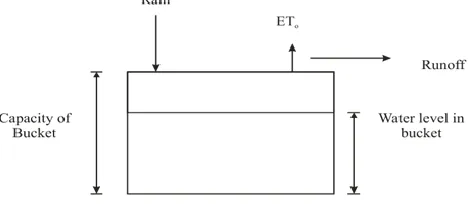
[image:2.612.328.563.579.685.2]Water budget models are the simplest types of soil moisture flow models used in irrigation water application. In this method soil medium profile is treated as bucket. This bucket is assumed to have fixed water capacity. The assumed bucket is filled with precipitation or on application of irrigation water and emptied with evaporation or evapotranspiration. The excess water above its water capacity is assumed as runoff, drainage or loss. These types of models ignore the vertical moisture distribution in the root zone and assume that the losses by evapotranspiration and deep infiltration are a function of the average degree of soil saturation. As per the views of Anderson and Harding [3] and Yadav et al. [20 and 21] the spatial and temporal distributions of soil moisture regime calculated by using water budget models are not so accurate to quantify moisture flow and solute transport in the vadoze zone. The concepts of field capacity and wilting point are central and important in water budget models. A drawback of water budget models is that redistribution of water (except for the recharge to field capacity) is not considered. De Jong and Bootsma [6] put forward that these models are restricted to free draining soils with a deep water table only. These models do not consider capillary rise of groundwater penetrating into the root zone. The strength of these type of models is that these models require a less amount of data, namely field capacity, wilting point, daily precipitation and evapotranspiration. The following figure depict all component parts of simple bucket model.
International Journal of Emerging Technology and Advanced Engineering
Website: www.ijetae.com (ISSN 2250-2459, ISO 9001:2008 Certified Journal, Volume 7, Issue 2, February 2017)
49
a. Niwa Model
Niwa model is a simple type in bucket model. It uses only one parameter, the soil moisture storage capacity (Smax). The rainfall or irrigation water is infiltrating into a
soil store and the moisture is reduced by
evapotranspiration. At the stage when soil store is full, it is assumed to be saturated or at field capacity and the excess rainfall water is treated as runoff. Evapotranspiration is treated to be continued at its potential rate till the soil water store drops to half of its field capacity or Smax. Evapotranspiration decreases linearly to zero when store is empty. Kandel et al. [14] used Smax value 150 mm for all modeling grids in their study.
b. Versatile Soil Moisture Budget (VSMB) Model
Bier and Robertson [4] state that in VSMB model, infiltration is distributed over six soil zones as a function of infiltration depth, relative water content in each zone, and a percolation coefficient. The latter determines the fraction of the infiltration water which percolates to the next zone before field capacity is reached. In another version of VSMB model described by Dyer and Mack [9], each zone can be filled to its saturation water content, rather than field capacity.
B. Semi-Dynamic Models
Semi-dynamic models uses the multi-layer concept. They combine water budget procedure with a more dynamic methodology. In these models daily application of water is stored in the uppermost soil layer, until this layer reaches its upper limit. The excess water from first layer start to cascade into lower layers, until sufficient storage is reached. This process continues to consequent layers. This subsequent redistribution and drainage is estimated by using a Darcy-type unsaturated flow computation equation. These models split evapotranspiration between potential crop transpiration and soil evaporation on the basis of ground cover and the leaf area index (LAI). As per De Jong and Bootsma [6] Semi-dynamic models provide a more detailed description of water movement through the soil than water budget models.
C. Dynamic Models
Infiltration and redistribution of water are controlled by the physical factors governing water movement in soil. Knowledge of the availability of soil moisture is an important factor in relation to crop production. The amount of irrigation water for a crop field is dependent on the rooting pattern of that crop and the layer-wise distribution of soil moisture in the root zone profile.
As the measurement of soil moisture at regular intervals is not economical and time consuming, there has been continuing interest in developing physical parameter based mathematical models. Molz and Remson [16] have classified the dynamic models in two major groups as follows:
Microscopic (Single Root) Dynamic Models
Macroscopic (Root System) Dynamic Models
a.Microscopic (Single Root) Dynamic Models
These Microscopic, bottom up approach dynamic models, deal with the radial flow of water to an individual (single) root. The driving force for the uptake of water into the root is the difference in water potential that exists between the soil solution adjacent to the root and the root xylem as described by Taylor and Klepper [17] and Yadav and Mathur [19].
b.Macroscopic (Root System) Dynamic Models
These macroscopic dynamic models are top-down approach models which eliminate the need for to obtaining soil and plant parameters. The flow to individual roots is ignored and the overall root system is considered to uptake moisture from each layer of the root zone at some rate. This rate depends on position of depth point in a coordinate system, existing moisture content, and time from initial condition. Chang and Corapcioglu [5] assumed the following boundary conditions:
Top soil surface as upper boundary
Lower boundary as the water table boundary
Gravity flow condition boundary (where water table boundary is not considered)
VI. EVAPOTRANSPIRATION
To schedule irrigation properly, farmer must know the environmental demand for surface water. This surface water loss occurs through evapotranspiration (ET). Fontenot [10] has expressed that it is simply the amount of water returned to the atmosphere through evaporation and transpiration. Dingman [8] and Allen et al. [2] had observed that the evapotranspiration (ET) is a function of following factors:
Location
Temperature
Solar radiation
Humidity
Wind
International Journal of Emerging Technology and Advanced Engineering
Website: www.ijetae.com (ISSN 2250-2459, ISO 9001:2008 Certified Journal, Volume 7, Issue 2, February 2017)
50 The process known as evapotranspiration (ET) is importance in many disciplines such as in irrigation system design, irrigation scheduling and hydrologic and drainage studies. Verstraete [18] has stated that ETo is a combined
process of both evaporation from soil surface, plant surfaces and transpiration through plant canopies. In this process the water is transferred from the soil medium and plant surfaces into the atmosphere in the form of vapour. Reference, potential and actual evapotranspiration are distinguishing terms which are commonly used, with some differences in their meaning.
A. Potential Evapotranspiration (ETp)
The potential evapotranspiration concept was first introduced in the late 1940s and 1950s by Penman as stated by Irmak and Haman [13] and its definition is available in standard text books. In the definition the evapotranspiration rate is not related to specific crop. As per the view of many researchers the main confusion with that definition is that there are many types of horticultural and agronomical crops that fit into the definition of short green crops. As per FAO researcher the main confusion as to which crop should be selected and to be used as a short green crop.
B. Reference Evapotranspiration (ETo)
In the reference evapotranspiration definition ambiguity about the crop is overcome. The grass is specifically defined as the reference crop and this crop is assumed to be free of water stress and diseases. The terms reference evapotranspiration and reference crop evapotranspiration both represent the same meaning. The reference evapotranspiration concept was introduced by irrigation engineers and researchers in the late 1970s and early’80s to avoid ambiguities that existed in the definition of potential evapotranspiration. By considering the reference crop as grass, it has become simple and practicable to use proper crop coefficients. Two main crops have been used as the reference crops which are grass and alfalfa. Alfalfa has the physical characteristics closer to many crops than grass. Literature review reveals that researchers mostly agree with a clipped grass which provides a better representation of reference evapotranspiration than alfalfa. According to that definition the weather data collection site is well defined. The reference evapotranspiration concept has been gaining significant acceptance by the engineers and scientists throughout the world because specific equations and standardized procedures being available for its estimates.
The report of the International Commission for Irrigation and Drainage (ICID) and the Food and Agriculture Organization (FAO) of the United Nations expert consultation on revision of methodologies for crop water requirements recommend the Penman-Monteith equation (FAO-56) be considered as the standard method for its estimation.
There are several methods to measure evapotranspiration directly. For instance, a lysimeter is used to measure ET. Fontenot [10] remarked that lysimeter can be expensive both economically and in time investments to install, check, and maintain the equipment. It was also pointed out that evaporation pans measure the loss of a known quantity of water through evaporation, but they do not measure transpiration directly, and therefore they must be adjusted by using pan coefficients to represent ET. The direct measurement of ET is difficult. To simplify the process of determining ET, models are developed to estimate. A major complication in modeling is the requirement for meteorological data of study area that may not be easily available everywhere. This restricts the use of more accurate models, and necessitates use of models that have less demanding data requirements. As per FAO-56, the Penman-Monteith model is the standard for ETo estimation.
This model is a variant of the original 1948 Penman model, and accounts for aerodynamic resistance (Ra) and bulk
surface resistance (Rs). In this model these terms have
modified the original equation to take into account the increasing resistances involved in transporting moisture from the evaporating surface upward and to the atmosphere under increasingly dry surface conditions. Allen et al. [2] reported that the Ra term describes the physical resistance
in transporting moisture from the evaporating surface (i.e. plant leaf) into the atmosphere. Fontenot [10] has also stated that these two terms allow the original Penman model to better approximate the actual processes of evapotranspiration from a vegetated surface. The
International Journal of Emerging Technology and Advanced Engineering
Website: www.ijetae.com (ISSN 2250-2459, ISO 9001:2008 Certified Journal, Volume 7, Issue 2, February 2017)
51 VII. CONCLUSION
Irrigation scheduling is important for both water savings and improved crop yields. The irrigation water is applied to the field based upon the soil water status. The traditional method for determining the amount of irrigation to apply involved gathering information by observing crop and soil appearance. There are three main means of irrigation scheduling: soil-based, plant-based and climate-based methods. Some available methods were discussed in this study. Selection of method depends upon available resource in hand.
REFERENCES
[1] Al-Kaisa, and Broner, (2014). ―Crop Water Use and Growth Stages.‖ Colorado State University, Fact Sheet No. 4.715.
[2] Allen, R. G., Pereira, L., Raes, D., and Smith, M. (1998). ―Crop Evapotranspiration.‖ FAO Irrigation and Drainage paper No 56: Food and Agriculture Organization of the United Nations, Rome, Italy.
[3] Anderson, L., and Harding, R. J. (1991). ―Soil moisture deficit simulation with model of varying complexity for forest and grass land sites in Sweden and the UK.‖ Water Resource Management, 5, 25-46.
[4] Bier, W., and Robertson, G. W. (1966). ―A new versatile soil moisture budget.‖ Can. J. Plant Sci., 46.
[5] Chang, Y. Y., and Corapcioglu. M. Y. (1997). ―Effect of Root on water flow in unsaturated soils.‖ J. Irrig. Drain. Eng, 123(3), 202-209.
[6] De Jong, R., and Bootsma, A. (1996). ―Review of recent developments in soil water simulation models.‖ Can. J. Soil Sc., 76, 263- 273.
[7] De Jong, R., and Kabat, P. (1990). ―Modelling water balance and grass production.‖ Soil Sci. Soc. Am. J, 54, 1725-1732.
[8] Dingman, S. L. (1994). ―Physical hydrology.‖ Prentice Hall Englewood Cliffs, New Jersey, USA.
[9] Dyer, J. A., and Mack, (1984). ―The versatile soil moisture budget Version-3.‖ Technical Bulletin Canada.
[10] Fontenot, R. L. (2004). ―An Evaluation of Reference Evapotranspiration Models in Louisiana‖. Unpublished Thesis B.S., Louisiana State University and A&M College, LA, USA.
[11] Hargreaves, G. L., Hargreaves, G. H., and Riley, J. P. (1985). ―Agricultural benefits for senegal river basin.‖ J. Irrig. Drain. Eng, ASCE 111, 113-124.
[12] Hargreaves, G. H. (1994). ―Defining and using reference evapotranspiration.‖ J. Irrig and Drain Eng, ASCE 120(6), 1132– 1139.
[13] Irmak, S., and Haman, D. Z. (2015). ―Evapotranspiration: Potential or Reference.‖ Department of Agriculture, UF/IFAS Extension Service, University of Florida, Gainesville, FL, USA.
[14] Kandel, D., Chiew, F., and Grayson, R. (2005). ―A Tool for mapping and forecasting soil moisture over Australia.‖ Technical Report 05/2. [15] Miller, R. W., and Donahue (1997 Seventh Edition). ―Soils in our
environment.‖ Prentice Hall of India, New Delhi, India.
[16] Molz, F. J., and Remson, I. (1970). ―Extraction term models of soil moisture use by transpiring plants.‖ Water Resources Research, 6(5), 1346-1356.
[17] Taylor, H. M. and Klepper, B. (1975) Water uptake by cotton root systems: an examination of assumptions in the single root model, Soil Science 120(1), 57 – 67.
[18] Verstraete, M. M. (1987). ―Radiation transfer in plant canopies: Transmission of direct solar radiation and the role of leaf orientation.‖ J. Geophysical Research Volume, 10985–10995. [19] Yadav, B. K., and Mathur, S. (2008). ―Modelling soil water uptake
by plants using non-linear dynamic root density distribution function.‖ J. Irrig. Drain. Eng, 134(4), 430 436.