IMPROVING COMPETITION WITHIN PUBLIC
PRIVATE PARTNERSHIP (PPP) PROCUREMENT
PROCESS FOR INFRASTRUCTURE DELIVERY
IN MALAYSIA
Muhammad Imran bin ZIN ZAWAWI
IMPROVING COMPETITION WITHIN PUBLIC
PRIVATE PARTNERSHIP (PPP) PROCUREMENT
PROCESS FOR INFRASTRUCTURE DELIVERY
IN MALAYSIA
Muhammad Imran bin ZIN ZAWAWI
School of the Built Environment
College of Science & Technology
University of Salford, UK
Submitted in Partial Fulfilment of the Requirements of the
Degree of Doctor of Philosophy
i
Table of Contents
List of Tables………..….vii
List of Figures .……….………...viii
Acknowledgements……….……….………….ix
Declarations……….………x
Abbreviations……….………..xi
Abstract……….………xii
Outputs and Dissemination………...……...xiii
1.0 CHAPTER ONE - INTRODUCTION……….………1
1.1 Introduction ... 1
1.2 Background of the Research... 2
1.3 Rationale of Research ... 4
1.4 Aim and Objectives of the Study ... 6
1.5 Scope of the Research ... 6
1.6 Research Process ... 7
1.7 Significance of the Research ... 8
1.8 Structure of the Thesis ... 9
2.0 CHAPTER TWO - LITERATURE REVIEW: PUBLIC PRIVATE PARTNERSHIP (PPP)...11
2.1 Introduction ... 11
2.2 Understanding PPP ... 11
2.3 Partnership Arrangement in PPP ... 17
2.4 Distinctive Diversity of PPP ... 21
2.4.1 Optimal Sharing of Responsibilities, Resources & Risk (3R) ... 22
2.4.2 Maximising Value for Public Stakeholders ... 23
2.5 PPP Structure ... 24
2.6 PPP Globally ... 26
2.7 PPP Law ... 29
2.8 PPP in the United Kingdom ... 33
ii
2.8.2 Second Thoughts ... 34
2.8.3 A New Lease of Life ... 35
2.9 PPP in Malaysia ... 36
2.9.1 The Transformation of a Nation ... 36
2.9.2 Malaysian Government Administration ... 36
2.9.3 Privatisation Policy ... 38
2.9.4 Malaysian Private Finance Initiative (PFI) ... 41
2.9.5 Public Private Partnership (PPP) in Malaysia ... 45
2.9.6 Unit Kerjasama Awam Swasta (UKAS) ... 49
2.9.7 Malaysian Legal Framework in Relation to PPP ... 49
2.9.8 New Economic Policy (NEP)... 52
2.10 Summary... 53
3.0 CHAPTER THREE - LITERATURE REVIEW: COMPETITION...55
3.1 Introduction ... 55
3.2 Understanding Competition ... 56
3.3 Understanding Procurement... 58
3.4 Competition within Procurement ... 59
3.5 Selection of the Private Sector Partner ... 63
3.5.1 Open Procedure ... 65
3.5.2 Restricted Procedure ... 66
3.5.3 Negotiated Procedure ... 66
3.5.4 Competitive Dialogue ... 68
3.6 Procurement Process for PPP ... 70
3.6.1 Official Notification ... 72
3.6.2 Request for Proposal ... 73
3.6.3 Dialogue with Bidders ... 75
3.6.4 Tender Evaluation ... 77
3.7 Unsolicited Proposals ... 80
3.8 Challenges in Incorporating Competition ... 82
3.8.1 Complexity of PPP ... 82
3.8.2 Tendering Cost ... 83
3.8.3 Lengthy Process ... 84
3.8.4 Renegotiation ... 85
3.8.5 Intellectual Property Right ... 86
3.9 Governance of Malaysian Procurement ... 88
iii
3.9.2 Direct Negotiations Procedure ... 91
3.9.3 Selective Tendering Procedures ... 92
3.10 Summary... 93
4.0 CHAPTER FOUR - RESEARCH METHODOLOGY...94
4.1 Introduction ... 94
4.2 Research Design... 94
4.3 Research Philosophy ... 96
4.4 Research Approach ... 98
4.5 Methodology Choice ... 98
4.6 Research Strategies... 100
4.7 Time Horizon ... 102
4.8 Data Collection Procedures ... 103
4.8.1 Document Review ... 104
4.8.1.1 Identification of Documents ... 104
4.8.2 Interviews ... 105
4.8.2.1 Sampling of Respondents ... 105
4.8.2.2 Interview Questions ... 108
4.8.4 Pilot Study ... 109
4.8.5 Conducting the Interviews ... 110
4.8.6 Data Analysis ... 110
4.8.6.1 Content Analysis ... 111
4.8.6.2 Coding of Data ... 111
4.8.7 Validation of the Frameworks ... 113
4.9 Validity and Reliability... 114
4.10 Reflexivity ... 116 4.11 Research Ethics ... 117 4.12 Summary... 117
5.0 CHAPTER FIVE - CASE STUDY: DOCUMENT REVIEW AND ANALYSIS OF INTERVIEWS...118
5.1 Introduction ... 118
5.2 Selected Documents ... 118
5.2.1 UKAS Guideline (2009) ... 119
5.2.2 UKAS Website ... 122
5.2.3 Privatisation Master Plan ... 128
5.2.3.1 Private-Initiated Proposals ... 129
iv
5.2.3.3 New Economic Policy ... 130
5.3 UKAS PPP ... 133
5.3.1 Non-Public Procurement ... 133
5.3.2 Public Procurement... 134
5.4 Identifying the Drivers of UKAS PPP ... 135
5.4.1 Private Sector Participation ... 136
5.4.2 Funding Mechanism ... 136
5.4.3 Urgency and High Demand for Infrastructure ... 137
5.4.4 Comprehensive Scope ... 138
5.4.5 Risk Sharing ... 138
5.4.6 Reduce Outflows ... 138
5.4.7 Global Trend ... 139
5.4.8 Additional Drivers for Malaysian PPP ... 139
5.4.8.1 Tools to Achieve National Agenda ... 139
5.5 Governance of UKAS Procurement Process ... 141
5.5.1 Role of UKAS ... 141
5.5.2 Continuity of Privatisation ... 142
5.5.3 Each Model is Unique ... 142
5.5.4 No Specific Regulations ... 143
5.5.5 Flexibility ... 144
5.5.6 Inter-Agency Committee ... 144
5.5.7 Mandate from Minister’s Cabinet Meeting ... 145
5.5.8 Value Management Workshop ... 145
5.5.9 Conditional Precedents ... 146
5.5.10 Good Governance ... 146
5.5.11 Fair Distribution ... 146
5.6 Evaluation Criteria ... 146
5.7 Issues...149
5.7.1 Inconsistencies ... 149
5.7.2 Future Deficit ... 151
5.7.3 Lack of Transparency ... 152
5.7.4 Lack of Understanding ... 152
5.7.5 High Turnover of Membership ... 153
5.7.6 Time Consuming ... 154
5.7.7 Competence of UKAS ... 154
5.7.8 Misunderstanding and Perception ... 155
5.7.9 Contract Terms ... 156
5.7.10 Different Political Party in Government ... 157
v
5.8.1 Value for Money ... 160
5.8.2 Quality of Delivery ... 160
5.8.3 Bargaining Power ... 161
5.8.4 Accountability ... 161
5.9 Beyond Competition ... 161
5.10 Exploration of Competition in UKAS Procurement Process ... 162
5.10.1 Procurement Procedures for Government-Initiated Proposal ... 163
5.10.1.1 Open Tendering for Request for Proposal ... 163
5.10.1.2 Selective Tendering for Request for Proposal ... 164
5.10.1.3 Direct Negotiation with a Sole Company ... 164
5.10.2 Procurement Procedures for Unsolicited Proposal ... 165
5.10.2.1 Open Tendering for Request for Proposal ... 166
5.10.2.2 Direct Negotiation with Original Proposer ... 167
5.10.2.3 Swiss Challenge ... 167
5.11 New Economic Policy ... 169
5.11.1 Bumiputera ... 170
5.11.2 Foreign Company Policy ... 171
5.12 Readiness of Industry ... 171
5.13 Current Level of Competition ... 173
5.14 Challenges in Incorporating Competition within Procurement Process ... 176
5.15 Summary... 180
6.0 CHAPTER SIX- DISCUSSION OF FINDINGS...182
6.1 Introduction ... 182
6.2 Procurement Process under UKAS... 182
6.2.1 Role of UKAS ... 183
6.2.2 Procurement Process: The Governance ... 184
6.2.2.1 Procurement Notice ... 186
6.2.2.2 Request for Proposal ... 186
6.2.2.3 Interaction with Bidders ... 187
6.2.2.4 Evaluation and Selection of Preferred Bidder ... 188
6.2.2.5 Unsolicited Proposals ... 190
6.2.3 PPP Status ... 192
6.2.4 Additional Drivers... 194
6.2.5 Issues Governing the Procurement Process ... 195
6.3 Relevance of Competition within PPP Procurement Process ... 197
vi
6.5 New Economic Policy ... 199
6.6 Challenges in Incorporating Competition within the Procurement Process .. 200
6.7 Formation of Framework ... 203
6.7.1 The Frameworks ... 207
6.8 Validating the Framework ... 215
6.8.1 Post Validation ... 218
6.9 Summary... 220
7.0 CHAPTER SEVEN - CONCLUSION...222
7.1 Introduction ... 222
7.2 Accomplishment of Research Objectives ... 223
7.2.1 Research Objective 1: To Understand and Analyse PPP Procurement Process with Particular Reference to Competition ... 224
7.2.2 Research Objective 2: To Evaluate the Challenges to Incorporating Competition within PPP Procurement Process Globally ... 225
7.2.3 Research Objective 3: To Appraise and Synthesise PPP Procurement Process with Particular Reference to Competition Adopted by the Malaysian Government for Infrastructure Delivery ... 226
7.2.4 Research Objective 4: To Investigate the Relevance of Competition Within the PPP Procurement Process in Malaysia ... 227
7.2.5 Research Objectives 5: To Develop and Validate a Competition-Based PPP Framework Which Targets Improvement for Malaysian PPP ... 228
7.3 Research Contribution ... 230
7.3.1 Contribution to Knowledge ... 230
7.3.2 Contribution to Practice ... 231
7.4 Research Limitations ... 232
7.5 Future Recommendations... 233
7.6 Conclusion ... 234
8.0 BIBILOGRAPHY………..…..236
Appendix A - Ethical Approval from University of Salford……….267
Appendix B - Approval to Conduct research in Malaysia.……….268
Appendix C - Interview Guideline Set 1……….270
Appendix D - Interview Guideline Set 2……….274
vii
List of Tables
Chapter Two
Table 2.1 – Global Common Elements of PPP ... 13
Table 2.2 – Types of Partnership Agreement ... 18
Table 2.3 – Relevant European Union Public Procurement Directives ... 31
Table 2.4 – European Union Members with Specific PPP Laws ... 32
Table 2.5 – Malaysia PPP Policy Timeline ... 38
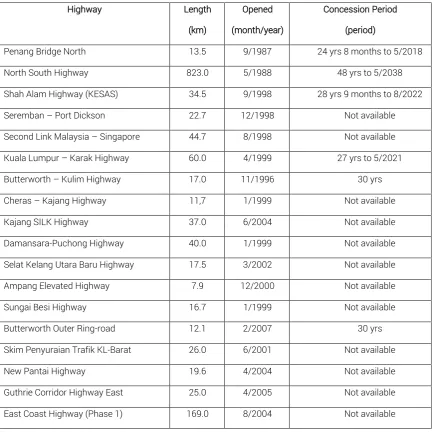
Table 2.6 – Highways Completed in Malaysia Using Privatisation... 40
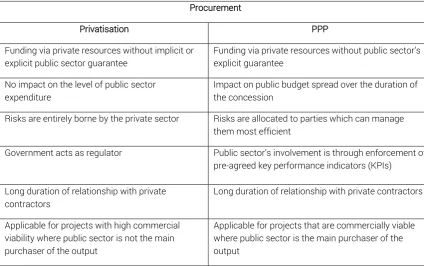
Table 2.7 – Features of PPP and Privatisation in Malaysia... 46
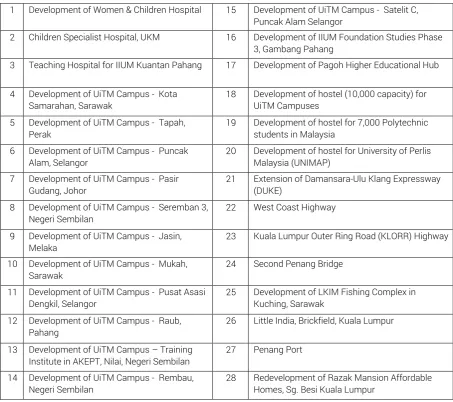
Table 2.8 – List of Major Projects ... 47
Table 2.9 – Significant Malaysian Acts and Regulations for Public Procurement ... 50
Chapter Three Table 3.10 – Comparison on Key Attributes of Four Procurement Procedures in the EU ... 64
Table 3.11 – Comparison of Procurement Processes Globally ... 71
Table 3.12 – Comparison of Evaluation Criteria From Selected Literature ... 79
Chapter Four Table 4.13 – Comparison of Assumptions Underpinning Positivism and Interpretivism .... 97
Table 4.14 – Features of Qualitative and Quantitative Approaches ... 99
Table 4.15 – Qualitative Research Strategies ... 100
Table 4.16 – Respondent Sampling ...106
Table 4.17 – Minimum Non-Probability Sample Size ...107
Table 4.18 – Research Validity and Reliability Strategies... 115
Chapter Five Table 5.19 – List of JKAS Members ... 127
Table 5.20 – List of JTAS Members ... 128
Table 5.21– Information Requested From Proposer as in Privatisation Master Plan ...130
Table 5.22 – Readiness of Industry ... 172
Chapter Six Table 6.23 – Justification for Identified Stakeholders ... 215
viii
List of Figures
Chapter One
Figure 1.1 – Research Process ... 8
Chapter Two Figure 2.2 – Level of Private Sector Involvement ... 21
Figure 2.3 – Typical PPP Structure ... 25
Figure 2.4 – Benchmark for PPP Market Maturity Curve ... 27
Figure 2.5 – PPP Market Maturity Curve ... 28
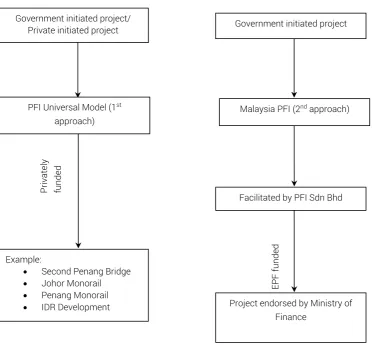
Figure 2.6 – Malaysian Approaches to PFI ... 43
Figure 2.7 – Typical PPP Structure in Malaysia ... 48
Chapter Four Figure 4.8 – The Research Onion ... 95
Figure 4.9 – Example of Data Presentation Using Nvivo 10 ... 113
Chapter Five Figure 5.10 – Process Flow in UKAS Guideline ... 121
Figure 5.11 – Stages of UKAS Procurement Process. ... 123
Figure 5.12 – Approval Process Flow Chart Part (i) ... 124
Figure 5.13 – Approval Process Flow Chart Part (ii) ... 125
Figure 5.14 – Cognitive Mapping for UKAS PPP Implementation ... 132
Figure 5.15 – UKAS PPP Status ... 133
Figure 5.16 – UKAS PPP Drivers ... 135
Figure 5.17 – Governance of UKAS Procurement Process ... 141
Figure 5.18 – Issues within UKAS Procurement Process ...150
Figure 5.19 – Cognitive Mapping for Competition ... 158
Figure 5.20 – Relevance of Competition in PPP Procurement Process ... 159
Figure 5.21 – Beyond Competition ... 162
Figure 5.22 – Procurement Procedures for Government-Initiated Proposal ... 163
Figure 5.23 – Procurement Procedures for Unsolicited Proposals ... 166
Figure 5.24 – New Economic Policy ...170
Figure 5.25 – Challenges in Incorporating Competition within the Procurement Process 176 Chapter Six Figure 6.26 – Proposed Role of Good Governance ...205
Figure 6.27 – Framework for Government-Initiated Proposals ...208
Figure 6.28 – Framework for Unsolicited Proposals ... 212
Figure 6.29 – Measures Proposed in the Framework ………..214 Figure 6.30 – Final Framework for Government-Initiated Proposals ... 219
ix
Acknowledgements
People warn that a PhD is a lonely journey. I have to refute that advice. In completing this thesis, I have been surrounded and supported by remarkable individuals/organisations whom I wish to thank. Not only does this thesis present the results of my research, it also represents complete lessons learnt, academically and in life.
I would like to thank my advisor, Dr Udayangani Kulatunga. The completion of this thesis would not have been possible without her continuous guidance, encouragement and time spent for consultation. I will always be grateful for her kindness in accepting me as her student. My appreciation also goes to my previous advisor, Professor David Eaton, who unfortunately retired for medical reasons. He has always believed in me.
In advance, I would like to thank the examination panel for their constructive criticism and insightful comments for the sake of getting the best out of me and making this thesis better. Not forgetting the faculty members at the School of the Built Environment, University of Salford for their never-ending assistance on postgraduate matters. It was a privilege to experience their professionalism and to learn from the best.
This journey would also not have been possible without the scholarship granted by the Government of Malaysia. I am indebted forever and promise to pay it forward. I would also like to acknowledge the help from friends who kindly extended their expertise and resources whenever needed. They are Hasif Rafidee, Azlin Sabtu, Amran Majid, Nurhayati Seman, Azrina Aziz, Paramanathan, Saifulnizam and Anwar Raof.
x
Declaration
This thesis is submitted as partial fulfilment for the award of Doctor of Philosophy at the University of Salford, United Kingdom and has not been previously submitted to meet requirements for an award at any higher education under my name or that of any other individuals.
Any materials previously published or written by another person(s)/organisation(s) is made reference accordingly. Part of the research findings were published in international peer-reviewed journals and as conference presentation prior to the submission of the thesis during the period of PhD study as per page xiii.
xi
Abbreviations
EPEC - European PPP Expertise Centre
ETP - Economic Transformation Programme
EU - European Union
GDP - Gross Domestic Product
JKAS - Jawatan Kerjasama Awam Swasta
JTAS - Jawatan Tertinggi Awam Swasta
NEP - New Economic Policy
NPV - Net Present Value
OECD - Organisation for Economic Co-operation and Development
PEMANDU - Performance Management and Delivery Unit
PFI - Public Finance Initiatives
PPP - Public Private Partnership
RFP - Request for Proposal
SIGMA - Support for Improvement in Governance and Management
TFEU - Treaty on the Functioning of the EU
TPPA - Trans Pacific Partnership Agreement
UKAS - Unit Kerjasama Awam Swasta
UNCITRAL - United Nations Commission on International Trade Law
UNCTAD - The United Nations Conference on Trade and Development
UNESCAP - The United Nations Economic and Social Commission for Asia and the Pacific
US - United States
WTO GPA - World Trade Organisation Agreement on General
xii
Abstract
Public Private Partnerships (PPP) have come to be preferred by governments for infrastructure development over traditional procurement. PPP is seen as the answer to many shortcomings of traditional procurement. Despite the complex nature of a PPP procurement process, governments around the world are emphasising and promoting competition within the procurement process. Competition is recognised as a significant element in the abundance of academic literature. Competition in the procurement process leads to desirable results for the procuring authority, by achieving value for money, encouraging innovation and promoting efficiency. Nevertheless, there is evidence that competition is still lacking within the PPP procurement process, so the idea of obtaining efficiency from the private sector may not be fully realised.
This thesis first examines the procurement process from the global practice, and the integration of competition within the complexity of PPP. It then focuses on analysing the less known Malaysian PPP procurement process and the competition organised within its procurement process. A case study was conducted on the Malaysian Public Private Partnership Unit, Unit Kerjasama Awam Swasta (UKAS), to investigate the manner of competition incorporated within PPP in Malaysia. UKAS is the central agency responsible for facilitating and coordinating PPP implementation in Malaysia. The case study was generated from a combination of thirteen semi-structured interviews and multiple document reviews to address the research objectives. Content analysis was adopted to examine the interview transcripts and documents. Nvivo was later used to manage the coding process.
xiii
Output and Dissemination
Articles in international peer-reviewed journals
Zawawi, M, Kulatunga, U and Thayaparan, M. 2017, 'Malaysian experience with Public Private Partnerships (PPP) – managing unsolicited proposals’, Built Environment Project and Asset Management, 6 (5), 508-520
Conference presentation
Zawawi, M,. 2015 Improving Competition within Public Private Partnership (PPP) Procurement Process: A Malaysian Case Study. Poster presentation at 12th
1
Chapter One - Introduction
1.1 Introduction
There have been rapid increases over recent years in the use of Public Private Partnerships (PPP) in place of traditional procurement. PPP can be identified as a procurement which involves cooperation between the public and private sectors to achieve a common goal (Koppenjan, 2005; Hodge & Greve, 2009; Kwak et al., 2009; Petersen, 2011a). PPP has been used by governments around the world as an alternative approach to the traditional procurement methods (Ball et al., 2000; Eaton & Akbiyikli, 2005; Grimsey & Lewis, 2005; Parker, 2009; Burger & Hawkesworth, 2011), due to the benefits gained from private sector participation: alternative financing (Ball et al., 2000; Yescombe, 2007; Dewulf et al., 2012; The World Bank, 2014); positive impact on quality and efficiency (Clive, 2003; Murphy, 2008; Son, 2012; World Bank Institute, 2012); and providing value for money (Yescombe, 2007; HM Treasury, 2008a; World Bank Institute, 2012). Despite its advantages, PPP has been the subject of numerous studies discussing whether it really is of benefit to the taxpayer and other stakeholders. Holistically, PPP has been discussed and investigated from all angles in many fields such as political science (Hayllar & Wettenhall, 2010; Gawel, 2011; Siddiquee, 2011); the law (Kalbe, 2005; Tvarnø, 2006; Burnett, 2009; Andersen et al., 2010); public administration (Brinkerhoff & Brinkerhoff, 2011; Chen et al., 2013); and accounting (Heald, 2003; Asenova & Beck, 2010).
2
companies to increase their authority in the government’s decision-making process and policy development (Whitfield, 2001).
1.2 Background of the Research
There is no shortage of definitions of PPP in the literature. It has been identified as a tool and strategy for governments around the world to procure infrastructure and services (Public Accounts Committee, 2006; Kwak et al., 2009). Generally, what differentiates PPP from other traditional forms of procurement is the single contract used for the whole development, compared to different contract arrangements for works, maintenance and operations. The bundling of works in a PPP contract explains the very long-term contract period, normally up 20 to 30 years or more (Grimsey & Lewis, 2005; Gillard, 2008; Parker, 2009; Reeves, 2013). Under PPP arrangements, governments are no longer seen as providing infrastructure to the public, but as buying services from the private sector (Eaton & Akbiyikli, 2005).
PPP encourages the involvement of the private sector in providing infrastructure to varying and increasing degrees: funding; planning; designing; and operating and maintaining the infrastructure. This is especially so in the case of private funding (Hodge, 2004), an innovation which has achieved enhanced value for money for the tax payer. Input from the private sector partner from the early stages of the project through the whole life cycle of an infrastructure development is essential to guarantee value for money. PPP and sub-procurement methods such as Private Finance Initiatives (PFI), Build Transfer Operate (BTO), Design Build Operate Maintain (DBOM) and Design Build Finance Operate (DBFO) have been successfully used by developed countries such as the UK, Australia and the US in procuring services and infrastructure (Kumaraswamy & Zhang, 2001; Siddiquee, 2011; Zhang & Chen, 2013).
3
Transformation Programme (ETP), a determined, detailed programme to improve and reform the country’s economy and ensure the transformation of Malaysia into a developed nation through certain identified sectors. Under this programme, the role of the private sector is crucial in terms of the required contributions, as well as participation in implementation of the ETP, particularly in delivering services and infrastructure to the people. An estimated 92% of the funding for the key areas identified in the ETP will be supported by the private sector with the government assisting in facilitating the delivery of public services through its regulatory actions (Prime Minister’s Department, 2011).
Malaysian experience of working with the private sector in infrastructure development began with the incorporated programme and privatisation in the 1980’s. Benefitting from the results of the successful privatisation programme in providing infrastructure, the government introduced the PFI as an enhancement to its privatisation programme. Later, it introduced PPP to continue the special relationship with the private sector experienced through privatisation and PFI. In spite of a long history of evolution of PPP in Malaysia, the current mode of PPP and its practice of competition is less understood. Existing literature on PPP activities in Malaysia focuses on the value for money of PPP (Khan et al., 2010; Ismail et al., 2011, 2012; Ismail, 2013a), risk management in PPP (Takim et al., 2009), Critical Success Factor (CSF), challenges in implementing PPP, drivers of PPP implementation (Ismail, 2013b, 2014; Ismail & Haris, 2014b) rather than the procurement process of PPP and implementation of competition mechanism in depth. Rahman et al. (2014) and Zainon et al. (2012) discussed the procurement process of Malaysian PPP, although their research was based on a review of the UK procurement process. Another recent article by Rashid et al. (2016) dedicates a sub-section to the Malaysian PPP procurement process, with the suggestion of referring to the guidelines published by the Malaysian PPP unit.
4
1.3 Rationale of Research
According to Burger and Hawkesworth (2011), there are many factors contributing to the success of PPP, one of which is competition amongst private parties. Competition is also deemed as the most important determinant to achieve value for money, apart from risk allocation (Grimsey & Lewis, 2005). They insisted that competition in PPP will lead to better value for money. Competition encourages the competing parties to be more innovative by efficiently using available resources and improving the quality of offers with the incentive of winning the concessions. In addition, competition safeguards the interest of the taxpayers (HM Treasury, 2008a). An effective competition policy in PPP also increases the propensity of attracting the private sector to invest in PPP programmes. As PPP is by its nature a long-term contract amounting to a huge amount of money, PPP is a magnet for potential misconduct of the procurement process to satisfy political or business interests. According to Amaral et al. (2009), most governments insist on competition being upheld in PPP. Without competition and transparency, PPP may be used as a mechanism to legalise the awarding of contracts or projects to a favoured company or party. Therefore the role of government is vital in ensuring and stimulating competition in the PPP procurement process (Office of Fair Trading, 2004).
Unfortunately, despite awareness of the importance of competition in PPP, Zou et al., (2008) and Kwak et al., (2009) stated that current causes of PPP failure are contributed to by the lack of competition in the procurement process. Given PPP’s huge and complex characteristics, there is evidence that competition is ignored during bidding exercises, with the result that obtaining efficiency from the private sector may not be fully realised (Pollitt et al., 2002; Bloomfield, 2003). A lack of competition within the procurement process has led to: minimal innovation (National Audit Office & Infrastructure UK, 2010); unethical decision making (Hassim, 2012); corruption (Estache & Iimi, 2008; Anderson et al., 2011); abuse of diplomatic and political power (Søreide, 2006); and failure to achieve value for money (Dudkin & Välilä, 2005; The World Bank, 2014). Based on Ireland’s experience using PPP, Reeves (2013a) listed competition as the one element that needs to be improved in order to achieve economic efficiency and the social welfare offered by PPP.
5
should be awarded in the same manner as other public procurement. Pouncey and Brown (2014) suggested that the open tender best suits a simple non-complex contract. A complex contract arrangement such as PPP might not be suitable in achieving the best competitive environment in an open tender procedure, since PPP usually involves a large-scale project (European Commission, 2003); high administration costs (Trybus, 2006); a minimum numbers of bidders to ensure that competition is intense (Shaoul et al., 2008); and the need for negotiation between parties (SIGMA, 2011).
Another ardently debated anti-competitive practice in PPP globally is the unsolicited proposal (Hodges & Dellacha, 2007; Andersen et al., 2010; Verma, 2010). In PPP, an unsolicited proposal is an attempt by a private company to submit a new idea or initiative in return for the exclusive award behind closed doors from the contracting authority. The practice of unsolicited proposals is acceptable in certain countries where it can be a source of innovation, especially where public needs go unnoticed by the government (Meyer, 2012). On the other hand, some countries have barred the practice for its anti-competitive conduct and lack of transparency (UNESCAP, 2010). There are also legal concerns about the proposal’s intellectual property rights (Søreide, 2006).
With the introduction of PPP, Malaysia is creating a private-sector led economy. The challenge faced by the government is making PPP an attractive investment opportunity in the eyes of potential investors (Economic Planning Unit, 2010). Malaysia has acknowledged the importance of greater competition to entice private investors, striving to improve current policies by removing barriers to greater competition and creating a more liberalised market (PEMANDU, 2010). Due to the Malaysian ethnicity-based affirmative-action policy which gives preferential treatment to the Bumiputera (the majority Malay ethnic group), the government has a huge task in attracting private investors to participate in PPP. The Bumiputera policy was originally developed to achieve national unity by narrowing the economic imbalance between different ethnic groups in Malaysia. This policy may be seen as a restriction on the competition exercise among existing players and potential entrants to Malaysian PPP.
6
and co-operation with the private sector by promoting PPP. Second, as little is known about the competition practice within the Malaysian PPP procurement process, the research intends to analyse global and Malaysian PPP practice and the competition incorporated within the PPP procurement process.
1.4 Aim and Objectives of the Study
The research aim is to enhance the procurement process for infrastructure delivery in Malaysian PPP by incorporating competition. Five objectives are developed to fulfil the research aim:
i. to understand and analyse the PPP procurement process with particular reference to competition;
ii. to evaluate the challenges to incorporating competition within PPP procurement process globally;
iii. to appraise and synthesise the PPP procurement process with particular reference to competition adopted by the Malaysian Government for infrastructure delivery;
iv. to investigate the relevance of competition within the PPP procurement process in Malaysia;
v. to develop and validate a competition-based PPP framework which targets improvement for Malaysian PPP.
1.5 Scope of the Research
7
responsibilities in serving community interests, such as educational, healthcare, social and welfare facilities (Inderst, 2010).
Various sub-procurement of PPP have been adopted around the world (see section 2.3). This study does not intend to cover each of these sub-procurements. Nevertheless, since the development of PPP is linked to privatisation and PFI, these elements are emphasised. Given the claim of lack of competition within the procurement process, this research seeks to study the competition element within the PPP procurement process, both globally and in the context of Malaysia’s infrastructure delivery.
1.6 Research Process
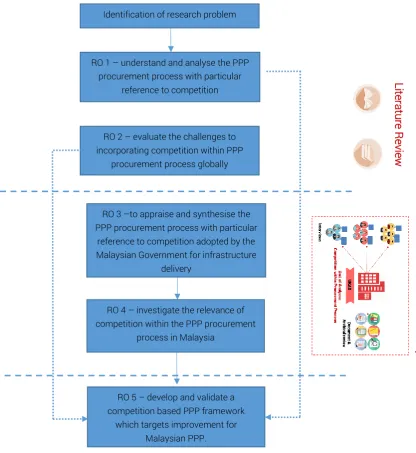
To achieve the aims and objectives of this research is challenging. To satisfy the objectives, a qualitative paradigm is adopted to focus on understanding the practice globally and to discover the Malaysian practice by drawing on the experience of involved individuals. The research is divided into several stages: the literature review, case study and framework development. These stages are illustrated in Figure 1.1. The literature review comprehensively examines the concept of PPP and leads to identification of the research problem. In particular, it appraises the concept of competition and its relevance within PPP, to address research objectives 1 and 2 outlined in section 1.4.
8
Figure 1.1 – Research Process
1.7 Significance of the Research
Since the use of PPP in the early days (from privatisation to PFI), Malaysia has benefited economically and socially. The government declared the privatisation programme a success, having implemented 698 PPP projects from initiation until December 2014. Since
RO 1 – understand and analyse the PPP procurement process with particular
reference to competition
RO 3 –to appraise and synthesise the PPP procurement process with particular
reference to competition adopted by the Malaysian Government for infrastructure
delivery
RO 4 – investigate the relevance of competition within the PPP procurement
process in Malaysia
RO 5 – develop and validate a competition based PPP framework
which targets improvement for Malaysian PPP. Identification of research problem
RO 1 – analyse PPP procurement process globally and with particular
reference to competition
Literature Review
RO 2 – evaluate the challenges to advocate competition within PPP procurement processes globally RO 2 – evaluate the challenges to incorporating competition within PPP
procurement process globally
Lit
era
tur
e R
9
privatisation, the government managed to save £37.81 billion of capital expenditure and £1.8 billion of government operating expenditure (Hamsa, 2015).
Nevertheless, the good reputation of PPP programmes has been smeared by critiques and allegations. Post-privatisation saw allegations that the concessionaire companies were making supra-profits from the government over a prolonged period, due to the lopsided nature of the agreement. There have also been allegations of abuse of power by the ruling government with a lack of competitive bidding in awarding contracts (Jomo and Syn, 2003; Tan, 2008; Wang et al., 2012). These allegations might deter private investors from participating in PPP programmes.
PPP must be seen as an attractive investment opportunity rather than merely a project to the private sector. Outcomes of the research may be used to indicate continuous effort by the government for good governance of public procurement and to suggest improvements to the current system if necessary. Further contributions of the research are presented in section 7.3.
1.8 Structure of the Thesis
This research is structured in seven chapters.
Chapter 1 introduces the research. The nature of the research is explained through an overview of the background, the research problem, and the aim and objectives. The content of this chapter guides the reader in understanding the progress of the research.
Chapter 2 presents the findings of the literature review on PPP, including the practice of PPP and the diversity offered by the procurement globally. The chapter also looks at the evolution of PPP in the UK, which has been identified as the most advance practitioner. The background and evolution of PPP in Malaysia is then examined, proving to be similar to that in the UK.
Chapter 3 is a literature review of the main subject of this study, concentrating on the best practice of competition within the PPP procurement process. The success of the European Union (EU) in organising competition within the procurement process among the many member states is highly regarded and is studied further in this chapter. The challenges faced by PPP practitioners in advocating competition within the PPP procurement process
10
are also investigated. The chapter ends with an overview of the Malaysian practice, as recorded in the literature.
Chapter 4 explains the research methodology. It discusses the selection of the philosophy, research strategy, data collection methods, data analysis and relevant instruments that facilitate meeting the aim and objectives of the research. The chapter also discusses the case study design and procedures.
Chapter 5 presents the outcome of the case study, comprising the findings from the document review and extracts from the interviews. The text from the interviews was analysed using content analysis, with the focus on discovering and understanding the Malaysian PPP practice, in particular the procurement process and competition.
Chapter 6 discusses the case study. It provides in-depth discussion of the data analysed which gives valuable meaning to the findings. Within the Malaysia context, competition within the procurement process is demonstrated as vital in achieving benefits in addition to economic ones. The chapter presents the proposed frameworks which address the aim and objectives of the research, and ends by describing the validation of the frameworks.
11
Chapter Two
-
Literature Review: Public Private Partnership (PPP)
2.1 Introduction
PPP has become a trend worldwide for governments to procure services and infrastructure, and there is no sign that the trend is going to stop soon. This is reflected by the continuing use of PPP today. This chapter reviews the essential literature that forms the foundation of this research. The research context and focus are provided for clarity. Referring to both scholarly articles and government publication as main sources, the literature review is divided into two main themes: PPP (Chapter 2) and competition (Chapter 3).
This chapter commences with an overview of the concept and practice of PPP globally. It includes discussion of PPP’s characteristics, reasons to employ PPP and the benchmarking of PPP practice. It focuses on the history and progress of PPP in the UK, identified as the pioneer of PPP in the modern world and currently a leader in its practice, and then evaluates the initiation and progress of PPP in Malaysia. Although PPP implementation in Malaysia is still in its infancy, the country has a long history of working with the private sector to develop the nation. The chapter ends with a summary of findings.
2.2 Understanding PPP
Thirty years ago, there was great excitement over a new procurement. Although three decades may seem like a long time, the pioneer PPP ventures are now on the verge of contractual expiry, as most PPP agreements were designed to be long term, from 25 to 30 years (Tvarnø, 2006; KPMG International, 2007; Hall, 2008; HM Treasury, 2008a; United Nations, 2008; Chinyio et al., 2009; Chong & Callender, 2009; Takim et al., 2009; Cheung et al., 2012).
12
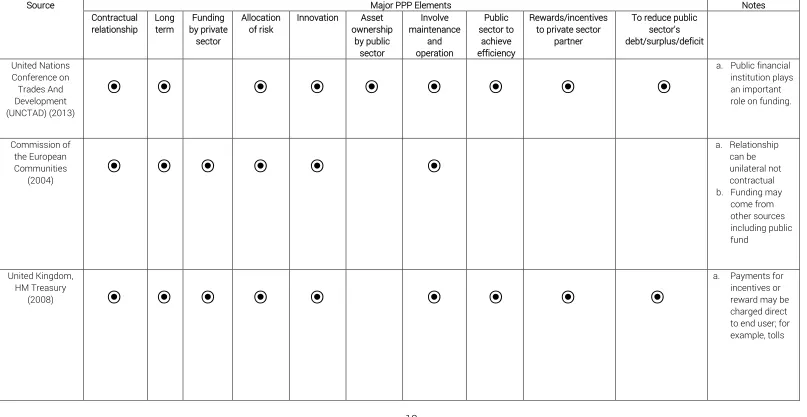
Despite the fact that it has been around in its present form for 30 years, there is still no single agreed legal definition of PPP (European Commission, 2003; PriceWaterhouseCoopers, 2005; Public Accounts Committee, 2006; Chinyio et al., 2009; Andersen et al., 2010; Wang et al., 2012; World Bank Institute, 2012; UNCTAD, 2013). With different types of PPP arrangements, a possible explanation for this diversity is that every nation has tailored the concept of PPP to suit its own needs and complexities. Therefore, as suggested by Perry (1998), this research examined common global elements of PPP approaches in developed and developing countries by contracting authorities. Perry (1998) also warned that definitions by other researchers might be influenced by trivial personal beliefs. Table 2.1 illustrates salient common characteristics of PPP. Although there is no unified definition of PPP, Table 2.1 highlights common elements that are exploited by government organisations and agencies in approaching PPP. Under the rubric of PPP, the majority of organisations emphasise the synergy of bundling elements of PPP which include the maintenance and operation of infrastructure, long-term contracts and risk allocation. The key distinct features of PPP, as opposed to conventional procurement, are the distribution of significant risks and responsibilities of parties, ownership and the conceptualisation of the built asset and the source of project finance/funding (Burger & Hawkesworth, 2011). In PPP, the private sector partner’s role is enhanced and is more actively involved in all the stages from planning and development up to maintenance of the completed facility. In addition, due to the bundling of contractual arrangements for the services in all of these stages, PPP is more complex than conventional procurement.
13
Table 2.1 –Global Common Elements of PPP
Source Major PPP Elements Notes
Contractual
relationship Long term by private Funding sector
Allocation
of risk Innovation ownership Asset by public sector Involve maintenance and operation Public sector to achieve efficiency Rewards/incentives to private sector
partner
To reduce public sector's debt/surplus/deficit United Nations Conference on Trades And Development (UNCTAD) (2013)
๏
๏
๏
๏
๏
๏
๏
๏
๏
a. Public financialinstitution plays an important role on funding.
Commission of the European Communities
(2004)
๏
๏
๏
๏
๏
๏
a. Relationship can be unilateral not contractual
b. Funding may
come from other sources including public fund United Kingdom, HM Treasury
(2008)
๏
๏
๏
๏
๏
๏
๏
๏
๏
a. Payments for
14
Source Major PPP Elements Notes
Contractual
relationship Long term by private Funding sector
Allocation
of risk Innovation ownership Asset by public sector Involve maintenance and operation Public sector to achieve efficiency Rewards/incentives to private sector
partner
To reduce public sector's debt/surplus/deficit
Meyer (2012) – The National Council of
Public-Private Partnerships
๏
๏
๏
๏
๏
๏
๏
๏
๏
๏
a. Faster projectdelivery
Hawkesworth & Marcel, (2011) - Organisation for Economic Co-operation and Development
(OECD)
๏
๏
๏
๏
๏
๏
๏
a. Rewards in theform of profit b. Ownership depends on model Fiscal Affairs Department International Monetary Fund (IMF) (2004)
๏
๏
๏
๏
๏
๏
๏
๏
๏
a. Acknowledges15
Source Major PPP Elements Notes
Contractual
relationship Long term by private Funding sector
Allocation
of risk Innovation ownership Asset by public sector Involve maintenance and operation Public sector to achieve efficiency Rewards/incentives to private sector
partner
To reduce public sector's debt/surplus/deficit Public-Private Partnership Unit (UKAS) Malaysia (2009)
๏
๏
๏
๏
๏
๏
๏
๏
a. Payments forincentives or reward may be a charge direct to end user
Felsinger & Miranda, (2008) –
Asian Development
Bank (ADB)
๏
๏
๏
๏
๏
๏
๏
๏
a. Acknowledgesrelationship but does not mention contractual b. Acknowledges private funding as private investment
c. Rewards in the
form of profit
European Commission (EC)
(2003)
๏
๏
๏
๏
๏
๏
๏
๏
๏
๏
Ministry of Finance
Singapore, (2012)
๏
๏
๏
๏
๏
๏
a. Acknowledges
16
Source Major PPP Elements Notes
Contractual
relationship Long term by private Funding sector
Allocation
of risk Innovation ownership Asset by public
sector
Involve maintenance
and operation
Public sector to
achieve efficiency
Rewards/incentives to private sector
partner
To reduce public sector's debt/surplus/deficit
European PPP Expertise Centre
(EPEC), (2011)
๏
๏
๏
๏
๏
a. Payments for
incentives or reward may be charged direct to end user
Infrastructure
Australia, (2008)
๏
๏
๏
๏
๏
๏
a. Receive
17
2.3 Partnership Arrangement in PPP
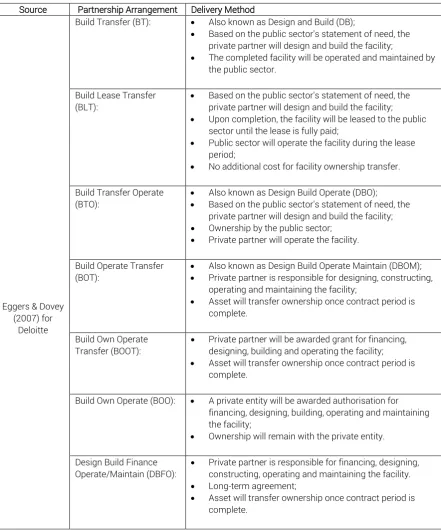
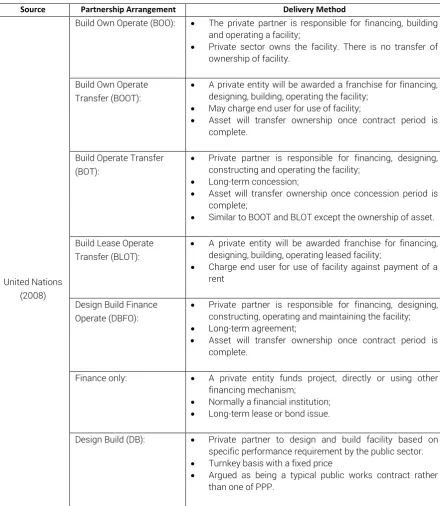
Contrary to the traditional role of the government in providing infrastructure for the people, the role has in some ways been shifted to the private sector in the form of PPP. In PPP, the public sector or the government is purely the purchaser of a service provided by the private sector. This change of role was initially driven by governments trying to reduce their fiscal debt level and spending, thus leading them to utilise private sector funding in the form of capital investment (Adair et al., 2011). Furthermore, the private sector is seen as being able to deliver things efficiently in order to achieve returns as a business (Alexandersson & Hultén, 2006; Boles et al., 2013). In return, the private sector receives return from leasing payments of the built infrastructure or direct payment from the user; for example, toll charges.
18
Table 2.2 – Types of Partnership Agreement
Source Partnership Arrangement Delivery Method
Eggers & Dovey (2007) for
Deloitte
Build Transfer (BT): Also known as Design and Build (DB);
Based on the public sector's statement of need, the
private partner will design and build the facility;
The completed facility will be operated and maintained by
the public sector.
Build Lease Transfer (BLT):
Based on the public sector's statement of need, the
private partner will design and build the facility; Upon completion, the facility will be leased to the public
sector until the lease is fully paid;
Public sector will operate the facility during the lease period;
No additional cost for facility ownership transfer.
Build Transfer Operate (BTO):
Also known as Design Build Operate (DBO);
Based on the public sector's statement of need, the
private partner will design and build the facility;
Ownership by the public sector;
Private partner will operate the facility.
Build Operate Transfer (BOT):
Also known as Design Build Operate Maintain (DBOM);
Private partner is responsible for designing, constructing, operating and maintaining the facility;
Asset will transfer ownership once contract period is complete.
Build Own Operate Transfer (BOOT):
Private partner will be awarded grant for financing, designing, building and operating the facility; Asset will transfer ownership once contract period is
complete.
Build Own Operate (BOO): A private entity will be awarded authorisation for
financing, designing, building, operating and maintaining the facility;
Ownership will remain with the private entity.
Design Build Finance Operate/Maintain (DBFO):
Private partner is responsible for financing, designing, constructing, operating and maintaining the facility.
Long-term agreement;
19
Table 2.2 (continued) - Types of Partnership Agreement
Source Partnership Arrangement Delivery Method
United Nations (2008)
Build Own Operate (BOO): The private partner is responsible for financing, building and operating a facility;
Private sector owns the facility. There is no transfer of ownership of facility.
Build Own Operate Transfer (BOOT):
A private entity will be awarded a franchise for financing, designing, building, operating the facility;
May charge end user for use of facility;
Asset will transfer ownership once contract period is complete.
Build Operate Transfer (BOT):
Private partner is responsible for financing, designing, constructing and operating the facility;
Long-term concession;
Asset will transfer ownership once concession period is complete;
Similar to BOOT and BLOT except the ownership of asset.
Build Lease Operate Transfer (BLOT):
A private entity will be awarded franchise for financing, designing, building, operating leased facility;
Charge end user for use of facility against payment of a
rent
Design Build Finance Operate (DBFO):
Private partner is responsible for financing, designing, constructing, operating and maintaining the facility;
Long-term agreement;
Asset will transfer ownership once contract period is complete.
Finance only: A private entity funds project, directly or using other
financing mechanism;
Normally a financial institution;
Long-term lease or bond issue.
Design Build (DB): Private partner to design and build facility based on
specific performance requirement by the public sector.
Turnkey basis with a fixed price
Argued as being a typical public works contract rather than one of PPP.
[image:34.595.104.545.94.601.2]20
Table 2.2 (continued) - Types of Partnership Agreement
Source Partnership Arrangement Delivery Method
Fiscal Affairs Department International Monetary Fund
(IMF) (2004)
Build Own Operate (BOO):
Private partner to design, build, own, develop, operate and manage facility based on specific performance requirement by the public sector;
No obligation to transfer ownership to public sector;
Variant of Design Build Finance Operate (DBFO)
Build Develop Operate (BDO):
Design Construct Manage Finance (DCMF):
Buy Build Operate (BBO): Private sector to buy/lease an existing facility from public sector;
Facility will be upgraded; Private sector will operate;
No obligation to transfer ownership to public sector. Lease Develop Operate
(LDO):
Wrap Around Addition (WAA):
Build Operate Transfer (BOT):
Private partner to design, build and operate facility; Transfers ownership of facility once contract period over; Private partner may rent or lease the facility from the
public sector. Build Own Operate
Transfer (BOOT):
Build Rent Operate Transfer (BROT): Build Lease Operate Transfer (BLOT):
Build Transfer Operate (BTO):
21
PPP, PFI involves the public sector as a service purchaser from the private sector for a specified time, usually long term with pre-set payment mechanisms (Eaton & Akbiyikli, 2005). PFI is also seen as a financial scheme where private investment replaces traditional funding of traditional construction procurements by the public sector (HM Treasury, 2003). Others may debate whether PPP and PFI are two different items; however, in this research, PFI’s role as an important foundation for the creation of PPP is acknowledged. However, the research will focus on PPP and will not be used interchangeably with PFI, since according to Eaton and Akbiyikli (2005) PFI is a sub-set of PPP. In line with the definition embraced by this research in an earlier chapter, this research agrees that Design Build Finance Operate (DBFO) largely mirrors PPP as the arrangements require the private sector to design, develop, finance, maintain and operate the infrastructure over a prolonged period, in consideration of payment by the public sector or end user for the service provided. Figure 2.2 shows selected partnership arrangements with the level of private sector involvement to illustrate the changes in the public sector role under PPP.
Low Private Sector Involvement High
Figure 2.2 – Level of Private Sector Involvement
Source: Kwak, Chih, & Ibbs, (2009)
Referring to Figure 2.2, PPP has indeed changed the public procurement paradigm, encouraging the involvement of the private sector in providing infrastructure to varying degrees. Within PPP, the involvement of the private sector in funding, planning, designing, operating and maintaining an infrastructure has increased.
2.4 Distinctive Diversity of PPP
So why did governments shift to PPP? Many publications have discussed governments’ motivations, whether right or wrong, for adopting PPP (McQuaid & Scherrer, 2010). The
Build Operate Transfer Design
Build Operate
Build Own Operate Design Build
Finance Operate Operation and
Maintenance
22
diverse features of PPP compared with traditional procurement have been recognised through theoretical research and actual case studies. Nonetheless, PPP has been designed to accommodate and allocate the needs of the public sector and the rewards for the private sector partner (European Commission, 2004; Chinyio et al., 2009; Ministry of Finance Singapore, 2012). The motivation for PPP is therefore driven by the diversity offered by this type of procurement.
2.4.1 Optimal Sharing of Responsibilities, Resources & Risk (3R)
An essential objective of public procurement is to achieve efficiency (Akbiyikli et al., 2012). Enhanced efficiency could lead to further remuneration and profitable returns. In a competitive and profit-oriented environment, unlike the public sector the private sector works to obtain profit. Private sector entities are more creative and innovative in their approach to a task with less wastage of resources (Bovis, 2013). Hence, forming partnerships with the private sector increases efficiency by means of distributing responsibilities and risks to the most capable party.
23
Demirag et al. (2011) identify four categories of risk that have to be dealt with in a PPP project: design and development; finance; operation; and ownership. The magnitude of the risks varies during different stages of PPP development. These risks should be allocated between the partners. Although there are no standard rules for distributing the risks, empirical approaches to risk allocation have been developed by various researchers to identify which party is best able to manage them (Bing et al., 2005; Wibowo & Alfen, 2013). The identification and allocation of potential risks is fundamental to realising the value for money achieved from PPP (Bing et al., 2005). Well equipped with advanced technology, management skills and construction ability, the private sector is seen as more capable in managing most of the risk and uncertainties. However, the public sector should be aware that shifting risk substantially to the private sector is not cheap (Dewatripont & Legros, 2005).
2.4.2 Maximising Value for Public Stakeholders
In an era where cash is king and time is gold, the public currently demands better value for money from public procurement. PPP offers the public sector an opportunity to deliver value for money better than by conventional procurement for its stakeholders (Chinyio et al., 2009). Value for the public stakeholders can be in different capacities. Nonetheless, PPP has constantly been associated with value for money.
There are many definitions of value for money. Jomo et al. (2016) emphasise that value for money in the PPP context should refer to the cost and quality of the service obtained. As the cost of PPP is higher than for traditional procurement, the quality received should be at par. Heald (2003) proposed that value for money is built around efficiency and effectiveness. HM Treasury (2003) goes further, describing value for money as the optimum combination of whole-life cost and quality (or fitness for purpose) to meet the user requirement. This view is similar to that of Burger and Hawkesworth (2011) who characterise value for money as an
optimal combination of quantity, quality, features and price expected over the whole of the
project’s lifetime. In other words, value for money can be seen as the expectation of a buyer or stakeholders of the quality of the purchased product at the best price. Although expectations may differ based on the partnership agreements and consideration of many other factors, according to Infrastructure Australia (2008) PPP offers value for money through:
24
c) Encouraging innovation; d) Efficient asset utilisation;
e) Integrated life cycle asset management.
Most countries use value for money to justify PPP adoption with the concept of acquiring a better quality product with an economical design and cost-effective operation and maintenance, compared to the traditional procurement. PPP promotes early involvement of the private sector in the procurement process as a strategy to allow the private sector partner to utilise its proficiency in designing the whole life cycle of the infrastructure into a potential cost-saving development. This move also helps to minimise design risk and uncertainties (Felsinger & Miranda, 2008). This will lead to the creation of incentives for the private sector. Different approaches to ensure value for money have been adopted by countries. Grimsey and Lewis (2005) identified that these approaches nevertheless share similarities when comparing two procurements measured by the lowest cost offered. A common tool used globally is the Public Sector Comparator (PSC), where a comparison of cost is made between a traditional public financed procurement and a privately financed PPP (Ismail et al., 2012; Wang et al., 2012).
2.5 PPP Structure
25
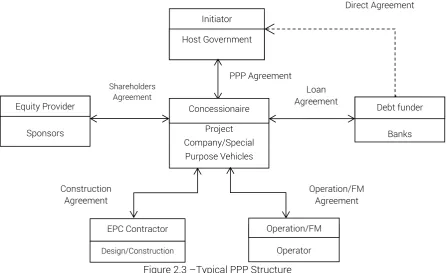
infrastructure development, and after completion an operation and maintenance contract will be formed to carry out the operation and maintenance work for a specified time. A typical PPP structure is illustrated as Figure 2.3.
[image:40.595.95.543.141.414.2]
Figure 2.3 –Typical PPP Structure
Source: World Bank Institute (2012)
As shown in Figure 2.3, the role of the Special Purpose Vehicles does not end there, but will normally, under the PPP agreement, be required to secure finance for the development and enter an agreement with the financial institution (Grimsey & Lewis, 2007; Yescombe, 2007). The financing of the project may be from mixed sources, single sourced from loans, in the form of investment from a private equity firm, or be a combination of different private equity firms that also be shareholders. Although receiving a much criticism in some countries, there are also facilitation funds or viability funds made available by the governments to attract the private investor’s participation in PPP and to kick-start the project (Aziz & Khaderi, 2010; Department of Economic Affairs, 2010; Wang et al., 2012; Yee, 2013).
Although most of the significant responsibilities and risks are transferred to the Special Purpose Vehicle, the public sector as a purchaser still plays a critical role in providing and specifying clear requirements and output specifications for the infrastructure. However, the Special Purpose Vehicle should be given freedom in the delivery method to allow innovation and cost minimisation to happen. The public sector as the purchaser should also sustain a payment regime to the Special Purpose Vehicle as specified in the PPP agreement. Although
Direct Agreement Initiator
Host Government
PPP Agreement
Loan Agreement
Shareholders Agreement
Sponsors Equity Provider
Banks Debt funder
Project Company/Special
Purpose Vehicles Concessionaire
Construction
Agreement Operation/FM Agreement
Operator Operation/FM EPC Contractor
26
PPP relies heavily on the efficiency of the private sector, it is fundamental for the PPP to be well structured with clear obligations and rights of parties to create a mutually beneficial environment for all parties involved.
2.6 PPP Globally
The estimated cost needed for infrastructure development globally is massive. An approximate amount estimated by EY (2015) to meet the infrastructure demand until 2030 can reach up to £38.6 trillion2. An estimated amount of £500 billion is needed by the UK until the year 2020 for infrastructure development (Helm et al., 2009), while the Asian Development Bank (2012) forecast that investment of £6.3 trillion is needed in the Asian region between 2010 to 2020 for infrastructure development. The amounts forecast for providing infrastructure are daunting for governments to provide.
With the shortfall in government reserves worldwide, PPP has been identified as the future direction to address the burgeoning infrastructure demand. PPP procurement is well established in most developed countries and has been widely used to procure infrastructure. Encouraged by these fruitful results of PPP, the enthusiasm of developing countries in procuring infrastructure services through PPP has grown (Cheung et al., 2012; Ng et al., 2012; Hwang et al., 2013; Reeves, 2013a)
Eggers and Dovey (2007) introduced the PPP market maturity curve, which is a model used to identify a nation’s PPP growth, based on nine criteria:
i. Awareness of risk transfer principles; ii. Public sector PPP experience;
iii. Private sector PPP experience; iv. Community and stakeholder support; v. Market size;
vi. Stable and supportive public sector environment; vii. Available funding;
viii. Recognising and achieving outcomes and innovation; ix. Legal framework and commercial structures.
27
In detail, a country’s growth will be evaluated against the benchmarks, complexity and accomplishments achieved using PPP. Although each country has its own template for developing the PPP market, with this model it can be evaluated based on the same parameters for private investors and as an indicator for other stakeholders.
Figure 2.4 - Benchmark for PPP Market Maturity Curve
Source: Eggers & Dovey (2007) for Deloitte
According to the standards set in the PPP market maturity curve (Figure 2.4), the growth of the PPP market in the UK has achieved the highest level of maturity with PPP practice widespread in every available industry, and steady availability of finance for PPP projects. The UK is a step ahead in procuring infrastructure through PPP. It has developed a strong institutional framework, a robust project pipeline and is supported by market confidence (EY, 2015)
Stage One
• Establish policy & legislative framework;
• Initiate central PPP policy unit to guide implementation;
• Develop deal structures;
• Get transactions right & develop public sector comparator model;
• Begin to build marketplace;
• Apply early lessons from transport to other sectors.
Stage Two
• Establish dedicated PPP units in agencies;
• Begin developing new hybrid delivery models;
• Expand and help shape PPP marketplace;
• Leverage new sources of funds from capital markets;
• Use PPPs to drive service innovation;
• PPP market gains depth—use is expanded to multiple projects & sectors.
Stage Three
• Refine new innovative models;
• More creative, flexible
approaches applied to roles of public & private sector;
• Use of more sophisticated risk models;
• Greater focus on total lifecycle of project;
• Sophisticated infrastructure market with pension funds & private equity funds;
• Public sector learns from private partner methods as competition changes the way government operations function;
• Underutilized assets leveraged into financial asset;
28
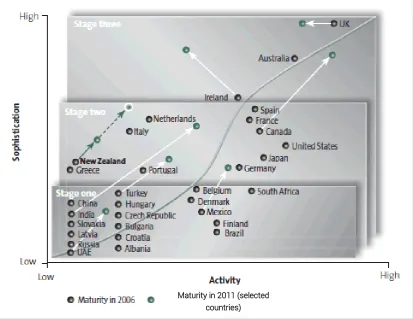
Figure 2.5 - PPP Market Maturity Curve
Source: Modified from Deloitte in Controller and Auditor General (2011)
Based on Figure 2.5, very few countries are identified as having reached stage three of potential PPP market maturity. Top of the list is the UK. Following the UK is Canada, which made substantial progress from 2006 to 2011, with Australia and Ireland trailing. According to the EY (ibid) report, the Canadian government provides a funding programme and financial mechanism to assist the viability of large infrastructure development. Through its PPP programme, Canada is anticipated to save a significant amount of money (Asia-Pacific Economic Cooperation, 2014). The government of Australia’s strong dedication made its PPP programme consistently joint world leader with the UK. An earlier OECD (2007) report even listed Australia as the most advanced PPP practitioner, ahead of the UK and Canada. The countries listed at stage three have leveraged significant numbers of infrastructure through PPP, attracting interest from domestic and international investors. At stage two, most of the countries are from Europe, plus the US, Japan and New Zealand.
29
2.7 PPP Law
According to Burger and Hawkesworth (2011), PPP implementation in most countries is governed by existing legislation and the regulations for conventional public procurement. However some countries, including Spain, Ireland and South Korea, have established a different set of laws specifically for PPP (CMS Legal Services EEIG, 2010; PPIAF, 2012). A sound legal framework helps to facilitate the PPP mechanism, supports the PPP programme consistently, provides better enforcement of PPP policy and promotes PPP partnership (Dutz et al., 2006; Eggers & Dovey, 2007). Consistent specific legislation will also improve the understanding and interpretation between PPP stakeholders, resulting in efficient PPP implementation (Adair et al., 2011). Although most public procurement legislation has stipulations on competition, the competition policy as applied in such public procurement may not be adequate for PPP (Verma, 2010). For example, how do public procurement laws deal with unsolicited proposals?
At stage one of the PPP market maturity curve (section 2.6), a country should develop its own PPP laws and establish a legal framework dedicated to supporting PPP implementation. Since PPP is a complex procurement process which involves: multiple dynamic activities, long-term contractual obligations and large contract sums, some current legislation might not be suitable or adequate for a PPP programme (United Nations, 2008). Suggested legislation pertaining to procurement, financial/budgetary considerations, competition and contract requirements might need to be reviewed or specifically set up for PPP. Specific legislation and regulations for PPP are recommended to define PPP and its arrangement, hence maintaining a consistent legislative framework. According to Verhoest et al. (2015), a specialised PPP law and regulatory framework is a form of government support for the PPP programme.