Artificial reproduction of neotropical fish: Extrusion
or natural spawning?
David Augusto Reynalte-Tataje¹*, Carolina Antonieta Lopes¹, Sunshine de Ávila-Simas¹, Juan Ramon Esquivel Garcia², Evoy Zaniboni-Filho1,3
1
Departamento de Aquicultura, Laboratório de Biologia e Cultivo de Peixes de Água Doce, Universidade Federal de Santa Catarina, Centro de Ciências Agrárias, Florianópolis, Brazil; *Corresponding Author: [email protected]
2
Estação de Piscicultura Panamá, Paulo Lopes, Brazil 3
Programa de Pós-Graduação em Aquicultura, Departamento de Aquicultura, Universidade Federal de Santa Catarina, Centro de Ciências Agrárias, Florianópolis, Brazil
Received 5 June 2012; revised 5 July 2013; accepted 12 July 2013
Copyright © 2013 David Augusto Reynalte-Tataje et al. This is an open access article distributed under the Creative Commons At-tribution License, which permits unrestricted use, disAt-tribution, and reproduction in any medium, provided the original work is prop-erly cited.
ABSTRACT
In captive conditions, most neotropical migra- tory species do not have the necessary incen- tive to complete gonadal maturation and spawn- ing, which require induction techniques, usually with the use of hormones. Numerous studies have therefore focused on finding an effective hormonal treatment to induce reproduction for each species. A standard treatment was suc- cessfully developed for most of these species, which consists of two doses of Carp Pituitary Extract (CPE), totaling 5.5 mgCPE/kg of fish. However, the best strategy for the subsequent fertilization of gametes is still unclear. This stu- dy was conducted with five species of com- mercial interest that do not reproduce naturally in captivity: pacu Piaractus mesopotamicus,
piracanjuba Brycon orbignyanus, curimbatá Prochilodus lineatus, dourado Salminus brasil- iensis and piauçu Leporinus macrocephalus.
Ninety-nine broodstocks were used, consisting of males and females of the five species to compare two techniques for spawning and fer- tilization: extrusion followed by the dry method and natural spawning. All fish were induced with two hormone doses, i.e., 0.5 and 5.0 mgCPE/kg, and were subjected to one of the two types of fertilization. The results were compared using the fertilization rate, number of oocytes pro- duced, relative fecundity and the broodstocks' survival rate on days following spawning. All species responded positively to spawning for extrusion, and only S. brasiliensis did not spawn
through the natural spawning method. The natural spawning technique provided a higher fertilization rate of eggs and a greater brood- stock survival rate (P < 0.05) for all species, ex- cept S. brasiliensis. It was concluded that the natural spawning technique can increase the production of viable eggs and reduce the mor- tality of species during breeding, except for S.
brasiliensis.
Keywords: Induced Breeding; Spawning; Fish Farming; Broodstocks; Induction Techniques
1. INTRODUCTION
Currently, the formation of wild fish broodstocks that have adequate genetic variability is hampered due to a number of factors, such as pollution, deforestation and dam construction, which are promoting the reduction of natural stocks and, in some situations, the extinction of neotropical fishes’ large-sized stocks. Accordingly, the maintenance and survival of broodstocks in hatchery stations, government research agencies and private re-search are considered of great importance [1]. However, several causes of broodstock mortality have not yet been overcome in the traditional management protocols to produce fingerlings of neotropical species; one of these is the absence of induction techniques for reproduction, which allows a high production of offspring without the high risk broodstock sacrifice.
total length, absolute fecundity, perivitelline space, as well as low values of hydrated egg diameter and duration of embryogenesis. Conversely, because these species cannot breed in captivity, numerous studies have been performed to develop hormonal induction techniques that promote their final maturation and spawning.
In South America, most procedures for induced spaw- ning use the extrusion technique to strip the gametes, followed by the dry method for fertilization. This proce- dure is traditional and widespread in the reproducetive sector. However, recent studies with neotropical fish spe-cies have demonstrated that natural spawning, which has no human interference during gamete release, reduces fish mortality and increases the egg fertilization rate [3].
The present study aims to compare results obtained through traditional spawning with those obtained through natural spawning for five neotropical species of com- mercial importance.
2. MATERIALS AND METHODS
2.1. Execution PlaceThis study was conducted at the Panamá fish hatchery, located in the city of Paulo Lopes, and at Estação Pis-cicultura São Carlos, located in the city of São Carlos; both sites are in the state of Santa Catarina (Brazil). The data was analyzed and processed at the Laboratório de Biologia e Cultivo de Peixes de Água Doce (LAPAD) in Universidade Federal de Santa Catarina.
2.2. Broodstocks Selection
[image:2.595.57.287.573.735.2]A total of 99 broodstocks were used, consisting males and females of five species. These fish were kept in tanks on land with an area between 800 and 2000 m2. The broodstock selection was based on the external charac- teristics of gonadal maturation described by Woy- narovich and Horváth [4] (Table 1).
Table 1. Total broodstocks used for each species with the age (years) and weight (grams) listed.
Species Total
broodstocks
Broodstocks number
Age
(years) Weight (g)
Female Male
Brycon
orbignyanus 15 5 10 4 1.100 - 2.200
Leporinus
macrocephalus 24 12 12 3 800 - 1.200
Piaractus
mesopotamicus 18 6 12 2 - 4 1.400 - 3.600
Prochilodus
lineatus 18 6 12 1 - 4 900 - 3.200
Salminus
brasiliensis 24 8 16 2 - 4 1.600 - 4300
After selection, broodstocks were sexed and placed in tanks of 1000-liters with an open water system, where they remained until the hormonal induction.
2.3. Hormonal Induction
Carp Pituitary Extract (CPE) was used because it is the hormone most often used by the productive sector. For hormonal application, broodstocks were removed from the tank with the help of a net, placed in plastic bags and weighed. Finally the fish were intraperitoneally injected with two hormone doses (0.5 mgCPE/kg and 5.0 mg- CPE/kg) at intervals of 12 hours between doses, as rec- ommended by Woynarovich and Horváth [4].
2.4. Spawning Technique
2.4.1. Natural Spawning
After the second hormone dose, males and females were grouped in (2:1) ratios, except for L. macrocepha- lus, which was maintained at a ratio of (1:1) in 1000-liter tanks. The tanks were partially covered to prevent fish stress. The fish were under constant observation to evalu- ate behavior and note the spawning time. Spawning al- ways occurred after two or three fish maintained a syn- chronized swimming and their bodies became close and laterally aligned. In the P. lineatus and L. macrocephalus species, the emission of sounds by males during spawn- ing was observed. After spawning, the eggs were re- moved with a plastic bucket that had a mesh retention of 0.5 mm to concentrate the eggs. This bucket was in- stalled at the outlet of the water tank, and the eggs were taken to the incubator. During transfer, a 500-mL beaker was used to measure the eggs by decanting the eggs into the beaker and measuring the volume marked. The num- ber of eggs per milliliter was determined by collecting four 3-mL samples of fully hydrated eggs from the bucket retainer using a 10-mL pipette; the samples were then counted on a petri plate [5]. This counting was con- ducted for each spawning.
2.4.2. Dry Method (Spawning for Extrusion)
and fixed in 4% buffered formaldehyde solution for later quantification. During reproduction, the water tempera- ture remained between 24.0˚C and 27.5˚C, the pH be- tween 6.5 and 8.2 and the dissolved oxygen between 5.6 and 9.8 mg/L. The experimental design is shown in
Table 2.
2.5. Degree-Hour
The time interval between the last decisive application and ovulation was calculated using degree-hours, which consists of multiplying the elapsed time between the last hormone injection and multiplying the spawning by the mean water temperature during this period, which is recommended by Woynarovich and Horváth [4].
2.6. Fertilization Rate
The fertilization rate was calculated nine hours after fertilization by analyzing 260 eggs per incubator, ac- cording to the recommendations of Zaniboni-Filho and Barbosa [7], by observing the eggs using a stereoscopic microscope at 10 x. The total number of eggs produced per broodstock weight was calculated by standardizing the values of the total number.
2.7. Relative Fecundity
The relative fecundity rate was quantified for the total number of eggs produced, and this value was divided by the total weight of the fish. This calculation was done with the aim of standardizing the data extrusion and natural spawning.
2.8. Statistical Analysis
[image:3.595.58.288.554.734.2]The number of females that spawned for each treat-
Table 2. Experimental design utilized to compare the different types of spawning for reproduction of five neotropical species. N = Natural; E = Extrusion.
Spawning types
Broodstocks number
Male doses
Female doses Species
Female Male (mgCPE/kg) (mgCPE/kg)
N 2 4 0.4 0.5 - 5.0
Brycon
orbignyanus E 3 6 0.4 0.5 - 5.0
N 6 6 0.4 0.5 - 5.0
Leporinus
macrocephalus E 6 6 0.4 0.5 - 5.0
N 3 6 0.4 0.5 - 5.0
Piaractus
mesopotamicus E 3 6 0.4 0.5 - 5.0
N 3 6 0.4 0.5 - 5.0
Prochilodus
lineatus E 3 6 0.4 0.5 - 5.0
N 3 6 0.4 0.5 - 5.0
Salminus
brasiliensis E 5 10 0.4 0.5 - 5.0
ment was determined, as well as the degree-hour value for spawning, fertilization rate, relative fecundity, num- ber of eggs produced and the survival of broodstocks after 10 days. All analyses used a univariate analysis of variance (ANOVA) with a 5% significance level.
3. RESULTS
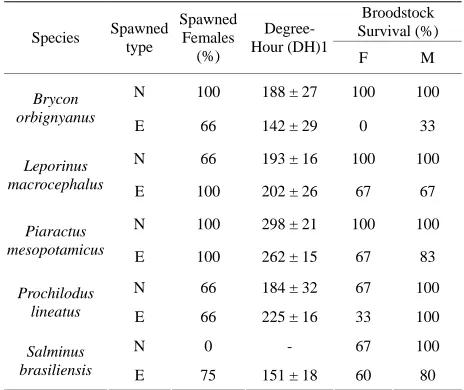
All tested fish species spawned via extrusion. All fe- males of L. macrocephalus and P. mesopotamicus spa- wned regardless of the technique used; in natural spawn- ing, only S. brasiliensis did not spawn into the tank.
We found a variation in degree-hour between species, with the shortest spawning time observed for B. orbign-
yanus and the longest observed for P. mesopotamicus.
We observed a trend of higher degree-hour values for natural spawning than for spawning by extrusion, but this tendency was only statistically confirmed for P. mesopo- tamicus (Table 3).
The survival of broodstocks after spawning varied ac-cording to the species, with the lowest values observed in
B. orbignyanus spawning extrusion. In general, higher
survival rates were observed with the technique of natu- ral spawning, where survival values ranged between 66.7% and 100% (Table 3).
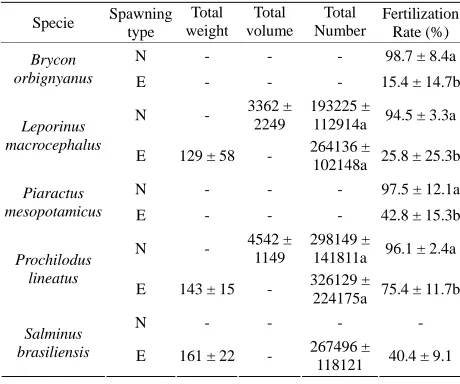
For L. macrocephalus and P. lineatus, the numbers of eggs produced by both spawning methods showed no statistically significant difference (P > 0.05). The fertili- zation rate parameter showed the greatest difference be- tween natural spawning and extrusion; all species show- ed a higher rate of egg fertilization with natural spawning and extrusion; all species showed a higher rate spawning compared to extrusion (P < 0.05) (Table 4).
Table 3. Mean values and standard deviation (±) of de-gree-hour and survival percentage values for spawning females and survival of broodstocks for different species assessed. N = Natural; E = Extrusion.
Broodstock Survival (%)
Species Spawned
type
Spawned Females (%)
Degree- Hour (DH)1
F M
N 100 188 ± 27 100 100
Brycon orbignyanus
E 66 142 ± 29 0 33
N 66 193 ± 16 100 100
Leporinus
macrocephalus E 100 202 ± 26 67 67
N 100 298 ± 21 100 100
Piaractus
mesopotamicus E 100 262 ± 15 67 83
N 66 184 ± 32 67 100
Prochilodus
lineatus E 66 225 ± 16 33 100
N 0 - 67 100
Salminus
Table 4. Mean values and standard deviation (±) of the total weight of oocytes spawned, the total volume of eggs per spawning, the total number of eggs produced per kilogram per spawning and the fertilization rate (%) per treatment. N = Natu-ral; E = Extrusion.
Specie Spawning
type
Total weight
Total volume
Total Number
Fertilization Rate (%)
N - - - 98.7 ± 8.4a
Brycon
orbignyanus E - - - 15.4 ± 14.7b
N - 3362 ±
2249
193225 ±
112914a 94.5 ± 3.3a
Leporinus macrocephalus
E 129 ± 58 - 264136 ±
102148a 25.8 ± 25.3b
N - - - 97.5 ± 12.1a
Piaractus
mesopotamicus E - - - 42.8 ± 15.3b
N - 4542 ±
1149
298149 ±
141811a 96.1 ± 2.4a
Prochilodus lineatus
E 143 ± 15 - 326129 ±
224175a 75.4 ± 11.7b
N - - - -
Salminus
brasiliensis E 161 ± 22 - 267496 ±
118121 40.4 ± 9.1
4. DISCUSSION
Among the spawning induction techniques used for neotropical migratory fish, the use of extrusion is well documented [4,7,8], as it has been used to produce such commercially important neotropical species as dourado, S. brasiliensis; matrinxã, B. cephalus; tambaqui C. ma-
cropomum and pacu, P. mesopotomicus. This type of
technique is widely used due to its low operational man- agement, high control of production and its status as a well-disseminated technique. Moreover, according to Bermudez, et al. [9], performing fertilization by extru- sion reduces egg handling, which is considered an im- portant factor in embryo development, reduces the chance of fungi appearance, increases the fertilization rate and increases the quality of future larvae.
However, a disadvantage of extrusion is that it may increase the mortality rate of broodstock used, which is generally positively related to the species-specific degree of tolerance for handling. Females and males of Brycon siebenthalae show high mortality rates after induction [10]. Catfish (Rhamdia quelen) and piauçu (L. macro-
cephalus) commonly exhibit high mortality rates a few
days after spawning by extrusion [11]. For B. orbign-
yanus, up to 100% broodstock mortality rates have been
observed [12]. The overall broodstock mortality rates after extrusion can exceed 50% in neotropical freshwater species. In this study, we observed that in the four evalu-ated species survival rates of individuals increased with natural spawning. The survival percentage of spawning by extrusion was low, especially for B. orbignyanus, which exhibited more than 80% mortality of broodstock males and 100% of brood stock females.
Survival after extrusion was related to species behave- ior. L. macrocephalus presented most docile behavior in handling and had the highest survival rates after extru- sion; the converse was observed for B. orbignyanus.
Many hormonally induced fish begin to spawn in the presence of active males after ovulation. In literature, this phenomenon is referred to either as “induced spawn- ing” or “hormonal induced spawning”. Landinez [13] believe that hormonal induction followed by fish spawn-ing occurrspawn-ing naturally in tanks without extrusion is a “semi-natural” spawning; however, there are problems in accepting this terminology. The term “induced spawn-ing” is conducive to erroneous interpretations and may even be mistaken for spawning by extrusion because the extrusion process is also a form of spawning induced by a handler. However, the name “semi-natural spawning” seems confusing. Perhaps the most appropriate term is “natural spawning” because the act of spawning is only regulated by breeding.
Saldaña and Ascon [14], working on tambaqui C.
macropomum, observed high fertilization rates (above
90%) with the natural spawning technique. Similar re- sults were found by Sirol, et al. [15] in P. mesopotamicus and by Varela, et al. [11] in R. quelen. In this study, the technique of natural spawning resulted in the spawning of more than 50% of females of different species, result- ing in fertilization rates above 95%. This value exceeds the general average fertilization rate of 54.3% obtained via extrusion. Fertilization rates differed by an even greater margin, with values of 7.5% for extrusion versus 86.1% for natural spawning. All values of fertilization rates via extrusion were lower than with natural spawn- ing.
According Bromage, et al. [16], determining the exact time of ovulation to induce female egg production is very important to obtain high-quality eggs, which is funda- mental to achieving high rates of subsequent fertilization. The appearance of female eggs before or after the mo- ment of ovulation can result in low fertilization rates and low-quality larvae [17,18]. The exact time of ovulation in females may vary according to the species, with the largest time intervals observed for cold water fish such as trout Oncorhynchus mykiss (4 - 6 days) [18] and Clupea
harengus (14 days) [19] and smaller time intervals ob-
creases due to the short optimum maturation window. This phenomenon is demonstrated in this study by the relatively low fertilization rates and the large variation in values.
According to Bermudez, et al. [9], natural spawning creates the possibility that broodstocks may not be en- tirely prepared for spawning and that the female gamete may release without a corresponding release of the male semen, causing a subsequent loss of eggs. Another possi-bility is that females do not release their gametes because they are not ready. In this study, we observed successful spawns with high fertilization rates, which indicate that males responded to female spawning. However, it was found that some female piauçu (L. macrocephalus) and curimbatá (P. lineatus) did not spawn, indicating that their eggs were not ready. The absence of spawning in dourado (S. brasiliensis) in a natural system may be an indication that fish were not ready or that using carp pi- tuitary extract in this system is not effective for this spe- cies.
In this study, we observed higher average egg produc- tion with extrusion. However, no significant differences (P > 0.05) in egg production were found between treat- ments for the different species evaluated.
Knowledge about aquaculture species of neotropical migratory fish is in its initial stages, and many studies are still needed to better understand the reproduction of these fish. The results of this study indicate that two investi- gated methodologies can be useful to obtain gametes from these species. The extrusion method offers greater practicality and less handling in spawning. Furthermore, the natural spawning method achieves a higher survival of broodstocks and high fertilization rates. Extrusion can be important in large-scale reproductions and in cases where the financial and environmental costs of brood- stocks are not high. Natural spawning is an important technique that could be applied for fish that are able to spawn in a tank containing males and that have high economic and environmental broodstock values. In case of an endangered fish such as piracanjuba (B. orbign- yanus), the species has a high environmental value due to its absence in nature and to the need to conserve its ge- netic load. The natural spawning method is therefore recommended for reproduction to reestablish a popula-tion where 1) matrices with high genetic variability are used, and 2) the loss of individuals during reproduction could have incalculable value.
5. CONCLUSION
Research perspectives related to spawning techniques improvements have continuingly been developed; how- ever, there is still limited knowledge regarding the neo- tropical migratory fish reproductive biology. Moreover the spawning techniques currently used still need im-
provement. Thus, some crucial aspects still need to be evaluated, for example, the specific moment in which fish is ready to spawn and the use of other hormones for induction of natural spawning.
REFERENCES
[1] Zaniboni-Filho, E., Reynalte-Tataje, D.A. and Hermes- Silva, S. (2010) Cultivo do gênero Steindachneridion. In: Baldisserotto, B. and Gomes, L.C. Ed., Espécies nativas para piscicultura no Brasil. Ed UFSM, Santa Maria, 210-333.
[2] Agostinho, A.A., Gomes, L.C. and Pelicice, F.M. (2007) Ecologia e Manejo de Recursos Pesqueiros em Reserva- tórios do Brasil. EDUEM, Maringá.
[3] Lopera-Barrero, N.M., Vargas, L., Sirol, R.N., Ribeiro, R.P., Povh, J.A. and Mangolin, C.A. (2010) Caracte- rização genética de Brycon orbignyanus utilizando o sis- tema seminatural. Arquivo Brasileiro de Medicina Vete- rinária e Zootecnia, 62, 184-191.
doi:10.1590/S0102-09352010000100025
[4] Woynarovich, E. and Horváth, L. (1989) The artificial propagation of warm-water finfihes—A manual for exten- sion. FAO Fisheries Technical Paper, 201,183.
[5] Reynalte-Tataje, D.A., Esquivel, B.M. and Esquivel, J.R. (2002) Reproducción inducida del piauçu, Leporinus macrocephalus Garavello y Britski, 1988 (Characiformes, Anostomidae). Boletim do Instituto de Pesca, 28, 11-18. [6] Ihering, R.V. and Azevedo, P. (1936) As piabas dos
açudes nordestinos (Characidae, Tetragonopterinae). Ar-quivos do Instituto Biológico, 7, 75-110.
[7] Zaniboni-Filho, E. and Barbosa E.N.D.C. (1996) Priming hormone administration to induce spawning of some Bra-zilian migratory fish. Revista Brasileira de Biologia, 56, 655-659.
[8] Sato, Y. (1999) Reprodução de peixes da bacia do rio São Francisco: Indução e caracterização de padrões. PhD Theses, Universidade Federal de São Carlos, São Carlos.
[9] Bermudez, D.A., Prada, N.A. and Kossowski, C. (1979) Ensayo sobre la reproducción de cachama Colossoma macropomum (Cuvier, 1818) em cautiveiro. Universidad Centro Occidental, Escuela de Agronomia, Barquisimero.
[10] Pardo-Carrasco, S.C., Arias, J.A., Atencio-García, V.J., Zaniboni-Filho, E. and Vasquez-Torres, W. (1998). Ensa- yos de reproducción inducida del yamú Brycon sieben- thalae en los llanos colombianos. Proceedings of the Congreso Sur Americano de Acuicultura, Recife, 17 June 1998, 282.
[11] Varela, Z., Fisher, K. and Fabiano, G. (1982) Repro- ducción artificial del bagre negro Rhamdia sapo, Proyecto FAO/PNUD/UR/78/005, Instituto Nacional de Pesca (INAPE), Montevideo.
[12] Baldisserotto, B., Neto, J.R. and Barcellos, L.G. (2010) Jundiá (Rhamdia sp.). In: Baldisserotto, B. and Gomes, L.C. Eds., Espécies nativas para piscicultura no Brasil, Ed UFSM, Santa Maria, 301-333.
del yamu Brycon siebenthalae a partir de extrato de hipófisis de carpa (EPC). Boletim Científico INPA, 3, 5-17.
[14] Saldaña, G. and Ascon, G. (1986) Ensayo sobre repro- ducción inducida de “gamitama” Colossoma macro- pomum (CUVIER, 1818) com Gonadotropina Corionica Humana. Hidrobios, 10, 1-12.
[15] Sirol, R.N. and Britto, S.G. (2006) Conservação e manejo da ictiofauna: repovoamento. In: Nogueira, M.G, Henry, R. and Jorcin, A., Eds., Ecologia de reservatórios: im- pactos potenciais, ações de manejo e sistemas em casca- tas, RiMA, São Carlos, 275-284.
[16] Bromage N., Bruce M., Basavaraja N. and Rana K. (1994) Egg quality determinants in finfish: The role of over rip- ening with special reference to the timing of stripping in the Atlantic Halibut Hippoglossus hippoglossus. Journal of the World Aquaculture Society, 25, 13-21.
[17] Hirose K., Ishida R. and Sakai K. (1977) Induced ovula- tion of ayu using HCG, with special reference to changes in several characteristics of eggs retained in the body cav- ity after ovulation. Bulletin of the Japanese Society for the Science of Fish, 43, 409-416.
doi:10.2331/suisan.43.409
[18] Springate, J.R.C., Bromage, N.R., Elliott, J.A.K. and Hudson, D.L. (1984) The timing of ovulation and strip- ping and the effects on the rates of fertilization and sur- vival to eying, hatch and swin-up in the rainbow trout (Salmo gairdneri). Aquaculture, 43, 313-322.
doi:10.1016/0044-8486(84)90032-2
[19] Hay, D.E. (1986) Effects of delayed spawning on viability of eggs and larvae of Pacific herring. Transactions of the American Fisheries Society, 11, 155-161.
doi:10.1577/1548-8659(1986)115<155:EODSOV>2.0.C O;2
[20] Formacion, M.J. (1991) Overripening of ovulated eggs in goldfish Carassius auratus. PhD Thesis, National Uni-versity of Singapure, Singapore.
[21] Fortuny, A., Espinach Ros, A. and Amutio, V.G. (1988) Hormonal induction of final maturation and ovulation in the sabalo Prochilodus platensis Holmberg, latency and incubation times and viability of ovules retained in the ovary after ovulation. Aquaculture, 73, 373-381.