ISSN Online: 2162-1993 ISSN Print: 2162-1985
Communication between Two
Lactuca
Species
Anna G. Aguilera, Sara Williams, Tiffany Armstrong
Biology Department, Simmons College, Boston, MA, USA
Abstract
There is increasing evidence of plant communication and behavior. We examine how two Lactuca species, L. sativa and L. serriola, communicate with themselves and one another via root exudates. We exposed both species to their own, to the same species, and to the other species root exudates. We then measured the length of their primary root as a proxy for competitive effort. L. serriola produced longer roots when ex-posed to its own exudates relative to when exex-posed to L. sativa’s. In contrast, L. sativa produced shorter roots when exposed to its own root exudates. These results indicate kin recognition in these species. Further, the results show that L. sativa, a domesti-cated species, shares resources well with conspecifics. In contrast, L. serriola, a sparsely distributed species, is more competitive with conspecifics than with other species. We argue that artificial selection and domestication of L. sativa, from its progenitor L. serriola, modify how the species interprets and respond to exudate cues from neighboring plants.
Keywords
Plant Communication, Lactuca, Root Exudate
1. Introduction
Emerging research shows that plants have complex systems of communication and be-havior. A mounting number of studies show plants are able to self-identify and recog-nize closely related kin [1]-[9]. Early evidence of self-recognition in plants was demon-strated with the desert shrub Ambrosia dumosa. When in contact with another indi-vidual’s roots, Ambrosia showed a precipitous decline in root growth. In contrast, there was no such decline when it was in contact with its own roots. Further, Ambrosia can distinguish individuals from its own population from that of Ambrosia plants from a different region. When in contact with its local neighbors, it responded with a decline in root growth. However, when in contact with plants from another region, its root growth remained robust [1]. It is believed that this behavior is a mechanism to limit
How to cite this paper: Aguilera, A.G., Williams, S. and Armstrong, T. (2016) Com- munication between Two Lactuca Species. Open Journal of Ecology, 6, 767-774.
http://dx.doi.org/10.4236/oje.2016.613068
Received: October 15, 2016 Accepted: December 23, 2016 Published: December 26, 2016 Copyright © 2016 by authors and Scientific Research Publishing Inc. This work is licensed under the Creative Commons Attribution International License (CC BY 4.0).
http://creativecommons.org/licenses/by/4.0/
competition with closely related kin. Other examples of self- and kin-recognition in plants reveal alternate plant behaviors. Impatiens palladida grown in the presence of siblings plants, had greater root growth than that of plants grown with strangers [10]. As evidence mounts, it is clear that plant species signal to one another, can determine the identity of the plants sending the signals and in some cases, can even distinguish between the sexes [11]. Following the receipt and identification of signals, plants then respond accordingly. It seems it is time to accept plants as autonomous creatures with communication and behavior.
As root communication studies emerged, they were criticized for not controlling va-riables such as pot volume, nutrient effects, and inherent size inequalities between dif-ferent populations [6] [7] [12]. Furthermore, there are complex underground microbial communities that influence plant behavior. Different plant species, and even ecotypes, generate unique microbial communities in the soil, and these communities feedback on plant growth [13]-[19]. Therefore, it is difficult to determine if plant behaviors are a result of direct interaction, or mediated by soil organisms. Biedrzycki et al. 2010 [5] addressed these issues by growing Arabidopsis in liquid media and exposing them to the root exudates of siblings, and of strangers. By not including the soil, they eliminated any influence of soil microbial communities. They found that plants exposed to the root exudates of strangers had greater root growth than those exposed to sibling ex-udates, showing that plants recognized and responded to direct communication from their neighbors [5].
While root interactions have been implicated in intra- and interspecific competition, we are not aware of any studies that consider root interaction as a potential mechanism for plant dispersion. Plant-soil feedbacks, competition, herbivory, and seed dispersal have been implicated in plant dispersion and rarity [15]-[21]. We suggest that under-ground root communication is also in-part driving plant rarity and likewise abundance in the wild. We also believe that plant-to-plant interactions are equally important agri-culturally. How plants respond to their neighbors can determine the viability of a given cultivar for either monocroping or intercropping. Different combinations of species can translate to a range of agricultural yields [8] [22]. For example, when the maize variety GZI was grown with soybean HX3, the roots tended to avoid each other. However, when maize variety NE1 was grown with soybean HX3, roots showed an affinity for one another [8].
We examined Lactuca sativa, a cultivated lettuce, in comparison with Lactuca serri-ola, its wild progenitor, to see whether artificial selection for agricultural use, changes the way of species communication and behavior. These two species are so genetically close that some argue they can be considered conspecific [23]. However, one of their key differences is their dispersion; L. sativa grows well in monoculture, and L. serriola is found distributed sparsely in the wild.
serri-ola growth, but also gives the L. serriola host increased competitive ability (Aguilera et al., in review). This work suggests that L. serriola’s sparseness in the field is in-part due to the negative feedback of its soil community. Likewise it implies that L. sativa’s suc-cess as a monoculture crop is again in-part, due to a release from these negative feed-backs. However to understand the complete picture we must first understand the indi-vidual effects of microbial feedback and direct communication.
In this paper, asked whether L. sativa and L. serriola can distinguish self, from the same species, or from another species. We grew each species in liquid media and posed them to their own exudates, the same species exudates, or the other species ex-udates. We expected that L. sativa, the cultivated species would reduce root growth when exposed to its own species, relative to when exposed to L. serriola, as a means of reducing intraspecific competition. In contrast, with the same design using L. serriola, we expected to see that opposite. Due to L. serriola’s reluctance to grow in monoculture in the wild we predicted that it will show reduced root growth with L. sativa, relative to it-self: thereby showing a preference for growing next to someone other than a conspecific.
2. Methods
We sterilized all seed in a 50% bleach solution for 5 minutes, followed by three 3-minute rinses with DI water. Following seed sterilization we germinated all seeds in sterilized liquid media (Murashige and Skoog Basal Medium). Once the seeds germi-nated (approximately 10 days), we placed seedlings into 3.5 ml wells in experimental well culture plates. In trial 1, we exposed L. sativa individuals to their own exudates (OWN), so other L. sativa exudates (SAME), and to L. serriola exudates (OTHER). In a procedure modified from Biedrzycki et al. (2010) [5], every day for seven days individ-uals in the OWN treatment were lifted out of their well using forceps then and placed them back into their original well. For the SAME treatment, individuals were rotated from their own well into a neighboring L. sativa well. Finally for the OTHER treatment, individuals were paired with with a L. serriola seedling and each day individuals were switched from one well to the other (Figure 1). We replicated this design 6 times. All experimental well plates were kept in a growth chamber used to simulate a typical New England environment with 15 hours of daylight at 25°C. Inside the growth chamber well plates were on a rotary shaker to maintain a constant mixing of the media solution and to prevent a state of hypoxia. Seven days after the start of the experimental treat-ments we removed the seedlings and measured the length of their primary root using calipers. We used root growth as a proxy for competitive effort, with increased root growth indicating increased below-ground competitive effort. For trial 2, we used an identical experimental design with L. serriola plants for the focal species and L. sativa plants for the OTHER treatment. All data were analyzed with a one-way ANOVA and pairwise comparisons were performed using the Holm-Sidak method in SigmaPlot.
3. Results
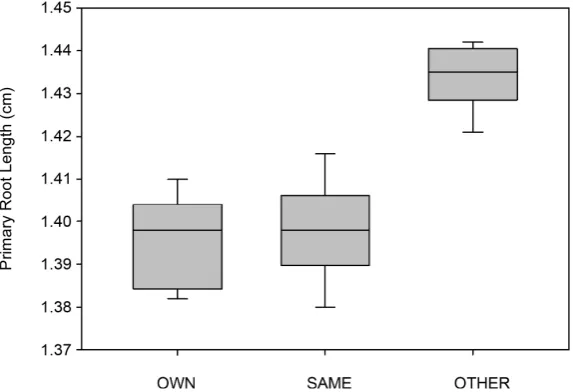
(ANOVA, F2.15 = 4.930, P = 0.023) (Figure 2) and in trial 2 with L. serriola (ANOVA, F2.15 = 26.465, P < 0.001) (Figure 3). Pairwise comparisons show that there was no sig-nificant difference in root length for either species when exposed to their OWN or SAME species root exudates, indicating no difference in competitive effort when faced with their own versus the same species exudates. However, when L. sativa was exposed to OTHER root exudates the primary roots grew significantly longer than when ex-posed to its OWN or SAME exudates (Holm-Sidak, OWN-OTHER, P = 0.039; SAME- OTHER, P = 0.038) (Figure 2). In contrast when L. serriola was exposed to OTHER
Figure 1. Schematic diagram of the experimental design for both trial 1 and trial 2.
Figure 2. Box and whisker plot showing the spread of the data for trial 1 with Lactuca sativa.
[image:4.595.231.518.457.653.2]Figure 3. Box and whisker plot showing the spread of the data for trial 2 with Lactuca serriola.
Exudate treatment is listed on the x axis and root length is on the y axis. For each treatment, the lines inside the boxes show the median, the first and third quartiles are shown the ends of the boxes, and the maximum and minimum values are shown at the ends of the whiskers.
root exudates the primary roots were significantly shorter (Holm-Sidak, OWN- OTHER, P < 0.001; SAME-OTHER, P < 0.001) (Figure 3). When considered as a proxy for competitive effort this root data shows that L. sativa exerts less competitive effort when exposed to the same species root exudates. In contrast, L. serriola showed in-creased competitive effort when exposed to the same species root exudates.
4. Discussion
Our experiment shows clear evidence for kin recognition in Lactuca species. Both L. sa-tiva and L. serriola react to conspecific root exudates as if they were their own (Figure 2 & Figure 3). It is important to distinguish kin-recognition from self-recognition. In true self-recognition, plants are able to distinguish genetically identical clones from themselves. For example, when Ambrosia roots are in contact with still connected sis-ter-roots, there is no change in root elongation rates. However, when in contact with physically separate, genetically identical clones, Ambrosia plants respond with reduced root elongation [1]. Kin recognition is in contrast when plants are able to distinguish kin presumably through genetic similarity [24]. For example the grass, Distichlis spica-ta, can distinguish sibling plants (from the same mother plant) from those of the same species but not siblings [10]. Our results indicate that while Lactuca root exudates may mediate kin-recognition, we see no evidence for exudate mediated self-recognition.
that L. sativa reduces its below competitive effort when grown with its own species. Conversely, L. serriola increases its competitive effort when grown with conspecifics.
While many studies implicate competition, plant-soil feedbacks, and herbivory, in plant distribution and abundance [16] [17] [18] [19] [20] [25], we know of none that implicate direct plant-to-plant communication. Clearly, distributions in the field are the net result of all of these interactions (and more) occurring simultaneously [26]. It is argued that plant-soil feedbacks and competitive interactions should never be consi-dered separately [27]. We argue that this should be extended to include direct plant communication as well. The soil microbial communities of L. sativa and L. serriola show that L. serriola has a less diverse microbial community in its rhizosphere soil than L. sativa[28]. Further, the microbial community of L. serriola creates a more negative soil feedback that influences both L. serriola growth and competition. Interestingly, L. serriola grows larger in the presence of L. sativa’s soil microbial community than it does in the face of its own soil community. In competition experiments in sterilized and non-sterilized soil, the microbial community of L. serriola makes it a stronger compet-itor (Aguilera et al., in review). In summary, when compared with L. sativa, L. serriola has a less diverse soil community that creates a more negative plant-soil feedback for itself and its neighboring competitor plants. Our results indicate that in addition to this, L. serriola is also sending direct plant-to-plant signals that discourage growth next to conspecifics. Taken together, it is a picture of how L. serriola carves out its own “per-sonal space” for each individual. Conversely, this implies that in selecting for agricultu-rally beneficial traits, we have altered the message which L. sativa plants send to each other. In essence, agriculture has been a selective force driving the evolution of the L. sativa towards a more social behavior, allowing them to grow well with conspecifics.
Our work supports the assertion that the environment requires plants to make deci-sion and act on them. Furthermore, those plants may be better understood once it is accepted that they are endowed with some degree of autonomy [4] [29]. Indeed, it is not just below ground where plants are directly communicating. Crepy and Casal (2015) [30] showed that Arabidopsis plants recognized neighboring kin and subse-quently reoriented their leaves to minimize mutual shading of neighboring kin. Other examples of cooperative behavior in plants involve the release of volatile organic com-pounds (VOCs) following herbivore attack that cues neighboring plants to increase herbivore defenses and avoid damage. Response to VOCs can also be population spe-cific where receiver plants respond only to VOCs sent from individuals within their population [31]. Clearly plants are complex creatures that receive information in a va-riety of ways, process that information, and act accordingly.
mo-nocultures can be an important tool for invasive plant control. Finally, when protecting rare species, it is vital to understand which species share resources in the most efficient way. In short, to understand and manage our vital plant resources, we need to listen to what plants are saying to each other, and understand how it affects their behavior.
References
[1] Mahall, B.E. and Callaway, R.M. (1996) Effects of Regional Origin and Genotype on Intras-pecific Root Communication in the Desert Shrub Ambrosia dumosa (Asteraceae). Ameri-can Journal of Botany, 83, 93-98. https://doi.org/10.2307/2445959
[2] Bais, H.P., Weir, T.L., Perry, L.G., Gilroy, S. and Vivanco, J.M. (2006) The Role of Root Exudates in Rhizosphere Interaction with Plants and Other Organisms. Annual Review of Plant Biology, 57, 233-266. https://doi.org/10.1146/annurev.arplant.57.032905.105159
[3] Dudley, S.A. and File, A.L. (2007) Kin Recognition in an Annual Plant. Biology Letters, 3, 435-438. https://doi.org/10.1098/rsbl.2007.0232
[4] Karban, R. (2008) Plant Behaviour and Communication. Ecology Letters, 11, 727-739.
https://doi.org/10.1111/j.1461-0248.2008.01183.x
[5] Biedrzycki, M.L., Jilany, T.A., Dudley, S.A. and Bais, H.P. (2010) Root Exudates Mediate Kin Recognition in Plants. Communicative & Integrative Biology, 3, 28-35.
https://doi.org/10.4161/cib.3.1.10118
[6] Chen, B.J.W., During, H.J. and Anten, N.P.R. (2012) Detect Thy Neighbor: Identity Recog-nition at the Root Level in Plants. Plant Science, 195, 157-167.
https://doi.org/10.1016/j.plantsci.2012.07.006
[7] Depuydt, S. (2014) Arguments for and against Self and Non-Self Root Recognition in Plants. Frontiers in Plant Science, 5, 1-7. https://doi.org/10.3389/fpls.2014.00614
[8] Fang, S., Gao, X., Deng, Y., Chen, X. and Liao, H. (2016) Crop Root Behavior Coordinates Phosphorus Status and Neighbors: From Field Studies to Three-Dimensional in Situ Re-construction of Root System Architecture. Plant Physiology, 155, 1277-1285.
https://doi.org/10.1104/pp.110.167304
[9] Zhang, L., Liu, Q., Tian, Y., Xu, X. and Ouyang, H. (2016) Kin Selection or Resource Parti-tioning for Growing with Siblings: Implications from Measurements of Nitrogen Uptake.
Plant and Soil, 398, 79-86. https://doi.org/10.1007/s11104-015-2641-z
[10] Murphy, G.P. and Dudley, S.A. (2009) Kin Recognition: Competition and Cooperation in
Impatiens (Balsaminaceae). American Journal of Botany, 96, 1990-1996.
https://doi.org/10.3732/ajb.0900006
[11] Mercer, C.A. and Eppley, S.M. (2014) Kin and Sex Recognition in a Dioecious Grass. Plant Ecology, 215, 845-852. https://doi.org/10.1007/s11258-014-0336-9
[12] Hess, L. and de Kroon, H. (2007) Effects of Rooting Volume and Nutrient Availability as an Alternative Explanation for Root Self/Non-Self Discrimination. Journal of Ecology, 95, 241- 251. https://doi.org/10.1111/j.1365-2745.2006.01204.x
[13] Reinhart, K.O. and Callaway, R.M. (2006) Soil Biota and Invasive Plants. New Phytologist, 170, 445-457. https://doi.org/10.1111/j.1469-8137.2006.01715.x
[14] Pendergast, T.H.I.V., Burke, D.J. and Carson, W.P. (2013) Belowground Biotic Complexity Drives Aboveground Dynamics: A Test of the Soil Community Feedback Model. New Phy-tologist, 197, 1300-1310. https://doi.org/10.1111/nph.12105
Feed-backs and Semiarid Grasslands. Ecology, 93, 2377-2385. https://doi.org/10.1890/12-0486.1
[16] Mangan, S.A., Schnitzer, S.A., Herre, E.A., Mack, K.M.L., Valencia, M.C., Sanchez, E.I. and Bever, J.D. (2010) Negative Plant-Soil Feedback Predicts Tree-Species Relative Abundance in a Tropical Forest. Nature, 466, 752-755. https://doi.org/10.1038/nature09273
[17] Kardol, P., Cornips, N.J., van Kempen, M.M.L., Bakx-Schotman, J.M.T. and van der Putten, W.H. (2007) Microbe-Mediated Plant-Soil Feedback Causes Historical Contingency Effects in Plant Community Assembly. Ecol Monographs, 77, 147-162.
https://doi.org/10.1890/06-0502
[18] Klironomos, J.N. (2002) Feedback with Soil Biota Contributes to Plant Rarity and Invasive-ness in Communities. Nature, 417, 67-70. https://doi.org/10.1038/417067a
[19] Kulmatiski, A., Beard, K.H., Stevens, J.R. and Cobbold, S.M. (2008) Plant-Soil Feedbacks: A Meta-Analytical Review. Ecology Letters, 11, 980-992.
https://doi.org/10.1111/j.1461-0248.2008.01209.x
[20] Goldberg, D.E. and Barton, A.M. (1992) Patterns and Consequences of Interspecific Com-petition in Natural Communities: A Review of Field Experiments with Plants. The Ameri-can Naturalist, 139, 771-801. https://doi.org/10.1086/285357
[21] Haddad, N.M., Tilman, D., Haarstad, J., Ritchie, M. and Knops, J.M.H. (2001) Contrasting Effects of Plant Richness and Composition on Insect Communities: A Field Experiment.
The American Naturalist, 158, 17-35. https://doi.org/10.1086/320866
[22] Li, L., Sun, J.H., Zhang, F.S., Guo, T.W., Bao, X.G., Smith, F.A. and Smith, S.E. (2006) Root Distribution and Interactions between Intercropped Species. Oecologia, 147, 280-290.
https://doi.org/10.1007/s00442-005-0256-4
[23] Kesseli, R., Ochoa, O. and Michelmore, R. (1991) Variation at RFLP Loci in Lactuca spp.
and Origin of Cultivated Lettuce (L. sativa). Genome,34, 430-436.
https://doi.org/10.1139/g91-065
[24] Alemu, S.W., Berg, P., Janss, L. and Bijima, P. (2014) Indirect Genetic Effects and Kin Rec-ognition: Estimating IGEs When Interactions Differ between Kin and Strangers. Heredity, 112, 197-206. https://doi.org/10.1038/hdy.2013.92
[25] Glinwood, R., Ninkovic, V. and Pettersson, J. (2011) Chemical Interaction between Unda-maged Plants—Effect on Herbivores and Natural Enemies. Phytochemistry, 72, 1683-1689.
https://doi.org/10.1016/j.phytochem.2011.02.010
[26] Pierik, R., Mommer, L. and Voesenek, L.A.C.J. (2013) Molecular Mechanisms of Plant Competition: Neighbour Detection and Response Strategies. Functional Ecology, 27, 841- 853. https://doi.org/10.1111/1365-2435.12010
[27] Casper, B.B. and Castelli, J.P. (2007) Evaluating Plant-Soil Feedbacks Together with Com-petition in a Serpentine Grassland. Ecology Letters, 10, 394-400.
https://doi.org/10.1111/j.1461-0248.2007.01030.x
[28] Cardinale, M., Grube, M., Erlacher, A., Quehenberger, J. and Berg, G. (2015) Bacterial Networks and Co-Occurrence Relationships in the Lettuce Root Microbiota. Environmental Microbiology, 17, 239-252. https://doi.org/10.1111/1462-2920.12686
[29] Gagliano, M. (2014) In a Green Frame of Mind: Perspectives on the Behavioural Ecology and Cognitive Nature of Plants. AoB Plants, 7, plu075.
[30] Crepy, M.A. and Casal, J.J. (2015) Photoreceptor-Mediated Kin Recognition in Plants. New Phytologist, 205, 329-338. https://doi.org/10.1111/nph.13040
[31] Moreira, X., Petry, W.K., Hernandez-Cumplido, J., Morelon, S. and Benrey, B. (2016) Plant Defense Responses to Volatile Alert Signals Are Population-Specific. Oikos, 125, 950-956.
Submit or recommend next manuscript to SCIRP and we will provide best service for you:
Accepting pre-submission inquiries through Email, Facebook, LinkedIn, Twitter, etc. A wide selection of journals (inclusive of 9 subjects, more than 200 journals)
Providing 24-hour high-quality service User-friendly online submission system Fair and swift peer-review system
Efficient typesetting and proofreading procedure
Display of the result of downloads and visits, as well as the number of cited articles Maximum dissemination of your research work