http://www.scirp.org/journal/jssm ISSN Online: 1940-9907
ISSN Print: 1940-9893
Presenting an Innovation Model in Orange
Technology
Babak Ziyae
Faculty of Entrepreneurship, University of Tehran, Tehran, Iran
Abstract
Nowadays, the technology is considered as a vital device to help people for consum-ing time, improvconsum-ing health, happiness and care. The path from green to orange is not only a shift learnt from green technology, but a cohesive image on the determination
of technology to humancivilization. Orange technology is regarded as an engine of
renewal, the cross-disciplinary incorporation of humanities and technology, andthe
social working of promoting people care, happiness andhealth. The purpose of this paper is to introduce orange technology as a strategy for technology expansion in the field of improving of human’s life. Since orange technology is ground-breaking and new concept in the field of entrepreneurship, the current study presents an innova-tive approach that could be considered in the business arena.
Keywords
Innovation, Orange Technology, Green Technology, Happiness, Health, Care
1. Introduction
Nowadays, technology is considered as tools to assist people for pursuing happiness
and achieving value. Suggesting the green to orange is not only a rising movement
learnt from green technology, but an integrated reflection on the purpose of technology to human civilization, particularly about the conflict between civilization and living af-ter industrial revolution. How to protect and tolerate the living environment of human
in order to follow a healthy andhappy living is keeping green and orange at the same
pace. Moreover, orange technology should be developed other than the present green technology [1].
The idea of Orange Technology was first suggested by Professor Jhing-Fa Wang, at the Department of Electrical Engineering, National Cheng Kung University, Taiwan, How to cite this paper: Ziyae, B. (2016)
Presenting an Innovation Model in Orange Technology. Journal of Service Science and Management, 9, 433-442.
http://dx.doi.org/10.4236/jssm.2016.95047
Received: July 10, 2016 Accepted: October 16, 2016 Published: October 19, 2016
Copyright © 2016 by author and Scientific Research Publishing Inc. This work is licensed under the Creative Commons Attribution International License (CC BY 4.0).
2009 [2]. It calls on worldwide scientists, economists, psychologist, sociologist, engi-neers, and all the other experts to dedicate their attention to such a movement, from
green movement to orange movement [3]. Orange movement not only underlines the
importance of the research on humanistic technologies, but also brings more health, happiness, and care to human beings [4].
The industrial revolution has caused a substantial consequence on human lifestyles. A number of changes occurred with the rapid growth of the economy and technology, including the information revolution, the second industrial revolution, and biotech-nology development. Although such evolution was significantly advantageous to hu-mans, it has caused a number of problems, such as capitalism, poverty gap, global warming, and an elderly population [3]. Because of recent changes, a number of people recognized these disasters and interested for operative answers, for example, the green movement, which successfully creates awareness of environmental protection and leads
to the development of green technology or green computing [5]. However, the green
movement does not focus on body and mind balance. Therefore, a solution that is possible for restriction the inconsistency between technology and humanity is of great-est concern.
In 1972, the King of Bhutan proposed a new idea that used Gross National Happiness (GNH) [6] to describe the standard of living of a country, instead of using Gross Do-mestic Product (GDP). The GNH has attracted significant consideration because it measured the mental health of people. Similar ideas were also proposed in other works
[6]. For example, Andrew Oswald advocated Happiness Economics by combining
eco-nomics with other research fields, such as psychology and sociology [7]. Moreover, a
book entitled “Well-Being”, which was written by Daniel Kahneman (a Nobel Prize
winner in Economic Sciences in 2002) explained the basics of happy psychology [8].
The common objective of those theories is to promote the living quality of humans, and to bring more happiness into our daily lives [9].
Recently, the IEEE launched the Humanitarian Technology Challenge (HTC) project by supporting resource-constrained areas to shape reliable electricity and medical facil-ities [10]. Such an action also highlights the importance of humanistic care [7]. Like the HTC project, Intel has supported a Center for Aging Services Technologies (CAST), and its objective is to quicken development of innovative healthcare technologies [11]. Several academic institutes responded to the trend and then initiated medical care re-search, such as the “Code Blue” and “Mercury” projects at Harvard University and “Computers in the Human Interaction Loop” (CHIL) at Carnegie Mellon University
[11]. Recent surveys on global healthcare markets and aging population also revealed
the same phenomenon. In response to the world trend [12] and inspired by those
re-lated concepts, Professor Wang created a new interdisciplinary “Orange Technology” for studying and endorsing health, happiness, and humanistic [2].
2. Literature Review
technologies related to human health, happiness and care [8]. It embraces, but not
lim-its to, sensors, communications, control and various software technologies. Thus,
strictly speaking, Orange Technology is not a new technology but a stylish combination of existing technologies for new products/applications [13] [14].
The purpose of orange technology is to endure working the fundamental value of
humanism technology [6]. To be specific, the mission of it is disadvantages could
prac-tice social caring more actively through technology, in order to pursue the value of
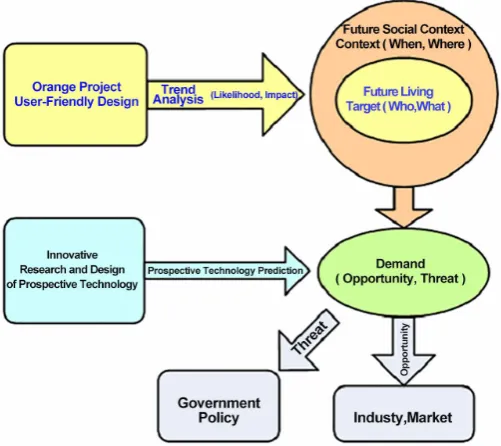
happiness together [1]. Orangetechnology is the engine of new resurgence, the cross-
disciplinary integration of humanities and technology, and the social functioning of
promoting people’s happiness andhealth that encourages caring to each other (Figure
1) [1] [15].
The vital goal is to make humanfeel blessed, which usually needs interdisciplinary
partnership [16]. However, as care is one of the three aims of the Orange Technology, it is easily to associate the Orange Technology with susceptible groups such as elders, children and disabled people [16] [17].
[image:3.595.248.499.449.672.2]Orange technology is a newly emerged interdisciplinary research area for combina-tion and innovacombina-tion of health, happiness, and care technologies. The research scope in-cludes computer science, electrical engineering, biomedical engineering, psychologi-cal/physiological science, cognitive science, and social science [4]. The illustrative color of orange technology originates from a choral fusion of red (representing brightness of health and happiness) and yellow (representing warming care). Instead of emphasizing the relations between environments and humans, as proposed by green technology, the objective of orange technology is to bring more health, happiness, warming care, and more mental wellness to society [10].
Figure 1. Orange technology is an implementing project of cross
2.1. Orange Technology and Green Technology Complement Each Other Well
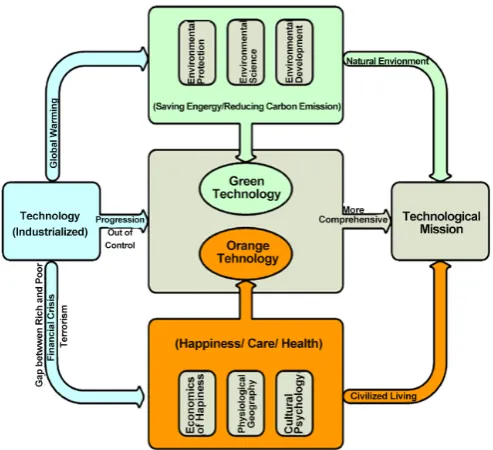
The green of green technology signifies theenvironment, which devotes to reduce
car-bon emissionsand to save energy in order to progress our livingenvironment [2]. As
for the orange of orange technology thatinterprets humanities, the temperature of its
color presentsthe vitality that cares about how to pursue a happy and healthy living.
Therefore, from green to orange would be reflecting how the development of
technolo-gy could ensurethe quality of living environment more comprehensively, and also the
pursuit of health and happiness. On the otherhand, from green to orange would not
only be the turning ofthe goal of technology development, but a more comprehensive
starting of mission (Figure 2) [1].
The purpose of orange technology is to call forstriving people’s attention from all
over the world on the issue of research and promotion of human technology, further
allows technology to bring health, happiness and humane care to all. Not only from
green to orangetechnology, but green to orange movement that covers: 1) health and
safety care and disease prevention of elders, 2) health and safety care and disease pre-vention of children, 3) protection and rescue of natural disaster for victims, 4) caring for low-income households, 5) caring for physicaland mental disabilities, 6) promotion
of humanitiesaccomplishment, and etc. The above could be covered toaccelerate the
promotion of orange technology. Orangetechnology could even be extended to orange
economy, orange design, orange product, orange space and so on [10].
[image:4.595.251.498.461.686.2]Orange technology and green technology supplement each other well. Green tech-nology emphasizes on environmental protection, whereas orange techtech-nology highlights humanism. Through such combination of green technology and orange technology, a complete mission can be succeeded [10].
2.2. Model Orange Technology
Wang et al. [2] proposed a concept for modeling health, happiness, and warming care.
As water is essential to life on earth, Health model, Happiness model, and Offering/
Caring/Warming model are abbreviated to H2O, for it symbolizes the essence of body
and mind:
• The health model is commonly used in medical expert systems. When a user inputs
a query to the interface, the system then consults with an expert or doctor [2]. After merging the opinion of the expert into the knowledge database, the system replies the user with a proper response [10].
• Like the health model, the happiness model also needs a user input and a predefi-
ned database. Most of time, the input is measured from the biosignals or behavior of a user, e.g., blood pressure, heart rates, gaits, laughter, etc. Thus, how to combine those data and determine happiness status becomes a challenging task [2].
• The Offering/Caring/Warming (OCW) model plays a key role in Orange
Technol-ogy since it involves whom, how, and when to give proper feedback. It also requires accurate semantic understanding techniques and delicate Human-Computer Inte-ractions (HCIs) [2].
Orange Index: Like Carbon footprints used in green technology, Orange Technology also adopts a criterion for calculating the degree of health, happiness, and warming care. Such an index can be used to evaluate a theory, a product, and even a policy [9]. Based on the theory of Wang et al. [2] orange index is discussed from the three aspects: magnitude, spectrum, and continuance.
• Magnitude measures the strength of a model. When tested on humans, it can be
re-garded as how strong a person feels.
• Spectrum refers to the range and the spread of a model. It discussed about how large
population a model can cover, e.g., products, persons, companies, communities, and nations.
• Continuance evaluates the duration of the model and how long it takes effects on
subjects.
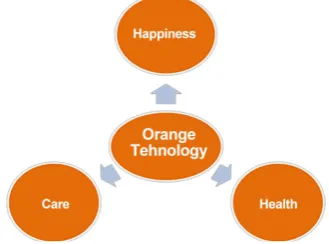
[image:5.595.291.456.557.679.2]Besides, orange index can be further decomposed into three sub-indices: health, hap-piness, and care. The following content introduces examples of each indicator (Figure 3).
Figure 3. Three orange technology
A) Happiness index:
• For nations: Prozac index can be viewed as a kind of happiness degrees since
Prozac has been widely used in treatment of depression for many years. The idea of Prozac index is analogous to Fine Wine Index proposed by Liv-Ex. It calculates the entire consumption of a nation in a year. When the consumption grows, it represents unhappiness level increases [2].
• For persons or products: Happiness tracks, or namely happiness degrees. In 2012,
Wang et al. [2] proposed that personal happiness can be estimated by using
laughter and smiles in a day. The electrical sensors were used to recognize and log the number of laughter and smiles generated by a person. In fact, personal emo-tions can be used for measurement of products. When tastes are using products, happiness footprints, e.g., Dopamine, are measured via their experience by sen-sors, equipments, or simply questionnaires.
B) Health index:
• For nations: such an indicator has been broadly investigated for many decades.
For example, Global Health Observatory (GHO) of World Health Organization (WHO) publishes world health statistics reports annually [10]. Their indicators include alcohol consumption, fertility rates, mortality rates, general government expenditure on health, and infection rates of specific diseases [18].
• For persons or products: Indices include toxic ingredients in products or
sub-stances secreted by human bodies [2]. C) Care index:
• For nations: This topic involves social care and community harmony. Charity
donation, social worker population, retirement house coverage, etc. can be se-lected as care indices.
• Orange Transform: Any non-orange production or design can be converted into
orange one as long as it adds three orange factors, including happiness index, health index, and care index, into the process or itself. Furthermore, all the indic-es need to be higher than a predefined thrindic-eshold [8].
2.3. New innovation in Orange Technology
In 2010, the new innovation model included “Orange Technology” in the theme.
Through this program it made people know more about the trend from Green Tech-nology to Orange TechTech-nology [11]. Because of caring of the earth and the elder are all important issues, the second of “Promoting Program for cross-field creative scenario value-adding” prototype exhibition found that many specialist are interested in this
Orange Design issue [13]. These creative ideas fromdifferent domains are humanism,
management, engineering, bio-techs [7]. There were 104 out of 181 designs used Oran-
computer interface-based music player with the function of music therapy for people
with dementia; Design and Implementation of drug/food/ vegetarian ingredients
re-minding system based on integration of barcode recognition, cloud computing and
family speech synthesis; automated-alert helmet; personal mobile device with crossing over obstacles wheels; adjustable hydrotherapy floatation jacket; system ofinteractive sound and light for eye-hand coordination training Groups of passion researchers are
devoting themselves in orange technology and orange design [1]. They form a close
community on the open platform of interdisciplinary creative value-adding and they corporate each other to make the Orange Dream come true [13] [19].
2.4. TechnologyDevelopment Policy
First ever world happiness report has beenpublished recently by the United Nations,
which reflects a new global demand for more attention to happiness as criteria for management policy [13] [20]. This also calls upon science andtechnology in both nat-ural and social areas to be developed for endorsing a happy and healthy lifestyle in our
modernsociety [4] [14]. To respond to such a trend, the research center of National
Chung Kung University at Taiwan proposes a new concept orange computing [9] for
health, happiness, and humanistic care. Rather than emphasizing therelations between environments and humans as green technology does, orange computing focuses on
de-signing procedures and systems for enhancing body and mind balance [13]. The goal of
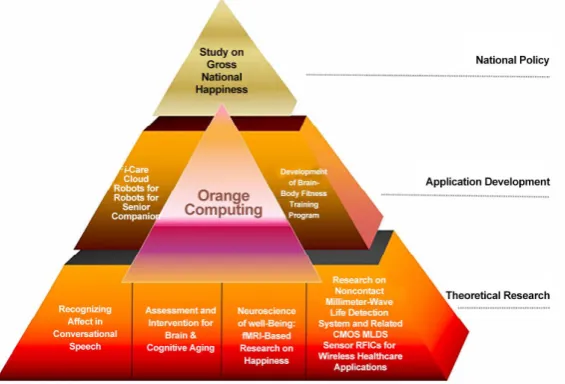
[image:7.595.231.514.495.687.2]orange computing is to bring more care or happiness to humans, and finally to pro-mote the well-being of society [5] [17]. The research center also launches a three-year interdisciplinary project studying health, happiness, and care technologies. The re-search scope includes computer science, electrical engineering, biomedical engineering, psychological/physiological science, cognitive science, and social science [12] [15].
Figure 4 shows the overview of the project. It is composed of the following seven subprojects:
Subproject 1: i-Care Cloud Robots for Senior Companion. Subproject 2: Study of Gross National Happiness.
Subproject 3: Development of Brain-Body Fitness TrainingProgram.
Subproject 4: Recognizing Affection in Conversational Speech.
Subproject 5: Research on Noncontact Millimeter-Wave Life Detection System and Related.
Subproject 6: Assessment and Intervention for Brain andCognitive Aging.
Subproject 7: Neuroscience of Well-Being: fMRI-BasedResearch on Happiness.
Additionally, these subprojects can be classified into threelayers according to their subjects, where the bottom layer istheoretical research, the middle layer is application development, and the top layer is related to national policy. Allthe subprojects are
sur-rounded by the central concept “orangecomputing.” The project is expected to realize
the research results in practical applications and the nation policy level [2] [16].
Regarding the research fields of Orange Technology, it includes the studies on 1) health technology, 2) happiness technology, and 3) warm technology. The detailed re-search fields may include:
1) Healthcare and disease treatment for the elderly. 2) Healthcare and disease treatment for children. 3) Care and disaster relief for stricken areas.
4) Care for low-income families.
5) Care for those with the problems of physiology, psychology, and spirits (i.e., body and mind care).
Orange Technology can even be extended to other areas, such as Orange Economy, Orange Design, Orange Product, and Orange Space, Orange Service, to bring more health, happiness, and warm care to human being [18] [21].
3. Conclusions
Technology is regarded as tools to serve people for pursuing happiness and fulfilling value. Orange Technology is a novel concept which indicates all technologies related to human health, happiness and care. The intention of orange technology is to continue practicing the fundamental value of humanism technology to be specific. The mission of it is that disadvantages couldpractice social caring more actively through technolo-gy, in order to pursue the value of happiness together. The ultimate goal is to make human feel blessed, which usually needs interdisciplinary collaboration. The green of green technology represents the environment, which dedicates to reduce carbon
emis-sions and to save energy in order to improve our livingenvironment. As for the orange
of orange technology that interprets humanities, the temperature of its color presents the vitality that cares about how to pursue a happy andhealthy living. Therefore, from green to orange would be reflecting how the development of technology could ensure the quality of living environment more comprehensively, and also the pursuit of health and happiness.
tech-nological innovation system. This innovation in the areas of health, happiness and care and with an interdisciplinary approach to the development of research in science and new businesses will be created. The research scope includes computer science, electrical engineering, biomedical engineering, psychological/physiological science, cognitive sci- ence, and social science Interdisciplinary research in the sciences through established specialized structures to supportcommercialization, such as technology transfer offices (TTOs), science parks and incubators, expand research projects universities to innova-tion. Orange Technology Research fields include: 1) healthcare and disease treatment for the elderly, 2) healthcare and disease treatment for children, 3) care and disaster re-lief , 4) care for low-income families, 5) care for those with the problems of physiology, psychology, and spirits (i.e., body and mind care), and 6) computer games.
However, mental care has become vital with the rapid growth of economy and tech-nology. Recent actions, such as green technologies, place more stress on environmental issues than on mental care. Therefore, this study presents an emerging technology called orange technology. Orange technology refers to health, happiness, and physio psychological care computing, which focuses on designing algorithms and systems for enhancing body and mind equilibrium. The representative color of Orange technology originates from a harmonic fusion of passion, love, happiness, and warmth. The system can notice emotional states of people by analyzing their facial expressions, emotional speech, and happiness in a pervasive environment. In addition, the system can provide corresponding feedback to users according to the results. Future experimental studies can reveal that the systems can achieve an accurate audiovisual recognition rate, there-by demonstrating the feasibility of the system.
Assimilating study from different fields can increase its capacity to expand strategies and rich social context. More qualitative research with grounded theory helps to create innovate business and improve health models. Considering any research or implemen-tation approach in isolation misses the significant advantage of addressing them to-gether. Current mechanisms of assessing health or funding research too often ignore a broad system wide approach.
References
[1] Gilk, L. (2009) Green Politics Is Eutopian. Lutterworth Press, Cambridge.
[2] OECD Health Data (2012) Paris Cedex, France: Organisation for Economic Co-Operation and Development. 198-203.
[3] Chen, S.-H. and Lee, R.S. (2013) A New Innovation Model: Interdisciplinary Creative Val-ue-Adding toward Commercialization. 2013 International Conference on Orange
Tech-nologies (ICOT), 12-16 March 2013, 164-467.
[4] Lorincz, K., Malan, D.J., Fulford-Jones, T.R.F., et al. (2004) Sensor Networks for Emergency Response: Challenges and Opportunities. IEEE Pervasive Computing, 3, 16-23.
http://dx.doi.org/10.1109/MPRV.2004.18
[5] Hargens, S.B.F. (2002) Integral Development—Taking the Middle Path towards Gross Na-tional Happiness. Journal of Bhutan Studies, 6, 24-87.
Based on Acoustic and Textual Features from Speech. Proceedings of the 2nd International
Symposium on Aware Computing (ISAC’10), Tainan, 1-4 November 2010, 92-96.
[7] Dunachie, F. (1996) The Success of the Industrial Revolution and the Failure of Political Revolutions: How Britain Got Lucky. Historical Notes, 8, 1-7.
[8] Liou, S. (2013) Toward a Technology for Humanity a More Comprehensive Technological Mission. 2013 International Conference on Orange Technologies (ICOT), Tehran, 75-78. [9] Busso, C. and Narayanan, S. (2007) Interrelation between Speech and Facial Gestures in
Emotional Utterances: A Single Subject Study. IEEE Transactions on Audio, Speech and
Language Processing, 15, 2331-2347. http://dx.doi.org/10.1109/TASL.2007.905145
[10] Kahneman, D., Diener, E. and Schwarz, N. (2008) Well-Being: The Foundations of Hedonic Psychology. Russell Sage Foundation Publications, New York.
[11] Hargens, S.B.F. (2002) Integral Development—Taking the Middle Path towards Gross Na-tional Happiness. Journal of Bhutan Studies, 6, 24-87.
[12] Hata, Y., Kobashi, S. and Nakajima, H. (2009) Human Health Care System of Systems.
IEEE Systems Journal, 3, 231-238. http://dx.doi.org/10.1109/JSYST.2009.2017389
[13] Chang, D.T.-H., Hung, Y.-H., Li, S.-C., Cheng, H.-H., Wang, H., Chou, C.-W. and Tang, Y.-C. (2013) An Orange Social Platform for Young People. 2013 International Conference
on Orange Technologies (ICOT), 12-16 March 2013, 325-327.
http://dx.doi.org/10.1109/ICOT.2013.6521224
[14] Wang, J-F. Chen, B., Fan, W. and Li, C. (2012) Emotion-Aware Assistive System for Hu-manistic Care Based on the Orange Computing Concept. Applied Computational
Intelli-gence and Soft Computing, 2012, Article ID: 183610.
http://dx.doi.org/10.1155/2012/183610
[15] Wang, H-Y., Chen, B., Bharanitharan, K., Wu, J., Tseng, S. and Wang, J. (2013) Hu-man-Centric Technology Based on Orange Computing. 2013 International Conference on
Orange Technologies (ICOT), 12-16 March 2013, 250-251.
http://dx.doi.org/10.1109/ICOT.2013.6521204
[16] Wang, J.-F. and Chen, B.W. ( 2012) Orange Technology: A Power Which Changes the World. 1st Edition, Orange Technology and GNH Research and Development Center, Na-tional Cheng Kung University, Tainan.
[17] Wang, J.-F. and Chen, B.W. (2011) Orange Computing: Challenges and Opportunities for Awareness Science and Technology. International Conference of Knowledge, Tehran, 87- 99.
[18] Jensen,S. (2013) The Modern Industrial Revolution, Exit, and the Failure of Internal Con-trol Systems. Journal of Applied Corporate Finance, 22, 43-58.
http://dx.doi.org/10.1111/j.1745-6622.2010.00260.x
[19] Veneris, Y. (1990) Modelling the Transition from the Industrial to the Informational Revo-lution. Environment & Planning, 21, 399-416. http://dx.doi.org/10.1068/a220399
[20] Waibel, A. (2008) Speech Processing in Support of Human-Human Communication.
Pro-ceedings of 2nd International Symposium of Universal Communication, Osaka, 11-21.
Submit or recommend next manuscript to SCIRP and we will provide best service for you:
Accepting pre-submission inquiries through Email, Facebook, LinkedIn, Twitter, etc. A wide selection of journals (inclusive of 9 subjects, more than 200 journals)
Providing 24-hour high-quality service User-friendly online submission system Fair and swift peer-review system
Efficient typesetting and proofreading procedure
Display of the result of downloads and visits, as well as the number of cited articles Maximum dissemination of your research work
Submit your manuscript at: http://papersubmission.scirp.org/