2018 International Conference on Computational, Modeling, Simulation and Mathematical Statistics (CMSMS 2018) ISBN: 978-1-60595-562-9
Design and Implementation of Virtual Parallel Smart Space Launching
Site Demonstration System
Jian-hua WANG
*, Long CHENG
and Yuan-wen CAI
Space Engineering University, No.1 Bayi Road, Huairou District, Beijing, China *Corresponding author
Keywords: Smart space launching site, Virtual parallelism, Demonstration verification, Cloud computing.
Abstract. Aiming at the design and construction of smart space launching site (SSLS) in the future, a virtual parallel demonstration and verification system for SSLS is proposed. The function realization of SSLS subsystems is preliminarily completed. The virtual layer of SSLS hardware is built based on the open source OpenStack software. The Hadoop is installed, and the data storage layer is estab-lished based on the HDFS and HBase. The MapReduce distributed parallel simulation calculation layer is configured and the Eclipse is installed to be a service development IDE. The Tomcat is used to be a Web server middleware to complete the basic environment of cloud platform system. The design and establishment of simulation structure of smart space launching site is preliminary com-pleted, and the typical tasks of SSLS is simulated and verified.
Introduction
The space test tasks and test launching process can be designed and optimized with the help of the dynamical management system of test launching process of space launching site (SLS). All items in the process of measuring nodes of SSLS can be effective managed. Based on the inputs, constraint conditions, and algorithms of process configuration and evaluation, comprehensive evaluation can be provided with respect to tasks in different stages of SLS tasks. The Microsoft Visual Studio is used to be the programming environment of software development. The ACCESS data-base is a data support for the SSLS. The system software of SSLS includes three functional modules: process design and configuration, process database management and process index evaluation [1].
The process design and configuration module can display and edit input conditions and constraint information of each project node, including the flow chart, process file management module, process parameter calculation module, and the process output module. Process database management module, includes the related database table which is used to store and manage information of tasks, equipment, and other project node. The process indicator evaluation module mainly completes the evaluation of a project node or whole process, and provides guidance for the next stage of task direction. It includes evaluation index management, expert information management, and event/evaluation management modules. The core technologies of the clouding computing mechanism are analyzed, a cloud platform architecture and basic support environment is designed. The typical application and data flow of the SSLS information are implemented [2-5]. This simulation system is focusing on the reproduction of
Scheme Design
The virtual hardware layer of the SSLS cloud system is built based on the open source OpenStack software. The Hadoop is installed, and the data storage layer is built by adopting HDFS and HBase. A MapReduce distributed parallel computing layer is configured. The Eclipse is installed to be a service development integrated development environment (IDE). The Tomcat is used to be a Web server middleware to complete the basic environment of cloud platform system [1]. By analyzing data source
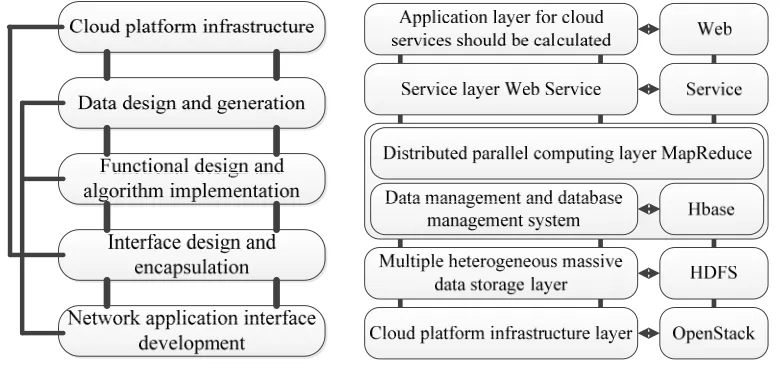
and data transfer flow, the environment data, launching test data, flight trajectory measurement data, equipment data and staff data are programmed and calculated. The mathematical model and simula-tion data generating model are established. The design diagram of the space launching test system is shown in the figure 1. [2, 3]
[image:2.612.119.509.212.396.2]
Figure 1. Schematic diagram of cloud platform system. Figure 2. The hierarchy of the cloud platform system. After establishment of basic environment of the cloud platform and data generation, it is necessary to define the process of data processing and calculation, determine ways to use the data, including data distributed storage and fault judgement. The flight trajectories are obtained and the precision of into orbit is analyzed. The data with respect to equipment and personnel work is monitored. Then, all the algorithms are encapsulated, algorithms of Web services are proposed. The dynamic Web ap-plication development system interface is used, and the Web service can be to display the calculating results to the client users or computers.
Implementation Process
The basic environment of cloud platform system is established based on the MapReduce distribute parallel algorithm. The calculating algorithms are encapsulated and used with the help of Web service application. The dynamic Web page technologies, application interface, and cloud services networks are all adopted in this system [2,3].
The data involved in this cloud system includes the equipment test data, personnel working data, basic model data, environment data, space launching test data, flight trajectory data, and random error data. A structure of the elastic data storage system for space launching test is designed, and a process algorithm for testing data is proposed. The flight trajectories are reshaped based on the measuring data and the equipment on-the-job data is obtained.
Infrastructure Construction
Cloud computing technology is series of technical systems of computer science and technologies, for verifying the effectiveness of the cloud computing, specific matching technology and environment support are needed, and details are shown in the figure 2. It is known that cloud computing technology is mainly used to solve the networking equipment application optimization, the data elastic expansion, large-scale heterogeneous data storage, efficient management, large-scale data parallel computing, data analysis and processing, and network application development and release. For quickly building low-cost cloud computing operation and software development environments, the OpenStack soft-ware is used to build the virtual hardsoft-ware layer of the cloud system. The Hadoop is installed, and the data storage layer is conducted with the help of HDFS and HBase. The computing layer is configured using MapReduce [1,4]. The basic environment is shown as below.
Basic infrastructure layer: to provide physical resources for cloud computing, including computing resources, storage resources and network bandwidth resources, etc. This system is proposed to adopt the virtualization OpenStack open source software to build the platform management layer.
Data storage layer: to provide needed data of the cloud computing system, first generating the data, and then save the data, finally conduct the data management and calculation.
Data management layer: data storage layer only solve the problem of data storage, so the data is arranged in a specific structure based on the NoSQL HBase database, the cloud system gives the data structure useful information to realize the efficient management of data.
Data computing layer: the serial computing mode based on CPU computing frequency has been replaced by parallel computing and distributed parallel computing. Parallel distributed computing of data using MapReduce programming model based on Hadoop system is used in this paper.
Data Design and Data Generation
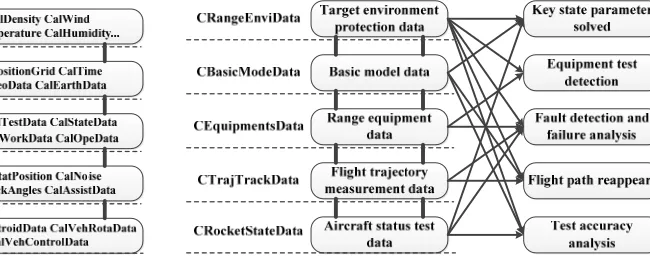
This part designs the generation and algorithm program for the simulation data, which is the data base of the system for cloud computing of the smart space launching site. The data class library and function implemented by the data design and generation program are shown in the figure 3 [2,5].
[image:3.612.189.514.442.574.2] [image:3.612.93.264.448.572.2]
Figure 3. Schematic diagram of data and function. Figure 4. Data generation function and support class library. According to typical tasks and data processing program, the environment basic data, equipment data, basic model data, flight trajectory measurement data, the rocket state data are designed and generated. Then, the algorithms of basic variable calculating, equipment testing, state monitoring, fault analysis, precision of into orbit are designed and implemented [2-4].
Environmental basic data: 1) Class library. CRangeEnviData. 2) Functions. Data collection point GetStatGridData; High altitude wind elevation data CalWind; Atmospheric temperature of sampling point CalTemperatureData.
Target equipment data: 1) Class name CEquipmentsData. 2) Function. The equipment work data CalEquiWorkData; Pre-test and monitoring data CalEquiTestData; The SSLS equipment operation data CalOpeData; The equipment operator monitoring data CalStateData. The typical task data of the equipment in the space launching site is designed and simulated to realize specific functions.
Flight trajectory data: 1) Class library name CTrajTrackData; 2) Function. External site location data CalStatPositionData; Measurement of noise data CalNoise; The measurement data of external station CalTrackAngles; The assistance data CalAssistData. The trajectories and measurement of the trajectories are designed and simulated.
Flight status test data: 1) Class library name CRocketStateData; 2) Function. Flight centroid data CalVehCentroidData; The vehicle rotational data CalVehRotaData; The rocket controlling test data CalVehControlData; The state test assistant data CalVehAssistData. The status data and test data of the rocket is designed and generated.
Functional Design and Algorithm Implementation
After the foundation environment and platform construction of SSLS cloud computing verification system is completed, the concrete simulation function and calibration algorithm need to be designed and implemented to achieve and verify the practical application of the SSLS cloud computing system. According to the requirements of test tasks of smart space launching site, and refer to previous works, the preliminary design of cloud computing system to complete the key state parameters calculating, equipment test, detection, monitoring and fault analysis of test equipment, test equipment trajectories emersion and test vehicle precision analysis is proposed in this section [2,4].
The typical main tasks of the SSLS are shown in the figure 4. The cloud system of SSLS not only relies on the design of system data and function described in the second part of this paper. Also, the basic physical mechanism, mathematical statistics, and estimation knowledge are all included [2,3].
General Computing Function Library
1) Interpolation calculation class CInterpolation: three-point quadratic equidistant interpolation function CInter32Fun; Step function CStepFun; Single variable data interpolation CDataInterFun; Binary three-point quadratic interpolation function CInterBi32Fun; Binary table interpolation func-tion CInterBiFun; Universal binary interpolafunc-tion funcfunc-tion CDataBiInterFun.
2) Matrix, vector and coordinate transformation function CVectorFun: The matrix class CMatrix; Matrix operation class CVector; CCustomCoordinate; Coordinate transfer matrix class CTransMatrix; Coordinate class CCoordinate associated with the earth.
3) Numerical integral class: Integral class CIntegral; Integral right function class CRightFunction; Vector/queue class CVectors.
4) Random number generation and statistical process class CRandomStatistics: abstract random distribution function class CAbstractRandom; Random number distribution CRandomFun; Normal distribution random number class CNormal; CRandomSet for random number collection.
5) Statistical theory: parameter estimation function CParameterEstimation; Parameter hypothesis testing function Chypoynstest, least squares estimation function CLeastSquaresFun.
State and Key Parameter Calculating
1) Rocket overall parameter calculating class CRocketParameters, mainly including the vehicle capacity, precision orbit rocket, rocket orbit gesture parameters such as accuracy, the rockets payload fairing static space.
2) Key parameter of the power subsystem is CRocketEngine, which includes power system thrust, total impulse, engine working time and specific impulse.
3) Key parameter of control subsystem is CRocketControl, which mainly includes flight program angle parameters, flight instructions, feedback coefficient, tracking error and control accuracy.
Equipment Testing and Failure Analysis
1) Equipment subsystem test method function class CEquSubsystemTestMethod, mainly involves the use of rocket system, safe system, telemetry system, control system, power system, aiming system and other subsystems, and the design data detection method and data processing function.
2) Equipment testing processing application function class CEquTestDataApply, mainly including equipment test data collection and processing, waveform display, data storage, data playback, data reorganization, data output, and processing applications such as data comparison.
3) Fault detection and data processing applications function class CErrorTestData, which mainly includes design of fault detection excitation signal and produce, detect input signal, signal sampling measurement, comparison and calculation and judgment, result of fault detection and record store.
4) Fault detection and fault processing algorithm class CErrorTestSovle, the function class library is mainly used to design typical fault detection and processing functions, and use detection data for fault diagnosis and resolution. The fault detection and locating method based on model fault detection and state variable detection are mainly included.
Flying Trajectory Track
1) Rocket flight function library class CLaunchBasicData, the rocket trajectory calculating, the required initialization data, etc.
2) Rocket state function library CRocketStateSolve, the flying states according to test data, and the calculation for speed, acceleration and position, and so on.
3) Flight path retrieval function library CRocketTrajectory, which is mainly based on vehicle state information of flight path filtering and navigation information.
4) Accuracy analysis: terminal control precision CRocketTerminalStateAccuracy, to calculate the terminal state of shut-down point mass center and around the center of mass control precision and the terminal orbit precision; the error analysis of vehicle function library CRocketErrorAnalysis, changes of the error factors mainly include the guidance error, error of attitude control, the influence of initial state error and the deviation error and so on.
In this paper, a virtual parallel demonstration and verification system for SSLS is proposed. The function realization of SSLS subsystems is preliminarily completed. The virtual layer of SSLS hardware is built based on the open source OpenStack software. The Hadoop is installed, and the data storage layer is established based on the HDFS and HBase. The MapReduce distributed parallel simulation calculation layer is configured and the Eclipse is installed to be a service development IDE. The Tomcat is used to be a Web server middleware to complete the basic environment of cloud platform system.
References
[1] Gu JiongJiong. Cloud computing architecture technologies and practice. Tsinghua University Press, Beijing, 2016.
[2] Wang JianHua, Liu LuHua, Wang Peng, et al. Guidance and control system design for hyper-sonic vehicles in dive phase. Aerospace Science and Technology, 2016; 53: 47–60.
[3] Wang JianHua, Liu LuHua, Zhao Tun. Integrated guidance and control for hypersonic vehicles in dive phase with multiple constraints. Aerospace Science and Technology, 2016; 53: 103-115. [4] Thomas Erl, Zaigham Mahmood, Ricardo Puttini. Cloud computing concepts, technology, and architecture, China Machine Press, 2017.