Working Paper
The Role of Problem Specification in Crowdsourcing
Contests for Design Problems: A Theoretical and
Empirical Analysis
Zhaohui (Zoey) Jiang
Stephen M. Ross School of Business
University of Michigan
Yan Huang
David A. Tepper School of Business
Carnegie Mellon University
Damian R. Beil
Stephen M. Ross School of Business
University of Michigan
Ross School of Business Working Paper
Working Paper No. 1388
October 2018
This paper can be downloaded without charge from the
Social Sciences Research Network Electronic Paper Collection:
The Role of Problem Specification in Crowdsourcing
Contests for Design Problems:
A Theoretical and Empirical Analysis
Zhaohui (Zoey) Jiang
Ross School of Business, University of Michigan, [email protected]
Yan Huang
Tepper School of Business, Carnegie Mellon University, [email protected]
Damian R. Beil
Ross School of Business, University of Michigan, [email protected]
This paper studies the role of seekers’ problem specification in crowdsourcing contests for design problems.
Platforms hosting design contests offer detailed guidance for seekers to specify their design problems when
launching a contest. Yet, problem specification in such crowdsourcing contests is something the theoretical
and empirical literature has largely overlooked. We aim to fill this gap by offering an empirically-validated
model to generate insights for the provision of information at contest launch. We develop a game-theoretic
model featuring different types of information (categorized as “conceptual objectives” or “execution
guide-lines”) conveyed in problem specifications, and assess their impact on design processes. Real-world data
is used to empirically test hypotheses generated from the model, and a quasi-natural experiment provides
further empirical evidence for our predictions and recommendations. We show theoretically and verify
empir-ically that, with more conceptual objectives disclosed in the problem specification, the number of participants
in a contest decreases, but the trial effort provision by each participant does not change; with more execution
guidelines disclosed in the problem specification, the trial effort provision by each participant increases, but
the number of participants in a contest does not change. With that knowledge, we are able to formulate
seekers’ optimal decisions on problem specifications. We find that, to maximize the expected quality of the
best solution to crowdsourced design problems, seekers should always provide more execution guidelines,
and only a moderate number of conceptual objectives.
Key words: crowdsourcing contests, problem specification, design, game theory, empirical analysis
1.
Introduction
Online crowdsourcing has become a popular channel for sourcing design (creative) products. A
widely used form of organizing the crowdsourced innovation process is theCrowdsourcing Contest,
sourc-ing approaches, crowdsourcsourc-ing contests allow seekers to access a large pool of designers, solicit a
larger number of solutions from which to choose, and pay for only the most satisfying solutions.
A typical crowdsourcing contest starts with a seeker specifying a design problem and associated
award(s), based on which designers generate solutions, and compete for the award(s).
We focus on the seeker’s problem specification: how the seeker specifies his design problem at the
launch of his crowdsourcing contest. In the problem specification, a seeker can state his problem
(e.g., he needs a logo for a real estate company), and communicate what he would like the
solu-tions to achieve (e.g., the logo should convey professionalism and reliability; blue color and sharp
edges are preferred). The information provided in the problem specification defines what
consti-tutes a “high-quality” solution in the focal contest, which can potentially affect designer behavior
and contest outcomes. Hence, it is important to understand the role of problem specifications in
crowdsourcing contests.
Yet, the best approach to problem specification is not obvious. At first sight, one may think
seekers should specify their problems in the most thorough manner possible. A detailed problem
specification clarifies what the seeker is looking for. Without it, designers may miss important
points when generating solutions, and they may also face increased uncertainty about how closely
their solutions match the seeker’s objectives. However, an overly specified problem may backfire,
especially when the seeker is not careful about the types of information he provides. By taking a
closer look at seekers’ problem specifications, we find that problem specifications can contain
mul-tiple types of information, which are likely to affect designers’ behavior differently. For example,
a problem specification with a long list of objectives can overwhelm designers. Designers have to
spend more time digesting the list, clarifying design objectives, and creating designs satisfying
mul-tiple objectives; consequently, designers may choose to not incorporate all of the design objectives,
or even choose not to participate.
In this paper, we aim to address the following research questions: (1) provided with different
types of information in a seeker’s problem specification, how do designers decide whether to join
the contest or not, and if so, how do they reflect information from the problem specification in
their design solutions; and (2) how should seekers optimally specify their design problems?
To answer these questions, we first construct a game-theoretical model to capture designers’
behavior given a problem specification. Our model distinguishes different types of information
pro-vided in problem specifications (“professionalism” and “reliability” can be considered asconceptual
objectivesthat the seeker wants design solutions to achieve, whereas “blue color” and “sharp edges”
asexecution guidancethat conveys the seeker’s instructions for design details). To assess how such
information influence decisions in designers’ design processes, our model features distinct stages in
literature (e.g., Sch¨on (1984, 1988), Cross (2011)), and explicitly captures thedesign problem
fram-ing,design concept formulatinganddesign trials generating stages designers go through to generate
designs. Our theoretical model predicts that the number of participating designers in a contest
decreases with more conceptual objectives disclosed in the problem specification, because designers
spend more efforts digesting those objectives and creating designs that satisfy those objectives.
In addition, participants’ trial effort provision increases with more execution guidelines provided
in the problem specification, because those guidelines inform designers about certain execution
details, which designers need to otherwise spend efforts deciding on.
The theoretical predictions of our model are empirically tested against a dataset of logo design
contests collected from a major crowdsourcing platform. In addition, we avail ourselves of a recent
“quasi-natural experiment” opportunity that arose on the platform, wherein changes were made
to the platform’s problem specification template. This further strengthens our empirical results’
reliability.
Leveraging our novel, empirically validated game-theoretical model, we offer insight on how
seekers can optimize their problem specifications to maximize the quality of the winning design.
Our analysis suggests that more execution guidance is always beneficial. However, disclosing more
conceptual objectives does not necessarily lead to a better contest outcome, and seekers should
not always disclose all their conceptual objectives. The recent update to the problem specification
template mentioned above directionally confirms these policy recommendations, and generates
additional nuanced insights into the implementation of these recommendations.
Our study makes several contributions. First, it is one of the first papers studying the role of
problem specifications in crowdsourcing contests, which holds great practical relevance. Second,
we theoretically and empirically distinguish between different types of information contained in
problem specifications, i.e., conceptual objectives and execution guidelines, and highlight their
differential effects on designers’ participation behavior and solution quality. Third, we bring findings
from the design research field into the study of crowdsourcing innovation contests. In particular,
we borrow from the qualitative design research literature, and formulate a mathematical model
to capture three distinct stages in design processes. The incorporation of the first two stages,
the design problem framing and design concept formulating stages, which are often omitted in
theoretical models of crowdsourcing contests, is crucial for capturing a more complete picture of
the designers’ design process and the impact of information provided in problem specification on
this process. Finally, we offer empirical evidence from the field to support the predictions and
recommendations from our theoretical model, linking the theoretical and empirical research of
2.
Literature Review
Emergingcrowdsourcing contests have attracted increasing academic interest from the operations
management community (see Chen et al. (2018) for a summary of the literature). Existing
oper-ations management literature on the design of crowdsourcing contests has looked at the impact
of award structure (Ales et al. 2017b); competition size and open/closed entry (Boudreau et al.
2011, 2016, Ales et al. 2018); joint decision on award and competition size (Terwiesch and Xu 2008,
K¨orpeo˘glu and Cho 2017); contest duration (Korpeoglu et al. 2017); contest stages
(simultane-ous/sequential) (Hu and Wang 2017); and solvers’ choices among coexisting contests (K¨orpeo˘glu
et al. 2017) on the outcome of crowdsourcing contests (e.g., the quality and quantity of the
crowd-sourced solutions). There is also an emerging literature examining the role ofinformationin
crowd-sourcing contests. A few recent studies investigate the impact of the disclosure of intermediate
solutions (Boudreau and Lakhani 2015, Wooten and Ulrich, Bockstedt et al. 2016), and interim
feedback (Jiang et al. 2016, Gross 2017, Wooten and Ulrich 2017, Bimpikis et al. 2017, Mihm and
Schlapp 2018), on contest dynamics and outcomes.
Another important occasion where seekers disclose information to solvers isproblem specification.
The information in a problem specification is a major part of what “defines” the contest, and as such
can have a significant impact on participants’ behavior and contest outcomes. Our paper contributes
to the limited literature on the role of problem specifications in crowdsourcing contests. To the
best of our knowledge, the only other study that looks at problem specification in crowdsourcing
contests is Erat and Krishnan (2012). In that paper, the authors study contests where the seeker
starts with a well-defined problem, and solvers choose from a set of known approaches. They focus
on how the completeness of problem specifications helps provide a more precise valuation of those
approaches, which narrows down the solvers’ search by revealing which of the known solutions are
more likely to be successful. By contrast, we study open-ended creative contests, where the seeker
describes the problem, the “approach(es)” to solving it are generated by each expert designer, and
a longer list of specifications may make it more difficult to find a suitable approach. Moreover,
we study how different types of information disclosed in the problem specification affect designers’
entry, design concept formation and design solution generation behavior. Not surprisingly, with
our different model/setting and research focus, we arrive at different managerial insights. Erat
and Krishnan (2012) find that the seeker may not want to fully specify their problem, in order to
increase ambiguity that in turn increases the breadth of search that the solvers undertake within
a set of known solution approaches. By contrast, we model two types of information, and show
that the seeker always wants divulge all his execution guidelines, but might not want to divulge
all his conceptual objectives because an overly long set of objectives may discourage creators
theoretical model, which not only helps ensure the validity of the theoretical model, but contributes
to the empirical literature of crowdsourcing contests.
An innovation in our theoretical model of crowdsourcing contests is that our model borrows from
the classic literature indesign research and explicitly captures various stages of designers’ solution
generation process. The design research literature (e.g., French et al. (1985), Pahl and Beitz (1988),
Hubka (1989), Roozenburg and Cross (1991)) often portrays the design process as a sequence of
activities, which can be grouped into phases of design problem framing (clarifying objectives),
design concept formulating (generating and refining design concepts), and design trial generating
(embodying designs and detailing designs). The last phase, which corresponds to the stage where
a designer generates actual solutions, is often the focus of analytical models of crowdsourcing
contests in the operations and economics literature. The first two phases are often overlooked,
possibly because they are less visible and more abstract. Researchers in design research realize the
importance of these two phases in the design process, and call for attention to them (Sch¨on 1984,
1988, Pahl and Beitz 1988, Cross 2011). For example, Sch¨on (1988) suggests that design problems
are often “ill-defined”, in that “in a design project it is often not at all clear what ‘the problem’ is”;
hence, in order to solve those problems, “the designer must frame a problematic design situation”,
in which “the goal is set at a high level with clear objectives”. Cross (2011) continuous to stress
the importance of the design concept formulating stage: “a clear concept of how to reach this goal
is devised, ... and the solution details then cascade from the concept”. In this stage, “designers
select features of the problem space to which they choose to attend, and identify areas of the
solution space in which they choose to explore” (Cross 2001). The model to be presented in the
next section reflects all these important stages of the design process, and captures how information
in the problem specification influence designers’ decisions in each of these stages.
3.
Theoretical Model
In this section, we construct a theoretical model that characterizes seekers’ and designers’ decisions
in a crowdsourcing design contest. Consider a situation where a seeker (“he”) wishes to source
solutions to a design problem from a group of designers through a crowdsourcing contest. The
seeker has someconceptual objectives in mind (e.g., the design should convey reliability and
help-fulness); each conceptual objective included in a design gives an equal, incremental qualityw. (In
Online Appendix EC.4.2 we consider an alternative model in which the conceptual objectives have
diminishing weights.) Apart from the conceptual objectives, the seeker can also provide execution
guidelines (e.g. what color or shape is/is not desired, etc.). Unlike conceptual objectives which
the designer has to interpret, execution guidelines are more straightforward — e.g., “don’t use the
guidelines in our data.) The sets of all the conceptual objectives and execution guidelines the seeker
has in mind are denoted as Sr and Sg respectively, with the size of the two sets being |Sr|:=Sr
and |Sg|:=Sg. Given Sr and Sg, the seeker decides which conceptual objectives and execution
guidelines to disclose in his problem specification. (Note that we do not study how seekers come
up withSr and Sg in the first place.)
The sequence of events in our crowdsourcing contest model is as follows:
• The seeker posts his design request, in which he announces the award amount (denoted byA)
for the contest winner (we consider “single-winner” contests as those are the most common
type of contests in our empirical setting), and specifies his design problem. In this problem
specification, the seeker can specify some or all of his conceptual objectives and execution
guidelines. The sets of disclosed conceptual objectives and execution guidelines are denoted
asSr (⊆Sr) and Sg (⊆Sg) respectively, with the sizes of the two sets beingSr (≤Sr) and Sg
(≤Sg).
• Given the design request, designers (“she”) first decide whether to enter the contest or not,
based on their assessment of the expected net payoff they will receive if they join the contest.
Those who decide to enter the contest then go through a design process (to be explained in
Section 3.1) to develop their design submissions, and submit them to the seeker.
• Finally, the seeker evaluates all the submitted designs, claims the best-quality design among
those submissions, and gives the award to the designer of the winning design.
As is common in the crowdsourcing literature (Terwiesch and Xu 2008, Erat and Krishnan 2012,
K¨orpeo˘glu et al. 2017, Ales et al. 2017b), we model designers simultaneously making participation
and other design decisions.
Below we present a mathematical model reflecting a typicaldesign process, drawing on the design
research literature. Using this model, we analyze designers’ behavior in contests in Section 3.2.
3.1. Designers’ Three-Stage Design Process
In the design literature, design processes are often considered to consist of several cognitive steps,
which can be broadly classified into three stages:design problem framing,design concept formulating
and design trial generating (van den Kroonenberg 1986, Cross 2001, 2011). To mathematically
represent these three distinct stages, we formulate a stylized model, with simple functional forms,
that tractably captures the key features of our setting; simplification by assuming functional forms,
to ensure tractability, is an approach widely used in previous theoretical research on crowdsourcing
or open innovation contests (Ales et al. 2017b, Korpeoglu et al. 2017, Mihm and Schlapp 2018).
Next we provide modeling details for each of the three stages in the design process.
Design Stage (I) — Framing the Design Problem.Design problems are nearly always “not all
a key aspect of the design process lies in digesting and understanding the conceptual objectives (Sr)
in seekers’ problem specifications. This stage is referred to as thedesign problem framing stage.
Framing the design problem is effort-consuming (Cross 2001). In reality, conceptual objectives
in a problem statement are often embedded in sentences or paragraphs, as seekers endeavor to
communicate what they are looking for in a design. Designers need to exert efforts to understand
the problem statement text and extract and comprehend the conceptual objectives conveyed. The
more conceptual objectives (Sr) are embedded in the problem specification, the higher effort cost a
solver has to incur in the design problem framing stage. We model this cost asc1Sr. Note that we
assume the problem framing cost increases only with conceptual objectives butnot with execution
guidelines in problem specifications, as execution guidelines are mostly objective instructions in
standardized design terms, and are therefore more straightforward for designers to understand.
(Empirical evidence for this assumption is provided in Online Appendix EC.2.)
Design Stage (II) — Formulating the Design Concept. After framing the problem,
par-ticipating designers “select features of the problem space to which they choose to attend”, and
then “identify areas in the solution space where they choose to explore” (Cross 2001). We form a
mathematical model for these two steps: (1) designerichooses Dr,i (⊆Sr) to incorporate into her
design(s), with the number of incorporated objectives being ri:=|Dr,i|; (2) designeri searches for
a design concept satisfying all conceptual objectives inDr,i.
We model the cost associated with step (2) as follows. Consider a potential design concept to be
a “sample” (random draw). The probability that a sampled design concept satisfies any particular
conceptual objective isp∈[0,1]. Assuming the objectives are independent (we consider an extension
capturing the level of overlap across objectives in Online Appendix EC.4.1), the probability of a
sampled design concept being “successful”, i.e., satisfying allri targeted objectives, ispri. Hence, in expectation, designeri has to attempt (1
p)
ri design concepts until she finds a “successful” one.
If the cost associated with each attempt isc2, the expected cost of thedesign concept formulating
stage isc2(1p)ri. Note that this cost increases exponentially with the number of objectives designer
i incorporates (ri), which captures the fact that it gets increasingly more challenging to find a
design concept thatsimultaneously satisfies more objectives.
Design Stage (III) — Generating Design Trials. In the final stage, based on the design
concept identified in Stage II, designers generate design trials, which are submitted to the seeker.
(Hereafter, we use submissions, solutions, and trials interchangeably.) We assume designers incur
a cost of c3 to come up with a design trial — in this stage, designers need to figure out the
execution details, such as shape, color, font, etc., which is effort-consuming. If the seeker provides
execution guidelines, (i.e., recommends designers what fonts, colors, shapes, etc. to use), it will save
trial (c3) decreases with more execution guidelines (Sg). Correspondingly, in our model, we assume
c3=h(Sg), whereh(·) is a decreasing function. (We provide empirical evidence for this assumption
in Section 4). Givenc3, designeriwho decides to generatemi design trials incurs a cost ofc3mi in
thedesign trial generating stage.
For focal designer i, the quality of each trial τ (= 1,2, ..., mi), denoted as Viτ, is assumed to be
the baseline value of designeri’s design concept (vi), plus a quality random shock (iτ) (i.e.,Viτ=
vi+iτ). The baseline quality of designer i’s design concept (vi) is the sum of weights associated
with all its satisfied conceptual objectives, vi=wri. The uncertainty captured by iτ may come
from seeker taste uncertainty (the perceived quality is often subject to the taste of the seeker)
and trial quality shock (the uncertainty associated with the execution of the design concept). Like
Dahan and Mendelson (2001) and Terwiesch and Xu (2008), we model trial shocks,iτ’s, as Gumbel
distributed with mean zero and scale parameterµ,i.i.d across design trials.
3.2. Designers’ Problem
Combining the three design stages discussed above, when participating designer iincorporates ri
conceptual objectives and generates mi design trials, her overall expected cost is:
Ci(ri, mi) = c1·Sr
| {z }
Design Stage (I)
+ c2·(1/p)
ri
| {z }
Design Stage (II)
+ c3·mi
| {z }
Design Stage (III)
, wherec3=h(Sg);
(1)
and the quality of designeri’s best design is:
Vi(ri, mi) = max τ=1,...,mi
Viτ= max τ=1,...,mi
(vi+iτ) =riw+ max τ=1,...,mi
iτ. (2)
We are modeling a single-winner contest, where the seeker’s utility is determined by the quality of
the best design; therefore, if a designer submits multiple designs, only her highest-quality design
matters. Note that we do not explicitly consider designers’ choices on the amount of execution
guidance to follow, because this decision is trivial: designers would always follow all the execution
guidance to lower their design trial generation cost. This is captured by settingc3=h(Sg).
We now analyze designers’ entry decision, design concept formation and trial effort provision in
a crowdsourcing contest. Consider a focal designer ifacing a contest with awardA,Sr conceptual
objectives, andSg execution guidelines. Let j= 1, ..., N(6=i) index the other designers who would
be i’s opponents participating in the contest, where rj is the number of conceptual objectives j
will incorporate and mj is the number of design trials j will generate. Focal designer i makes
the following decisions: whether to join the contest or not (i.e., a binary entry decision, denoted
by di), how many conceptual objectives to incorporate in the design concept formulating stage
generating stage (i.e., a trial effort decision, denoted by mi). Designer i makes those decisions to
maximize her expected utility (her expected compensation minus her expect costs):
max
di,ri,miUi(di, ri, mi) =Idi=1·[Pr(i wins)·A−Ci(ri, mi)] +Idi=0·s,
where Pr(i wins) = Pr(Vi> Vj|j=1,...,N(6=i)) = Pr(Vi(ri, mi)>max{Vj|j=1,...,N(6=i)(rj, mj)}). (3)
If designer i decides not to join (di = 0), she earns utility s from choosing her outside option.
(In other words, we consider s to be the opportunity cost of joining a contest.) If designer i’s
best design provides the highest value to the seeker (i.e.Vi> Vj,∀j6=i), she wins the contest and
receives the awardA; otherwise, she does not receive anything.
3.3. Designer’s Equilibrium Behavior
Utilizing Equation (3), we solve for designers’ equilibrium behavior. As is common in the
crowd-sourcing literature (Terwiesch and Xu 2008, Erat and Krishnan 2012, K¨orpeo˘glu et al. 2017, Ales
et al. 2017b), we focus on symmetric pure strategy Nash equilibrium throughout the paper. In our
analysis, we assume that the number of potential participants is sufficiently large that participants
will enter the contest as long as it is profitable to do so. That is, the size of a contest is never
limited by a lack of potential participants. (This assumption is natural in crowdsourcing contests
— for example, in our dataset, on any given day, the average number of active designers (i.e.,
potential participants) on the platform is around 300, while the average number of participants in
a contest is around 26; see Table 1). Theorem 1 characterizes the equilibrium number of
partic-ipants (N∗) in a crowdsourcing contest, the equilibrium number of objectives each participating
designer incorporates (r∗), and the equilibrium number of design trials each participating designer
generates (m∗). See Appendix A for the proof. For simplicity, in our analysis we allowN∗,r∗, and
m∗ to be non-integer numbers; and to avoid trivial solutions, we confine our attention to problem
parameters for which can assume N∗>1, m∗>0, and the seeker is able to induce designers to
incorporate all disclosed conceptual objectives by disclosing sufficiently few conceptual objectives
in the problem statement (i.e.,r∗=Sr ifSr is sufficiently small).
Theorem 1. In a crowdsourcing contest, the equilibrium number of participating designers,N∗,
decreases with more disclosed conceptual objectives Sr, but does not change with the amount of
execution guidance provided Sg. (The exact formula for N∗ is provided in Appendix A.)
The unique symmetric equilibrium forr∗ andm∗are as follows. The equilibrium number of
objec-tives a designer incorporates is r∗= min{r, Sr}, wherer=
ln(N∗−1 (N∗)2
w µcA2
1 ln(1/p))
ln(1/p) , and the equilibrium
number of design trials each designer generates is m∗=A(N∗−1) (N∗)2c
3 , where c3=h(Sg).
Theorem 1 suggests that fewer designers will join a contest in which the seeker discloses more
have to spend more time understanding and digesting the objectives, and more effort searching for
design concepts that satisfy those objectives simultaneously, which leads to a higher participation
cost (i.e., the total cost a designer incurs throughout the three stages of the design process). This is
true even in cases where designers choose to only select a subset of the disclosed objectives to
incor-porate (i.e., the number of disclosed objectivesSris larger than the number of objectives designers
are willing to incorporate ¯r), because although designers’ design concept formation cost does not
increase whenSr exceeds ¯r, they would still need to spend more time understanding and digesting
all disclosed objectives to frame the design problem at the beginning of the design process. Thus,
the participation cost always increases with more disclosed conceptual objectives, which leads to
a lower equilibrium expected profit under the same level of competition, and correspondingly a
smaller number of participants in equilibrium.
Comparing the marginal benefit and cost of incorporating each objective, a participating designer
is willing to incorporate at mostrobjectives. When the seeker discloses fewer objectives than what
designers are willing to incorporate (Sr≤r), designers incorporate all the disclosed objectives, i.e.
r∗=Sr; otherwise (Sr> r), designers only incorporate a subset of the disclosed objectives, i.e.
r∗=r. In terms of the trial effort, designers decide on their design trial effort by comparing the
marginal benefit against the marginal cost of generating one design trial. Designers’ equilibrium
trial effort (m∗) increases with a lower cost for the designer to come up with a design trial (c
3). Per
Section 3.1,c3decreases with more execution guidance (Sg). Hence, with more execution guidance
(Sg) and correspondingly a lower trial cost (c3), designers increase trial effort (m∗). Since designers
tailor their equilibrium number of design trials (m∗) to the size ofc
3 (or associatedSg), the size of
c3 (or associated Sg) ends up not affecting the designers’ entry decision.
3.4. Key Takeaways and Model Extensions
We summarize the key theoretical results as follows.
Takeaway 1: The number of participating designers decreases with the number of disclosed
con-ceptual objectives in the problem specification, but does not change with the amount of execution
guidance in the problem specification.
Takeaway 2: Given the equilibrium number of participating designers, more execution guidance
leads to a higher level of designer trial effort provision from each participating designer. However,
more conceptual objectives will not affect designers’ trial effort provision.
We keep our main model parsimonious and focus on capturing a complete picture of
design-ers’ design process. The results from this parsimonious model are in fact robust to alternative
modeling assumptions and are supported by empirical data. We formally derive theoretical results
Appendix EC.4.) First, we consider overlaps among conceptual objectives (e.g., “friendly” and
“welcoming” overlap more than “friendly” and “professional” do). Second, we allow for diminishing
weight/importance among conceptual objectives (i.e., some objectives are more important than
the others, and objectives are sorted of descending order in importance). In both extensions, the
qualitative findings, i.e., Takeaways 1 and 2, remain intact. Next, we specify two sets of hypotheses
derived from the theoretical results, and empirically test them in Section 4.
3.5. Hypotheses
Based on the aforementioned predictions of our theoretical model, we develop testable hypotheses.
Specifically, we derive Hypothesis 1a and Hypothesis 1b from Takeaway 1, and Hypothesis 2a and
Hypothesis 2b from Takeaway 2. We formally specify the hypotheses as follows.
Hypothesis 1a:The number of participants (N∗) decreases with the number of conceptual
objec-tives (Sr) specified in the problem specification.
Hypothesis 1b:The number of participants (N∗) does not change with the amount of execution
guidance (Sg) provided in the problem specification.
Hypothesis 2a: Given the number of participants (N∗), more execution guidance (S
g) leads to
more trial effort provision (m∗) from each participating designer.
Hypothesis 2b:Given the number of participants (N∗), the number of conceptual objectives (S
r)
does not affect the trial effort provision from each participating designer (m∗).
4.
Data Description and Empirical Analysis
In this section, we empirically test the hypotheses specified in Section 3.5.
4.1. Empirical Context and Data Description
The data we use for the empirical analysis is from crowdsourced creative contests hosted on an
online platform. We focus on logo design contests because it is a representative form of open-ended
creative contests; it is also the largest category on the platform both in terms of the number of
completed contests and the number of designers participating in the category.
A typical logo design contest on this platform proceeds as follows. First, a seeker in need of a
design posts a design request. In the posting, he specifies the design problem by answering the
following five questions:
• Q1: What name should be in the logo?
• Q2: What is the industry?
• Q3: What are the top 3 things the logo should communicate?
• Q4: What are preferred design styles for the logo?
The seeker also announces the award structure (e.g., whether the award is guaranteed, the number
of winners, and the award(s) for the winner(s)). Based on the seeker specified information, designers
on the platform can join the contest and submit design(s). Finally, the seeker picks his favorite
submission(s) and gives the pre-announced award to its (their) author(s). Note that, although the
platform asks the seeker to list the “top 3 things” (in Q3), there is no hard limit on seekers’ answer
to this question. As can be seen from the additional examples in Online Appendix EC.1, some
seekers specify more than “3 things” in their problem specification. As further evidence of the
same, the summary statistics to be shown in Table 1 reveal substantial variation in the length of
seekers’ answers to Q3 across different contests.
The main advantages of our data include the fact that (i) different types of information, namely,
conceptual objectives (Q3) and execution guidelines (Q4 and Q5) are already separated by questions
in a seeker’s problem specification (the categorization is self-explanatory with how the questions
are raised); (ii) the number of submissions made by each designer is available, which allows us to
quantify the designers’ trial efforts (often-unobserved in other contexts); (iii) the exact problem
specification (textual information) provided in each contest is available, from which we can extract
conceptual objectives and execution guidelines mentioned in each problem specification using either
manual coding or natural language processing.
We use data from logo-design contests on this crowdsourcing platform from March, 2012 to
November, 2014. For each contest, we record the seeker’s problem specification and participating
designers’ submission activities. To facilitate the empirical analysis, we focus on 7-day contests
where the design seekers promise to award $200 to one and only one final winner. This is because
it has been documented (Yang et al. 2009, Liu et al. 2014) that the contest length and award
structure can affect designers’ behavior and contest outcomes; since the objective of this study is to
examine the effect of problem specification and to find the optimal way to specify a design problem,
we purposefully minimize the heterogeneity among the contests in these other dimensions. The
contests included in our sample are representative contests on the platform — 97% of the contests
held on the platform have a single award, 61% have a guaranteed award, and $200 and 7-day are
the most common award-level and length among all contests.
The final working sample consists of 463 contests and 11,148 contest-designer combinations.
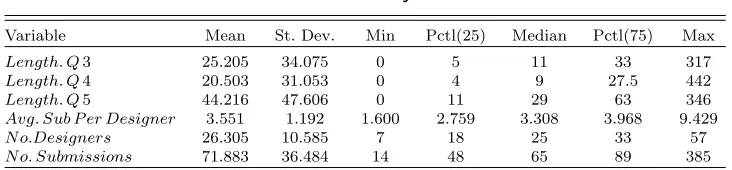
Table 1 reports summary statistics of contest-level characteristics. The first three rows present the
summary statistics for the word count for answers to Q3, Q4, and Q5. In our main empirical
analy-sis, we use word count to measure the amount of information provided in the problem specification.
That is, a longer answer to Q3 indicates more disclosed conceptual objectives, and longer answers
to Q4 and Q5 indicate more execution guidance. We are aware that word count is not a perfect
human or machine coding errors. Later, as robustness checks, we consider alternative measures
constructed using textual analysis and manual coding. Specifically, we use textual analysis to count
keywords related to each aspect of design execution included in the problem specification (e.g.,
colors, fonts, shapes, art styles, etc). However, it is challenging to apply this approach (textual
analysis based on keywords) to extract conceptual objectives, because conceptual objectives are
much less structured and involve a wide range of concepts, which are often embedded in sentences
and sometimes implicitly mentioned. Hence, we hire several coders with design backgrounds to
read the sampled problem specifications, and manually list down the key conceptual objectives in
each problem specification. (See Table EC.1 for summary statistics of these alternative measures.)
Also reported in Table 1 are summary statistics characterizing designers’ behavior, including
their entry (N o.Designers) and effort (Avg. Sub P er Designer) decisions in each contest. We
observe considerable variation in these variables across different contests. Our empirical analysis
[image:14.612.122.488.338.423.2]explores the relationship between characteristics of problem specifications and designers’ behavior.
Table 1 Summary Statistics
Variable Mean St. Dev. Min Pctl(25) Median Pctl(75) Max
Length. Q3 25.205 34.075 0 5 11 33 317
Length. Q4 20.503 31.053 0 4 9 27.5 442
Length. Q5 44.216 47.606 0 11 29 63 346
Avg. Sub P er Designer 3.551 1.192 1.600 2.759 3.308 3.968 9.429
N o.Designers 26.305 10.585 7 18 25 33 57
N o. Submissions 71.883 36.484 14 48 65 89 385
4.2. Empirical Models
Effect of Conceptual Objectives on Number of Participating Designers: To test
Hypoth-esis 1a and HypothHypoth-esis 1b, we estimate Equation (4), which characterizes the relationship between
different types of information provided in problem specification and designers’ entry decisions.
(N o.Designers)q=β0+
Effect of Conceptual objectives
z }| {
β1log(lenQ3+ 1)q +
Effect of Execution Guidance
z }| {
β2log(lenQ4+ 1)q+β3log(lenQ5+ 1)q +α1(N o.U pdates)q+ωIndustry+φW eek Day+δM onth+µY ear.
(4)
In Equation (4), q indexes contests. The number of conceptual objectives contest q’s problem
specification contains is measured by the logarithm of the word count of the seeker’s answer to
Q3 (log(lenQ3+ 1)q), and the amount of execution guidance is proxied by the logarithm of the
word counts of the seeker’s answers to Q4 and Q5 (log(lenQ4+ 1)q and log(lenQ5+ 1)q). (The
log transformation is applied to reduce the skewness of the distribution of the word count of
seekers’ answers to these questions.) We control for the number of times the seeker updates the
problem specification ((N o.U pdates)q) during contestq. We include the industry fixed effect (i.e.,
levels of attractiveness to designers; we also include the year dummies, day-of-week dummies and
month fixed effects to control for possible seasonality effects or contemporaneous unobservables.
Effect of Execution Guidelines on Number of Submissions Per Participating Designer:
Next, we use Equation (5) to empirically test Hypothesis 2a and Hypothesis 2b. Designer i’s
trial effort in contest q is proxied by the number of submissions made by designeri to contest q
((N o.Submissions)i,q). Specifically, we regress (N o.Submissions)i,q on the amounts of different
types of information in the problem specification (proxied bylog(lenQ3+ 1)q,log(lenQ4+ 1)q and
log(lenQ5+ 1)q) and the number of designers (N o.Designersq) in contest q. We control for the
number of updates ((N o.U pdates)q), and include industry dummies, day-of-week dummies, month
dummies, year fixed effects and designer-specific dummies.
(N o.Submissions)i,q=ρ0+
Effect of Conceptual objectives
z }| {
ρ1log(lenQ3+ 1)q+
Effect of Execution Guidance
z }| {
ρ2log(lenQ4+ 1)q+ρ3log(lenQ5+ 1)q +ζ1(N o.U pdates)q+ζ2(N o.Designers)q+υIndustry+χDesigner+ηW eek Day+ιM onth+ψY ear.
(5)
4.3. Empirical Results
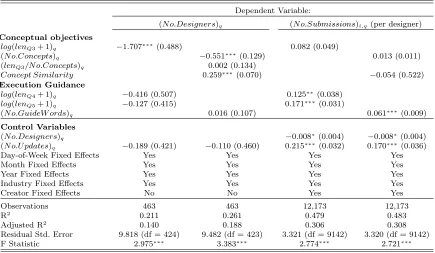
The estimation results for Equation (4) are presented in the first column in Table 2. As can be seen
from the table, the number of participating designers in a contest ((N o.Designers)q) is significantly
negatively associated with the number of conceptual objectives (proxied bylog(lenQ3+ 1)q), which
supports Hypothesis 1a. Additionally, the proxies for the amount of seeker execution guidance
(log(lenQ4+ 1)q and log(lenQ5+ 1)q) are not significantly associated with (N o.Designers)q, which
is consistent with Hypothesis 1b.
The estimation results for Equation (5) are presented in the third column in Table 2. These
results show that (N o.Submissions)i,q is significantly positively correlated with the amount of
seeker execution guidance (measured by log(lenQ4 + 1)q and log(lenQ5 + 1)q). This supports
Hypothesis 2a — more seeker execution guidance leads to more submissions per designer.
More-over, (N o.Submissions)i,q is not significantly associated with the number of conceptual objectives
(log(lenQ3+ 1)q), which supports Hypothesis 2b.
Overall, the regression results (for Equations (4)-(5)) are consistent with our theoretical
predic-tions and support our theoretical model. (Negative binomial count models for Equapredic-tions (4)-(5)
yield qualitatively similar results.)
4.4. Robustness Checks
We perform robustness checks to ensure our empirical results are not sensitive to how we measure
the numbers of conceptual objectives and execution guidelines. In addition, we use
Table 2 Regression Results of Equation (4) and Equation (5) and Corresponding Robustness Checks
Dependent Variable:
(N o.Designers)q (N o.Submissions)i,q(per designer) Conceptual objectives
log(lenQ3+ 1)q −1.707∗∗∗(0.488) 0.082 (0.049)
(N o.Concepts)q −0.551∗∗∗(0.129) 0.013 (0.011)
(lenQ3/N o.Concepts)q 0.002 (0.134)
Concept Similarity 0.259∗∗∗(0.070) −0.054 (0.522) Execution Guidance
log(lenQ4+ 1)q −0.416 (0.507) 0.125∗∗(0.038)
log(lenQ5+ 1)q −0.127 (0.415) 0.171∗∗∗(0.031)
(N o.GuideW ords)q 0.016 (0.107) 0.061∗∗∗(0.009) Control Variables
(N o.Designers)q −0.008∗(0.004) −0.008∗(0.004)
(N o.U pdates)q −0.189 (0.421) −0.110 (0.460) 0.215∗∗∗(0.032) 0.170∗∗∗(0.036)
Day-of-Week Fixed Effects Yes Yes Yes Yes
Month Fixed Effects Yes Yes Yes Yes
Year Fixed Effects Yes Yes Yes Yes
Industry Fixed Effects Yes Yes Yes Yes
Creator Fixed Effects No No Yes Yes
Observations 463 463 12,173 12,173
R2 0.211 0.261 0.479 0.483
Adjusted R2 0.140 0.188 0.306 0.308
Residual Std. Error 9.818 (df = 424) 9.482 (df = 423) 3.321 (df = 9142) 3.320 (df = 9142)
F Statistic 2.975∗∗∗ 3.383∗∗∗ 2.774∗∗∗ 2.721∗∗∗
Note: ∗p<0.05;∗∗p<0.01;∗∗∗p<0.001
possibility that certain contest specific unobservables can affect both designers’ entry and trial
effort decisions, and show the robustness of our empirical results to this assumption.
Alternative Measure for Number of Conceptual objectives: In our main empirical
analy-ses, we uselog(lenQ3+ 1)q (based on word-count) as a proxy for the number of disclosed conceptual
objectives in seekers’ problem specifications. One might argue that different seekers can have
dif-ferent writing styles, e.g., some seekers write in a concise way, while others in a more elaborate
way. In other words, two problem specifications that contain the same amount of information may
have different lengths. To ensure our empirical results are robustness to the measure of conceptual
objectives, we consider an alternative measure that involves manual coding. Specifically, we hire
several coders with design background and ask each of them to independently read the problem
specifications in our dataset, and manually list down the conceptual objectives for each contest.
(The complete coding instructions and resulting data are available from the authors upon request.)
We take the average across coders and use it as an alternative measure for the number of
concep-tual objectives ((N o.Concepts)q) in each problem specification. The average inter-rater reliability
(assessed using Weighted Kappa) is 0.91, which is considered very good (Cohen 1968).
Alternative Measure for Amount of Execution Guidance: In our main empirical analysis,
we uselog(lenQ4+ 1)qandlog(lenQ5+ 1)q based on word-count to proxy for the amount of execution
guidance. We now consider an alternative measure — we use textual analysis to count keywords
problem specification. For example, we count words such as “green”, “red”, “round”, “shining”,
etc., and use the total number of such keywords (N o.GuideW ords)q as an alternative measure for
the amount of execution guidance.
Robustness Checks with These New Measures:With the new measures of the number of
con-ceptual objectives ((N o.Concepts)q) and the amount of execution guidance ((N o.GuideW ords)q),
we make the following modifications to Equations (4)-(5). First, we replace the original measure
of conceptual objectives log(lenQ3+ 1)q with (N o.Concepts)q, and replace the original measure
of execution guidance log(lenQ4+ 1)q &log(lenQ5+ 1)q with (N o.GuideW ords)q. (Note that in
these robustness checks, we replace the measures for both conceptual objectives and execution
guidance at the same time. The conclusions from robustness checks are the same if we replace
the measure for one of them at a time.) Additionally, when measuring conceptual objectives using
(N o.Concepts)q, we also control for the level of overlap among the coded conceptual objectives.
(We compute the semantic similarity of coded objectives based on Wordnet, and use the average
pairwise similarity (Concept Similarity; on a scale of 1-100) to account for the level of overlap
among conceptual objectives.) Finally, in Equation (4), we also add the ratio (lenQ3/N o.Concept)q,
a proxy for in-conciseness, as another control variable.
We estimate the modified Equation (4), and report the estimation results in the second
col-umn of Table 2. The results reveal that (N o.Designers)q is significantly negatively associated
with the measure of the number of conceptual objectives (N o.Concepts)q, but not significantly
associated with the amount of execution guidance (N o.GuideW ords)q, which again supports
Hypothesis 1a and Hypothesis 1b. Additionally, after including (N o.Concepts)q, (N o.Designers)q
is not significantly associated with the in-conciseness ((lenQ3/N o.Concepts)q), which further
ver-ifies that (N o.Designers)q is affected by the number of conceptual objectives (Hypothesis 1a),
rather than the conciseness of seekers’ expression for each objective. It is also worth noting that
(N o.Designers)q is significantly positively associated withConcept Similarity, which supports an
additional theoretical result from the extension (which we relegate to Online Appendix EC.4.1 to
save space) accounting for the overlap across conceptual objectives — the number of participating
designers in a contest increases with the overlap across conceptual objectives, everything else equal.
We next estimate the modified Equation (5), and report the estimation results in the last column
in Table 2. The results again support Hypothesis 2a and 2b: (N o.Submissions)i,q is significantly
positively associated with the measure of the amount of execution guidance (N o.GuideW ords)q,
but not significantly associated with the number of conceptual objectives (N o.Concepts)q.
Seemingly Unrelated Regression System: We further consider the possibility that certain
contest-specific unobservables can affect both designers’ entry and trial effort decisions. If this
model and estimate the SUR, and find that the results are almost the same as OLS regression
results.
5.
Managing the Problem Specification
In the previous sections, we explored how designers’ entry, concept formulating and trial effort
decisions are influenced by the conceptual objectives and execution guidelines a seeker provides in
his problem specification. Based on our empirically validated theoretical model, in this section we
analyze how seekers should provide information in their problem specification to maximize their
“profit” in crowdsourcing design contests.
A seeker’s profit (Πs) is defined as the expected highest quality among all the designs submitted
to his contest, i.e., Πs=EmaxiVi∗, whereVi∗ is the equilibrium quality of designeri’s best design, and the expectation is taken over the vector of all participating designers’ design trials’ quality
shocks . (For simplicity, the “profit” ignores the cost of the awardA, as this is a fixed value and
we are focusing on how the seeker optimizes the problem specification given an award size A).
The seeker maximizes Πs by choosingthe number of conceptual objectives to disclose (Sr) and the
amount of execution guidance to provide (Sg). We define the seeker’s problem as:
max Sr≤Sr,Sg≤Sg
Πs(Sr, Sg) = max Sr≤Sr,Sg≤Sg
h Emax
i∈N∗V
∗
i (r
∗, m∗)i, (6)
whereN∗ is the equilibrium number of participating designers, andr∗ and m∗ are the equilibrium
design concept formation and trial generation strategies of participating designers. Problem (6) is
a joint problem in bothSr and Sg. From Theorem 1, we know the impacts fromSr and Sg can be
separated: N∗ and r∗ are only affected by Sr but not bySg; and givenN∗,m∗ is only affected by
Sg but not by Sr. So, we can rewrite Problem (6) as the following problem separable inSr and Sg
(see Appendix B for the proof):
Lemma 1.
max Sr≤Sr,Sg≤Sg
Πs(Sr, Sg) = max Sr≤Sr
h
w·r∗(Sr) +µlnA
N∗(Sr)−1)
N∗(S
r)
i
+ max Sg≤Sg
[−µln(h(Sg))]. (7)
With the seeker’s decisions on Sr and Sg being separable (Problem (7)), we next discuss how the
seeker should setSr andSg separately.
Seeker’s Decision on Number of Conceptual Objectives to Disclose.We first consider the
problem associated with the seeker’s optimal choice ofSr, the number of conceptual objectives to
disclose in the problem specification. The seeker’s objective is to choose a Sr that maximizes the
expected quality of the best design sourced from the contest under any fixed amount of execution
Proposition 1. Πs(Sr;Sg) decreases in Sr once Sr becomes sufficiently large, and thus for
sufficiently large S¯r, we have S∗r<S¯r. Details are in Appendix C.
The seeker’s profit Πs is first increasing and eventually decreasing with Sr. The intuition is as
follows. Disclosing more conceptual objectives has two countervailing effects. On the one hand, with
more conceptual objectives being disclosed, designers are aware of and thus can incorporate more
objectives, which leads to a higher expected quality of each design generated, positively affecting
the best design quality Πs(Sr). We call this effect the “quality effect”. On the other hand, with more
disclosed objectives, the designers’ total participating cost increases (higher costs in the design
problem framing anddesign concept formulating stages), leading to fewer designers participating in
the contest. We call this the“competition effect”. Thiscompetition effectnegatively affects the best
design quality Πs(Sr), because Πs(Sr) is an extreme value of qualities of all design submissions,
which will decrease if there are fewer participating designers.
As the seeker discloses more and more conceptual objectives (a larger Sr), the negative
com-petition effect increases and eventually dominates the quality effect, because (i) design concept
formation cost grows exponentially with Sr, hence the number of designers decreases quickly, (ii)
with only a handful of designers in the contest, a small decrease in the number of participating
designers would have a severe impact on the extreme value Πs(Sr). As a result, Πs(Sr) will decrease
when the seeker discloses too many conceptual objectives. Therefore, the seeker should not always
disclose all the conceptual objectives he cares about. For reasonable parameter ranges, simulation
results suggest that the optimalS∗
r is relatively small (from 2 to 5); see Appendix C.
Seeker’s Decision on Number of Execution Guidelines to Provide. Next, we consider
the seeker’s problem of choosing a Sg that maximizes the expected quality of the best design
sourced from the contest under any fixed level of conceptual objectives provided (Sr), i.e.,
maxSg≤SgΠs(Sg;Sr). This problem is trivial, since providing more execution guidelines (Sg) always
increases best design quality. Intuitively, as the seeker provides more execution guidelines (a larger
Sg), it is easier for designers to come up with design trials (a lower trial cost c3), because the
execution guidelines give directions for different aspects of design execution (such as color, shape,
etc.), which designers otherwise need to spend effort figuring out and deciding on. Hence, with the
lowered cost to generate each design trial, designers will come up with more trials (a larger m∗),
which then in turn leads to a higher extreme value in submission quality (a higher Πs). Therefore,
the seeker should disclose all his execution guidelines (i.e., S∗
g=Sg).
6.
Further Evidence from the Field
In this section, we discuss a recent change to the crowdsourcing platform we collect data from:
not only validates our earlier suggestions on how seekers should provide information in problem
specifications, but also introduces an exogenous shock to seeker problem specification behavior on
the platform and thus provides an opportunity for us to further identify the effects of disclosing
conceptual objectives and execution guidelines on designers’ behavior.
The update took place in summer 2017. The update involves two major adjustments. First, the
platform provided an example when prompting the seeker to specify conceptual objectives (i.e.,
“top 3 things to communicate”). This example only includes three sample keywords. Potentially,
this short three-keyword example can lead seekers to shorten their list of conceptual objectives.
Second, the updated template changed the way the seeker provides execution guidelines. Instead
of providing a short text answer to the “what logo styles do you prefer” question in a text box,
seekers are asked to answer four multiple choice questions, including logo usage (e.g. screen/digital,
clothing), preferred logo style (e.g. image+text, image only), preferred fonts (e.g. sans-serif, mono),
colors to explore (e.g. aqua, green). The multiple choice question format can potentially reduce
the cost for seekers to provide execution guidelines. (In our model, we concluded that the seeker
should provide all his execution guidelines but we did not include a cost of doing so. One can easily
imagine that, if there are costs associated with the seeker coming up with or disclosing execution
guidelines, the seeker will stop providing more when the marginal cost of providing an additional
guideline exceeds the marginal benefit from doing so.) The multiple choice question format can
also remind them to provide guidelines on each of these four aspects of logo designs. But at the
same time, it limits the guidelines the seeker can provide — the seeker is not expected to provide
guidelines on other logo features beyond usage, style, font and color. Therefore, the direction of
the effect of this second adjustment is not very clear.
Since this update does not affect how seekers answer Question 5 (Q5) much, we do not consider
Q5 in the following analysis. Besides the two main changes described above, we also observe that
the platform added a new area called “vision” in the template. This new area is located below
the “top 3 things” box, providing additional space for the seeker to elaborate what message he
envisions a logo to convey. We find that most of the time, content provided in the “vision” area
does not involve introducingadditional conceptual objectives. In the manual coding of conceptual
objectives for contests that took place after the website update, we incorporate the occasional
additional objectives that are mentioned in the “vision” area but do not appear in the “top 3
things” box.
This update shows that the platform recognizes problem specification as a crucial design
ele-ment for crowdsourcing design contests, and distinguishes among different types of information
Moreover, the example the platform provides for specifying the “top 3 things” is also aligned with
our recommendation not to specify too many conceptual objectives.
In addition, the website update provides an exogenous shock to how seekers specify their
prob-lems. In the empirical analysis presented in Section 4, the identification of the effects of the number
of disclosed conceptual objectives and the number of execution guidelines relies on cross-contest
variations in the amounts of these two types of information provided under the same website
lay-out. One may argue that these variations could be driven by seekers’ unobserved idiosyncratic
characteristics, and if those seeker characteristics can also affect designers’ participation behavior,
then the regression models presented earlier may suffer from an endogeneity problem. The update
to the problem specification template imposes an exogenous shock on the number of conceptual
objectives and execution guidelines, which is unlikely to be correlated with seekers’ idiosyncratic
characteristics, allowing us to better identify the effects of conceptual objectives and execution
guidelines on designers’ participation behavior.
Specifically, we collect additional data on all logo design contests that took place on the platform
three months before and three months after the update. As in the empirical analysis presented
in Section 4, we focus on contests where the design seekers promise to give a $200 award to one
and only one winner. (However, we include contests that are not only 7-days long to increase the
statistical power of the test.) The contests that took place during the transition of the platform
website (i.e., 10 days before and after August 31, 2017) are excluded. This new sample consists
of 214 contests (6,070 contest-designer combinations). Below, we first establish how the template
update affects the numbers of conceptual objectives and execution guidelines seekers provide in
their problem specification, and then study how these changes in seekers’ problem specification
affect designers’ entry and trial effort decisions.
Conceptual objectives:We first test whether the number of conceptual objectives decreases, as
expected, after the website update. Specifically, we compare how many words there are in seekers’
answers to Q3 (i.e., using the seeker’s answer to the “top 3 things” question as a proxy for the
number of conceptual objectives) before and after the template update — the average word-count
for Q3 before the update (Len(Q3)pre
q ) is 30.02, and the average word-count after the update
(Len(Q3)post
q ) is 8.75, and the difference is statistically significant (p-value<0.001; details of T-tests
are in Appendix D). We also compare the number of manually coded conceptual objectives before
and after the update, and the results are similar — the average number of conceptual keywords
before the update ((N o.Concept)pre
q ) is 5.72, and the number after the update ((N o.Concept)
post
q )
is 3.81, and the difference is also statistically significant (p-value<0.001). In the manual coding
3 things” and “vision” areas. These results suggest that seekers indeed provide fewer conceptual
objectives after the update.
Next we examine how fewer disclosed conceptual objectives affect designer behaviors. Specifically,
we regress the number of designers in each contest on the the dummy variable I(post-update)q,
which indicates whether the focal contest took place after the website update. We include contest
duration, and Day-of-Week dummies in the regression as control variables. Additionally, we include
“Week Slope” in the regression model, to control for any time trend that may exist prior to the
website update. The estimation results for this regression are shown in the first column of Table 3.
The estimated coefficient of the dummy variable I(post-update)q is positive and significant,
indi-cating that after the update, the number of participating designers increases. This result, combined
with the finding that after the website update, seekers disclose fewer conceptual objectives, again
supports Hypothesis 1a, which hypothesizes that the number of participating designers decreases
with the number of disclosed conceptual objectives. (In a robustness check, we test and verify that
the increase in (N o.Designers)qis indeed due to the decrease in the number of disclosed objectives,
but not other concurrent changes to the platform resulting from this update. Details are provided
[image:22.612.125.483.406.590.2]in Appendix D.)
Table 3 Regression Results for the Update’s Impacts on Contests’ Outcomes
Dependent Variable:
(N o.Designers)q (N O Submission)i,q
I(post-update)q 10.579∗∗(3.779) −0.872∗∗(0.313)
I(short Q4)q∗I(pre-update)q 0.772 (0.384)
I(long Q4)q∗I(pre-update)q 1.213∗∗∗(0.354)
Control Variables
(N o.Designers)q −0.004 (0.004) −0.004 (0.004)
Durationq 0.650∗∗(0.195) 0.035∗∗(0.011) 0.028∗(0.011)
Week Slope Yes Yes Yes
N o.U pdates Yes Yes Yes
Industry Fixed Effects Yes Yes Yes
Designer Fixed Effects No Yes Yes
Day-of-Week Fixed Effects Yes Yes Yes
Observations 214 6,070 6,070
R2 0.323 0.316 0.318
Adjusted R2 0.199 0.211 0.213
Residual Std. Error 12.136 (df = 180) 3.337 (df = 5262) 3.333 (df = 5261)
F Statistic 2.604∗∗∗ 3.011∗∗∗ 3.033∗∗∗
Note: ∗p<0.05;∗∗p<0.01;∗∗∗p<0.001
Execution Guidelines:Since the platform updated the form of execution guidelines from
open-ended descriptions to multiple choice questions, we cannot directly measure the change in the
number of execution guidelines; however, we notice some changes in the information provided.
Prior to the update, the number of guidelines provided varies a lot from seeker to seeker — some
seekers provide extremely detailed execution guidelines, including suggestions for shape, color, and
that the logo doesn’t rely on silver and gold effects, need a color palette that is easily translatable to
web. Please do not use green, blue or maroon.”), whereas others provide very brief guidelines (e.g.,
“image+text”). After the update, this seeker heterogeneity no longer exists, because all seekers are
now required to answer the exact same set of multiple-choice questions.
We regress the number of submissions per designer on the post-update dummy, controlling for
the number of designers in the same contest, contest duration, Day-of-Week dummies and week
slope. The regression results are reported in the second column of Table 3. Quite surprisingly,
the coefficient of I(post-update)q turns out to be negative and significant, suggesting that on
average each designer submits fewer designs after the update. Why is this the case? One possible
explanation is that, as mentioned previously, the template update removes seeker heterogeneity
in execution guideline provision. Prior to the update, some seekers are willing to provide detailed
guidelines, and others are not. For seekers who would provide few execution guidelines in the
open-ended Q4 template, the switch to the standardized questionnaire may have increased the number
of guidelines they provide; whereas for seekers who would provide detailed guidelines in the
open-ended Q4 template, the switch in fact limits the amount of execution guidance they can provide. An
average negative effect reflected in the negative estimated coefficient of I(post-update)q seems to
suggest that more seekers suffer the negative effect of the switch to the standardized questionnaire
format than those who benefit from it.
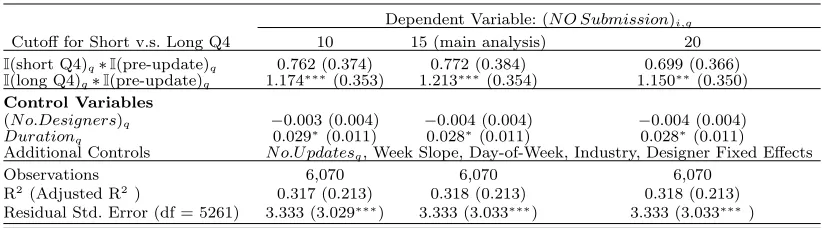
To test whether this explanation is supported by the data, we use I(short Q4)q∗I(pre-update)q
andI(long Q4)q∗I(pre-update)q to substitute for theI(post-update)q dummy variable in the
regres-sion of the number of submisregres-sions per designer described above, with I(short Q4)q (I(long Q4)q)
indicating the focal contest having less (more) than 15 words in the Q4 answer. In doing so,
we treat the post-update contests as the baseline group, and separately evaluate the difference
in the number of submissions per designer between the post-update contests and pre-update
contests with short (I(short Q4)q) v.s. long (I(long Q4)q) execution guidelines. The results of
the regression are presented in the third column of Table 3. The coefficient of the interaction
term I(short Q4)q∗I(pre-update)q is insignificant, whereas the coefficient of the interaction term
I(long Q4)q∗I(pre-update)q is significant and positive. These results align with our conjecture:
pre-update seekers who provide a lot of execution guidelines on average receive more submissions
from each participating designer, compared with seekers using the new multiple-choice format;
seekers using the new multiple-choice format can only achieve a similar number of submissions per
participant as pre-update seekers who provide few execution guidelines.
To fully understand the mechanism driving the difference in outcome between long- and
short-guideline contests, we perform a textual analysis to understand the exact change in the content of
seeker-provided execution guidelines into seven categories (colors, logo styles, shapes, font, usage,
art styles, and resources). For each problem specification in the sample (to increase the statistical
power we include all single-guaranteed-award contests from March 2012 to November 2014, and
control for the award amount and contest duration), we note down whether the seeker provides any
information in each of these seven categories. Then we regress the number of submissions made by
each participating designer on the seven dummy variables indicating whether the seeker provides
guidelines in the corresponding categories, as well as a similar set of control variables as those
appearing in Table 3. The results of this regression (reported in Table D.3 in Appendix D to save
space in the body), provides several interesting observations. (1) Providing guidelines for “color”
and “logo style”, two of the four categories included in the new multiple-choice format, is not very
helpful in increasing the number of submissions made by each designer. (2) Providing guidelines for
“shape” and “art style”, information categories that are not included in the new multiple-choice
format, has a significant positive effect on the number of submissions per participating designer.
(3) The multiple-choice format limits the amount of information the seeker can provide for each
category. Consider “usage” as an example. After the update, the seeker can only choose from
the five options provided (outdoor, clothing, screen/digital, print, signature); whereas, prior to
the update, seekers could, and in fact did provide more detailed information about logo usage
(e.g. embroidery, building, banner, sticker, letterhead, device, t-shirt, vest, uniform, hat, etc). All
these results suggest that the new multiple-choice format appears to be less effective for execution
guideline provision than the old open-ended format, and therefore, this change may have increased
designers trial cost (c3 in our analytical model), which then leads to the decrease in the number of
submissions per participant we observe in the data. This result further supports Hypothesis 2a.
To sum up, the recent website update discussed above underscores the importance of managing
the problem specification, especially the seeker’s provision of conceptual objectives and executive
guidelines. The update related to the conceptual objective provision is successful — as discussed in
Section 5, disclosing fewer conceptual objectives may increase the number of participants, which is
beneficial to the seeker. On the other hand, the update related to the execution guideline provision
is not very effective. The convenient multiple-choice format is intended to encourage seekers to
provide more execution guidelines; however, empirical data suggest that this new format may have
limited the amount and the variety of execution guidance the seeker can provide, and consequently,
has a negative effect on the number of submissions made by each participating designer, especially
in contests where seekers are willing to provide detailed execution guidance if possible.
7.
Conclusion
Crowdsourcing contests are an increasingly popular way to source solutions to design problems
(creative problems). How to optimally specify problems for such contests is an important