R E S E A R C H
Open Access
Maximum norm error estimates of
fourth-order compact difference scheme for
the nonlinear Schrödinger equation involving
a quintic term
Hanqing Hu
1and Hanzhang Hu
1**Correspondence: [email protected] 1School of Mathematics, Jiaying
University, Meizhou, P.R. China
Abstract
A compact finite difference (CFD) scheme is presented for the nonlinear Schrödinger equation involving a quintic term. The two discrete conservative laws are obtained. The unconditional stability and convergence in maximum norm with orderO(
τ
2+h4)are proved by using the energy method. A numerical experiment is presented to support our theoretical results.
Keywords: Schrödinger equation involving a quintic term; Compact finite difference scheme; Conservation; Convergence; Unconditional stability; The max norm
1 Introduction
The Schrödinger (NLS) equation is one of the most important equations of mathematical physics with applications in many fields [1–4] such as plasma physics, nonlinear optics, water waves, and bimolecular dynamics. There are many studies on numerical approaches, including finite difference [5–11], finite element [12–14], and polynomial approximation methods [15, 16], of the initial or initial-boundary value problems of the Schrödinger equations. We consider the initial-boundary value problem for the NLS equation involv-ing a quintic term:
i∂u ∂t +
∂2u
∂x2 –
|u|2+|u|4u=f(x,t)u (x
l<x<xr, 0 <t≤T), (1.1)
u(x, 0) =u0(x) (xl<x<xr), (1.2)
u(xl,t) =u(xr,t) = 0 (0 <t≤T), (1.3)
whereu(x,t) is a complex function,f(x,t) is a real function,u0(x) is a prescribed smooth
function, andi2= –1.
Computing the inner product of equation (1.1) withuand∂u
∂t and then taking the imagi-nary part and the real part, respectively, the two conservative laws are obtained as follows:
Q(t) =u2L2=Q(0), (1.4)
E(t) =∂u
∂x
2
L2
+
xr
xl
1 2|u|
4+1
2|u|
6
dx=E(0) –
t
0
xr
xl
f(x,t)∂
∂t|u|
2dxdt, (1.5)
where · L2 is theL2norm.
Zhang et al. found that the nonconservative schemes may easily show nonlinear blow-up when studying for NLS equation, so they presented a conservative difference scheme in [11]. Moreover, extensive mathematical and numerical studies have been carried out for the NLS equations in the literature [17–28]. Zhang presented a difference scheme for the NLS equation involving a quintic term [27], and it was proved with orderO(τ2+h2). Then,
in [28] Wang proposed a new difference scheme for NLS equation involving a quintic term and showed that convergence rates of the present scheme were of orderO(τ2+h4). Wang
presented a compact finite difference scheme for the NLS equation in [22], which provided a new thinking on the theoretical proving of a compact difference scheme. There are lots of literature works concerning the Schrödinger equations using different treatments, but, to the best of our knowledge, there are few results of unconditional maximum norm con-vergence of compact difference scheme for NLS equations involving a quintic term. Thus, the purpose of this paper is to prove maximum norm error estimates of a fourth-order compact difference scheme for the NLS equation involving a quintic term.
The remainder of this paper is organized as follows. A fourth-order compact difference scheme is proposed in Sect.2. The discrete conservation laws of the difference scheme are discussed in Sect.3. In Sect.4, the convergence and stability for the compact difference scheme are proved. In the last section, numerical results will be discussed.
2 Some notations and compact finite difference scheme
For simplicity of exposition, some notations are firstly introduced. Thus, the following notations for difference operators are used:
δtunj = un
j –unj–1
τ , δxu
n j =
un j+1–unj
h , δx¯u n j =
un j –unj–1
h , u
n+12
j = un+1
j +unj
2 ,
δ2xunj =δxδ¯xunj = un
j–1– 2unj +unj+1
h2 , Ahu
n j =unj +
h2
12δ
2
xunj = 1 12
unj–1+ 10unj +unj+1,
whereh=xr–xl
J andτ= T
N are step sizes of space and time, respectively, andJ,Nare two positive integers.
For anyuuu,vvv∈Vh={vvv|vvv= (v0,v1, . . . ,vJ),v0=vJ= 0}, the inner product is defined as
(uuu,vvv) =h J–1
j=1
ujv¯j.
The discrete norms ofuare defined as
uuupp=h J–1
j=1
|uj|p, δxuuu2=h J–1
j=0
|δxuj|2, uuu∞= max
1≤j≤J–1|uj|.
For simplicity, we define {Un
j} as the exact solution and{unj}as the numerical one. Let
different values at different occurrences. For the exact solution of the initial-boundary value problem (1.1)–(1.3), we assume that
max Un,δxUn,Un∞
≤C. (2.1)
Now, we present the following compact finite difference scheme for problem (1.1)–(1.3):
iAhδtunj + 1 2δ
2
x
unj+1+unj–1 4Ahu
n+1
j
2
+unj2unj+1+unj
–1 6Ahu
n+1
j
4
+unj+12unj2+unj4unj+1+unj=Ah
fn+12u
n+1
j +unj 2
(j= 1, 2, . . . ,J– 1,n= 1, 2, . . . ,N– 1), (2.2)
un0=unJ = 0 (n= 1, 2, . . . ,N), (2.3)
u0J =u0(xj) (j= 1, 2, . . . ,J). (2.4)
Let
u u
un=un0,un1, . . . ,unJ–1T,
uuun+12+uuun2=diagdiagdiagun0+12+un02, . . . ,uJn–1+12+unJ–12.
(2.2) can be rewritten as
iMMMδtuuun+ 1 2δ
2
x
u
uun+1+uuun–1 4MMMuuu
n+12+uuun2uuun+1+uuun
–1 6MMMuuu
n+14+uuun2uuun+12+uuun4uuun+1+uuun=MMMfn+12uuun+1+uuun
2 ,
n= 1, 2, . . . ,N– 1,
where the matrixMis defined by
M M M= 1
12
⎛ ⎜ ⎜ ⎜ ⎜ ⎝
10 1 0 · · · 0
1 10 1 · · · 0
. .. ... ...
0 · · · 0 1 10
⎞ ⎟ ⎟ ⎟ ⎟ ⎠
(J–1)×(J–1)
.
M
MMis a tridiagonal symmetric matrix, and there is a symmetric positive definite matrixHHH
such thatHHH=MMM–1. Thus, the compact finite difference scheme (2.2)–(2.4) can be rewritten
as the following matrix equation:
iδtuuun+ 1 2HHHδ
2
x
u
uun+1+uuun–1 4uuu
n+12+uuun2uuun+1+uuun
–1 6uuu
n+14+uuun+12uuun2+uuun4uuun+1+uuun=fffn+12uuun+1+uuun
2
un0=unJ = 0 (n= 1, 2, . . . ,N), (2.6)
u0J =u0(xj) (j= 0, 1, 2, . . . ,J). (2.7)
3 Some useful lemmas and discrete conservation laws
Lemma 3.1([29]) For any two mesh functions uuu,vvv∈Vh,there is
h J–1
j=1
δx2uj
¯ vj= –h
J–1
j=1
(δxuj)(δxv¯j).
Lemma 3.2([22]) For any real symmetric positive definite matrices HHH,we have
ReHHHδ2xuuun+1+uuun,uuun+1–uuun= –RRRδxuuun+12–RRRδxuuun2
,
where RRR is obtained by the Cholesky decomposition for HHH,denoted as RRR=chol(HHH).
Theorem 3.1 The difference scheme(2.2)–(2.4)is conservative in the sense
Qn=uuun=Qn–1=· · ·=Q0, (3.1)
En=RRRδ xuuun
2
+1 2uuu
n4
4+
1 3uuu
n6
6+h
J–1
j=1
fn–
1 2
j unj
2
=En–1+h J–1
j=1
fn–
1 2
j –f n–32
j u n j
2
=E0+ n
l=1
J–1
j=1
fl–
1 2
j –f l–32
j u n j
2
h, (3.2)
for n= 1, 2, . . . ,N,where Qnis discrete mass,Enis discrete energy.
Proof Computing the inner product of (2.2) withuuun+1+uuunand then taking the imaginary part, we obtain
I1+I2–I3–I4=I5,
where
I1=Im
iδtuuun,uuun+1+uuun
=Reδtuuun,uuun+1+uuun
=1
τuuu
n+12–uuun2,
I2=
1 2Im
HHHδx2uuun+1+uuun,uuun+1+uuun= –2ImRRRδxuuun+
1 2,RRRδ
xuuun+
1 2= 0,
I3=
1 4Imuuu
n+12
+uuun2uuun+1+uuun,uuun+1+uuun= 0,
I4=
1 6Imuuu
n+14+uuun+12uuun2+uuun4uuun+1+uuun,uuun+1+uuun= 0,
I5=
1 2Im
We can obtain
uuun+12–uuun2= 0.
Then we have
Qn=uuun=Qn–1=· · ·=Q0.
Computing the inner product of (2.2) withuuun+1–uuun, and then taking the real part, we get
I6+I7–I8–I9=I10,
where
I6=Reτ
iδtuuun,δtuuun
= 0,
I7=
1 2Re
HHHδx2uuun+1+uuun,uuun+1–uuun= –1 2RRRδxuuu
n+12
–RRRδxuuun
2
,
I8=
1 4Reuuu
n+12
+uuun2uuun+1+uuun,uuun+1–uuun=1 4uuu
n+14 4–uuu
n4 4
,
I9=
1 6Reuuu
n+14+uuun+12uuun2+uuun4uuun+1+uuun,uuun+1–uuun
=1
6uuu n+16
6–uuu
n6 6
,
I10=
1 2Re
fffn+12uuun+1+uuun,uuun+1–uuun=h
2 J–1
j=1
fn+12un+1
j
2
–unj2.
Let
En=RRRδxuuun2+ 1 2uuu
n4 4+
1 3uuu
n6 6+h
J–1
j=1
fn–
1 2
j unj
2
.
We can obtain
En=En–1+h J–1
j=1
fn–
1 2
j –f n–32
j u n j
2
.
Summing up for n, we have
En=E0+ n
l=1
J–1
j=1
fl–
1 2
j –f l–32
j unj
2
h.
4 Numerical analysis
To obtain the error estimate in the maximum norm, we need the following lemmas.
Lemma 4.1(Discrete Sobolev’s inequality [30]) Suppose that ujis mesh functions.Given ε≥0,there exists a constant C dependent onεsuch that
Lemma 4.2 (Gronwall’s inequality [30]) Suppose that the nonnegative mesh function {un|n= 0, 1, 2, . . . ,N,Nτ =T}satisfies the inequality
un≤A+τ n
l=1
Bkuk,
where A and Bk(k= 1, 2, . . . ,N,Nτ =T)satisfying the inequality are nonnegative constants. Then,for any0≤n≤N,there is
un∞≤Ae2τNk=1Bk,
whereτ is sufficiently small such thatτ(maxk=1,2,...,NBk)≤12.
Lemma 4.3([22]) For any real symmetric positive definite matrices HHH,there exist two
pos-itive numbers C∗and C∗such that
C∗uuun2≤HHHuuun,uuun≤C∗uuun2.
Theorem 4.1 Suppose that|f(x,t)| ≤M1,|ft(x,t)| ≤M2,u0∈H01,then, for any n(0≤
nτ ≤T),the following estimates hold:
uuun≤C, uuun∞≤C.
Proof From (3.1), we have
uuun≤C. (4.1)
From (3.2), we obtain
RRRδxuuun
2
+1 2uuu
n4 4+
1 3uuu
n6 6+h
J–1
j=1
fn–
1 2
j unj
2
=E0+ n
l=1
J–1
j=1
fl–
1 2
j –f l–32
j unj
2
h,
thus, we have
RRRδxuuun
2
≤E0+ n
l=1
J–1
j=1
fl–
1 2
j –f l–32
j unj
2
h–h J–1
j=1
fn–
1 2
j unj
2
.
On the one hand, from (4.1), we have
RRRδxuuun
2
≤E0+ n
l=1
J–1
j=1
fl–
1 2
j –f l–32
j unj
2
h–h J–1
j=1
fn–
1 2
j unj
2
≤E0+M1h
J–1
j=1
un j
2
+h n
l=1
J–1
j=1
∂f∂t
(j,l+θ)
·ulj2
On the other hand, from Lemma4.3, we have
RRRδxuuun2=
H
HHδxuuun,δxuuun
≥C∗δxuuun2.
Then we see that
δxuuun≤C. (4.2)
From (4.1)–(4.2) and Lemma4.1, we obtain
uuun∞≤C. (4.3)
Suppose that the truncation error
rrrn=rn0,rn1, . . . ,rnJ–1T∈Vh,
then we have
rrrn=iδ tUUUn+
1 2HHHδ
2
x
U
UUn+1+UUUn–1 4UUU
n+12+UUUn2UUUn+1+UUUn
–1
6UUU
n+14+UUUn2UUUn+12+UUUn4UUUn+1+UUUn–fffn+12UUU
n+1+UUUn
2 . (4.4)
According to Taylor’s expansion, the following can be easily obtained.
Lemma 4.4 Suppose that u0(x)∈H01,u(x,t)∈C6,3,then we have
rnj≤Oh4+τ2, (4.5)
δtrjn≤O
h4+τ2. (4.6)
Lemma 4.5 [[22]]For u={u0,u1, . . . ,un,un+1}and g={g0,g1, . . . ,gn–1,gn},we have
2τ
n
l=0
glδtul
≤u0
2
+τ n
l=1
ul2+un+12+g02+τ n–1
l=0
δtgl2+gn2. (4.7)
Theorem 4.2 Suppose that the conditions of Theorem4.1and Lemma4.4are satisfied,
then the numerical solution of scheme(2.2)–(2.4)converges to the solution of problem(1.1)–
(1.3)with order O(h4+τ2)in the discrete · ∞norm.
Proof Let
eeen=UUUn–uuun.
Subtracting (2.5) from (4.4), we obtain
rrrn=iδteeen+ 1 2HHHδ
2
x
eeen+1+eeen–1 4FFF
n–1 6GGG
n–fffn+12eee
n+1+eeen
where
F F
Fn=UUUn+12+UUUn2UUUn+1+UUUn–uuun+12+uuun2uuun+1+uuun,
G G
Gn=UUUn+14+UUUn+12UUUn2+UUUn4UUUn+1+UUUn
–uuun+14+uuun+12uuun2+uuun4uuun+1+uuun,
F F
Fn=UUUn+12+UUUn2UUUn+1+UUUn–uuun+12+uuun2uuun+1+uuun
=UUUn+12+UUUn2–uuun+12+uuun2UUUn+1+UUUn
+uuun+12+uuun2eeen+1+eeen
=UUUn+1eee¯n+1+eeen+1UUU¯n+1+UUUneee¯n+eeenUUU¯nUUUn+1+UUUn+uuun+12
+uuun2eeen+1+eeen.
(4.9)
Noting thatF0n=FJn= 0, from (2.1), (4.9), and Theorem4.1, we have
FFFn2≤Ceeen2+eeen+12. (4.10)
Similarly, we obtain
δxFFFn2≤Ceeen2+eeen+12+δxeeen2+δxeeen+12
, (4.11)
G G
Gn=UUUn+14+UUUn+12UUUn2+UUUn4UUUn+1+UUUn
–uuun+14+uuun+12uuun2+uuun4uuun+1+uuun
=UUUn+14+UUUn+12UUUn2+UUUn4–uuun+14+uuun+12uuun2+uuun4
×UUUn+1+UUUn
+uuun+14+uuun+12uuun2+uuun4eeen+1+eeen
=UUUn+12+UUUn+12UUUn+1eee¯n+1+eeen+1UUU¯n+1+UUUn2+UUUn2UUUneee¯n+eeenUUU¯n
+uuun2UUUn+1eee¯n+1+eeen+1uuu¯n+1+uuun+12UUUneee¯n+eeenuuu¯nUUUn+1+UUUn
+uuun+14+uuun+12uuun2+uuun4eeen+1+eeen. (4.12)
Similarly, we obtain
GGGn2≤Ceeen2+eeen+12, (4.13)
δxGGGn
2
≤Ceeen2+eeen+12+δxeeen
2
+δxeeen+1
2
. (4.14)
Computing the inner product of (4.9) withen+1+enand taking the imaginary part, we have
Imrrrn,eeen+eeen+1
=Imiδteeen,eeen+eeen+1
+ImHHHδ2xeeen+eeen+1,eeen+eeen+1–1 2Im
FFFn,eeen+eeen+1
–1
3Im
G G
Gn,eeen+eeen+1–1 2Im
For each term on the right-hand side of (4.15), we bound them as follows:
Imiδteeen,eeen+eeen+1
=1
τeee
n+12–eeen2. (4.16)
As to the second term
ImHHHδ2xeeen+eeen+1,eeen+eeen+1= 4ImRRRδxeeen+
1
2,RRRδxeeen+12= 0. (4.17)
For the last three terms on the right-hand side of (4.15), by using the Cauchy–Schwarz inequality, we obtain
12ImFFFn,eeen+eeen+1≤1
4
F FFn2+1
2eee n2
+eeen+12
≤Ceeen2+eeen+12, (4.18)
13ImGGGn,eeen+eeen+1≤1
6
G GGn2+1
2eee
n2+eeen+12
≤Ceeen2+eeen+12, (4.19)
1 2Im
fffn+12eeen+eeen+1,eeen+eeen+1≤Ceeen2+eeen+12. (4.20)
For the term on the left-hand side of (4.15), we have
Imrrrn,eeen+eeen+1≤1
2
rrrn2+1 2eee
n2
+eeen+12. (4.21)
From (4.15)–(4.21), we can obtain
eeen+12–eeen2≤τrrrn2+Cτeeen2+eeen+12. (4.22)
Summing (4.22) up forn, we have
eeen2≤Oh4+τ22+Cτ
n
l=1
eeel2+eeel+12. (4.23)
Whenτis small enough, it follows from Lemma4.2that
eeen≤Oh4+τ2. (4.24)
Computing the inner product of (4.8) withδteeenand taking the real part, we have
Rerrrn,δteeen
=Reiδteeen,δteeen
+1 2Re
H
HHδx2eeen+eeen+1,δteeen
–1
4Re
FFFn,δteeen
–1 6Re
G GGn,δteeen
–1
2Re
fffn+12eeen+eeen+1,δ
teeen
. (4.25)
For each term on the right-hand side of (4.25), we bound them as follows:
Reiδteeen,δteeen
For the second term, it follows from Lemma3.1that 1 2Re H H
Hδ2xeeen+eeen+1,δteeen
=–1
2τRRRδxeee
n+12–RRRδ
xeeen
2
. (4.27)
As to the third term, it follows from (4.8) that
δteeen=i 1 2HHHδ
2
x
eeen+1+eeen– i 4FFF
n– i 6GGG
n–ifffn+12eeen+1+eeen
2 –irrr
n. (4.28)
By using the Cauchy–Schwarz inequality, we obtain
ReFFFn,δteeen
=1
2Re
FFFn,iHHHδx2eeen+1+eeen– i 4FFF
n– i 6GGG
n–ifffn+12eeen+1+eeen
2 –irrr
n
=–1
2 Im
FFFn,HHHδ2xeeen+1+eeen+1 6Im
FFFn,GGGn
+Im
F F Fn,fffn+12eee
n+1+eeen 2
+ImFFFn,rrrn
=1
2Im
RRRδxFFFn,RRRδx
eeen+1+eeen+1 6Im
FFFn,GGGn
+Im
F F Fn,fffn+12eee
n+1+eeen 2
+ImFFFn,rrrn, (4.29)
where
ImRRRδxFFFn,RRRδx
eeen+1+eeen
≤1
2
R RRδxFFFn
2
+1
2RRRδxeee
n+12+RRRδ
xeeen
2
≤C1δxFFFn2+δxeeen+12+δxeeen2
≤Ceeen+12+eeen2+RRRδxeeen+12+RRRδxeeen2
, Im F F Fn,fffn+12eee
n+1+eeen 2 ≤1 2 F
FFn2+M1 2 eee
n+12+eeen2
≤Ceeen+12+eeen2,
ImFFFn,rrrn≤1
2FFF n2
+rrrn2≤Ceeen+12+eeen2+rrrn2,
ImFFFn,GGGn≤1
2FFF n2
+GGGn2≤Ceeen+12+eeen2.
Then we have
ReFFFn,δteeen
≤Ceeen+12+eeen2+rrrn2+RRRδxeeen+1
2
+RRRδxeeen
2
. (4.30)
Similarly, we obtain
ReGGGn,δteeen
≤Ceeen+12+eeen2+rrrn2+RRRδxeeen+1
2
+RRRδxeeen
2
Re
fffn+12eee
n+1+eeen 2 ,δteee
n
≤Ceeen+12+eeen2+rrrn2+RRRδxeeen+1
2
+RRRδxeeen
2
. (4.32)
From (4.25)–(4.32), we can obtain
RRRδxeeen+1
2
–RRRδxeeen
2
≤τCτRRRδxeeen2+RRRδxeeen+12
) +Rerrrn,δteeen
+τOh4+τ22. (4.33)
Summing (4.33) up forn, we obtain
eeen2≤CτOh4+τ22+Cτ n
l=1
RRRδxeeel
2
+RRRδxeeel+1
2
)
+Cτ n
l=1
Rerrrl,δ teeel
. (4.34)
From Lemma4.4and Lemma4.5, we have
τRe
n
l=1
Rerrrl,δteeel
≤
Oh4+τ22. (4.35)
Substituting (4.35) into (4.34) and applying the discrete Gronwall inequality when taking
τ sufficiently small, we have
RRRδxeeen≤
Oh4+τ2. (4.36)
Then, from Lemma4.3, we have
δxeeen≤
Oh4+τ2. (4.37)
From (4.2) and (4.34), and using Lemma4.1, we have
eeen∞≤Oh4+τ2. (4.38)
Similarly, we can prove the stability of the difference solution.
Theorem 4.3 Under the conditions of Theorem4.2,the solution of the difference scheme
(2.2)–(2.4)is unconditionally stable for initial data in the · ∞norm.
5 Numerical experiment
In this section, we consider the following problem:
i∂u ∂t +
∂2u
∂x2 –
|u|2+|u|4u
u(x, 0) =e–x2+ix (–15 <x< 15), (5.2)
u(–15,t) =u(15,t) = 0 (0 <t≤1). (5.3)
An exact solution is given by
u(x,t) =e–(x–2t)2+i(x–3t). (5.4)
For problems (5.1)–(5.3), we have the following CFD scheme:
i τAh
unj+1–unj+1 2δ
2
x
unj+1+unj–1 4Ahu
n+1
j
2
+unj2unj+1+unj
–1 6Ahu
n+1
j
4
+unj+12unj2+unj4unj+1+unj=Ah
fn+12u
n+1
j +unj 2
(j= 1, 2, . . . ,J– 1,n= 1, 2, . . . ,N– 1), (5.5)
un0=unJ = 0 (n= 1, 2, . . . ,N), (5.6)
u0J =u0(xj) (j= 1, 2, . . . ,J). (5.7)
In order to obtain the numerical solutionun+1
j , an iterative algorithm can be used. We define the following iterative algorithm:
Ajn–1+1(s)ujn–1+1(s+1)+Bnj+1(s)ujn+1(s+1)+Cnj+1+1(s)unj+1+1(s+1)=Dnj+1(s), (5.8)
wheresdenotes the number of iteration, and
Anj–1+1(s)= i 12+
r
2–
τ
48E n+1(s)
j–1 –
τ
72F n+1(s)
j–1 –
τ
24f n+12
j–1 ,
Cjn+1+1(s)= i 12+
r
2–
τ
48E n+1(s)
j+1 –
τ
72F n+1(s)
j+1 –
τ
24f n+12
j+1 ,
Bnj+1(s)=5i 6 –r–
5τ
24E n+1(s)
j –
5τ
36F n+1(s)
j –
5τ
12f n+12
j ,
Dnj+1(s)=
i 12– r 2+ τ 48E n+1(s)
j–1 +
τ
72F n+1(s)
j–1 +
τ
24f n+12
j–1
unj–1
+
5i
6 +r+ 5τ
24E n+1(s)
j +
5τ
36F n+1(s)
j +
5τ
12f n+12
j
unj
+ i 12– r 2+ τ 48E n+1(s)
j+1 +
τ
72F n+1(s)
j+1 +
τ
24f n+12
j+1
unj+1.
The initial value of iterationunj+1(0)=un
j, whenun+1(s+1)–un+1(s)∞≤ε, it is the end of iteration (this paper hasε= 10–6).
In order to compare the efficiency of CFD scheme with reference to the scheme in [27,
28], we give their schemes
iδˆtunj + 1 2δ
2
x
unj+1+unj–1–1 2u
n j
2
unj+1+unj–1
–1
6u
n+1
j
4
=
fnu n+1
j +unj–1 2
(j= 1, 2, . . . ,J– 1,n= 1, 2, . . . ,N– 1),
iδtunj + 1 24
–δx2unj–1+1+ 14δ2xunj+1–δx2unj+1+1+–δx2unj–1+ 14δx2unj –δx2unj+1
–1
4u n+1
j
2
+unj2ujn+1+unj–1
6u
n+1
j
4
+unj+12unj2+unj4unj+1+unj
=
fn+12
un+1
j +unj 2
,
(j= 1, 2, . . . ,J– 1,n= 1, 2, . . . ,N– 1).
For convenience, we denote the one in [27] as Scheme 2, and the one in [28] as Scheme 3, respectively.
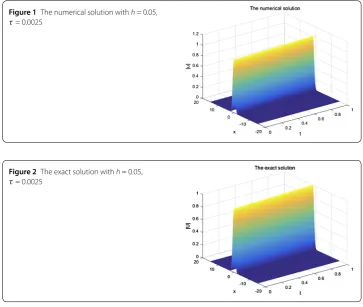
From Fig.1and Fig.2, we can see that the numerical solution of the compact scheme
and the exact solution are in good agreement. As shown in Table1, the accuracy of CFD
Scheme is higher than that of the other schemes. As indicated in Table2, the CPU time of CFD Scheme has the same CPU time cost as that of Scheme 2 and Scheme 3 in
[image:13.595.136.471.81.218.2]computa-Figure 1The numerical solution withh= 0.05, τ= 0.0025
Figure 2The exact solution withh= 0.05, τ= 0.0025
Table 1 Comparison of the accuracy for the numerical solutions
t CFD Scheme Scheme 2 Scheme 3
0.2 3.1712e-4 4.8000e-3 3.5170e-4
0.4 6.0713e-4 8.2000e-3 6.5370e-4
0.6 7.9096e-4 1.1300e-2 8.5260e-4
0.8 8.4966e-4 1.2700e-2 9.1910e-4
[image:13.595.115.479.330.637.2] [image:13.595.114.477.664.732.2]Table 2 CPU time of the three schemes
h t CFD Scheme Scheme 2 Scheme 3
0.2 0.04 0.80 s 0.81 s 0.58 s
0.1 0.01 5.83 s 6.49 s 6.23 s
0.05 0.0025 62.21 s 64.05 s 40.79 s
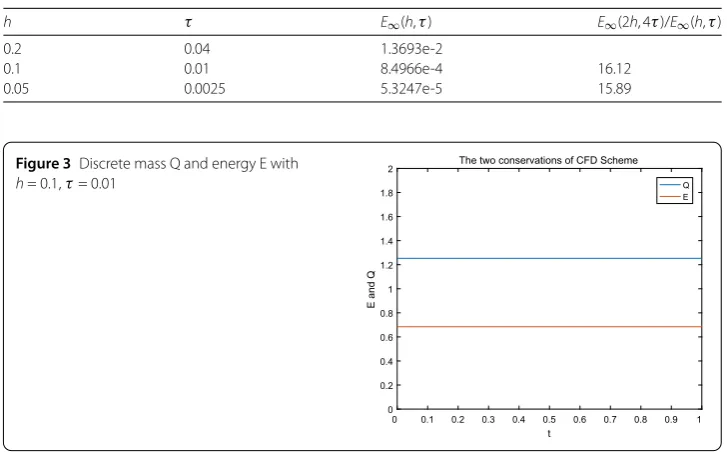
Table 3 Errors and convergence order at difference steps
h τ E∞(h,τ) E∞(2h, 4τ)/E∞(h,τ)
0.2 0.04 1.3693e-2
0.1 0.01 8.4966e-4 16.12
[image:14.595.116.480.173.399.2]0.05 0.0025 5.3247e-5 15.89
Figure 3Discrete mass Q and energy E with
h= 0.1,τ= 0.01
tion. From Table3, it is obvious that CFD Scheme is convergent in maximum norm, and
the convergence order isO(h4+τ2). Figure3indicates that the two conservations of CFD
Scheme are very good.
6 Conclusion
In this paper, a compact finite difference scheme is constructed for the nonlinear Schrödinger equation involving a quintic term. The discrete maximum norm error es-timates show that the proposed schemes are in second and fourth order accurate in time and space, respectively. In numerical experiment, numerical results are carried out to confirm the theoretical analysis.
Funding
This work is supported by the National Science Foundation of China (11671157).
Competing interests
The authors declare that they have no competing interests.
Authors’ contributions
All authors contributed equally to this work. All authors read and approved the final manuscript.
Publisher’s Note
Springer Nature remains neutral with regard to jurisdictional claims in published maps and institutional affiliations.
Received: 16 February 2018 Accepted: 12 July 2018 References
2. Dodd, R.K., Eilbeck, J.C., Gibbon, J.D., Morris, H.C.: Solitons and Nonlinear Wave Equations. Academic Press, New York (1982)
3. Hasegawa, A.: Optical Solitons in Fibers. Springer, Berlin (1989)
4. Sulem, C., Sulem, P.L.: The Nonlinear Schrödinger Equation Self-Focusing and Wave Collapse. Springer, New York (1999)
5. Chang, Q., Jia, E., Sun, W.: Difference schemes for solving the generalized nonlinear Schrödinger equation. J. Comput. Phys.148(2), 397–415 (1999)
6. Dai, W.Z.: An unconditionally stable three-level explicit difference scheme for the Schrödinger equation with a variable coefficient. SIAM J. Numer. Anal.29(1), 174–181 (1992)
7. Dehghan, M., Taleei, A.: A compact split-step finite difference method for solving the nonlinear Schrödinger equations with constant and variable coefficients. Comput. Phys. Commun.181(1), 43–51 (2010)
8. Nash, P.L., Chen, L.Y.: Efficient finite difference solutions to the time-dependent Schrödinger equation. J. Comput. Phys.130(2), 266–268 (1997)
9. Sun, Z., Wu, X.: The stability and convergence of a difference scheme for the Schrödinger equation on an infinite domain by using artificial boundary conditions. J. Comput. Phys.214(1), 209–223 (2006)
10. Wu, L.: Dufort–Frankel-type methods for linear and nonlinear Schrödinger equations. SIAM J. Numer. Anal.33(4), 1526–1533 (1996)
11. Zhang, F., Peréz-Ggarcía, V.M., Vázquez, L.: Numerical simulation of nonlinear Schrödinger equation system: a new conservative scheme. Appl. Math. Comput.71, 165–177 (1995)
12. Akrivis, G.D., Dougalis, V.A., Karakashian, O.A.: On fully discrete Galerkin methods of second- order temporal accuracy for the nonlinear Schrödinger equation. Numer. Math.59(1), 31–53 (1991)
13. Karakashian, O., Akrivis, G.D., Dougalis, V.A.: On optimal order error estimates for the nonlinear Schrödinger equation. SIAM J. Numer. Anal.30(2), 377–400 (1993)
14. Tourigny, Y.: Some pointwise estimates for the finite element solution of a radial nonlinear Schrödinger equation on a class of nonuniform grids. Numer. Methods Partial Differ. Equ.10(6), 757–769 (1994)
15. Bao, W., Jaksch, D.: An explicit unconditionally stable numerical method for solving damped nonlinear Schrödinger equations with a focusing nonlinearity. SIAM J. Numer. Anal.41(4), 1406–1426 (2003)
16. Li, B., Fairweather, G., Bialecki, B.: Discrete-time orthogonal spline collocation methods for Schrödinger equations in two space variables. SIAM J. Numer. Anal.35(2), 453–477 (1998)
17. Berikelashvili, G., Gupta, M.M., Mirianashvili, M.: Convergence of fourth order compact difference schemes for three-dimensional convection-diffusion equations. SIAM J. Numer. Anal.45(1), 443–455 (2007)
18. Gopaul, A., Bhuruth, M.: Analysis of a fourth-order scheme for a three-dimensional convection- diffusion model problem. SIAM J. Sci. Comput.28(6), 2075–2094 (2006)
19. Liao, H., Sun, Z.: Maximum norm error bounds of ADI and compact ADI methods for solving parabolic equations. Numer. Methods Partial Differ. Equ.26(1), 37–60 (2010)
20. Liao, H., Sun, Z., Shi, H.: Error estimate of fourth-order compact scheme for linear Schrödinger equations. SIAM J. Numer. Anal.47(6), 4381–4401 (2010)
21. Xie, S., Li, G., Yi, S.: Compact finite difference schemes with high accuracy for one-dimensional nonlinear Schrödinger equation. Comput. Methods Appl. Mech. Eng.198(9–12), 1052–1060 (2009)
22. Wang, T., Guo, B.: Unconditional convergence of two conservative compact difference schemes for non-linear Schrödinger equation in one dimension. Sci. Sin., Math.41(3), 207–233 (2011)
23. Wang, T.: Optimal point-wise error estimate of a compact difference scheme for the coupled nonlinear Schrödinger equations. J. Comput. Math.32(1), 58–74 (2014)
24. Wang, T., Jiang, J., Wang, H., Xu, W.: An efficient and conservative compact finite difference scheme for the coupled Gross–Pitaevskii equations describing spin-1 Bose-Einstein condensate. Appl. Math. Comput.323, 164–181 (2018) 25. Wang, T.: A linearized, decoupled and energy-preserving compact finite difference scheme for the coupled nonlinear
Schrödinger equations. Numer. Methods Partial Differ. Equ.33(3), 840–867 (2017)
26. Li, X., Zhang, L., Wang, S.: A compact finite difference scheme for the nonlinear Schrödinger equation with wave operator. Appl. Math. Comput.219, 3187–3197 (2012)
27. Zhang, L., Chang, Q.: A difference scheme for the nonlinear Schrödinger equation involving a quintic term. Acta Math. Appl. Sin.23(3), 351–358 (2000)
28. Wang, X., Cao, S.: A new difference scheme for nonlinear Schrödinger equation involving a quintic term. Period. Ocean Univ. China39(Supplement), 487–491 (2009)
29. Sun, Z.: Numerical Methods of the Partial Differential Equations. Science Press, Beijing (2005)