2019 International Conference on Information Technology, Electrical and Electronic Engineering (ITEEE 2019) ISBN: 978-1-60595-606-0
Aircraft Type Identification Using Reinforcement Active Learning
Hong-lan HUANG
1, Ruo-tong LIAO
2, Li CHEN
1, Kui-hua HUANG
1,*,
Yang-he FENG
1, Jin-cai HUANG
1, Ze-yi LIU
1and Jia-rui ZHANG
31
College of Systems Engineering, National University of Defense Technology, Changsha, China
2
National University of Defense Technology, Changsha, China
3
College of Aerospace Science and Engineering, National University of Defense Technology, Changsha, China
*Corresponding author
Keywords: Aircraft type identification, Reinforcement learning, Active learning, One-shot learning.
Abstract. As a subclass of Automatic Target Recognition problem, Automatic Aircraft Recognition
plays an important role in air traffic management and modern battlefield for automatic monitoring and detection. The research on Automatic Aircraft Recognition is still in the exploratory stage. Since aircrafts move at high speeds in complex background, it is still a challenging task of fast data processing and accurate aircraft type recognition. Besides, active learning has recently attracted many researcher’s interesting. Based on this, we employ a learning-based approach which combines active learning with reinforcement learning to learn how and when to request labels for the aircraft type recognition problem. The experimental results show that the model can achieve a good prediction accuracy with few label requests.
Introduction
Nowadays the types and numbers of aircrafts are increasing quickly, so the ability to recognize aircraft type accurately is a vital aspect of air traffic control not only in daily life but also the modern battlefield. At present, in order to achieve a better identification accuracy, the work of aircraft type identification still needs a great deal of human experience.
Usually the way to deal with small data sets is using the expert experience to give high-confidence data annotation. However, taking time cost and labeling overhead into account, this ground truth labeling is no longer viable as the data size increases dramatically. Under this circumstance, semi-supervised learning and active learning algorithms have emerged and developed rapidly, and become an important technology to deal with unlabeled examples. Although both of them use unlabeled and labeled instances to train a highly accurate classifier to reduce the workload of human experts, the active learning algorithm simulates the human learning process, selects part of instances to label and join the training set, and iteratively improves the generalization performance of the classifier.
flight track information. Different from extracting contour invariants during aircraft movement, the benefit of extracting the dynamic characteristics during the movement is that it can well eliminate the shortcomings mentioned before.
Most of the traditional active learning methods are carefully formulating some criteria for selecting samples, such as uncertainty sampling[7], query-by-committee[8], margin[9] and representative and diversity-based sampling[10]. It's hard to judge which approach is better, because each approach starts from a reasonable, meaningful and completely different motivation. At the same time, there is no all-purpose method that perform best on all datasets. Inspired by the fact that humans can learn new classes from a single instance[11], our goal is to design an artificial intelligence agent that has the capability to avoid requesting classification labels too often[12]. Here we introduce a learning-based approach rather than a hand-designing criterion, a model that learns active learning algorithms via reinforcement learning[13, 14]. This method can not only learn to classify instances using small supervision but additionally learn a label query strategy. And our model falls into the class of stream-based active learners which considers the online setting of active learning. It is a natural fit for an active learner using reinforcement learning to solve a continuous decision problem since each query action affects the next decision (when and which instance to query based on the state of the basic learner). In this way, the active query system trained by the reinforcement can learn a cogent, non-myopic strategy[15] and can make effective decisions with small supervision.
Our primary contribution is firstly using the active one-shot learning model in aircraft type identification problem. Our model is mostly inspired by Mark Woodward et al[16], whose work is considered as the first application of reinforcement learning with deep recurrent models to the task of active learning. And with the use of some effective motion feature our model has several obvious advantages: 1. The motion features have strong representation, and the aircraft type is identified by its set motion characteristics closer to the actual needs. 2. In the dynamic process[17], extracting dynamic motion features is easier than extracting invariant features. The motion model of a single aircraft can be simplified to the motion model of the probe points, which greatly reduces the computational complexity. 3. Since most aircraft fly on fixed routes, combined with track information, our model can achieve higher accuracy for civil aircraft with very similar shape and motion characteristics.
We evaluate the model on dataset of airplane target tracks collected by multiple sensors, and experiment results show that our model can learn efficient label querying strategies. We demonstrate empirically that our model can achieve better performance and learn a query strategy based on uncertainty in an end-to-end fashion. For active learning, it means significantly reducing the workload of human experts.
Related Work
A common technique for identification of military aircraft is Identification Friend Foe (IFF). Civilian aircraft use a technique similar to IFF called Secondary Surveillance Radar (SSR)[5]. The fundamental drawback of techniques like IFF and SSR is that they require active cooperation of pilots which makes these techniques less efficient and less practical. Aircraft identification based on image contour is mainly to find the approximate invariant features[18-20]. Commonly used invariant feature extraction methods include Hu matrix[19], affine distance, Fourier descriptor[21], wavelet moment, and Zernike moments.
face of practical problems. A fatal flaw in pure reinforcement learning method is reinforcement learning sometimes may be horribly sample inefficient. To solve this problem, the idea of adding a fair amount of expert experience came into being.
In this article, we mainly consider the setting of the single pass stream-based online active learning in aircraft identification. Most of existing methods have relied on heuristics, such as similarity measures between current instances, the instances seen so far[23], or uncertainty metrics in label prediction[23, 24]. Different from engineered selection heuristics, we introduce a model learning active learning algorithms end-to-end in an reinforcement learning way. Some recent researches have had similar inspiration. Woodward & Finn[16] first combined reinforcement learning with active learning. Bachman et al.[25] and Pang et al.[15] introduced a pool-based active learning algorithm through meta-learning. The same idea is applied to the artificial intelligence classification systems by Puzanov & Cohen[12]. In our work, a deep recurrent neural network[26] function approximator is used to represent the action-value function.
Basic Approach
Data Collection and Preprocessing
Our dataset is based on the time-series data of civilian aircraft flight track collected by multiple sensors including the detecting time t, longitude Lng, latitude Lat, altitude H, velocity V, heading Di, sensor signal type Sg and aircraft type label Label. And the ground truth aircraft type labels are marked by the oracle according to expert's experience.
Feature Extraction
Due to differences in aircraft performance and pilot flight habits, we can extract useful features as input to a historical trajectory-based recognition model. Four motion features were extracted from the flight data[6]: maximum speed, cruising speed, maximum acceleration, maximum rate of climb.
Since most aircrafts have a fixed route, we also consider the longitude, latitude, altitude, velocity, heading information, sensor signal types together with the above four characteristics as the inputs of our identification model.
Task Description and Methodology
In this section, we employ a model termed the reinforcement one-shot active learning (AOL) framework , introduced by Mark Woodward et al. (2016)[16], to achieve the active aircraft type recognition, as depicted in Fig. 1,where a long short-term memory (LSTM), which is connected to a linear output layer, is used to approximate the action-value function. Next, the specific algorithm is given.
At each time step of the episode, the model receives an instance , and need to decide to execute an action. Assume that in each episode, there are up to ossible classes. Let be the action at timestep
, so the action space is defined as follows:
c1,...,cM,areq
is the reward received after action in state , and represents the discount factor for future rewards. At each time step, one of three rewards is given depending on the action it choose: for correctly predicting the label, for incorrectly predicting the label, for requesting the label. The aim is to maximize the sum of rewards received in this episode.
ˆ , if predicting and
ˆ , if predicting and
, if a label is requested
cor t t
t inc t t
req
R y y
r R y y
R
(2)
Shuffle:
Labels Classes Samples
Episode
0
(0,x)
0:
x xt: xt 1:
1 t+1
( ,y xt t ) or (0,x )
if request if predict if request if predict
[0,1] or [yt, 0]
t
[image:4.595.67.470.145.428.2]r
Figure 1. Task structure.
Experimental Results
Now we represent the results of the experiments of our model. In the experiment, we train the model on the dataset of civilian aircraft flight tracks collected by multiple sensors and extracted the motion features as the inputs of the model. The dataset covers 78 classes of aircrafts, each class consists of 20 aircrafts, giving 1560 total aircrafts. We randomly divided the dataset into 54 classes for training and keep the rest 24 classes for testing. Our model interacts with classes of characters it did not encounter during training to measure its test performance.
In each episode, 30 aircraft flight tracks were randomly selected from 3 randomly sampled classes, without replacement. Here, the number of samples from each class may not be balanced. Each selected class in the episode was assigned to a random label which was represented by a slot in a one-hot vector of length 3, giving . An LSTM with 400 hidden units was used here. We optimized the parameters of our model using Adam with the default parameters[27]. During training process, epsilon greedy exploration with is used for actions selection. The learning rate of training was set to 0.002 and the discount factor was set to 0.5. The reward values were set as:
and .
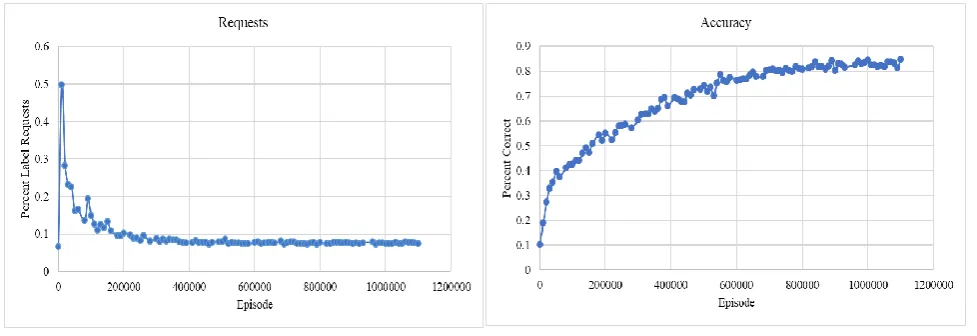
As can be seen in the plot, our model learns to query the label for early instances of a class, and make more prediction for later instances. At the same time, the accuracy of the model is improved on later instances of a class. This is an important evidence of successful achieving the intelligent recognition of aircraft type obtained with the use of the active one-short learning model based on deep reinforcement learning.
[image:5.595.66.536.146.328.2](a) Identified requests (b) Identified accuracy
Figure 2. Label requests(a) and accuracies(b) per episode for the 1st, 2nd, 5th, and 10th instances of all classes.
Overall Requests (b) Overall Accuracy
Figure 3. Overall request (a) and accuracy (b) results.
Conclusion
[image:5.595.55.544.358.526.2]Acknowledgement
This study was supported by the National Natural Science Foundation of China (No. 71701205 and No. 71701206).
References
[1]Kamgar-Parsi, B., B. Kamgar-Parsi, and A.K. Jain. Automatic aircraft recognition: toward using
human similarity measure in a recognition system. in Computer Vision and Pattern Recognition,
1999. IEEE Computer Society Conference on. 1999.
[2]Hsieh, J.W., et al., Aircraft type recognition in satellite images. IEE Proceedings - Vision, Image and Signal Processing, 2005. 152(3): pp. 307-315.
[3]Liu, Y., Aircraft type recognition based on convex hull features and SVM. Proceedings of SPIE - The International Society for Optical Engineering, 2007. 6786.
[4]Somaie, A.A., A. Badr, and T. Salah. Aircraft recognition system using eigenvector technique. in
Radio Science Conference, 1999. NRSC '99. Proceedings of the Sixteenth National. 1999.
[5]Proefschrift, A., et al., Aircraft Recognition from Features Extracted from Measured and
Simulated Radar Range Profiles. Universiteit Van Amsterdam Uva, 2003.
[6]Huang, H., et al., Aircraft Type Recognition Based on Target Track. Journal of Physics: Conference Series, 2018. 1061(1): p. 012015.
[7]Kapoor, A., et al., Active Learning with Gaussian Processes for Object Categorization. 2015.
88(2): pp. 1-8.
[8]Seung, et al., Query by committee. Proc of the Fith Workshop on Computational Learning Theory, 1992. 284: pp. 287-294.
[9]Tong, S. and D. Koller, Support vector machine active learning with applications to text
classification. 2002: JMLR.org. 45-66.
[10]Chattopadhyay, R., et al., Batch Mode Active Sampling based on Marginal Probability
Distribution Matching. Acm Transactions on Knowledge Discovery from Data, 2013. 7(3): pp. 1-25.
[11]Lake, B.M., R. Salakhutdinov, and J.B. Tenenbaum, Human-level concept learning through
probabilistic program induction. Science, 2015. 350(6266): pp. 1332-1338.
[12]Puzanov, A. and K. Cohen, Deep Reinforcement One-Shot Learning for Artificially Intelligent
Classification Systems. 2018.
[13]Mnih, V., et al., Human-level control through deep reinforcement learning. Nature, 2015.
518(7540): p. 529.
[14]Sutton, R.S. and A.G. Barto, Reinforcement Learning: An Introduction. IEEE Transactions on Neural Networks, 1998. 9(5): pp. 1054-1054.
[15]Pang, K., et al., Meta-Learning Transferable Active Learning Policies by Deep Reinforcement
Learning. 2018.
[16]Woodward, M. and C. Finn, Active One-shot Learning. 2017.
[17]Chu, W. and L. Liu. Research and Simulation Implementation of Airplane Target Typical
Motion Model. in International Conference on Computational and Information Sciences. 2013.
[18]Li, X.D., J.D. Pan, and J. Dezert. Automatic Aircraft Recognition using DSmT and HMM. in
[19]Rong, H.J., Y.X. Jia, and G.S. Zhao, Aircraft recognition using modular extreme learning
machine. Neurocomputing, 2014. 128(5): pp. 166-174.
[20]Dudani, S.A., K.J. Breeding, and R.B. Mcghee, Aircraft Identification by Moment Invariants.
IEEE Transactions on Computers, 1977. C-26(1): pp. 39-46.
[21]Wallace, T.P. and P.A. Wintz, An efficient three-dimensional aircraft recognition algorithm
using normalized fourier descriptors *. Computer Graphics & Image Processing, 1980. 13(2): pp.
99-126.
[22]Irpan, A., Deep Reinforcement Learning Doesn't Work Yet. 2018.
[23]Lughofer, E., Single-pass active learning with conflict and ignorance. Evolving Systems, 2012.
3(4): pp. 251-271.
[24]Chu, W., et al. Unbiased online active learning in data streams. in ACM SIGKDD International
Conference on Knowledge Discovery and Data Mining, San Diego, Ca, Usa, August. 2011.
[25]Bachman, P., A. Sordoni, and A. Trischler, Learning Algorithms for Active Learning. 2017.
[26]Hochreiter, S. and J. Schmidhuber, Long short-term memory. Neural Computation, 1997. 9(8): pp. 1735-1780.