R E S E A R C H
Open Access
New cautious BFGS algorithm based on
modified Armijo-type line search
Zhong Wan
*, Shuai Huang and Xiao Dong Zheng
*Correspondence:
[email protected] School of Mathematics and Statistics, Central South University, Changsha, Hunan, China
Abstract
In this paper, a new inexact line search rule is presented, which is a modified version of the classical Armijo line search rule. With lower cost of computation, a larger descent magnitude of objective function is obtained at every iteration. In addition, the initial step size in the modified line search is adjusted automatically for each iteration. On the basis of this line search, a new cautious Broyden-Fletcher-Goldfarb-Shanno (BFGS) algorithm is developed. Under some mild assumptions, the global convergence of the algorithm is established for nonconvex optimization problems. Numerical results demonstrate that the proposed method is promising, especially in comparison with the existent methods.
Keywords: unconstrained optimization; inexact line search rule; global convergence; BFGS
1 Introduction
Consider the following unconstrained optimization problem:
min
x∈Rnf(x), ()
wheref :Rn→Ris a twice continuously differentiable function.
Amongst the variant methods to solve problem (), it is well known that the Broyden-Fletcher-Goldfarb-Shanno (BFGS) method has obtained great success either in the aspect of the theoretical research or in the field of engineering applications. In this connection, it is referred to, for example, the literature [–] and the references therein.
Summarily, in the framework of the BFGS method, a quasi-Newton directiondkat the
current iterate pointxkis first obtained by solving the following linear system of equation:
Bkdk= –gk, ()
whereBkis a given positive definite matrix,g:Rn→Rnis the gradient function off, and
gkis the value ofgatxk. At the new iterate pointxk+,Bkis updated by
Bk+=Bk–
BksksTkBk
sTkBksk
+yky
T k
yTksk
, ()
wheresk=xk+–xk,yk=gk+–gk.
Next, along the search directiondk, we choose a suitable stepsizeαkby employing some
line search strategy. Thus, the iterate pointxkis updated by
xk+=xk+αkdk. ()
Actually, it has been reported that a choice of suitable line search rule is important to the efficiency and convergence of the BFGS method (see, for example, [, –] and []). It is well known that the Armijo line search is the cheapest and most popular algorithm to obtain a step length among all line search methods. However, when the Armijo line search algorithm is implemented to find a step lengthαk,Bk+in () may not be positive definite even ifBkis a positive definite matrix []. For this, in [] a cautious BFGS method(CBFGS)
associated with the Armijo line search is presented to solve the nonconvex unconstrained optimization problems. The update formula ofBkin [] is
Bk+=
⎧ ⎨ ⎩
Bk– BksksTkBk
sT kBksk +
ykyTk
yT ksk, if
yT ksk
sk ≥gk
γ,
Bk, otherwise,
()
whereandγ are positive constants.
In this paper, we shall first present a modified Armijo-type line search rule. Then, on the basis of this line search, a new cautious BFGS algorithm is developed. It will be shown that in our line search, a larger descent magnitude of an objective function is obtained with lower cost of computation at every iteration. In addition, the initial step size is adjusted automatically at each iteration.
The rest of this paper is organized as follows. In Section , a modified Armijo-type in-exact line search rule is presented and a new cautious BFGS algorithm is developed. Sec-tion is devoted to establishing the global convergence of the proposed algorithm under some suitable assumptions. In Section , numerical results are reported to demonstrate the efficiency of the algorithm. Some conclusions are given in the last section.
2 Modified Armijo-type line search rule and new cautious BFGS algorithm
The classical Armijo line search is to findαksuch that the following inequality holds:
f(xk+αkdk)≤f(xk) +σαkgkTdk, ()
whereσ∈(, ) is a given constant scalar. In a computer procedure,αkin () is obtained
by searching in the set{β,βρ,βρ. . . ,}such thatαk is the largest component satisfying
(), whereρ∈(, ) andβ> are given constant scalars.
Compared with other line search methods, the computer procedure of the Armijo line search is simplest, and the computational cost to find a feasible stepsize is very low, espe-cially for >ρ> being close to . Its drawback lies in that at each iteration, there may be only little reduction of an objective function to be obtained.
Inspired by this observation, we present a modified Armijo-type line search (MALS) rule as follows. Suppose thatgis a Lipschitz continuous function. LetLbe the Lipschitz constant. LetLkbe an approximation ofL. Set
βk= –
gT kdk
(Lkdk)
Different from the classical Armijo line search (), we find a step size αk as the largest
component in the set{βk,βkρ,βkρ. . .}such that the inequality
f(xk+αkdk)≤f(xk) +σ αk
gkTdk–
αkμLkdk
()
holds, whereσ∈(, ),μ∈[, +∞),ρ∈(, ) are given constant scalars.
In the following proposition, we show that the new line search () is well defined.
Proposition Let f :Rn→R be a continuously differentiable function.Suppose that the
gradient function g of f is Lipschitz continuous.Let Lk> be an approximation value of
the Lipschitz constant.If dkis a descent direction of f at xk,then there is anα> in the set
{βk,βkρ,βkρ. . .}such that the following inequality holds:
f(x+αdk)≤f(xk) +σ α
gkTdk–
αμLkdk
()
whereσ∈(, ),μ∈[, +∞),ρ∈(, )are given constant scalars.
Proof In fact, we only need to prove that a step lengthαis obtained in finitely many steps. If it is not true, then for all sufficiently large positive integerm, we have
fx+βkρmdk
–f(xk) >σ α
gkTdk–
βkρ
mμL kdk
. ()
By the mean-theorem, there is aθk∈(, ) such that
βkρmg
xk+θkβkρmdk T
dk>σβkρm
gkTdk–
βkρ
mμL kdk
. ()
Thus,
gxk+θkβkρmdk
–gk T
dk> (σ– )gkTdk–
σβkρ
mμL
kdk. ()
Asm→ ∞, it is obtained that (σ– )gkTdk≤.
Fromσ∈(, ), it follows thatgT
kdk≥. This contradicts the fact thatdkis a descent
direction.
Remark Since the third term on the right-hand side of () is negative, it is easy to see that the obtained step sizeαensures a larger descent magnitude of the objective function than that in ().
It is noted that () reduces to () whenμ= .
Remark In the MALS, the parameterLkshould be estimated at each iteration. In this
paper, fork> , we choose
Lk=
sT k–yk–
sk–
wheresk–=xk–xk–,yk–=gk–gk–. Actually,Lkin () is a solution of the minimization
problem
minLksk––yk–. ()
Therefore, it is acceptable thatLkis an approximation ofL.
Based on Proposition , Remarks and , a new cautious BFGS algorithm is developed for solving problem ().
Algorithm (New cautious BFGS algorithm)
Step . Choose an initial pointx∈Rnand a positive definite matrixB. Chooseσ ∈ (, ),μ≥,> andL> . Setk:= .
Step . Ifgk ≤, the algorithm stops. Otherwise, go to Step .
Step . Finddkthat is a solution of the following system of linear equations:
Bkdk= –gk.
Step . Determine a step sizeαksatisfying ().
Step . Setxk+:=xk+αkdk. Computeskandyk. UpdateBkasBk+by (). Setk:=k+ , return to Step .
3 Global convergence
In this section, we are going to prove the global convergence of Algorithm . We need the following conditions.
Assumption
. The level set ={x∈Rn|f(x)≤f(x
)}is bounded.
. In some neighborhood N of ,f is continuously differentiable and its gradient is Lipschitz continuous,namely there exists a constantL> such that
g(x) –g(y) ≤Lx–y, ∀x,y∈N. ()
. The sequence{Lk}, <Lk≤ML,whereMis a positive constant.
Before the statement of the global convergence, we first prove the following useful lem-mas.
Lemma Let{xk}be a sequence generated by Algorithm.If Lk> for each k≥,then
for any given initial point x,the following results hold:
. {fk}is a decreasing sequence. . {xk} ∈ .
. ∞k=(fk–fk+) < +∞.
Proof The first and second results are directly from the conditionLk> for eachk≥,
Since{fk}is a decreasing sequence and is bounded below, it is clear that there exists a
constantf*such that
lim
k→∞fk=f
*. ()
From (), we have
∞
k=
(fk–fk+) = lim
N→∞ N
k=
(fk–fk+) = lim
N→∞(f–fk+) =f–f
*. ()
Thus,
∞
k=
(fk–fk+) < +∞. ()
Lemma Let{xk} be a sequence generated by Algorithm.Let{dk}be the sequence of
search direction.If Assumptionholds,then
∞
k=
gT kdk
dk
< +∞. ()
In particular,
lim
k→∞
gT kdk
dk
= . ()
Proof Denote
K={k|αk=βk}, K={k|αk<βk}.
Fork∈K, we have
fk–fk+≥–σ αk
gkTdk–
αkμLkdk
= –σ –g
T kdk
Lkdk
gkTdk–
–gkTdk
Lkdk
μLkdk =σ + μ
(gT kdk)
Lkdk
≥σ( +μ) ML
gT kdk
dk
. ()
Fork∈K, it follows from () that
fxk+ρ–αkdk
–f(xk) >σρ–αk
gkTdk–
ρ
–α
kμLkdk
By the mean-theorem, there is aθk∈(, ) such that
ρ–αkg
xk+θkρ–αkdk T
dk>σρ–αk
gkTdk–
ρ
–α
kμLkdk
. ()
Hence,
gxk+θkρ–αkdk
–gk T
dk> (σ– )gkTdk–
σρ
–α
kμLkdk. ()
From the Lipschitz continuity ofg, it is obtained that
L+ σ μLk
ρ–αkdk> (σ– )gkTdk. ()
It reads
αk> –
ρ( –σ) L+σ μLk
gT kdk
dk
. ()
From () and (), it is deduced that
fk–fk+≥–σ αk
gkTdk–
αkμLkdk
≥–σ–ρ( –σ) L+σ μLk
gkTdk
dk
gkTdk
≥ ρσ( –σ) L+σ μML
gT kdk
dk
. ()
Denote
η=min
σ( +μ) ML ,
ρσ( –σ) L+σ μML
. ()
Then from (), we obtain
fk–fk+≥η
gT kdk
dk
. ()
From Lemma , it is clear that
∞ k= η gT kdk
dk
< +∞. ()
That is to say
∞
k=
gT kdk
dk
< +∞, ()
sinceη> . It is certain that
lim
k→∞
gT kdk
dk
= . ()
Lemma Let{xk}be a sequence generated by Algorithm.Suppose that there exist
con-stants a,a> such that the following relations hold for infinitely many k:
Bksk ≤ask, ask≤sTkBksk. ()
Then
lim inf
k→∞ gk= . ()
Proof Letbe the indices set ofksatisfying (). From () andgk= –Bkdk, it follows that for eachk∈,
adk≤dTkBkdk= –gkTdk. ()
Thus,
adk ≤–
gkTdk
dk
. ()
Combined with (), it yields
lim
k∈,k→∞dk= . ()
On the other hand, from () andgk= –Bkdk, it is deduced that for eachk∈,
≤ gk=Bkdk ≤adk. ()
From () and (), it is easy to see that
lim
k∈,k→∞gk= . ()
The desired result () is proved.
Lemma indicates that for the establishment of the global convergence, it suffices to show that () holds for infinitely manykin Algorithm . The following lemma gives suf-ficient conditions for () to hold (see Theorem . in []).
Lemma Let Bbe a symmetric and positive matrix and Bkbe updated by().Suppose
that there are positive constants m,m(m<m)such that for all k≥,
yT ksk
sk ≥
m,
yk
yTksk
≤m. ()
Now, we come to establish the global convergence for Algorithm . For the sake of con-venience, we define an index set
˜
K=
i y
T i si
si≥
giγ
. ()
Theorem Let{xk}be a sequence generated by Algorithm.Under Assumption, ()
holds.
Proof From Lemma , we only need to show that () holds for infinitely manyk. IfK˜ is a finite set, thenBkremains a constant matrix after a finite number of iterations.
Hence, there are constantsa,asuch that () holds for allksufficiently large. The proof of the result is completed.
In the following, we prove () in the case thatK˜ is a infinite set.
Suppose that () is not true. Then there is a constantδ> such thatgk ≥δfor allk.
From (), the inequality
yTksk
sk ≥
δγ ()
holds for allk∈ ˜K.
Combined with (), it is obtained that
yk
yTksk
≤ yk
δγs k ≤
L
δγ. ()
From Lemma , it follows that there exist constantsa,asuch that () holds for infinitely manyk. It contradicts the result in Lemma .
The proof is completed.
4 Numerical experiments
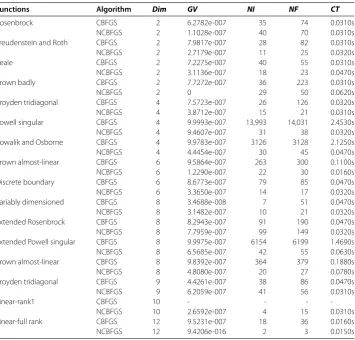
In this section, we report the numerical performance of Algorithm . The numerical ex-periments are carried out on a set of test problems from []. We make comparisons with the cautious BFGS method associated with the ordinary Armijo line search rule.
In order to study the numerical performance of Algorithm , we record the run time of CPU, the total number of function evaluations required in the process of line search and the total number of iterations for each algorithm.
All MATLAB procedures run in the following computer environment: GHz CPU, GB memory based operating system of WINDOWs XP. The parameters are chosen as follows:
= –, B=In×n, ρ= ., σ= ., μ= , L= .
As to the parameters in the cautious update (), we first letγ= . ifgk ≥, andγ =
ifgk< .
The performance of algorithms and the solution results are reported in Table . In this table, we use the following denotations:
Table 1 Comparison of efficiency with other method
Functions Algorithm Dim GV NI NF CT
Rosenbrock CBFGS 2 6.2782e-007 35 74 0.0310s
NCBFGS 2 1.1028e-007 40 70 0.0310s
Freudenstein and Roth CBFGS 2 7.9817e-007 28 82 0.0310s
NCBFGS 2 2.7179e-007 11 25 0.0320s
Beale CBFGS 2 7.2275e-007 40 55 0.0310s
NCBFGS 2 3.1136e-007 18 23 0.0470s
Brown badly CBFGS 2 7.7272e-007 36 223 0.0310s
NCBFGS 2 0 29 50 0.0620s
Broyden tridiagonal CBFGS 4 7.5723e-007 26 126 0.0320s
NCBFGS 4 3.8712e-007 15 21 0.0310s
Powell singular CBFGS 4 9.9993e-007 13,993 14,031 2.4530s
NCBFGS 4 9.4607e-007 31 38 0.0320s
Kowalik and Osborne CBFGS 4 9.9783e-007 3126 3128 2.1250s
NCBFGS 4 4.4454e-007 30 45 0.0470s
Brown almost-linear CBFGS 6 9.5864e-007 263 300 0.1100s
NCBFGS 6 1.2290e-007 22 30 0.0160s
Discrete boundary CBFGS 6 8.6773e-007 79 85 0.0470s
NCBFGS 6 3.3650e-007 14 17 0.0320s
Variably dimensioned CBFGS 8 3.4688e-008 7 51 0.0470s
NCBFGS 8 3.1482e-007 10 21 0.0320s
Extended Rosenbrock CBFGS 8 8.2943e-007 91 190 0.0470s
NCBFGS 8 7.7959e-007 99 149 0.0320s
Extended Powell singular CBFGS 8 9.9975e-007 6154 6199 1.4690s
NCBFGS 8 6.5685e-007 42 55 0.0630s
Brown almost-linear CBFGS 8 9.8392e-007 364 379 0.1880s
NCBFGS 8 4.8080e-007 20 27 0.0780s
Broyden tridiagonal CBFGS 9 4.4261e-007 38 86 0.0470s
NCBFGS 9 6.2059e-007 41 56 0.0310s
Linear-rank1 CBFGS 10 - - -
-NCBFGS 10 2.6592e-007 4 15 0.0310s
Linear-full rank CBFGS 12 9.5231e-007 18 36 0.0160s
NCBFGS 12 9.4206e-016 2 3 0.0150s
GV: the gradient value of the objective function when the algorithm stops;
NI: the number of iterations;
NF: the number of function evaluations;
CT: the run time of CPU;
CBFGS: the CBFGS method associated with Armijo line search rule; NCBFGS: the new BFGS method proposed in this paper.
In Table it is shown that the developed algorithm in this paper is promising. In some cases, it requires less number of iterations, less number of function evaluation or less CPU time to find an optimal solution with the same tolerance than another algorithm.
5 Conclusions
A modified Armijo-type line search with an automatical adjustment of initial step size has been presented in this paper. Combined with the cautious BFGS method, a new BFGS algorithm has been developed. Under some assumptions, the global convergence was es-tablished for nonconvex optimization problems. Numerical results demonstrate that the proposed method is promising.
Competing interests
Authors’ contributions
ZW carried out the studies of the new Armijo line search studies, participated in the sequence alignment, the proof of the main results and drafted the manuscript. SH participated in the proving some main results. XZ participated in the design of algorithm and performed the numerical experiments. All authors read and approved the final manuscript.
Acknowledgements
Supported by the National Natural Science Foundation of China (Grant No. 71210003, 71071162).
Received: 8 October 2011 Accepted: 20 September 2012 Published: 17 October 2012 References
1. Al-Baali, M: Quasi-Newton algorithms for large-scale nonlinear least-squares. In: Di Pillo, G, Murli, A (eds.) High Performance Algorithms and Software for Nonlinear Optimization, pp. 1-21. Kluwer Academic, Dordrecht (2003) 2. Al-Baali, M, Grandinetti, L: On practical modifications of the quasi-Newton BFGS method. Adv. Model. Optim.11(1),
63-76 (2009)
3. Gill, PE, Leonard, MW: Limited-Memory reduced-Hessian methods for large-scale unconstrained optimization. SIAM J. Optim.14, 380-401 (2003)
4. Guo, Q, Liu, JG: Global convergence of a modified BFGS-type method for unconstrained nonconvex minimization. J. Appl. Math. Comput.21, 259-267 (2006)
5. Li, DH, Fukushima, M: On the global convergence of the BFGS method for nonconvex unconstrained optimization problems. SIAM J. Optim.11(4), 1054-1064 (2001)
6. Mascarenhas, WF: The BFGS method with exact line searches fails for non-convex objective functions. Math. Program.
99, 49-61 (2004)
7. Nocedal, J: Theory of algorithms for unconstrained optimization. Acta Numer.1, 199-242 (1992) 8. Xiao, YH, Wei, ZX, Zhang, L: A modified BFGS method without line searches for nonconvex unconstrained
optimization. Adv. Theor. Appl. Math.1(2), 149-162 (2006)
9. Zhou, W, Li, D: A globally convergent BFGS method for nonlinear monotone equations without any merit function. Math. Comput.77, 2231-2240 (2008)
10. Zhou, W, Zhang, L: Global convergence of the nonmonotone MBFGS method for nonconvex unconstrained minimization. J. Comput. Appl. Math.223, 40-47 (2009)
11. Zhou, W, Zhang, L: Global convergence of a regularized factorized quasi-Newton method for nonlinear least squares problems. Comput. Appl. Math.29(2), 195-214 (2010)
12. Cohen, AI: Stepsize analysis for descent methods. J. Optim. Theory Appl.33, 187-205 (1981)
13. Dennis, JE, Schnable, RB: Numerical Methods for Unconstrained Optimization and Nonlinear Equations. Prentice-Hall, Englewood Cliffs (1983)
14. Shi, ZJ, Shen, J: New inexact line search method for unconstrained optimization. J. Optim. Theory Appl.127(2), 425-446 (2005)
15. Sun, WY, Han, JY, Sun, J: Global convergence of nonmonotone descent methods for unconstrained optimization problems. J. Comput. Appl. Math.146, 89-98 (2002)
16. Wolfe, P: Convergence conditions for ascent methods. SIAM Rev.11, 226-235 (1969) 17. Nocedal, J, Wright, JS: Numerical Optimization. Springer, New York (1999)
18. Byrd, R, Nocedal, J: A tool for the analysis of quasi-Newton methods with application to unconstrained minimization. SIAM J. Numer. Anal.26, 727-739 (1989)
19. More, JJ, Garbow, BS, Hillstrom, KE: Testing unconstrained optimization software. ACM Trans. Math. Softw.7, 17-41 (1981)
doi:10.1186/1029-242X-2012-241