2018 3rd International Conference on Information Technology and Industrial Automation (ICITIA 2018) ISBN: 978-1-60595-607-7
A Routing Protocol Based on Link Quality and
Hop Count in Wireless Sensor Networks
Panpan Dong, Bencan Gong, Dong Ren and Peng Chen
ABSTRACT
In wireless sensor networks, data transmission quality and energy efficiency are closely related to link quality indicator. In order to improve the performance of Multipath Routing protocol, this paper proposes a LqiRings Routing protocol based on link quality and hops between nodes. In the routing discovery stage, LqiRings Routing does not take hops as the only factor in routing decision-making, but considers hops and link quality as two factors, and determines the optimal path by adjusting the weights between them. The LqiRings Routing protocol, Multipath Routing protocol and Hop Counts Routing protocol are simulated and analyzed in Castalia simulator. The experimental results show that the LqiRings Routing protocol proposed in this paper has higher packet delivery rate and lower average
energy consumption under the same environment.1
INTRODUCTION
Wireless sensor networks (WSNs) are composed of lightweight, low power and small size sensor nodes, which can sense, collect and monitor the environment of the network distribution area or the information of specific monitoring objects, and obtain accurate field information. Wireless sensor networks have important scientific research and application value in military, industrial, agricultural, intelligent transportation, family, health and environmental protection due to their
1
Panpan Dong, Bencan Gong, Peng Chen, College of Computer and Information Technology, China Three Gorges University, Yichang Hubei, China
self-organization, data-centric, dynamic and reliable characteristics. There has been recent research interest on routing in wireless sensor networks [1]. The research on
Figure1. Poor link quality. Figure 2. Better link quality.
the former routing protocol aims to enhance the energy efficiency and the stability of data transmission, and both of them are affected by the link quality. By improving the Multipath Routing protocol [2], the LqiRings Routing protocol based on link quality and hops is proposed, which changes the route selection mechanism, increases the data packet delivery rate and reduces average energy consumption.
RELATED WORK
At present, routing algorithms in wireless sensor networks have become a hot topic in recent years. Hop count is an important factor in wireless sensor networks. From the analysis of hop limit in wireless multi-hop networks [3] to the application of minimum hop routing protocol [4], hop count is taken as an index to optimize routing protocol [5] [6], so that the performance of routing protocol can achieve the desired results. As another important factor in wireless sensor networks, link quality is also a hotspot in routing protocol research. The influence of active interference on link quality awareness path selection in wireless sensor networks is analyzed based on link quality selection path [7]. Some propose a new opportunistic routing method based on link quality, which evaluates the link quality of the path through link quality assessment technology, and improves the quality of service of wireless sensor networks [8]. Combining the two important factors mentioned above, this paper proposes an LqiRings Routing protocol based on link quality and hop count by improving the Multipath Routing protocol.
receiving the topological establishment packet will get the ring number, and then increase its ring number by 1 to broadcast the packet to other nodes in the network. Only nodes between adjacent ring numbers can communicate. In the process of communication, many duplicate packets will be generated, which wastes energy. Moreover, the link quality between nodes is not considered in the process of communication, resulting in poor data transmission quality. As shown in Figure 1, all of nodes obtain the ring number one. However, it is obvious that node 2 and node 5 are far away from the sink node, and the link quality is poor. Considering the weights of hops and link quality, the routing topology is shown in Figure 2, which greatly improves the stability of network data transmission.
LQIRINGSROUTING SCHEME
The LqiRings Routing routing algorithm can be viewed as two phases, the path establishment phase and the data transmission phase [9]. In the path construction phase, the LqiRings Routing routing protocol gets the link quality and current hops between nodes through physical layer and MAC layer, Several important parameters in the path selection mechanism are link quality difference M, link quality thresholds LQIth1, LQIth2 and hop difference Hth. Destination node chooses path after receiving topology establishment package, then the routing table information should be stored and broadcast. When the node receives the route request packet, the action flow chart is as shown in Figure3. In the data transmission phase, because we have added the parent ID in the data packet, and directly forward the address of the parent ID string conversion as its next hop. Then unicast is used instead of broadcasting, greatly reduces the number of packets dropped, thereby improving the packet delivery rate.
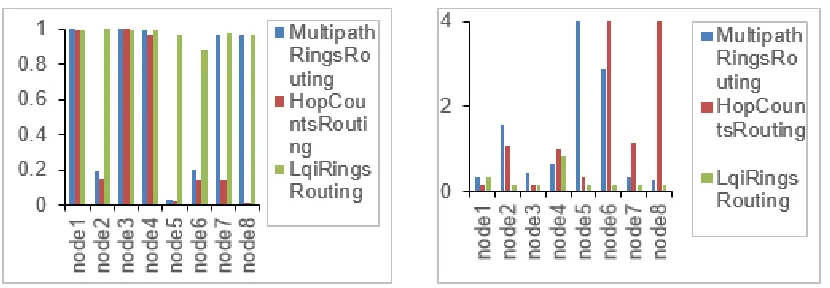
Figure 4. Packet delivery rate of each node. Figure 5. Average energy consumption. of each node.
SIMULATION AND RESULT ANALYSIS
This paper uses Castalia simulator [10] to simulate and compare MultipathRouting protocol, HopCountsRouting protocol and LqiRingsRouting protocol. The performance of the three protocols is measured by two performance indicators: data packet delivery rate and average energy consumption of data packet. The emulation environment used in this paper is OMNET++ version 4.6 and Castalia-3.2.
The simulation environment is 40m
40m, the specific distribution of nodes isshown in Figure 2 above. The simulation time is 6000s.The wireless transmitter module is CC2430, the initial energy of node is 18730J.The packet size is 20bytes.The important parameters in simulation:H value is 1,M value is 2, LQIth1 value is 8,and LQIth2 value is 10.
The simulation results show that the LqiRingsRouting protocol have better performance. The packet delivery rate of LqiRingsRouting is 40% higher than MultipathRouting and 125% higher than HopCountsRouting. The average energy consumption of LqiRingsRouting is 55.9% lower than MultipathRouting and 41.8% lower than HopCounts. The specific distribution of packet delivery rates for each node is shown in Figure 4,the average energy consumption distribution of each node is shown in Figure 5.
CONCLUSIONS
received by nodes and achieves the goal of reducing the average energy consumption. The simulation results show that the LqiRingsRouting routing protocol improves the packet delivery rate and reduces the average energy consumption of the network.
ACKNOWLEDGMENTS
This work is supported by the National Natural Science Foundation of China (No. 60672137), the National Key Research and Development Projects of China (No. 2016YFD0800902) and the Major Technological Innovation Project in Hubei Province of China (No.2017ABA157).
REFERENCES
1. K H Han, Y B Ko, J H Kim. “A Novel Gradient Approach for Efficient Data Dissemination in Wireless Sensor Networks”. 2004, 4(2):2979 – 2983.
2. Dhwani J B, Ishan R. “Performance of Multipath Ring Routing Protocol with Static Implementation in Wireless Sensor Network”. International Journal of Engineering Technology, Management and Applied Sciences, 2015,3(1):35-37.
3. W Liao, M Wu, M Zhao, et al. “Hop Count Limitation Analysis in Wireless Multi-Hop Networks”. International Journal of Distributed Sensor Networks, 2017, 13(1):1-13.
4. S S Chiang, C H Huang, K C Chang. “A Minimum Hop Routing Protocol for Home Security Systems Using Wireless Sensor Networks”. IEEE Transactions on Consumer Electronics, 2007, 53(4):1483-1489.
5. Gurung S, Hossain A K, Kanchanasut K. “A Hop-Count Based Positioning Algorithm for Wireless Ad-Hoc Networks”. Wireless Networks, 2014, 20(6):1431-1444.
6. Beyme S, C Leung. “A Stochastic Process Model of the Hop Count Distribution in Wireless Sensor Networks”. Ad Hoc Networks, 2014, 17(3):60-70.
7. Bhavathankar P, Chatterjee S, Misra S. “Link-Quality Aware Path Selection in the Presence of Proactive Jamming in Fallible Wireless Sensor Networks”. IEEE Transactions on Communications, 2018, 66(4):1689-1704.
8. Bapu B R T, Gowd L C S. “Link Quality Based Opportunistic Routing Algorithm for QOS: Aware Wireless Sensor Networks Security”. Wireless Personal Communications, 2017, 97(1):1-16.
9. Merkel S, Mostaghim S, Schmeck H. “Hop Count Based Distance Estimation in Mobile ad Hoc Networks – Challenges and consequences”. Ad Hoc Networks, 2014, 15(6):39-52.