10.1177/0192513X05277810 Journal of Family Issues Ha et al. / Effects of W idowhood
Older Adults’ Perceptions
of Intergenerational
Support After Widowhood
How Do Men and Women Differ?
Jung-Hwa Ha
University of MichiganDeborah Carr
Rutgers UniversityRebecca L. Utz
University of UtahRandolph Nesse
University of MichiganThis study examines the ways that widowhood affects older adults’ perceived exchange of support with their children, and whether exchange patterns differ by gender. Data are from the Changing Lives of Older Couples (CLOC), a pro-spective study of 1,532 married individuals age 65 years and older. Spousal loss increases older adults’dependence on their children 6 months after the loss yet decreases children’s dependence on their surviving parents. Patterns of postloss parent-child exchanges differ by gender of parent. Compared to wid-owers, widows are more dependent on their children for financial and/or legal advice yet provide more emotional and instrumental support. However, these gender differences are contingent on educational attainment. Education decreases widows’ dependence on children for financial and legal advice yet increases widowers’provision of emotional support to their children. The find-ings suggest that adherence to traditional gender roles among married couples may influence older adults’ adaptation to spousal loss.
Keywords: widowhood; parent-child dependence; gender roles;
inter-generational exchange
3 Journal of Family Issues
O
ne of the most well-documented features of parent-child relationships is that the exchange of support does not always follow the norms of equity and reciprocity: Resources and support often flow from parent to child up until the very late stages of the life course (e.g., Bengston, Rosenthal, & Burton, 1990; Greenberg & Becker, 1988; Hoyert, 1991; R. D. Lee, 1994; Soldo & Hill, 1993). As Soldo and Hill (1993) observed, “More help flows from parents to children than the reverse. . . . Past patterns of transfers tend to repeat themselves, persisting over time rather than exhibiting reciprocity” (p. 199).However, well-established patterns of intergenerational exchange may be interrupted or reversed when a life-altering event occurs, such as widow-hood. Widowhood is considered one of the most stressful of all life events (Holmes & Rahe, 1967). During the first 6 to 12 months following the loss, the bereaved spouse typically experiences sadness, anxiety, and yearning for the deceased (e.g., Carr, House, Wortman, Nesse, & Kessler, 2001; Carr & Utz, 2002). At the same time, the bereaved must manage those household and financial responsibilities that were handled previously by the now-deceased spouse (Berardo & Berardo, 2000; Pearlin & Lieberman, 1979; Smith & Zick, 1986; Utz et al., 2004). Consequently, bereaved spouses who are coping with the psychological and financial challenges associated with late-life widowhood may become more dependent on and less able to pro-vide help to their children (Cooney & Uhlenberg, 1992; Eggebeen, 1992; Rossi & Rossi, 1990).
The specific flows of intergenerational support between bereaved parents and their children may reflect lifelong socialization patterns that prescribe certain roles within marital and parent-child relationships. Current cohorts of older women came of age in the first half of the 20th century, and most were socialized to devote their time and energies to family responsibilities, such as homemaking and child rearing, rather than to paid employment (Bernard, 1981; Coontz, 1992; Williams, 2000). Because, in part, of this traditional
4 Journal of Family Issues
Authors’ Note:The Changing Lives of Older Couples study was supported by the following
gender-based allocation of family roles, current cohorts of older women have had less continuous employment histories (and thus lower earnings) than their male peers, and many left household financial management and deci-sion making up to their husbands (Becker, 1991; Lopata, 1996). Older men, on the other hand, were typically socialized to fulfill the role of so-called breadwinner (Bernard, 1981) and focused their energies on paid employ-ment rather than on nurturing and providing emotional support to their chil-dren. As a result, bereaved persons may be daunted by the responsibilities that were once performed by their late spouse. Several empirical studies con-firm that homemaking tasks are distressing for widowers, whereas financial strains are particularly distressing for widows (G. R. Lee, DeMaris, Bavin, & Sullivan, 2001; Lopata, 1996; Umberson, Wortman, & Kessler, 1992). Thus, bereaved spouses may show increased levels of dependence in these areas on widowhood.
A large body of research has explored older adults’ adaptation to loss (see Carr & Utz, 2002, for overview) and reciprocal helping relationships between older parents and their adult children (e.g., Eggebeen & Hogan, 1990; Gallagher, 1994; Spitze & Logan, 1992), yet few studies bridge these two important topics by exploring the role that adult children play in helping bereaved elders cope with the challenges of loss. We know of no studies that examine prospectively the amount or type of assistance that each generation gives and receives after loss; nor are we aware of any studies that examine systematically whether and how these patterns differ for widowed fathers and mothers. Our research will fill this gap by identifying the ways that par-ent-child interdependence is affected by widowhood, and how these helping patterns differ for widowed fathers and mothers.
We use data from the Changing Lives of Older Couples (CLOC; Carr & Utz, 2002) study to address two questions: (a) To what extent does late-life widowhood affect parent-child dependence and (b) do widows and widow-ers differ in terms of how much assistance they exchange in the domains of emotional, financial and legal, and instrumental support? We examined three separate domains because in families abiding by the traditional allocation of gender roles men tend to specialize in economic tasks and women manage emotional tasks and household chores (Becker, 1991). An examination of these distinctive domains may reveal the ways in which lifelong patterns of gender role socialization prepare (or impair) older adults and their children as they adjust to the challenges of spousal loss. Our findings may help practi-tioners identify those older adults who face the greatest challenges upon spousal loss and pinpoint the types of help they need most.
Theoretical Issues
Parent-Child Dependence After Widowhood
Widowhood is a life-altering event that creates psychological distress for the surviving spouse (e.g., Carr et al., 2001; Zisook & Shuchter, 1991), and that requires behavioral adjustments by surviving spouses and their children as they adapt to the loss of spouse and parent, respectively (O’Bryant & Mor-gan, 1990; Utz et al., 2004). Widowhood affects parent-child living arrange-ments (Aquilino, 1990; Roan & Raley, 1996) and the frequency of parent-child contact and communication (Anderson, 1984; Crimmins & Ingegneri, 1990; Lopata, 1979; Roan & Raley, 1996). However, researchers have not examined in depth the ways that widowhood affects intergenerational exchanges of instrumental and expressive support. Previous studies of intergenerational transfers have focused primarily on motivations behind the transfers—such as motives of reciprocity or altruism (Becker, 1974; Cox, 1987; Logan & Spitze, 1995; Silverstein, Conroy, Wang, Giarrusso, & Bengtson, 2002). Overwhelmingly, this research has focused on regular and enduring exchange patterns during the life course; little attention has been paid to the ways that these exchange patterns may be altered by an unantici-pated or stressful event such as widowhood.
A handful of studies shows that widowed parents are less likely to provide support to their children than married parents (Cooney & Uhlenberg, 1992; Eggebeen, 1992; Rossi & Rossi, 1990). However, these studies have relied primarily on cross-sectional data and cannot distinguish whether postloss levels of parent-child exchange are attributable to the event of widowhood or to other characteristics that may be linked to elevated risk of widowhood. For instance, those who are economically disadvantaged and those providing intensive care to an ailing spouse are more likely to become widowed, and more likely to depend on their children—even prior to the actual death of their spouses. If potential selection effects are not considered, then the effect of spousal loss may be overstated. Because the current study used data col-lected prior to loss, we were able to distinguish the effect of widowhood from the effects of respondents’ preloss characteristics on parent-child dependence.
The effect of widowhood on parent-child dependence also may vary based on how long one has been widowed: Recently widowed parents may express elevated needs for support, whereas parents who have been widowed for several years may have adapted to circumstances and thus require less support (Ferraro & Barresi, 1982; Lopata, 1973). In the current study, levels of parent-child dependence were assessed 6 months after the loss of a spouse
for every respondent. Thus, the findings were not weakened by varying dura-tions of widowhood. We also included in the sample widowed and nonwidowed persons to directly evaluate the effect of widowhood on parent-child dependence.
Gender Differences In Parent-Child
Relationships After Widowhood
A further objective of the current research was to evaluate whether pat-terns of parent-child dependence following widowhood are different for men and women. Because most research on bereaved elders relies on samples of widowed women only (e.g., Bankoff, 1983; Gallagher & Gerstel, 1993; Lopata, 1973; O’Bryant & Morgan, 1990; Roan & Raley, 1996), very little is known about gender differences in the ways that persons who are bereaved manage spousal loss in later life.
Among current cohorts of older married adults, men have typically spent most of their adult years specializing in financial and legal matters of the household, and women have taken care of children and household chores (Becker, 1991; Coverman, 1983). Given this widely documented gender-typed allocation of marital roles, those who are bereaved may depend on their children for assistance with tasks traditionally performed by members of the opposite sex.
Widows and widowers also may differ in the types of help they can offer their children; that is, children may depend on mothers and fathers for differ-ent types of support. In families who maintain a traditional gendered division of labor, mothers are more likely to provide emotional and instrumental sup-port, whereas fathers are more likely to help children with financial resources and advice (Gallagher, 1994; Rossi & Rossi, 1990). Thus, adult children may not receive the same kinds of help from a widowed father as they might from a widowed mother, given the different skills and resources of each parent.
The extent to which gender affects parent-child exchanges of support may vary further by the bereaved elder’s attitudes toward and compliance with traditional gender roles. Although members of the CLOC sample were all born at roughly the same point in time and share a cohort identity, there is a within-cohort variation in adherence to traditional beliefs and practices. Even among current cohorts of older adults, not all married men and women subscribe to the male breadwinner–female homemaker arrangement (Ber-nard, 1981), and gender-typed patterns of parent-child dependence among these older adults may be less rigid than among those who do comply with traditional norms. We propose that educational attainment is an important indicator of one’s “generational unit,” or a meaningful subdivision of a birth
cohort that creates this within-cohort variation (Mannheim, 1952). Educa-tional attainment is a well-documented correlate of holding liberal attitudes toward gender roles (e.g., Thornton & Freedman, 1979). Furthermore, cation affects one’s opportunity structures; women with higher levels of edu-cational attainment may have had more opportunity to work for pay during their young and middle-adult years and thus may be better equipped to man-age financial and legal matters in later life. Hence, educational attainment may moderate the effect of gender: The gender gap in the types of assistance exchanged with children may be narrowest for persons with advanced education.
In sum, we examined gender differences in parent-child dependence after widowhood. We examined whether the event of widowhood affects intergenerational support differently for men and for women. Next, we explored whether men and women who were recently bereaved rely on and offer help to their children for different types of support, including emotional support, financial and legal advice, and instrumental support. Finally, we investigated whether gendered patterns of intergenerational exchange of help vary based on the level of education.
Method
Sample
The CLOC study is a prospective study of a two-stage area probability sample of 1,532 married men and women from the Detroit Standardized Metropolitan Statistical Area (SMSA). To be eligible for the study, respon-dents had to be English-speaking members of a married couple in which the husband was age 65 years or older. All sample members were not institution-alized and were capable of participating in a 2-hour face-to-face interview. Approximately 68% of those contacted for an interview participated, which is consistent with the response rate from other Detroit area studies. Baseline face-to-face interviews were conducted between June 1987 and April 1988. The data are weighted here to adjust for unequal probabilities of selection and differential response rate at baseline.
CLOC researchers monitored spousal loss by reading the daily obituaries in three Detroit-area newspapers and by using monthly death records pro-vided by the State of Michigan. The National Death Index (NDI) was used to confirm the deaths and obtain causes of death. Of the 319 respondents who lost a spouse during the study, 86% (n= 276) participated in at least one of the follow-up interviews, conducted 6 months (Wave 1), 18 months (Wave 2), and 48 months (Wave 3) after the death. The primary reasons for
nonresponse were refusal to participate (38%) and ill health or death at fol-low-up (42%). Controls from the original sample of 1,532 were selected to match the widowed persons along the dimensions of age, race, and sex. The matched controls were interviewed at the three follow-up interviews at roughly the same time as their corresponding widowed persons.
We used two analytic samples in the current study. First, to examine the effect of widowhood on parent-child dependence, we used a sample of 272 persons (193 widowed persons and 79 matched controls) who were inter-viewed at the 6-month follow-up and who had at least one living child at that time. (Of the total of 297 persons who were interviewed at the 6-month fol-low-up, 272 persons [92%] had at least one living child.) The small sample of controls is due to a shortage of funding during the initial data collection period. Second, to explore gender differences in the patterns of parent-child dependence among widowed persons, we used a sample of 193 widowed persons (137 women and 56 men). Women were oversampled in the CLOC study to maximize the number of baseline respondents who would experi-ence spousal loss in the near future. Weighted data are used to account for the oversampling.
Measures
Dependent variables. Two composite indicators of parent-child depend-ence at the 6-month follow-up are used in the first part of the analysis. Par-ents’ dependence on their children (alpha = .47) was assessed with a three-item scale consisting of the following questions: “How much do you depend on your children for (a) emotional support, (b) help or advice with financial and legal matters, and (c) help with errands or other chores?” Children’s dependence on respondent (alpha = .47) is a three-item scale comprising the following items: “How much do your children depend on you for (a) emo-tional support, (b) help or advice with financial and legal matters, and (c) help with babysitting or other errands?” Response categories include not at all, a little, some, and a lot. Higher scores reflect higher levels of dependence. For ease of interpretation, both scales were standardized and, thus, have a mean of 0 and a standard deviation of 1. The reliability coefficients for these scales are quite low, which may be because individual items in the scales cap-ture different aspects of dependence. We are aware of this limitation and fur-ther examined specific domains of support in the second part of the analyses. In the second part, we examined the correlates of giving and receiving sup-port in three specific domains: emotional supsup-port, financial and/or legal advice, and instrumental help. These measures are based on the individual
items used to compile the scales described above. Higher scores indicate higher levels of dependence.
One important caveat must be noted here. Parent-child dependence here reflects the parent’s perceptions only. The CLOC study did not obtain chil-dren’s reports of how much they give to and receive from their parent. We recognize that this measure may not accurately reflect the absolute level of children’s dependence. However, this measure does capture the older par-ent’s subjective appraisal of the parent-child exchange; perceptions of help giving and receiving are important in their own right and are more effective predictors of older parents’psychological adjustment than are objective mea-sures such as hours of care received (e.g., Wallsten, Tweed, Blazer, & George, 1999).
Independent variables. The central independent variables are widowhood and gender. Widowhood is a dichotomous variable, where 1 indicates those persons who became widowed during the study period. Gender is a dichoto-mous variable, where 1 is female. In the first part of the analysis (where we examined overall dependence among widowed persons and controls), we included an interaction term of Widowhood×Gender to evaluate whether the influence of widowhood on parent-child dependence differed by gender; the interaction term was dropped in the final analysis because it was not statisti-cally significant. In the second part of the analysis (where we examined domain-specific dependence among widowed persons only), an interaction term of Gender×Education was evaluated to determine whether education moderates the relationship between gender and parent-child dependence. Other possible moderators (e.g., income, baseline dependence on spouse for specific task) were explored in preliminary analyses; we hypothesized that women who have financial difficulty or who have depended on their spouse for male-typed tasks prior to death may show higher levels of dependence on their children after widowhood. However, because of limited space and lack of clear or significant findings, the results are not presented in this article.
Three indicators of children’s availability also are considered in the cur-rent analyses: the number of living children one has, whether at least one child resides within a 1-hour drive, and whether the parent and a child coreside (regardless of whether the two are residing in the parent or child’s home). We included these variables because the exchange of instrumental support is more frequent when parents have more children (Uhlenberg & Cooney, 1990) and when parents and children live near one another (Rossi & Rossi, 1990). Gender of children is also a significant predictor of parent-child exchange of support (Spitze & Logan, 1990), yet the CLOC did not obtain information on the gender of one’s children at the 6-month follow-up.
Control variables. Demographic and socioeconomic status characteris-tics were adjusted in our analyses because reliance of the recently bereaved parents on their children may be linked to these characteristics (e.g., Carr, House, Kessler, Nesse, Sonnega, & Wortman, 2000; Eggebeen & Hogan, 1990; Hogan, Eggebeen, & Clogg, 1993; Morgan, 1983; Rossi & Rossi, 1990). Variables include age (in years), race (1 = White, 0 = Black), educa-tion (1 = 12 years or more, 0 = fewer than 12 years), home ownership (1 = owns home, 0 = does not own home) at the 6-month follow-up, and total household income at baseline. The household income measure was not avail-able in the follow-up survey; thus, the baseline measure is used. A continu-ous measure of income was derived by taking the midpoint of the income cat-egories that respondents indicated as most accurately characterizing their economic status. The natural log of income was used because the income dis-tribution was heavily skewed.
Confounding factors. Two aspects of change in respondents’ health between baseline and follow-up interviews are considered. Depression (alpha = .81) is assessed with a subset of 9 negative items from the 20-item Center for Epidemiologic Studies Depression (CES-D) Scale (Radloff, 1977). Functional limitation (alpha = .77) is a 4-item scale indicating how much dif-ficulty the respondent has (a) bathing by oneself, (b) walking a few flights of stairs, (c) walking several blocks, and (d) doing heavy housework. Change scores are calculated for both measures and then recoded into a dummy vari-able, where those who became more depressed or more limited in their activ-ities were coded 1. (The reference category includes those who had either no change or a decline in symptoms).
We controlled parent-child dependence prior to loss to help distinguish long-standing patterns of dependence from the new patterns that develop fol-lowing the death. Baseline measures of the dependent variables are measured exactly the same way as the 6-month follow-up measures. Spouse’s health at baseline was assessed with the question “How would you rate your (hus-band’s or wife’s) health at the present time?” Responses of fair and poor were coded 1; excellent, very good, and good were coded 0. Respondents’ depend-ence on spouse at baseline (alpha = .60) was measured with a four-item scale based on the questions: “How much do you depend on your (husband or wife) to (a) handle or help with preparing meals, general housework, and laundry; (b) handle or help with home maintenance and minor repairs; (c) keep up with checking and savings accounts and pay bills; and (d) make major financial and legal decisions?” Response categories are not at all, a lit-tle, some, and a lot. The scale is standardized, and higher scores reflect higher levels of dependence. In the domain-specific analysis, item (d) was
used as a single measure of financial and legal dependence at baseline. Posi-tive emotional support from spouse at baseline (alpha = .72) was assessed with the questions “How much does your (husband or wife) (a) make you feel loved and cared for and (b) is willing to listen when you need to talk about your worries or problems?” Response categories are a great deal, quite a bit, some, a little, and not at all.
Finally, all analyses control the duration (in months) between the baseline and 6-month follow-up interviews. Although all follow-up interviews were conducted 6 months following spousal death, the duration between the two interviews ranged from 9 to 76 months because of variation in the timing of spouse’s death in relation to the baseline interview. Thus, baseline assess-ments were more temporally distant for those who lost their spouses later during the study period.
Results
Sample Characteristics
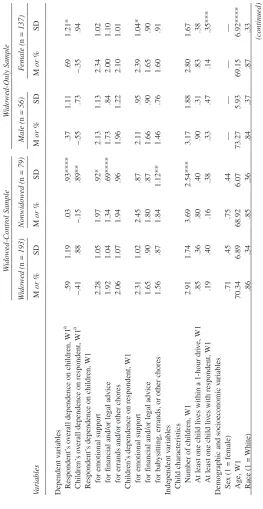
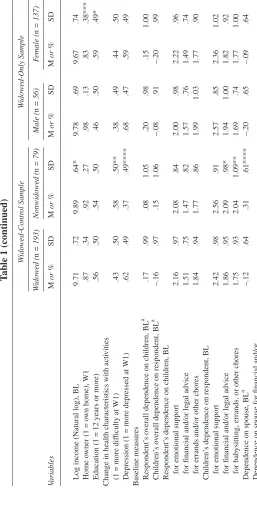
Descriptive statistics andttests comparing means for the widowed and matched controls (column 1), and for widows and widowers (column 2), are presented in Table 1. At the 6-month follow-up, widowed persons reported significantly higher levels of dependence on their children (.59 vs. .03,p≤
.01), and significantly lower levels of children’s dependence on them (–.41 vs. –.15,p≤.05), compared to nonwidowed matched controls. Compared to matched controls, widowed persons also have significantly fewer children and lower income, and a higher proportion has had increased depressive symptoms since the baseline interview. However, a higher percentage of married controls reported decline in physical functioning. Widowed persons were significantly less likely to have had healthy spouses at baseline and had much lower levels of dependence on their spouses at that time; yet they reported higher levels of emotional support from their spouses at baseline than married controls.
The descriptive statistics in column 2 reveal that widows are more dependent on their children than widowers are (.69 vs. .37,p≤.10). Widows reported giving significantly more emotional support to their children than widowers do (2.39 vs. 2.11,p≤.10). Widowers are older and more likely to live with a child and own a home than widows. Widows report higher levels of emotional support and financial and legal advice from spouse at baseline.
13
T
able 1
Descripti
v
e Statistics, Changing Li
v
es of Older Couples Study
, 1987-1993 W idowed-Contr ol Sample W idowed-Only Sample W idowed ( n = 193) Nonwidowed ( n = 79) Male ( n = 56) F emale ( n = 137) V ariables M or % SD M or % SD M or % SD M or % SD Dependent v ariables Respondent ’s o v
erall dependence on children, W1
a .59 1.19 .03 .93**** .37 1.11 .69 1.21* Children ’s o v
erall dependence on respondent, W1
a –.41 .88 –.15 .89** –.55 .73 –.35 .94 Respondent ’s
dependence on children, W1
for emotional support
2.28 1.05 1.97 .92* 2.13 1.13 2.34 1.02 for f
inancial and/or le
g al advice 1.92 1 .04 1.34 .69**** 1.73 .84 2.00 1.10
for errands and/or other chores
2.06 1.07 1 .94 .96 1.96 1.22 2.10 1.01 Children ’s
dependence on respondent, W1
for emotional support
2.31 1.02 2.45 .87 2.11 .95 2.39 1.04* for f
inancial and/or le
g al advice 1.65 .90 1.80 .87 1.66 .90 1.65 .90
for babysitting, errands, or other chores
1.56 .87 1.84 1.12** 1.46 .76 1.60 .91 Independent v ariables
Child characteristics Number of children, W1
2.91 1.74 3.69 2.54*** 3.17 1.88 2.80 1.67
At least one child li
v
es within a 1-hour dri
v e, W1 .85 .36 .80 .40 .90 .31 .83 .38
At least one child li
v
es with respondent, W1
.19 .40 .16 .38 .33 .47 .14 .35***
Demographic and socioeconomic v
ariables
Se
x (1 = female)
.71 .45 .75 .44 — — — — Age, W1 70 .34 6.89 68 .92 6.07 73 .27 5.93 69 .15 6.92****
Race (1 = White)
[image:11.612.187.450.147.656.2]14
Log income (Natural log), BL
9.71 .72 9.89 .64* 9.78 .69 9.67 .74 Home o
wner (1 = o
wn home), W1
.87 .34 .92 .27 .98 .13 .83 .38***
Education (1 = 12 years or more)
.56 .50 .54 .50 .46 .50 .59 .49*
Change in health characteristics with acti
vities
(1 = more dif
ficulty at W1)
.43 .50 .58 .50** .38 .49 .44 .50
Depression (1 = more depressed at W1)
.62 .49 .37 .49**** .68 .47 .59 .49
Baseline measures Respondent
’s
o
v
erall dependence on children, BL
a .17 .99 .08 1.05 .20 .98 .15 1.00 Children ’s o v
erall dependence on respondent, BL
a –.16 .97 .15 1.06 –.08 .91 –.20 .99 Respondent ’s
dependence on children, BL
for emotional support
2.16 .97 2.08 .84 2.00 .98 2.22 .96 for f
inancial and/or le
g al advice 1.51 .75 1.47 .82 1.57 .76 1.49 .74
for errands and/or other chores
1.84 .94 1.77 .86 1.99 1.03 1.77 .90 Children ’s
dependence on respondent, BL
for emotional support
2.42 .98 2.56 .91 2.57 .85 2.36 1.02 for f
inancial and/or le
g al advice 1.86 .95 2.09 .98* 1.94 1.00 1.82 .92
for babysitting, errands, or other chores
1.75 .93 2 .04 1.09** 1.69 .74 1.77 1.00
Dependence on spouse, BL
a –.12 .64 .31 .61**** –.20 .65 –.09 .64
Dependence on spouse for f
inancial and/or
T
able 1 (continued)
[image:12.612.167.424.156.661.2]15
le
g
al advice, BL
2.90
1.08
3
.32
.98**
2.43
1.05
3.09
1.03****
Emotional support from spouse, BL
a
–.19
1.18
.02
.90
.07
1.15
–.30
1.18*
Spouse in poor or f
air health, BL
.60
.49
.30
.46****
.52
.50
.64
.48
NO
TE:
T
w
o-tailed
t
tests
were
used
to
assess
signif
icant
dif
ferences
between
means.
N
s
are
weighted.
BL
=
baseline;
W1
=
W
av
e
1
(6-month
follo
w-up).
a. The v
ariable is standardized on the total sample at baseline.
*
p
≤
.10. **
p
≤
.05. ***
p
≤
.01. ****
p
≤
Influence of Widowhood on
Parent-Child Dependence
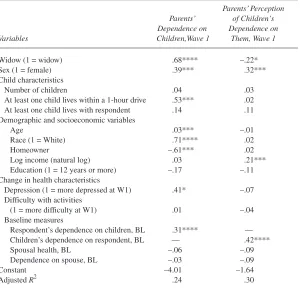
The first objective of this article is to explore whether widowhood affects parents’ reported dependence on children and children’s dependence on par-ents. Table 2 presents ordinary least squares (OLS) regression models for the total sample (i.e., widowed persons and matched controls). In preliminary analyses, we evaluated whether the effect of widowhood on dependence dif-fered by gender; the Widowhood×Gender interaction term was not statisti-cally significant (at thep≤.05 level). Because widowhood affects measures
of overall dependence in similar ways for men and women, we included models for the pooled sample (i.e., men and women together).
Widowhood has a large significant effect on the surviving parent’s overall dependence on his or her children; widowed persons report dependence lev-els that are about 0.7 standard deviations higher than their peers who are still married. An additional analysis (not reported but available) indicates that this overall increase is mainly due to increased levels of dependence for emo-tional and financial or legal support. In contrast, widowhood (represents the death of a parent for the children) decreases children’s dependence on par-ents by 0.2 standard deviations. Whereas widowed parpar-ents report greater reliance on their children than do married parents, they also appear to provide less support to their children after widowhood. Compared to men, women report that they are more reliant on their children, and their children are more reliant on them.
One of the most powerful predictors of parent-child dependence at the 6-month follow-up is one’s level of dependence at baseline, suggesting that older adults and their children have fairly well-established patterns of giving and receiving assistance that persist even in the face of widowhood (Atchley, 1989). Other findings were consistent with the assumption that family mem-bers seek assistance when they are in need and provide assistance when they have the resources to do so. Parents tend to rely more heavily on their chil-dren when they are in poor health and have fewer economic resources. For example, advanced age and decline in mental health increase parent’s dependence on their children, whereas parents with greater financial stability (indicated by home ownership) report significantly less dependence on their children. Geographic proximity (i.e., living within 1 hour from a child) is also a positive and significant predictor of parents’ dependence on children. Similarly, children’s dependence on their parents is significantly linked to parental income; respondents with greater economic resources provide more support to their children.
Gender Differences in Parent-Child
Dependence Among the Bereaved
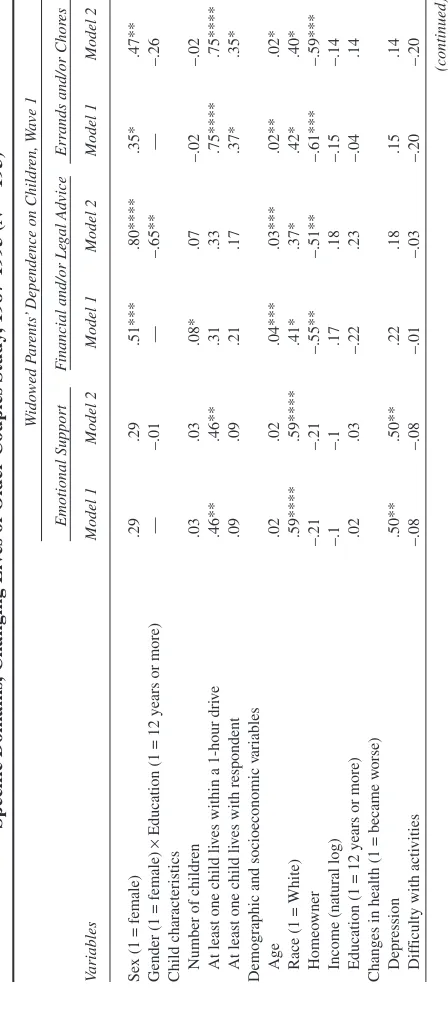
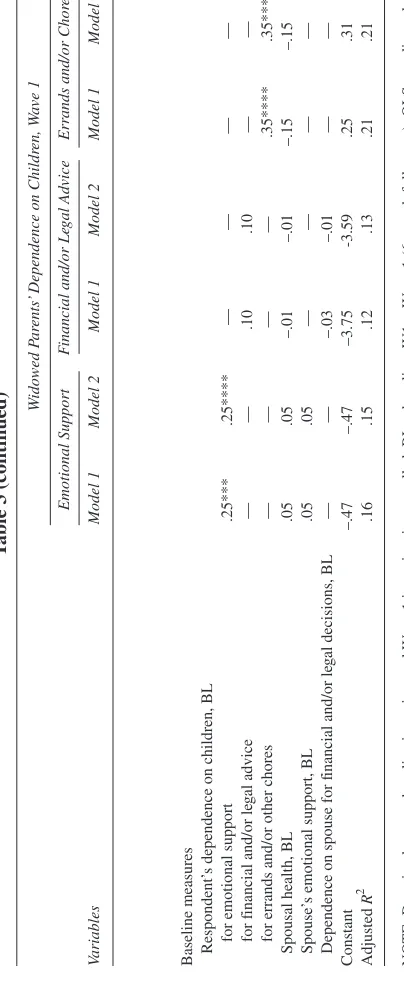
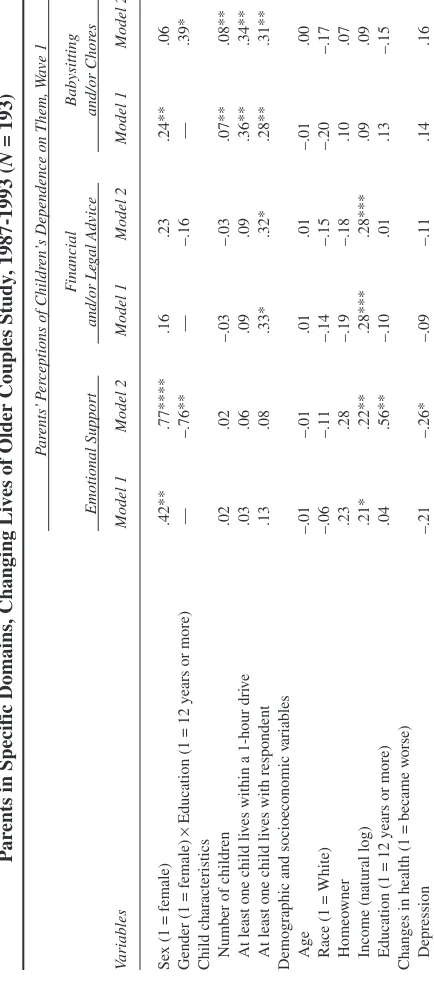
Our second objective was to examine whether widowed fathers and moth-ers give and receive different types of support, including emotional support, financial and/or legal advice, and practical assistance, such as help with errands and/or chores. Table 3 presents OLS models predicting parents’ dependence and Table 4 presents models predicting children’s dependence.
[image:15.612.158.458.204.492.2]Ha et al. / Effects of Widowhood 17
Table 2
OLS Regression Predicting Dependence Among Parents and Children, Changing Lives
of Older Couples Study, 1987-1993 (N= 272)
Parents’ Perception
Parents’ of Children’s
Dependence on Dependence on
Variables Children,Wave 1 Them, Wave 1
Widow (1 = widow) .68**** –.22*
Sex (1 = female) .39*** .32***
Child characteristics
Number of children .04 .03
At least one child lives within a 1-hour drive .53*** .02 At least one child lives with respondent .14 .11 Demographic and socioeconomic variables
Age .03*** –.01
Race (1 = White) .71**** .02
Homeowner –.61*** .02
Log income (natural log) .03 .21***
Education (1 = 12 years or more) –.17 –.11 Change in health characteristics
Depression (1 = more depressed at W1) .41* –.07 Difficulty with activities
(1 = more difficulty at W1) .01 –.04
Baseline measures
Respondent’s dependence on children, BL .31**** — Children’s dependence on respondent, BL — .42****
Spousal health, BL –.06 –.09
Dependence on spouse, BL –.03 –.09
Constant –4.01 –1.64
AdjustedR2 .24 .30
NOTE: Duration between baseline interview and Wave 1 interview is controlled. BL = baseline; W1 = Wave 1 (6-month follow-up); OLS = ordinary least squares.
Model 1 assesses the main effects of all predictors, and Model 2 examines the interactive effects of gender and education. Because the dependent variables in this set of analyses are ordinal variables, we initially evaluated ordered probit models; however, because of the small number of widowers in the sample (n= 56), we could not use probit models to test interaction terms. Thus, we present OLS models here; the results for the main effect analyses were nearly identical in the probit and OLS models (ordered probit estima-tions are available from the first author).
Table 3 shows that widows and widowers do not significantly differ in terms of their dependence on children for emotional support. On the other hand, widows reported significantly higher levels of dependence on their children for financial and legal advice (b= .51,p≤.01) and for errands and other chores (b= .35,p≤.05) than widowers do. The gender difference in dependence for financial and legal advice, however, was conditional on edu-cational attainment. Among those who had fewer than 12 years of education, widows show level of dependence that is 0.8 standard deviation higher than that of widowers; yet among those who graduated from high school (educa-tion of 12 years or more), the gender gap narrowed to 0.15 standard devia-tion. Men’s dependence on children for financial advice does not differ starkly based on education, whereas higher education clearly protects women from needing (or asking for) assistance with financial advice.
Several other characteristics were significant predictors of parental dependence. Parental dependence is positively related to parents’ geographic proximity to a child. Whites report higher levels of dependence on their chil-dren in all three domains, compared to African Americans. Younger parents and homeowners are less dependent on their children for financial and legal advice and instrumental support, presumably because these people have more resources and stability to weather the short-term strains associated with widowhood. Baseline levels of dependence for emotional and instrumental support and an increase in depression for emotional support were positively associated with parental dependence.
Table 4 shows models predicting children’s dependence on widowed par-ents. Compared to widowed fathers, widowed mothers report higher levels of children’s dependence for emotional (b= .42,p≤.05) and instrumental sup-port (b= .24,p≤.05). However, this gender gap was contingent on parents’ educational attainment. Among those who completed fewer than 12 years of education, widowed men reported children’s emotional dependence that was 0.77 standard deviation lower than that of widowed women; whereas among those who attained 12 or more years of education, the gender gap decreases to 0.01 standard deviation. The results indicate that higher education decreases the gender gap in parents’ giving emotional support to their
19 T able 3 OLS Regr ession Pr edicting W ido wed P a rents’
Dependence on Childr
en in
Specif
ic Domains, Changing Liv
es of Older Couples Study
, 1987-1993 (
N = 193) W idowed P a rents’
Dependence on Childr
en, W
ave 1
Emotional Support
F
inancial and/or Le
gal Advice
Err
ands and/or Chor
es V ariables Model 1 Model 2 Model 1 Model 2 Model 1 Model 2 Se
x (1 = female)
.29 .29 .51*** .80**** .35* .47**
Gender (1 = female)
×
Education (1 = 12 years or more)
— – .01 — – .65** — – .26
Child characteristics Number of children
.03 .03 .08* .07 –.02 –.02
At least one child li
v
es within a 1-hour dri
v e .46** .46** .31 .33 .75**** .75****
At least one child li
v
es with respondent
.09 .09 .21 .17 .37* .35*
Demographic and socioeconomic v
ariables Age .02 .02 .04*** .03*** .02** .02*
Race (1 = White)
.59**** .59**** .41* .37* .42* .40* Homeo wner –.21 –.21 –.55** –.51** –.61*** –.59***
Income (natural log)
–.1 – .1 .17 .18 –.15 –.14
Education (1 = 12 years or more)
.02 .03 –.22 .23 –.04 .14
Changes in health (1 = became w
orse) Depression .50** .50** .22 .18 .15 .14 Dif
ficulty with acti
[image:17.612.197.421.151.659.2]20
Baseline measures Respondent
’s
dependence on children, BL
for emotional support
.25*** .25**** — — — — for f
inancial and/or le
g al advice — — .10 .10 — —
for errands and/or other chores
— — — — .35**** .35****
Spousal health, BL
.05 .05 –.01 –.01 –.15 –.15 Spouse ’s
emotional support, BL
.05 .05 — — — —
Dependence on spouse for f
inancial and/or le
g
al decisions, BL
— — –.03 –.01 — — Constant –.47 –.47 –3 .75 -3 .59 .25 .31 Adjusted R 2 .16 .15 .12 .13 .21 .21 NO TE: Duration between baseline intervie w and W av e 1 intervie w is controlled. BL = baseline; W1 = W av e 1 (6-month follo w-up); OLS = ordinary least
squares. *p
≤ .10. ** p ≤ .05. *** p ≤ .01. **** p ≤ .001. T
able 3 (continued)
W
idowed P
a
rents’
Dependence on Childr
en, W
ave 1
Emotional Support
F
inancial and/or Le
gal Advice
Err
ands and/or Chor
[image:18.612.171.373.159.656.2]dren. Although women’s levels of giving emotional support were similar regardless of education level, education clearly increases men’s reports of giving support to their children. However, parents’ provision of instrumental support does not follow the same pattern (see column 3 Model 2). The gender gap was not reduced among the most educated; on the contrary, it was only among those who attained more education that we see stark gender differ-ences. Among those who have 12 or more years of education, women reported giving support that was 0.45 standard deviation higher than that of men. We ran some additional analyses to explore why this pattern might occur. Although further investigation is needed, we suspect that this may be because women with higher education tend to be younger and healthier than other groups and, thus, able to provide most help.
Coefficients of other predictors show that parents give (or children seek) support when their resources enable them to do so. Those who have more children or who live closer to their children reported higher levels of chil-dren’s dependence for instrumental support. Parents with richer economic resources (indicated by income) reported that their children are highly dependent on them for emotional support and financial and legal advice. One’s provision of help to children at baseline was also a significant predic-tor in all three domains.
Taken together, the multivariate analyses supported our hypothesis that patterns of parent-child dependence differ by gender and reflect gender-typed skills and dependencies that develop during the life course. Parents tend to turn to their children for those resources and skills that they lack and offer their children assistance in those domains where they are best equipped to help. Yet the gender gap in the exchange of emotional and financial or legal help attenuates considerably among the most educated, suggesting that per-sons with higher levels of education may be least strongly tied to the tradi-tional gender-typed performance of important social and family roles.
Discussion
Summary of Findings
We explored whether widowhood affects intergenerational dependence and whether widows and widowers give and receive different levels of emo-tional, financial or legal, and instrumental support to and from their children. The analyses revealed four important findings.
First, parent-child relationships are altered significantly when the aging parent loses a spouse. Widowhood increases parents’ dependence on their children, whereas it decreases children’s dependence on their parents. This
22 T able 4 OLS Regr ession Pr edicting W ido wed P a rents’ P er
ceptions of Childr
en’
s Dependence on
P
a
rents in Specif
ic Domains, Changing Liv
es of Older Couples Study
, 1987-1993 (
N = 193) P a rents’ P er
ceptions of Childr
en’
s Dependence on Them, W
ave 1 F inancial Babysitting Emotional Support and/or Le gal Advice and/or Chor es V ariables Model 1 Model 2 Model 1 Model 2 Model 1 Model 2 Se
x (1 = female)
.42** .77**** .16 .23 .24** .06
Gender (1 = female)
×
Education (1 = 12 years or more)
— – .76** — – .16 — .39*
Child characteristics Number of children
.02 .02 –.03 –.03 .07** .08**
At least one child li
v
es within a 1-hour dri
v e .03 .06 .09 .09 .36** .34**
At least one child li
v
es with respondent
.13 .08 .33* .32* .28** .31**
Demographic and socioeconomic v
ariables Age –.01 –.01 .01 .01 –.01 .00
Race (1 = White)
–.06 –.11 –.14 –.15 –.20 –.17 Homeo wner .23 .28 –.19 –.18 .10 .07
Income (natural log)
.21* .22** .28*** .28*** .09 .09
Education (1 = 12 years or more)
.04 .56** –.10 .01 .13 –.15
Changes in health (1 = became w
[image:20.612.204.421.157.653.2]23
Dif
ficulty with acti
vities .01 –.01 –.01 –.01 .01 .02
Baseline measures Children
’s
dependence on respondent, BL
for emotional support
.34****
.33****
————
for f
inancial and/or le
g al advice — — .20*** .20*** — —
for babysitting, errands, or other chores
— — — — .44**** .45****
Spousal health, BL
–.14 –.15 .19 .19 –.23** –.23**
Dependence on spouse for f
inancial and/or le
g
al decisions, BL
— — –.11 –.10 — — Constant –.40 –.14 –1 .36 -1 .32 –.29 –.42 Adjusted R 2 .15 .17 .08 .08 .40 .41 NO TE: Duration between baseline intervie w and W av e 1 intervie w is controlled. BL = baseline; W1 = W av e 1 (6-month follo w-up); OLS = ordinary least
squares. *p
finding suggests that traditional theoretical approaches to intergenerational exchange, which assume largely invariant motives of transfers during the life course (e.g., altruistic or reciprocal motives), may not be appropriate when examining parent-child exchanges during periods of change and distress. In the face of a stressful life event, parents may become more dependent and less able to provide support to their children (or children seek less support), despite long-standing patterns of giving help (Soldo & Hill, 1993).
Second, our domain-specific analyses among widowed persons present clear gender differences in the patterns of widowed parents’ giving and receiving of help. Widows report higher levels of dependence on their chil-dren for financial or legal advice and instrumental support and higher levels of children’s dependence for emotional and instrumental support. In general, our findings suggest that current cohorts of widowed persons are influenced by the traditional gender roles into which they have been socialized. Widows may seek more help in managing financial and legal matters because they may not possess the skills or experience to deal with these matters, which were presumably the responsibility of their late husbands. However, they may be more effective than widowers in terms of providing emotional and instrumental support because they are accustomed to taking care of other family members in times of stress. As for the exchange of instrumental sup-port, our findings do not fully support our hypothesis. We expected that wid-owers may require more help because they are not accustomed to managing household chores; our finding reveals that widows give and receive more help than widowers. This may be because of the way instrumental depend-ence is measured;errands and other chorescan include male- and female-typed tasks and thus may mask any significant gender effects. Nevertheless, this finding reiterates previous findings that widowed mothers maintain more intimate relationships with children on loss and, thus, are more likely to exchange actual help with adult children than widowed fathers (Bengston et al., 1990).
Third, our research shows that gender differences in help giving and help receiving were significantly moderated by one’s educational attainment. In the domains of emotional and financial and/or legal support, the pronounced gender differences are minimized among the most educated members of the sample. Higher education makes women less dependent on their children for financial and legal advice and encourages men to provide more emotional support to their children. This suggests that increased education helps older adults move away from traditional gender roles and have greater flexibility in managing family responsibilities; as a result, widows and widowers who are highly educated may adjust more easily to the financial and emotional chal-lenges of widowhood. However, higher education does not decrease the
der gap in widowed parents’ provision of instrumental support to their chil-dren. Providing instrumental support often requires that one has important resources, such as good health; given that education is also correlated with these resources, widows who are more educated may be better equipped to provide instrumental help than their peers who are less educated. Further inspection is warranted to examine the factors that may account for this par-ticular pattern.
Fourth, our findings are largely consistent with previous research regard-ing the ways that needs and resources affect parent-child dependence (e.g., Eggebeen, 1992; Hoyert, 1991). Our results concur with other studies show-ing a positive association between elderly parents’ economic resources (home ownership, income) and children’s dependence on parents. Elderly parents’ health characteristics (e.g., depression) and geographic proximity to a child are also influential in determining the parents’ level of dependence on children. However, our research also reveals that intergenerational exchanges were only weakly related to the number and proximity of one’s children. The number of children does not significantly alter parents’ level of dependence on children in any of the domains examined. In addition, for the exchanges of noninstrumental support (i.e., financial and/or legal advice and emotional support), the effect of geographic proximity to a child is minimal. Given these findings, we should be cautious in making a general assumption that older adults who have fewer children or children living farther away would experience more difficulty receiving support from their children in times of stress. Some have predicted that aging Baby Boomers may have lim-ited sources of social support in late life, given that they have fewer children than past cohorts, and their children often live further away (Easterlin, Schaeffer, & Macunovich, 1993). Our results suggest that this dire prediction may not ring true. However, because our sample was confined to those who have at least one child we do not know whether remaining childless will indeed lead to decreases in social support.
Overall, our findings shed new light on intergenerational relationships among current cohorts of older adults. Gender differences in parent-child assistance after widowhood suggest that current cohorts of widowed older adults are accustomed to and highly influenced by the traditional gender roles they have held throughout their lives. However, future cohorts of older adults may maintain different patterns of parent-child dependence following spousal loss because the boundaries between gender roles are becoming blurred among current cohorts of young adults (Sanchez & Thomson, 1997). Given the increase in educational attainment across birth cohorts, future cohorts may show relatively few gender differences in patterns of
intergenerational exchange. Education may promote this change even among current cohorts of older adults.
Limitations and Future Directions
The current study builds on previous research in several ways: It used pro-spective data to examine the effects of widowhood on parent-child depend-ence; it examined parents’ and children’s dependence, incorporating the con-cept of bidirectionality in the parent-child relationships; and the sample had widowed persons and nonwidowed persons and was stratified by gender, allowing comparisons between different groups. In addition, the current study examined differences between widows and widowers in specific domains, enabling us to more fully understand the impact of gender roles on intergenerational exchanges after widowhood. Nevertheless, several limita-tions should be addressed.
First, the current study contributes a unique perspective to the study of widowhood by looking at both directions of parent-child dependence follow-ing widowhood. However, because children’s dependence on parents was measured through the parents’ perceptions of their dependence rather than the children’s own report of their dependence, this measurement may not accurately represent how much children actually depend on their parents. Parents, especially those who are highly dependent on their children, may report higher levels of children’s dependence to feel equitable in their rela-tionships. Ideally, future studies should collect data from the parent and child to determine the true levels of intergenerational exchange (Freedman, Wolf, Soldo, & Stephen, 1991).
Second, what is considered so-called dependent may be influenced by parents’ definitions of the termdependence. Some parents may feel children are dependent on them if children contact them frequently, whereas others may interpret this behavior differently. Intergenerational dependence also may be contingent on the quality or frequency of contact between parents and children. A preliminary analysis of parent-child contact in the CLOC data suggests that widows do have more frequent contact with their children than widowers. Thus, widowed mothers’ reports of their children’s depend-ence may be inflated because of their more frequent contact (compared to widowed fathers). This warrants further studies with other conceptualiza-tions of children’s dependence on parents.
Third, because all CLOC follow-up interviews were conducted 6 months after the spousal death, our research sidesteps the problem of having varia-tion in the time elapsed since widowhood. However, the research design inevitably leads to large variations in the time elapsed between the baseline
(preloss) and the follow-up interviews. Although we controlled for this dura-tion in our analyses, we recognized that the observed changes in the level of dependence may have taken place before the spousal death rather than after the death (Utz, Carr, Nesse, & Wortman, 2002). We also recognized that the small number of males in the analytic sample may limit our statistical power to detect the gender differences in parent-child dependence. A study with a comparable number of female and male subjects would be ideal for future studies.
Finally, because parent-child dependence is measured across all the chil-dren rather than for each individual child, and because there is no indication of the children’s sex in the follow-up survey data (unless the child lives in the household), we could not discern how the child’s gender affects the parent-child relationship. Previous findings suggest that those who have daughters are more likely to receive help (Spitze & Logan, 1990) and that there are same-gender preferences in parent-child relationships (G. R. Lee, Dwyer, & Coward, 1993). Thus, future research should explore how the child’s sex affects the parent-child relationship after widowhood.
In conclusion, our findings have important implications for the study of widowhood and parent-child relationships. Our results suggest that identify-ing gender differences in specific domains of support is crucial to under-standing how mothers and fathers cope with and adjust to the process of wid-owhood. The results have important implications for the design and implementation of social services. If widows and widowers need different kinds of help as they adapt to widowhood, then developing services focusing on the domains where widows and widowers are most vulnerable may enhance the effectiveness of the social intervention. In addition, providing opportunities for widowed older adults to learn skills and roles that were tra-ditionally held by the opposite sex would benefit the current cohorts of older adults.
References
Anderson, T. B. (1984). Widowhood as a life transition: Its impact on kinship ties.Journal of
Marriage and the Family,46, 105-114.
Aquilino, W. S. (1990). The likelihood of parent–adult child coresidence: Effects of family struc-ture and parental characteristics.Journal of Marriage and the Family,52, 405-419. Atchley, R. C. (1989). Continuity theory of normal aging.The Gerontologist,29, 183-190. Bankoff, E. A. (1983). Social support and adaptation to widowhood.Journal of Marriage and
the Family,45, 827-839.
Becker, G. (1991).A treatise on the family. Cambridge, MA: Harvard University Press. Becker, G. S. (1974). A theory of social interactions.Journal of Political Economy,82,
1063-1093.
Bengston, V. L., Rosenthal, C., & Burton, L. (1990). Families and aging: Diversity and heteroge-neity. In R. H. Binstock & L. K. George (Eds.),Handbook of aging and the social sciences (3rd ed., pp. 205-226). San Diego, CA: Academic Press.
Berardo, F. M., & Berardo, D. H. (2000). Widowhood. In E. F. Borgatta (Ed.),Encyclopedia of
sociology(2nd ed., pp. 3255-3261). New York: Macmillan.
Bernard, J. (1981). The good provider role: Its rise and fall.American Psychologist,36, 1-12. Carr, D., House, J. S., Kessler, R. C., Nesse, R. M., Sonnega, J., & Wortman, C. (2000). Marital quality and psychological adjustment to widowhood among older adults: A longitudinal analysis.Journal of Gerontology: Social Sciences,55B, S197-S207.
Carr, D., House, J. S., Wortman, C., Nesse, R., & Kessler, R. C. (2001). Psychological adjust-ment to sudden and anticipated spousal death among the older widowed.Journal of
Geron-tology: Social Sciences,56B, S237-S248.
Carr, D., & Utz, R. (2002). Late-life widowhood in the United States: New directions in research and theory.Ageing International,27, 65-88.
Cooney, T., & Uhlenberg, P. (1992). Support from parents over the life course: The adult child’s perspective.Social Forces,71, 63-84.
Coontz, S. (1992).The way we never were: American families and the nostalgia trap. New York: Basic Books.
Coverman, S. (1983). Gender, domestic labor time, and wage inequality.American Sociological
Review,48, 623-637.
Cox, D. (1987). Motives for private income transfers.Journal of Political Economy,95, 509-546. Crimmins, E. M., & Ingegneri, D. G. (1990). Interaction and living arrangements of older parents and their children: Past trends, present determinants, future implications.Research on Aging, 12, 3-35.
Easterlin, R. A., Schaeffer, C. M., & Macunovich, D. J. (1993). Will the baby boomers be less well off than their parents? Income, wealth, and family circumstances over the life cycle in the United States.Population and Development Review,19, 497-522.
Eggebeen, D. (1992). Family structure and intergenerational exchanges.Research on Aging,12, 3-35.
Eggebeen, D., & Hogan, D. P. (1990). Giving between generations in American families.Human
Nature,1, 211-232.
Ferraro, K. F., & Barresi, C. M. (1982). The impact of widowhood on the social relations of older persons.Research on Aging,4, 227-247.
Freedman, V. A., Wolf, D. A., Soldo, B. J., & Stephen, E. A. (1991). Intergenerational transfers: A question of perspective.The Gerontologist,31, 640-647.
Gallagher, S. K. (1994).Older people giving care: Helping family and community. Westport, CT: Auburn House.
Gallagher, S. K., & Gerstel, N. (1993). Kin-keeping and friend-keeping among older women: The effect of marriage.The Gerontologist,33, 675-681.
Greenberg, J., & Becker, M. (1988). Aging parents as family resources.The Gerontologist,28, 786-791.
Hogan, D. P., Eggebeen, D., & Clogg, C. (1993). The structure of intergenerational exchanges in American families.American Journal of Sociology,98, 1428-1498.
Holmes, J. H., & Rahe, R. H. (1967). The Social Readjustment Rating Scale.Journal of
Psycho-somatic Research,11, 213-228.
Hoyert, D. (1991). Financial and household exchanges between generations.Research on Aging, 13, 205-225.
Lee, G. R., Dwyer, J. W., & Coward, R. T. (1993). Gender differences in parent care: Demo-graphic factors and same-gender preferences.Journal of Gerontology: Social Sciences,48, S9-S16.
Lee, R. D. (1994). The formal demography of population aging, transfers, and the economic life cycle. In L. Martin & S. H. Preston (Eds.),Demography of aging(pp. 8-49). Washington, DC: National Academy Press.
Logan, J. R., & Spitze, G. D. (1995). Self-interest and altruism in intergenerational relations.
Demography,32, 353-364.
Lopata, H. Z. (1973).Widowhood in an American city. Cambridge, MA: Schenkman. Lopata, H. Z. (1979).Women as widows: Support systems. New York: Elsevier. Lopata, H. Z. (1996).Current widowhood. Thousand Oaks, CA: Sage.
Mannheim, K. (1952). The problems of generations. In D. Kecskemeti (Ed.),Essays on the
soci-ology of knowledge(pp. 286-323). London: Routledge and Kegan.
Morgan, L. A. (1983). Intergenerational economic assistance to children: The case of widows and widowers.Journal of Gerontology,28, 725-731.
O’Bryant, S. L., & Morgan, L. A. (1990). Recent widows’ kin support and orientations to self-sufficiency.The Gerontologist,30, 391-398.
Pearlin, L. I., & Lieberman, M. A. (1979). Social s ources of emotional dis tres s . In R. Simmons (Ed.),Research in community and mental health(pp. 217-248). Greenwich, CT: JAI.
Radloff, L. (1977). The CES-D Scale: A self-report depression scale for research in general pop-ulation.Applied Psychological Measurement,1, 381-401.
Roan, C. L., & Raley, R. K. (1996). Intergenerational coresidence and contact: A longitudinal analysis of adult children’s response to their mother’s widowhood.Journal of Marriage and
the Family,58, 708-717.
Rossi, A., & Rossi, P. (1990).Of human bonding. New York: Aldine.
Sanchez, L., & Thomson, E. (1997). Becoming mothers and fathers: Parenthood, gender, and the division of labor.Gender & Society,11, 742-772.
Silverstein, M., Conroy, S. J., Wang, H., Giarrusso, R., & Bengtson, V. L. (2002). Reciprocity in parent-child relations over the adult life course.Journals of Gerontology: Social Sciences, 57B, S3-S14.
Smith, K. R., & Zick, C. D. (1986). The incidence of poverty among the recently widowed: Mediating factors in the life course.Journal of Marriage and the Family,48, 619-630. Soldo, B. J., & Hill, M. S. (1993). Intergenerational transfers: Economic, demographic, and
social perspectives. In G. L. Maddox & M. P. Lawton (Eds.),Focus on kinship, aging, and
social change(pp. 187-216). New York: Springer.
Spitze, G., & Logan, J. (1990). Sons, daughters, and intergenerational social support.Journal of
Marriage and the Family,52, 420-430.
Spitze, G., & Logan, J. R. (1992). Helping as a component of parent-adult children relations.
Research on Aging,14, 291-312.
Thornton, A., & Freedman, D. (1979). Changes in the sex role attitudes of women, 1962-1977: Evidence from a panel study.American Sociological Review,44, 831-842.
Uhlenberg, P., & Cooney, T. M. (1990). Family size and mother-child relations in later life.The
Gerontologist,30, 618-625.
Umberson, D., Wortman, C. B., & Kessler, R. C. (1992). Widowhood and depression: Explain-ing long-term gender differences in vulnerability.Journal of Health and Social Behavior,33, 10-24.
Utz, R. L., Carr, D., Nesse, R., & Wortman, C. (2002). The effect of widowhood on older adults’ social participation: An evaluation of activity, disengagement, and continuity theories.The
Gerontologist,42, 522-533.
Utz, R. L., Reidy, E. B., Carr, D., Kessler, R., Nesse, R., & Wortman, C. (2004). The daily conse-quences of widowhood: The role of gender and intergenerational transfers of subsequent housework performance.Journal of Family Issues,25, 683-712.
Wallsten, S. M., Tweed, D. L., Blazer, D. G., & George, L. K. (1999). Disability and depressive symptoms in the elderly: The effects of instrumental support and its subjective appraisal.
International Journal of Aging and Human Development,48, 145-159.
Williams, J. (2000).Unbending gender: Why work and family conflict and what to do about it. New York: Oxford University Press.
Zisook, S., & Shuchter, S. R. (1991). Early psychological reaction to the stress of widowhood.
Psychiatry,54, 320-332.