2018 International Conference on Computer, Electronic Information and Communications (CEIC 2018) ISBN: 978-1-60595-557-5
An Implementation of Robust Image Fingerprinting Based on DCT
Zhi-qiang QU
*, Jun HE
and Wei DAI
School of information and communication, National University of Defense Technology, Wuhan, Hubei, China
*Corresponding author
Keywords: Image fingerprinting, Information hiding, DCT.
Abstract. As a new technology of copyright protection, digital fingerprinting has played an important role in multimedia piracy tracking. In this paper, a new image fingerprinting scheme was presented. Including an embedding algorithm based on image dividing and DCT coefficients, an extracting algorithm based on image registration. In the algorithm implementation we enhance the robustness by skipping the smaller coefficients and improve the extracting accuracy by optimizing the transformation matrix of image registration. The experimental results show that our image fingerprinting scheme has good invisibility and robustness against noise, low-pass filtering and geometric attacks such as scaling, rotation and cropping.
Introduction
Since digital images are easily copied, distributed and edited, copyright protection of image works is always a prominent problem in the development of multimedia and Internet. Digital watermarking and fingerprinting play an important role in image copyright protection, and fingerprinting has come into being for tracing traitors. Generally, a complete image fingerprinting framework consists of three parts: the generation module, the embedding module and the extracting and tracking module. How to design a robust, secure and efficient image fingerprinting is the focus of current research.
In 1995, D. Boneh and J. Shaw [1] presented a relatively clear digital fingerprinting solution that became a classic fingerprinting coding. In 1997, Cox et al. [2] proposed a watermarking algorithm based on spread spectrum, the Gaussian fingerprint is embedded into the DCT coefficient. In 2003, W. Trappe et al. [3] proposed an anti-collusion codes (ACC) which improves the coding efficiency greatly and withstands the collusion. In paper [4, 5] a cascade code is constructed, which combines the inner code with the error correcting code (ECC) to improve the reliability, anti-collusion ability and detection efficiency of the fingerprint. J. Abraham and V. Paul [6] embed-ding the fingerprinting in image DWT domain, that improves the robustness of the scheme to various image processing attacks. G. Gigaud [7] proposed a highly robust algorithm against cropping using compressed SURF features to estimate and invert the geometric attack. X. Nie et al. [8] mine the local-feature-point relationships including local structures and global relevance against image modifications.
Although scholars at home and abroad have done a great deal of research on image copyright protection and traitor tracking, there is no benchmark scheme or method at present. Especially in robustness of fingerprinting, we need do further improvement.
Experimental results show that our image fingerprinting scheme has a good performance in invisibility, robustness and security against white noise pollution, low-pass filtering, scaling, cropping, rotation and other geometric attacks.
Cover image
Image Blocks Binary random
sequence
Fingerprint Database Blocking
DCT Coefficients DCT
+
Fingerprinted image Embedding
Process or Attack Feature
Points SIFT
Feature Points
SIFT
- ×
Registrating
Detected
Fingerprint ×
Traitor
Ex tr ac ti ng
Tracking
Figure 1. The framework of image fingerprinting scheme.
Methods
Fingerprinting Embedding Algorithm
We can know that embedding information in frequency domain of image performs better than temporal-spatial domain from the previous research [2, 7]. And we proposed an image fingerprinting embedding algorithm based on DCT domain. Consider that the fingerprints may be lost as a result of image cropping, we adopted a dividingand backups strategy to preserve the fingerprinting. The cover image is divided into 4 blocks, and each block is transformed with 2D DCT, and 128 coefficients are chosen from the low and medium frequency band. Then each coefficient was embedded fingerprint according to formula (1). That is the fingerprint is backed up in different areas of the image. From another point of view the fingerprints can selfcheck each other when extracting. At last, we reconstruct the image through inverse 2D DCT transforms.
1, 1
1+ = +
1, 0
j
i i i i
j w
C C M C MC M
w
α α α =
′ = ≤ ≤ =
− =
( ) , 0 1, . (1)
Where, Ci is the ith original coefficient, α is the embedding strength, M is the modulation
coefficient, and wj is the jth bit value of the fingerprint sequence. Therefore, the Ciand α are two key
parameters for embedding. When extracting the fingerprinting, we get the fingerprinting bit comparing the value of Ci′ and Ci. That is, the correctness of extracting is related to the second term
i MC
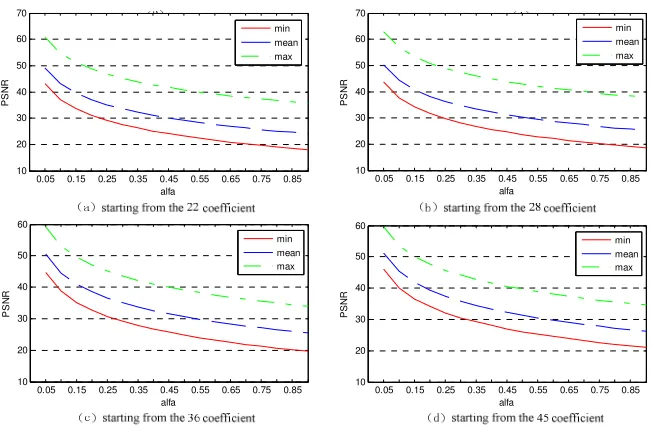
In order to explore the influence of the embedding strength α and frequency coefficient Ci on the
invisibility of the fingerprinting, we embedded the fingerprints into the images selected in the BASEBOSS image dataset [10] randomly. The Peak Signal Noise Ratio (PSNR) is used to measure the image quality. The results are shown in Figure 2.
We can see that the PSNR of the image gradually decreases with the increase of α. When α is above 0.5, the mean of PSNR is less than 30dB, when αis less than 0.25, the minimum PSNR is greater than 30dB in the four frequency band. Therefore, the appropriate α is less than 0.5, and less than 0.3 is the best for image quality.
0.05 0.15 0.25 0.35 0.45 0.55 0.65 0.75 0.85
10 20 30 40 50 60 70 alfa P S N R min mean max
0.05 0.15 0.25 0.35 0.45 0.55 0.65 0.75 0.85
10 20 30 40 50 60 70 alfa P S N R min mean max
0.05 0.15 0.25 0.35 0.45 0.55 0.65 0.75 0.85
10 20 30 40 50 60 alfa P S N R min mean max
0.05 0.15 0.25 0.35 0.45 0.55 0.65 0.75 0.85
[image:3.612.140.467.177.390.2]10 20 30 40 50 60 alfa P S N R min mean max
Figure 2. The line chart of SPNR and embedding strength.
Fingerprinting Extracting and Tracking Algorithm
According to the formula (1) we can get the fingerprints comparing the DCT coefficients of cover image and fingerprinted image. However, in practical application, the fingerprinted images would be edited and attacked, which would destroy or jam the fingerprint such as zoom scale, cropping, rotation and so on. In order to solve the problem, we presented an extraction algorithm based on SIFT which is invariant of shift, scale and rotation. Before extracting, we align the detected image to the original image in content by SIFT feature points matching. The algorithm flow is shown as Figure 3.
1 1 2 2 3 3 4 4 5 5 6 6 7 7 8 8 9 9 10 10 11 11 12 12 13 13 14 14 15 15 16 16
[image:3.612.152.467.527.697.2]In the above diagram, the transforms matrix is the key of whole algorithm, and the feature points influence the transforms matrix directly. Known a point A x y( ,1 1)and its mapping point A x y′( ,1′ 1′)in
another coordinate, then the mapping relationship can be expressed as the following formula:
11 12 13 1 1
1 1 , 21 22 23
1 1 0 0 1
t t t
x x
y T y T t t t
′
′
= =
. (2)
Where, T is called transforms matrix. From the equation, we can solve the transfer matrix T through 3 pairs of mapping points. In this paper, we use the siftDemoV4 toolbox [11] to extract the SIFT feature points, and find the pairs of mapping points through the feature matching. In this paper, the minimum error method is used to optimize the transforms matrix. In order to ensure the efficiency of the algorithm, we select 16 pairs of points.
Experimental Results
In this paper, we do our experiments with the environment of Win7 OS and Matlab2012a. All the fingerprints are from the fingerprinting database (10000 fingerprints) built by ourselves, and all images are from BASEBOSS image dataset (10000 gray images). Our fingerprinting algorithm is also suitable for color images of course.
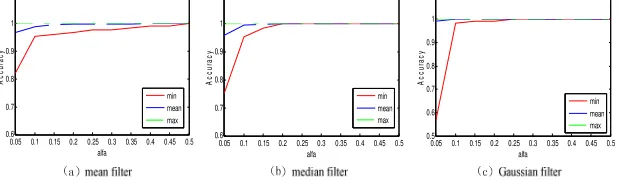
In theory, our algorithm is robust against low-pass filtering avoiding the high frequency band of the image. To confirm this inference, we process the fingerprinted images with mean filtering, median filtering and Gaussian filtering, and the fingerprints extracting accuracy shown in Figure 4.
0.05 0.1 0.15 0.2 0.25 0.3 0.35 0.4 0.45 0.5 0.6
0.7 0.8 0.9 1 1.1
alfa
A
c
c
u
ra
c
y
min mean max
0.05 0.1 0.15 0.2 0.25 0.3 0.35 0.4 0.45 0.5 0.6
0.7 0.8 0.9 1 1.1
alfa
A
c
c
u
ra
c
y
min mean max
0.05 0.1 0.15 0.2 0.25 0.3 0.35 0.4 0.45 0.5 0.5
0.6 0.7 0.8 0.9 1 1.1
alfa
A
c
c
u
ra
c
y
[image:4.612.151.461.377.467.2]min mean max
Figure 4. The line chart of extraction accuracy and low-pass filtering.
0.3 0.5 0.8 1.2 1.5 2 0.9
0.92 0.94 0.96 0.98 1 1.02
Zoom scale
A
c
c
u
ra
c
y
-150 -110 -70 -30 10 50 90 130 170 0.8
0.85 0.9 0.95 1 1.05 1.1
Rotate angle
A
c
c
u
ra
c
y
1 2 3 4 5 6 7 8 9 10 0.8
0.85 0.9 0.95 1 1.05
group
A
c
c
u
ra
c
y
1/9 2/9 3/9 4/9 5/9 6/9 7/9 0.2
0.4 0.6 0.8 1
Cutting proportion
A
c
c
u
ra
c
[image:5.612.148.455.69.278.2]y
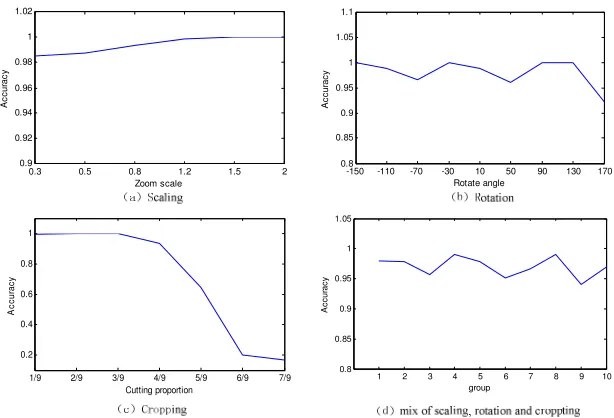
Figure 5. The line chart of extraction accuracy and geometric transforms.
From the Figure 5-(a) curve, we can see that the proposed fingerprinting algorithm has good robustness against image zooming. The accuracy retains over 0.985 even at a smaller scaling ratio. From the Figure 5-(b) curve, we can see that the proposed image alignment strategy achieves better results against rotation whose scope vary from -150 to 170. And the tracking accuracy is above 0.95. From the Figure 5-(c) curve, it is known that the accuracy decreases with the increase of cutting ratio. When the cutting ratio is less than 4/9 the accuracy is above 0.9, and when the cutting ratio is greater than 0.5, the accuracy goes down straightly. The main reason is that the image was divided into four blocks to embed fingerprint. When the cropping ratio is less than 0.5, there are two normal blocks which preserves the fingerprinting, and when the ratio is greater than 0.5, all blocks are attacked. The experimental results show that our blocking strategy is effective against cutting to a certain extent. At last, we attack the fingerprinted image combining scaling, rotation and cutting. We presuppose that the scaling interval is 0.3 to 2, the rotation angle interval is -170 to 170, and the cutting ratio interval is 0 to 0.45. We did 10 groups of experiments including 50 images and 50 fingerprints. The fingerprinted image was zoomed in random scale, rotated by random angle and crop with random ratio. The experimental results curve was seen in Figure 5-(d). The experimental results show that the proposed fingerprinting algorithm has good robustness against geometric attack such as scaling, rotation and cutting.
Conclusion
We presented an invisible and robust image fingerprinting scheme based on DCT domain in this paper. Dividing strategy and alignment method are applied to solve the geometric attacks. The experimental results show that the embedding algorithm and extracting algorithm are effective, and our fingerprinting scheme is feasible, invisible and robust. But at the same time, the efficiency of the fingerprint algorithm needs to be improved. The extraction accuracy heavily depends on the image alignment. How to divide the image and how to resist collusion attack need further research.
References
[1] D. Boneh, J. Shaw, Collusion-secure fingerprinting for digital data, In Annual International Cryptology Conference, Springer, Berlin, Heidelberg, pp. 452-465. (1995)
[3] W. Trappe, M. Wu, Z. J. Wang, K. R. Liu, Anti-collusion fingerprinting for multimedia. IEEE Transactions on Signal Processing, 51(4), 1069-1087. (2003).
[4] F. Zane, Efficient watermark detection and collusion security, In International Conference on Financial Cryptography, pp. 21-32, Springer, Berlin, Heidelberg. (2000).
[5] W. S. Lin, S. He, J. Bloom, Performance study and improvement on ECC-based binary anti-collusion forensic code for multimedia, In Proceedings of the 11th ACM workshop on Multimedia and security, pp. 93-98. (2009).
[6] J. Abraham, V. Paul, A blind watermarking method for fingerprinting digital images, International Conference on Data Mining and Advanced Computing, pp. 145-149. (2016).
[7] G. Gigaud, M. Pierre, A Geometrically-Resilient Surf-Based Image Fingerprinting Scheme, 2010 IEEE International Conference on Image Processing, pp. 3669-3672. (2010).
[8] X. Nie, X. Li, Y. Chai, C. Cui, X. Xi, Y. Yin, Robust Image Fingerprinting Based on Feature Point Relationship Mining, IEEE Transactions on Information Forensics and Security. (2018).
[9] C. M. Pun, C. Yan, X. C. Yuan, Image alignment-based multi-region matching for object-level tampering detection, IEEE Transactions on Information Forensics and Security, 12(2), 377-391. (2017).
[10] Break Our Steganography System Homepage, http://agents.fel.cvut.cz/boss.